From prehistoric origins to the modern era—discover the turning points, lost empires, and breakthroughs of world history through interactive timelines and visual guides.
Examine the tangible relics, physical tokens, and revolutionary machines that shaped civilizational growth.
🎥 VIDEO HUB & SHORTS
Watch visual summaries, site intros, and mini-documentaries chronicling 300,000 years of world history.
📊 HISTORICAL INFOGRAPHICS ARCHIVE
Museum-grade visual graphics, civilizational timelines, and architectural breakdowns curated for educators and history lovers.
THE HISTORIA CIRCLE
Join the collective discussion, study logs, and contributions of fellow historians mapping humanity's path.
Historia Forum Discussions
Start a Discussion Thread
THEMATIC PATHWAYS
Trace a single thread — disease, trade, energy, migration — across all eras and civilizations.
History is not just a sequence of events — it is a network of patterns. These thematic pathways allow you to follow a single concept across thousands of years: how agriculture spread, how warfare evolved, how trade routes shaped civilizations. Each pathway collects the most relevant chronicles across all eras.
🧩
How is this different from the sidebar Topics?
While the sidebar Topics (like Science & Tech or Empires) filter articles within your selected historical Era, Thematic Pathways cut horizontally across all eras (from Prehistoric to the Future). Use Themes to trace a single concept's evolutionary line across 300,000 years.
CIVILIZATION HUBS
Comprehensive profiles of the world's greatest civilizations and empires — from ancient cradles to global super-states.
Human Historia provides an academically rich exploration of the world's most influential civilizations. From the monumental achievements of ancient Egypt, Han China, and the Roman Empire, to the sophisticated societies of the Maya, the Islamic Caliphates, and West African empires, these hubs offer deep insights into the cultural, political, and technological legacies that continue to shape our global story.
EVOLUTION OF HUMAN SKILLS
Trace the compounding technologies, practical capabilities, and cognitive milestones of the human species.
Human progress is a story of compounding skills. Every breakthrough, from the spark of prehistoric fire to modern silicon transistors, builds directly on previous generations of ingenuity. Hover over a skill node to trace its historical prerequisites, and click it to explore its development timeline, species-wide impact, and related chronicles.
Prehistoric Ancient Medieval Modern Future
🧠
Select any skill node in the tree to explore its evolutionary path, development timeline, and historical impact.
ACADEMIC PASSPORT
Track your intellectual journey, quiz outcomes, and historical badges of honor.
HISTORIA PASSPORT⏳
👤Scribe Novice
Scholar NameHistoria Explorer
Rank RatingSumerian Record Scribe
Chronicles Read0 / 48
Study Guide Pins0 Guides
Security AccessLevel 1 (Novice)
Earned Badges of Honor
🔥
Fire Keeper
Unlock 3 prehistoric chronicles.
🏛️
Codex Keeper
Unlock 3 ancient chronicles.
🏰
Guild Master
Unlock 3 medieval chronicles.
⚙️
Steam Engineer
Unlock 3 modern chronicles.
🚀
Singularity Sage
Unlock 3 future chronicles.
👑
Grand Scholar
Score 5/5 on the Lab Quiz.
Recent Lab Activities
No recent activities recorded. Take a quiz or bookmark articles!
🏛️ MISSION & ARCHIVAL STANDARDS
About Human Historia
A visual encyclopedia and timeline of human history, dedicated to documenting 300,000 years of civilizational evolution through rigorous research, authentic artifacts, and visual clarity.
🌍
The 300,000-Year Story
Human Historia traces our collective journey across five historical epochs: Prehistory, Ancient Worlds, Middle Ages, Modern Age, and Future Horizons. From the first control of fire to quantum computation, we organize turning points into interconnected timelines.
📜
Historiographical Rigor
Every chronicle is built upon primary historical manifests, contemporary excavation reports, and peer-reviewed historical consensus. We prioritize authentic public domain artifacts and clearly identify scholarly debates surrounding major civilizational transitions.
🎨
Museum-Grade Visuals
Complex historical transitions demand visual understanding. We develop high-resolution infographics, architectural cutaways, and comparative territorial maps to transform abstract timelines into vivid, unforgettable learning experiences.
📖
Educational Access
Knowledge belongs to humanity. Human Historia is free, ad-light, and engineered as an educational resource for students, classroom educators, academic researchers, and curious minds across all continents.
Editorial Governance & Inquiries
We welcome peer reviews, academic corrections, museum archival collaborations, and educational partnerships. To submit historical inquiries or provide archival feedback, reach our editorial desk directly.
An immersive graphical anthology tracing the paths of civilizations, breakthroughs, and conflicts that forged the modern consciousness.
25Chronicles
Showing all articles
Bronze Age Collapse (1200 BCE): Why Ancient Empires Fell
Written by Humanhistoria AdministrationHistorical Era: ANCIENT
In the archives of the palace at Pylos — a grand Mycenaean complex on the southwestern coast of Greece — a scribe pressed cuneiform-like signs into wet clay sometime around 1180 BCE. The tablets he left behind were never meant to survive. They were administrative records, inventories of bronze and grain, lists of rowers being deployed to coastal watch-posts. They endured only because the palace burned, ferociously enough to bake them into permanence. The scribe, whoever he was, almost certainly died in that fire. His palace was never rebuilt. Within a generation, no one in Greece could read what he had written. The script he used — Linear B, the earliest written form of Greek — would not be deciphered again until 1952. The story of those tablets is the story of the Bronze Age Collapse: a catastrophe so total that it erased not just kingdoms, but the very capacity to remember them.
🎯 Quick Historical Summary
What Caused the Bronze Age Collapse (1200 BCE)?
The Late Bronze Age Collapse was a catastrophic civilizational breakdown between 1200 and 1150 BCE that destroyed advanced interconnected Mediterranean civilizations, including the Mycenaeans, Hittites, and New Kingdom Egypt's Levantine empire. It was caused by a combined shock of mega-droughts, earthquakes, trade collapse, and invasions by mysterious 'Sea Peoples'.
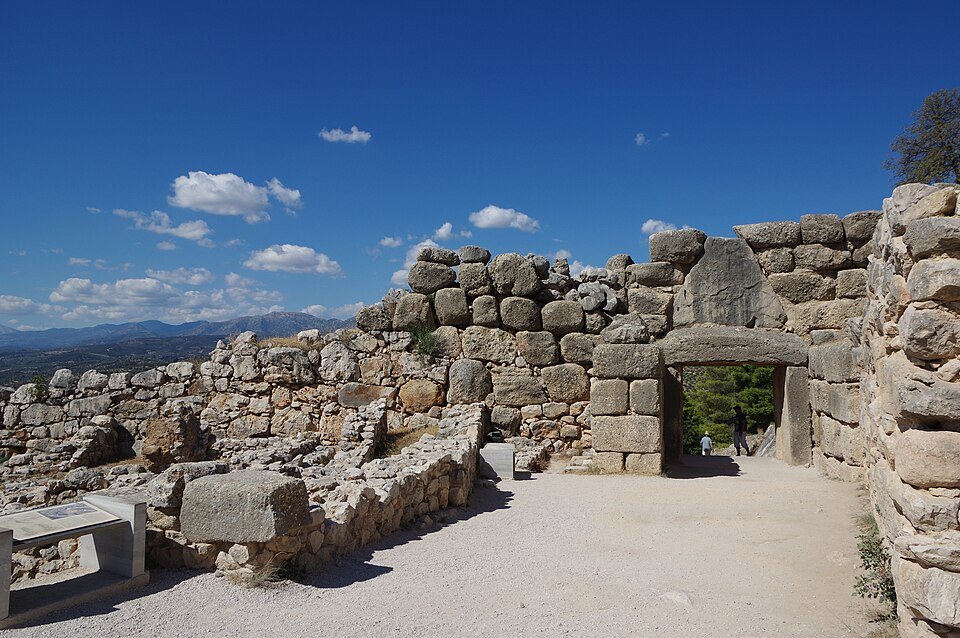
The monumental cyclopean Lion Gate of Hattusa, the imperial capital of the Hittite Empire destroyed during the Late Bronze Age collapse (c. 1200 BCE). (Hattusa Archaeological Site, Turkey)
Historical Context
By 1200 BCE, the eastern Mediterranean had sustained a sophisticated, interconnected civilizational network for centuries. The palace states of Mycenaean Greece controlled agricultural surpluses and redistributed them through elaborate bureaucracies. The Hittite Empire, centered at Hattusa in modern-day Turkey, had contested Egypt as a near-equal power — their peace treaty following the Battle of Kadesh in 1274 BCE is the oldest surviving international peace agreement in recorded history. The city of Ugarit on the Syrian coast functioned as a cosmopolitan trading hub where Cypriote copper merchants, Egyptian diplomats, Canaanite scribes, and Aegean sailors all interacted. In Mesopotamia, the Kassite dynasty governed Babylon with administrative sophistication inherited from centuries of Sumerian and Akkadian precedent. Egypt, under Ramesses II and his successors, projected military power from the Nile Delta to the Levantine coast.
This was not a primitive world. Bronze Age palaces maintained extensive libraries, managed large-scale irrigation, sponsored specialist craftsmen, and conducted long-distance trade spanning thousands of miles. Tin for bronze came from as far as Afghanistan. Amber traveled from the Baltic. Lapis lazuli from the Hindu Kush appeared in Mycenaean graves. The world of 1250 BCE was, in many respects, the most globally connected civilizational network humanity had yet produced. Within fifty years, almost all of it was gone.
Between approximately 1200 and 1150 BCE, Mycenae, Tiryns, Pylos, and virtually every other major palace center in Greece was destroyed and abandoned. Hattusa, the Hittite capital, was burned so thoroughly that its ruins still display vitrified stonework from the heat. Ugarit received a desperate letter from the king of Alashiya (Cyprus) warning of burning ships offshore — and was then destroyed before the letter could be answered. The Kassite dynasty collapsed. Egypt survived, barely, but lost its Levantine empire and never truly recovered its earlier strength. Across the entire arc from Greece to Mesopotamia, population levels fell dramatically. Some areas would not recover for centuries.
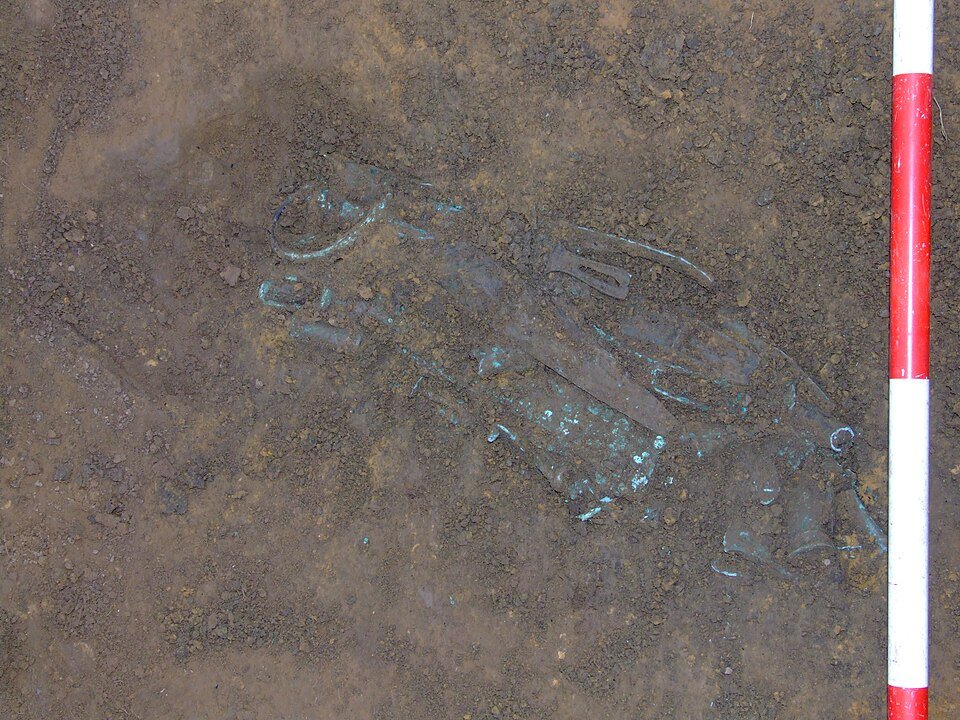
A hoard of Late Bronze Age bronze swords and spearheads from England. (British Museum)
Why It Happened
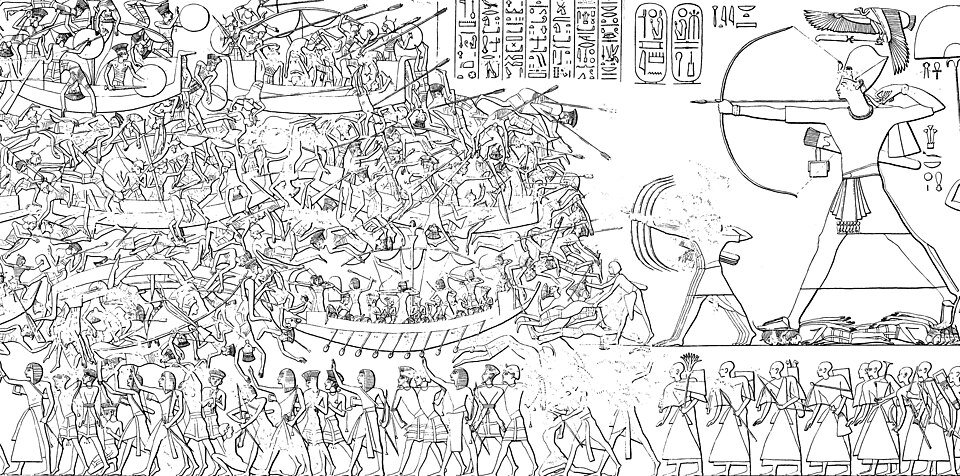
For most of the twentieth century, historians looking for a single cause fixed on the "Sea Peoples" — mysterious groups attested in Egyptian inscriptions, depicted in the relief carvings at Medinet Habu commissioned by Ramesses III around 1175 BCE. These carvings show naval battles, land battles, migrants traveling with ox-carts and children: an entire people on the move. The Egyptian texts name groups with evocative labels — the Peleset, Tjeker, Shekelesh, Denyen, Weshesh — whom scholars have variously tried to identify as Philistines, Sicilians, Sardinians, Lycians, or displaced Aegeans. The traditional view, articulated forcefully by scholars like Nancy Sandars in her 1978 work The Sea Peoples, held that these were migrating warrior confederacies sweeping down from the north and west, destroying every civilization in their path like a civilizational wildfire.
The problem, as subsequent archaeology has relentlessly demonstrated, is that this explanation is almost certainly backwards. The Sea Peoples are more plausibly a symptom than a cause. This is the central argument of Eric Cline's landmark 2014 study 1177 B.C.: The Year Civilization Collapsed, which synthesized decades of archaeological and textual evidence to propose what he calls a "perfect storm" model. Rather than a single external shock, the Bronze Age Collapse was the result of multiple stressors hitting a deeply interconnected, and therefore deeply fragile, system simultaneously.
The stressors Cline identifies include prolonged drought (now confirmed by paleoclimatic data from lake sediment cores in the region), a sequence of major earthquakes documented archaeologically at sites including Mycenae, Tiryns, and Ugarit, disruption of the intricate long-distance trade networks on which palace economies depended for essential materials like tin, and possible internal rebellions driven by social strain. Each factor alone might have been survivable. Together, and in a system where the failure of one node could cascade through interconnected dependencies, they created a collapse from which recovery proved impossible. The Sea Peoples, in this reading, were themselves often refugees from earlier waves of the collapse — displaced populations who then became raiders out of desperation, accelerating a process already well underway.
The trade network disruption argument is particularly compelling. Bronze Age palatial economies were not self-sufficient. Tin — essential for making bronze — had no local source anywhere in the Aegean or Near East and had to be imported across enormous distances. A palace that lost access to tin could not arm its soldiers, could not maintain its tools, could not sustain the agricultural surplus that fed its population and legitimized its rulers. When trade routes frayed, the whole system of specialized production and redistribution on which palace economies rested began to unravel with startling speed.
Detail of the mortuary temple relief of Pharaoh Ramesses III at Medinet Habu, Luxor (c. 1175 BCE), depicting captured Sea Peoples warriors wearing distinctive feathered headdresses following the naval Battle of the Delta. (Medinet Habu Archaeological Complex, Luxor)
The Tablets of Pylos: A Society in Panic
The Linear B tablets recovered from Pylos, first excavated by Carl Blegen beginning in 1939 and now numbering over a thousand documents, offer something extraordinarily rare in Bronze Age scholarship: a snapshot of an administrative system in its final weeks. Most of what we read in these tablets is mundane — the kind of bureaucratic record-keeping common to all complex states. Inventories of sheep. Allocations of grain rations. Lists of craftswomen and their children. But scattered through the collection are documents that speak directly to crisis.
One set of tablets records the deployment of rowers — "o-ka" tablets, named for a Linear B term — to coastal watching stations. Fifty-seven men are assigned here, forty there, watching the sea approaches. Another document records the removal of bronze from temple tripods and cauldrons: sacred vessels being stripped of their metal to re-arm soldiers. This was not routine administration. Bronze was being pulled from the gods themselves to make weapons. The palace knew something was coming. It did not survive to record what.
Michael Ventris, who deciphered Linear B in 1952 with the crucial collaboration of John Chadwick, recognized almost immediately that the Pylos tablets represented a uniquely intimate window into Bronze Age administrative anxiety. Chadwick's 1958 book The Decipherment of Linear B documented how the script revealed a society sophisticated enough to manage thousands of dependent workers across dozens of villages — and vulnerable enough to have all that infrastructure annihilated within a single generation. When the palace burned, no one in the surrounding countryside had the resources, or perhaps the will, to rebuild it. The Mycenaean writing tradition died with the palace administrators who maintained it.
~1,000+ Linear B tablets recovered from Pylos, the largest single archive from Bronze Age Greece
57 rowers deployed to sea-watch stations in one tablet set, suggesting coastal defense mobilization
Bronze stripping from sanctuary vessels documented, indicating extreme resource desperation
No rebuilding at Pylos after c. 1180 BCE — the palace site was simply abandoned
400+ years elapsed before writing reappeared in Greece, now using a Phoenician-derived alphabet
The Scale of the Collapse
Between 1200 and 1150 BCE, at least 47 major Bronze Age cities and palace centers across the eastern Mediterranean were destroyed or abandoned. Population estimates for Greece suggest a decline of 75–90% over the following century. The Hittite Empire, which had fielded armies of 37,000 men at Kadesh, simply ceased to exist as a political entity. No Hittite king ever again sent a letter to an Egyptian pharaoh. In Greece, literacy itself disappeared for approximately four centuries — an almost unprecedented cultural regression in a complex society.
How Long Did the Bronze Age Collapse Last?
When historians analyze the duration of the Late Bronze Age Collapse, they distinguish between two interconnected phases: the acute destructive collapse and the prolonged recovery dark age that followed:
The Acute Destruction Phase (~50 Years, c. 1200 – 1150 BCE): Within five decades, an interconnected civilizational world that had endured for over two millennia was systematically obliterated. Between 1200 and 1150 BCE, over forty major fortified cities—including Mycenae, Tiryns, Pylos, Hattusa, and Ugarit—were burned to the ground and never rebuilt.
The Prolonged Civilizational Dark Age (~400 Years, c. 1150 – 750 BCE): While the acute violence peaked over fifty years, the societal vacuum lasted for nearly four centuries. In mainland Greece and the Aegean, the loss of palace administrative hierarchies erased linear writing (Linear B), ceased monumental stone construction, and collapsed regional populations by an estimated 75% to 90%.
The 8th-Century BCE Rebirth: Not until approximately 750 BCE did Greece and the Levant experience a full cultural renaissance, marked by the adoption of the Phoenician phonetic alphabet, the composition of the Homeric epics, and the rise of independent, iron-weaponed city-states (poleis).
Social & Human Effects
The human cost of the Bronze Age Collapse is difficult to quantify with precision, but the archaeological record is stark. In Greece, survey archaeology has documented a dramatic reduction in the number of inhabited sites between the Late Bronze Age and the Early Iron Age. Areas that supported dozens of villages in 1300 BCE show only a handful of small settlements by 1100 BCE. Cemetery evidence suggests populations collapsed to perhaps a tenth of their Bronze Age levels in the most severely affected regions. This was not merely political disruption: it was demographic catastrophe, driven by violence, famine, and the breakdown of the agricultural systems that palace redistribution networks had sustained.
The effects on literacy and cultural memory were equally profound. The Linear B script required specialist training — it was a palace technology, maintained by scribes employed within the administrative system. When the palaces fell, the scribes died or dispersed, and within a generation there was no one left who could teach the next generation to read. Greece entered what scholars have called the "Dark Ages" — a period of approximately four centuries for which we have almost no written sources because writing had essentially ceased. Oral tradition preserved fragments of the Bronze Age world, and those fragments eventually found their way into Homer's Iliad and Odyssey — but the continuous documentary record was broken, permanently and completely.
Social hierarchies were upended. The palace economy depended on a rigid redistributive system in which specialist craftsmen, agricultural workers, and military personnel all operated within a managed network. When that network collapsed, the specialists — bronze-smiths, weavers, potters trained in palace-standard techniques — lost both their patrons and their supply chains. The elaborate palatial pottery styles that archaeologists can track across the Late Bronze Age abruptly gave way to much simpler handmade wares. Skills accumulated over centuries were lost, not because people forgot them, but because the economic and social structures that had made those skills viable no longer existed.
Economic Consequences
The collapse of Bronze Age trade networks was not merely an economic inconvenience. The palace economies of the eastern Mediterranean had developed over centuries into a system of extraordinary interdependence. Ugarit exported textiles and received copper from Cyprus. The Mycenaean palaces processed wool, made perfumed oil, and exchanged these for the tin and copper they needed to arm their warriors. Egypt traded gold for Levantine timber it could not grow at home. Each node in this network was simultaneously a producer and a dependent consumer. The system was, in the language of modern complexity theory, deeply coupled — which meant that disruption at any point could propagate rapidly through the whole.
The economic historian Barry Strauss has argued that the Bronze Age collapse is one of history's clearest examples of what modern economists call a "supply chain collapse" — a failure not of individual components but of the interdependencies between them. When drought reduced agricultural surpluses, palace administrators could no longer sustain the specialist craftsmen and military forces that maintained the system. When trade routes were disrupted, the tin essential for bronze production became unavailable. When coastal raiding became frequent, merchants stopped sailing the routes that had connected the network. These failures reinforced each other in a downward spiral that no individual palace had the resources or information to arrest.
Recovery, when it came, was built on fundamentally different foundations. Iron ore, unlike tin, was widely available locally. The Iron Age that emerged from the ashes of the Bronze Age was, paradoxically, in some ways more economically democratic — iron tools were eventually accessible to farmers who could never have afforded bronze equivalents. The alphabetic writing systems that replaced Linear B and its contemporaries were simpler to learn, not requiring years of scribal training. The decentralized, city-state and tribal political structures that replaced the palace systems were more resilient to exactly the kind of cascading failure that had destroyed their predecessors.
⚖️
Historian Debate: Who Were the Sea Peoples?
Traditional View
The Sea Peoples were migrating warrior confederacies originating from the Aegean and Anatolia, possibly including displaced Mycenaeans, Lycians, and others driven from their homelands by population pressure or internal conflict. They swept through the eastern Mediterranean as a primary destructive force, destroying Ugarit, threatening Egypt, and settling in Canaan as the Philistines. This view, associated with scholars including Nancy Sandars and earlier with Gaston Maspero, treats the Sea Peoples as an active cause of the collapse rather than a product of it.
Revisionist View
Eric Cline and colleagues like Assyriology scholar Trevor Bryce argue that the Sea Peoples are better understood as refugees and opportunists operating within a collapse already underway, rather than its initiating cause. Archaeological evidence shows that many Bronze Age destructions predate the Sea Peoples' documented activity. The "multicausal" model — drought, earthquake, trade disruption, internal unrest, and migration interacting in a "perfect storm" — has gained broad support as it better accounts for the geographic breadth and timing of the destructions than any single-cause explanation.
Scholars such as Eric Cline and Trevor Bryce have shaped this debate through works like 1177 B.C.: The Year Civilization Collapsed (2014) and The Kingdom of the Hittites (1998). The debate remains open; new paleoclimatic and isotopic data continue to refine the picture.
"Behold, the enemy's ships came, and fire was set and they did evil things in my country... The seven ships of the enemy that came and did evil things, they were stronger than we... Now then, be strong, and wherever [there are] men and women, may you know it... do not be afraid!"
— Letter from the King of Ugarit to the King of Alashiya (Cyprus), c. 1185 BCE. The city was destroyed before a reply arrived. RS 20.238, Ras Shamra Archive.
Long-Term Legacy
What emerged from the Bronze Age collapse was, eventually, a Mediterranean world that in several respects was more dynamic and geographically distributed than what had preceded it. The Iron Age brought iron tools and weapons that were ultimately stronger than bronze and far more widely available. The Phoenician city-states that survived and flourished in the post-collapse Levant developed an alphabetic script of roughly 22 characters that was adopted and adapted by Greeks, Aramaeans, Hebrews, and ultimately became the ancestor of virtually every Western alphabet in use today. The decentralized political landscape — Greek city-states, Hebrew kingdoms, Aramaic trading networks, Assyrian territorial states — proved more resilient to the kind of catastrophic cascade that had undone the Bronze Age palace network.
The memory of the Bronze Age itself, filtered through four centuries of oral tradition, left its marks in the cultural record. The Trojan War cycle that Homer crystallized in the eighth century BCE is now understood by scholars including Sarah Morris and Gregory Nagy to contain genuine, if distorted, memories of the Late Bronze Age world — Mycenaean palace culture, Anatolian city-states, the dynamics of raid and counter-raid that characterized the period's end. Archaeology at Hisarlik, the site identified with Troy, has revealed destruction layers consistent with the period, though the relationship between the archaeological site and the Homeric narrative remains contested.
Perhaps most importantly for modern readers, the Bronze Age Collapse has become a touchstone for historians and systems theorists thinking about civilizational vulnerability. Eric Cline has been explicit that his research on 1200 BCE was shaped by his awareness of modern globalized interdependencies — the same logic that made Bronze Age palace economies efficient also made them brittle. A world in which supply chains, climate stability, and political order are deeply coupled is a world in which multiple simultaneous stressors can produce outcomes that no single component's failure would predict. The scribes of Pylos could not have imagined that their panicked bronze-stripping and coastal watch-posting would one day be read as a warning for civilizations they never knew existed. They have, nonetheless, delivered exactly that.
Eric H. Cline — 1177 B.C.: The Year Civilization Collapsed (2014). The definitive modern synthesis of collapse evidence, arguing for multicausal "perfect storm" dynamics; essential reading for any serious engagement with the topic.
John Chadwick — The Decipherment of Linear B (1958). A firsthand account of one of archaeology's great intellectual breakthroughs, placing the Pylos tablets in their human context.
Trevor Bryce — The Kingdom of the Hittites (1998). The standard scholarly history of the Hittite Empire, invaluable for understanding what was lost in the collapse.
Nancy Sandars — The Sea Peoples: Warriors of the Ancient Mediterranean (1978). The traditional case for the Sea Peoples as primary agents of collapse; important for understanding the historiographic baseline that Cline and others revised.
Brandon Drake — "The Influence of Climatic Change on the Late Bronze Age Collapse," Journal of Archaeological Science (2012). Key paleoclimatic study confirming drought conditions during the collapse period through isotopic and sediment core analysis.
📊 Museum-Grade Infographic Poster
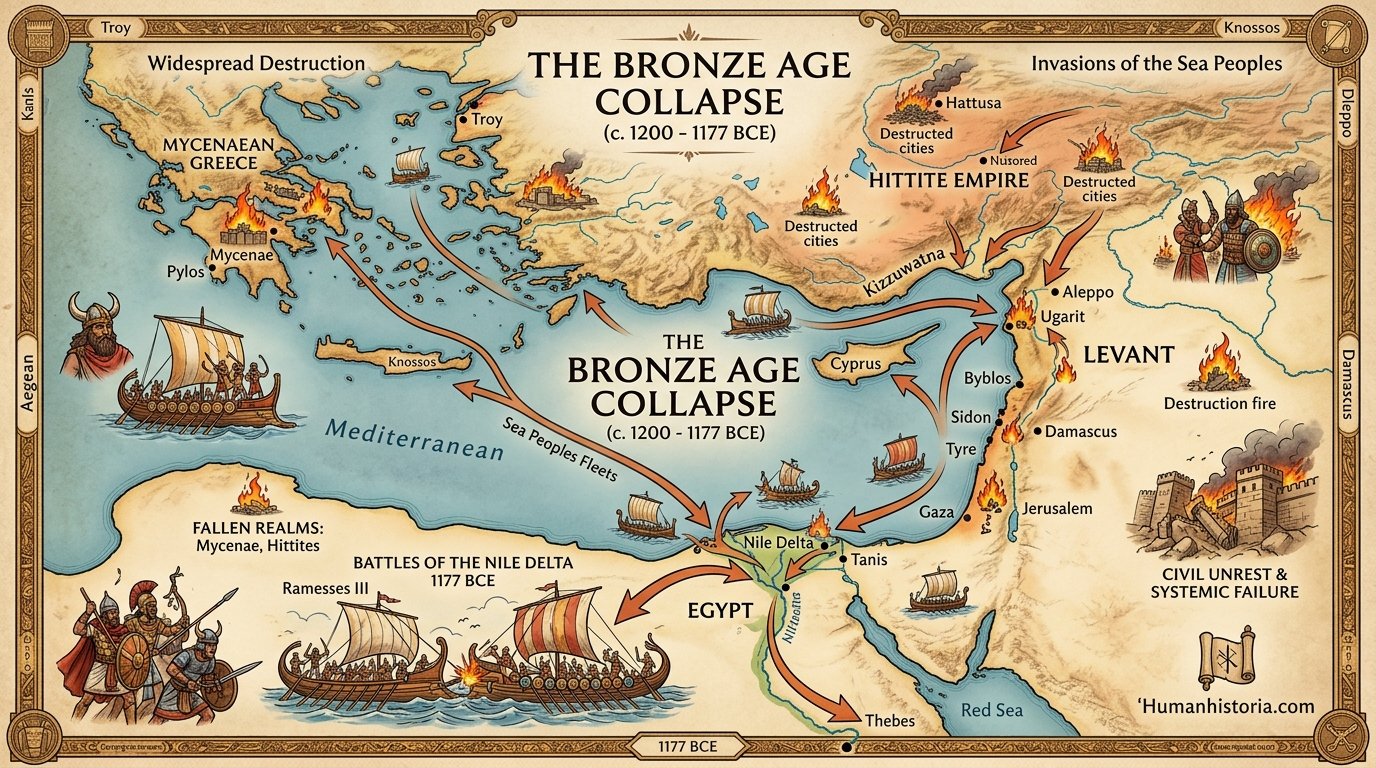
The Late Bronze Age Collapse Map Infographic
💡 Click anywhere on poster to expand in high resolution🔎 Expand Lightbox
Regional map plotting the destruction of Mycenaean, Hittite, and Levantine cities around 1200 BCE, highlighting the Sea Peoples' paths.
📖 SCHOLARLY INQUIRIES
Frequently Asked Questions
Essential historical questions and evidence-based answers concerning this chronicle.
Q.What followed the Bronze Age Collapse?
The region entered a Greek and Near Eastern 'Dark Age' characterized by loss of writing (Linear B), urban depopulation, and the eventual dawn of the Iron Age.
Q.How long did the Bronze Age Collapse last?
The acute destruction phase lasted roughly 50 years (c. 1200–1150 BCE), during which over 40 major cities like Mycenae, Hattusa, and Ugarit were destroyed. However, the resulting 'Greek Dark Ages' and economic contraction persisted for roughly 400 years (c. 1150–750 BCE) before literacy, population, and trade re-emerged.
Q.What was the Bronze Age Collapse?
The Bronze Age Collapse (c. 1200–1150 BCE) was the near-simultaneous disintegration of every major civilization in the Eastern Mediterranean: the Hittite Empire vanished, Mycenaean Greek palace economies collapsed, the Ugarit trading city was burned and never rebuilt, and Egypt entered permanent decline. It is the most complete societal systems failure in recorded history.
Q.Who were the Sea Peoples?
The 'Sea Peoples' is an Egyptian term for waves of migrants and raiders who attacked Egypt and coastal Levantine cities around 1207–1177 BCE. Their origins remain debated—they may have included displaced Mycenaean Greeks, Anatolians, Cypriots, and Aegean islanders who themselves were fleeing cascading collapses. Some scholars argue they were refugees, not the cause of collapse, but were swept up in the same crisis.
Q.Could the Bronze Age Collapse happen to modern civilization?
Modern systems are both more and less resilient: more resilient because communication is global and faster, less resilient because modern supply chains are far more interdependent than Bronze Age trade networks. The 2021 global semiconductor shortage, the COVID-19 supply chain disruptions, and the vulnerability of undersea internet cables are all discussed in contemporary systems-risk literature using the Bronze Age Collapse as a reference model.
📚 Academic Sources & Scholarly Bibliography
Cline, E.H. (2014).
1177 B.C.: The Year Civilization Collapsed.
Princeton University Press.
Knapp, A.B. & Manning, S.W. (2016).
Crisis in Context: The End of the Late Bronze Age in the Eastern Mediterranean.
American Journal of Archaeology 120(1): 99-149. doi:10.3764/aja.120.1.0099
Middleton, G.D. (2017).
Understanding Collapse: Ancient History and Modern Myths.
Cambridge University Press.
📖 Scholar Mode Active — Click to exit focused reading
History Lab 🧪
Interactive historical deduction games, tactical matchup simulators, and currency calculators.
🕵️ Who Am I? (The Historical Guess Game)
A secret historical figure has been selected. Ask yes/no questions to narrow down the pool of candidates. Click any active card to make your accusation!
Secret Identity
❓ Who Am I?
Ask questions using the board below to narrow down my identity.
Ask a Question:
Question LogQuestions: 0 / 7
No questions asked yet.
Candidate Board:
🗺️ Timeline Scramble
Five historical events appear out of order. Click them in the correct chronological sequence — from oldest to most recent. How well do you know your history?
🏺 Relic or Fake?
Is this a real historical artifact or a convincing fabrication? Judge each one based on its description and era — then see the truth revealed!
Artifact 1 / 10Score: 0
Empire Matchup Simulator
Empire ATerritory Size (Peak, M km²)Empire B
00
Empire APopulation (Peak, Millions)Empire B
00
Empire AMilitary Power (Army Size)Empire B
00
Tactical Battle Analysis
Select empires and click simulate to run evaluations.
Historical Purchasing Power Converter
See what ancient coins are worth in modern terms and check their historical purchasing power.
Modern Value Equivalent
$0.00 USD
Historical Purchasing Power:
Select currency to view purchasing capability.
Historical Identity Generator
Forge an authentic historical identity from ancient civilisations, complete with linguistic meaning and biography.
Neutral
Gaius Julius
Meaning:Descendant of Jupiter
Historical Background:
A Roman citizen and clerk who worked in the forum under Roman republic rule.
Chrono-Cultural Fusion Simulator
Fuse the culture, technology, and governance of two legendary civilizations to synthesize a unique hybrid society.
Cohesion & Coexistence Rate
85%
🏛️ Hybrid Architecture
⚙️ Synthesized Asset
📜 Synthetic Governance
Historical Tactics & Trivia Quiz
Test your historical knowledge and battle tactics to claim your administrative rank.
8 Questions • Multi-Era
You will be presented with random scenarios and trivia spanning ancient Egypt, classical Rome, Islamic Golden Age, and the modern industrial era. Complete the evaluation to see your historical title!
Question 1 of 8Score: 0
What was the Code of Hammurabi written on?
Correct!
Evaluation Complete!
6 / 8
Correct
Rank Attained
Imperial Legionary
Your knowledge of classical strategy and administrative structures is respectable.
🎲 Counterfactual "What If?" Scenario Simulator
Explore alternative historical trajectories by tweaking key civilizational pivot points.
Simulated Shift
Selected Era
Prehistoric Era
Millions of years ago to ~3000 BCE
The dawn of humanity. From the evolutionary split of early hominids to the mastery of stone tools, fire, and the birth of language.
Landmark Milestones
Welcome to Historia
Enter your Scholar Name to synchronize your chronicles and save your journey.
 ⭐ Featured Chronicle

 ANCIENT AGES
 ANCIENT AGES
 ANCIENT AGES
 MEDIEVAL PERIOD
 MEDIEVAL PERIOD
 PREHISTORIC ERA