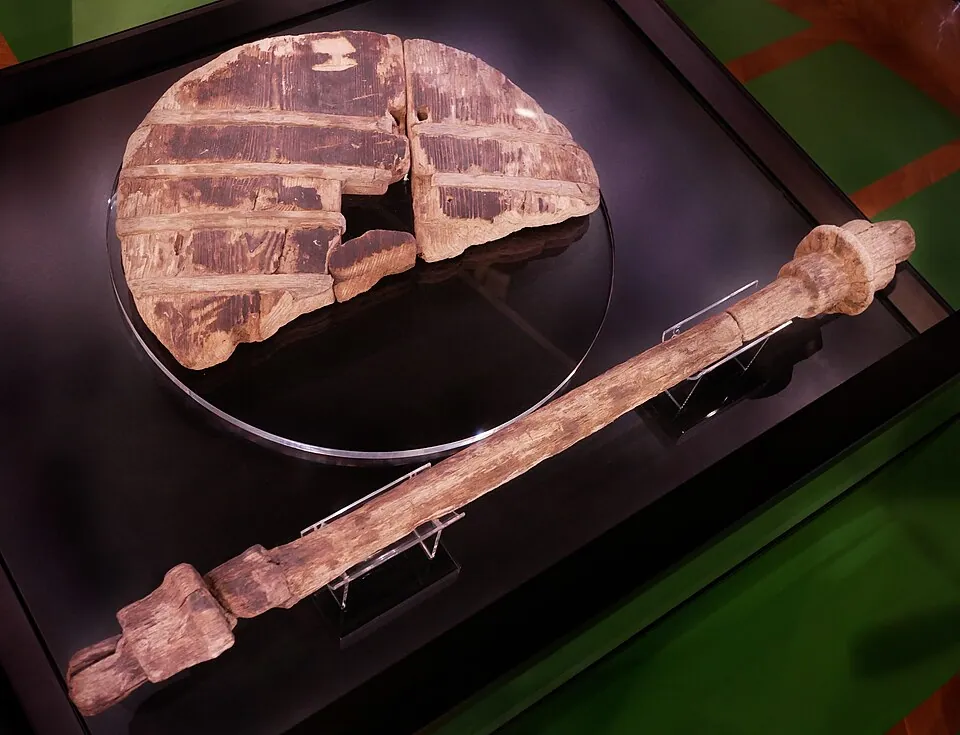
Examine the tangible relics, physical tokens, and revolutionary machines that shaped civilizational growth.
THE HISTORIA CIRCLE
Join the collective discussion, study logs, and contributions of fellow historians mapping humanity's path.
Historia Forum Discussions
Start a Discussion Thread
THEMATIC PATHWAYS
Trace a single thread β disease, trade, energy, migration β across all eras and civilizations.
History is not just a sequence of events β it is a network of patterns. These thematic pathways allow you to follow a single concept across thousands of years: how agriculture spread, how warfare evolved, how trade routes shaped civilizations. Each pathway collects the most relevant chronicles across all eras.
How is this different from the sidebar Topics?
While the sidebar Topics (like Science & Tech or Empires) filter articles within your selected historical Era, Thematic Pathways cut horizontally across all eras (from Prehistoric to the Future). Use Themes to trace a single concept's evolutionary line across 300,000 years.
CIVILIZATION HUBS
Comprehensive profiles of the world's greatest civilizations and empires β from ancient cradles to global super-states.
Human Historia provides an academically rich exploration of the world's most influential civilizations. From the monumental achievements of ancient Egypt, Han China, and the Roman Empire, to the sophisticated societies of the Maya, the Islamic Caliphates, and West African empires, these hubs offer deep insights into the cultural, political, and technological legacies that continue to shape our global story.
ACADEMIC PASSPORT
Track your intellectual journey, quiz outcomes, and historical badges of honor.
HISTORIA PASSPORTβ³
π€Scribe Novice
Scholar NameHistoria Explorer
Rank RatingSumerian Record Scribe
Chronicles Read0 / 48
Study Guide Pins0 Guides
Security AccessLevel 1 (Novice)
Earned Badges of Honor
π₯
Fire Keeper
Unlock 3 prehistoric chronicles.
ποΈ
Codex Keeper
Unlock 3 ancient chronicles.
π°
Guild Master
Unlock 3 medieval chronicles.
βοΈ
Steam Engineer
Unlock 3 modern chronicles.
π
Singularity Sage
Unlock 3 future chronicles.
π
Grand Scholar
Score 5/5 on the Lab Quiz.
Recent Lab Activities
No recent activities recorded. Take a quiz or bookmark articles!
Curated Exhibition
Human Historia
An immersive graphical anthology tracing the paths of civilizations, breakthroughs, and conflicts that forged the modern consciousness.
25Chronicles
Showing all articles
Athenian Democracy and Roman Law
Written by Historia AdministrationHistorical Era: Ancient Ages
π¨ Historical Illustration (AI)
* Note: Cover images and unreferenced inline images are AI-generated illustrations for illustrative purposes.
In the late 6th century BCE, the city-state of Athens pioneered a radical system of self-governance known as demokratiaβ"rule by the people." Unlike modern representative systems, Athenian democracy was a direct democracy, where citizens did not elect politicians to make laws but voted on legislation and policy themselves in a public assembly. It was an extraordinary political experiment that championed civic equality, freedom of speech (*parrhesia*), and the selection of public officials by lottery (sortition) rather than election, which they viewed as oligarchic. Yet, this celebrated "cradle of democracy" was structurally dependent on the systematic exclusion of the majority of its population. The democratic leisure of the Athenian citizen was financed by the labor of tens of thousands of enslaved people and sustained by the exclusion of women and foreign residents. Classical Athens was an imperial democracyβa state that championed freedom at home while running an aggressive empire abroad and keeping its own domestic engine running on human bondage.
Historical Context: The Cleisthenic Reforms
Before democracy, Athens was ruled by aristocratic families (the Eupatridae) who controlled the best land and dominated the governing council (the Areopagus). Economic inequality was so severe that many poor citizens fell into debt slavery, leading to social unrest. In 594 BCE, the lawmaker Solon abolished debt slavery and divided citizens into wealth classes, but political tension persisted, resulting in the rise of the tyrant Peisistratus and his sons. Following the overthrow of the tyranny, an aristocratic conservative named Isagoras attempted to restore oligarchy with Spartan military help, sparking a popular uprising by the Athenian populace in 508 BCE.
To secure power, an aristocratic reformer named Cleisthenes allied himself with the popular movement. He introduced a series of revolutionary reforms that broke the political power of the old noble families. Cleisthenes divided the citizens of Attica into ten new tribes based on demes (local municipalities) rather than kinship. Each tribe was a mixture of people from the coast, the inland farming areas, and the city, forcing different social classes to cooperate. This tribal restructuring served as the administrative foundation of the democracy, establishing the Council of 500 (Boule), which prepared the agenda for the citizen Assembly.
Why It Happened: Sortition and the Fear of Oligarchy
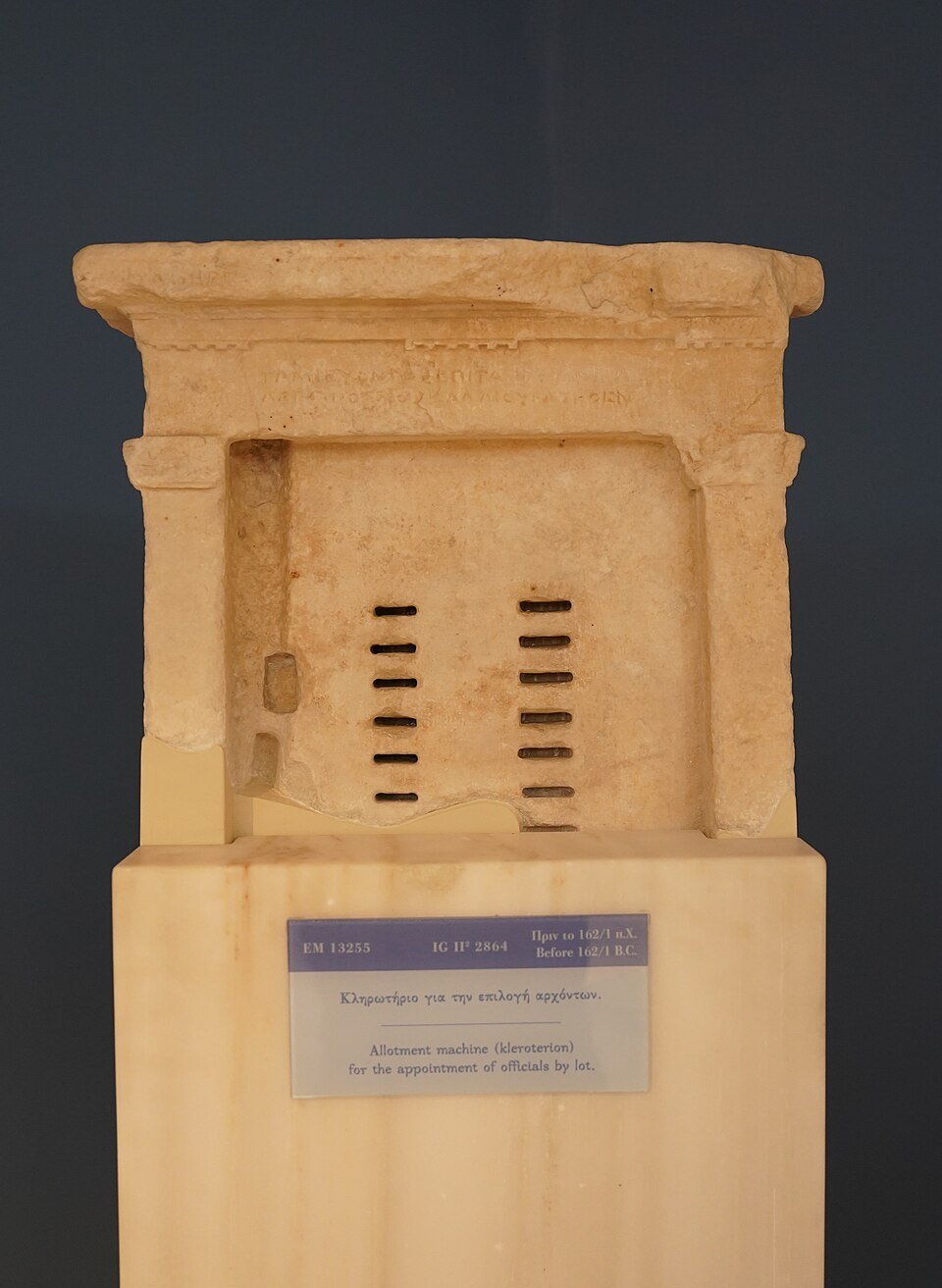
The Athenians believed that elections were inherently oligarchic, as they favored the wealthy, the famous, and the eloquent. Therefore, to ensure equality and prevent the rise of a political class, they selected almost all public administrators, judges, and council members by lottery (sortition) using a stone randomization machine called a kleroterion. Any citizen over thirty could be selected to serve in the government for a one-year term. Only military generals (strategoi) and tax administrators, which required technical expertise, were elected.
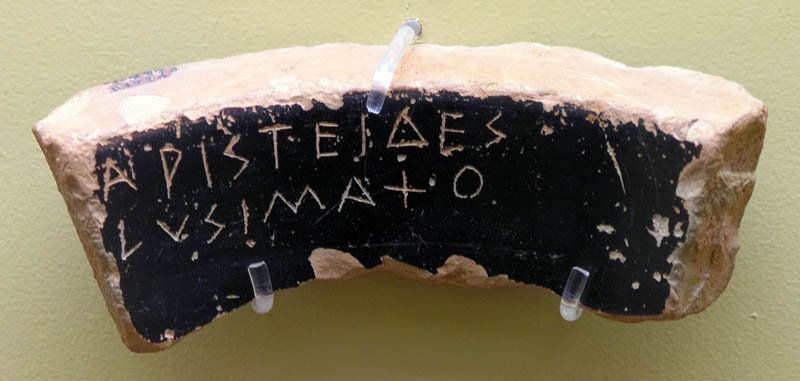
To defend their democracy from aspiring tyrants, the Athenians practiced ostracism. Once a year, the Assembly voted on whether to hold an ostracism. If they agreed, citizens gathered in the agora and wrote the name of a political figure they feared or disliked on shards of broken pottery called ostraka. If a quorum of 6,000 votes was met, the person with the most votes was banished from Athens for ten years, though they kept their property. This system was designed to defuse political factionalism and protect the collective rule of the assembly.
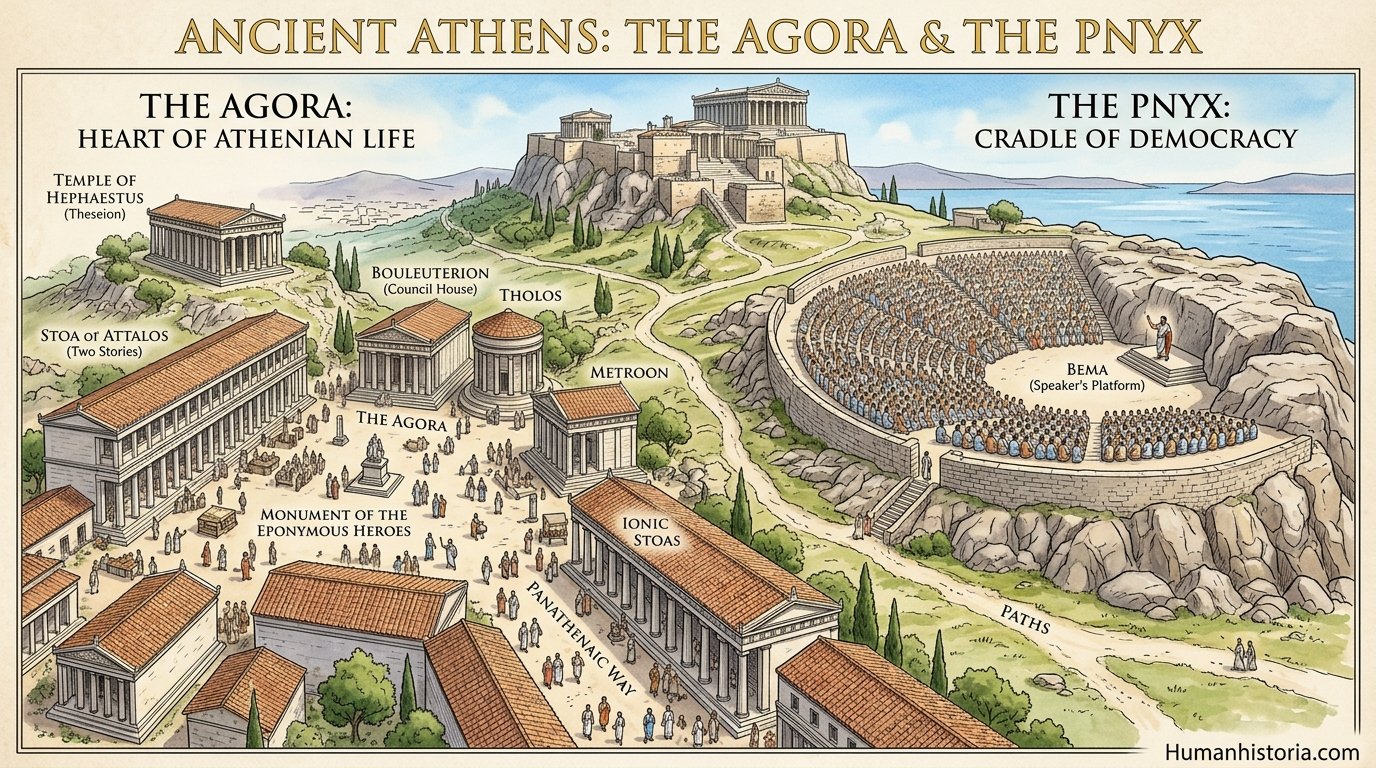
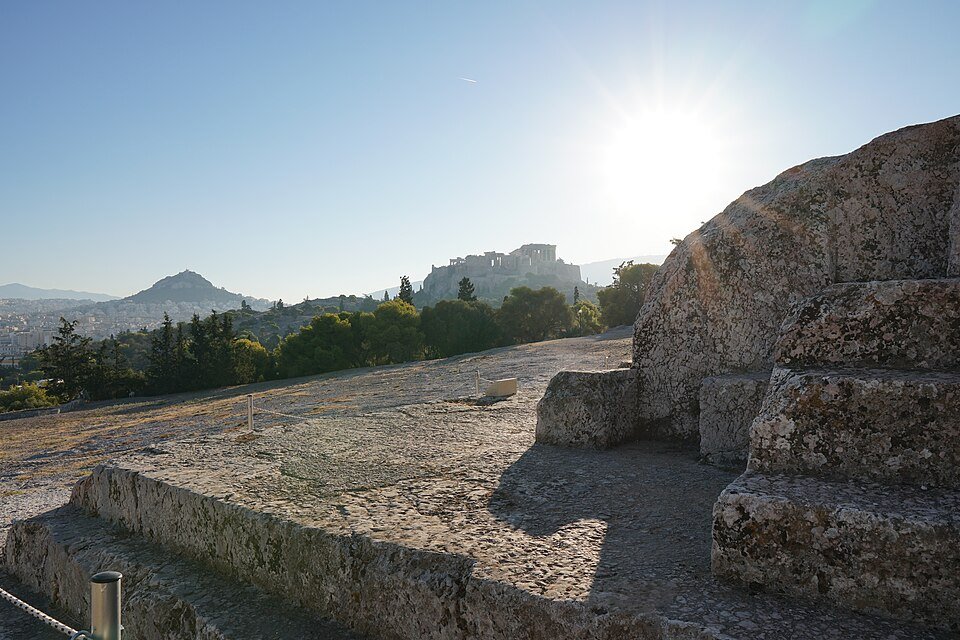
A depiction of the Athenian Assembly (Ekklesia) meeting on the Pnyx hill. Up to 6,000 citizens gathered here to debate, listen to speakers, and vote on laws, war, and treaties by a show of hands.
Key Development: The Peloponnesian War and the Trial of Socrates
Athenian democracy was tested by the Peloponnesian War (431β404 BCE)βa devastating conflict between Athens and its allies against Sparta and the Peloponnesian League. Following the death of the moderate leader Pericles, the Assembly fell under the influence of demagoguesβpopular speakers like Cleon and Alcibiades who appealed to the emotions and prejudices of the crowd rather than reason. Under their influence, the Assembly made disastrous decisions, including the execution of all male citizens of the rebelling island of Melos and the catastrophic Sicilian Expedition, which decimated the Athenian army.
The war ended with the defeat of Athens, which was forced to accept a Spartan-backed oligarchy known as the Thirty Tyrants. Although democracy was restored a year later, the political culture was deeply traumatized and suspicious of critics. In 399 BCE, this suspicion culminated in the trial and execution of the philosopher Socrates, who was accused of "corrupting the youth" and "impiety." The execution of Socrates, a critic of the lottery system and assembly rule, stands in history as a major warning about the potential for direct democracy to devolve into "mob rule" (*ochlocracy*).
508 BCE β Cleisthenes introduces the tribal reforms, establishing the democratic framework
490 BCE β 479 BCE β Greco-Persian Wars; Athenian victories at Marathon and Salamis validate democratic military power
461 BCE β Ephialtes strips the aristocratic Areopagus of its powers, initiating the "Golden Age" of radical democracy
431 BCE β 404 BCE β Peloponnesian War against Sparta; rise of demagoguery and temporary oligarchic coups
399 BCE β Trial and execution of Socrates by a democratic jury of 501 citizens
338 BCE β Philip II of Macedon defeats Athens and Thebes at the Battle of Chaeronea, ending democratic independence
The Ostraka Shards: Voting for Exile
Archaeologists excavating the Athenian Agora have recovered thousands of ostraka shards bearing the names of famous politicians, including Themistocles, Aristides, and Cimon. The ostraka reveal that ostracism was frequently used as a weapon in factional struggles. Some caches of ostraka show identical handwriting, suggesting that political factions pre-prepared shards to distribute to illiterate voters, demonstrating that political manipulation and lobbying were active even in the earliest direct democracies.
Social & Human Effects: Slavery and the Excluded Majority
Athenian democracy was an exclusive club. Out of an estimated population of 300,000 in Attica, only adult males who had completed military training and were born of two Athenian parents were citizens with voting rights. This group numbered between 30,000 and 40,000, representing less than 15% of the population. Women had no political rights, could not own significant property, and were legally represented by a male guardian (*kyrios*). Foreign residents, known as metics, who made up the commercial backbone of Athens, were disenfranchised and had to pay a special tax to reside in the city.
Below the citizens was a massive population of enslaved people, estimated at 80,000 to 100,000. Slaves did the agricultural labor on estates, worked in domestic service, and, most brutally, mined silver in the state-owned mines at Laurium. The silver from Laurium funded the Athenian navy and built the public monuments. Without the constant labor of these slaves, Athenian citizens would not have had the leisure time required to attend the Assembly, sit on juries, and run the state. The democracy of the few was financed by the bondage of the many.
Economic Consequences: The Delian League and Imperial Tributaries
Athenian democracy was also an imperialist enterprise. Following the defeat of the Persian invasion, Athens organized the Delian Leagueβa coalition of Greek city-states designed to protect the Aegean from Persia. However, Athens quickly converted the league into an empire. Member states were forced to pay an annual tribute (*phoros*) to Athens, which was kept in the state treasury. When members tried to secede, Athens used its military navy to crush them and establish colonies of Athenian citizens on their lands.
In 454 BCE, Pericles moved the treasury of the Delian League from Delos to Athens. He used the tribute money to fund a massive public works project on the Acropolis, constructing the Parthenon, the Propylaea, and the Temple of Athena Nike. This project employed thousands of citizen builders, sculptors, and laborers, linking the economic prosperity of the Athenian working class directly to the exploitation of imperial subject states. Athenian democracy was sustained by imperial extortion.
βοΈ
Historian Debate: Sortition vs. Election
The Classical Critique
Ancient philosophers like Plato and Aristotle were deeply critical of Athenian direct democracy. In his Republic, Plato argued that governance requires specialized knowledge and virtue, comparing democracy to a ship run by an ignorant crew who choose the captain based on popularity rather than navigation skills. Aristotle viewed democracy as a degenerate form of government that favors the interests of the poor majority over the common good.
The Modern Democratic Re-evaluation
Modern political theorists, such as Bernard Manin and Josiah Ober, have re-evaluated the Athenian system. They argue that selection by lottery (sortition) was highly effective at preventing the formation of corrupt political dynasties, ensuring that ordinary citizens were active participants in governance. They suggest that modern electoral democracies are actually "electoral oligarchies," where professional politicians are elected by a passive electorate, and look to Athenian sortition as a potential tool to revitalize modern civic engagement.
Scholars such as Bernard Manin and Josiah Ober have shaped this debate through works like Manin's The Principles of Representative Government (1997) and Ober's Mass and Elite in Democratic Athens (1989).
"Our constitution is called a democracy because power is in the hands not of a minority but of the whole people. When it is a question of settling private disputes, everyone is equal before the law... No one, so long as he has it in him to be of service to the state, is kept in obscurity because of poverty."
β Pericles' Funeral Oration, recorded in Thucydides' History of the Peloponnesian War (c. 431 BCE). This speech represents the classic ideological defense of Athenian democracy, celebrating its civic equality and open society.
Long-Term Legacy
The legacy of Athenian democracy is complex and contradictory. For centuries after its fall, democracy was viewed by Western thinkers as a dangerous and unstable form of government, associated with mob rule and the execution of Socrates. The founders of the American constitution in 1787 deliberately rejected direct democracy, choosing instead a representative republic with checks and balances designed to insulate the government from the direct passions of the electorate.
However, during the 19th and 20th centuries, direct democracy was romanticized, and the Athenian experiment was adopted as the foundational myth of modern democratic values. Today, as trust in representative institutions declines, political scientists and activists are looking back at Athens to find ways to involve citizens directly in decision-making through citizens' assemblies and participatory budgeting, proving that the ancient debates on the Pnyx hill continue to shape the evolution of modern governance.
Related Civilizations & Contexts
Roman RepublicSpartan OligarchyAchaemenid Persian EmpireMacedonian KingdomCarthaginian RepublicUnited States Republic (1789)French First RepublicEarly Sumerian City Assemblies
Further Reading
Josiah Ober β Democracy and Knowledge: Innovation and Learning in Classical Athens (2008). Examines how Athenian democratic institutions successfully concentrated and organized information to outcompete rival states.
Bernard Manin β The Principles of Representative Government (1997). A critical study comparing ancient sortition-based democracy with modern election-based representative systems.
M.I. Finley β Democracy Ancient and Modern (1973). A foundational comparative work examining the differences in political participation and class dynamics between Athens and modern states.
Thucydides β History of the Peloponnesian War. The primary historical source detailing the military conflicts, the plague of Athens, and the debates in the Assembly.
Pseudo-Xenophon (The Old Oligarch) β Constitution of the Athenians. A contemporary aristocratic critique of Athenian democracy, arguing that the system deliberately favors the poor and uneducated.
π Scholar Mode Active β Click to exit focused reading
History Lab π§ͺ
Run simulated matches between civilizations and convert ancient currencies.
π΅οΈ Who Am I? (The Historical Guess Game)
A secret historical figure has been selected. Ask yes/no questions to narrow down the pool of candidates. Click any active card to make your accusation!
Secret Identity
β Who Am I?
Ask questions using the board below to narrow down my identity.
Ask a Question:
Question LogQuestions: 0 / 7
No questions asked yet.
Candidate Board:
πΊοΈ Timeline Scramble
Five historical events appear out of order. Click them in the correct chronological sequence β from oldest to most recent. How well do you know your history?
πΊ Relic or Fake?
Is this a real historical artifact or a convincing fabrication? Judge each one based on its description and era β then see the truth revealed!
Artifact 1 / 10Score: 0
Empire Matchup Simulator
Empire ATerritory Size (Peak, M kmΒ²)Empire B
00
Empire APopulation (Peak, Millions)Empire B
00
Empire AMilitary Power (Army Size)Empire B
00
Tactical Battle Analysis
Select empires and click simulate to run evaluations.
Historical Purchasing Power Converter
See what ancient coins are worth in modern terms and check their historical purchasing power.
Modern Value Equivalent
$0.00 USD
Historical Purchasing Power:
Select currency to view purchasing capability.
Historical Identity Generator
Forge an authentic historical identity from ancient civilisations, complete with linguistic meaning and biography.
Neutral
Gaius Julius
Meaning:Descendant of Jupiter
Historical Background:
A Roman citizen and clerk who worked in the forum under Roman republic rule.
Chrono-Cultural Fusion Simulator
Fuse the culture, technology, and governance of two legendary civilizations to synthesize a unique hybrid society.
Cohesion & Coexistence Rate
85%
ποΈ Hybrid Architecture
βοΈ Synthesized Asset
π Synthetic Governance
Historical Tactics & Trivia Quiz
Test your historical knowledge and battle tactics to claim your administrative rank.
8 Questions β’ Multi-Era
You will be presented with random scenarios and trivia spanning ancient Egypt, classical Rome, Islamic Golden Age, and the modern industrial era. Complete the evaluation to see your historical title!
Question 1 of 8Score: 0
What was the Code of Hammurabi written on?
Correct!
Evaluation Complete!
6 / 8
Correct
Rank Attained
Imperial Legionary
Your knowledge of classical strategy and administrative structures is respectable.
Selected Era
Prehistoric Era
Millions of years ago to ~3000 BCE
The dawn of humanity. From the evolutionary split of early hominids to the mastery of stone tools, fire, and the birth of language.
Landmark Milestones
Welcome to Historia
Enter your Scholar Name to synchronize your chronicles and save your journey.