Examine the tangible relics, physical tokens, and revolutionary machines that shaped civilizational growth.
🎥 VIDEO HUB & SHORTS
Watch visual summaries, site intros, and mini-documentaries chronicling 300,000 years of world history.
📊 HISTORICAL INFOGRAPHICS ARCHIVE
Museum-grade visual graphics, civilizational timelines, and architectural breakdowns curated for educators and history lovers.
THE HISTORIA CIRCLE
Join the collective discussion, study logs, and contributions of fellow historians mapping humanity's path.
Historia Forum Discussions
Start a Discussion Thread
THEMATIC PATHWAYS
Trace a single thread — disease, trade, energy, migration — across all eras and civilizations.
History is not just a sequence of events — it is a network of patterns. These thematic pathways allow you to follow a single concept across thousands of years: how agriculture spread, how warfare evolved, how trade routes shaped civilizations. Each pathway collects the most relevant chronicles across all eras.
🧩
How is this different from the sidebar Topics?
While the sidebar Topics (like Science & Tech or Empires) filter articles within your selected historical Era, Thematic Pathways cut horizontally across all eras (from Prehistoric to the Future). Use Themes to trace a single concept's evolutionary line across 300,000 years.
CIVILIZATION HUBS
Comprehensive profiles of the world's greatest civilizations and empires — from ancient cradles to global super-states.
Human Historia provides an academically rich exploration of the world's most influential civilizations. From the monumental achievements of ancient Egypt, Han China, and the Roman Empire, to the sophisticated societies of the Maya, the Islamic Caliphates, and West African empires, these hubs offer deep insights into the cultural, political, and technological legacies that continue to shape our global story.
EVOLUTION OF HUMAN SKILLS
Trace the compounding technologies, practical capabilities, and cognitive milestones of the human species.
Human progress is a story of compounding skills. Every breakthrough, from the spark of prehistoric fire to modern silicon transistors, builds directly on previous generations of ingenuity. Hover over a skill node to trace its historical prerequisites, and click it to explore its development timeline, species-wide impact, and related chronicles.
Prehistoric Ancient Medieval Modern Future
🧠
Select any skill node in the tree to explore its evolutionary path, development timeline, and historical impact.
ACADEMIC PASSPORT
Track your intellectual journey, quiz outcomes, and historical badges of honor.
HISTORIA PASSPORT⏳
👤Scribe Novice
Scholar NameHistoria Explorer
Rank RatingSumerian Record Scribe
Chronicles Read0 / 48
Study Guide Pins0 Guides
Security AccessLevel 1 (Novice)
Earned Badges of Honor
🔥
Fire Keeper
Unlock 3 prehistoric chronicles.
🏛️
Codex Keeper
Unlock 3 ancient chronicles.
🏰
Guild Master
Unlock 3 medieval chronicles.
⚙️
Steam Engineer
Unlock 3 modern chronicles.
🚀
Singularity Sage
Unlock 3 future chronicles.
👑
Grand Scholar
Score 5/5 on the Lab Quiz.
Recent Lab Activities
No recent activities recorded. Take a quiz or bookmark articles!
Curated Exhibition
Human Historia
An immersive graphical anthology tracing the paths of civilizations, breakthroughs, and conflicts that forged the modern consciousness.
25Chronicles
Showing all articles
History of Human Aviation 1903: Wright Brothers & Aeronautical Age
Written by Historia TransportHistorical Era: MODERN
🎨 Historical Illustration (AI)
* Note: Cover image is an AI-generated historical illustration.
🧠Key Chronicle Takeaway (Atomic Summary)
How two bicycle mechanics solved the physics of aerodynamics and launched the aviation age at Kitty Hawk in 1903.
On December 17, 1903, along the windy sand dunes of Kitty Hawk, North Carolina, two brothers from Dayton, Ohio—Wilbur and Orville Wright—achieved the first controlled, sustained, powered, heavier-than-air human flight. While previous inventors had constructed hot air balloons or built heavy steam-powered models, the Wrights solved the physics of aerodynamics and the mechanics of flight control. By designing a system of three-axis control (roll, pitch, and yaw), testing wing profiles in a wind tunnel, and carving the first efficient aerial propellers, they unlocked the skies, initiating an aviation age that shrunk the globe and led directly to spaceflight within a single human lifetime.
Pre-Flight History: Lighter-than-Air and Gliders
Humanity’s desire to fly is recorded in ancient myths, such as Icarus, and early Renaissance drawings, most notably Leonardo da Vinci's 15th-century designs for ornithopters (machines with flapping wings modeled on birds). However, human muscle power was insufficient to lift the weight of a machine.
The first success occurred in 1783 CE, when the Montgolfier Brothers in France demonstrated the hot air balloon. This represented lighter-than-air flight: by heating air inside a large fabric envelope, the balloon became less dense than the surrounding atmosphere, rising due to buoyancy. While balloons allowed humans to ascend, they were at the mercy of wind currents and could not be steered or propelled on a chosen course.
In the 19th century, the British engineer Sir George Cayley established the principles of modern aerodynamics. Cayley realized that instead of flapping wings, a flying machine needed a fixed wing to generate lift, a separate propulsion system to generate thrust, and a tail assembly for control. This led to the glider experiments of Otto Lilienthal in Germany during the 1890s. Lilienthal built and flew hang gliders, studying the curvature of bird wings (camber) to generate lift. However, Lilienthal lacked a system to steer his gliders, and in 1896, he was killed when a sudden gust of wind stalled his glider, showing that flight control remained the primary unsolved barrier.
The Wright Brothers: The Control Philosophy
Wilbur and Orville Wright operated a bicycle repair and manufacturing shop in Dayton, Ohio. This practical background in bicycle mechanics shaped their approach to flight.
While contemporary competitors (most notably Samuel Langley, who received state funding from the Smithsonian Institution) focused on building powerful engines to force heavy machines into the air, the Wrights realized that generating lift and power was useless if the pilot could not steer and balance the aircraft. They viewed a flying machine not as a stable carriage, but as an inherently unstable platform that required continuous pilot adjustment—just like a bicycle.
To solve the flight problem, the Wrights developed the Three-Axis Control System, which remains the standard for all modern aircraft:
Pitch (Nose Up or Down): Controlled by a horizontal elevator situated at the front of the aircraft, which altered the angle of attack relative to the wind.
Yaw (Nose Left or Right): Controlled by a movable vertical rudder placed at the rear, preventing the aircraft from spinning during turns.
Roll (Banking Left or Right): Solved via Wing Warping. Wilbur observed that birds roll to turn by twisting the tips of their wings. The Wrights constructed a system of cables that allowed the pilot to warp (twist) the wooden wingtips in opposite directions. The warped wing on one side generated more lift, while the other side generated less, causing the aircraft to bank and turn smoothly.
1901 Wind Tunnel Testing
During early glider tests at Kitty Hawk, the Wrights found that existing tables of aerodynamic lift (such as those compiled by Lilienthal and John Smeaton) were inaccurate, causing their wings to generate less lift than expected. In late 1901, they built a small wind tunnel in their bicycle shop, using a gasoline engine to blow air over sheet-metal wing profiles. They tested over 200 wing shapes, recording lift and drag data. This allowed them to compile the first accurate aerodynamic tables, which they used to design the wings of the 1903 Wright Flyer.
The Propulsion Solution: Propellers and Charlie Taylor
With a controllable glider design completed in 1902, the Wrights had to solve the propulsion problem. This required an engine and propellers.
Existing automobile engines were too heavy, and manufacturers refused to build a lightweight engine to the Wrights’ specifications. The brothers, along with their shop mechanic Charlie Taylor, designed and built their own engine. Taylor cast the engine block from aluminum—a rare material choice for the era—and machined a four-cylinder gasoline engine that weighed only 180 pounds yet produced 12 horsepower, achieving the necessary power-to-weight ratio.
The Wrights also solved the physics of the propeller. Traditional inventors treated propellers as screws that bored through the air. The Wrights realized that an aerial propeller is actually a rotating wing. By twisting the wooden blades along their length, they created an aerofoil profile that generated horizontal lift (thrust). Their hand-carved pine propellers achieved an efficiency of 66%, an extraordinary engineering feat for the time.
December 17, 1903: Kitty Hawk
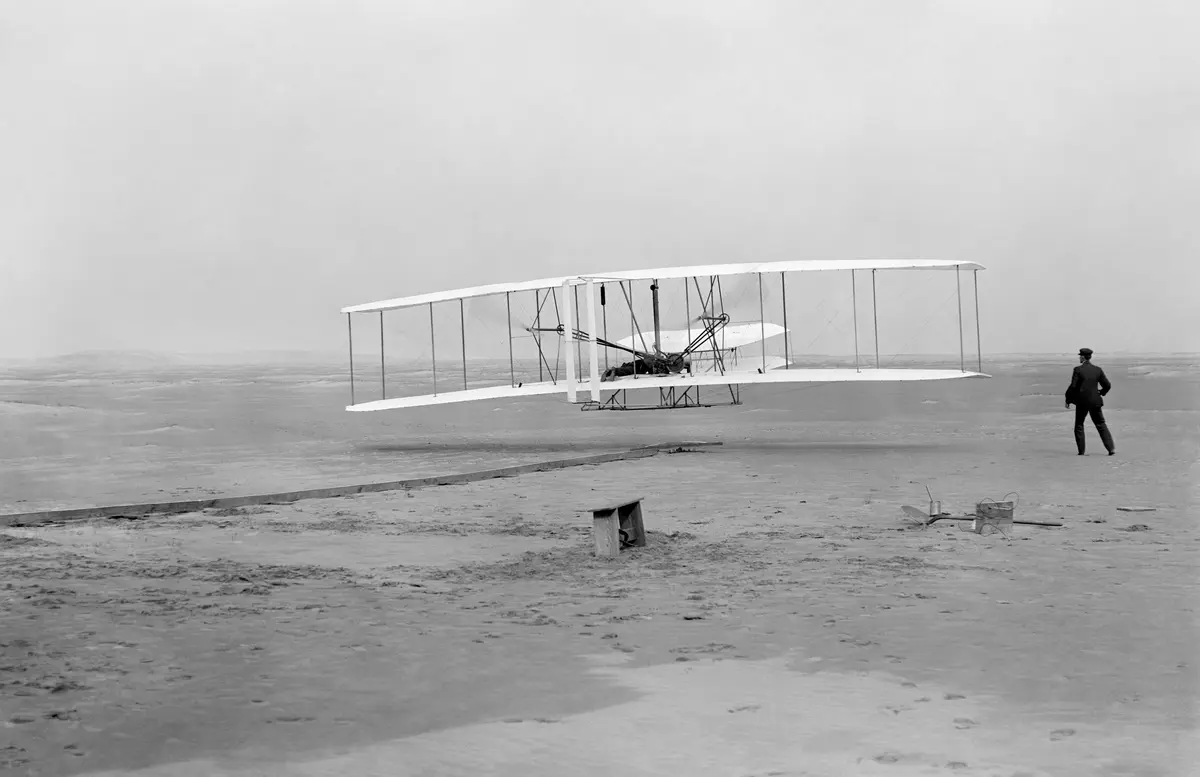
In late 1903, the Wrights assembled the Wright Flyer at their camp in Kitty Hawk, selected for its steady winds and soft sand landings. The aircraft was a biplane made of spruce wood and muslin cloth, with a wingspan of 12.3 meters, with the pilot lying prone on the lower wing next to the engine.
On the morning of December 17, in freezing winds, Orville took the controls. The Flyer rolled down a 60-foot launching rail and took off, remaining airborne for 12 seconds and traveling 120 feet before landing in the sand. It was the first controlled, powered, sustained flight. They conducted three more flights that day, with Wilbur making the final flight of 59 seconds, traveling 852 feet, proving the machine's capability.
From Kitty Hawk to the Moon in 66 Years
The speed of aviation progress following the Wrights' flight was unprecedented. In 1909, Louis Bleriot flew across the English Channel; by World War I, aircraft were used for aerial reconnaissance and combat. In 1927, Charles Lindbergh crossed the Atlantic solo; in 1939, Hans von Ohain and Frank Whittle developed the jet engine. In 1969—only sixty-six years after the 120-foot hop at Kitty Hawk—humanity landed on the Moon. Astronaut Neil Armstrong carried a piece of the original muslin cloth from the wing of the 1903 Wright Flyer inside his spacesuit, symbolizing the rapid journey from the dunes of North Carolina to the Sea of Tranquility.
Supersonic Flight and the Jet Age
The aviation age accelerated in the mid-20th century. Scribes and engineers developed the Jet Engine (pioneered independently by Frank Whittle in Britain and Hans von Ohain in Germany during the 1930s), which replaced propellers with gas turbines, allowing aircraft to fly faster and higher.
On October 14, 1947, the American pilot Chuck Yeager flew the rocket-powered Bell X-1, becoming the first human to break the sound barrier (flying faster than the speed of sound, Mach 1, at roughly 700 miles per hour) in controlled flight. Supersonic aviation compressed travel times, leading to the development of commercial passenger jets (such as the Boeing 707 and the supersonic Concorde) that connected continents in hours, transforming international travel and global logistics.
Civil Aviation and the Global Tourist Economy
The development of civil aviation in the post-World War II era transformed the global economy and society. The introduction of long-range passenger jets, such as the Boeing 707 in 1958, made international travel accessible to the public. This compressed travel times, allowing individuals to cross oceans in hours. The growth of civil aviation birthed the global tourist economy, which has become one of the world's largest industries, and enabled real-time international business coordination, proving that flight was the primary catalyst for modern globalization.
The Aerodynamics of Lift, Drag, and Thrust
The physics of heavier-than-air flight requires balancing four physical forces: lift, drag, thrust, and weight. Lift is generated by the wings, utilizing the Bernoulli principle and Newton's third law to create pressure differences. Drag is the resistance of the air against the aircraft's motion, while thrust is the forward force generated by the engine and propeller. For an aircraft to fly, lift must exceed weight, and thrust must exceed drag. Scribes and engineers note that the Wrights’ success relied on their ability to minimize drag and maximize lift through their wing designs, proving that aerodynamic optimization is essential for flight.
In summary, the historical and structural developments explored in this chronicle demonstrate that human progress is a collective, cumulative endeavor. No single technology, empire, law, or language arose in a vacuum; each milestone built directly upon the achievements, resources, and failures of the civilizations that came before it. By examining these complex connections, we can see how early hominids mastering fire initiated a chain of technological innovations that led to the steam engine, heavy industry, and the digital age. As humanity stands on the brink of interplanetary exploration and artificial superintelligence, understanding these historical precedents provides us with the perspective needed to navigate the ethical, social, and technological challenges of the future. The human odyssey remains an ongoing, choices-driven journey across space and time, shaping the destiny of our species and the universe.
Aerodynamic Physics: Lift, Drag, Thrust, and Weight
The achievement of controlled, heavier-than-air flight required a scientific understanding of the four primary forces of aerodynamics: lift, drag, thrust, and weight. Lift is the upward force generated by the wings as they move through the air. To generate lift, the Wright brothers utilized the Bernoulli principle and Newton's third law of motion. By designing a wing with a curved upper surface (camber), they forced the air to travel faster over the top of the wing than underneath, creating a low-pressure zone on top and a high-pressure zone below, lifting the aircraft.
To move forward, the aircraft must generate thrust to overcome drag—the aerodynamic resistance of the air against the structure. The Wrights solved this by designing highly efficient wooden propellers, which they treated as rotating wings that generated thrust horizontally. Finally, weight is the downward gravitational force that lift must overcome. The Wrights managed weight by using a lightweight spruce wood frame covered with canvas and building a custom 12-horsepower aluminum engine with the help of Charlie Taylor. By balancing these four forces, the Wrights transformed flight from a series of dangerous glides into a controllable, stable technology, laying the physics foundation for modern aviation.
The authentic photograph of the Wright Flyer's historic first powered flight at Kitty Hawk, North Carolina, on December 17, 1903.
Conclusion and Legacy
The Wright Brothers’ achievement at Kitty Hawk transformed human mobility, shrinking geographic distance and integrating the globe. By solving the physics of three-axis control, propeller thrust, and lightweight engine design, they converted the sky from a barrier into a highway, demonstrating that human engineering can overcome gravity and open new frontiers.
⚖️
Historian Debate: Were the Wright Brothers the First to Fly?
Controlled, Powered, Heavier-than-Air Flight
Aviation historians credit Wilbur and Orville Wright's Kitty Hawk flight in 1903 as the first successful, controlled, powered flight, due to their innovative three-axis control system.
European and Brazilian Rivals
Alternative claimants like Alberto Santos-Dumont (France/Brazil, 1906) or Gustav Whitehead (USA, 1901) are highlighted by critics who argue the Wrights' flight relied on a catapult launch rather than self-power.
Aviation transformed global transport, logistics, and military strategy within a single generation.
"The machine is lifting! It is flying! It is not a leap, it is a sustained flight in the air!"
— Orville Wright, Telegram to his father from Kitty Hawk, North Carolina (December 17, 1903).
Related Civilizations & Contexts
United StatesFrench RepublicGerman EmpireBritish Empire
Further Reading
The Wright Brothers — by David McCullough. A masterfully written biography of the brothers from Dayton and their struggles.
Santos-Dumont: Father of Aviation — by Henrique Lins de Barros. Presents the Brazilian perspective on the early history of flight.
📖 Scholar Mode Active — Click to exit focused reading
History Lab 🧪
Run simulated matches between civilizations and convert ancient currencies.
🕵️ Who Am I? (The Historical Guess Game)
A secret historical figure has been selected. Ask yes/no questions to narrow down the pool of candidates. Click any active card to make your accusation!
Secret Identity
❓ Who Am I?
Ask questions using the board below to narrow down my identity.
Ask a Question:
Question LogQuestions: 0 / 7
No questions asked yet.
Candidate Board:
🗺️ Timeline Scramble
Five historical events appear out of order. Click them in the correct chronological sequence — from oldest to most recent. How well do you know your history?
🏺 Relic or Fake?
Is this a real historical artifact or a convincing fabrication? Judge each one based on its description and era — then see the truth revealed!
Artifact 1 / 10Score: 0
Empire Matchup Simulator
Empire ATerritory Size (Peak, M km²)Empire B
00
Empire APopulation (Peak, Millions)Empire B
00
Empire AMilitary Power (Army Size)Empire B
00
Tactical Battle Analysis
Select empires and click simulate to run evaluations.
Historical Purchasing Power Converter
See what ancient coins are worth in modern terms and check their historical purchasing power.
Modern Value Equivalent
$0.00 USD
Historical Purchasing Power:
Select currency to view purchasing capability.
Historical Identity Generator
Forge an authentic historical identity from ancient civilisations, complete with linguistic meaning and biography.
Neutral
Gaius Julius
Meaning:Descendant of Jupiter
Historical Background:
A Roman citizen and clerk who worked in the forum under Roman republic rule.
Chrono-Cultural Fusion Simulator
Fuse the culture, technology, and governance of two legendary civilizations to synthesize a unique hybrid society.
Cohesion & Coexistence Rate
85%
🏛️ Hybrid Architecture
⚙️ Synthesized Asset
📜 Synthetic Governance
Historical Tactics & Trivia Quiz
Test your historical knowledge and battle tactics to claim your administrative rank.
8 Questions • Multi-Era
You will be presented with random scenarios and trivia spanning ancient Egypt, classical Rome, Islamic Golden Age, and the modern industrial era. Complete the evaluation to see your historical title!
Question 1 of 8Score: 0
What was the Code of Hammurabi written on?
Correct!
Evaluation Complete!
6 / 8
Correct
Rank Attained
Imperial Legionary
Your knowledge of classical strategy and administrative structures is respectable.
🎲 Counterfactual "What If?" Scenario Simulator
Explore alternative historical trajectories by tweaking key civilizational pivot points.
Simulated Shift
Selected Era
Prehistoric Era
Millions of years ago to ~3000 BCE
The dawn of humanity. From the evolutionary split of early hominids to the mastery of stone tools, fire, and the birth of language.
Landmark Milestones
Welcome to Historia
Enter your Scholar Name to synchronize your chronicles and save your journey.