From prehistoric origins to the modern era—discover the turning points, lost empires, and breakthroughs of world history through interactive timelines and visual guides.
Examine the tangible relics, physical tokens, and revolutionary machines that shaped civilizational growth.
🎥 VIDEO HUB & SHORTS
Watch visual summaries, site intros, and mini-documentaries chronicling 300,000 years of world history.
📊 HISTORICAL INFOGRAPHICS ARCHIVE
Museum-grade visual graphics, civilizational timelines, and architectural breakdowns curated for educators and history lovers.
THE HISTORIA CIRCLE
Join the collective discussion, study logs, and contributions of fellow historians mapping humanity's path.
Historia Forum Discussions
Start a Discussion Thread
THEMATIC PATHWAYS
Trace a single thread — disease, trade, energy, migration — across all eras and civilizations.
History is not just a sequence of events — it is a network of patterns. These thematic pathways allow you to follow a single concept across thousands of years: how agriculture spread, how warfare evolved, how trade routes shaped civilizations. Each pathway collects the most relevant chronicles across all eras.
🧩
How is this different from the sidebar Topics?
While the sidebar Topics (like Science & Tech or Empires) filter articles within your selected historical Era, Thematic Pathways cut horizontally across all eras (from Prehistoric to the Future). Use Themes to trace a single concept's evolutionary line across 300,000 years.
CIVILIZATION HUBS
Comprehensive profiles of the world's greatest civilizations and empires — from ancient cradles to global super-states.
Human Historia provides an academically rich exploration of the world's most influential civilizations. From the monumental achievements of ancient Egypt, Han China, and the Roman Empire, to the sophisticated societies of the Maya, the Islamic Caliphates, and West African empires, these hubs offer deep insights into the cultural, political, and technological legacies that continue to shape our global story.
EVOLUTION OF HUMAN SKILLS
Trace the compounding technologies, practical capabilities, and cognitive milestones of the human species.
Human progress is a story of compounding skills. Every breakthrough, from the spark of prehistoric fire to modern silicon transistors, builds directly on previous generations of ingenuity. Hover over a skill node to trace its historical prerequisites, and click it to explore its development timeline, species-wide impact, and related chronicles.
Prehistoric Ancient Medieval Modern Future
🧠
Select any skill node in the tree to explore its evolutionary path, development timeline, and historical impact.
ACADEMIC PASSPORT
Track your intellectual journey, quiz outcomes, and historical badges of honor.
HISTORIA PASSPORT⏳
👤Scribe Novice
Scholar NameHistoria Explorer
Rank RatingSumerian Record Scribe
Chronicles Read0 / 48
Study Guide Pins0 Guides
Security AccessLevel 1 (Novice)
Earned Badges of Honor
🔥
Fire Keeper
Unlock 3 prehistoric chronicles.
🏛️
Codex Keeper
Unlock 3 ancient chronicles.
🏰
Guild Master
Unlock 3 medieval chronicles.
⚙️
Steam Engineer
Unlock 3 modern chronicles.
🚀
Singularity Sage
Unlock 3 future chronicles.
👑
Grand Scholar
Score 5/5 on the Lab Quiz.
Recent Lab Activities
No recent activities recorded. Take a quiz or bookmark articles!
🏛️ MISSION & ARCHIVAL STANDARDS
About Human Historia
A visual encyclopedia and timeline of human history, dedicated to documenting 300,000 years of civilizational evolution through rigorous research, authentic artifacts, and visual clarity.
🌍
The 300,000-Year Story
Human Historia traces our collective journey across five historical epochs: Prehistory, Ancient Worlds, Middle Ages, Modern Age, and Future Horizons. From the first control of fire to quantum computation, we organize turning points into interconnected timelines.
📜
Historiographical Rigor
Every chronicle is built upon primary historical manifests, contemporary excavation reports, and peer-reviewed historical consensus. We prioritize authentic public domain artifacts and clearly identify scholarly debates surrounding major civilizational transitions.
🎨
Museum-Grade Visuals
Complex historical transitions demand visual understanding. We develop high-resolution infographics, architectural cutaways, and comparative territorial maps to transform abstract timelines into vivid, unforgettable learning experiences.
📖
Educational Access
Knowledge belongs to humanity. Human Historia is free, ad-light, and engineered as an educational resource for students, classroom educators, academic researchers, and curious minds across all continents.
Editorial Governance & Inquiries
We welcome peer reviews, academic corrections, museum archival collaborations, and educational partnerships. To submit historical inquiries or provide archival feedback, reach our editorial desk directly.
An immersive graphical anthology tracing the paths of civilizations, breakthroughs, and conflicts that forged the modern consciousness.
25Chronicles
Showing all articles
Feudalism vs Manorialism: Feudal Contract, Social Pyramid & Medieval Hierarchy
Written by Humanhistoria AdministrationHistorical Era: MEDIEVAL
In the wake of the collapse of the Carolingian Empire and the onset of devastating raids by Vikings, Magyars, and Saracens during the 9th and 10th centuries, Western Europe developed a decentralized system of governance and labor known as feudalism. Characterized by reciprocal legal and military obligations between the warrior nobility, feudalism organized society through personal oaths of vassalage and the granting of land grants (fiefs). At the local level, this political superstructure was supported by manorialism—an economic system where peasant serfs, bound to the soil, performed agricultural labor for a noble lord in exchange for physical protection and access to communal lands. While long presented in popular culture as a uniform, hierarchical pyramid of kings, lords, knights, and peasants, historical research reveals that "feudalism" was a highly chaotic, regionally diverse network of local customs, whose reality was defined by the systematic exploitation of serfs, the disenfranchisement of women, and constant private warfare.
🎯 Quick Historical Summary
What Was the Feudal System?
Feudalism was the dominant political, social, and economic system of medieval Europe from the 9th to 15th centuries. Kings granted land (fiefs) to noble vassals in exchange for military service and loyalty, while peasant serfs worked the land in exchange for physical protection and access to agricultural plots.
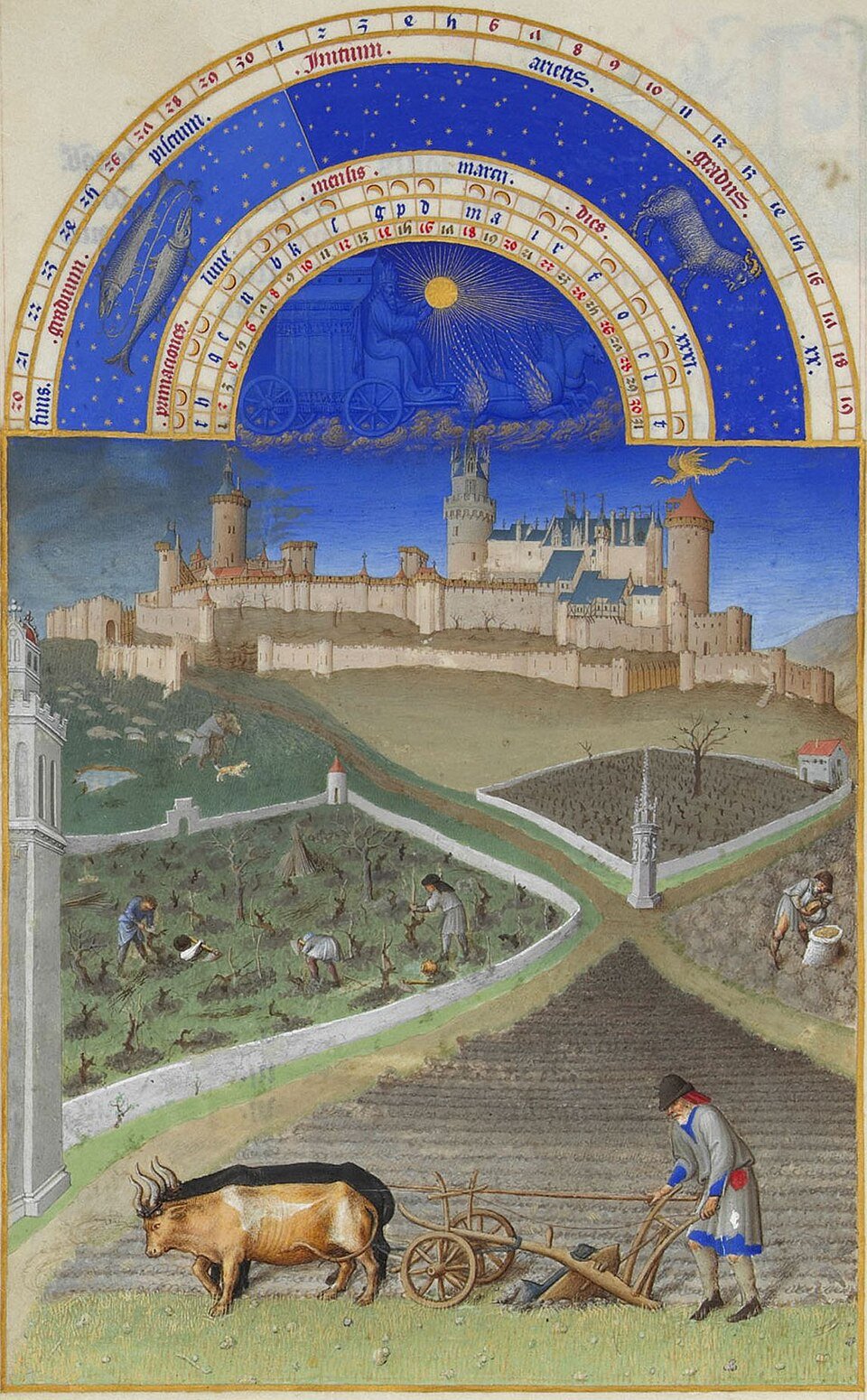
Archival visual record and historical depiction representing Feudalism vs Manorialism: Feudal Contract, Social Pyramid & Medieval Hierarchy.
The 4-Tier Medieval Feudal Hierarchy
1. Monarch (King / Queen) • Owned all realm land; granted vast fiefs to loyal lords.
Supreme Sovereign
2. Nobles & Barons (Lords) • Leased land from the king; supplied armored knights for war.
Aristocratic Vassals
3. Knights & Retainers • Professional armored cavalry; protected estates and fought in battle.
Military Vanguard
4. Peasants & Serfs • Bound to the soil (90% of population); farmed land and provided food.
Agrarian Engine
Feudalism vs Manorialism: What Is the Difference?
While frequently conflated, feudalism and manorialism (also termed the seigneurial system) represent two distinct yet complementary operational halves of medieval European civilization:
System Feature
Feudalism (Political & Military Hierarchy)
Manorialism (Economic & Agricultural Production)
Core Focus
Decentralized governance, knightly military allegiance, and territorial sovereignty.
Agrarian estate production, labor dues, and self-sufficient manor organization.
Social Participants
The warrior aristocracy: Kings, Dukes, Barons, and Vassal Knights.
The agrarian working class: The Lord of the Manor and Peasant Serfs.
Primary Exchange
The lord grants a fief (estate) in return for military combat service (typically 40 days/year) and political counsel.
The lord provides physical defense and court justice in return for unpaid labor on the demesne and agricultural tithes.
Legal Foundation
A voluntary, honorable contract sworn through public religious ceremonies of homage and fealty.
Hereditary legal bondage: serfs were legally bound to the soil (glebae adscripti) under manorial court jurisdiction.
Freedom & Mobility
Vassals were free noblemen who could hold multiple fiefs and enter contracts.
Serfs were unfree laborers who could not leave, marry, or change trades without the lord's permission and payment of fines.
What Was the Feudal System? Post-Carolingian Origins and Hierarchy
The rise of feudal institutions was triggered by the disintegration of central authority. Charlemagne had briefly unified Western Europe under the Carolingian Empire in 800 CE, but following the death of his son Louis the Pious, the empire was partitioned among his three grandsons by the Treaty of Verdun in 843 CE. This division weakened royal authority, leaving local regions unable to defend themselves against sudden, highly mobile foreign invaders: Viking longships raiding rivers, Magyar horsemen invading from the east, and Saracen pirates raiding Mediterranean coasts.
Faced with this threat, local landowners did not wait for the king's slow-moving armies. They constructed defensive earthwork-and-timber castles (motte-and-bailey) and mobilized their own private guards. Political authority fragmented, shifting from the royal court to local lords who held monopoly power over their immediate territories. In this environment, personal relationships of dependency replaced state institutions, establishing the legal framework of vassalage.
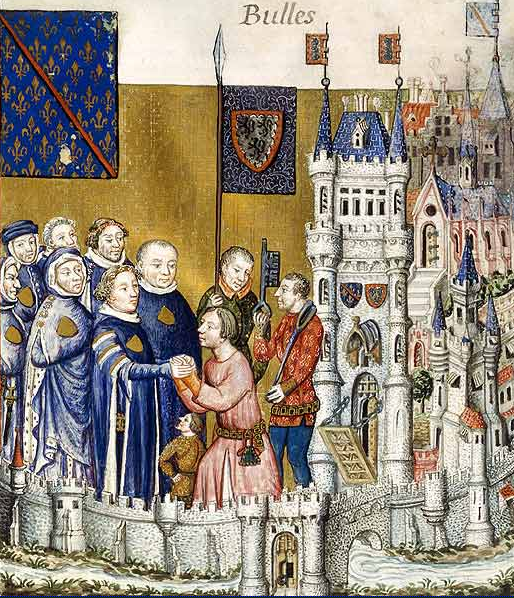
Miniature from the cartulary of Clermont-en-Beauvaisis showing a vassal performing the act of homage to his lord. .
The Feudal Contract: Homage, Fealty, Fiefs, and Mutual Obligations
What was the feudal contract? At its core, the feudal contract was an unwritten, reciprocal agreement between a lord and his vassal. In an age devoid of standing armies and centralized police, a king or great noble granted a fief (income-producing land with attached peasant labor) to a lesser noble in exchange for a binding military oath. The vassal pledged to supply armed knights for defense (the right to feudal allegiance or service), provide hospitality to the lord, and attend the lord's court to render legal counsel. In turn, the lord swore to defend the vassal from foreign aggression and ensure impartial justice.
Feudalism emerged because of a lack of centralized administrative machinery and a cash economy. Medieval kings and dukes could not pay salaries to bureaucrats or standing soldiers because currency was scarce and trade was localized. Instead, they paid their supporters in land, granting them a fief (a manor or collection of manors) in exchange for military service, usually forty days a year as a heavy armored cavalryman (knight). This transaction was formalized through the ceremony of homage and fealty.
In this ceremony, the vassal knelt before his lord, placed his hands between the lord's hands, and swore a solemn oath on holy relics to be the lord's man (homo). The lord then raised the vassal and gave him a ceremonial object—a ring, a staff, or a clod of earth—representing the investiture of the fief. This contract created a web of mutual obligations: the lord promised protection and justice, while the vassal promised military aid and counsel. However, this system was prone to extreme conflict: vassals frequently swore oaths to multiple lords, leading to complex legal disputes when those lords went to war with each other.
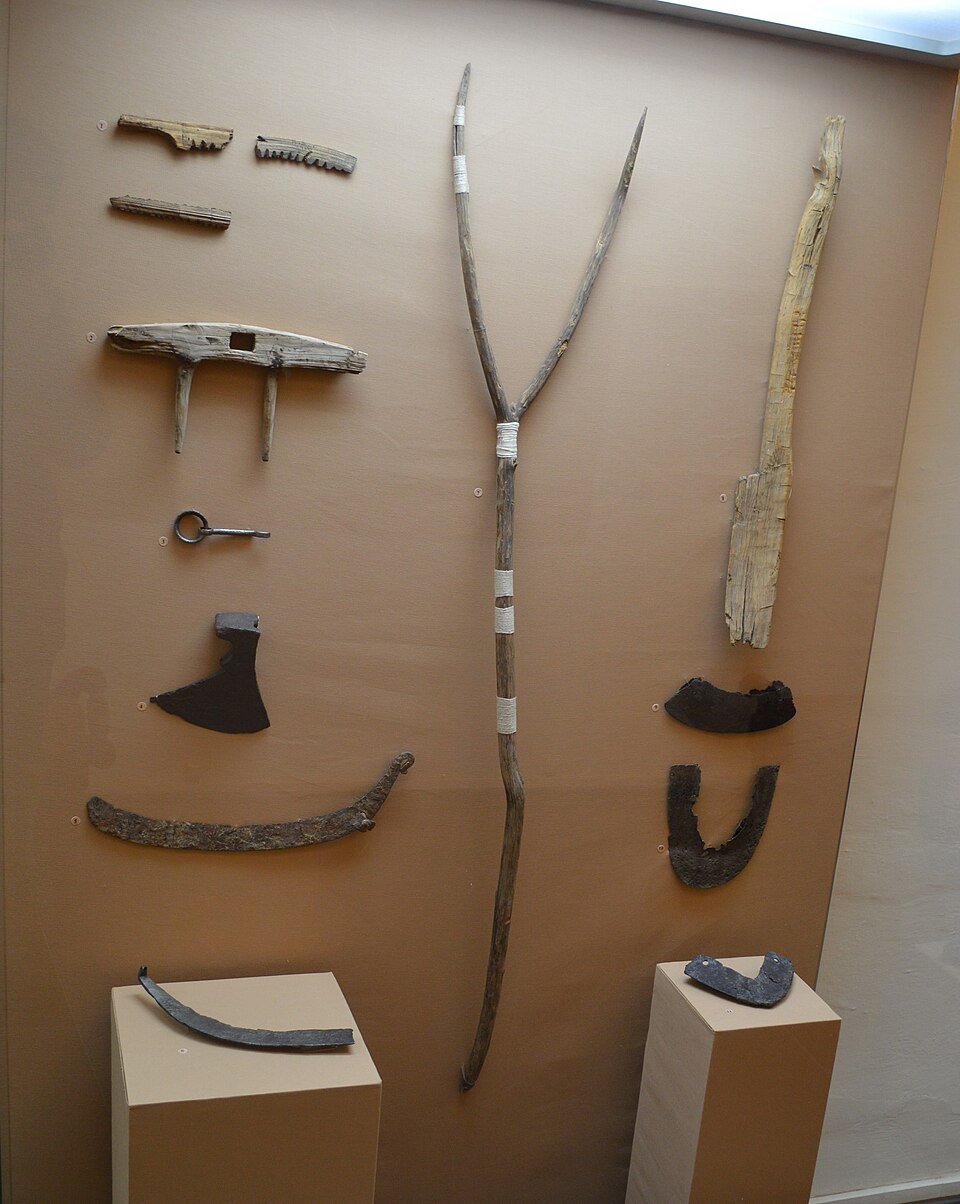
A collection of medieval iron agricultural artifacts (10th-14th centuries) showing peasant farming tools. (Rostov Kremlin Museum)
Key Development: The Manorial Economy and Serfdom
While feudalism describes the political relationships among the nobility, manorialism describes the economic relationship between the lord and the peasantry. The agricultural engine of the manor was the serf (or villein). Serfs were not slaves; they could not be bought or sold away from the land, they could own personal property, and their families had traditional rights to cultivate specific plots of land. However, serfs were not free. They were legally bound to the manor; they could not leave, marry, or change their occupation without the lord's permission and the payment of a fine.
Serfs worked under a coercive system of labor duties. They had to work the lord's personal fields (the demesne) for several days a week, harvest the lord's crops first, and pay taxes in kind (grain, chickens, or pigs). Serfs were also forced to use the lord's mill, oven, and winepress, paying a fee (banality) for each use. If a serf died, their heir had to pay a "heriot" tax—often the family's best beast—to inherit the tenancy. This system concentrated the agricultural surplus in the hands of the nobility, financing their armor, horses, and castles, while keeping the peasantry at a near-subsistence level.
843 CE — Treaty of Verdun divides the Carolingian Empire, accelerating political fragmentation
911 CE — King Charles the Simple grants Normandy to the Viking leader Rollo, formalizing a defensive fief
1066 CE — William the Conqueror invades England, introducing a highly centralized Norman feudal system
1127 CE — Galbert of Bruges records the murder of Charles the Good, providing a detailed description of homage ceremonies
1347 CE – 1351 CE — The Black Death decimates Europe's population, leading to a labor shortage that undermines serfdom
1381 CE — The Peasants' Revolt in England; peasants burn manor rolls and demand the end of serfdom
1789 CE — The French National Assembly officially abolishes the feudal system during the French Revolution
Medieval Women: Noble Managers and Peasant Laborers
The status of women in feudal society was defined by their subordination to male relatives, as they could not hold public office or sit in courts. However, they played critical economic roles. Peasant women worked the fields alongside men, managed household gardens, spun wool, and brewed ale. In the noble class, when lords went to war or on crusade, noblewomen took direct control of the castle's administration, commanding garrisons, defending against sieges, and managing the estate's finances. The convent served as the primary alternative for women seeking intellectual autonomy, allowing figures like Hildegard of Bingen to become major scholars, composers, and advisors to kings.
Social & Human Effects: Regional Variety and Peasant Resistance
Feudalism was not a uniform system; its character varied dramatically by region. In southern France and Italy, many lands remained "allodial" (owned outright without vassalage obligations), and Roman law persisted, maintaining a cash economy and urban merchant class. In northern France, England, and western Germany, classical feudal structures were dominant. In Eastern Europe, serfdom did not become widespread until the late medieval and early modern periods (the "Second Serfdom"), when lords in Poland and Russia legally bound peasants to the soil to secure grain exports to Western Europe, a system that persisted in Russia until 1861.
Peasants did not accept their exploitation passively. While open rebellion was rare due to the military monopoly of the armored knights, peasants practiced daily forms of resistance: working slowly, poaching the lord's deer in the royal forests, hiding grain during tax collections, and appealing to the royal courts to protect their traditional rights against the lord's innovations. The Black Death (1347–1351), which killed a third of Europe's population, transformed the economy: the sudden shortage of labor allowed peasants to demand cash wages and lower rents, eventually leading to the decline of serfdom in Western Europe as manors converted to cash-based tenancy.
Economic Consequences: The Three-Field System and Self-Sufficiency
The economic focus of the manor was self-sufficiency. Because roads were poor and local lords levied tolls on every merchant crossing their territory, trade was limited to essential luxuries (salt and iron). The agricultural economy was stabilized by the three-field system of crop rotation. In this system, land was split into three fields: one planted with winter crops (wheat or rye), one with spring crops (barley, peas, or oats), and one left fallow to recover nutrients. This method increased crop yields by 16% and reduced the risk of famine, supporting a steady demographic expansion between 1000 and 1300 CE.
This demographic growth stimulated the revival of towns. Surplus peasants fled to cities, where they could gain freedom (expressed in the German proverb Stadtluft macht frei—"town air makes you free," meaning a serf who lived in a town for a year and a day without being claimed by a lord became legally free). Towns became centers of guild production and international trade fairs, creating a new commercial middle class (the bourgeoisie) that gradually challenged the political monopoly of the feudal nobility.
⚖️
Historian Debate: Did Feudalism Actually Exist?
The Socio-Economic Model
Social historians like Marc Bloch, in his classic Feudal Society (1939), argue that "feudalism" is a valid and useful term. Bloch defined it as a total social system characterized by a peasant class bound to the soil, a warrior class dominating the state, and a fragmented authority that allowed local personal ties to substitute for public institutions, arguing that this model captures the structural reality of medieval Europe.
The Legal Construct Critique
Conversely, revisionist historians like Elizabeth A.R. Brown and Susan Reynolds argue that "feudalism" is an artificial legal construct invented by 17th-century lawyers. They assert that the word does not appear in medieval documents and that the neat hierarchy of fiefs and vassals is a fiction that ignores the chaotic reality of medieval land ownership, where most transactions were resolved through pragmatism rather than formal vassal contracts.
Scholars such as Marc Bloch and Susan Reynolds have shaped this debate through works like Bloch's Feudal Society and Reynolds's Fiefs and Vassals: The Medieval Evidence Reinterpreted (1994).
"He did homage in this way: the count asked him if he wished to become his man without reserve, and he answered: 'I wish it.' Then, with his hands joined between the hands of the count, they bound themselves together by a kiss. Next, the count gave him investiture of the fief by a wand which he held in his hand, promising security and justice."
— Galbert of Bruges, The Murder of Charles the Good (1127). This detailed description of the homage ceremony of the vassals of Flanders is one of the few surviving contemporary witness accounts of feudal ritual.
Is Feudalism Centralized or Decentralized?
Historians characterize classical European feudalism as fundamentally decentralized. Following the collapse of the Western Roman Empire and the fragmentation of Charlemagne's Carolingian state after the Treaty of Verdun (843 CE), monarchs lacked the tax revenues, bureaucratic networks, and logistical infrastructure to enforce imperial authority across vast territories.
Power fractured into thousands of localized, semi-autonomous domains. Local dukes, counts, and castellans minted their own currencies, collected road tolls, levied private armies, and presided over independent courts. While kings claimed sovereign dominion, they were often weaker in practical military force than their own wealthiest vassals. Only with the introduction of gunpowder, standing mercenary armies, and the growth of commercial cash economies in the late Middle Ages did power begin centralizing back into sovereign monarchies.
Serfs vs Vassals: Are Vassals and Knights the Same Thing?
To understand the medieval social hierarchy, one must distinguish between the legal ranks of vassals, knights, and serfs:
Vassal vs. Serf: A vassal was a free nobleman who swore allegiance to a higher lord; a serf was an unfree peasant laborer tied to a manorial estate. Vassals fought for honor, land, and status; serfs farmed the land to survive and pay mandatory feudal dues.
Are Vassals and Knights the Same Thing? While closely related, they are not identical. A knight was an armored professional cavalry warrior who had achieved chivalric military knighthood. A vassal was anyone who held a fief from a superior lord. All vassal warriors who held knight's fees were knights, but a great duke was also a vassal to the king without being a mere foot soldier, and impoverished knights who held no personal land were retainers rather than landed vassals.
Who Benefited the Most From Feudalism? The high nobility (monarchs, dukes, barons) and the ecclesiastical prince-bishops benefited overwhelmingly, extracting agricultural surpluses and labor without engaging in physical manual labor.
Long-Term Legacy
The institutional legacy of the feudal era shaped the political and legal systems of modern Europe. The contract-based nature of vassalage—where a ruler's authority was dependent on their compliance with a legal agreement—paved the way for constitutional monarchy and representative government. The most famous example is the Magna Carta (1215), in which English barons forced King John to sign a treaty guaranteeing their traditional feudal rights, establishing the principle that the king is not above the law.
Furthermore, the feudal divisions of land and local jurisdictions evolved into modern European property law and county administrations, while the chivalric myth of the noble knight and courtly love continues to influence Western literature, film, and popular culture. Comparative historians also use the European feudal experience as a model to analyze decentralized military regimes in other cultures, most notably the Kamakura and Tokugawa Shogunates of Japan, demonstrating the universal dynamics of state fragmentation and personal dependency in pre-industrial societies.
Related Civilizations & Contexts
Carolingian EmpireKamakura Shogunate JapanByzantine Empire (Pronoia)Holy Roman EmpireMali Empire (Tributary States)Roman Latifundia estatesSassanian Persian MarzbansNorman Kingdom of Sicily
Further Reading
Marc Bloch — Feudal Society (1939). The classic sociological and historical study that defined the concept of the feudal system in Western Europe.
Susan Reynolds — Fiefs and Vassals: The Medieval Evidence Reinterpreted (1994). A major revisionist study challenging the traditional legal definitions of feudalism.
Georges Duby — The Three Orders: Feudal Society Imagined (1978). An influential analysis of how medieval thinkers categorized society into those who pray, those who fight, and those who work.
Elizabeth A.R. Brown — The Tyranny of a Construct: The Feudalism Myth (1974). A seminal article that initiated the modern historical critique of the term feudalism.
Henri Pirenne — Medieval Cities: Their Origins and the Revival of Trade (1925). Explores the economic decline of the early Middle Ages and the rise of towns that eventually undermined feudalism.
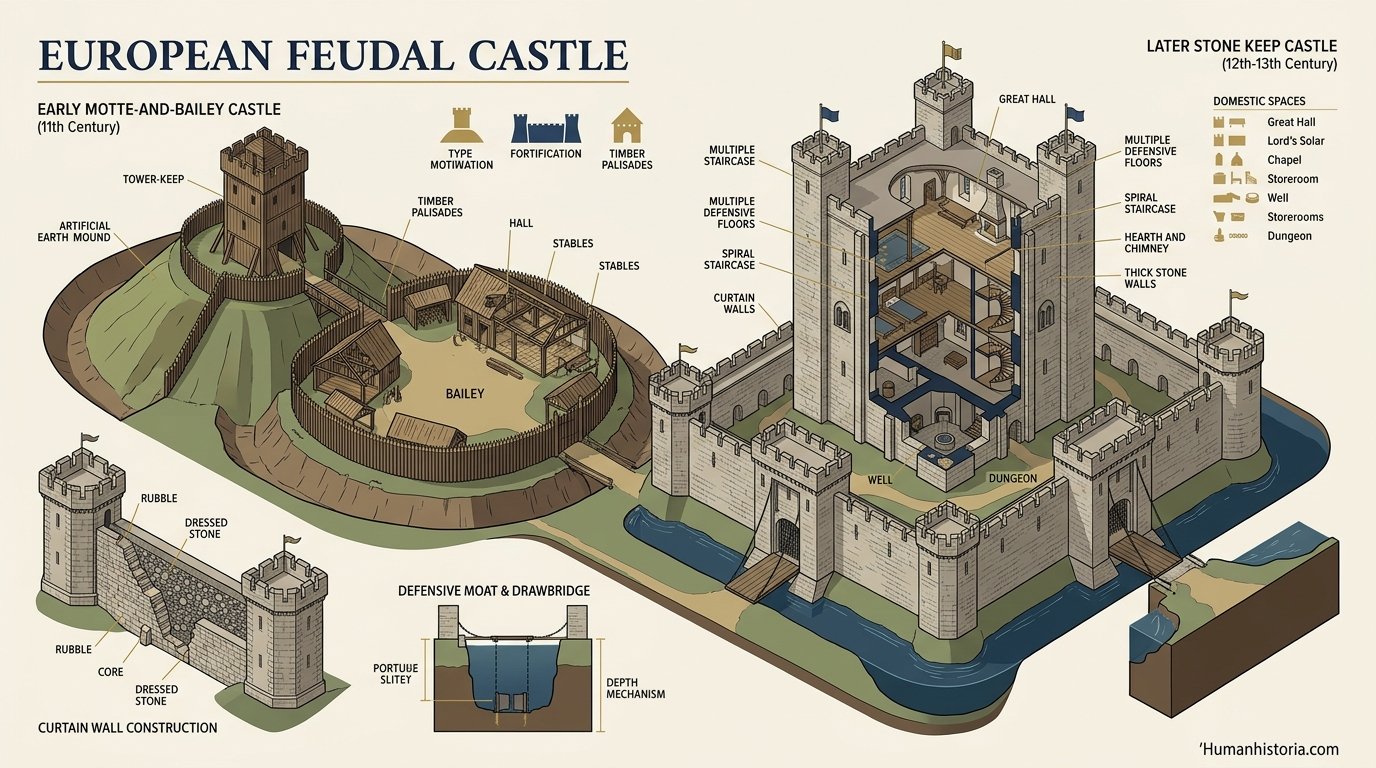
📊 Museum-Grade Infographic Poster
Feudal Europe Pyramid & European Castle Fortifications
💡 Click anywhere on poster to expand in high resolution🔎 Expand Lightbox
Visual analysis of medieval European feudalism, the 4-tier social pyramid (King, Nobles, Knights, Serfs), and the architectural evolution of feudal motte-and-bailey fortifications into stone keeps.
📖 SCHOLARLY INQUIRIES
Frequently Asked Questions
Essential historical questions and evidence-based answers concerning this chronicle.
Q.Why did feudalism decline in Europe?
Feudalism declined due to the Black Death (which caused severe labor shortages and empowered peasants to demand wages), the rise of centralized monarchies, and the transition to a money-based economy.
Q.What was the difference between a serf and a slave?
Serfs were not personal chattel property and could not be bought or sold individually; they were legally bound to the land manor and owed labor service to their lord.
Q.What did Magna Carta achieve in 1215?
Magna Carta forced King John to respect feudal customs, protected barons against illegal imprisonment, and established that the monarch was subject to the law.
Q.What ended feudalism in Europe?
The Black Death (1347–1351) created acute labor shortages, allowing surviving peasants to demand cash wages and buy their freedom, weakening manorial bonds.
📚 Academic Sources & Scholarly Bibliography
Bloch, M. (1961).
Feudal Society.
University of Chicago Press.
Ganshof, F.L. (1964).
Feudalism.
Harper & Row.
Holt, J.C. (1992).
Magna Carta.
Cambridge University Press.
📖 Scholar Mode Active — Click to exit focused reading
History Lab 🧪
Interactive historical deduction games, tactical matchup simulators, and currency calculators.
🕵️ Who Am I? (The Historical Guess Game)
A secret historical figure has been selected. Ask yes/no questions to narrow down the pool of candidates. Click any active card to make your accusation!
Secret Identity
❓ Who Am I?
Ask questions using the board below to narrow down my identity.
Ask a Question:
Question LogQuestions: 0 / 7
No questions asked yet.
Candidate Board:
🗺️ Timeline Scramble
Five historical events appear out of order. Click them in the correct chronological sequence — from oldest to most recent. How well do you know your history?
🏺 Relic or Fake?
Is this a real historical artifact or a convincing fabrication? Judge each one based on its description and era — then see the truth revealed!
Artifact 1 / 10Score: 0
Empire Matchup Simulator
Empire ATerritory Size (Peak, M km²)Empire B
00
Empire APopulation (Peak, Millions)Empire B
00
Empire AMilitary Power (Army Size)Empire B
00
Tactical Battle Analysis
Select empires and click simulate to run evaluations.
Historical Purchasing Power Converter
See what ancient coins are worth in modern terms and check their historical purchasing power.
Modern Value Equivalent
$0.00 USD
Historical Purchasing Power:
Select currency to view purchasing capability.
Historical Identity Generator
Forge an authentic historical identity from ancient civilisations, complete with linguistic meaning and biography.
Neutral
Gaius Julius
Meaning:Descendant of Jupiter
Historical Background:
A Roman citizen and clerk who worked in the forum under Roman republic rule.
Chrono-Cultural Fusion Simulator
Fuse the culture, technology, and governance of two legendary civilizations to synthesize a unique hybrid society.
Cohesion & Coexistence Rate
85%
🏛️ Hybrid Architecture
⚙️ Synthesized Asset
📜 Synthetic Governance
Historical Tactics & Trivia Quiz
Test your historical knowledge and battle tactics to claim your administrative rank.
8 Questions • Multi-Era
You will be presented with random scenarios and trivia spanning ancient Egypt, classical Rome, Islamic Golden Age, and the modern industrial era. Complete the evaluation to see your historical title!
Question 1 of 8Score: 0
What was the Code of Hammurabi written on?
Correct!
Evaluation Complete!
6 / 8
Correct
Rank Attained
Imperial Legionary
Your knowledge of classical strategy and administrative structures is respectable.
🎲 Counterfactual "What If?" Scenario Simulator
Explore alternative historical trajectories by tweaking key civilizational pivot points.
Simulated Shift
Selected Era
Prehistoric Era
Millions of years ago to ~3000 BCE
The dawn of humanity. From the evolutionary split of early hominids to the mastery of stone tools, fire, and the birth of language.
Landmark Milestones
Welcome to Historia
Enter your Scholar Name to synchronize your chronicles and save your journey.
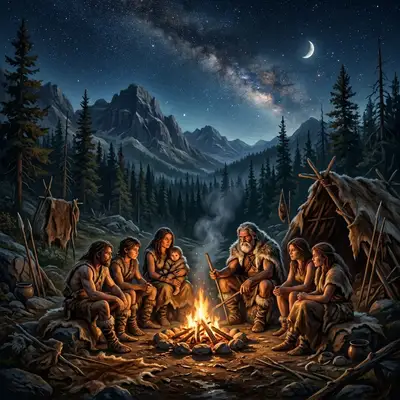
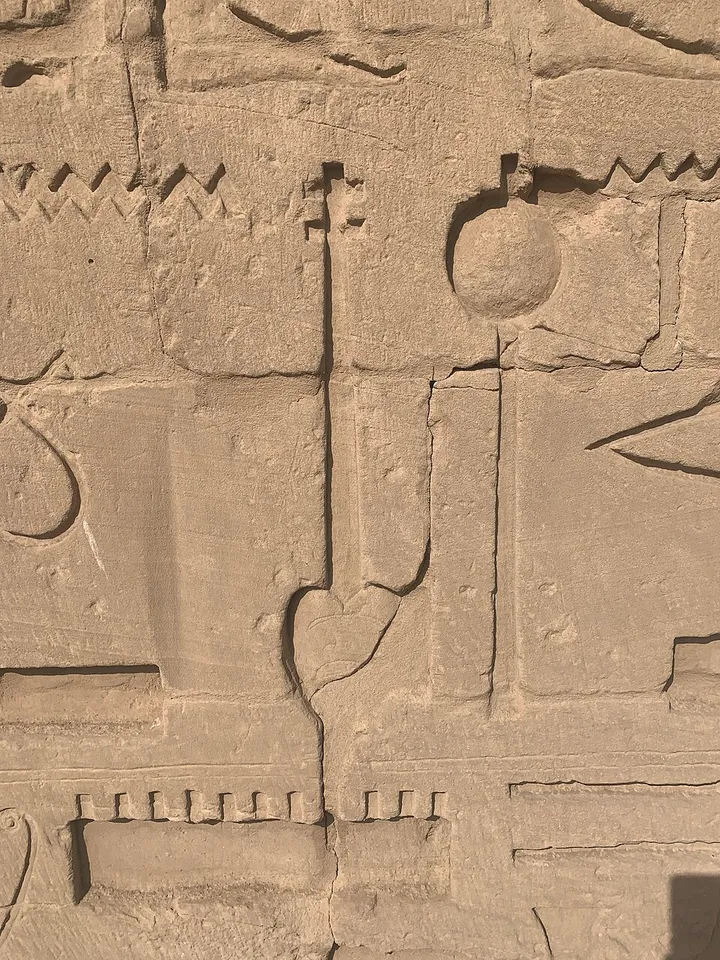
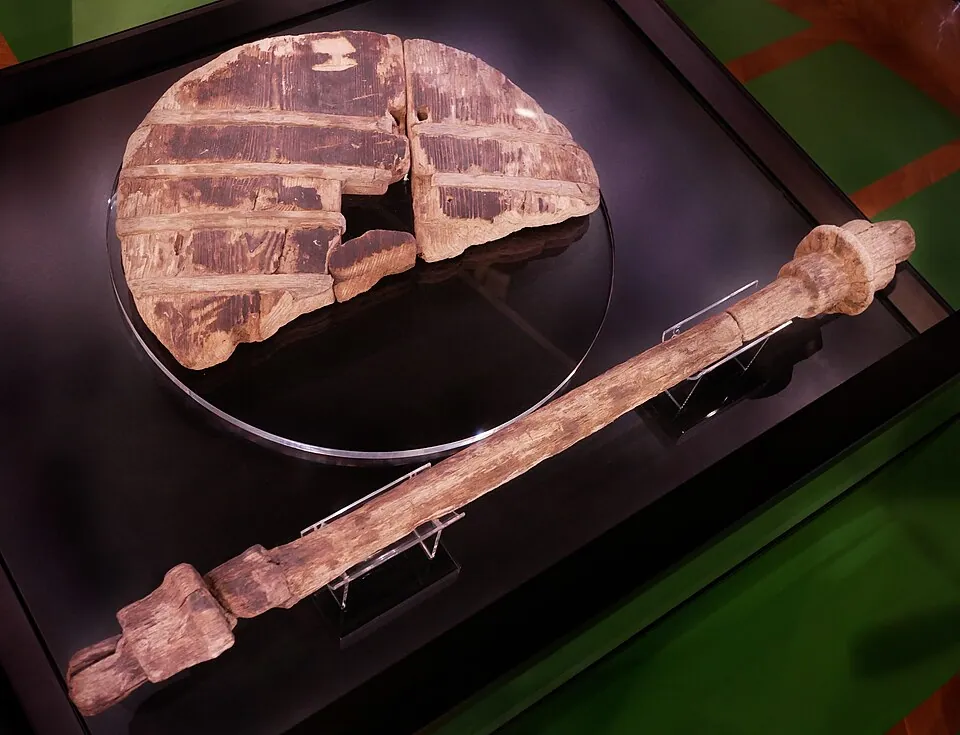 ⭐ Featured Chronicle

 ANCIENT AGES
 ANCIENT AGES
 ANCIENT AGES
 MEDIEVAL PERIOD
 MEDIEVAL PERIOD
 PREHISTORIC ERA