~7,000 Years from farming to writing
๐Ÿ›๏ธ

Ancient Ages

c. 3,200 BCE โ€” 500 CE ยท Empires, Laws & Philosophy
~400 Years from Roman fall to medieval rebirth
๐Ÿฐ

Medieval Period

c. 500 CE โ€” 1500 CE ยท Empires of Faith, Trade & Castles
~50 Years from printing press to Scientific Revolution
โš™๏ธ

Modern Age

c. 1450 CE โ€” 2000 CE ยท Revolutions, Industry & Discovery
~50 Years from computers to quantum age

THE ARTIFACT GALLERY

Examine the tangible relics, physical tokens, and revolutionary machines that shaped civilizational growth.

๐ŸŽฅ VIDEO HUB & SHORTS

Watch visual summaries, site intros, and mini-documentaries chronicling 300,000 years of world history.

๐Ÿ“Š HISTORICAL INFOGRAPHICS ARCHIVE

Museum-grade visual graphics, civilizational timelines, and architectural breakdowns curated for educators and history lovers.

THE HISTORIA CIRCLE

Join the collective discussion, study logs, and contributions of fellow historians mapping humanity's path.

Historia Forum Discussions

Start a Discussion Thread

THEMATIC PATHWAYS

Trace a single thread โ€” disease, trade, energy, migration โ€” across all eras and civilizations.

History is not just a sequence of events โ€” it is a network of patterns. These thematic pathways allow you to follow a single concept across thousands of years: how agriculture spread, how warfare evolved, how trade routes shaped civilizations. Each pathway collects the most relevant chronicles across all eras.

๐Ÿงฉ
How is this different from the sidebar Topics?
While the sidebar Topics (like Science & Tech or Empires) filter articles within your selected historical Era, Thematic Pathways cut horizontally across all eras (from Prehistoric to the Future). Use Themes to trace a single concept's evolutionary line across 300,000 years.

CIVILIZATION HUBS

Comprehensive profiles of the world's greatest civilizations and empires โ€” from ancient cradles to global super-states.

Human Historia provides an academically rich exploration of the world's most influential civilizations. From the monumental achievements of ancient Egypt, Han China, and the Roman Empire, to the sophisticated societies of the Maya, the Islamic Caliphates, and West African empires, these hubs offer deep insights into the cultural, political, and technological legacies that continue to shape our global story.

EVOLUTION OF HUMAN SKILLS

Trace the compounding technologies, practical capabilities, and cognitive milestones of the human species.

Human progress is a story of compounding skills. Every breakthrough, from the spark of prehistoric fire to modern silicon transistors, builds directly on previous generations of ingenuity. Hover over a skill node to trace its historical prerequisites, and click it to explore its development timeline, species-wide impact, and related chronicles.

Prehistoric Ancient Medieval Modern Future
๐Ÿง 

Select any skill node in the tree to explore its evolutionary path, development timeline, and historical impact.

ACADEMIC PASSPORT

Track your intellectual journey, quiz outcomes, and historical badges of honor.
HISTORIA PASSPORT โณ
๐Ÿ‘ค Scribe Novice
Scholar Name Historia Explorer
Rank Rating Sumerian Record Scribe
Chronicles Read 0 / 48
Study Guide Pins 0 Guides
Security Access Level 1 (Novice)

Earned Badges of Honor

๐Ÿ”ฅ
Fire Keeper
Unlock 3 prehistoric chronicles.
๐Ÿ›๏ธ
Codex Keeper
Unlock 3 ancient chronicles.
๐Ÿฐ
Guild Master
Unlock 3 medieval chronicles.
โš™๏ธ
Steam Engineer
Unlock 3 modern chronicles.
๐Ÿš€
Singularity Sage
Unlock 3 future chronicles.
๐Ÿ‘‘
Grand Scholar
Score 5/5 on the Lab Quiz.

Recent Lab Activities

No recent activities recorded. Take a quiz or bookmark articles!
Curated Exhibition

Human Historia

An immersive graphical anthology tracing the paths of civilizations, breakthroughs, and conflicts that forged the modern consciousness.

25Chronicles
Showing all articles

Mastery of Fire: Early Hominids, Cooked Food & Brain Development

Written by Historia Science Historical Era: PREHISTORIC
* Note: Cover image is an AI-generated historical illustration.

๐Ÿง Key Chronicle Takeaway (Atomic Summary)

The biochemical and cognitive leap triggered by humanity's control over fire.

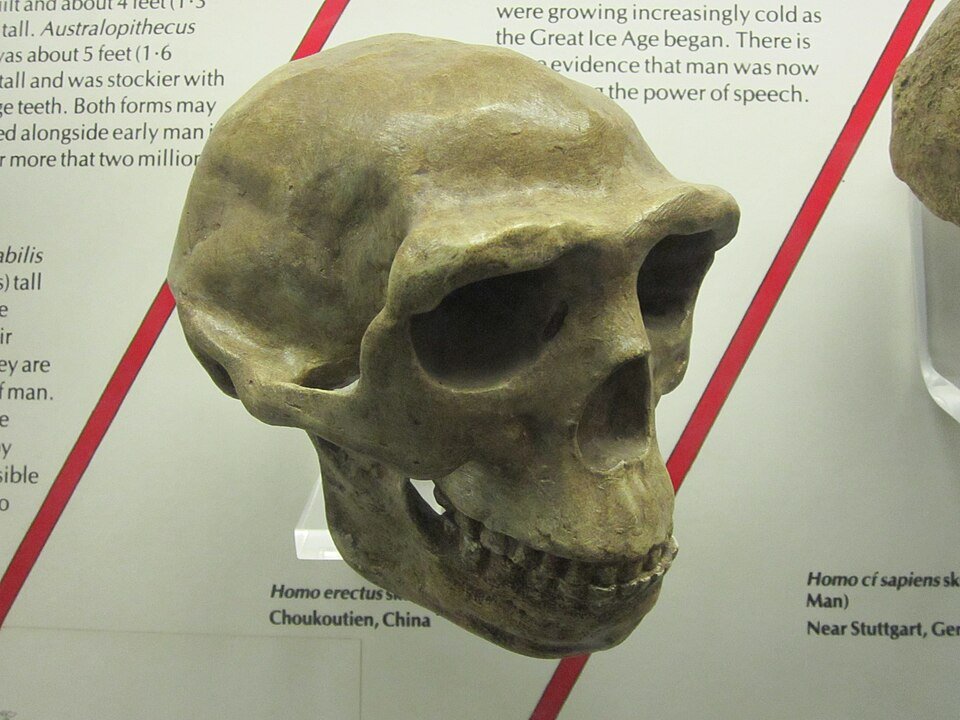
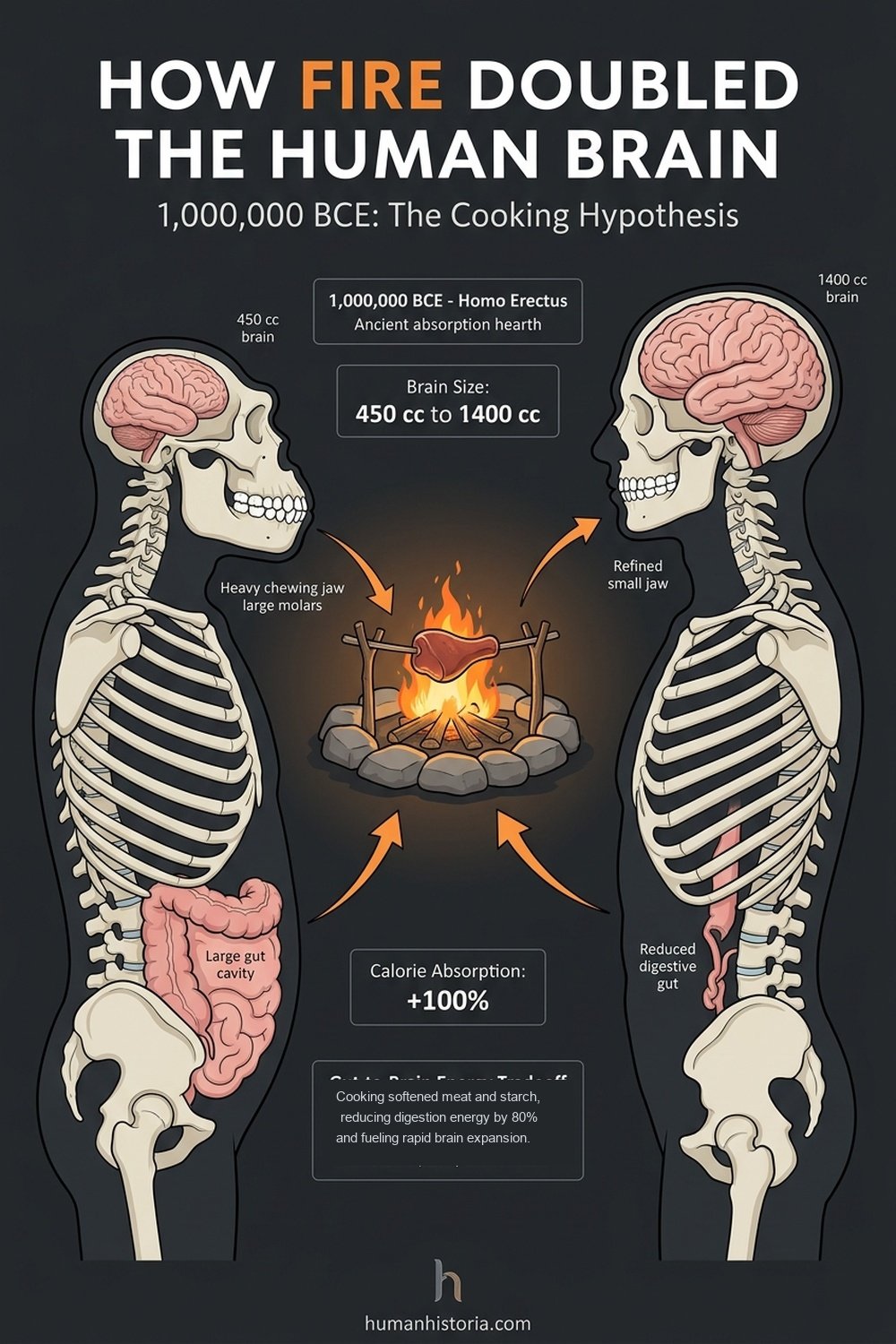
Approximately one million years ago, early hominidsโ€”most likely Homo erectusโ€”mastered the control of fire. This mastery represents the first energy revolution in human history, marking the moment hominids broke free from the constraints of their biological energy envelopes. By learning to preserve, transport, and eventually ignite combustion, hominids gained control over a source of external chemical energy that provided heat, light, protection, and toolmaking power. Crucially, the mastery of fire enabled the cooking of food, which pre-digested proteins and starches, triggering a profound metabolic shift: a dramatic reduction in the size of the human digestive tract and a corresponding expansion of the human brain. The campfire became the physical and social center of the early human band, extending the waking hours, restructuring social groups, and fostering the development of language, culture, and collaborative storytelling that set humanity on its distinct evolutionary path.

Historical Context: The Paleolithic Hearth

Before the mastery of fire, early hominids were evolutionary primates, subject to the same ecological constraints as other animals. They had to consume raw vegetation and raw meat, which required massive jaws, large teeth, and a long, energy-intensive digestive tract to break down tough plant fibers and raw flesh. They were also vulnerable to nocturnal predators, meaning they had to sleep in trees for safety, limiting their geographic mobility and social complexity.

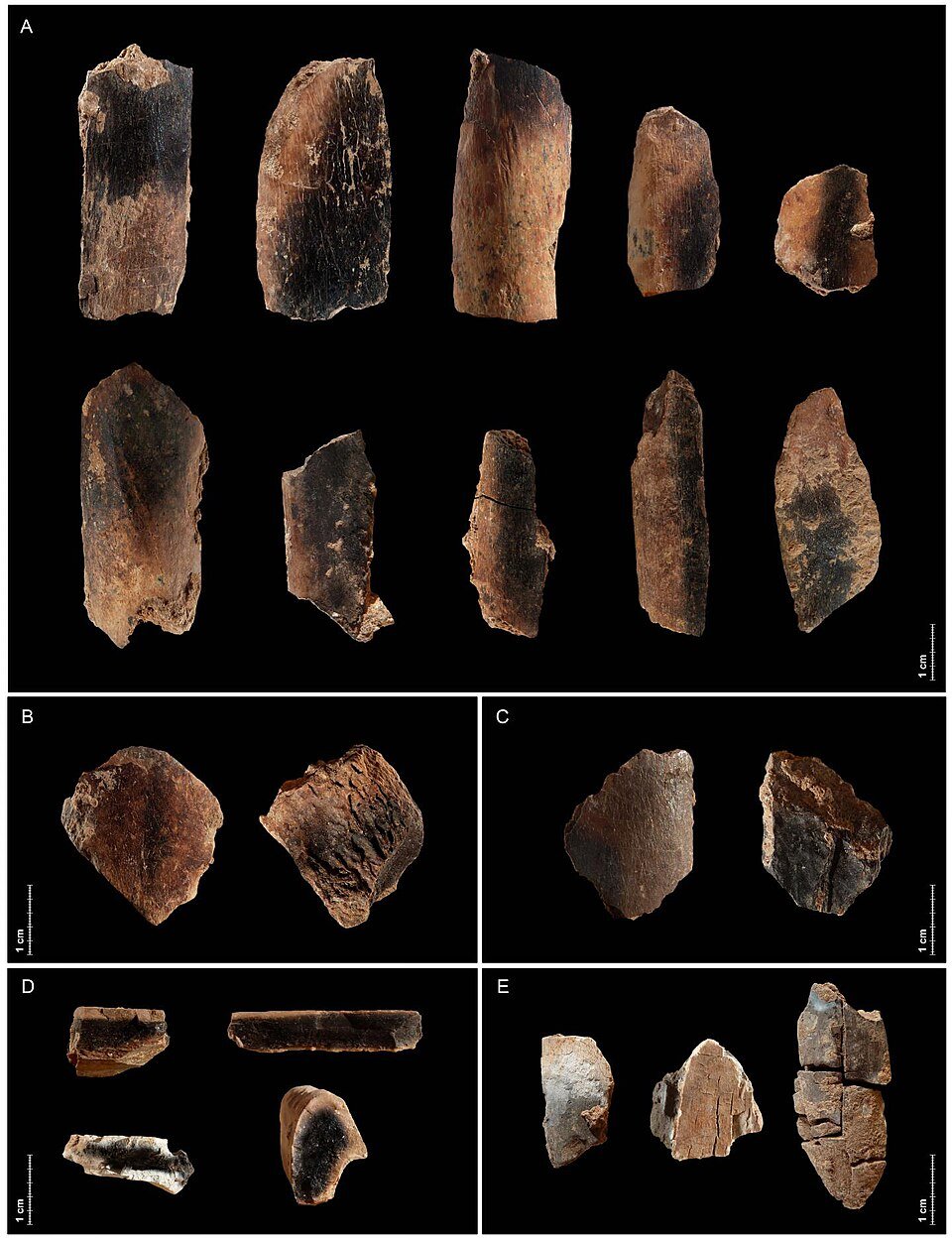
The transition to controlled fire was a slow, multi-stage process. Hominids first encountered fire from natural sources, such as lightning strikes or volcanic activity. They learned to overcome their natural fear of fire, observing that wild fires left behind cooked animal carcasses that were tender and easy to eat. Hominids began capturing embers from these natural fires, preserving them in caves or sheltered hearths, and keeping them burning continuously. The earliest widely accepted archaeological evidence of controlled fire usage dates to around one million years ago at sites like Wonderwerk Cave in South Africa, where microscopic ash and burned bone fragments have been recovered deep inside the cave, indicating intentional hearths rather than natural grass fires.

Why It Happened: The Cooking Hypothesis and Brain Evolution

The evolutionary biologist Richard Wrangham argues that the key driver of human brain evolution was cooked food. Brain tissue is metabolically expensive, consuming about 20% of a resting human's energy despite representing only 2% of body weight. In contrast, gut tissue is also highly energy-expensive. In primates, there is a strict trade-off: a species cannot have both a large brain and a large digestive system.

Cooking acts as a form of pre-digestion. Heat gelatinizes starches and denatures proteins, making them far easier for the body to absorb. By cooking their food, early hominids extracted up to 50% more calories from their diet while spending far less metabolic energy on digestion. This reduction in digestive workload allowed the human gut to shrink over generations, releasing metabolic energy that was redirected to feed an expanding brain. The archaeological record shows a clear correlation: as evidence of controlled fire and cooking increases, hominids experience a rapid increase in cranial capacity, transitioning from the smaller-brained Homo habilis to the larger-brained Homo erectus and eventually Homo sapiens.

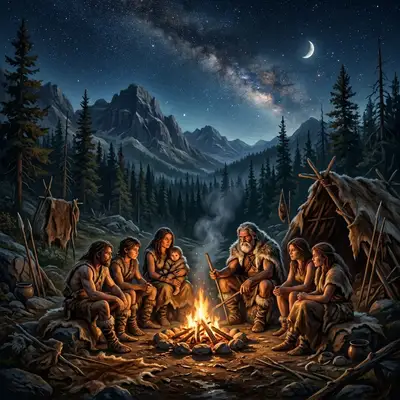
Palaeolithic band gathered around a cave fire cooking food
A depiction of a Paleolithic hominid band gathered around a cave hearth cooking meat and sharing food. The fire served as a protective barrier, keeping predators away and allowing hominids to transition to sleeping on the ground.

Key Development: The Hearth as Social Center

The control of fire reshaped the daily rhythm and social structure of hominid bands. Without fire, the human day ended at sunset, forcing hominids to sleep to conserve energy and avoid predators. Fire provided artificial light and warmth, effectively extending the day by several hours. These extra hours were spent not in foraging, but in social interaction around the hearth. In 2014, the anthropologist Polly Wiessner analyzed conversations in Bushmen communities in southern Africa, finding a stark contrast: daytime talk focused on work and logistics, while nighttime campfire talk was dedicated to storytelling, singing, dancing, and building social alliances.

The campfire created a space for "social cognitive scaffolding." Sharing stories around the fire fostered empathy, cooperation, and the transmission of complex cultural knowledge across generations. The need to maintain the fire also enforced a division of labor: some members had to forage for firewood, others had to guard the embers, and others cooked. This cooperative structure reinforced the social bonding that made early human bands highly effective collaborative units, enabling them to survive in harsh, seasonal climates and migrate out of Africa into colder Eurasian environments.

  • 1,500,000 BCE โ€” Hominids observe and interact with natural fires; tentative evidence of fire use in East Africa
  • 1,000,000 BCE โ€” The earliest confirmed, stratigraphically secure hearths deep inside Wonderwerk Cave, South Africa
  • 790,000 BCE โ€” Evidence of systematic, repeated fire control at Gesher Benot Ya'aqov in Israel, showing wood selection
  • 400,000 BCE โ€” Development of hearths in Europe and Asia by Neanderthals and Homo heidelbergensis
  • 200,000 BCE โ€” Homo sapiens develop the ability to create fire at will using iron pyrites and flint or wooden fire-drills
  • 100,000 BCE โ€” Fire is used to heat-treat silcrete stone tools, making them easier to flake and sharpen, in South Africa
  • 40,000 BCE โ€” Fire is used to produce cave art pigments and bake early clay figurines, showing symbolic use

Pyrotechnology: Hardening Stone and Wood

Beyond warmth and cooking, early humans used fire as an engineering tool. At sites like Pinnacle Point in South Africa, archaeologists discovered that Middle Stone Age humans (around 100,000 years ago) heat-treated silcrete stones. Raw silcrete is difficult to shape into blades, but when buried under a hearth and heated slowly, the stone changes color and molecular structure, becoming glass-like and easy to flake into razor-sharp tools. Fire was also used to harden the tips of wooden spears, representing the earliest form of material engineering (pyrotechnology) that paved the way for ceramics, metallurgy, and modern manufacturing.

Social & Human Effects: Domestication of the Human Body

The mastery of fire did not just change human culture; it domesticated the human body itself. Cooking made our teeth and jaws smaller, as we no longer needed to chew raw, fibrous foods for hours. It altered our stomach and intestinal anatomy, leaving us dependent on cooked food for survival; modern humans cannot survive on raw, wild foods alone in nature, as our digestive systems lack the size and enzymes to extract sufficient calories. We are, in a literal sense, "the cooking apes."

Fire also transformed the human sleep cycle. Primates sleep in trees to avoid ground-dwelling predators, which limits their sleep quality and keeps their brains in a state of semi-alertness. The protective barrier of the campfire allowed hominids to sleep on the ground, leading to deeper, more restorative REM sleep. This increase in REM sleep is believed to have played a major role in memory consolidation, emotional regulation, and creative thinking, directly supporting the cognitive expansion of the human brain.

Ecological & Environmental Consequences: Fire-Stick Farming

Once hominids learned to control fire, they began using it on a landscape scale. Early humans practiced "fire-stick farming" (cultural burning)โ€”setting fires to dry savanna grasslands and woodlands. These controlled, low-intensity burns cleared undergrowth, stimulated the growth of fresh green grass that attracted grazing game animals, and made travel and hunting easier. Over millennia, this practice completely reshaped the vegetation and ecosystems of entire continents, particularly in Australia, where fire-stick farming promoted fire-resistant eucalyptus forests and created the open savanna landscapes observed by European colonizers.

This landscape burning was the earliest form of human modification of the global biosphere. By releasing carbon dioxide from burning vegetation, early hunter-gatherers began altering local climate cycles. The mastery of fire was the first step on a path that led from the Paleolithic hearth to the coal-fired boilers of the Industrial Revolution, establishing a dependency on combustion that remains the central challenge of modern civilization.

โš–๏ธ

Historian Debate: Did Cooking Drive Human Evolution?

The Cooking Hypothesis

Richard Wrangham argues that cooking was the primary driver of brain evolution. He asserts that the anatomical changes in Homo erectusโ€”smaller teeth, smaller gut, larger brainโ€”can only be explained by the nutritional boost provided by cooked food, which started around 1.8 million years ago. On this view, fire was the catalyst that made us human, allowing our ancestors to develop the cognitive capacity for language and culture.

The Raw Meat Hypothesis

Conversely, paleoanthropologists like Katherine Milton and Manuel Domรญnguez-Rodrigo argue that meat-eating alone was sufficient to drive brain expansion. They suggest that the consumption of raw meat, marrow, and brain tissue from scavenged carcasses provided the necessary fats and proteins for brain growth, and that systematic cooking did not emerge until much later in the archaeological record (around 400,000 years ago), serving as an enhancement rather than the primary cause of evolution.

Scholars such as Richard Wrangham and Katherine Milton have shaped this debate through works like Wrangham's Catching Fire: How Cooking Made Us Human (2009) and Milton's studies on primate diets.

"The discovery of fire... is the first instance of human control over a force of nature. It made possible the transition from a purely biological existence to a cultural one, establishing a space of light and warmth around which the first human communities gathered to speak, sing, and remember."

โ€” Charles Darwin, The Descent of Man (1871). Darwin recognized fire and language as the two most important discoveries that distinguished humans from other animals.

Long-Term Legacy

The mastery of fire laid the foundation for all subsequent human technology. Without fire, the pyrotechnological transitions of the Neolithic and Bronze Ages would be impossible: we could not have baked clay into pottery, smelted copper and tin into bronze, or forged iron into steel. Every engine, power plant, and vehicle in the modern world is a direct descendant of the Paleolithic hearth, relying on the combustion of fuel to generate work.

However, this reliance has created a global crisis. The same energy revolution that made us human is now threatening our survival, as the greenhouse gas emissions from our global combustion engines alter the earth's climate. Relearning how to manage energy without relying on combustionโ€”transitioning from the age of fire to the age of solar, wind, and nuclear energyโ€”is the defining challenge of the 21st century, bringing the history of human energy full circle.

Further Reading

  • Richard Wrangham โ€” Catching Fire: How Cooking Made Us Human (2009). The definitive presentation of the cooking hypothesis, explaining how cooked food drove brain expansion.
  • Stephen J. Pyne โ€” Fire: A Brief History (2001). A comprehensive environmental history exploring how human fire management has reshaped the earth's ecosystems.
  • Polly Wiessner โ€” Embers of the Past: Campfire Talk and Social Bonding (2014). An anthropological study analyzing how nighttime campfire talk supports social network maintenance.
  • Daniel Lieberman โ€” The Story of the Human Body: Evolution, Health, and Disease (2013). Explores the evolutionary transitions of the human body, including the impact of agriculture and cooking.
  • James C. Scott โ€” Against the Grain (2017). Includes chapters on how early hominids used landscape fire to shape animal and plant populations.
๐Ÿ“– Scholar Mode Active โ€” Click to exit focused reading
Selected Era

Prehistoric Era

Millions of years ago to ~3000 BCE

The dawn of humanity. From the evolutionary split of early hominids to the mastery of stone tools, fire, and the birth of language.

Landmark Milestones

Welcome to Historia

Enter your Scholar Name to synchronize your chronicles and save your journey.