From prehistoric origins to the modern era—discover the turning points, lost empires, and breakthroughs of world history through interactive timelines and visual guides.
Examine the tangible relics, physical tokens, and revolutionary machines that shaped civilizational growth.
🎥 VIDEO HUB & SHORTS
Watch visual summaries, site intros, and mini-documentaries chronicling 300,000 years of world history.
📊 HISTORICAL INFOGRAPHICS ARCHIVE
Museum-grade visual graphics, civilizational timelines, and architectural breakdowns curated for educators and history lovers.
THE HISTORIA CIRCLE
Join the collective discussion, study logs, and contributions of fellow historians mapping humanity's path.
Historia Forum Discussions
Start a Discussion Thread
THEMATIC PATHWAYS
Trace a single thread — disease, trade, energy, migration — across all eras and civilizations.
History is not just a sequence of events — it is a network of patterns. These thematic pathways allow you to follow a single concept across thousands of years: how agriculture spread, how warfare evolved, how trade routes shaped civilizations. Each pathway collects the most relevant chronicles across all eras.
🧩
How is this different from the sidebar Topics?
While the sidebar Topics (like Science & Tech or Empires) filter articles within your selected historical Era, Thematic Pathways cut horizontally across all eras (from Prehistoric to the Future). Use Themes to trace a single concept's evolutionary line across 300,000 years.
CIVILIZATION HUBS
Comprehensive profiles of the world's greatest civilizations and empires — from ancient cradles to global super-states.
Human Historia provides an academically rich exploration of the world's most influential civilizations. From the monumental achievements of ancient Egypt, Han China, and the Roman Empire, to the sophisticated societies of the Maya, the Islamic Caliphates, and West African empires, these hubs offer deep insights into the cultural, political, and technological legacies that continue to shape our global story.
EVOLUTION OF HUMAN SKILLS
Trace the compounding technologies, practical capabilities, and cognitive milestones of the human species.
Human progress is a story of compounding skills. Every breakthrough, from the spark of prehistoric fire to modern silicon transistors, builds directly on previous generations of ingenuity. Hover over a skill node to trace its historical prerequisites, and click it to explore its development timeline, species-wide impact, and related chronicles.
Prehistoric Ancient Medieval Modern Future
🧠
Select any skill node in the tree to explore its evolutionary path, development timeline, and historical impact.
ACADEMIC PASSPORT
Track your intellectual journey, quiz outcomes, and historical badges of honor.
HISTORIA PASSPORT⏳
👤Scribe Novice
Scholar NameHistoria Explorer
Rank RatingSumerian Record Scribe
Chronicles Read0 / 48
Study Guide Pins0 Guides
Security AccessLevel 1 (Novice)
Earned Badges of Honor
🔥
Fire Keeper
Unlock 3 prehistoric chronicles.
🏛️
Codex Keeper
Unlock 3 ancient chronicles.
🏰
Guild Master
Unlock 3 medieval chronicles.
⚙️
Steam Engineer
Unlock 3 modern chronicles.
🚀
Singularity Sage
Unlock 3 future chronicles.
👑
Grand Scholar
Score 5/5 on the Lab Quiz.
Recent Lab Activities
No recent activities recorded. Take a quiz or bookmark articles!
🏛️ MISSION & ARCHIVAL STANDARDS
About Human Historia
A visual encyclopedia and timeline of human history, dedicated to documenting 300,000 years of civilizational evolution through rigorous research, authentic artifacts, and visual clarity.
🌍
The 300,000-Year Story
Human Historia traces our collective journey across five historical epochs: Prehistory, Ancient Worlds, Middle Ages, Modern Age, and Future Horizons. From the first control of fire to quantum computation, we organize turning points into interconnected timelines.
📜
Historiographical Rigor
Every chronicle is built upon primary historical manifests, contemporary excavation reports, and peer-reviewed historical consensus. We prioritize authentic public domain artifacts and clearly identify scholarly debates surrounding major civilizational transitions.
🎨
Museum-Grade Visuals
Complex historical transitions demand visual understanding. We develop high-resolution infographics, architectural cutaways, and comparative territorial maps to transform abstract timelines into vivid, unforgettable learning experiences.
📖
Educational Access
Knowledge belongs to humanity. Human Historia is free, ad-light, and engineered as an educational resource for students, classroom educators, academic researchers, and curious minds across all continents.
Editorial Governance & Inquiries
We welcome peer reviews, academic corrections, museum archival collaborations, and educational partnerships. To submit historical inquiries or provide archival feedback, reach our editorial desk directly.
Written by Humanhistoria EconomicsHistorical Era: MEDIEVAL
The Silk Road was not a single, paved highway, but a vast, shifting network of overland and maritime trade routes that connected East Asia with the Mediterranean, Central Asia, India, and the Middle East for over 1,500 years. Established during the Han Dynasty in the 2nd century BCE, this commercial network facilitated the exchange of luxury goods, scientific ideas, technologies, and religious beliefs, serving as the first global network. By linking diverse civilizations, the Silk Road compressed geographic distance, shaped the economies of empires, and laid the foundations for the modern, interconnected world.
🎯 Quick Historical Summary
What Was the Silk Road?
The Silk Road was an ancient 4,000-mile network of trade routes connecting China to the Mediterranean from roughly 130 BCE to 1453 CE. Originating when Han Dynasty explorer Zhang Qian sought military horses in Central Asia, it transported Chinese silk, spices, and paper in exchange for Roman glass, horses, and precious metals.
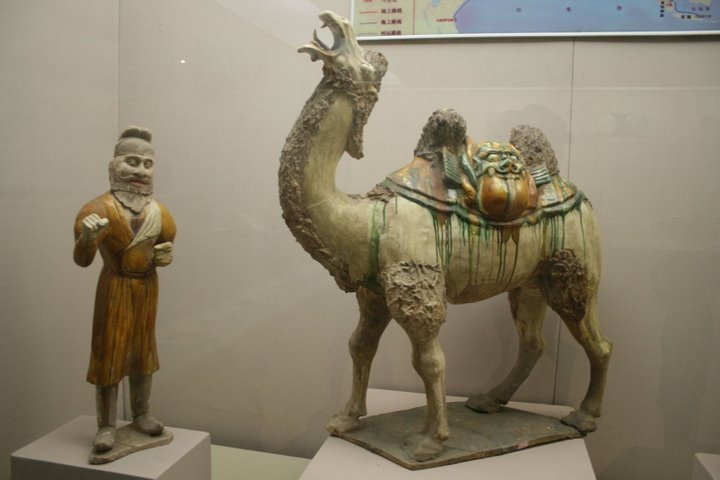
Caravan traversing the historic Silk Road desert sands near the Dunhuang oasis in Gansu, China. .
How War Created the Silk Road: Zhang Qian and the Ferghana War Horses
The formal origin of the Silk Road was diplomatic and military. In the 2nd century BCE, the Han Dynasty of China (under Emperor Wu) faced a persistent threat from the nomadic Xiongnu confederation along their northern borders. In 138 BCE, Emperor Wu dispatched the diplomat Zhang Qian on a mission to the far west. His goal was to contact the Yuezhi people (another nomadic group) to negotiate a military alliance against the Xiongnu.
Zhang Qian's expedition was hazardous; he was captured by the Xiongnu twice and held hostage for a total of ten years before escaping. Although his alliance mission failed, Zhang Qian returned to Chang'an in 126 BCE with intelligence regarding the kingdoms of Central Asia, Persia, and India. He reported on the sophisticated city-states of Fergana (modern Uzbekistan), which possessed large, powerful horses (the "Heavenly Horses" of Fergana) that were superior to Chinese breeds. Realizing the military value of these horses to counter nomadic cavalry, Emperor Wu launched campaigns to secure Fergana, opening the corridor through the Hexi valley and establishing the first trade channels to the West.
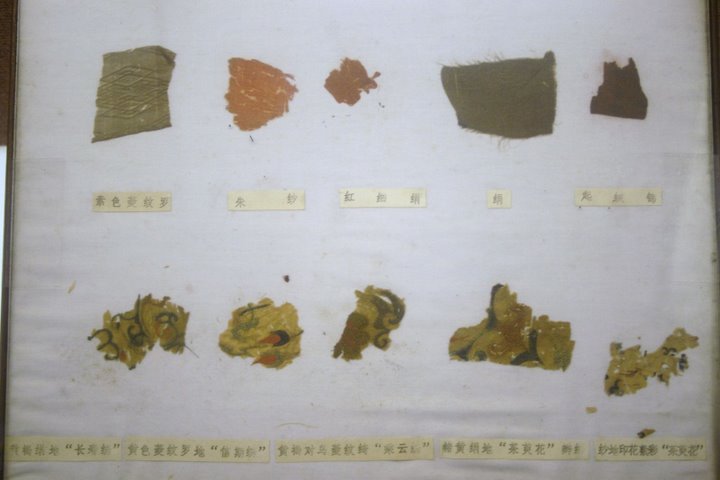
Ancient Chinese silk damask textile fragments dating to the Western Han Dynasty, excavated along the Silk Road trade route. (Silk Road Museum)
Geographic Routes and the Taklamakan Desert
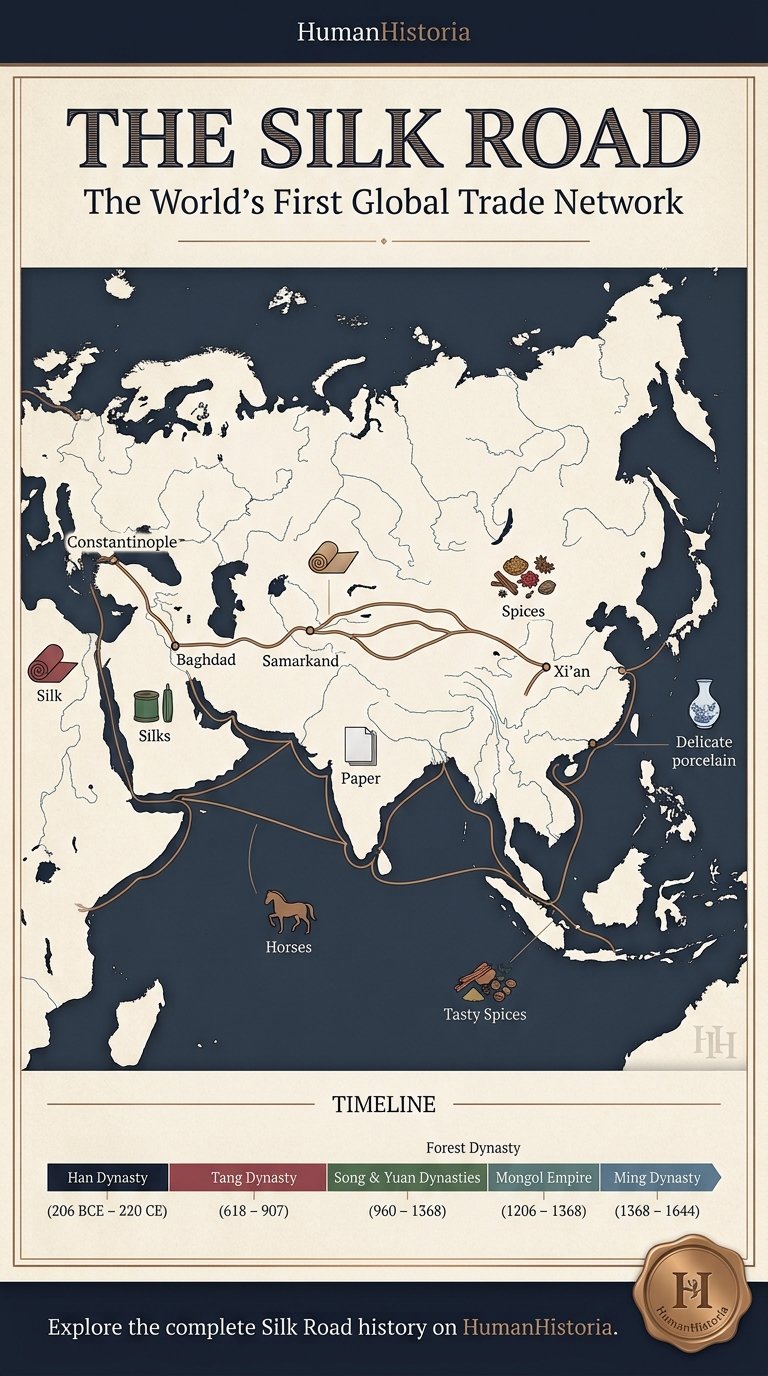
The overland Silk Road spanned over 4,000 miles, starting at the Chinese capital of Chang'an (Xi'an), passing through the Hexi Corridor, and splitting into northern and southern routes to skirt the edges of the dreaded Taklamakan Desert—whose name translates locally as "you go in, but you don't come out."
The Northern Route: Skirted the base of the Tian Shan Mountains, passing through the oasis cities of Hami, Turpan, and Kashgar, crossing the Pamir Mountains into Transoxiana (Uzbekistan) and Persia.
The Southern Route: Ran along the base of the Kunlun Mountains, passing through Dunhuang, Khotan, and Yarkand, crossing the Karakoram range into northern India.
The Maritime Route: Developed during the Roman and Tang eras, linking ports in southern China (Quanzhou, Guangzhou) with India, Ceylon, the Persian Gulf, and the Red Sea ports of Roman Egypt.
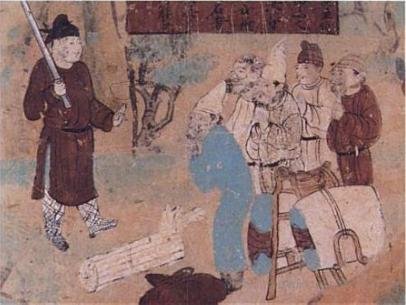
A detailed mural from Cave 45 of the Mogao Caves in Dunhuang depicting merchants defending a camel caravan from bandits. (Dunhuang Academy)
The Logistics of the Caravan and Caravanserais
Overland trade along the Silk Road was not conducted by single merchants traveling the entire 4,000-mile length. Instead, trade operated as a relay system. Goods were passed from one merchant band, city-state, or nomadic group to another, with prices rising at each transfer point to cover transport costs and risks.
The primary vehicle of this trade was the Bactrian Camel. Possessing two humps, these beasts were suited for the cold, dry deserts of Central Asia, capable of carrying 400 pounds of cargo and traveling weeks without water. Caravans consisting of hundreds of camels were organized to protect against bandits and sandstorms.
To support this trade, rulers constructed a network of caravanserais—fortified roadside inns situated roughly 20 to 30 miles apart, representing a day's march. The caravanserai featured a central courtyard surrounded by stables, warehouses, guest rooms, and baths. Here, merchants could secure water, purchase food, rest their animals, exchange intelligence regarding routes, and trade goods, serving as early commercial centers and hotels.
Dunhuang: The Oasis of Culture
Situated at the junction of the northern and southern routes, the oasis city of Dunhuang grew into a major trade hub and sacred site. It housed the Mogao Caves (the Caves of the Thousand Buddhas)—a cliffside sanctuary containing hundreds of hand-carved temples decorated with murals, statues, and manuscripts. Dunhuang was a multilingual city where Chinese, Tibetan, Sogdian, Sanskrit, and Hebrew documents were written and stored, preserving the intellectual diversity of the Silk Road.
The Exchange of Commodities
The Silk Road moved high-value, lightweight luxury goods to justify the transport costs over thousands of miles.
East to West: The primary commodity was silk, a fabric whose production process (sericulture) was a Chinese state secret. Silk was used as a currency, a diplomatic gift, and a status symbol in Rome and Constantinople. Other exports included tea, paper, porcelain, lacquerware, cinnamon, rhubarb, and gunpowder.
West to East: China imported Roman glassware, gold and silver bullion, wool, linen textiles, jade from Khotan, and agricultural crops such as grapes, alfalfa (needed to feed warhorses), walnuts, pomegranates, and sesame.
Cultural and Religious Diffusion
The most enduring impact of the Silk Road was not commercial, but cultural. The trade routes served as vectors for the transmission of ideas, arts, and major world religions:
Buddhism: Emerging in India, Buddhism traveled along the Silk Road through the Kushan Empire into China during the Han Dynasty. Monks, most notably the translator Kumarajiva and the Chinese pilgrim Xuanzang, translated Sanskrit texts into Chinese, establishing Buddhism as a major religion in East Asia.
Islam: Following the Muslim conquests of Persia in the 7th century, Islam spread along the Silk Road, converting the oasis cities of Central Asia (such as Bukhara and Samarkand) into centers of Islamic scholarship, science, and theology.
Sogdian Merchants: The Sogdians (an Iranian people centered in modern Uzbekistan) served as the primary trade translators of the Silk Road, operating merchant networks that spanned from China to Byzantium and translating texts in Buddhism, Manichaeism, and Nestorian Christianity.
Pax Mongolica and the Yam System
In the 13th and 14th centuries, the Mongol Empire conquered and unified Eurasia. The Pax Mongolica (Mongol Peace) secured the trade routes under a single legal system (the Yassa). The Mongols established the Yam System—a rapid postal relay network of post stations with fresh horses and riders. Merchants carrying the paiza (a metal passport) could travel from Venice to Beijing safely. This era of security allowed travelers like Marco Polo and Ibn Battuta to document their global travels.
What Was the Golden Age of the Silk Road? The Eurasian Trade Route at Its Zenith
Economic historians and orientalists generally identify two distinct peaks as the Golden Age of the Silk Road, when cross-continental commerce and intellectual exchange achieved maximum integration across the Eurasian trade route:
1. The Tang & Islamic Golden Age (7th – 8th Century CE)
Under the Tang Dynasty (618–907 CE), China opened its borders to foreign merchants, turning Chang'an into the world's most populous cosmopolis of over one million citizens, home to Persian Zoroastrians, Nestorian Christians, and Arab merchants. Concurrently, the Abbasid Caliphate in Baghdad created a thriving commercial zone that unified Near Eastern markets. Following the Battle of Talas in 751 CE, Chinese prisoners transmitted the secret of papermaking to Samarkand, revolutionizing Islamic and later European administration and literacy.
2. The Pax Mongolica (13th – 14th Century CE)
The second, and commercially most unified, golden age occurred when the Mongol Empire brought the entirety of the trans-Eurasian trade route under a single sovereign administration. Under the Pax Mongolica, bandits were ruthlessly eradicated, tolls standardized, and the Yam horse-messenger postal relay established every 25 miles. Merchants carrying the golden Paiza tablet could journey uninterrupted from Venice and Tabriz all the way to Beijing and Hangzhou, enabling chroniclers like Marco Polo and Ibn Battuta to witness a truly globalized commercial world.
The Dark Side: Transmission of the Black Death
The integration of Eurasia under the Pax Mongolica had a catastrophic consequence: the transmission of epidemic disease. In the mid-14th century, the bacterium Yersinia pestis (the Black Death) traveled along the trade routes from Central Asia, carried by fleas on rodents nesting in merchant grain sacks and horse saddles. The plague spread through Mongol army camps and caravanserais, arriving at the Genoese trading port of Kaffa in the Crimea in 1346. From Kaffa, ships carried the plague to Europe, North Africa, and the Middle East, wiping out an estimated 30% to 60% of the population, collapsing economies, and disrupting trade networks.
Closure and the Age of Discovery
The decline of the Mongol Empire and the rise of the Ottoman Empire in the 15th century ended the overland Silk Road. Following the capture of Constantinople in 1453, the Ottomans imposed heavy taxes and restrictions on Christian merchants traveling through their territories.
Faced with high costs and unstable land routes, European kingdoms (most notably Portugal and Spain) sought alternative sea routes to access the spice and silk markets of Asia. This prompted the voyages of Vasco da Gama, who sailed around the Cape of Good Hope to reach India in 1498, and Christopher Columbus, who sailed west in 1492 to reach Asia but instead encountered the Americas. The opening of these global ocean trade routes shifted economic power from the overland oases of Central Asia to the maritime ports of Western Europe, bringing an end to the Silk Road era.
The Sogdian Merchant Network
The primary organizers of Silk Road trade were the Sogdians, an Iranian-speaking people who lived in modern Uzbekistan (Transoxiana) with their capital at Samarkand. Scribes and historians note that while Chinese and Roman empires controlled the ends of the road, the Sogdians managed the vast middle section. They established merchant colonies at every major oasis along the Taklamakan Desert and inside Chinese cities, acting as translators, diplomats, and trade brokers.
The Sogdians were also cultural and religious translators. Being multilingual, Sogdian scribes translated Sanskrit Buddhist texts, Syriac Christian scriptures, and Manichaean treatises into the Sogdian language, which spread these ideas to the nomadic tribes of the Eurasian steppe and into China. The discovery of the Sogdian Ancient Letters (early 4th century CE), written by Sogdian merchants trapped in Chinese cities during nomadic invasions, has provided modern historians with details on the logistics, currency, and personal lives of the merchants who traveled the Silk Road, proving that cultural syncretism was central to the trade network.
Passports and the Yam Post Stations
The efficiency of the Silk Road under the Mongol Empire was sustained by the paiza—a tablet of gold, silver, or wood that served as an imperial passport. Engraved with the seal of the Khan and a warning that anyone who disobeyed the passport holder would be executed, the paiza allowed diplomats, messengers, and key merchants to secure fresh horses, food, and lodging at any station in the Yam post network. This administrative security allowed travelers to cross the continent without fear of local extortion, demonstrating how a centralized administrative passport system was essential to coordinate trade across Eurasia.
The Maritime Silk Road and Monsoon Logistics
While the overland Silk Road routes traversed the deserts of Central Asia, a parallel trade network known as the Maritime Silk Road connected China, India, Southeast Asia, Arabia, and East Africa by sea. This maritime trade was governed by the physics of the monsoon winds. Between November and February, the northeast monsoon blew ships southwest across the Indian Ocean toward India and Africa. Between May and September, the southwest monsoon reversed direction, propelling vessels northeast toward China. Merchants had to plan their voyages around these seasonal winds, living in foreign port cities for months at a time, which led to the creation of multicultural merchant diasporas.
Maritime trade was highly efficient because ships could carry bulk items that were too heavy for camels, such as porcelain, timber, rice, and spices. Chinese shipbuilders developed the junk, featuring watertight compartments and sternpost rudders, while Arab sailors constructed the dhow, using lateen (triangular) sails that allowed them to sail against the wind. This maritime network connected major commercial hubs like Guangzhou, Malacca, Calicut, Aden, and Kilwa, demonstrating that global economic integration was as much a maritime phenomenon as a terrestrial one, laying the foundation for modern global shipping lanes.
Conclusion and Legacy
The Silk Road was the first global trade network, establishing the economic and cultural connections that linked East and West. By facilitating the exchange of paper-making, printing, gunpowder, mathematics, and religious ideas, it laid the foundations for the Renaissance and the modern world, proving that human progress is driven by cross-cultural exchange.
⚖️
Historian Debate: How Integrated was the Silk Road?
Global Commercial Network
Proponents argue that the Silk Road was a highly integrated trade system that connected China to Rome, causing price convergence and transferring technology (paper, gunpowder).
Localized Oasis Relays
Skeptics like Valerie Hansen argue that trade was extremely small, highly localized, and consisted of a series of short oases relays, with very few merchants crossing the entire continent.
The trans-Eurasian trade network transported luxury commodities and pathogens (Black Death) across hemispheres.
"The merchants of Sogdiana travel to all lands to trade... Their caravans are like cities on the move, carrying silk, glass, and spices across the desert sands."
— Xuanzang, Great Tang Records on the Western Regions (646 CE).
The Silk Road: A New History — by Valerie Hansen. A revisionist history relying on archaeological finds to show the local, small-scale nature of the trade.
The Silk Roads: A New History of the World — by Peter Frankopan. A major global history centering the world's axis on the trade networks of Central Asia.
💡 Click anywhere on poster to expand in high resolution🔎 Expand Lightbox
Historical trade routes map chronicling maritime shipping routes linking Alexandria and Constantinople to Indian and Chinese ports.
📖 SCHOLARLY INQUIRIES
Frequently Asked Questions
Essential historical questions and evidence-based answers concerning this chronicle.
Q.What major ideas spread along the Silk Road?
Beyond physical goods like silk and porcelain, the Silk Road spread Buddhism from India to China, paper-making technology to the Islamic world and Europe, and early medical and astronomical sciences.
Q.What was the golden age of the Silk Road?
The Silk Road experienced two distinct Golden Ages: 1) The Tang Dynasty & Abbasid Caliphate era (7th–8th centuries CE), when cosmopolitan Chang'an and Baghdad flourished and paper manufacturing spread west; and 2) The Pax Mongolica (13th–14th centuries CE), when the Mongol Empire unified the Eurasian trade route under a single legal code (Yassa) and courier system (Yam), enabling safe travel from Venice to Beijing.
Q.What was the Eurasian trade route, and what was traded along it?
The Eurasian trade route was a 4,000-mile relay network linking East Asia, Central Asia, India, and the Mediterranean. East-to-west exports included Chinese silk, porcelain, tea, paper, and gunpowder, while west-to-east imports included Roman glassware, gold bullion, Frankish textiles, and Fergana warhorses.
Q.Why did the overland Silk Road decline?
The overland Silk Road declined in the 15th century due to the fragmentation of the Mongol Empire, high tariffs imposed by the Ottoman Empire after the fall of Constantinople (1453), and European navigators discovering cheaper maritime sea routes to Asia during the Age of Discovery.
📚 Academic Sources & Scholarly Bibliography
Frankopan, P. (2015).
The Silk Roads: A New History of the World.
Bloomsbury.
Hansen, V. (2012).
The Silk Road: A New History.
Oxford University Press.
Whitfield, S. (2015).
Life Along the Silk Road.
University of California Press.
📖 Scholar Mode Active — Click to exit focused reading
History Lab 🧪
Interactive historical deduction games, tactical matchup simulators, and currency calculators.
🕵️ Who Am I? (The Historical Guess Game)
A secret historical figure has been selected. Ask yes/no questions to narrow down the pool of candidates. Click any active card to make your accusation!
Secret Identity
❓ Who Am I?
Ask questions using the board below to narrow down my identity.
Ask a Question:
Question LogQuestions: 0 / 7
No questions asked yet.
Candidate Board:
🗺️ Timeline Scramble
Five historical events appear out of order. Click them in the correct chronological sequence — from oldest to most recent. How well do you know your history?
🏺 Relic or Fake?
Is this a real historical artifact or a convincing fabrication? Judge each one based on its description and era — then see the truth revealed!
Artifact 1 / 10Score: 0
Empire Matchup Simulator
Empire ATerritory Size (Peak, M km²)Empire B
00
Empire APopulation (Peak, Millions)Empire B
00
Empire AMilitary Power (Army Size)Empire B
00
Tactical Battle Analysis
Select empires and click simulate to run evaluations.
Historical Purchasing Power Converter
See what ancient coins are worth in modern terms and check their historical purchasing power.
Modern Value Equivalent
$0.00 USD
Historical Purchasing Power:
Select currency to view purchasing capability.
Historical Identity Generator
Forge an authentic historical identity from ancient civilisations, complete with linguistic meaning and biography.
Neutral
Gaius Julius
Meaning:Descendant of Jupiter
Historical Background:
A Roman citizen and clerk who worked in the forum under Roman republic rule.
Chrono-Cultural Fusion Simulator
Fuse the culture, technology, and governance of two legendary civilizations to synthesize a unique hybrid society.
Cohesion & Coexistence Rate
85%
🏛️ Hybrid Architecture
⚙️ Synthesized Asset
📜 Synthetic Governance
Historical Tactics & Trivia Quiz
Test your historical knowledge and battle tactics to claim your administrative rank.
8 Questions • Multi-Era
You will be presented with random scenarios and trivia spanning ancient Egypt, classical Rome, Islamic Golden Age, and the modern industrial era. Complete the evaluation to see your historical title!
Question 1 of 8Score: 0
What was the Code of Hammurabi written on?
Correct!
Evaluation Complete!
6 / 8
Correct
Rank Attained
Imperial Legionary
Your knowledge of classical strategy and administrative structures is respectable.
🎲 Counterfactual "What If?" Scenario Simulator
Explore alternative historical trajectories by tweaking key civilizational pivot points.
Simulated Shift
Selected Era
Prehistoric Era
Millions of years ago to ~3000 BCE
The dawn of humanity. From the evolutionary split of early hominids to the mastery of stone tools, fire, and the birth of language.
Landmark Milestones
Welcome to Historia
Enter your Scholar Name to synchronize your chronicles and save your journey.
 ⭐ Featured Chronicle

 ANCIENT AGES
 ANCIENT AGES
 ANCIENT AGES
 MEDIEVAL PERIOD
 MEDIEVAL PERIOD
 PREHISTORIC ERA