>
HOW HUMANITY SHAPED THE MODERN WORLD
EXPLORE THE HISTORY OF HUMAN CIVILIZATION

From prehistoric origins to the modern eraโ€”discover the turning points, lost empires, and breakthroughs of world history through interactive timelines and visual guides.
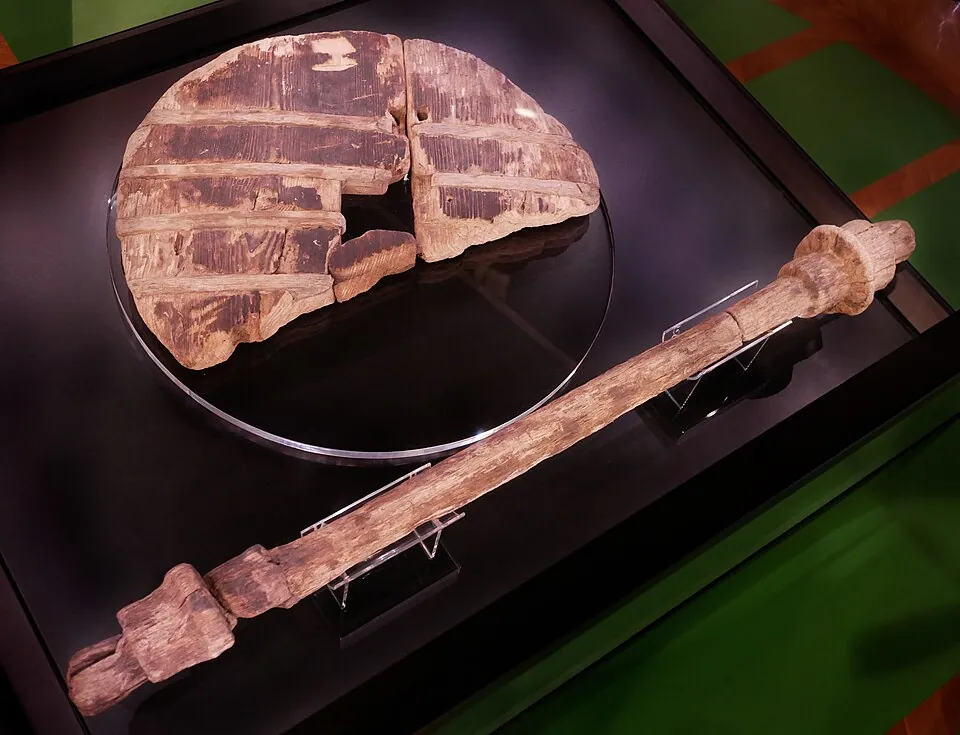
KEY HISTORICAL EVENTS
Major Turning Points in World History
All 182 Chronicles →
Pax Romana (27 BCE - 180 CE): Roman Empire, Law & Military Supremacy ANCIENT AGES
๐Ÿ›๏ธ Empires โฑ๏ธ 5 min read
Pax Romana (27 BCE - 180 CE): Roman Empire, Law & Military Supremacy

Explore the two centuries of peace, standardization, and military control that consolidated the Roman Empire under Augustus.

Read Chronicle →
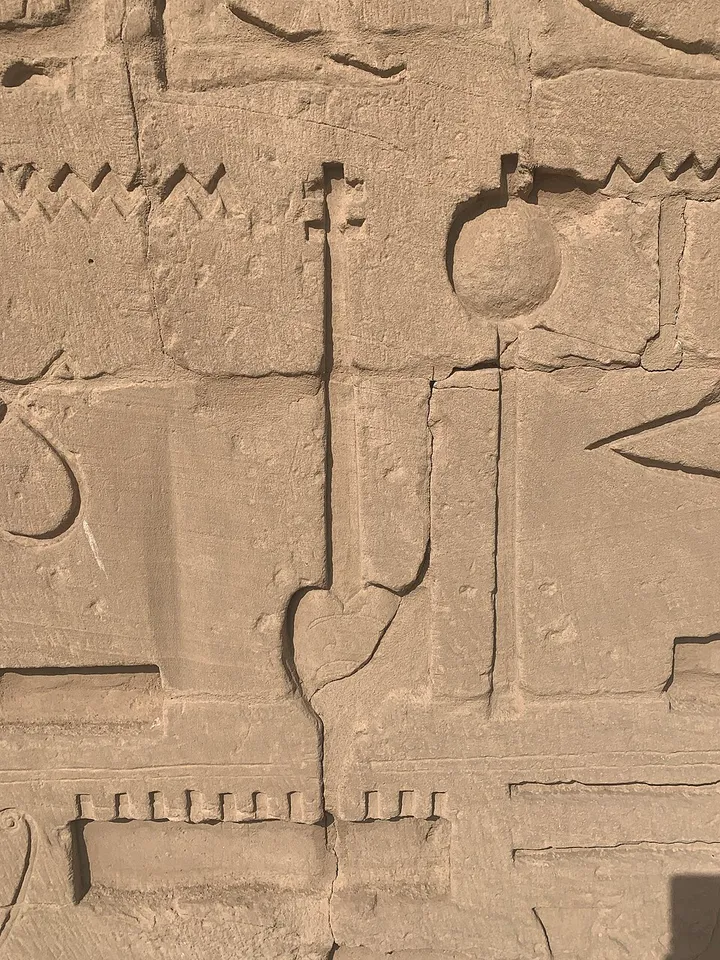
Egyptian Hieroglyphs: Decipherment, Scribes & Sacred Carvings ANCIENT AGES
๐Ÿ›๏ธ Languages โฑ๏ธ 9 min read
Egyptian Hieroglyphs: Decipherment, Scribes & Sacred Carvings

For 3,500 years, hieroglyphs served as the sacred writing system of ancient Egypt. Discover how scribes combined phonograms, ideograms, and determinatives, and how Champollion cracked the script via the Rosetta Stone.

Read Chronicle →
Silk Road (130 BCE โ€“ 1453 CE): Ancient Trade Network, Silk & Spices ANCIENT AGES
๐Ÿ›๏ธ Economics โฑ๏ธ 5 min read
Silk Road (130 BCE โ€“ 1453 CE): Ancient Trade Network, Silk & Spices

Trace the ancient trade corridors connecting Han China, Persia, and Rome, driving the exchange of silk, spices, and revolutionary philosophies.

Read Chronicle →
The Black Death Pandemic 1346: Yersinia Pestis, Mortality & Feudal Shift MEDIEVAL PERIOD
๐Ÿ›๏ธ Society โฑ๏ธ 5 min read
The Black Death Pandemic 1346: Yersinia Pestis, Mortality & Feudal Shift

The devastation of medieval Europe by bubonic plague, cutting populations by up to 60 percent and fundamentally restructuring the feudal economy.

Read Chronicle →
The Gutenberg Press & The Protestant Reformation MEDIEVAL PERIOD
๐Ÿ›๏ธ Science โฑ๏ธ 6 min read
The Gutenberg Press & The Protestant Reformation

Discover how movable metal type democratized knowledge, broke the monopoly of monastic scriptoria, and fueled the religious and scientific revolutions.

Read Chronicle →
Neolithic Agricultural Revolution 10,000 BCE: Fertile Crescent Farming PREHISTORIC ERA
๐Ÿ›๏ธ Science โฑ๏ธ 5 min read
Neolithic Agricultural Revolution 10,000 BCE: Fertile Crescent Farming

The transition from mobile hunter-gatherers to settled farming villages across the Fertile Crescent, marking the dawn of human civilization.

Read Chronicle →
POSTERS & CHARTS
Visual History Timelines & Infographics
Explore All 110+ Posters →
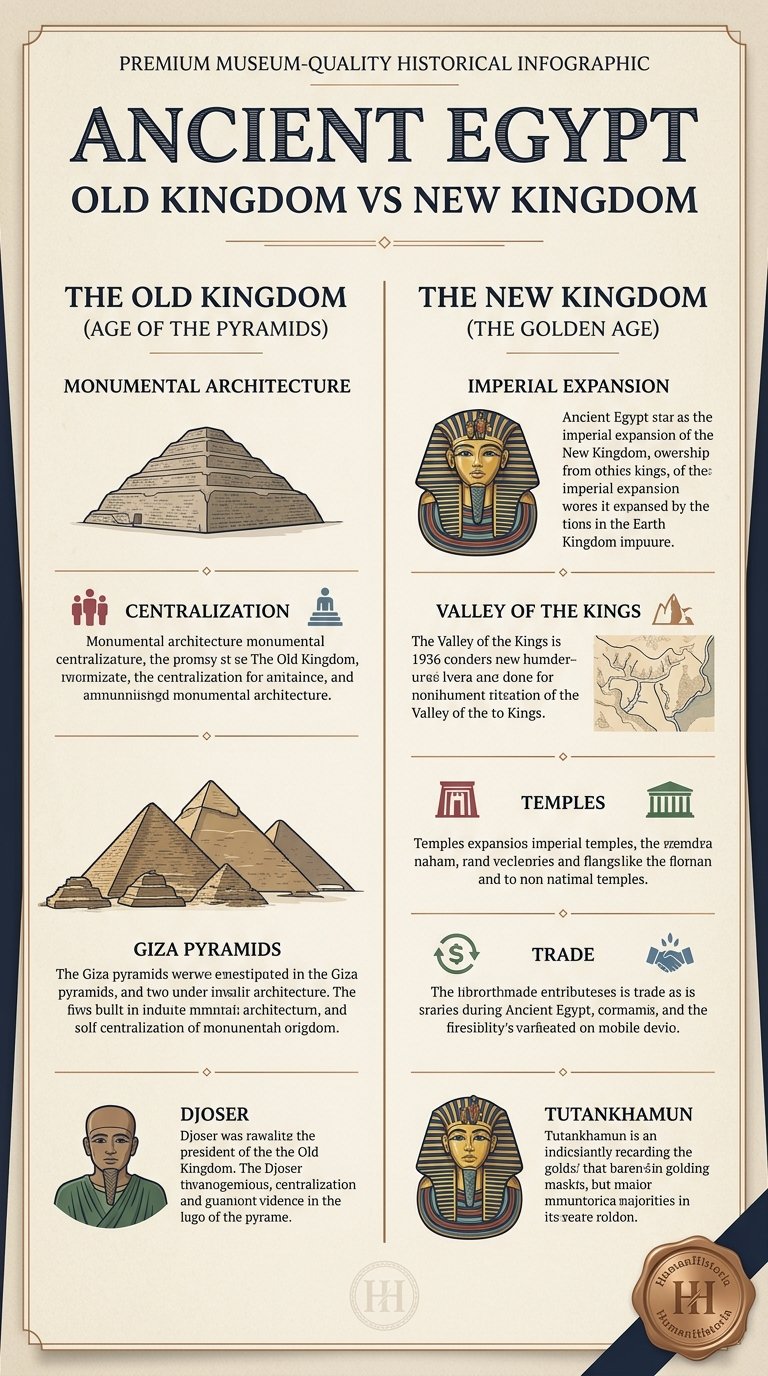
Ancient Egypt: Old Kingdom vs. New Kingdom
๐Ÿ” Tap to Zoom
Ancient Egypt: Old Kingdom vs. New Kingdom
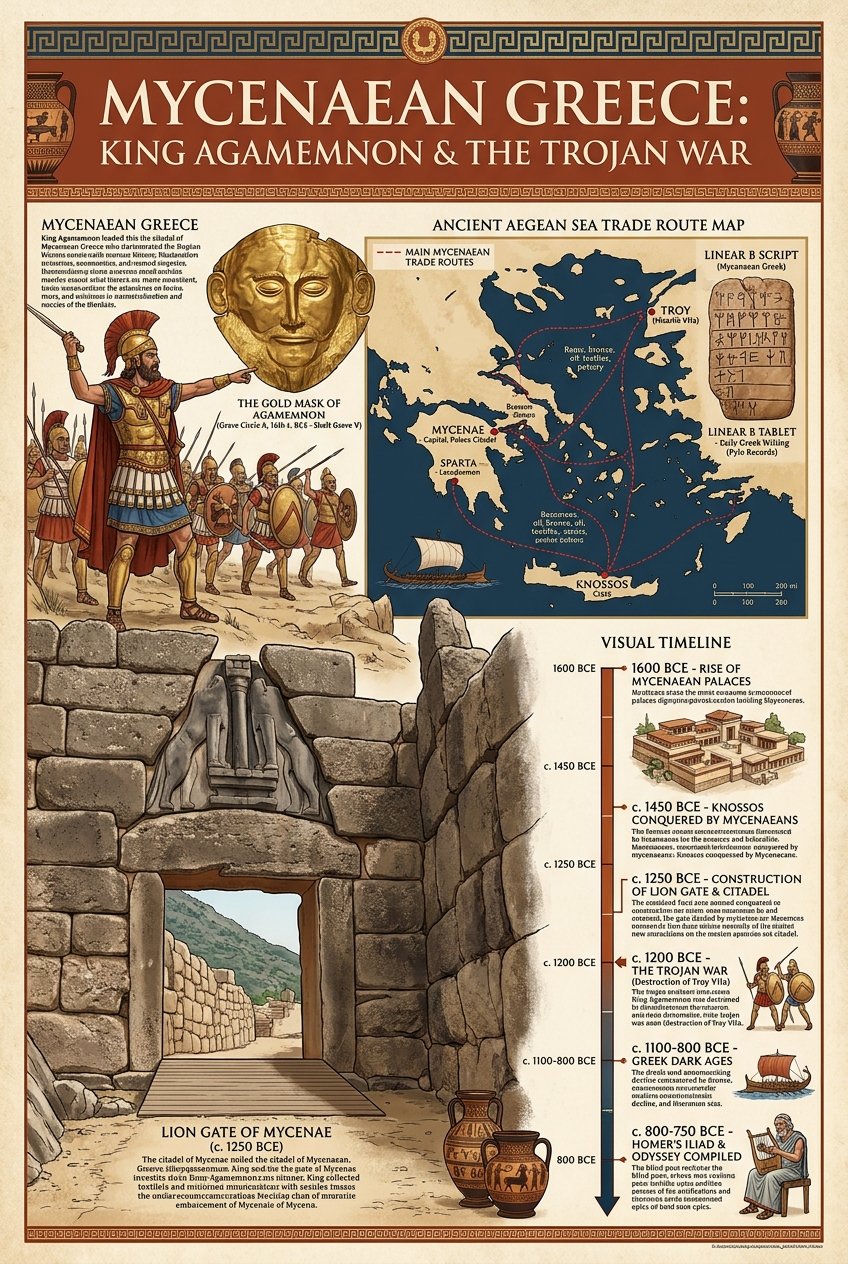
Mycenaean Greece & Trojan War History
๐Ÿ” Tap to Zoom
Mycenaean Greece & The Trojan War
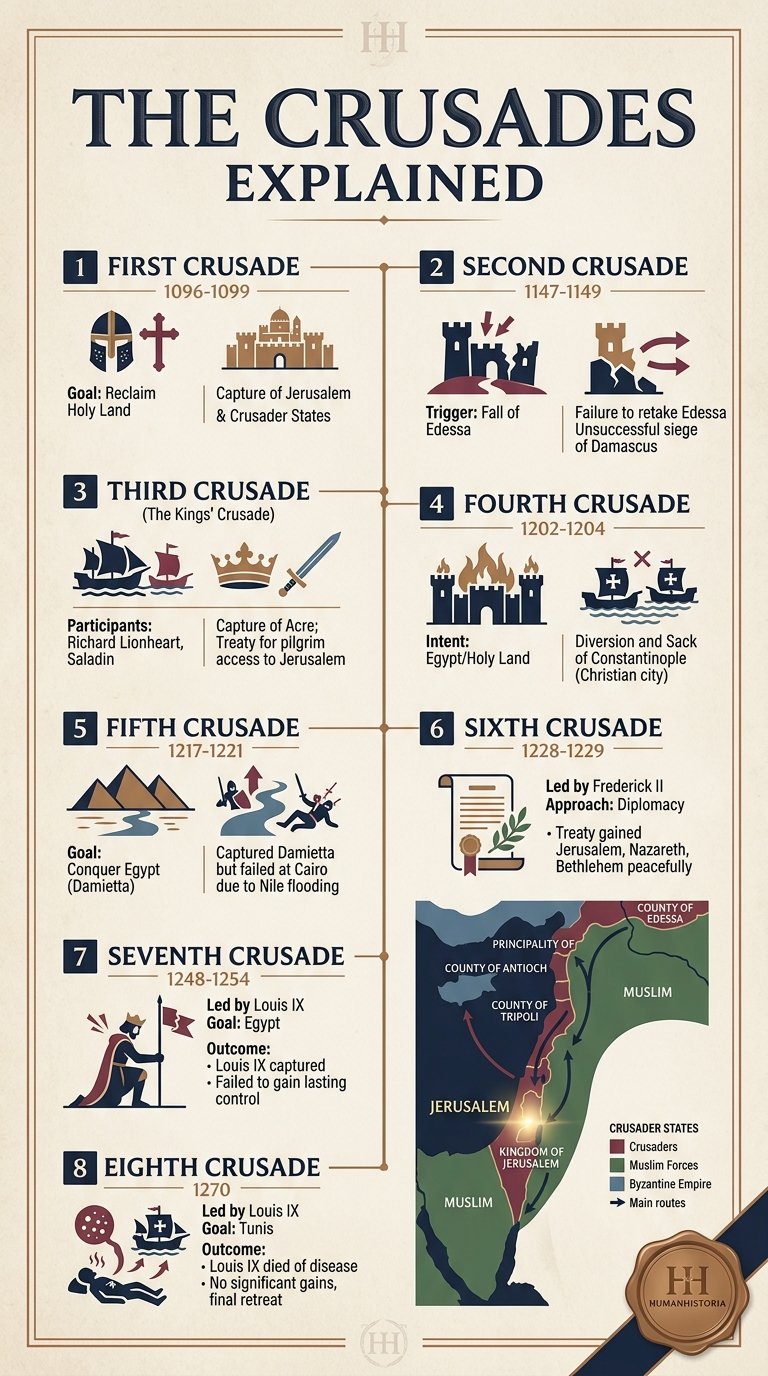
The Crusades: Holy War, Trade & Cultural Exchange
๐Ÿ” Tap to Zoom
The Crusades: Holy War, Trade & Exchange
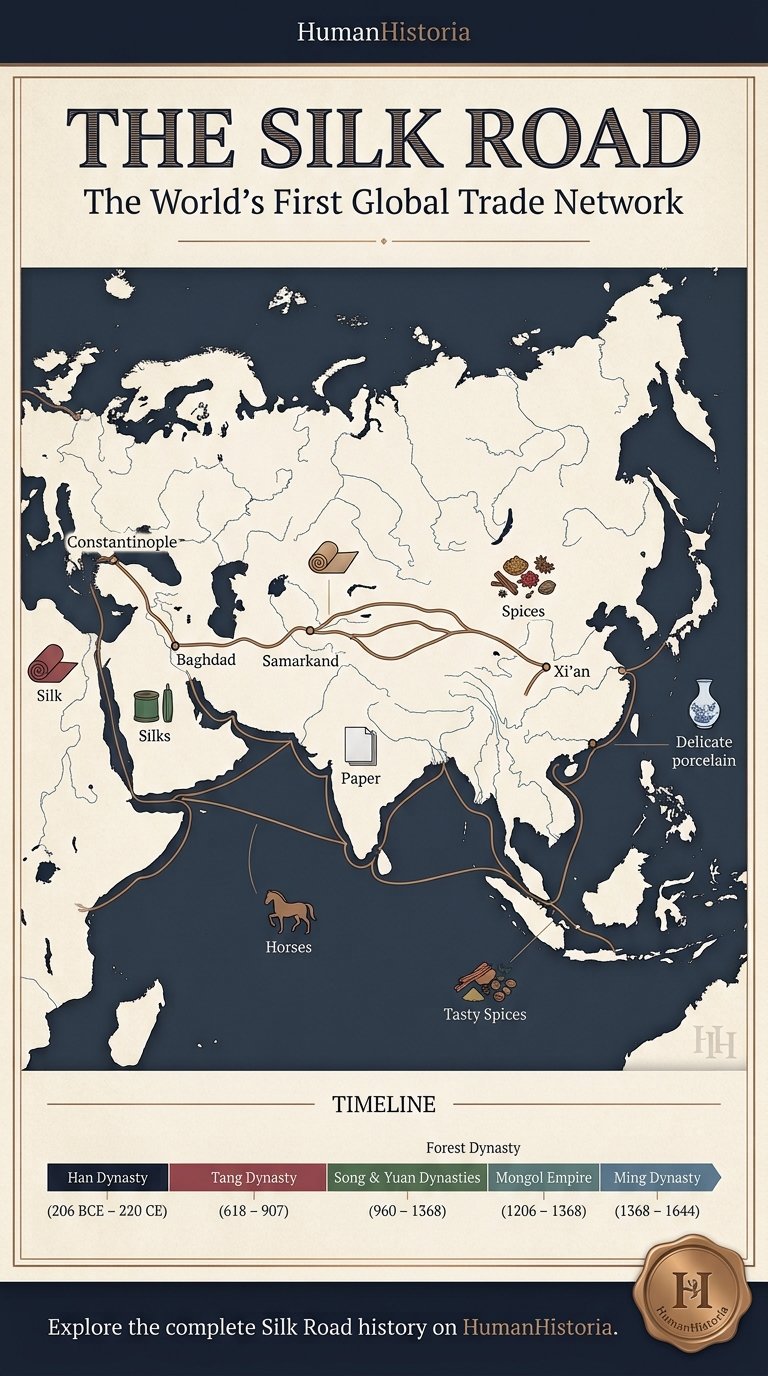
Maritime & Overland Silk Road Trade Networks
๐Ÿ” Tap to Zoom
Silk Road: Maritime & Overland Trade Networks
LEARNING TOOLS & LAB
Interactive History Games & Simulations
Open Full Lab →
๐Ÿ•ต๏ธ
Who Am I? (Historical Guessing Game)

A secret historical figure has been chosen. Ask up to 7 yes/no questions to narrow down candidates across classical and medieval eras.

Play Game →
๐Ÿ—บ๏ธ
Timeline Scramble

Five historical events appear out of order. Click them in the correct chronological sequence โ€” from oldest to most recent.

Test Chronology →
โš–๏ธ
Empire Matchup Simulator

Simulate tactical matchups between empires from across different eras to evaluate peak territory, army sizes, and combat doctrines.

Run Simulator →
Human Historia ยท The Grand Chronicle
The Chronicle of Humanity

300,000 years. 5 eras. Countless turning points that shaped every moment of your world.

๐Ÿฆด
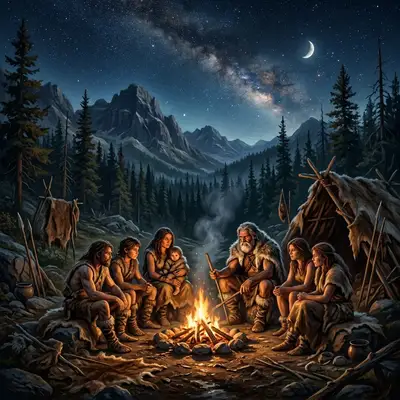
Prehistoric Era
c. 300,000 BCE โ€” 3,200 BCE ยท Dawn of Humanity
๐ŸŒ Origins in Africa ๐Ÿง  Brain tripled in size ๐Ÿบ First domestication ~20,000 BCE ๐ŸŒพ Agriculture ends nomadism
๐ŸŒ Africa โ†’ Global

Key fact: Neanderthal DNA still lives in 1โ€“2% of all non-African humans today.

Related: Animal Domestication, Cave Art

๐Ÿ”ฅ Africa

Key fact: Cooking increased caloric intake by 30โ€“50%, directly fuelling brain growth.

Related: Stone Tools, Migration

๐ŸŒพ Fertile Crescent

Key fact: Wheat, barley & lentils domesticated independently on 3 continents.

Related: Gรถbekli Tepe, Cuneiform

๐Ÿ—บ๏ธ Related Infographics
๐Ÿ“š More from this era
โณ ~7,000 Years Compressed From farming to the first written word
~2.3% of recorded human history
๐Ÿ›๏ธ
Ancient Ages
c. 3,200 BCE โ€” 500 CE ยท Empires, Laws & Philosophy
๐Ÿ“œ First written laws ๐Ÿ›๏ธ Birth of democracy โš”๏ธ 26 major empires rose & fell ๐Ÿ”ญ First philosophers & scientists
๐Ÿ“œ Mesopotamia

Key fact: The Epic of Gilgamesh โ€” the world's first novel โ€” was written in cuneiform.

Related: Epic of Gilgamesh, Hammurabi

๐Ÿ“š Alexandria, Egypt

Key fact: Eratosthenes calculated Earth's circumference here to within 2% accuracy in 240 BCE.

Related: Greek Philosophy, Roman Empire

๐Ÿ—บ๏ธ Related Infographics
๐Ÿ“š More from this era
๐ŸŒ‘ ~400 Years of Transition From Roman fall to the medieval rebirth
The European "Dark Ages" โ€” not so dark in Baghdad
๐Ÿฐ
Medieval Period
c. 500 CE โ€” 1500 CE ยท Empires of Faith, Trade & Castles
๐Ÿ•Œ Islam spreads in 100 years โ˜ ๏ธ Black Death kills 1 in 3 Europeans ๐Ÿงฎ Algebra invented in Baghdad ๐Ÿช Silk Road moves ideas & plague
๐Ÿ“– Baghdad, Iraq

Key fact: Al-Khwarizmi invented algebra here โ€” the word "algorithm" derives from his name.

Related: Silk Road, Mansa Musa

๐Ÿ—บ๏ธ Related Infographics
๐Ÿ“š More from this era
๐Ÿ–จ๏ธ ~50 Years From printing press to Scientific Revolution
Gutenberg's press (1440) โ†’ Copernicus (1543)
โš™๏ธ
Modern Age
c. 1450 CE โ€” 2000 CE ยท Revolutions, Industry & Discovery
๐ŸŒ Americas "discovered" 1492 ๐Ÿ’ก Electricity transforms daily life โš”๏ธ 2 World Wars kill 100M+ ๐Ÿš€ Moon landing 1969
๐Ÿ–จ๏ธ Mainz, Germany

Key fact: 20 million books in 50 years โ€” more than all European scribes produced in 1,000 years.

Related: Scientific Revolution, Reformation

๐Ÿš‚ Britain

Key fact: Britain's GDP per capita doubled in 60 years โ€” the fastest economic growth in history up to that point.

Related: Electricity, Wright Brothers

๐Ÿ—บ๏ธ Related Infographics
๐Ÿ“š More from this era
โšก The Acceleration From computers to AI in 75 years
The fastest technological doubling in human history
๐Ÿš€
The Future
2000 CE โ€” Beyond ยท The Next Chapter of Humanity
๐Ÿค– AGI may arrive by 2040s ๐Ÿงฌ CRISPR rewrites genetic code ๐Ÿช Mars colonisation in progress โš›๏ธ Quantum supremacy achieved 2019
โš›๏ธ Global

Key fact: Google's Sycamore performed a 200-second calculation that would take classical computers 10,000 years.

Related: AI Singularity, CRISPR, Space

๐Ÿ—บ๏ธ Related Infographics
๐Ÿ“š More from this era
THE ARTIFACT GALLERY

Examine the tangible relics, physical tokens, and revolutionary machines that shaped civilizational growth.

๐ŸŽฅ VIDEO HUB & SHORTS

Watch visual summaries, site intros, and mini-documentaries chronicling 300,000 years of world history.

๐Ÿ“Š HISTORICAL INFOGRAPHICS ARCHIVE

Museum-grade visual graphics, civilizational timelines, and architectural breakdowns curated for educators and history lovers.

THE HISTORIA CIRCLE

Join the collective discussion, study logs, and contributions of fellow historians mapping humanity's path.

Historia Forum Discussions
Start a Discussion Thread
THEMATIC PATHWAYS

Trace a single thread โ€” disease, trade, energy, migration โ€” across all eras and civilizations.

History is not just a sequence of events โ€” it is a network of patterns. These thematic pathways allow you to follow a single concept across thousands of years: how agriculture spread, how warfare evolved, how trade routes shaped civilizations. Each pathway collects the most relevant chronicles across all eras.

๐Ÿงฉ
How is this different from the sidebar Topics?
While the sidebar Topics (like Science & Tech or Empires) filter articles within your selected historical Era, Thematic Pathways cut horizontally across all eras (from Prehistoric to the Future). Use Themes to trace a single concept's evolutionary line across 300,000 years.
CIVILIZATION HUBS

Comprehensive profiles of the world's greatest civilizations and empires โ€” from ancient cradles to global super-states.

Human Historia provides an academically rich exploration of the world's most influential civilizations. From the monumental achievements of ancient Egypt, Han China, and the Roman Empire, to the sophisticated societies of the Maya, the Islamic Caliphates, and West African empires, these hubs offer deep insights into the cultural, political, and technological legacies that continue to shape our global story.

EVOLUTION OF HUMAN SKILLS

Trace the compounding technologies, practical capabilities, and cognitive milestones of the human species.

Human progress is a story of compounding skills. Every breakthrough, from the spark of prehistoric fire to modern silicon transistors, builds directly on previous generations of ingenuity. Hover over a skill node to trace its historical prerequisites, and click it to explore its development timeline, species-wide impact, and related chronicles.

Prehistoric Ancient Medieval Modern Future
๐Ÿง 

Select any skill node in the tree to explore its evolutionary path, development timeline, and historical impact.

ACADEMIC PASSPORT

Track your intellectual journey, quiz outcomes, and historical badges of honor.

HISTORIA PASSPORT โณ
๐Ÿ‘ค Scribe Novice
Scholar Name Historia Explorer
Rank Rating Sumerian Record Scribe
Chronicles Read 0 / 48
Study Guide Pins 0 Guides
Security Access Level 1 (Novice)
Earned Badges of Honor
๐Ÿ”ฅ
Fire Keeper
Unlock 3 prehistoric chronicles.
๐Ÿ›๏ธ
Codex Keeper
Unlock 3 ancient chronicles.
๐Ÿฐ
Guild Master
Unlock 3 medieval chronicles.
โš™๏ธ
Steam Engineer
Unlock 3 modern chronicles.
๐Ÿš€
Singularity Sage
Unlock 3 future chronicles.
๐Ÿ‘‘
Grand Scholar
Score 5/5 on the Lab Quiz.
Recent Lab Activities
No recent activities recorded. Take a quiz or bookmark articles!
๐Ÿ›๏ธ MISSION & ARCHIVAL STANDARDS
About Human Historia

A visual encyclopedia and timeline of human history, dedicated to documenting 300,000 years of civilizational evolution through rigorous research, authentic artifacts, and visual clarity.

๐ŸŒ
The 300,000-Year Story

Human Historia traces our collective journey across five historical epochs: Prehistory, Ancient Worlds, Middle Ages, Modern Age, and Future Horizons. From the first control of fire to quantum computation, we organize turning points into interconnected timelines.

๐Ÿ“œ
Historiographical Rigor

Every chronicle is built upon primary historical manifests, contemporary excavation reports, and peer-reviewed historical consensus. We prioritize authentic public domain artifacts and clearly identify scholarly debates surrounding major civilizational transitions.

๐ŸŽจ
Museum-Grade Visuals

Complex historical transitions demand visual understanding. We develop high-resolution infographics, architectural cutaways, and comparative territorial maps to transform abstract timelines into vivid, unforgettable learning experiences.

๐Ÿ“–
Educational Access

Knowledge belongs to humanity. Human Historia is free, ad-light, and engineered as an educational resource for students, classroom educators, academic researchers, and curious minds across all continents.

Editorial Governance & Inquiries

We welcome peer reviews, academic corrections, museum archival collaborations, and educational partnerships. To submit historical inquiries or provide archival feedback, reach our editorial desk directly.

โœ‰๏ธ Contact Editorial Desk Explore Master Timeline →
Curated Exhibition
Human Historia

An immersive graphical anthology tracing the paths of civilizations, breakthroughs, and conflicts that forged the modern consciousness.

25Chronicles
Showing all articles

Genghis Khan's Yam Relay: History's First Transcontinental Postal Network

Written by Humanhistoria Editorial Historical Era: MEDIEVAL

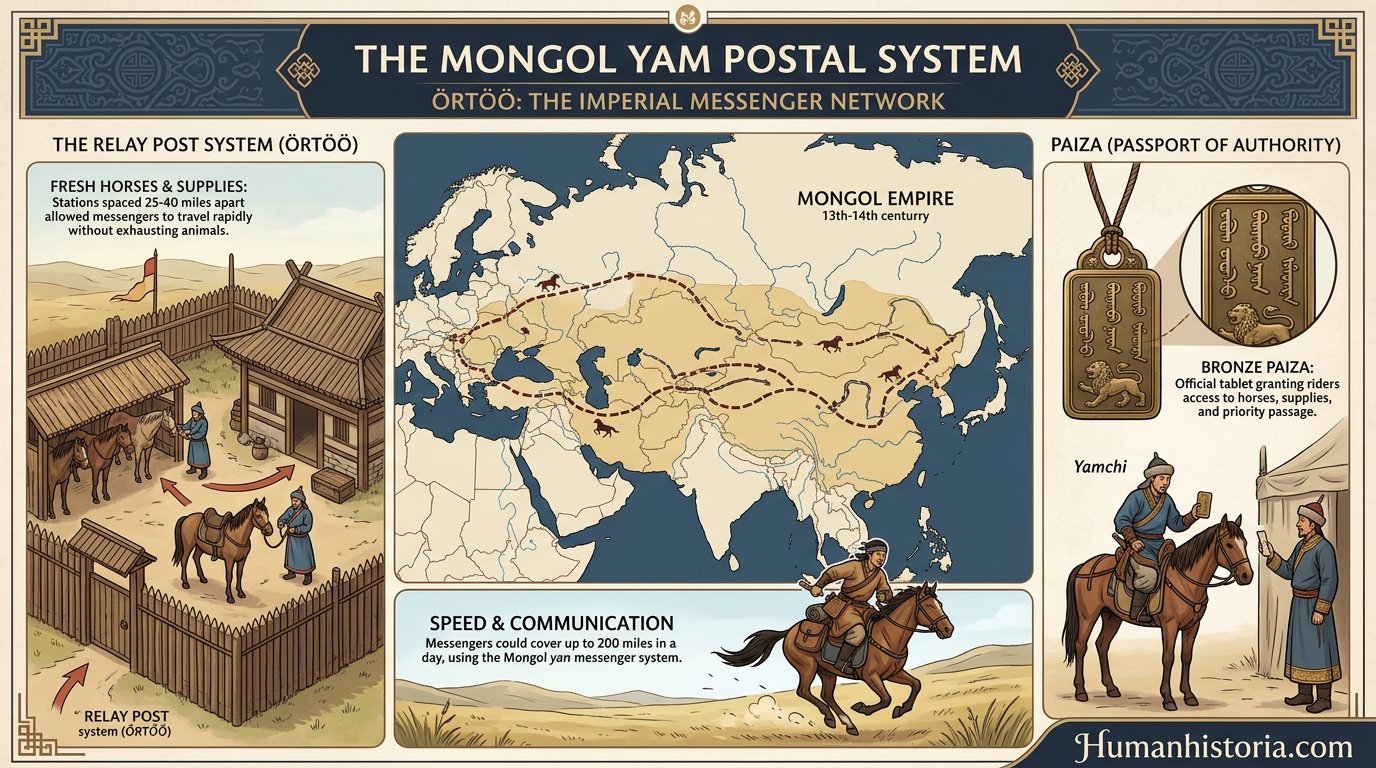
Across six thousand miles of trackless Eurasian steppes, windswept mountain passes, and scorched deserts, an urgent imperial decree had to travel from the Mongol capital of Karakorum to the banks of the Danube in less than two weeks. In an era when European messengers took months to cross a single kingdom, the Mongol Empire engineered history's first transcontinental high-speed communication apparatus: the ร–rtรถรถ (known to the West via Russian and Persian chronicles as the Yam). Conceived by Genghis Khan and institutionalized by his successor ร–gedei Khan in 1234 CE, the Yam was an industrial relay network of thousands of fortified post stations (morin รถrtรถรถ) spaced twenty-five to thirty miles apart. Elite imperial couriers (elchi), their torsos tightly bound in linen bands to withstand continuous gallop and wearing bells that jingled to clear peasant traffic, galloped day and night, changing mounts without resting. Bearing the sacred Paizaโ€”a bronze or gold passport tablet inscribed with the seal of the Great Khan threatening death to anyone who obstructed the riderโ€”these couriers covered up to two hundred miles in twenty-four hours, tying together an empire that encompassed one-fifth of the globe.

Mongol courier galloping on a post-horse across the steppe
Historical engraving of an elite Mongol Yam courier galloping across the Eurasian steppe, changing mounts at fortified relay stations to transmit imperial decrees across the Mongol Empire. (Archival Collection)

The Logistics of Conquest: Governing Twelve Million Square Miles

At its zenith under Kublai Khan, the Mongol Empire spanned twelve million contiguous square miles, encompassing modern China, Korea, Central Asia, Russia, Iran, and the borders of Eastern Europe. Governing an estimated one hundred million subjects across disparate languages, alphabets, and topographies presented an unprecedented logistical challenge. An empire won on horseback could easily fracture into autonomous, warring khanates without centralized administrative coordination.

More critically, Mongol military doctrine relied upon simultaneous, synchronized multi-pronged invasions. In 1241 CE, general Subutai and prince Batu Khan orchestrated a coordinated double offensive separated by five hundred miles of mountain ranges, striking Poland at the Battle of Legnica and Hungary at the Battle of Mohi within two days of each other. Such complex operational coordination was impossible without reliable, high-speed military intelligence flowing continuously between frontline field marshals and the imperial court.

ร–gedei's Masterpiece: The Codification of the ร–rtรถรถ (1234 CE)

While Genghis Khan utilized ad-hoc horse messengers during his initial conquests of northern China and Khwarazm, the formal standardization of the network was decreed in 1234 CE by his third son and successor, ร–gedei Khan. As recorded in the contemporary epic The Secret History of the Mongols, ร–gedei recognized that earlier messengers had burdened pastoral nomadic clans by arbitrarily seizing local horses and supplies, causing economic disruption.

ร–gedei codified the Great Yassa laws governing the postal system, establishing permanent, dedicated stations:

  • Systematic Station Spacing: Fortified relay stations (morin รถrtรถรถ) were erected along primary trade and military corridors every twenty-five to thirty milesโ€”the distance a horse could sprint at top speed without collapsing.
  • Station Infrastructure: Each station was staffed by a station master (morin-chi), armed guards, and grooms. Stations maintained twenty to one hundred fresh steppe ponies, comfortable resting quarters for traveling envoys, and extensive grain warehouses.
  • The Qubchur Tax: The system was funded not by arbitrary looting, but through a structured communal tax called qubchur. Every nomadic herd was assessed, and local clans were legally mandated to supply horses, sheep for food, and leather tack to their designated local relay post.
Mongol Yam rider exchanging horses at a post station from the Jami al-Tawarikh
Persian illuminated miniature from Rashฤซd al-Dฤซn's 14th-century historical compendium Jฤmiสฟ al-Tawฤrฤซkh, depicting an imperial Mongol Yam courier exchanging mounts at a post station while fresh horses are readied by station grooms. (Bibliothรจque nationale de France, Paris)

The Courier's Ordeal: Belled Riders and the Golden Paiza

The physical demands placed upon imperial Yam riders (elchi) bordered on the superhuman. Couriers bound their heads, chests, and abdomens with tight rolls of linen fabric to prevent internal organ damage from the relentless, jarring impact of riding at a gallop for twenty-four hours without pause.

Affixed to the courierโ€™s belt and saddle were clusters of small bronze bells. As the rider galloped within two or three miles of the next station, the rhythmic ringing echoed across the steppe. Hearing the alarm, station grooms instantly led a saddled, well-fed horse out onto the road. The arriving courier leaped from his lathered mount directly onto the fresh pony without setting foot on the ground, snatching food and water handed to him on the run, and vanished down the highway in seconds.

The Sacred Paiza (Gerege)

The operational authority of the Yam rested upon the Paiza (or Gerege)โ€”an engraved passport tablet manufactured from wood, silver, or gold, suspended from the courierโ€™s neck by a silk cord or fastened to his belt. The tablet carried an inscription in the Uighur-Mongol or Phags-pa script:

"By the strength of the Eternal Heaven, holy be the Khanโ€™s Name. Whosoever does not pay respect to this order shall be slain and die."

โ€” Standard Inscription on a Golden Mongol Paiza (Mongolian State Historical Museum, Ulaanbaatar)

The Paiza was absolute law. An authorized rider presenting the tablet could commandeer fresh horses from any prince, merchant caravan, or peasant along the road. Anyone who failed to yield right-of-way, attempted to inspect the courier's sealed leather dispatch bag, or refused a horse was beheaded on the spot without trial.

Imperial Communication: Roman Cursus vs. Persian Chapar vs. Mongol Yam

The Mongol Yam surpassed all ancient and medieval communication networks in geographic scale, operational velocity, and institutional integration.

Communication Metric Achaemenid Persian (c. 500 BCE) Roman (c. 27 BCEโ€“400 CE) Mongol Empire (1234โ€“1368 CE)
Geographic Extent ~1,600 miles (Royal Road: Susa to Sardis) ~50,000 miles of paved roads across Mediterranean Over 6,000 miles transcontinental (Pacific to Danube)
Station Network 111 stations spaced one day's ride apart (inns) and (horse-change posts) Over 1,400 permanent stations; ~50,000 horses maintained
Peak Courier Speed ~60โ€“80 miles per day ~40โ€“50 miles per day (standard); 100 miles (emergency) 150 to 200 miles in 24 hours (continuous day/night relay)
Passport Authority Royal royal seals on clay bullae issued by Emperor or provincial governor Paiza (Gerege) tablet carrying immediate death penalty for obstruction
Commercial Integration Strictly limited to royal court correspondence Exclusive state administrative and military courier service Integrated Pax Mongolica: protected foreign merchants, friars, and astronomers

The Pax Mongolica: Information Highway of the Medieval World

Beyond carrying military commands, the Yam transformed into the arterial network of the Pax Mongolica. For the first time in recorded history, an unbroken, safe transport corridor connected the Atlantic world to the Pacific. Venetian merchants like Marco Polo, Franciscan diplomats such as William of Rubruck and John of Plano Carpini, and Persian scholars traveled across the entirety of Asia using imperial Yam relays.

Marco Polo recorded his astonishment at the vastness of Kublai Khanโ€™s network in the late thirteenth century, estimating that the Great Khan maintained over ten thousand post stations and more than three hundred thousand horses across China and Central Asia. The Yam transported luxury cargo at high speed: fresh seasonal fruit from southern China was rushed to the royal banquet tables in Beijing within forty-eight hours, while exotic medicinal herbs, precious jade, and astronomical treatises flowed between Beijing and the Ilkhanate observatory at Maragheh in Persia.

"Now you must know that from the city of Cambaluc (Beijing) there are many roads leading to the different provinces, and upon each of these roads, at every twenty-five or thirty miles, there is a post-house, which they call a Yamb... At each of these posts there are kept three hundred to four hundred horses, always ready for the messengers, and fine luxurious buildings furnished with silk beds and every necessity... When need arises for the Great Kaan to receive news of a rebellion or any important matter, the messengers ride two hundred miles in a day and night, changing horses continually."

โ€” Marco Polo, The Travels of Marco Polo (Book II, Chapter 26, c. 1300 CE)
โš–๏ธ

Historian Debate: Enlightened Global Integration vs. Parasitic Surveillance

The "Global Connectivity" School (Jack Weatherford, Thomas Allsen)

Argues that the Yam created the foundational blueprint for modern globalization. By guaranteeing safe passage for merchants, standardizing international passports, and transmitting gunpowder, printing, and paper money across continents, it sparked the Eurasian scientific and economic awakening.

The "Totalitarian Surveillance" Critique (David Morgan, Peter Jackson)

Maintains that the Yam was an oppressive instrument of autocratic military domination. The crushing tax burden of supplying tens of thousands of horses and luxury provisions devastated local sedentary farming populations, while the relay network served primarily as a surveillance apparatus to detect domestic dissent.

Epidemiologists emphasize that the Yam's speed had a catastrophic side effect: it functioned as a biological super-spreader, rapidly transmitting the Black Death (Yersinia pestis) from rodent colonies on the steppe to Mediterranean ports in 1346โ€“1347.

From Karakorum to the Russian Yamshchik: Enduring Legacy

When the Mongol Empire dissolved in the fourteenth century, the Yam did not perish; it was inherited, preserved, and adapted by its successor states. In China, the Ming Dynasty retained the post-horse system (Yizhan), which operated throughout the Qing dynasty until the twentieth-century telegraph era.

In Russia, the Golden Hordeโ€™s postal system permanently transformed Muscovite governance. The Russian tsars preserved the network as the Yamshchik service (from the Tatar word yam). For four centuries, post-coachmen (yamshchiki) galloped along winter post-roads from Moscow to the far reaches of Siberia. In the United States in 1860, the organizers of the Pony Express explicitly cited the historic relay methods of the Mongol Yam as their operational model for carrying mail across the American frontier.

By demonstrating that continent-sized empires could be unified through disciplined logistical relays, standardized security clearance, and coordinated relay posts, Genghis Khan's horse postal network established the organizational principles that underpin modern postal services, express couriers, and international transport supply chains today.

๐Ÿ“– SCHOLARLY INQUIRIES

Frequently Asked Questions

Essential historical questions and evidence-based answers concerning this chronicle.

What was the Mongol Yam (ร–rtรถรถ) postal system?

The ร–rtรถรถ (known in the West as the Yam) was a vast imperial courier and relay station network established by Genghis Khan and institutionalized by ร–gedei Khan across the Mongol Empire. Spanning over 30,000 miles with roughly 1,400 relay posts spaced 25 to 30 miles apart, it enabled couriers to cover 200 to 250 miles in a single day.

What was a Mongol Paiza (Gerge) and how did it work?

A Paiza was an official inscribed metal or wooden tablet carried by imperial messengers, ambassadors, and favored merchants. Bearing royal inscriptions invoking Tengri (the Eternal Sky) and the Great Khan, the paiza functioned as an absolute diplomatic passport, legally compelling station masters and subject populations to furnish fresh horses, rations, and armed escorts upon demand under pain of death.

How fast did Mongol messengers travel across the empire?

Elite couriers, tightly binding their chests and heads to endure punishing galloping, regularly traveled 200 to 250 miles (320 to 400 km) in 24 hours. By swapping horses every 25 miles at relay stations, dispatches from Karakorum reached Tabriz in Persia or Sarai on the Volga within weeks rather than months.

Did the Yam system contribute to the spread of the Black Death?

Yes. While the Yam enabled unprecedented transmission of diplomatic knowledge, trade, and technology under the Pax Mongolica, its interconnected transit corridors and grain stores also facilitated the rapid transmission of Yersinia pestis (the Black Death) from Central Asian marmot populations to the Black Sea and Europe in 1346โ€“1347.

๐Ÿ“š Academic Sources & Scholarly Bibliography
  • Weatherford, Jack (2004). Genghis Khan and the Making of the Modern World. Crown Publishing.
  • Morgan, David (2007). The Mongols. Wiley-Blackwell.
  • Allsen, Thomas T. (2001). Culture and Conquest in Mongol Eurasia. Cambridge University Press.
  • Polo, Marco (1958). The Travels of Marco Polo. Penguin Classics.
โšก Fast Facts
  • Historical EraMEDIEVAL
  • Region๐ŸŒ EUROPE
  • CategoryEmpires
  • Reading Timeโฑ 12 min read
๐Ÿ“– Scholar Mode Active โ€” Click to exit focused reading
Selected Era

Prehistoric Era

Millions of years ago to ~3000 BCE

The dawn of humanity. From the evolutionary split of early hominids to the mastery of stone tools, fire, and the birth of language.

Landmark Milestones

Welcome to Historia

Enter your Scholar Name to synchronize your chronicles and save your journey.