~7,000 Years from farming to writing
๐Ÿ›๏ธ

Ancient Ages

c. 3,200 BCE โ€” 500 CE ยท Empires, Laws & Philosophy
~400 Years from Roman fall to medieval rebirth
๐Ÿฐ

Medieval Period

c. 500 CE โ€” 1500 CE ยท Empires of Faith, Trade & Castles
~50 Years from printing press to Scientific Revolution
โš™๏ธ

Modern Age

c. 1450 CE โ€” 2000 CE ยท Revolutions, Industry & Discovery
~50 Years from computers to quantum age

THE ARTIFACT GALLERY

Examine the tangible relics, physical tokens, and revolutionary machines that shaped civilizational growth.

๐ŸŽฅ VIDEO HUB & SHORTS

Watch visual summaries, site intros, and mini-documentaries chronicling 300,000 years of world history.

๐Ÿ“Š HISTORICAL INFOGRAPHICS ARCHIVE

Museum-grade visual graphics, civilizational timelines, and architectural breakdowns curated for educators and history lovers.

THE HISTORIA CIRCLE

Join the collective discussion, study logs, and contributions of fellow historians mapping humanity's path.

Historia Forum Discussions

Start a Discussion Thread

THEMATIC PATHWAYS

Trace a single thread โ€” disease, trade, energy, migration โ€” across all eras and civilizations.

History is not just a sequence of events โ€” it is a network of patterns. These thematic pathways allow you to follow a single concept across thousands of years: how agriculture spread, how warfare evolved, how trade routes shaped civilizations. Each pathway collects the most relevant chronicles across all eras.

๐Ÿงฉ
How is this different from the sidebar Topics?
While the sidebar Topics (like Science & Tech or Empires) filter articles within your selected historical Era, Thematic Pathways cut horizontally across all eras (from Prehistoric to the Future). Use Themes to trace a single concept's evolutionary line across 300,000 years.

CIVILIZATION HUBS

Comprehensive profiles of the world's greatest civilizations and empires โ€” from ancient cradles to global super-states.

Human Historia provides an academically rich exploration of the world's most influential civilizations. From the monumental achievements of ancient Egypt, Han China, and the Roman Empire, to the sophisticated societies of the Maya, the Islamic Caliphates, and West African empires, these hubs offer deep insights into the cultural, political, and technological legacies that continue to shape our global story.

EVOLUTION OF HUMAN SKILLS

Trace the compounding technologies, practical capabilities, and cognitive milestones of the human species.

Human progress is a story of compounding skills. Every breakthrough, from the spark of prehistoric fire to modern silicon transistors, builds directly on previous generations of ingenuity. Hover over a skill node to trace its historical prerequisites, and click it to explore its development timeline, species-wide impact, and related chronicles.

Prehistoric Ancient Medieval Modern Future
๐Ÿง 

Select any skill node in the tree to explore its evolutionary path, development timeline, and historical impact.

ACADEMIC PASSPORT

Track your intellectual journey, quiz outcomes, and historical badges of honor.
HISTORIA PASSPORT โณ
๐Ÿ‘ค Scribe Novice
Scholar Name Historia Explorer
Rank Rating Sumerian Record Scribe
Chronicles Read 0 / 48
Study Guide Pins 0 Guides
Security Access Level 1 (Novice)

Earned Badges of Honor

๐Ÿ”ฅ
Fire Keeper
Unlock 3 prehistoric chronicles.
๐Ÿ›๏ธ
Codex Keeper
Unlock 3 ancient chronicles.
๐Ÿฐ
Guild Master
Unlock 3 medieval chronicles.
โš™๏ธ
Steam Engineer
Unlock 3 modern chronicles.
๐Ÿš€
Singularity Sage
Unlock 3 future chronicles.
๐Ÿ‘‘
Grand Scholar
Score 5/5 on the Lab Quiz.

Recent Lab Activities

No recent activities recorded. Take a quiz or bookmark articles!
Curated Exhibition

Human Historia

An immersive graphical anthology tracing the paths of civilizations, breakthroughs, and conflicts that forged the modern consciousness.

25Chronicles
Showing all articles

Invention of the Wheel (c. 3500 BCE): Mesopotamia & Transport Revolution

Written by Historia Transport Historical Era: ANCIENT
* Note: Cover image is an AI-generated historical illustration.

๐Ÿง Key Chronicle Takeaway (Atomic Summary)

The invention of the wheel in Mesopotamia and its adaptation to military chariots and logistics.

The wheel is the universal symbol of mechanical progress, yet its invention was one of the most difficult and late developments in human prehistory. While ancient civilisations constructed cities, developed pottery, and domesticated animals without the wheel, the breakthroughโ€”occurring around 3500 BCE in Mesopotamia and Eastern Europeโ€”unlocked land-based mobility. By pairing a rotating wheel with a fixed axle, and later developing the lightweight Spoked Wheel and the horse-drawn Chariot, humanity overcame the friction limits of land transport, accelerating trade logistics, transforming military tactics, and establishing the mechanical principles of gears and engines that drive the modern industrial world.

Pre-Wheel Transport: The Friction Barrier

Before the wheel, overland transport was severely limited by physical friction. To move goods, early humans relied on:

  • Human Portability: Carrying loads on their backs, heads, or shoulders, which limited the weight a single person could move to around 50 to 100 pounds.
  • Pack Animals: Domesticating donkeys, llamas, and oxen, which could carry heavier loads but were restricted by rugged terrain, food supplies, and speed.
  • Sledges and Rollers: Dragging heavy stones or timber on wooden sledges over wet mud or ice. Scribes and engineers have noted that while heavy statues (such as in ancient Egypt) could be moved using wooden rollers, this required a massive labor force to continuously pick up logs from the rear and place them at the front, making it impractical for long-distance commercial trade.

Because dragging objects required overcoming high sliding friction, overland trade was slow and expensive. Consequently, early civilisations remained tied to rivers and coasts, where water buoyancy eliminated friction, allowing boats to move heavy cargo with minimal energy.

The Invention of the Wheel-and-Axle System

The core invention was not the circle itselfโ€”potters had been using rotating clay wheels for centuries, and logs were known to roll. The breakthrough was the wheel-and-axle system, which required precise carpentry and metallurgy.

To create a functional wheeled vehicle, craftsmen had to solve a mechanical problem: a wheel must rotate freely around a central shaft (the axle), yet the axle must remain firmly attached to the carriage frame. This required:

  • A Perfect Fit: The hole at the center of the wheel (the hub) had to be perfectly round and slightly larger than the axle shaft. If it was too tight, the wheel would jam; if it was too loose, the vehicle would wobble and break.
  • Friction Management: The contact surfaces between the wooden wheel and the axle had to be smooth and lubricated (often using animal fat or vegetable oil) to prevent heat build-up and wear.
  • Metal Tools: The invention occurred during the Bronze Age, as the development of hard bronze chisels, gouges, and saws allowed carpenters to carve the precise mortise-and-tenon joints needed for the axle shaft.

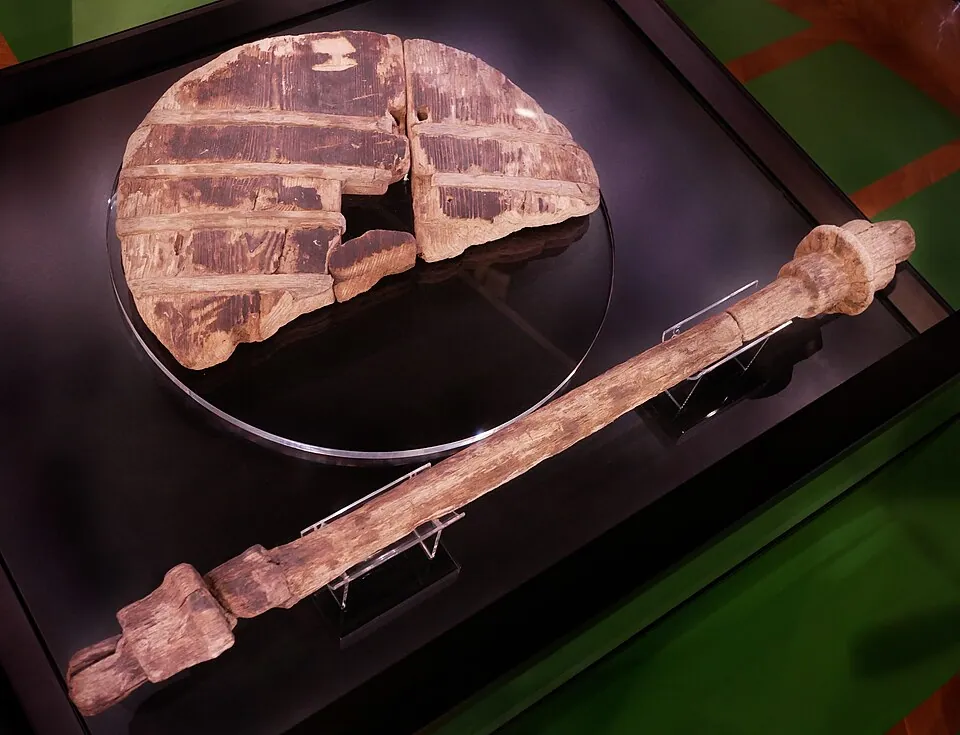
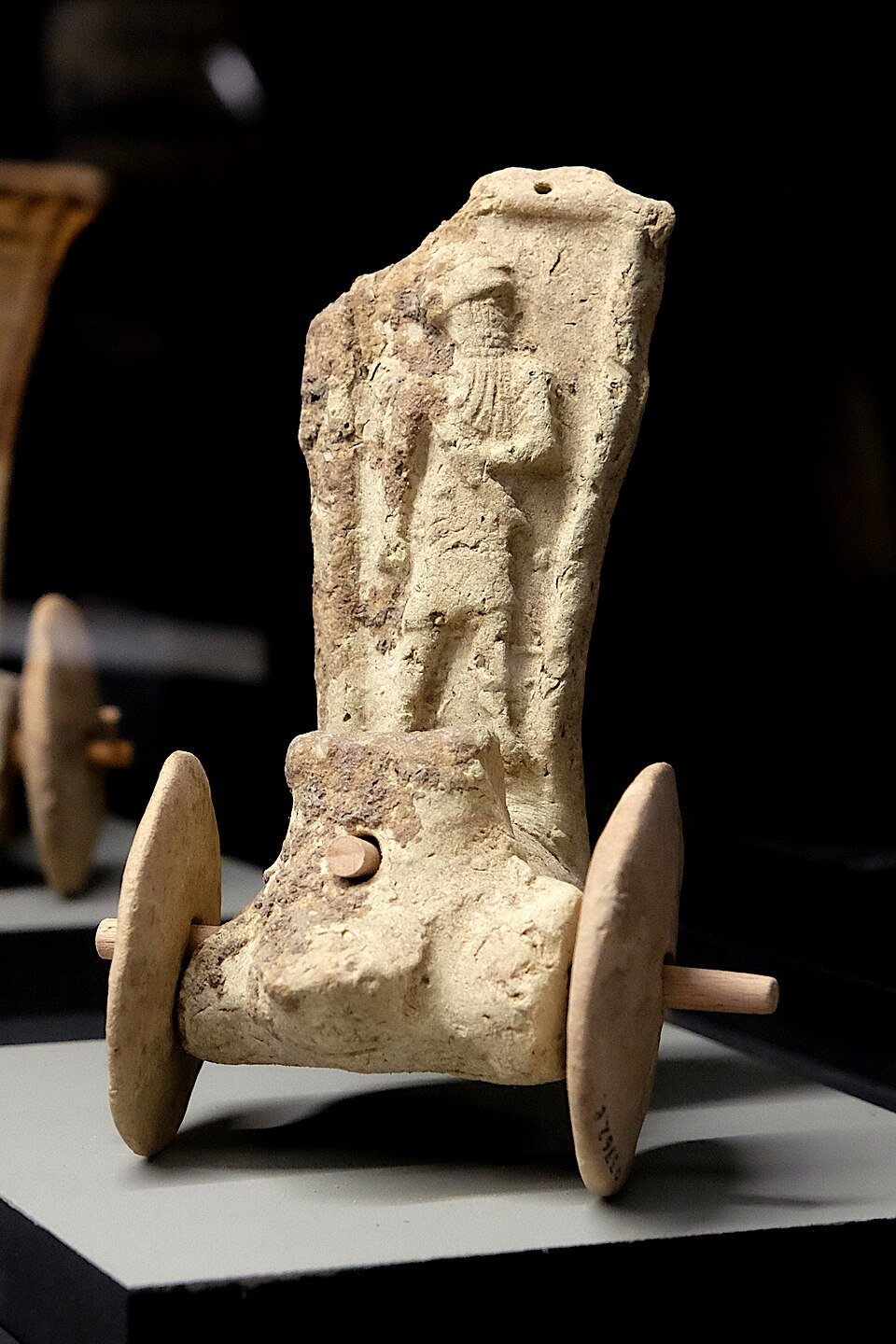
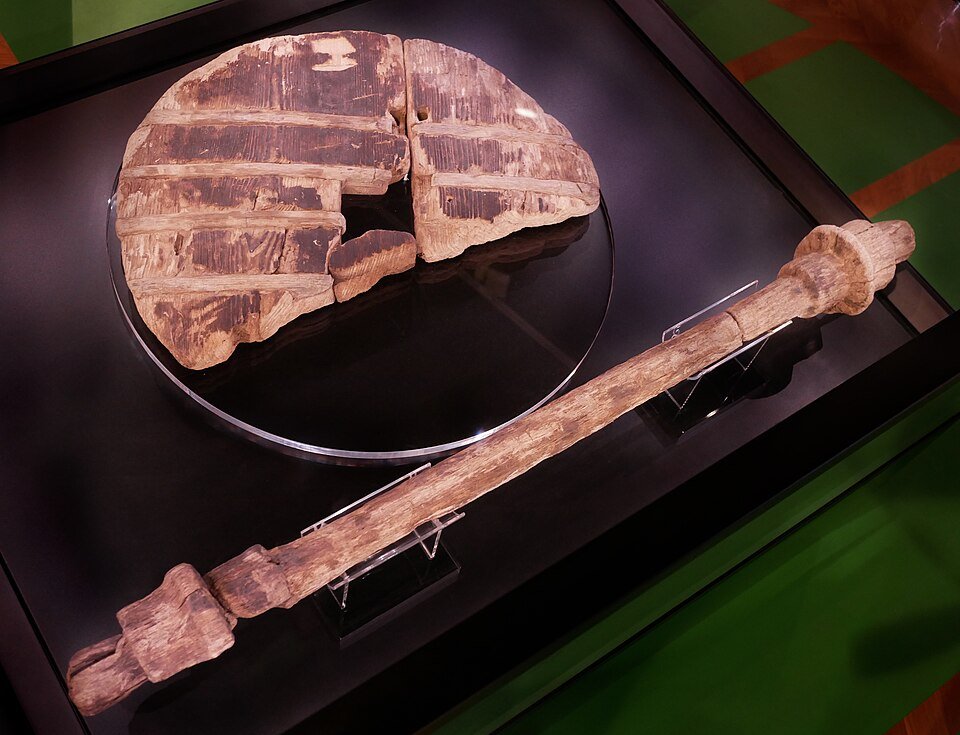
Archaeological evidence shows the wheel emerged almost simultaneously around 3500โ€“3000 BCE in three regions: Mesopotamia, the northern Caucasus (the Maykop culture), and Central Europe (depicted on the Bronocice clay pot in Poland). These early wheels were solid disks, made by joining three thick wooden planks together with wooden dowels and carving them into a circle, fitted onto a heavy, rotating wooden axle pulled by slow-moving oxen.

The Sintashta Culture and the Spoked Wheel

The solid wooden wheel was heavy, weighing up to 100 pounds, making it slow and prone to cracking in rugged terrain. The next mechanical leap occurred around 2000 BCE in the steppe region north of the Caspian Sea, developed by the Sintashta Culture (in modern Russia and Kazakhstan).

To reduce weight, Sintashta craftsmen hollowed out the solid wooden disk, replacing it with a light outer rim, a central hub, and thin spokes held under tension.

This required woodworking:

  • Craftsmen bent green wood (such as ash or birch) using steam to form a circular outer rim (the felloe).
  • They carved a central hub and inserted multiple wooden spokes (usually 4 to 12) that radiated outward to connect the hub to the rim.
  • This spoked wheel weighed less than a quarter of a solid wheel, allowing for high speeds and structural flexibility, absorbing shocks in rugged terrain.

The Chariot: The Bronze Age Mobile Platform

The spoked wheel, combined with the domestication of the horse, led to the invention of the Chariotโ€”a lightweight, two-wheeled war vehicle. The chariot served as the ultimate weapons platform of the Late Bronze Age. Carrying a driver and an archer armed with a composite bow, a chariot squadron could sweep across plains, firing arrows at infantry lines from distance. The Hittites, Egyptians, Mycenaean Greeks, and Vedic Aryans used chariot tactics to dominate battles, defining the geopolitics of the Bronze Age Near East.

Roman Road Infrastructure: Viae

While the wheel transformed transport, vehicles were only as good as the ground they rolled on. In wet soil or mud, heavy carts sank, breaking axles. To exploit the wheelโ€™s efficiency, the Roman Empire constructed a massive network of paved roadsโ€”the viaeโ€”spanning over 50,000 miles across Europe, North Africa, and the Middle East.

Roman roads were engineered for durability:

  1. Engineers dug a deep trench, filling the base with large stones for drainage.
  2. They added a layer of gravel and sand to absorb shocks.
  3. The surface was paved with large, flat hexagonal volcanic paving stones (pavimentum), sloped from the center to the sides to allow rainwater runoff.

These paved roads allowed wheeled carts to travel year-round, securing military logistics and enabling the Cursus Publicus (the state mail relay system) to move messages and officials across the empire at speeds of 50 miles a day.

The Wheel as a Rotary Power Transmitting Component

Beyond transportation, the mechanical principles of the wheel-and-axle led to the development of rotary power transmission. Scribes and engineers adapted the wheel to create the waterwheel and the windmill to grind grain. By adding interlocking teeth to the wheel's rim, they invented gears, allowing machines to alter speed, torque, and direction of force, laying the mechanical foundations for clocks, steam engines, and modern machinery.

Ball Bearings and the Pneumatic Rubber Tire

The evolution of the wheel accelerated in the late 19th century through two innovations:

  • Steel Ball Bearings: Developed in the 1860s, ball bearings placed small steel spheres inside the wheel hub to minimize rotational friction between the wheel and the axle, allowing for high speeds and heavy loads without wear.
  • The Pneumatic Tire: In 1887, the Scottish inventor John Boyd Dunlop patented the pneumatic rubber tireโ€”an air-filled rubber tube wrapped around the wheel rim. Dunlop originally designed the tire to give his son's tricycle a smoother ride on cobbles. The pneumatic tire absorbed shocks, protected the wheel from wear, and improved traction.

These innovations allowed wheels to operate on high-speed bicycles, automobiles, trains, and industrial machinery, transforming modern transportation and manufacturing logistics.

Mechanical Clocks and Gear Train Engineering

The mechanical principles of the wheel were central to the development of the mechanical clock in medieval Europe. Invented in the late 13th century, mechanical clocks used a weight-driven gear train controlled by an escapement mechanism to measure time. The gear wheels had to be carved with precise tooth profiles to transmit force without slipping. The development of mechanical clocks standardized time-keeping, moving society away from solar time to clock time, which structured the schedules of monasteries, city markets, and eventually, the factories of the Industrial Revolution.

Rotary Gears in Antikythera and Clocks

The mechanical application of the wheel led to early computers. The most famous ancient example is the Antikythera Mechanism (discovered in a Greek shipwreck, dating to c. 150-100 BCE). This device used a gear train of over 30 bronze wheel gears to calculate the positions of the sun, moon, and planets, serving as an early analog computer. Scribes note that the mechanical principles of these rotating gears were later adapted in the 13th century to build mechanical clocks, proving that the wheel was the primary component used to automate time and calculate astronomical data.

In summary, the historical and structural developments explored in this chronicle demonstrate that human progress is a collective, cumulative endeavor. No single technology, empire, law, or language arose in a vacuum; each milestone built directly upon the achievements, resources, and failures of the civilizations that came before it. By examining these complex connections, we can see how early hominids mastering fire initiated a chain of technological innovations that led to the steam engine, heavy industry, and the digital age. As humanity stands on the brink of interplanetary exploration and artificial superintelligence, understanding these historical precedents provides us with the perspective needed to navigate the ethical, social, and technological challenges of the future. The human odyssey remains an ongoing, choices-driven journey across space and time, shaping the destiny of our species and the universe.

The War Chariot in the Battle of Megiddo

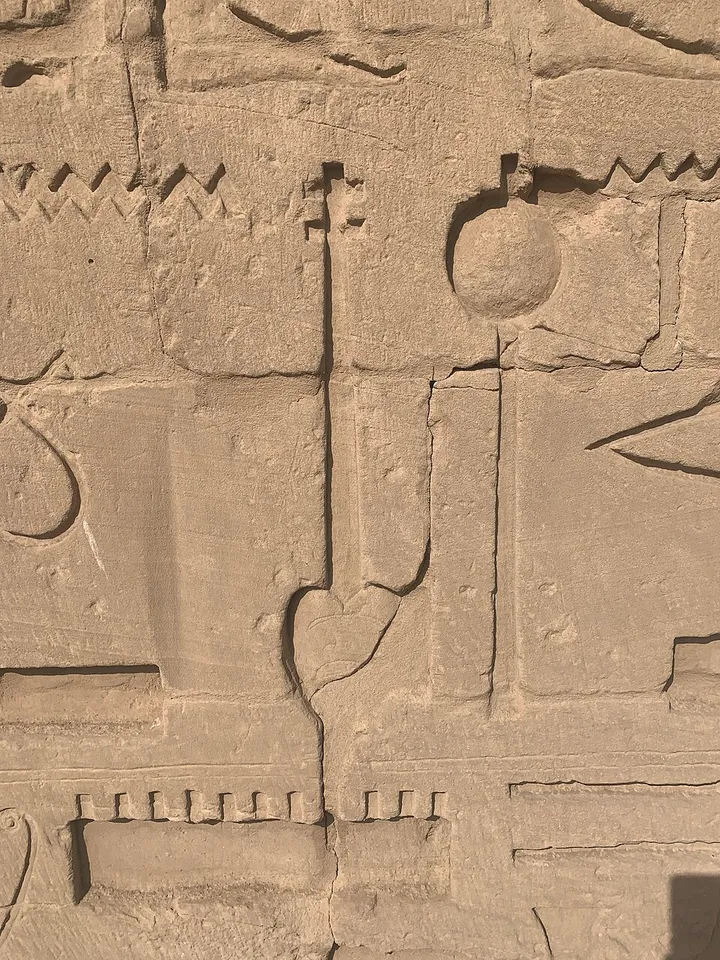
The military application of the spoked wheel transformed ancient Near Eastern warfare, as demonstrated by the Battle of Megiddo (1457 BCE) between Egypt, under Pharaoh Thutmose III, and a coalition of Canaanite vassal states. Megiddo is the first battle in recorded history to features detailed tactical accounts, written by the military scribe Tjaneni on the walls of the Temple of Karnak.

Both armies relied on the light spoked-wheel war chariot as their primary strike weapon. Constructed from bent wood and leather, these chariots were pulled by two horses, carrying a driver and a composite-bow archer. The spoked wheel allowed the chariot to turn at high speed without breaking. Thutmose III led a surprise charge of his chariot forces through a narrow mountain pass, caught the Canaanites off guard, and routed them. The Egyptian chariot acted as a mobile archer platform, maintaining range and firing arrows to break infantry ranks before they could make contact. The victory at Megiddo established Egyptian control over the Levant and proved that wheeled transport was the decisive factor in Bronze Age empire-building.

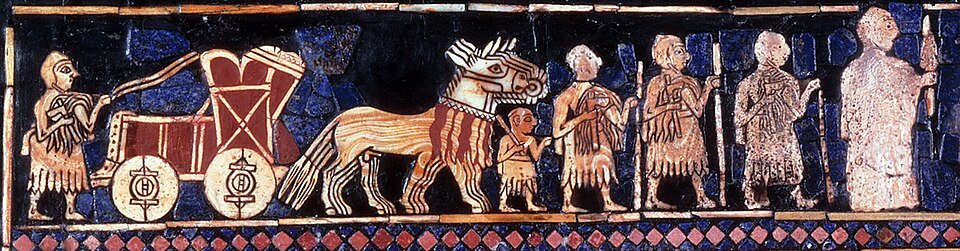
Sumerian war chariot with solid wooden wheels on the Standard of Ur
A detail of the Standard of Ur (c. 2500 BCE) showing Sumerian war chariots equipped with early solid tripartite wooden wheels.

Conclusion and Legacy

The wheel and chariot transformed the physical geography of human trade and war. By converting sliding friction into rolling rotation, this Bronze Age invention allowed societies to move agricultural produce, raw materials, and armies over land, laying the mechanical and infrastructural foundations that eventually led to steel railways, combustion engines, and the global logistics networks of the modern world.

โš–๏ธ

Historian Debate: Where Was the Wheel Invented?

The Mesopotamian Cradle

Historically, archaeologists pointed to Sumerian clay tablets from Uruk (c. 3500 BCE) as the earliest evidence of wheeled carts used for urban logistics.

The Eurasian Steppe and Cucuteni-Trypillia

Recent clay models and trackways suggest the wheel arose independently among Neolithic copper miners in the Carpathian Mountains or pastoralists of the Pontic Steppe.

The wheel transformed logistics, military chariotry, and spatial integration across Afro-Eurasia.

"The wagon was the vessel of the steppe โ€” it allowed pastoralists to transport their families and water, transforming the vast grasslands into a corridor of migration."

โ€” David W. Anthony, The Horse, the Wheel, and Language (2007).

Further Reading

  • The Horse, the Wheel, and Language โ€” by David W. Anthony. A monumental study on how pastoralists with wagons and horses reshaped Eurasian history.
  • Wheels: A Pictorial History โ€” by Edwin Tunis. A visual history of the development of wheeled transport.
๐Ÿ“– Scholar Mode Active โ€” Click to exit focused reading
Selected Era

Prehistoric Era

Millions of years ago to ~3000 BCE

The dawn of humanity. From the evolutionary split of early hominids to the mastery of stone tools, fire, and the birth of language.

Landmark Milestones

Welcome to Historia

Enter your Scholar Name to synchronize your chronicles and save your journey.