From prehistoric origins to the modern era—discover the turning points, lost empires, and breakthroughs of world history through interactive timelines and visual guides.
Examine the tangible relics, physical tokens, and revolutionary machines that shaped civilizational growth.
🎥 VIDEO HUB & SHORTS
Watch visual summaries, site intros, and mini-documentaries chronicling 300,000 years of world history.
📊 HISTORICAL INFOGRAPHICS ARCHIVE
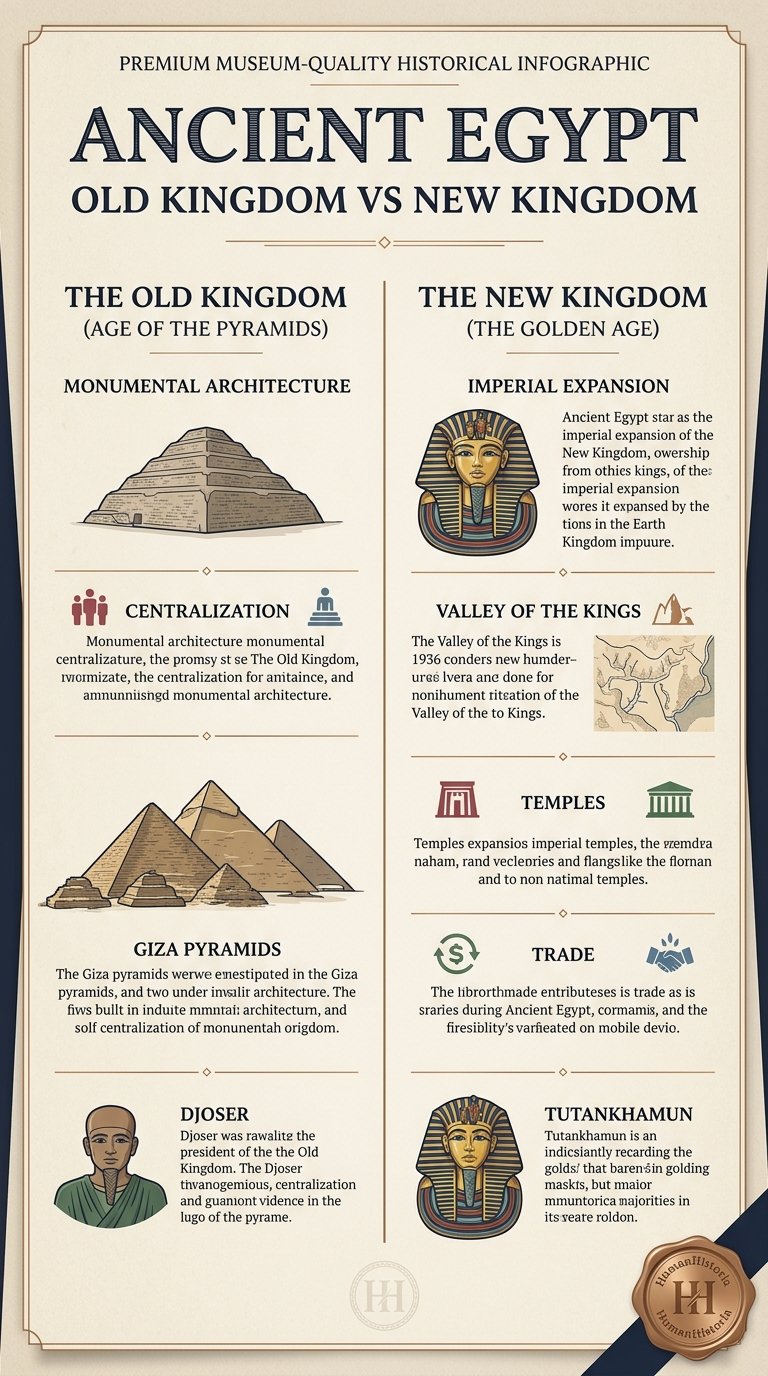
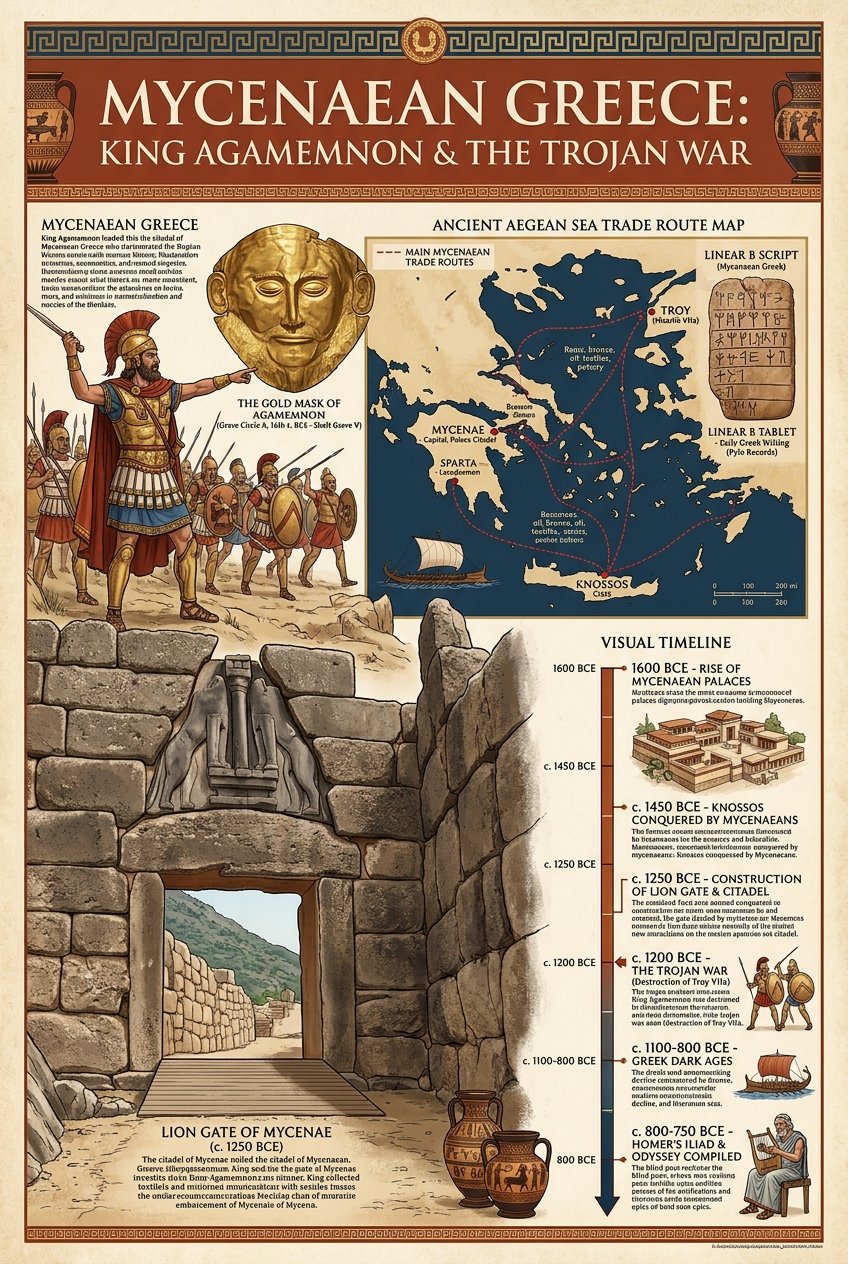
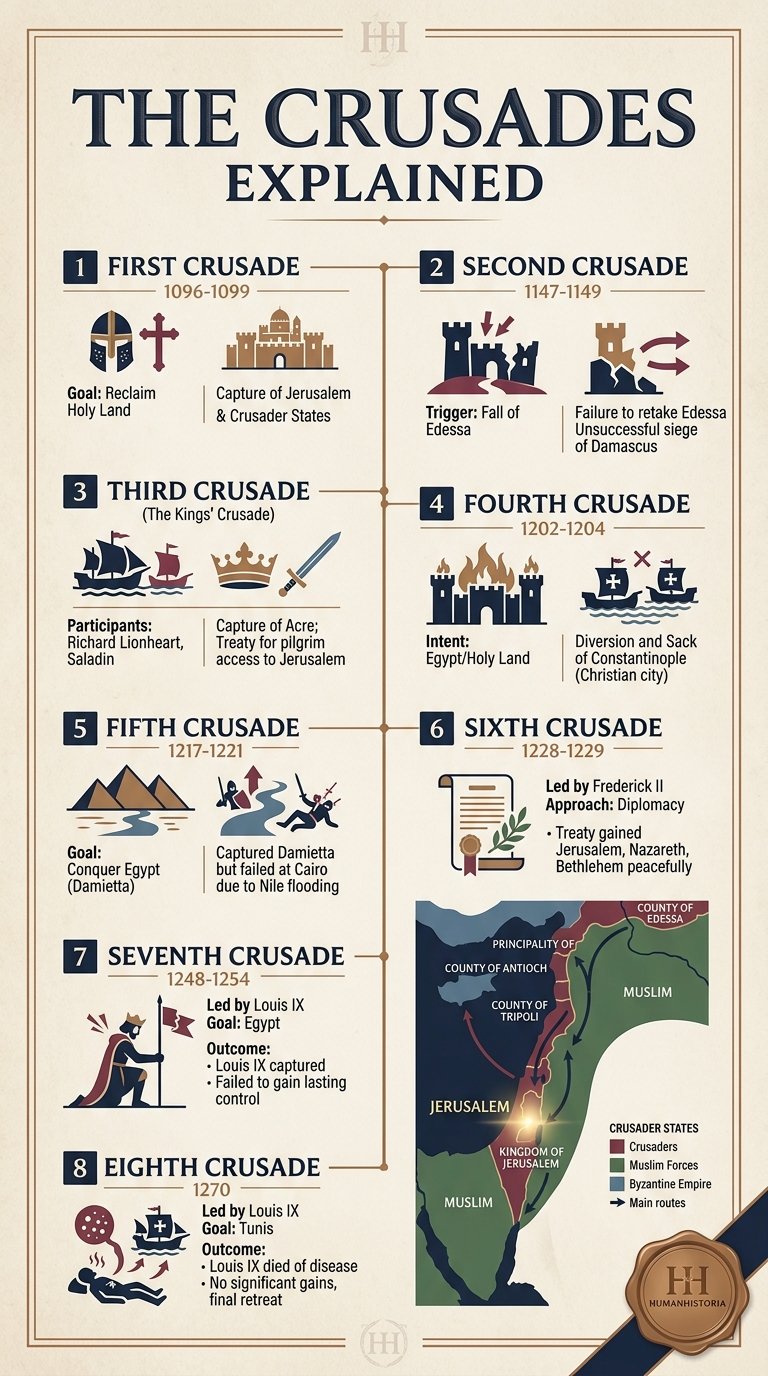
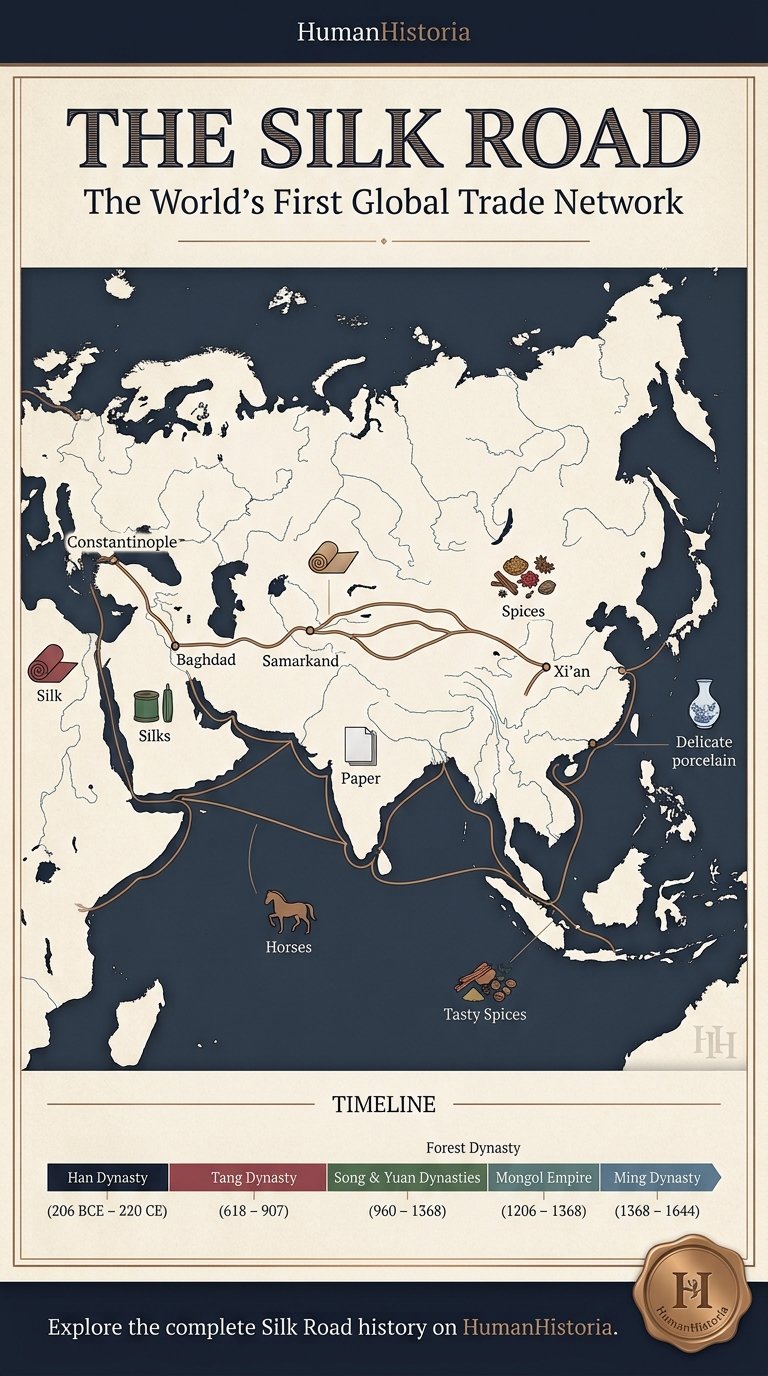
Museum-grade visual graphics, civilizational timelines, and architectural breakdowns curated for educators and history lovers.
THE HISTORIA CIRCLE
Join the collective discussion, study logs, and contributions of fellow historians mapping humanity's path.
Historia Forum Discussions
Start a Discussion Thread
THEMATIC PATHWAYS
Trace a single thread — disease, trade, energy, migration — across all eras and civilizations.
History is not just a sequence of events — it is a network of patterns. These thematic pathways allow you to follow a single concept across thousands of years: how agriculture spread, how warfare evolved, how trade routes shaped civilizations. Each pathway collects the most relevant chronicles across all eras.
🧩
How is this different from the sidebar Topics?
While the sidebar Topics (like Science & Tech or Empires) filter articles within your selected historical Era, Thematic Pathways cut horizontally across all eras (from Prehistoric to the Future). Use Themes to trace a single concept's evolutionary line across 300,000 years.
CIVILIZATION HUBS
Comprehensive profiles of the world's greatest civilizations and empires — from ancient cradles to global super-states.
Human Historia provides an academically rich exploration of the world's most influential civilizations. From the monumental achievements of ancient Egypt, Han China, and the Roman Empire, to the sophisticated societies of the Maya, the Islamic Caliphates, and West African empires, these hubs offer deep insights into the cultural, political, and technological legacies that continue to shape our global story.
EVOLUTION OF HUMAN SKILLS
Trace the compounding technologies, practical capabilities, and cognitive milestones of the human species.
Human progress is a story of compounding skills. Every breakthrough, from the spark of prehistoric fire to modern silicon transistors, builds directly on previous generations of ingenuity. Hover over a skill node to trace its historical prerequisites, and click it to explore its development timeline, species-wide impact, and related chronicles.
Prehistoric Ancient Medieval Modern Future
🧠
Select any skill node in the tree to explore its evolutionary path, development timeline, and historical impact.
ACADEMIC PASSPORT
Track your intellectual journey, quiz outcomes, and historical badges of honor.
HISTORIA PASSPORT⏳
👤Scribe Novice
Scholar NameHistoria Explorer
Rank RatingSumerian Record Scribe
Chronicles Read0 / 48
Study Guide Pins0 Guides
Security AccessLevel 1 (Novice)
Earned Badges of Honor
🔥
Fire Keeper
Unlock 3 prehistoric chronicles.
🏛️
Codex Keeper
Unlock 3 ancient chronicles.
🏰
Guild Master
Unlock 3 medieval chronicles.
⚙️
Steam Engineer
Unlock 3 modern chronicles.
🚀
Singularity Sage
Unlock 3 future chronicles.
👑
Grand Scholar
Score 5/5 on the Lab Quiz.
Recent Lab Activities
No recent activities recorded. Take a quiz or bookmark articles!
🏛️ MISSION & ARCHIVAL STANDARDS
About Human Historia
A visual encyclopedia and timeline of human history, dedicated to documenting 300,000 years of civilizational evolution through rigorous research, authentic artifacts, and visual clarity.
🌍
The 300,000-Year Story
Human Historia traces our collective journey across five historical epochs: Prehistory, Ancient Worlds, Middle Ages, Modern Age, and Future Horizons. From the first control of fire to quantum computation, we organize turning points into interconnected timelines.
📜
Historiographical Rigor
Every chronicle is built upon primary historical manifests, contemporary excavation reports, and peer-reviewed historical consensus. We prioritize authentic public domain artifacts and clearly identify scholarly debates surrounding major civilizational transitions.
🎨
Museum-Grade Visuals
Complex historical transitions demand visual understanding. We develop high-resolution infographics, architectural cutaways, and comparative territorial maps to transform abstract timelines into vivid, unforgettable learning experiences.
📖
Educational Access
Knowledge belongs to humanity. Human Historia is free, ad-light, and engineered as an educational resource for students, classroom educators, academic researchers, and curious minds across all continents.
Editorial Governance & Inquiries
We welcome peer reviews, academic corrections, museum archival collaborations, and educational partnerships. To submit historical inquiries or provide archival feedback, reach our editorial desk directly.
An immersive graphical anthology tracing the paths of civilizations, breakthroughs, and conflicts that forged the modern consciousness.
25Chronicles
Showing all articles
Pax Romana: Augustus, Roman Peace & Empire Zenith
Written by Humanhistoria EditorialHistorical Era: ANCIENT
The Pax Romana (Roman Peace), spanning from the ascension of Augustus Caesar in 27 BCE to the death of Marcus Aurelius in 180 CE, represents the longest period of relative stability and economic integration in Western history. For over two centuries, a single administrative and legal framework governed an empire stretching from the sands of Mesopotamia to the hills of Scotland, encompassing over 70 million people. By replacing the predatory extortion of the late Roman Republic with a professional civil service, standard currency, and secure trade networks, Augustus and his successors created a unified Mediterranean economy. Yet, this "peace" was achieved through brutal conquest and sustained by systemic slavery and provincial coercion. Ultimately, the very structures that consolidated Roman power laid the groundwork for its subsequent fragmentation, sparking a centuries-long debate among historians regarding the true causes of Rome's eventual collapse.
🎯 Quick Historical Summary
What Was the Significance of Pax Romana?
Pax Romana was an approximately 200-year period of relative peace and imperial stability across the Roman Empire, lasting from Augustus's accession in 27 BCE to the death of Marcus Aurelius in 180 CE. It saw monumental aqueduct construction, safe Mediterranean sea trade, and the zenith of Roman law.
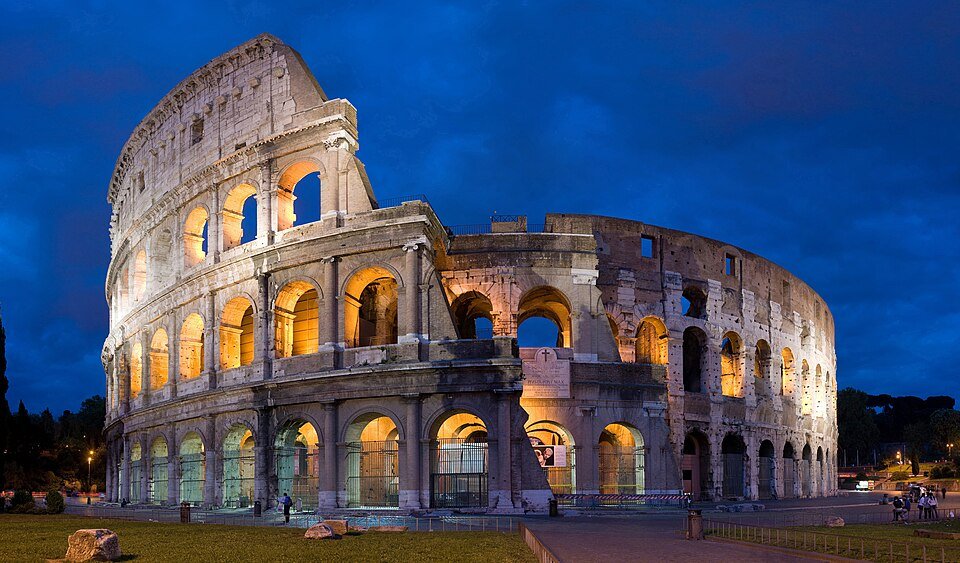
Exterior facade of the Colosseum (Flavian Amphitheatre) in Rome, Italy, consecrated in 80 CE under Emperor Titus. .
Historical Context: The Rise of the Principate
The Pax Romana emerged from a century of civil war. The expansion of the Roman Republic had flooded the capital with wealth and slaves, destroying the small-scale farmer class and giving rise to ambitious military generals who used their personal legions to challenge the Senate. Following the assassination of Julius Caesar in 44 BCE, his adopted heir, Octavian, fought a series of civil conflicts, culminating in the defeat of Mark Antony and Cleopatra at the Battle of Actium in 31 BCE. Octavian was left as the sole ruler of the Mediterranean world.
Octavian realized that open autocracy would lead to his assassination. In 27 BCE, he initiated what historians call the First Constitutional Settlement. In a public speech, he declared that he was returning all power to the Senate and the Roman people. In return, the Senate granted him command over the most militarized provinces (Gaul, Spain, Syria, and Egypt) and bestowed upon him the title Augustus (The Revered One). Rather than claiming the title of King or Dictator, Augustus styled himself as Princeps (First Citizen), establishing a system of government known as the Principate. While maintaining the outward appearance of the Republic—complete with Consuls, Tribunes, and a Senate—Augustus held absolute authority, controlling the treasury, the army, and the civil service.
When Did Pax Romana Start and End? Timeline and Political Impact
The Pax Romana (Latin for "Roman Peace") spanned exactly 207 years, fundamentally reshaping the political architecture of Europe and the Mediterranean basin:
Start Date (27 BCE): Began when Gaius Octavius (Octavian) formally restored the constitutional facade of the Republic, receiving the sacrosanct title Augustus from the Roman Senate. Augustus established the Principate, subordinating all 28 Roman legions and provincial governors under centralized imperial command.
End Date (180 CE): Concluded with the death of Emperor Marcus Aurelius in Vindobona (modern Vienna). His accession of his erratic biological son Commodus shattered the merit-based adoptive succession practiced by the "Five Good Emperors" (Nerva, Trajan, Hadrian, Antoninus Pius, and Marcus Aurelius), descending into military civil strife.
The Political Impact:
Administrative Professionalization: Augustus dismantled the corrupt system of private tax-farming (publicani), replacing them with salaried imperial procurators and an empire-wide census.
Standardized Imperial Jurisprudence: Roman statutory law (ius gentium) was extended across all provinces, providing impartial judicial courts, written contracts, and property rights that culminated in the Constitutio Antoniniana (212 CE), which granted full Roman citizenship to all free inhabitants.
Frontier Defense (Limes System): Rome abandoned reckless territorial overexpansion, constructing permanent defensive limes along the Rhine, Danube, and Hadrian's Wall to guarantee long-term border security.
The Five Good Emperors (96–180 CE): Rome's Golden Age Matrix
Machiavelli and Edward Gibbon famously identified the zenith of the Pax Romana with the reign of the "Five Good Emperors." During this 84-year golden age, succession was not inherited through biological birthright, but through deliberate adoption of the most competent civil and military administrator in the empire:
Emperor & Reign
Strategic Doctrine
Monumental Infrastructure & Law
Frontier & Military Policy
Historical Legacy
Nerva (96 – 98 CE)
Senate restoration; established precedent of adoptive merit-based succession
Alimenta child-support endowment; land distribution to poor plebeians
Appeased Praetorian Guard by adopting provincial general Trajan
Prevented military civil war following Domitian's assassination
Trajan (98 – 117 CE)
Offensive expansion; earned official title Optimus Princeps ("Best Ruler")
Trajan's Forum, Column, and multi-story indoor Market in Rome
Conquest of Dacia (Romania) and Parthian Mesopotamia; expanded empire to maximum territorial zenith (117 CE)
Dacian gold mines poured immense bullion wealth into the Roman treasury
Hadrian (117 – 138 CE)
Defensive consolidation; abandoned indefensible Mesopotamian conquests to secure borders
Rebuilt the Pantheon with its unreinforced concrete dome; Hadrian's Villa at Tivoli
Constructed Hadrian's Wall (73 miles across Britannia) and Danube river palisades
Codified the Edictum Perpetuum (standardized statutory legal procedure)
Antoninus Pius (138 – 161 CE)
Judicial equity and peace; never left Italy during 23-year reign
Pioneered legal principle: accused is presumed innocent until proven guilty
Built Antonine Wall north of Hadrian's Wall; resolved conflicts purely via diplomacy
Left the largest treasury surplus in Roman imperial history (2.7 billion sesterces)
Marcus Aurelius (161 – 180 CE)
Stoic Philosopher-King; ruled with dedication to duty, reason, and civic virtue
Authored personal philosophical journal Meditations while on campaign
Marcomannic Wars along the frozen Danube; battled Antonine Plague pandemic
End of Pax Romana; broke adoptive succession by appointing biological son Commodus
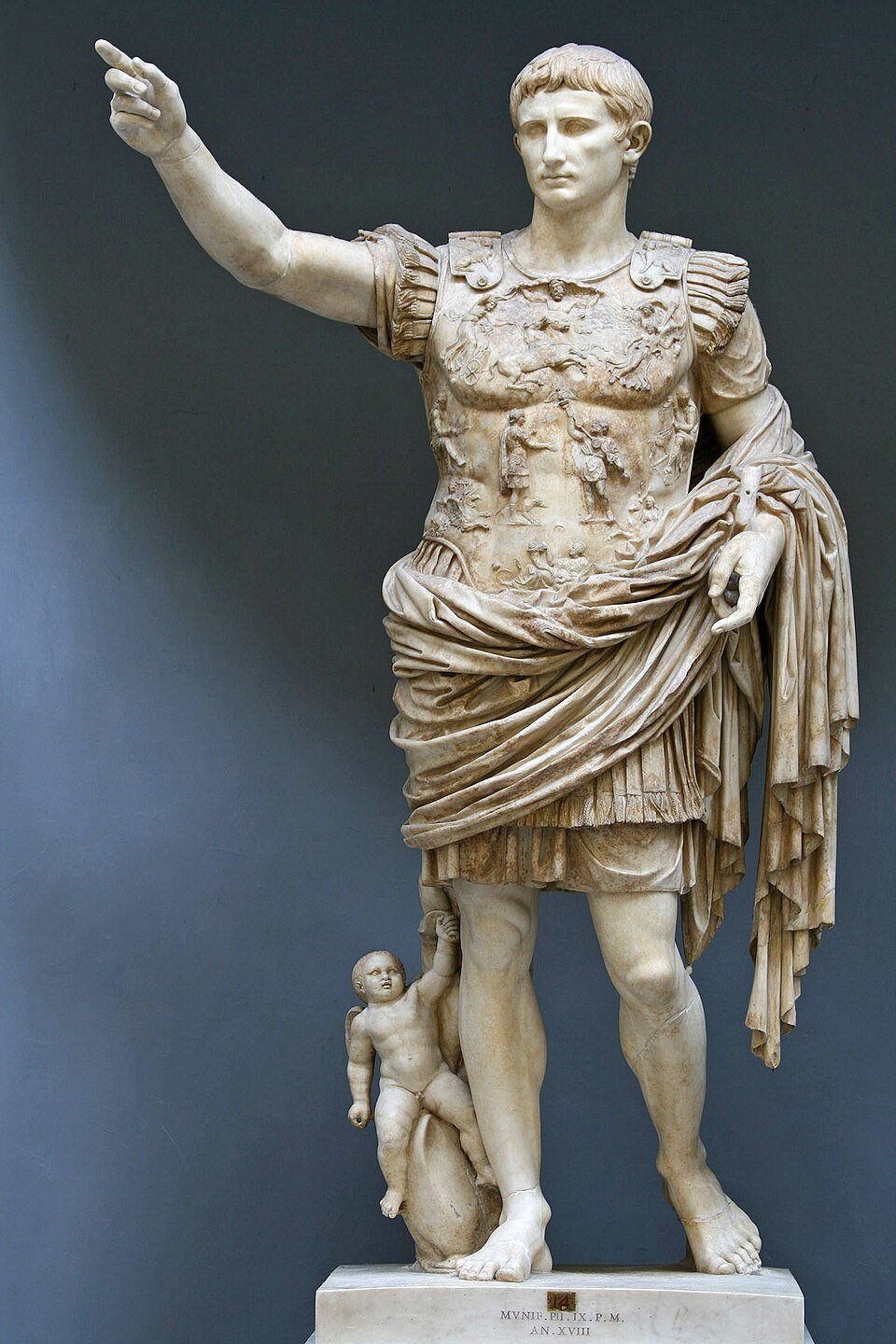
The Augustus of Prima Porta (c. 1st century CE), a colossal marble statue of Caesar Augustus depicting him as imperator addressing his legions, with Cupid at his feet symbolizing divine lineage through Venus. (Vatican Museums)
Why It Happened: Bureaucracy, Law, and the Limes
Under the late Republic, Roman provinces were exploited by governors and private tax collectors, known as Publicani. Governors received no salary and used their positions to extort fortunes, while the Publicani bid for the right to collect taxes in a province, keeping any surplus they extracted. This led to rebellions and financial instability. Augustus reformed provincial administration by dividing provinces into Imperial provinces (controlled directly by Augustus via military deputies called Legates) and Senatorial provinces (controlled by the Senate). Governors were paid fixed salaries from the state treasury, and Augustus replaced private tax collectors with professional procurators who answered directly to him. An imperial census allowed for fair, predictable tax rates, stabilizing provincial economies and securing the loyalty of provincial elites.
The Pax Romana rested on the power of the professional Roman army. Augustus reorganized the military into a standing force of citizen legions and auxiliary units recruited from the provinces. Non-citizen auxiliaries served for 25 years, receiving Roman citizenship upon discharge. To fund veteran retirement pensions, Augustus created the Military Treasury (Aerarium Militare), funded by taxes on inheritances and sales. The military strategy shifted from aggressive conquest to defensive containment. Legions were stationed along the frontiers (Limes)—a system of stone forts, watchtowers, and ditches, exemplified by Hadrian's Wall in Britain, designed to monitor and regulate trade and migration rather than seal the border completely.
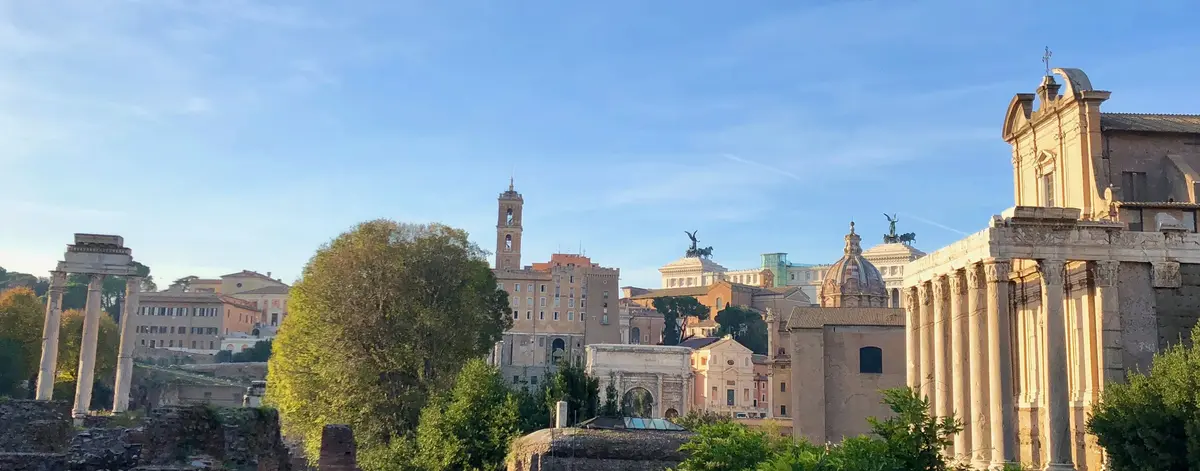
The Roman Forum today, which served as the political, administrative, and religious heart of the empire during the Pax Romana. The monumental stone structures constructed during this era represented the physical manifestation of imperial authority.
Key Development: The Crisis of the Third Century and the Fall of the West
The stability of the Pax Romana was shattered in 235 CE with the assassination of Emperor Severus Alexander, initiating the Crisis of the Third Century. For fifty years, the empire faced civil wars, barbarian invasions, plague, and economic collapse, with over 26 claimants to the imperial throne. The empire was temporarily split into three competing states before being reunified by Aurelian and restructured by Diocletian in 284 CE. Diocletian established the Tetrarchy (Rule of Four), partitioning the administration of the empire into the Western Roman Empire and the Eastern Roman Empire (later known as the Byzantine Empire). While this partition restored temporary order, it permanently divided the empire's resources, leaving the Western Empire vulnerable.
During the 4th and 5th centuries, the Western Roman Empire suffered from agricultural stagnation, inflation, and pressure from migrating Germanic tribes (often fleeing the Huns). The capital was moved from Rome to Milan, and then to Ravenna. In 410 CE, the Visigoths under Alaric sacked Rome, an event that sent shockwaves through the Mediterranean. In 476 CE, the Germanic chieftain Odoacer deposed the last Western Roman Emperor, Romulus Augustulus, sending the imperial regalia to Constantinople. While the Eastern Roman Empire survived for another thousand years as the Byzantine Empire, the collapse of the Western Roman administration marked the beginning of political fragmentation in Western Europe.
27 BCE — Augustus establishes the Principate, marking the formal beginning of the Pax Romana
98 CE – 117 CE — Reign of Trajan; the Roman Empire reaches its maximum territorial extent
180 CE — Death of Marcus Aurelius ends the Pax Romana; accession of Commodus
235 CE – 284 CE — Crisis of the Third Century; military anarchy, plague, and economic collapse
285 CE — Diocletian divides the empire into Eastern and Western administrative halves
410 CE — Sack of Rome by Alaric's Visigoths; collapse of the illusion of imperial invulnerability
476 CE — Romulus Augustulus is deposed, marking the formal end of the Western Roman Empire
The Praetorian Guard: Kingmakers of Rome
To secure his personal safety and prevent military coups in the capital, Augustus established the Praetorian Guard in 27 BCE. Consisting of nine cohorts of elite soldiers, the Guard was the only military force allowed in Italy. While they successfully protected Augustus and early emperors, the Praetorian Guard quickly became political kingmakers. In subsequent decades, they would assassinate emperors who threatened their privileges (such as Caligula) and even sold the imperial throne to the highest bidder (Didius Julianus in 193 CE), representing a structural instability in the heart of the Roman administration.
Social & Human Effects: Slavery and the Coercive Peace
The "peace" of the Pax Romana was built on a foundation of massive human suffering. The Roman economy was a slave-based system. Millions of enslaved people, captured during Rome's conquests, worked in agricultural estates (latifundia), mines, and domestic service. Slaves were legally classified as property (instrumentum vocale or "speaking tools") and had no civil rights. The extraction of agricultural surplus from the provinces to feed the city of Rome was only possible through the intensive exploitation of this enslaved labor force.
For subject populations, Roman rule was often synonymous with cultural erasure and violent subjugation. Rebellion was met with swift, devastating retribution: during the First Jewish-Roman War (66–73 CE), the Romans destroyed Jerusalem and the Second Temple, crucifying thousands of captives and enslaving tens of thousands more. In Britain, the suppression of Boudica's revolt resulted in the slaughter of an estimated 80,000 Britons. The Pax Romana was, for many, a peace enforced by the sword, creating a unified culture by destroying local resistance.
Economic Consequences: Mare Nostrum and the Annona
With the legions securing the frontiers and the Roman navy clearing the Mediterranean of pirates, the empire enjoyed an economic boom. The Mediterranean Sea became a secure highway for trade, known to Romans as Mare Nostrum (Our Sea). Standardized currencies—the silver Denarius and gold Aureus—circulated from Britain to Egypt, facilitating trade without exchange fees. Agricultural specialization allowed provinces to specialize in crops best suited to their climate: Egypt and North Africa became the "breadbaskets" of Rome, Spanish latifundia exported olive oil and fish sauce (garum), and Gaul became a center of wine production.
The centerpiece of this economic integration was the grain dole, known as the Annona. The city of Rome grew to a population of over one million inhabitants, a scale that was unsustainable without external food supplies. To feed this massive urban populace, the Roman state took direct control of the grain supply chain, contracting fleets of massive merchant ships to transport wheat from Alexandria and Carthage to the port city of Ostia. From Ostia, the grain was moved up the Tiber River to be distributed for free to hundreds of thousands of eligible citizens. This administrative feat required complex logistics, including state-funded grain warehouses (horrea), harbor maintenance, and detailed distribution ledgers. The grain supply was a matter of national security; a delay in the arrival of the grain fleet could spark urban riots and destabilize the government, making the administration of the grain dole a primary concern for the Princeps and his procurators.
⚖️
Historian Debate: Why Did Rome Fall?
Moral & Religious Decline
Edward Gibbon, in his classic 18th-century work The History of the Decline and Fall of the Roman Empire, argued that the rise of Christianity undermined the traditional civic virtues of the Roman elite. By emphasizing a heavenly kingdom and peaceful values, Christianity supposedly weakened the military spirit of the empire. Gibbon also pointed to internal decay, corruption, and the moral softeness of the upper classes as primary factors that left Rome vulnerable to barbarian invasions.
Socio-Economic & Environmental Collapse
Modern historians, such as Kyle Harper and Joseph Tainter, emphasize environmental and systemic factors. Harper argues that the Antonine Plague and the Justinian Plague, combined with the Late Antique Little Ice Age (a period of cooling and drought), devastated the agricultural workforce and decimated the population. Tainter analyzes the fall as a case of "diminishing returns on complexity," where the administrative cost of maintaining the empire exceeded the energy and resource yields it could extract.
Scholars such as Kyle Harper and Joseph Tainter have shaped this debate through works like Harper's The Fate of Rome: Climate, Disease, and the End of an Empire (2017) and Tainter's The Collapse of Complex Societies (1988).
"Robbers of the world, having by their universal plunder exhausted the land, they rifle the deep... To ravage, to slaughter, to usurp under false titles, they call empire; and where they make a desert, they call it peace."
— Tacitus, Agricola (c. 98 CE). This famous speech, put into the mouth of the Caledonian chieftain Calgacus before the Battle of Mons Graupius, represents a radical contemporary critique of the Pax Romana from within the Roman senatorial class.
Long-Term Legacy
The administrative, legal, and physical infrastructure built during the Pax Romana survived the political collapse of the Western Roman Empire. The roads, bridges, and aqueducts remained in use for a millennium, serving as the physical arteries of medieval Europe. Roman civil law, codified under Emperor Justinian in the 6th century (Corpus Juris Civilis), served as the blueprint for the legal systems of continental Europe, Latin America, and parts of Asia.
Furthermore, the administrative divisions of the Roman provinces shaped the political boundaries of modern Europe, and Latin evolved into the Romance languages (French, Spanish, Italian, Portuguese, and Romanian), while remaining the language of scholarship and administration in the Catholic Church. The Pax Romana established a persistent cultural ideal of a unified, law-governed European state—an ideal that inspired Charlemagne's Holy Roman Empire, the Napoleonic Code, and eventually the European Union.
Related Civilizations & Contexts
Han Dynasty ChinaParthian EmpireByzantine EmpireRashidun CaliphateCarthage and North AfricaVisigoths and OstrogothsAlexandrian LibraryRoman Engineering & Concrete
Further Reading
Adrian Goldsworthy — Pax Romana: War, Peace and Conquest in the Roman World (2016). A comprehensive modern history that examines how the Roman peace was established and maintained.
Kyle Harper — The Fate of Rome: Climate, Disease, and the End of an Empire (2017). An innovative study linking the collapse of the Roman Empire to climate change and pandemics.
Edward Gibbon — The History of the Decline and Fall of the Roman Empire (1776–1789). The classic foundational text of Roman historiography, detailing the moral and military decline.
Joseph Tainter — The Collapse of Complex Societies (1988). A sociological and economic analysis of how complex civilizations, including Rome, collapse due to diminishing returns.
Tacitus — The Annals & The Histories (c. 109–117 CE). The primary historical source describing the reigns of early Roman emperors, providing an insider's view of imperial politics.
📊 Museum-Grade Infographic Poster
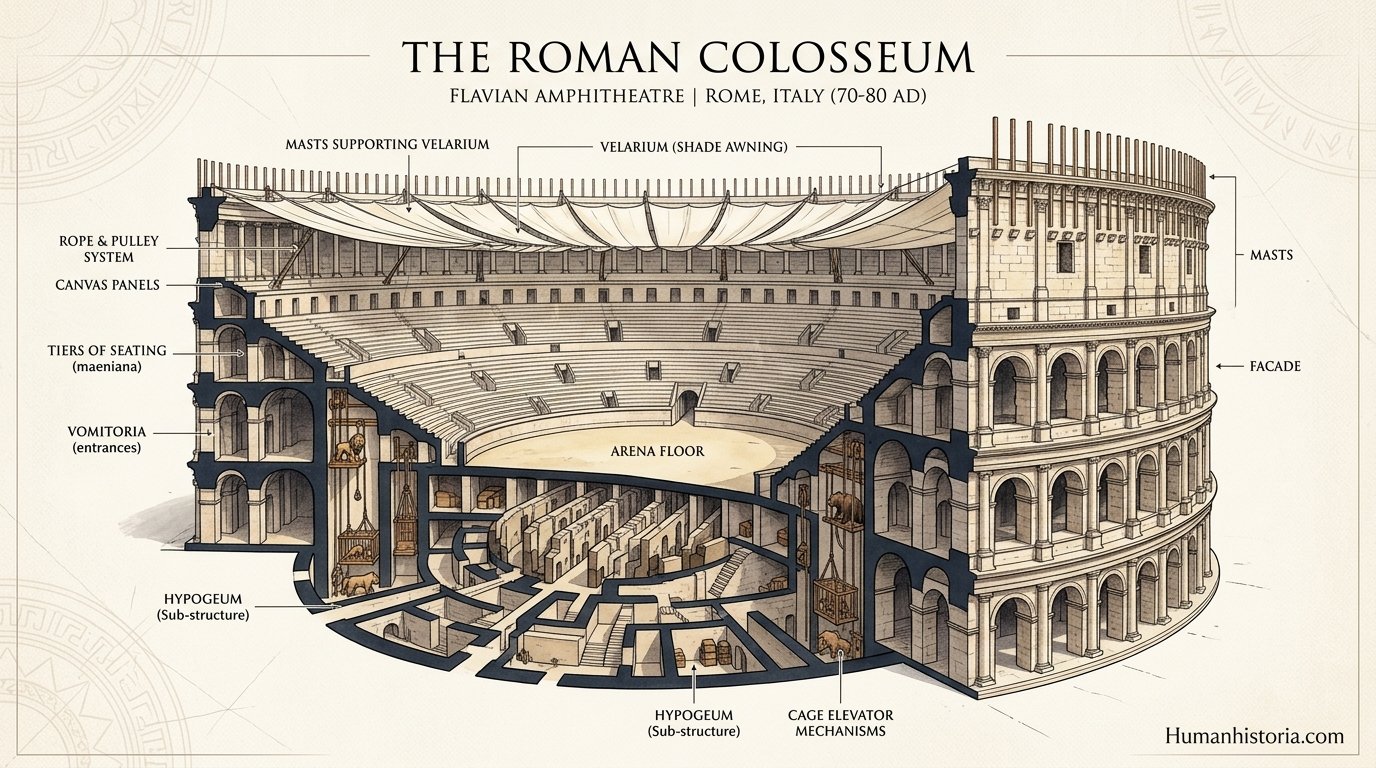
Roman Colosseum Architectural Cutaway Infographic
💡 Click anywhere on poster to expand in high resolution🔎 Expand Lightbox
Detailed structural cutaway highlighting the concrete groin vaults, retractable awning (Velarium), and subterranean elevators.
📖 SCHOLARLY INQUIRIES
Frequently Asked Questions
Essential historical questions and evidence-based answers concerning this chronicle.
Q.What caused the end of Pax Romana?
The era concluded with the reign of Commodus in 180 CE, leading into the Crisis of the Third Century marked by civil war, economic collapse, and barbarian invasions.
Q.When did Pax Romana start and end?
Pax Romana started in 27 BCE with the accession of Augustus Caesar and the establishment of the Principate, and ended in 180 CE with the death of Emperor Marcus Aurelius and the succession of Commodus, lasting 207 years.
Q.What was the political impact of the Pax Romana?
The political impact included replacing unstable civil wars with centralized imperial bureaucracy, eliminating corrupt private tax farming with salaried procurators, establishing permanent frontier defense borders (the limes), and extending universal Roman legal jurisprudence across 70 million provincial inhabitants.
Q.Why did the Roman Republic become an Empire?
The Republic's institutions were designed for a city-state, not a Mediterranean empire. A century of civil wars (133–27 BCE)—fuelled by inequality and the private armies of wealthy generals—showed the Senate could no longer govern. Augustus preserved Republican forms while concentrating real power in himself as Princeps.
Q.What language did Romans actually speak?
Latin was the administrative language, but spoken Latin varied enormously by region and class. Educated Romans also conversed in Greek, which remained the prestige language of philosophy. The Romance languages (Spanish, French, Italian, Portuguese, Romanian) all descend from Vulgar Latin dialects spoken by ordinary Romans.
Q.What really caused Rome's fall?
Historians debate this actively. Peter Heather emphasizes external pressure from the Huns displacing Gothic peoples onto Roman frontiers. Bryan Ward-Perkins focuses on economic and institutional decline. Many argue it was a gradual transformation into medieval Germanic kingdoms rather than sudden collapse—the Western Empire's end in 476 CE was largely an administrative formality.
📚 Academic Sources & Scholarly Bibliography
Beard, M. (2015).
SPQR: A History of Ancient Rome.
Profile Books.
Goldsworthy, A. (2009).
How Rome Fell: Death of a Superpower.
Yale University Press.
Heather, P. (2006).
The Fall of the Roman Empire.
Macmillan.
📖 Scholar Mode Active — Click to exit focused reading
History Lab 🧪
Interactive historical deduction games, tactical matchup simulators, and currency calculators.
🕵️ Who Am I? (The Historical Guess Game)
A secret historical figure has been selected. Ask yes/no questions to narrow down the pool of candidates. Click any active card to make your accusation!
Secret Identity
❓ Who Am I?
Ask questions using the board below to narrow down my identity.
Ask a Question:
Question LogQuestions: 0 / 7
No questions asked yet.
Candidate Board:
🗺️ Timeline Scramble
Five historical events appear out of order. Click them in the correct chronological sequence — from oldest to most recent. How well do you know your history?
🏺 Relic or Fake?
Is this a real historical artifact or a convincing fabrication? Judge each one based on its description and era — then see the truth revealed!
Artifact 1 / 10Score: 0
Empire Matchup Simulator
Empire ATerritory Size (Peak, M km²)Empire B
00
Empire APopulation (Peak, Millions)Empire B
00
Empire AMilitary Power (Army Size)Empire B
00
Tactical Battle Analysis
Select empires and click simulate to run evaluations.
Historical Purchasing Power Converter
See what ancient coins are worth in modern terms and check their historical purchasing power.
Modern Value Equivalent
$0.00 USD
Historical Purchasing Power:
Select currency to view purchasing capability.
Historical Identity Generator
Forge an authentic historical identity from ancient civilisations, complete with linguistic meaning and biography.
Neutral
Gaius Julius
Meaning:Descendant of Jupiter
Historical Background:
A Roman citizen and clerk who worked in the forum under Roman republic rule.
Chrono-Cultural Fusion Simulator
Fuse the culture, technology, and governance of two legendary civilizations to synthesize a unique hybrid society.
Cohesion & Coexistence Rate
85%
🏛️ Hybrid Architecture
⚙️ Synthesized Asset
📜 Synthetic Governance
Historical Tactics & Trivia Quiz
Test your historical knowledge and battle tactics to claim your administrative rank.
8 Questions • Multi-Era
You will be presented with random scenarios and trivia spanning ancient Egypt, classical Rome, Islamic Golden Age, and the modern industrial era. Complete the evaluation to see your historical title!
Question 1 of 8Score: 0
What was the Code of Hammurabi written on?
Correct!
Evaluation Complete!
6 / 8
Correct
Rank Attained
Imperial Legionary
Your knowledge of classical strategy and administrative structures is respectable.
🎲 Counterfactual "What If?" Scenario Simulator
Explore alternative historical trajectories by tweaking key civilizational pivot points.
Simulated Shift
Selected Era
Prehistoric Era
Millions of years ago to ~3000 BCE
The dawn of humanity. From the evolutionary split of early hominids to the mastery of stone tools, fire, and the birth of language.
Landmark Milestones
Welcome to Historia
Enter your Scholar Name to synchronize your chronicles and save your journey.

 ⭐ Featured Chronicle

 ANCIENT AGES
 ANCIENT AGES
 ANCIENT AGES
 MEDIEVAL PERIOD
 MEDIEVAL PERIOD
 PREHISTORIC ERA