~7,000 Years from farming to writing
๐Ÿ›๏ธ

Ancient Ages

c. 3,200 BCE โ€” 500 CE ยท Empires, Laws & Philosophy
~400 Years from Roman fall to medieval rebirth
๐Ÿฐ

Medieval Period

c. 500 CE โ€” 1500 CE ยท Empires of Faith, Trade & Castles
~50 Years from printing press to Scientific Revolution
โš™๏ธ

Modern Age

c. 1450 CE โ€” 2000 CE ยท Revolutions, Industry & Discovery
~50 Years from computers to quantum age

THE ARTIFACT GALLERY

Examine the tangible relics, physical tokens, and revolutionary machines that shaped civilizational growth.

๐ŸŽฅ VIDEO HUB & SHORTS

Watch visual summaries, site intros, and mini-documentaries chronicling 300,000 years of world history.

๐Ÿ“Š HISTORICAL INFOGRAPHICS ARCHIVE

Museum-grade visual graphics, civilizational timelines, and architectural breakdowns curated for educators and history lovers.

THE HISTORIA CIRCLE

Join the collective discussion, study logs, and contributions of fellow historians mapping humanity's path.

Historia Forum Discussions

Start a Discussion Thread

THEMATIC PATHWAYS

Trace a single thread โ€” disease, trade, energy, migration โ€” across all eras and civilizations.

History is not just a sequence of events โ€” it is a network of patterns. These thematic pathways allow you to follow a single concept across thousands of years: how agriculture spread, how warfare evolved, how trade routes shaped civilizations. Each pathway collects the most relevant chronicles across all eras.

๐Ÿงฉ
How is this different from the sidebar Topics?
While the sidebar Topics (like Science & Tech or Empires) filter articles within your selected historical Era, Thematic Pathways cut horizontally across all eras (from Prehistoric to the Future). Use Themes to trace a single concept's evolutionary line across 300,000 years.

CIVILIZATION HUBS

Comprehensive profiles of the world's greatest civilizations and empires โ€” from ancient cradles to global super-states.

Human Historia provides an academically rich exploration of the world's most influential civilizations. From the monumental achievements of ancient Egypt, Han China, and the Roman Empire, to the sophisticated societies of the Maya, the Islamic Caliphates, and West African empires, these hubs offer deep insights into the cultural, political, and technological legacies that continue to shape our global story.

EVOLUTION OF HUMAN SKILLS

Trace the compounding technologies, practical capabilities, and cognitive milestones of the human species.

Human progress is a story of compounding skills. Every breakthrough, from the spark of prehistoric fire to modern silicon transistors, builds directly on previous generations of ingenuity. Hover over a skill node to trace its historical prerequisites, and click it to explore its development timeline, species-wide impact, and related chronicles.

Prehistoric Ancient Medieval Modern Future
๐Ÿง 

Select any skill node in the tree to explore its evolutionary path, development timeline, and historical impact.

ACADEMIC PASSPORT

Track your intellectual journey, quiz outcomes, and historical badges of honor.
HISTORIA PASSPORT โณ
๐Ÿ‘ค Scribe Novice
Scholar Name Historia Explorer
Rank Rating Sumerian Record Scribe
Chronicles Read 0 / 48
Study Guide Pins 0 Guides
Security Access Level 1 (Novice)

Earned Badges of Honor

๐Ÿ”ฅ
Fire Keeper
Unlock 3 prehistoric chronicles.
๐Ÿ›๏ธ
Codex Keeper
Unlock 3 ancient chronicles.
๐Ÿฐ
Guild Master
Unlock 3 medieval chronicles.
โš™๏ธ
Steam Engineer
Unlock 3 modern chronicles.
๐Ÿš€
Singularity Sage
Unlock 3 future chronicles.
๐Ÿ‘‘
Grand Scholar
Score 5/5 on the Lab Quiz.

Recent Lab Activities

No recent activities recorded. Take a quiz or bookmark articles!
Curated Exhibition

Human Historia

An immersive graphical anthology tracing the paths of civilizations, breakthroughs, and conflicts that forged the modern consciousness.

25Chronicles
Showing all articles

The Byzantine Empire: How Eastern Rome Survived 1,000 Years After Rome Fell

Written by Historia Editorial Historical Era: MEDIEVAL
* Note: Cover image is an AI-generated historical illustration.

๐Ÿง Key Chronicle Takeaway (Atomic Summary)

How the Eastern Roman Empire survived, consolidating classical laws into the Corpus Juris Civilis and rebuilding Constantinople.

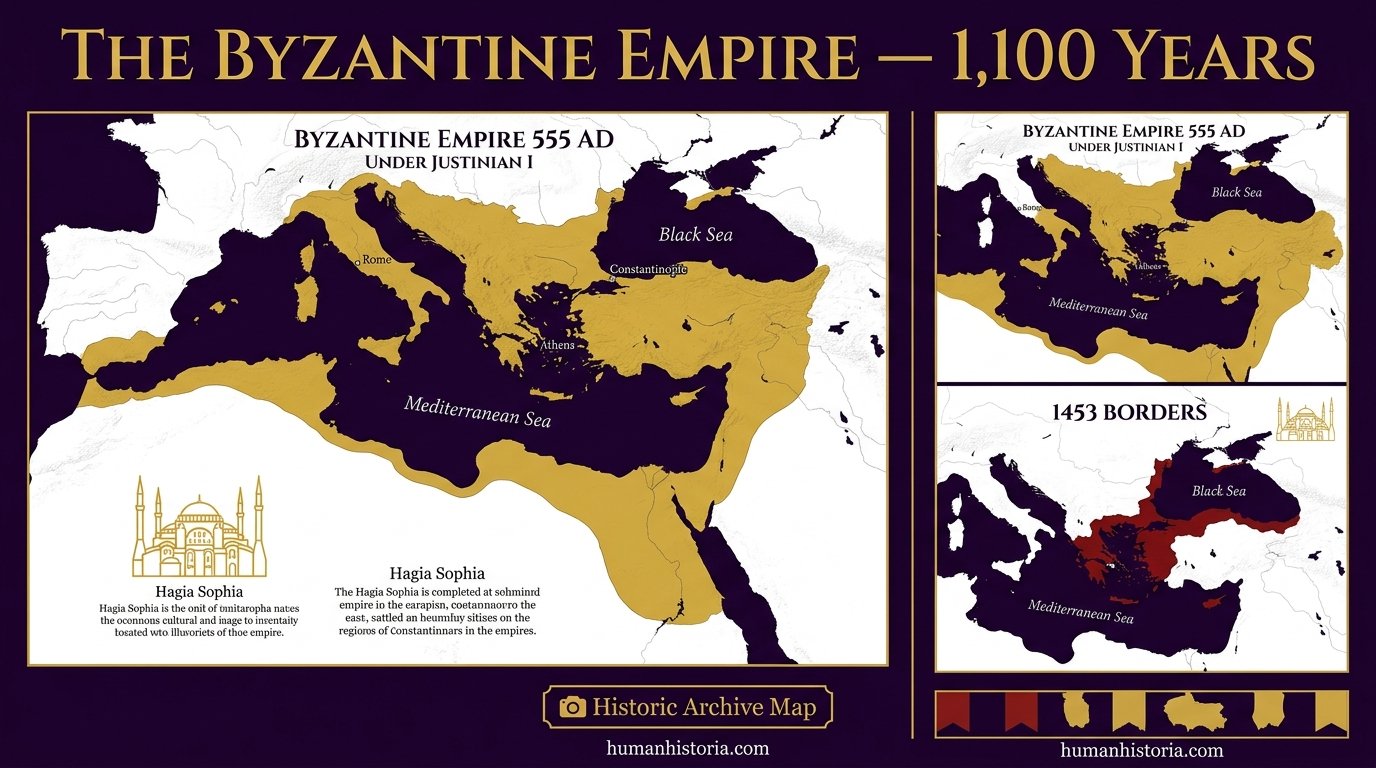
The fall of the Western Roman Empire in 476 CE is often viewed as the end of classical antiquity. However, in the East, the Roman Empire survived, centered on the capital of Constantinople. This eastern half, known to modern historians as the Byzantine Empire, preserved the administrative, legal, and cultural traditions of Rome for another thousand years. The peak of this medieval Roman survival occurred during the reign of Emperor Justinian I (reigned 527โ€“565 CE). Driven by a vision of imperial restoration (Recovratio Imperii), Justinian reconquered parts of Italy and North Africa, built the monumental cathedral of Hagia Sophia, and organized the compilation of Roman Law into a single civil code. The Byzantine administration under Justinian represents the ultimate synthesis of classical Roman law, Greek culture, and Christian theology.

Constantinople: The Center of the East

The foundation of Byzantine survival was its capital, Constantinople, founded by Constantine the Great in 330 CE on the site of ancient Byzantium. Located on the Bosporus Strait, the city sat at the crossroads of European and Asian trade routes, allowing the imperial treasury to collect massive customs duties. The city was also an impregnable fortress: defended by the massive double-layered Theodosian Walls and the sea, Constantinople resisted dozens of sieges over a millennium, acting as a secure anchor for the imperial administration during the migration of Eurasian tribes.

Justinian inherited a wealthy, stable Eastern Empire, but one that was plagued by legal chaos and administrative corruption. The legal codes of Rome had accumulated over a millennium, consisting of thousands of contradictory decrees, juristic opinions, and regional variations. This made the administration of justice slow, corrupt, and unpredictable. Scribes and judges struggled to determine which laws were active, leading to legal instability across the provinces. Justinian realized that a unified, rational legal system was essential for consolidating his authority and reforming the state administration.

The Corpus Juris Civilis: Standardizing Roman Law

In 528 CE, Justinian appointed a commission of legal scholars, led by the brilliant jurist Tribonian, to execute a complete reform of Roman law. The result of their labor was the Corpus Juris Civilis (Body of Civil Law), a monumental work that organized and modernized Roman jurisprudence:

  • The Codex Justinianus: A systematic collection of all imperial edicts since the time of Hadrian, eliminating duplicates and contradictions.
  • The Digest (Pandects): A massive compilation of the opinions and writings of the classical Roman jurists, reduced from three million lines of text to a structured, 50-book collection.
  • The Institutes: An introductory textbook designed for law students across the empire, standardizing legal education.
  • The Novellae: A collection of new laws issued by Justinian during his reign, written primarily in Greek, reflecting the cultural shift of the Eastern Empire.
Legal scholars compiling the Corpus Juris Civilis
A depiction of the commission of jurists led by Tribonian sorting and organizing centuries of Roman legal decrees into the Corpus Juris Civilis.

The Legal Legacy of Justinian's Code

The Corpus Juris Civilis was lost to Western Europe during the Middle Ages but was rediscovered in Italy in the 11th century. It became the foundation of legal education at the University of Bologna, driving the development of civil law across Continental Europe. It served as the direct blueprint for the Napoleonic Code of 1804 and forms the basis of the modern legal codes of more than 150 nations, proving that Justinian's most lasting conquest was not achieved by his generals, but by his jurists.

The Nika Riots and Imperial Restoration

Justinian's legal and administrative reforms, combined with high taxes to fund his military campaigns, triggered intense opposition. In 532 CE, this discontent erupted in the capital during a chariot race at the Hippodrome, escalating into the Nika Riots. Rebellious factions burned half the city and declared a new emperor. Justinian prepared to flee, but his empress, Theodora, famously intervened, declaring that she would not live to see a day when she was not addressed as empress, stating that "royalty is a fine winding-sheet."

Inspired by Theodora's resolve, Justinian sent his generals, Belisarius and Mundus, to trap the rioters in the Hippodrome. The military crushed the rebellion, executing 30,000 people. This brutal victory consolidated Justinian's absolute power. He used the destruction of the city as an opportunity to launch a monumental rebuilding program, centering on the construction of the Hagia Sophia (Church of Holy Wisdom). Built with a massive, floating dome that seemed suspended from heaven, the cathedral stood as a physical manifestation of the emperor's absolute authority and spiritual legitimacy, a statement of Roman power built in brick and mortar.

The Secret History of Procopius

The primary source for Justinian's reign is the historian Procopius of Caesarea. During his life, Procopius wrote official histories praising the emperor's buildings and conquests. However, after his death, a secret manuscript was discovered: the Anecdota (Secret History). In it, Procopius viciously attacked Justinian and Theodora, describing them as demonic rulers who destroyed the state through high taxes, administrative tyranny, and religious persecution. This contrasting record highlights the complex, often repressive reality behind the golden mosaics of the Byzantine court.

The Recovratio Imperii and the Plague

With the capital secured and the treasury filled, Justinian launched his campaign to reconquer the West. His general, Belisarius, executed brilliant campaigns, recapturing North Africa from the Vandals, Sicily, and eventually Rome and Ravenna from the Ostrogoths. For a brief moment, the Mediterranean Sea was once again a Roman lake. Scribes celebrated the restoration of the empire's ancient boundaries, and the administration of Roman civil law was established across Italy.

However, this restoration was short-lived. In 541 CE, a devastating pandemicโ€”the Plague of Justinian (the first recorded outbreak of bubonic plague)โ€”struck the empire. The plague killed up to 10,000 people a day in Constantinople, decimating the army, destroying the agricultural labor force, and emptying the treasury. Sapped of tax revenue and soldiers, the Byzantine administration could not defend the newly reconquered Western territories against new invaders, such as the Lombards in Italy. The empire retreated back to the East, permanently ending the dream of a unified classical Roman Empire.

The Nika Riots and the Rebuilding of the Empire

The political stability of Justinian I's reign was tested by the Nika Riots in 532 CE, a violent rebellion that almost overthrew the emperor and destroyed Constantinople. The riots started in the Hippodrome, the chariot-racing arena that served as the center of public life. The rival chariot factionsโ€”the Blues and the Greensโ€”united in their anger against Justinian's high taxes and corrupt officials, chanting *"Nika!"* (Victory!) and burning public buildings, including the original church of Hagia Sophia. Scribes recorded that Justinian prepared to flee the capital, but was stopped by his wife, Empress Theodora, who famously declared that the imperial purple made a fine burial shroud.

Inspired by Theodora, Justinian remained in the palace and ordered his generals, Belisarius and Mundus, to crush the rebellion. The imperial troops trapped the rioters in the Hippodrome, executing over 30,000 citizens. To restore his political authority and show the glory of the empire, Justinian initiated a massive rebuilding program. He constructed a new, magnificent Hagia Sophia with a soaring dome that stood as the largest cathedral in the world for a thousand years. This architectural masterpiece, combined with the codification of the Civil Law, stabilized the Byzantine state and consolidated Justinian's legacy as the restorer of Roman grandeur.

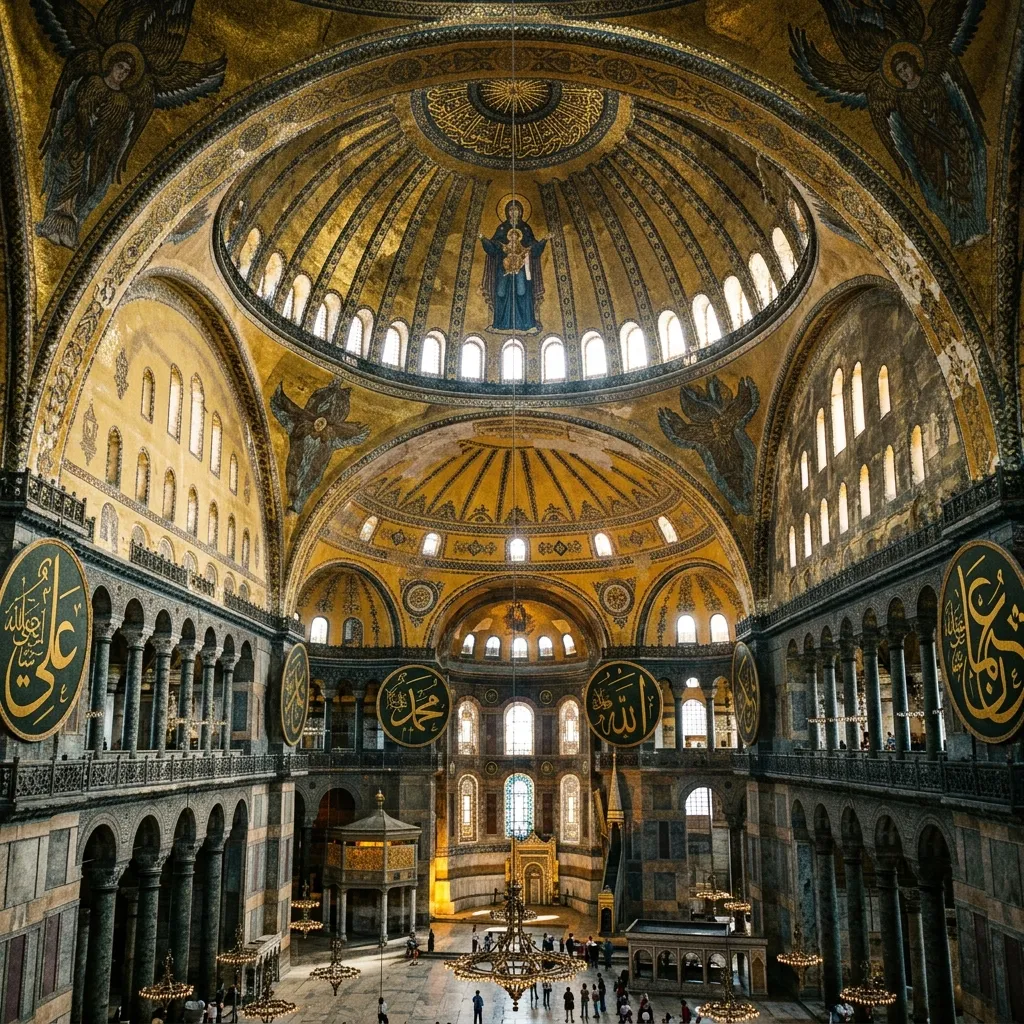
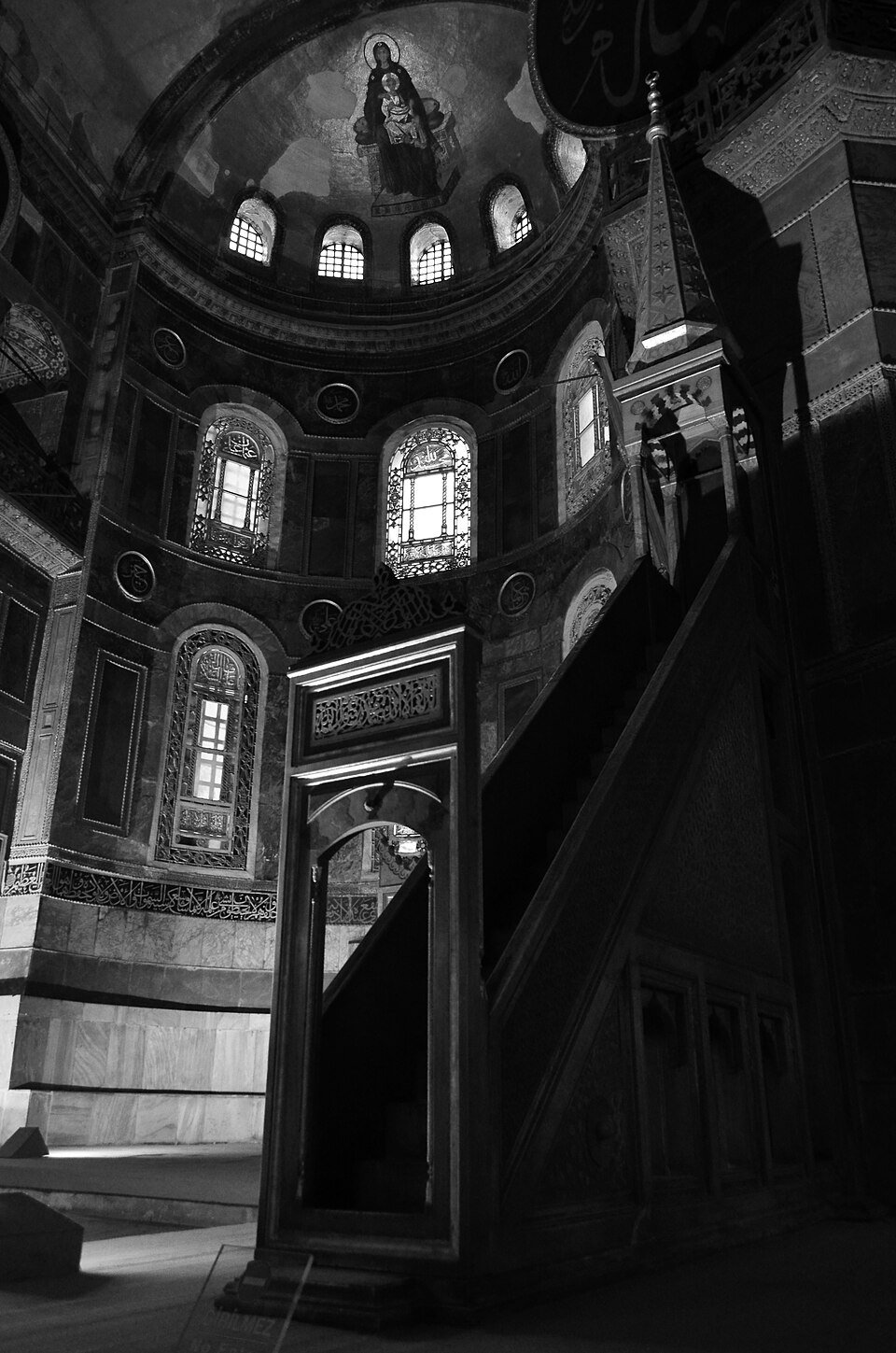
The soaring interior dome of the Hagia Sophia
The interior of the Hagia Sophia showing the massive floating dome, illuminated by sunlight filtering through forty windows around its base, demonstrating Byzantine architectural mastery.

The Silk Monopolies and Economic Administration

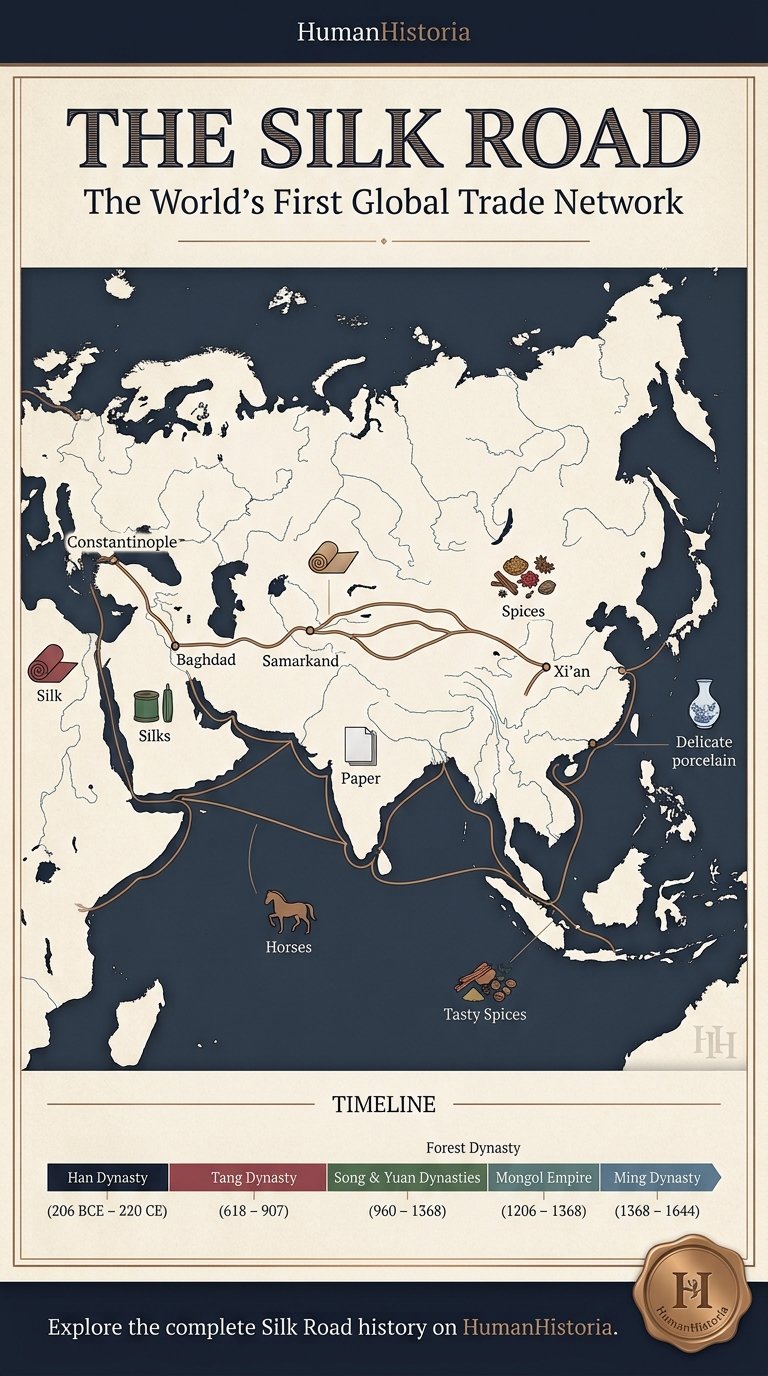
The survival of the Byzantine Empire was funded by a highly centralized and regulated economy, most notably the Imperial Silk Monopoly. Prior to the 6th century, silk was imported from China along the Silk Road, making it an expensive luxury item that drained the empire's gold reserves. Scribes recorded that in 552 CE, Justinian I sent two Nestorian monks to China as industrial spies. The monks smuggled silkworm eggs out of China inside hollow bamboo walking sticks, returning them to Constantinople.

Under Justinian's direction, the Byzantine state established state-owned silk workshops (*gynaecia*) and prohibited private citizens from producing or selling purple-dyed silk. Scribes managed these workshops with strict administrative rules, setting prices, regulating quality, and controlling exports. Scribes and historians note that the silk monopoly provided the imperial treasury with a reliable source of gold revenue, which funded the construction of the Hagia Sophia and paid for the professional army and administrative bureaucracy. This economic administration allowed Byzantium to survive for centuries despite constant military invasions, proving that financial monopolies are vital tools of imperial survival.

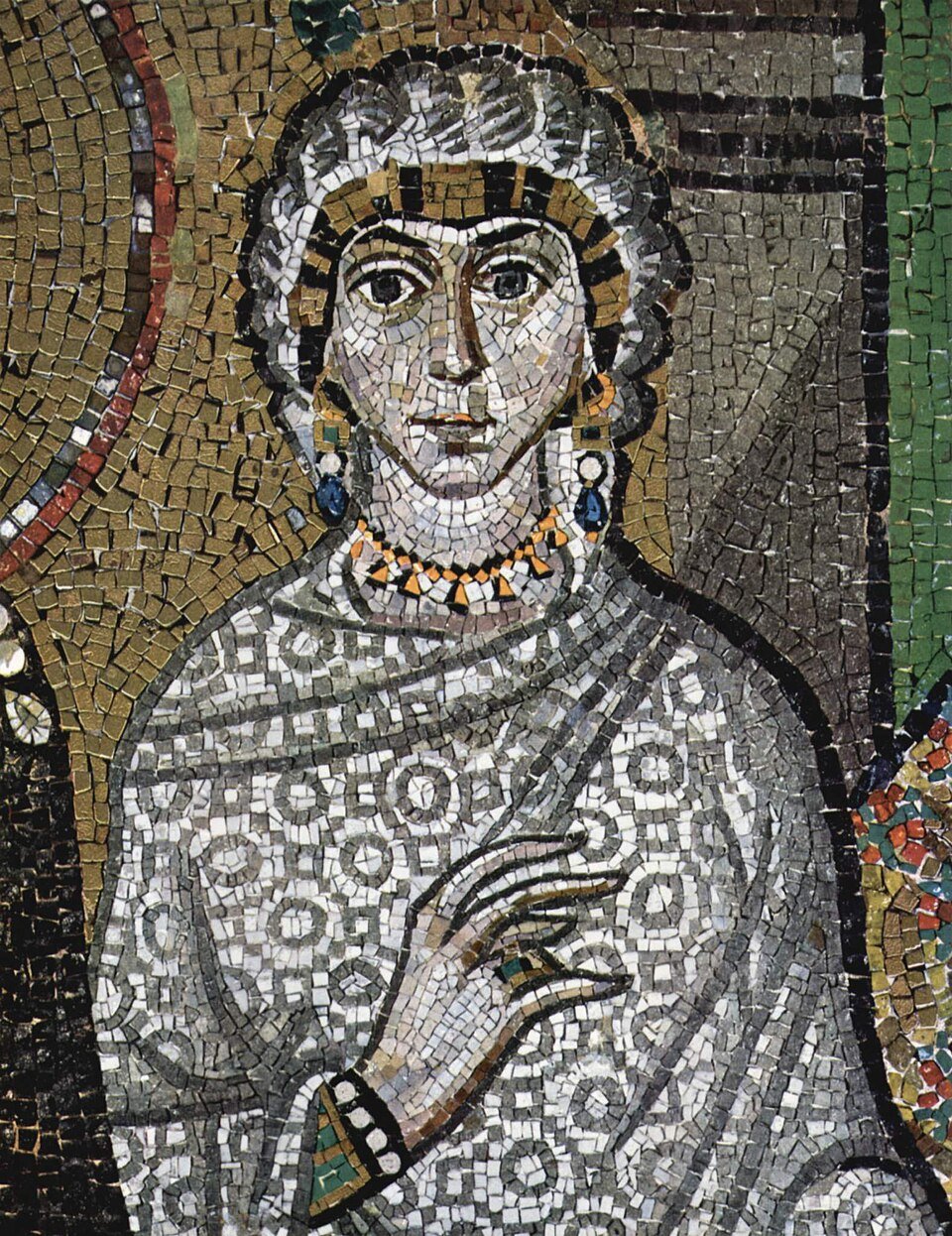
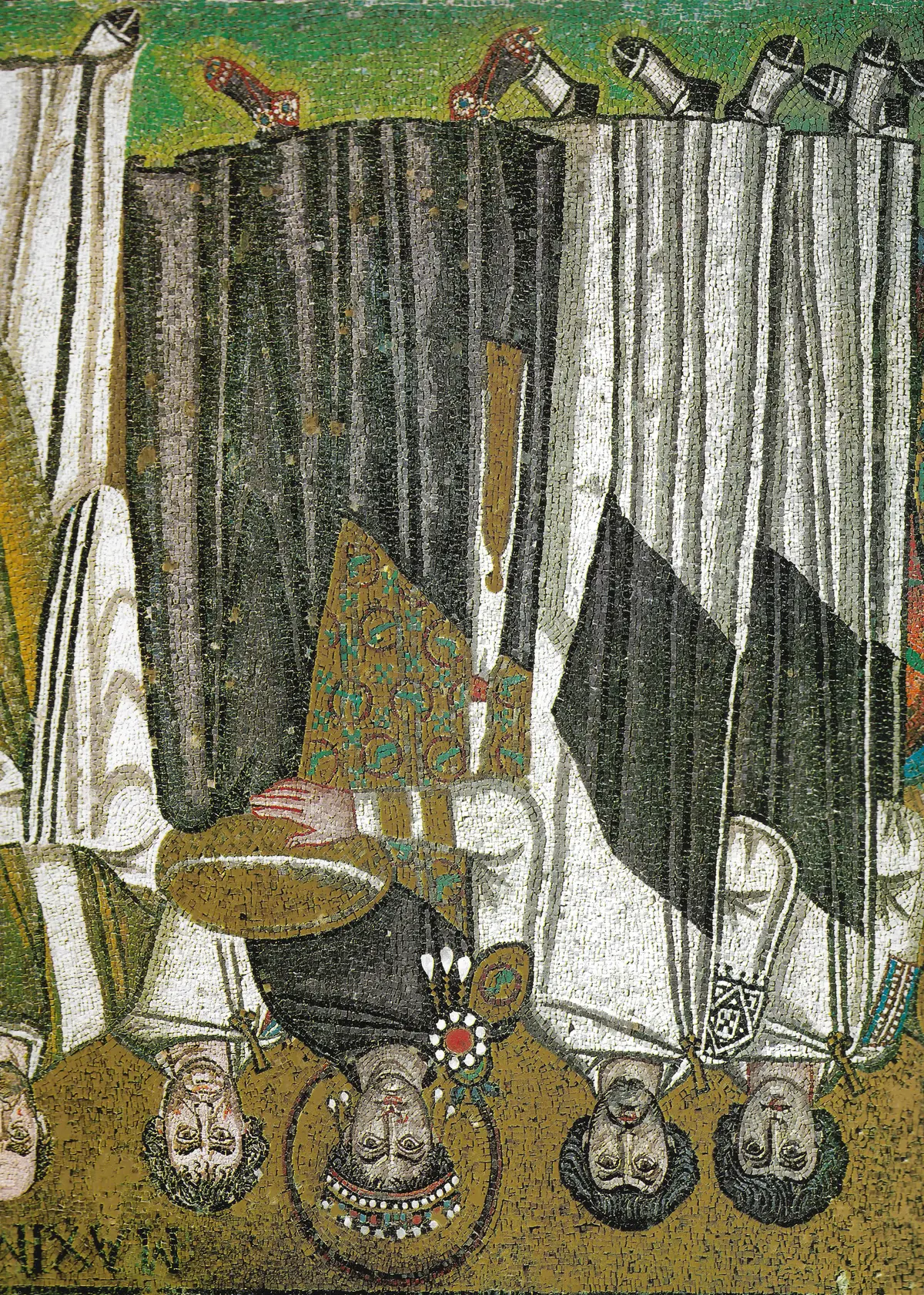
Mosaics of Justinian I in Basilica of San Vitale Ravenna
The famous 6th-century mosaic from the Basilica of San Vitale in Ravenna, depicting Byzantine Emperor Justinian I and his court.

Conclusion: The Bridge of Empires

Justinian's reign represents the transition from the classical Roman world to the medieval Byzantine world. By codifying Roman law into the Corpus Juris Civilis and constructing the Hagia Sophia, he preserved the intellectual and architectural achievements of antiquity, adapting them to a Christian, Greek-speaking medieval empire. The administrative and legal frameworks he built allowed the Byzantine Empire to survive for another nine centuries, acting as a vital bridge that preserved the heritage of Greece and Rome for the Renaissance, demonstrating that the true strength of a state lies in its legal and cultural preservation.

โš–๏ธ

Historian Debate: Was Byzantium Roman or Greek?

Continuity of the Roman State

Byzantine elites called themselves 'Rhomaioi' (Romans) and maintained Roman civil law, administrative structures, and imperial ideology until the fall of Constantinople.

Hellenized Christian Culture

Critics argue that after Heraclius made Greek the official language in 610 CE, the empire became a distinct Greek-speaking Christian state, separate from Western Rome.

The Byzantine Empire served as the eastern wall of Christian Europe against Islamic expansion.

"The Empire of the Romans did not fall in 476; it simply moved its heart to the Golden Horn, preserving the laws of Justinian."

โ€” Procopius, Secret History (c. 550 CE).

Further Reading

  • Byzantium: The Surprising Life of a Medieval Empire โ€” by Judith Herrin. An accessible, thematic history of Byzantine culture, administration, and defense.
  • The Lost World of Byzantium โ€” by Jonathan Harris. A narrative history exploring the political strategy and diplomacy of the empire.
๐Ÿ“– Scholar Mode Active โ€” Click to exit focused reading
Selected Era

Prehistoric Era

Millions of years ago to ~3000 BCE

The dawn of humanity. From the evolutionary split of early hominids to the mastery of stone tools, fire, and the birth of language.

Landmark Milestones

Welcome to Historia

Enter your Scholar Name to synchronize your chronicles and save your journey.