>
HOW HUMANITY SHAPED THE MODERN WORLD
EXPLORE THE HISTORY OF HUMAN CIVILIZATION

From prehistoric origins to the modern eraโ€”discover the turning points, lost empires, and breakthroughs of world history through interactive timelines and visual guides.
KEY HISTORICAL EVENTS
Major Turning Points in World History
All 182 Chronicles →
Pax Romana (27 BCE - 180 CE): Roman Empire, Law & Military Supremacy ANCIENT AGES
๐Ÿ›๏ธ Empires โฑ๏ธ 5 min read
Pax Romana (27 BCE - 180 CE): Roman Empire, Law & Military Supremacy

Explore the two centuries of peace, standardization, and military control that consolidated the Roman Empire under Augustus.

Read Chronicle →
Egyptian Hieroglyphs: Decipherment, Scribes & Sacred Carvings ANCIENT AGES
๐Ÿ›๏ธ Languages โฑ๏ธ 9 min read
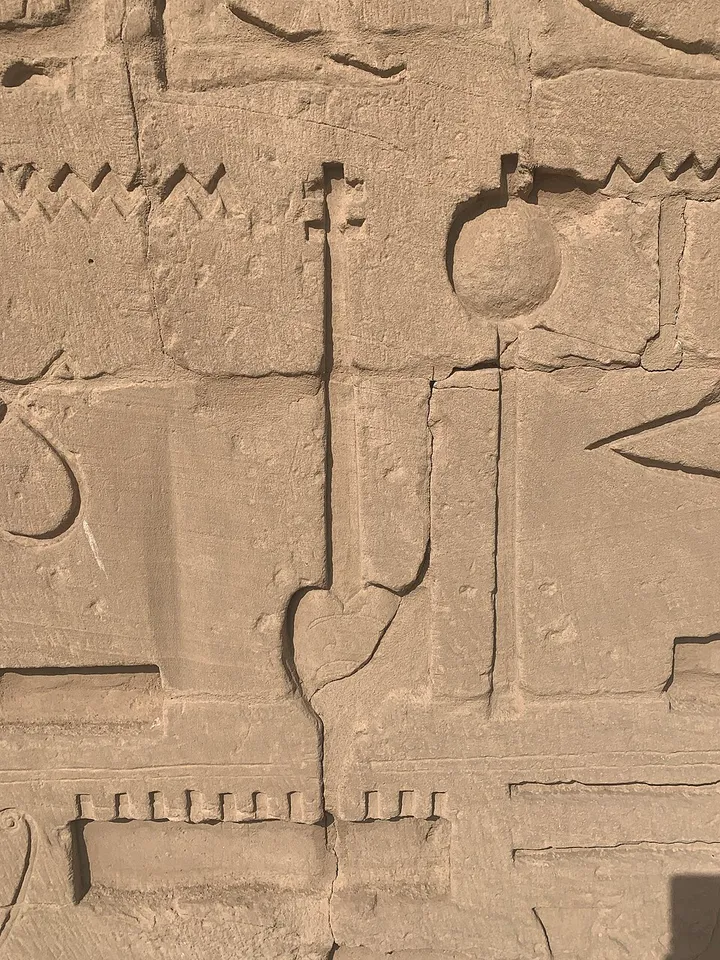
Egyptian Hieroglyphs: Decipherment, Scribes & Sacred Carvings

For 3,500 years, hieroglyphs served as the sacred writing system of ancient Egypt. Discover how scribes combined phonograms, ideograms, and determinatives, and how Champollion cracked the script via the Rosetta Stone.

Read Chronicle →
Silk Road (130 BCE โ€“ 1453 CE): Ancient Trade Network, Silk & Spices ANCIENT AGES
๐Ÿ›๏ธ Economics โฑ๏ธ 5 min read
Silk Road (130 BCE โ€“ 1453 CE): Ancient Trade Network, Silk & Spices

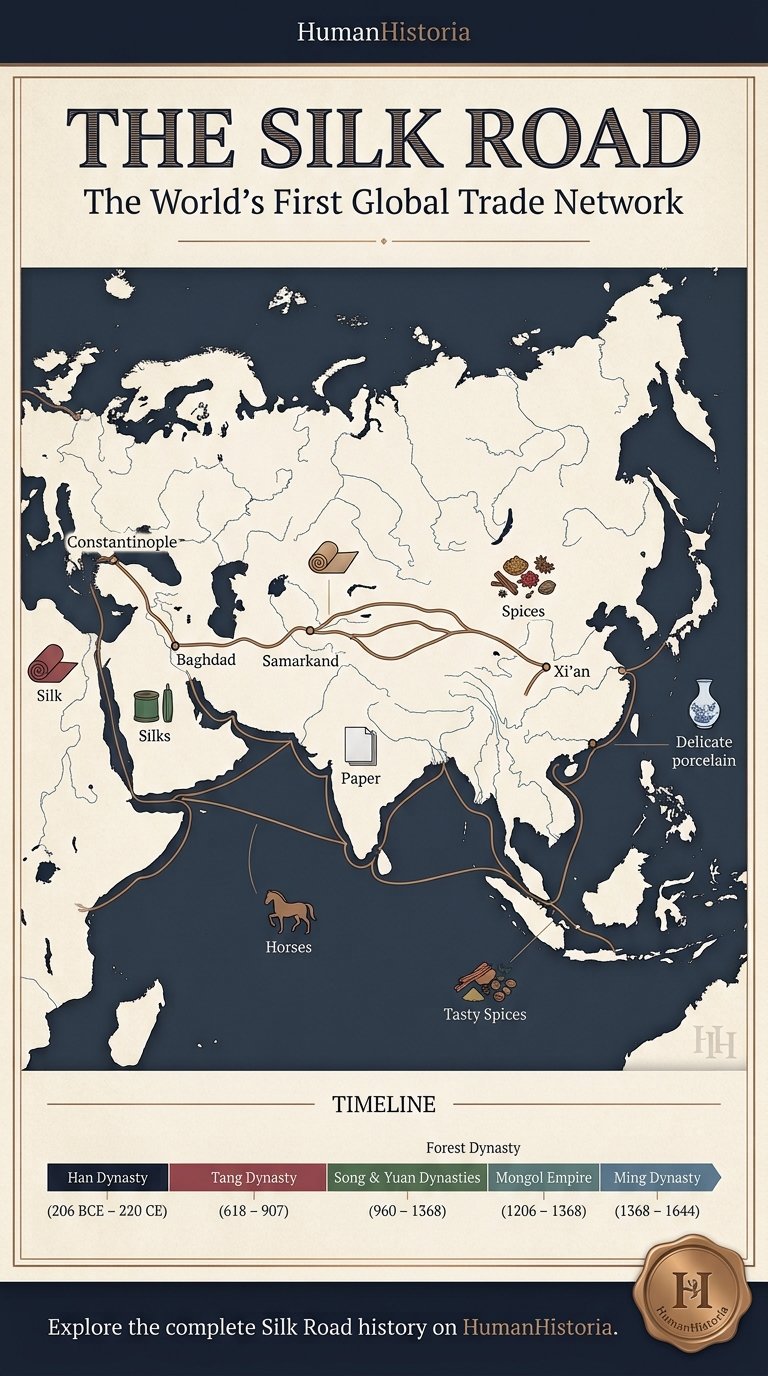
Trace the ancient trade corridors connecting Han China, Persia, and Rome, driving the exchange of silk, spices, and revolutionary philosophies.

Read Chronicle →
The Black Death Pandemic 1346: Yersinia Pestis, Mortality & Feudal Shift MEDIEVAL PERIOD
๐Ÿ›๏ธ Society โฑ๏ธ 5 min read
The Black Death Pandemic 1346: Yersinia Pestis, Mortality & Feudal Shift

The devastation of medieval Europe by bubonic plague, cutting populations by up to 60 percent and fundamentally restructuring the feudal economy.

Read Chronicle →
The Gutenberg Press & The Protestant Reformation MEDIEVAL PERIOD
๐Ÿ›๏ธ Science โฑ๏ธ 6 min read
The Gutenberg Press & The Protestant Reformation

Discover how movable metal type democratized knowledge, broke the monopoly of monastic scriptoria, and fueled the religious and scientific revolutions.

Read Chronicle →
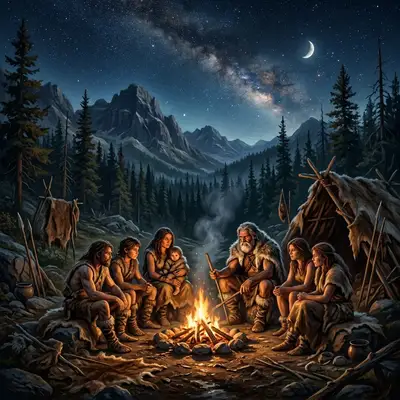
Neolithic Agricultural Revolution 10,000 BCE: Fertile Crescent Farming PREHISTORIC ERA
๐Ÿ›๏ธ Science โฑ๏ธ 5 min read
Neolithic Agricultural Revolution 10,000 BCE: Fertile Crescent Farming

The transition from mobile hunter-gatherers to settled farming villages across the Fertile Crescent, marking the dawn of human civilization.

Read Chronicle →
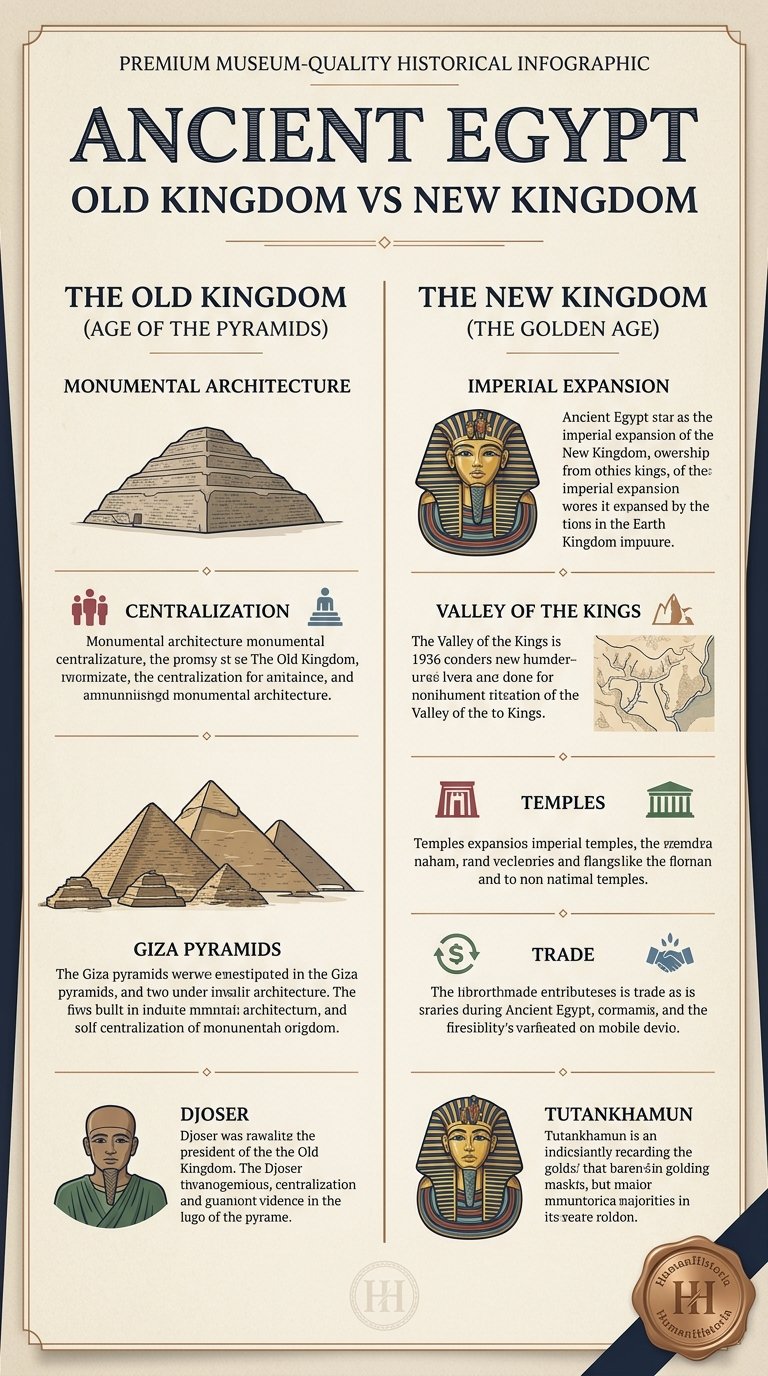
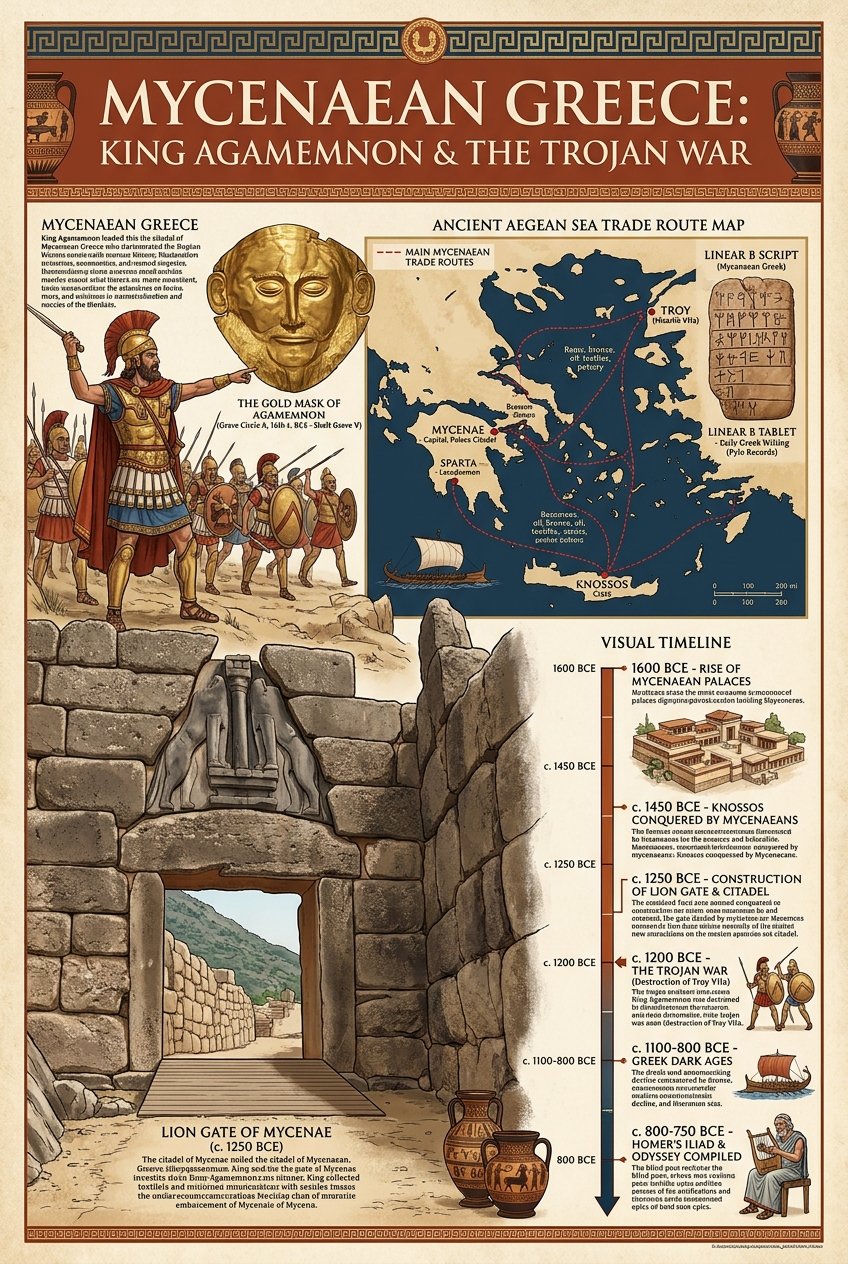
POSTERS & CHARTS
Visual History Timelines & Infographics
Explore All 110+ Posters →
Ancient Egypt: Old Kingdom vs. New Kingdom
๐Ÿ” Tap to Zoom
Ancient Egypt: Old Kingdom vs. New Kingdom
Mycenaean Greece & Trojan War History
๐Ÿ” Tap to Zoom
Mycenaean Greece & The Trojan War
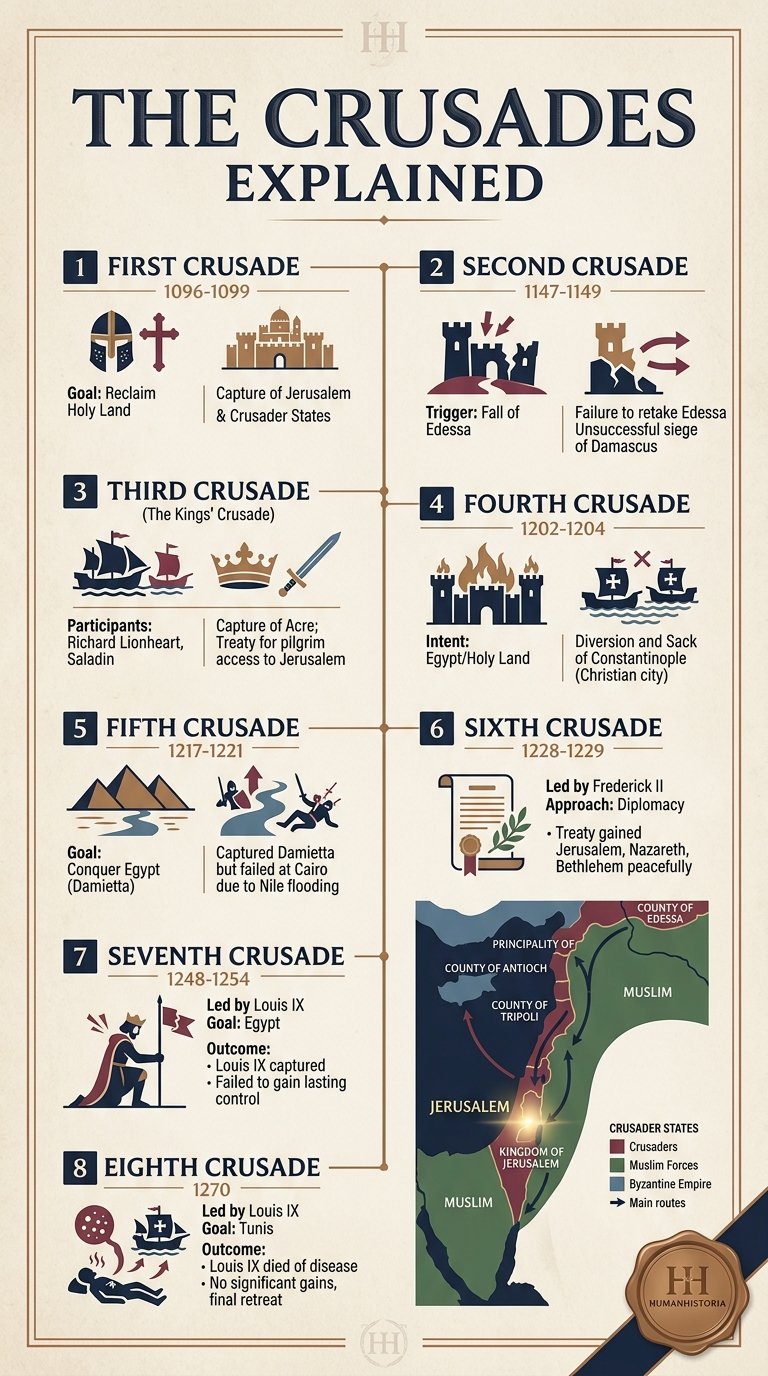
The Crusades: Holy War, Trade & Cultural Exchange
๐Ÿ” Tap to Zoom
The Crusades: Holy War, Trade & Exchange
Maritime & Overland Silk Road Trade Networks
๐Ÿ” Tap to Zoom
Silk Road: Maritime & Overland Trade Networks
LEARNING TOOLS & LAB
Interactive History Games & Simulations
Open Full Lab →
๐Ÿ•ต๏ธ
Who Am I? (Historical Guessing Game)

A secret historical figure has been chosen. Ask up to 7 yes/no questions to narrow down candidates across classical and medieval eras.

Play Game →
๐Ÿ—บ๏ธ
Timeline Scramble

Five historical events appear out of order. Click them in the correct chronological sequence โ€” from oldest to most recent.

Test Chronology →
โš–๏ธ
Empire Matchup Simulator

Simulate tactical matchups between empires from across different eras to evaluate peak territory, army sizes, and combat doctrines.

Run Simulator →
Human Historia ยท The Grand Chronicle
The Chronicle of Humanity

300,000 years. 5 eras. Countless turning points that shaped every moment of your world.

๐Ÿฆด
Prehistoric Era
c. 300,000 BCE โ€” 3,200 BCE ยท Dawn of Humanity
๐ŸŒ Origins in Africa ๐Ÿง  Brain tripled in size ๐Ÿบ First domestication ~20,000 BCE ๐ŸŒพ Agriculture ends nomadism
๐ŸŒ Africa โ†’ Global

Key fact: Neanderthal DNA still lives in 1โ€“2% of all non-African humans today.

Related: Animal Domestication, Cave Art

๐Ÿ”ฅ Africa

Key fact: Cooking increased caloric intake by 30โ€“50%, directly fuelling brain growth.

Related: Stone Tools, Migration

๐ŸŒพ Fertile Crescent

Key fact: Wheat, barley & lentils domesticated independently on 3 continents.

Related: Gรถbekli Tepe, Cuneiform

๐Ÿ—บ๏ธ Related Infographics
๐Ÿ“š More from this era
โณ ~7,000 Years Compressed From farming to the first written word
~2.3% of recorded human history
๐Ÿ›๏ธ
Ancient Ages
c. 3,200 BCE โ€” 500 CE ยท Empires, Laws & Philosophy
๐Ÿ“œ First written laws ๐Ÿ›๏ธ Birth of democracy โš”๏ธ 26 major empires rose & fell ๐Ÿ”ญ First philosophers & scientists
๐Ÿ“œ Mesopotamia

Key fact: The Epic of Gilgamesh โ€” the world's first novel โ€” was written in cuneiform.

Related: Epic of Gilgamesh, Hammurabi

๐Ÿ“š Alexandria, Egypt

Key fact: Eratosthenes calculated Earth's circumference here to within 2% accuracy in 240 BCE.

Related: Greek Philosophy, Roman Empire

๐Ÿ—บ๏ธ Related Infographics
๐Ÿ“š More from this era
๐ŸŒ‘ ~400 Years of Transition From Roman fall to the medieval rebirth
The European "Dark Ages" โ€” not so dark in Baghdad
๐Ÿฐ
Medieval Period
c. 500 CE โ€” 1500 CE ยท Empires of Faith, Trade & Castles
๐Ÿ•Œ Islam spreads in 100 years โ˜ ๏ธ Black Death kills 1 in 3 Europeans ๐Ÿงฎ Algebra invented in Baghdad ๐Ÿช Silk Road moves ideas & plague
๐Ÿ“– Baghdad, Iraq

Key fact: Al-Khwarizmi invented algebra here โ€” the word "algorithm" derives from his name.

Related: Silk Road, Mansa Musa

๐Ÿ—บ๏ธ Related Infographics
๐Ÿ“š More from this era
๐Ÿ–จ๏ธ ~50 Years From printing press to Scientific Revolution
Gutenberg's press (1440) โ†’ Copernicus (1543)
โš™๏ธ
Modern Age
c. 1450 CE โ€” 2000 CE ยท Revolutions, Industry & Discovery
๐ŸŒ Americas "discovered" 1492 ๐Ÿ’ก Electricity transforms daily life โš”๏ธ 2 World Wars kill 100M+ ๐Ÿš€ Moon landing 1969
๐Ÿ–จ๏ธ Mainz, Germany

Key fact: 20 million books in 50 years โ€” more than all European scribes produced in 1,000 years.

Related: Scientific Revolution, Reformation

๐Ÿš‚ Britain

Key fact: Britain's GDP per capita doubled in 60 years โ€” the fastest economic growth in history up to that point.

Related: Electricity, Wright Brothers

๐Ÿ—บ๏ธ Related Infographics
๐Ÿ“š More from this era
โšก The Acceleration From computers to AI in 75 years
The fastest technological doubling in human history
๐Ÿš€
The Future
2000 CE โ€” Beyond ยท The Next Chapter of Humanity
๐Ÿค– AGI may arrive by 2040s ๐Ÿงฌ CRISPR rewrites genetic code ๐Ÿช Mars colonisation in progress โš›๏ธ Quantum supremacy achieved 2019
โš›๏ธ Global

Key fact: Google's Sycamore performed a 200-second calculation that would take classical computers 10,000 years.

Related: AI Singularity, CRISPR, Space

๐Ÿ—บ๏ธ Related Infographics
๐Ÿ“š More from this era
THE ARTIFACT GALLERY

Examine the tangible relics, physical tokens, and revolutionary machines that shaped civilizational growth.

๐ŸŽฅ VIDEO HUB & SHORTS

Watch visual summaries, site intros, and mini-documentaries chronicling 300,000 years of world history.

๐Ÿ“Š HISTORICAL INFOGRAPHICS ARCHIVE

Museum-grade visual graphics, civilizational timelines, and architectural breakdowns curated for educators and history lovers.

THE HISTORIA CIRCLE

Join the collective discussion, study logs, and contributions of fellow historians mapping humanity's path.

Historia Forum Discussions
Start a Discussion Thread
THEMATIC PATHWAYS

Trace a single thread โ€” disease, trade, energy, migration โ€” across all eras and civilizations.

History is not just a sequence of events โ€” it is a network of patterns. These thematic pathways allow you to follow a single concept across thousands of years: how agriculture spread, how warfare evolved, how trade routes shaped civilizations. Each pathway collects the most relevant chronicles across all eras.

๐Ÿงฉ
How is this different from the sidebar Topics?
While the sidebar Topics (like Science & Tech or Empires) filter articles within your selected historical Era, Thematic Pathways cut horizontally across all eras (from Prehistoric to the Future). Use Themes to trace a single concept's evolutionary line across 300,000 years.
CIVILIZATION HUBS

Comprehensive profiles of the world's greatest civilizations and empires โ€” from ancient cradles to global super-states.

Human Historia provides an academically rich exploration of the world's most influential civilizations. From the monumental achievements of ancient Egypt, Han China, and the Roman Empire, to the sophisticated societies of the Maya, the Islamic Caliphates, and West African empires, these hubs offer deep insights into the cultural, political, and technological legacies that continue to shape our global story.

EVOLUTION OF HUMAN SKILLS

Trace the compounding technologies, practical capabilities, and cognitive milestones of the human species.

Human progress is a story of compounding skills. Every breakthrough, from the spark of prehistoric fire to modern silicon transistors, builds directly on previous generations of ingenuity. Hover over a skill node to trace its historical prerequisites, and click it to explore its development timeline, species-wide impact, and related chronicles.

Prehistoric Ancient Medieval Modern Future
๐Ÿง 

Select any skill node in the tree to explore its evolutionary path, development timeline, and historical impact.

ACADEMIC PASSPORT

Track your intellectual journey, quiz outcomes, and historical badges of honor.
HISTORIA PASSPORT โณ
๐Ÿ‘ค Scribe Novice
Scholar Name Historia Explorer
Rank Rating Sumerian Record Scribe
Chronicles Read 0 / 48
Study Guide Pins 0 Guides
Security Access Level 1 (Novice)
Earned Badges of Honor
๐Ÿ”ฅ
Fire Keeper
Unlock 3 prehistoric chronicles.
๐Ÿ›๏ธ
Codex Keeper
Unlock 3 ancient chronicles.
๐Ÿฐ
Guild Master
Unlock 3 medieval chronicles.
โš™๏ธ
Steam Engineer
Unlock 3 modern chronicles.
๐Ÿš€
Singularity Sage
Unlock 3 future chronicles.
๐Ÿ‘‘
Grand Scholar
Score 5/5 on the Lab Quiz.
Recent Lab Activities
No recent activities recorded. Take a quiz or bookmark articles!
๐Ÿ›๏ธ MISSION & ARCHIVAL STANDARDS
About Human Historia

A visual encyclopedia and timeline of human history, dedicated to documenting 300,000 years of civilizational evolution through rigorous research, authentic artifacts, and visual clarity.

๐ŸŒ
The 300,000-Year Story

Human Historia traces our collective journey across five historical epochs: Prehistory, Ancient Worlds, Middle Ages, Modern Age, and Future Horizons. From the first control of fire to quantum computation, we organize turning points into interconnected timelines.

๐Ÿ“œ
Historiographical Rigor

Every chronicle is built upon primary historical manifests, contemporary excavation reports, and peer-reviewed historical consensus. We prioritize authentic public domain artifacts and clearly identify scholarly debates surrounding major civilizational transitions.

๐ŸŽจ
Museum-Grade Visuals

Complex historical transitions demand visual understanding. We develop high-resolution infographics, architectural cutaways, and comparative territorial maps to transform abstract timelines into vivid, unforgettable learning experiences.

๐Ÿ“–
Educational Access

Knowledge belongs to humanity. Human Historia is free, ad-light, and engineered as an educational resource for students, classroom educators, academic researchers, and curious minds across all continents.

Editorial Governance & Inquiries

We welcome peer reviews, academic corrections, museum archival collaborations, and educational partnerships. To submit historical inquiries or provide archival feedback, reach our editorial desk directly.

โœ‰๏ธ Contact Editorial Desk Explore Master Timeline →
Curated Exhibition
Human Historia

An immersive graphical anthology tracing the paths of civilizations, breakthroughs, and conflicts that forged the modern consciousness.

25Chronicles
Showing all articles

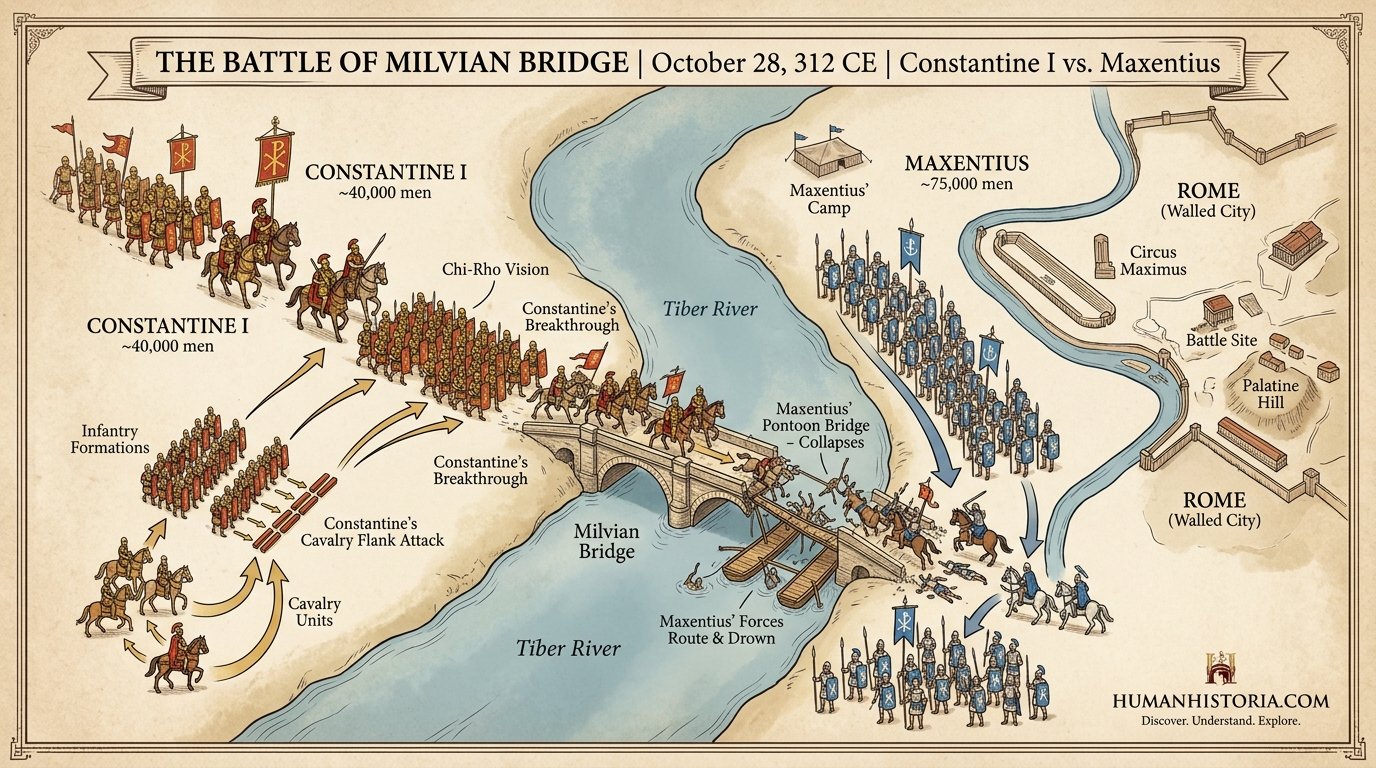
Constantine the Great: The Battle of Milvian Bridge & Christian Rome

Written by Humanhistoria Editorial Historical Era: ANCIENT

On the crisp morning of October 28, 312 CE, two Roman imperial armies converged upon the narrow stone arches of the Milvian Bridge just north of Rome. The prize was nothing less than supreme dominion over the Western Roman Empire; the stakes were the spiritual destiny of Western civilization. Driven by what he later testified was a daylight vision of a radiant cross emblazoned above the noon sun with the words In hoc signo vinces ("In this sign, conquer"), thirty-nine-year-old Flavius Valerius Constantinus ordered his legionaries to paint the sacred monogram of Christโ€”the Chi-Rhoโ€”upon their bronze-faced shields. The ensuing rout of Emperor Maxentius in the churning waters of the Tiber broke the back of Diocletian's Tetrarchy, sparked the imperial legalization of Christianity via the Edict of Milan, and established the ideological foundations of Christian Europe and the thousand-year Byzantine Empire.

Raphael workshop fresco depicting the Battle of the Milvian Bridge
Fresco of the Battle of the Milvian Bridge by Giulio Romano and the workshop of Raphael (c. 1520โ€“1524), depicting Constantine charging forward as angel messengers present the cross and Maxentius drowns in the Tiber. (Apostolic Palace, Vatican Museums, Rome)

The Dying Tetrarchy: Rome's Four-Way Civil War

To understand the high-stakes confrontation at the Milvian Bridge, one must examine the institutional crisis of the late third century. Following decades of military anarchy, hyperinflation, and barbarian invasions, Emperor Diocletian had radically restructured Roman governance in 293 CE by establishing the Tetrarchy ("Rule of Four"). Under this bureaucratic college, the vast empire was partitioned between two senior Augusti (one in the Latin West, one in the Greek East), each aided by a junior Caesar who was groomed to succeed him.

While the Tetrarchy stabilized imperial frontiers, it suppressed natural dynastic loyalty. When Constantine's father, Constantius Chlorus (Augustus of the West), died at Eboracum (modern York, England) in 306 CE, the loyal British and Gallic legions ignored Diocletian's complex succession scheme, immediately hailing twenty-four-year-old Constantine as Augustus on their shields. Simultaneously in Rome, Maxentiusโ€”the son of retired Western Augustus Maximianโ€”seized control of Italy and North Africa with the backing of the Praetorian Guard, who were enraged by Diocletian's decision to strip Rome of its imperial court and tax exemptions.

For six years, the Roman world fractured into an unprincipled civil war between rival claimants. By early 312 CE, Constantine recognized that coexistence was impossible. Maxentius had fortified Rome with years of grain reserves, allied with the Eastern usurper Maximinus Daza, and erected monumental public worksโ€”including the colossal Basilica of Maxentiusโ€”to solidify his prestige. In the early spring of 312 CE, Constantine gathered approximately forty thousand veteran legionaries and embarked on an audacious lightning invasion of Italy across the Mont Cenis pass of the snow-covered Alps.

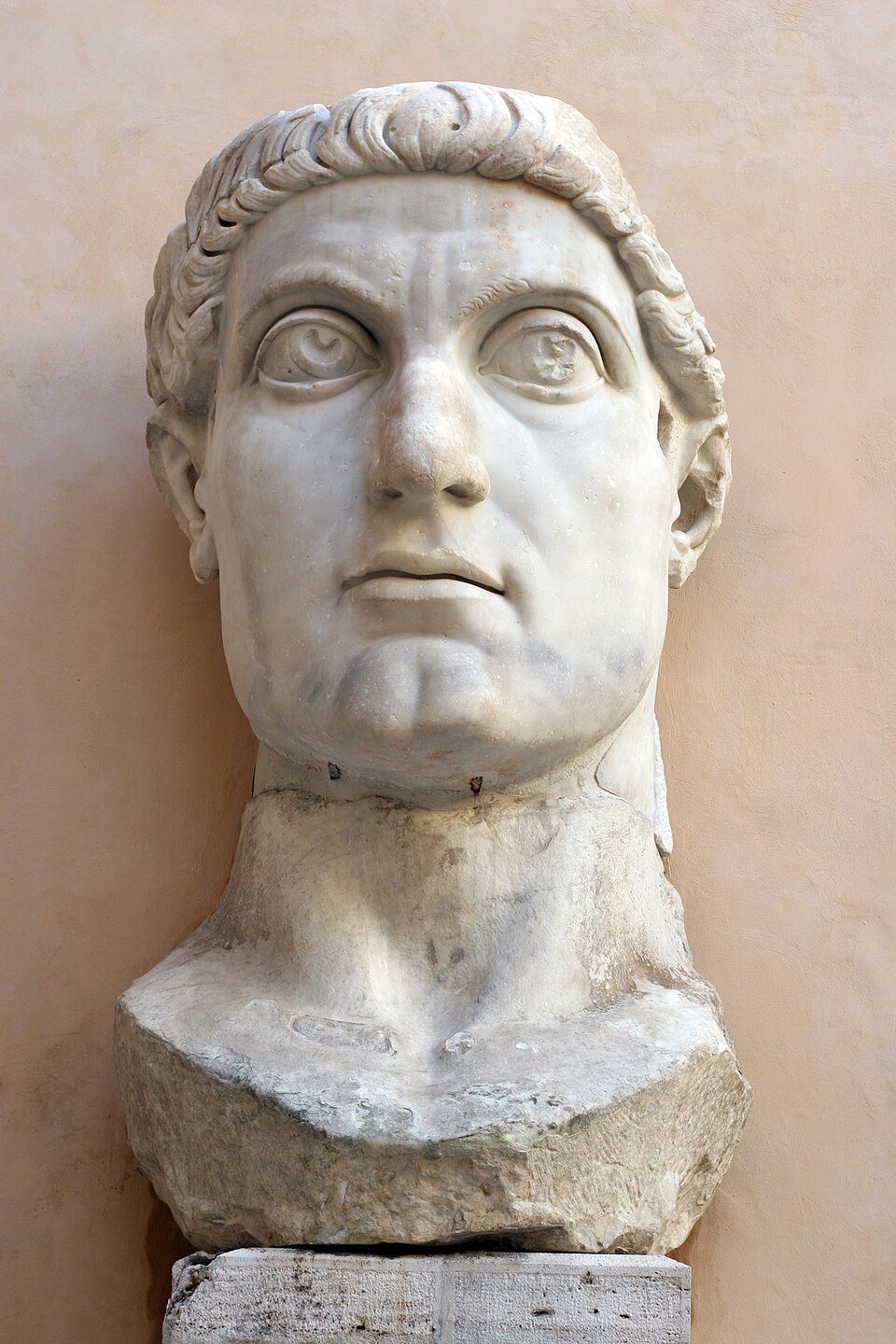
Colossal marble head of Emperor Constantine the Great
Colossal marble head of Emperor Constantine the Great (c. 312โ€“315 CE), originally part of an acrolithic seated statue that dominated the western apse of the Basilica of Maxentius in the Roman Forum. (Capitoline Museums, Palazzo dei Conservatori, Rome)

The Midday Vision: In Hoc Signo Vinces & The Labarum

Descending into the Po Valley, Constantine executed a masterclass in operational speed. He routed Maxentius' heavy cataphract cavalry at Turin by ordering his infantry to yield and encircle the armored horses with iron-tipped clubs. After capturing Milan, Brescia, and Verona, the roads to Rome lay open. Yet as Constantine marched down the Via Flaminia toward the ancient capital, strategic anxiety weighed heavily upon him: Rome was defended by the formidable Aurelian Walls, Maxentius commanded an army more than double his own size, and previous invading generalsโ€”Severus and Galeriusโ€”had seen their armies melt away in mutiny outside the imperial city.

It was during this psychological crisis on the march toward Rome that the pivotal spiritual event occurred. As recorded by contemporary Christian apologist Lactantius in his treatise De Mortibus Persecutorum (written just two years after the battle) and corroborated in lavish detail by bishop Eusebius of Caesarea (who claimed to have heard the story directly from Constantine's own lips under solemn oath):

"He saw with his own eyes the trophy of a cross of light in the heavens, above the sun, and an inscription attached to it saying: 'By this sign, conquer' (En Touto Nika / In hoc signo vinces). At this sight he himself was struck with amazement, and his whole army also, which followed him on this expedition, and witnessed the miracle."

โ€” Eusebius of Caesarea, Life of Constantine (Book I.28, c. 339 CE)

That night in a dream, Christ appeared to Constantine holding the same celestial sign, commanding him to make a likeness of that symbol and use it as a safeguard in all engagements with his enemies. Upon waking, Constantine summoned his goldsmiths and crafted the Labarumโ€”an imperial military standard consisting of a long gold-plated spear intersected by a transverse bar, draped with purple silk, and crowned with a golden laurel wreath encircling the sacred Chi-Rho monogram (the first two Greek letters of Christos: โ˜ง). Defying centuries of traditional Roman pagan military ritual, Constantine ordered every soldier in his legionary vanguard to paint the Christian monogram onto their curved shields before deploying for battle.

Tactical Collision: The Trap at the Milvian Bridge

On October 27, 312 CE, Constantine encamped at the roadside station of Malborghetto, nine miles north of the city. Within Rome, Maxentius consulted the ancient pagan Sibylline Books for omens. The priestesses returned an ambiguous prophecy: "On this day, the enemy of Rome shall perish." Interpreting the enemy as Constantine, Maxentius committed a fatal operational blunder. Instead of remaining secure behind the impregnable Aurelian Walls and subjecting Constantine's supply lines to a winter siege, Maxentius marched his vast armyโ€”including the elite Praetorian Guard, Italian levies, and Moorish light horsemenโ€”out across the Tiber River.

The crossing point was the Milvian Bridge (Pons Milvius), a stone bridge carrying the Via Flaminia over the river. To facilitate the movement of his large host, Maxentius cut the stone bridge's central arches and constructed an auxiliary floating pontoon bridge of timber boats lashed together, held in place by iron chains and wooden pins.

October 28, 312 CE: The Rout in the Mud

At dawn, Maxentius deployed his army with their backs pressed dangerously close to the swelling Tiber. Constantine seized the initiative instantly. Launching his veteran Gallic heavy cavalry against Maxentius' mounted flanks, Constantine shattered the enemy horsemen, driving them in chaotic panic off the field. With his flanks exposed, Constantine unleashed his compact legionary infantry down the gentle slope of the Saxa Rubra.

The demoralized Italian levies folded almost immediately under the shock of Constantine's veterans. As the front line shattered, thousands of Maxentius' soldiers broke and fled toward the river, converging upon the narrow pontoon bridge in a desperate crush of armor and horses. Overburdened by the sheer weight of thousands of panicked men, the timber pontoon bridge collapsed. Pontoon boats capsized, and the river became a drowning ground of men weighed down by bronze armor. Maxentius himself, attempting to swim his armored warhorse across the swirling current, was dragged beneath the muddy water by the weight of his imperial armor. His waterlogged corpse was washed ashore the following morning; Constantine ordered his rival's head severed, fixed atop a pike, and paraded through the streets of Rome.

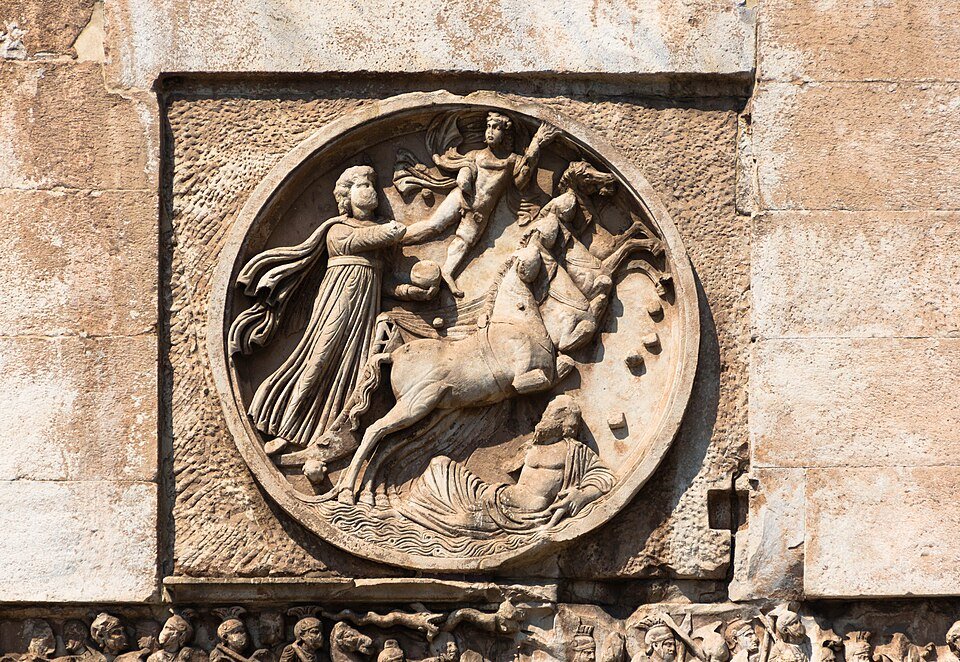
The monumental marble triumphal Arch of Constantine near the Colosseum in Rome
The triumphal Arch of Constantine in Rome, dedicated by the Senate in 315 CE to celebrate his victory at the Milvian Bridge, bearing the famous inscription attributing the triumph to the 'inspiration of the divinity' (instinctu divinitatis). (Roman Forum Archaeological Complex, Rome)
Dimension The Pagan Tetrarchic Order (Maxentius / Diocletian) The Constantinian Imperial Order (Christian Rome)
State Religion Greco-Roman polytheism; Emperor as Jupiter's vicar (Jovius); Imperial cult. Christian monotheism legalized; Emperor as God's earthly servant (Isapostolos).
Treatment of Christians The Great Persecution (303โ€“311 CE); church burnings, property confiscation, torture. Edict of Milan (313 CE); full religious tolerance; state restitution of church estates.
Military Insignia Traditional pagan Aquila eagles, thunderbolts, and legionary tutelary deities. The Labarum; shield-painted Chi-Rho monogram (โ˜ง); Christian chaplains.
Imperial Capital Decentralized administrative hubs (Trier, Milan, Sirmium, Nicomedia, Rome). Founding of Constantinople (330 CE) as a dedicated Christian "New Rome".
Succession Model Meritocratic Tetrarchic co-emperors appointed without dynastic inheritance. Dynastic monarchy; hereditary sons elevated to Caesars under imperial autocracy.

The Transformation of the West: From Milan to Nicaea

The immediate political consequence of the Milvian Bridge was Constantine's unchallenged control over the Western Roman Empire. Entering Rome in triumph, Constantine refused to ascend the Capitoline Hill to offer the traditional blood sacrifice to Jupiter Optimus Maximus, signaling a radical break with eight centuries of pagan civic ritual.

In February 313 CE, Constantine met with Licinius, the ruler of the Eastern provinces, in Mediolanum (Milan). Together, they issued the revolutionary Edict of Milan. This historic imperial proclamation granted unconditional freedom of worship to Christians and all other citizens across the Roman world, ordering the immediate restoration of all confiscated church properties, basilicas, and cemeteries without financial penalty.

Christianity shifted in a single generation from an outlawed, persecuted underground movement into the favored religion of the Roman state. Constantine channeled imperial revenues into monumental Christian architecture: founding the original St. Peter's Basilica over the Vatican tomb, the Basilica of St. John Lateran, and the Church of the Holy Sepulchre in Jerusalem. In 324 CE, Constantine defeated Licinius at the Battle of Chrysopolis, unifying the entire Roman world under his sole autocratic rule.

To establish theological unity across his empire, Constantine convened the First Council of Nicaea in 325 CEโ€”the first ecumenical council in historyโ€”bringing together over three hundred bishops to resolve the Arian controversy and draft the universal Nicene Creed. In 330 CE, on the site of ancient Byzantium overlooking the Bosporus, Constantine formally dedicated his new imperial capital: Constantinople (Nova Roma). Stripped of pagan temples and designed as a thoroughly Christian metropolis, Constantinople endured as the capital of the Eastern Roman Empire for 1,123 years until its fall in 1453.

"When I, Constantine Augustus, and I, Licinius Augustus, met so happily at Milan... we resolved to grant to the Christians and to all others free choice to follow whatever mode of worship they wished, to the end that whatever divinity there be in the heavenly seat may be pleased and propitious toward us and toward all who are under our government."

โ€” The Edict of Milan, Imperial Rescript of Constantine and Licinius (Recorded in Lactantius, De Mortibus Persecutorum, XLVIII, 313 CE)
โš–๏ธ

Historian Debate: Sincere Spiritual Conversion vs. Pragmatic Imperial Realpolitik

The Pragmatic Realpolitik School (Jacob Burckhardt, Edward Gibbon)

Contends that Constantine was an unprincipled political opportunist who recognized that traditional paganism was splintered, seizing upon the disciplined, cohesive hierarchy of the Christian Church as an instrument of imperial consolidation and absolute monarchical control.

The Sincere Faith & Transformation School (Peter Brown, Timothy Barnes)

Argues from Constantine's personal correspondence and theological interventions that his devotion was genuine within the late antique religious mindset. Believing the supreme divinity had granted him victory at the bridge, he felt a solemn obligation to protect and patronize the Church.

Contemporary scholarship views the binary as false: in antiquity, divine favor and political legitimacy were inextricably bound together.

Long-Term Legacy: The Christianization of Western Civilization

Few military engagements in human annals have exerted such transformative, long-term civilizational consequences as the Battle of the Milvian Bridge. Had Maxentius' defenses held or Constantine perished in the Tiber, the Roman state would likely have maintained its pagan imperial framework, leaving the disparate Christian churches subject to renewed persecutions and regional fragmentation.

Constantine's conversion fused Roman administrative law, Greek philosophical theology, and Christian monotheistic faith into a singular civilizational synthesis. That synthesis formed the cultural matrix of medieval Christendom, survived the barbarian dismemberment of the Western provinces, and shaped the legal, moral, and architectural architecture of the Western world for nearly two millennia.

๐Ÿ“– SCHOLARLY INQUIRIES

Frequently Asked Questions

Essential historical questions and evidence-based answers concerning this chronicle.

What was Constantine's vision before the Battle of Milvian Bridge?

According to historian Eusebius, Constantine saw a cross of light above the sun inscribed with 'In hoc signo vinces' ('In this sign, conquer'), painting the Chi-Rho monogram on his soldiers' shields.

What was the Edict of Milan (313 CE)?

The Edict of Milan was a joint proclamation by Constantine and Licinius guaranteeing full religious tolerance for Christians and restoring confiscated church property across the Roman Empire.

Why did Constantine move the capital to Constantinople?

Constantinople (modern Istanbul) possessed immense strategic advantages: defending the Danube and Euphrates frontiers while controlling the lucrative Bosporus maritime trade between Europe and Asia.

๐Ÿ“š Academic Sources & Scholarly Bibliography
  • Eusebius of Caesarea (1999). Life of Constantine. Oxford University Press.
  • Barnes, T. D. (1981). Constantine and Eusebius. Harvard University Press.
  • MacMullen, R. (1984). Christianizing the Roman Empire (A.D. 100-400). Yale University Press.
โšก Fast Facts
  • Historical EraANCIENT
  • Region๐ŸŒ EUROPE
  • CategoryEmpires
  • Reading Timeโฑ 12 min read
๐Ÿ“– Scholar Mode Active โ€” Click to exit focused reading
Selected Era

Prehistoric Era

Millions of years ago to ~3000 BCE

The dawn of humanity. From the evolutionary split of early hominids to the mastery of stone tools, fire, and the birth of language.

Landmark Milestones

Welcome to Historia

Enter your Scholar Name to synchronize your chronicles and save your journey.