Examine the tangible relics, physical tokens, and revolutionary machines that shaped civilizational growth.
THE HISTORIA CIRCLE
Join the collective discussion, study logs, and contributions of fellow historians mapping humanity's path.
Historia Forum Discussions
Start a Discussion Thread
THEMATIC PATHWAYS
Trace a single thread β disease, trade, energy, migration β across all eras and civilizations.
History is not just a sequence of events β it is a network of patterns. These thematic pathways allow you to follow a single concept across thousands of years: how agriculture spread, how warfare evolved, how trade routes shaped civilizations. Each pathway collects the most relevant chronicles across all eras.
How is this different from the sidebar Topics?
While the sidebar Topics (like Science & Tech or Empires) filter articles within your selected historical Era, Thematic Pathways cut horizontally across all eras (from Prehistoric to the Future). Use Themes to trace a single concept's evolutionary line across 300,000 years.
CIVILIZATION HUBS
Comprehensive profiles of the world's greatest civilizations and empires β from ancient cradles to global super-states.
Human Historia provides an academically rich exploration of the world's most influential civilizations. From the monumental achievements of ancient Egypt, Han China, and the Roman Empire, to the sophisticated societies of the Maya, the Islamic Caliphates, and West African empires, these hubs offer deep insights into the cultural, political, and technological legacies that continue to shape our global story.
ACADEMIC PASSPORT
Track your intellectual journey, quiz outcomes, and historical badges of honor.
HISTORIA PASSPORTβ³
π€Scribe Novice
Scholar NameHistoria Explorer
Rank RatingSumerian Record Scribe
Chronicles Read0 / 48
Study Guide Pins0 Guides
Security AccessLevel 1 (Novice)
Earned Badges of Honor
π₯
Fire Keeper
Unlock 3 prehistoric chronicles.
ποΈ
Codex Keeper
Unlock 3 ancient chronicles.
π°
Guild Master
Unlock 3 medieval chronicles.
βοΈ
Steam Engineer
Unlock 3 modern chronicles.
π
Singularity Sage
Unlock 3 future chronicles.
π
Grand Scholar
Score 5/5 on the Lab Quiz.
Recent Lab Activities
No recent activities recorded. Take a quiz or bookmark articles!
Curated Exhibition
Human Historia
An immersive graphical anthology tracing the paths of civilizations, breakthroughs, and conflicts that forged the modern consciousness.
25Chronicles
Showing all articles
The Code of Hammurabi: The First Written Laws
Written by Historia AdministrationHistorical Era: Ancient Ages
π¨ Historical Illustration (AI)
* Note: Cover images and unreferenced inline images are AI-generated illustrations for illustrative purposes.
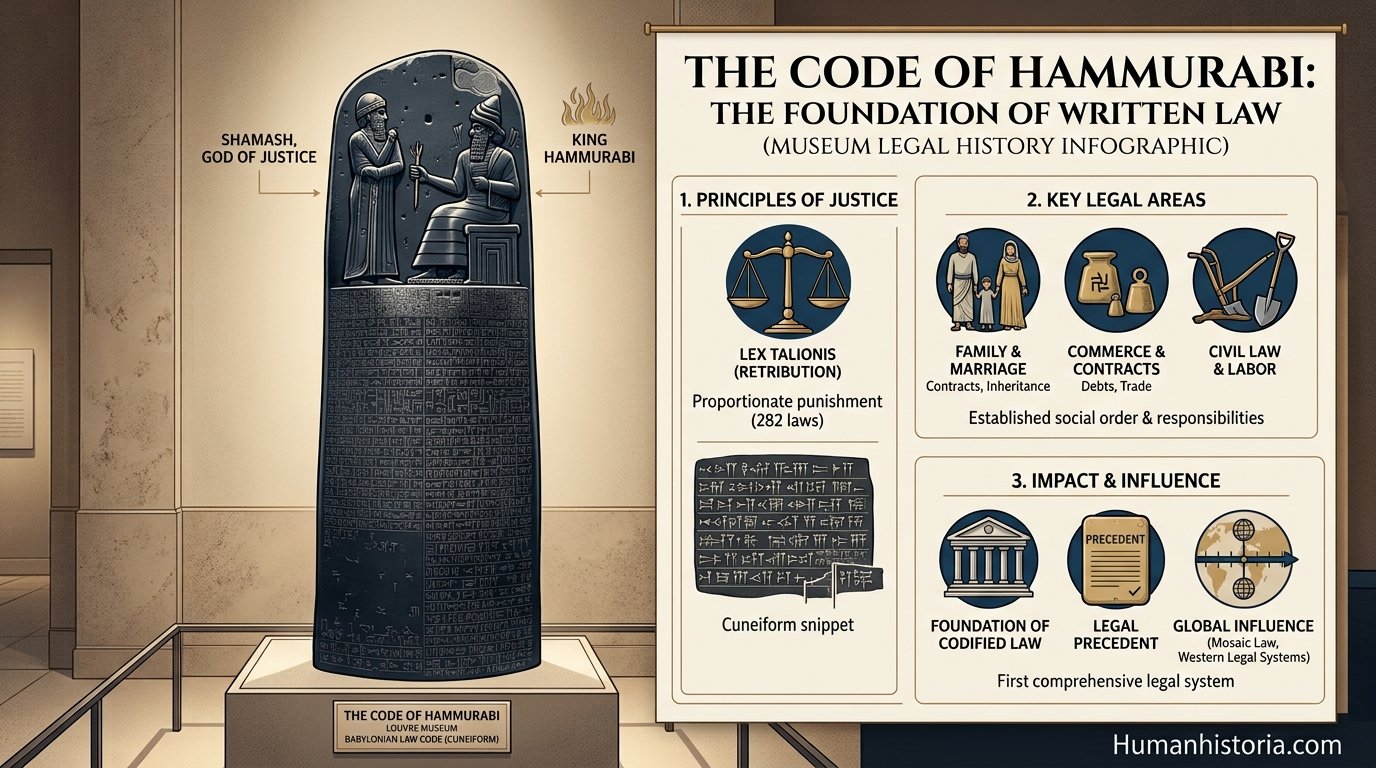
The Code of Hammurabi (codified c. 1750 BCE) is one of the oldest, most complete, and most famous written legal systems in human history. Issued by the sixth king of the First Babylonian Dynasty, Hammurabi, and inscribed onto a massive basalt stele, this body of 282 laws established a standardized code of civic accountability, commercial regulation, and criminal justice. By placing written law in public view, the code represented a significant shift in statecraft, transitioning society away from arbitrary, personalized rule toward statutory law, defining the administration of justice in the ancient Near East and shaping the development of legal codes for centuries.
The Babylonian Empire and the Need for Code
To understand the creation of the code, one must examine the political expansion of Babylon under Hammurabi (reigned c. 1792β1750 BCE). When Hammurabi took the throne, Babylon was a small city-state in central Mesopotamia, surrounded by powerful rivals. Through a series of military campaigns, alliances, and diplomatic betrayals, Hammurabi conquered his neighbors, uniting the warring city-states of Sumer and Akkad into a single, centralized Babylonian Empire.
This rapid conquest created an administrative challenge. The empire contained diverse populations speaking different languages and operating under varying local customs, commercial standards, and tribal traditions. To govern this territory, Hammurabi recognized that he needed a single, unified, public legal system. By standardizing contracts, prices, interest rates, and criminal penalties, the code aimed to integrate these diverse regions, secure property rights, and project the image of the pharaoh as a just, divine protector of his subjects.
The Basalt Stele: Divine Authority and Written Record
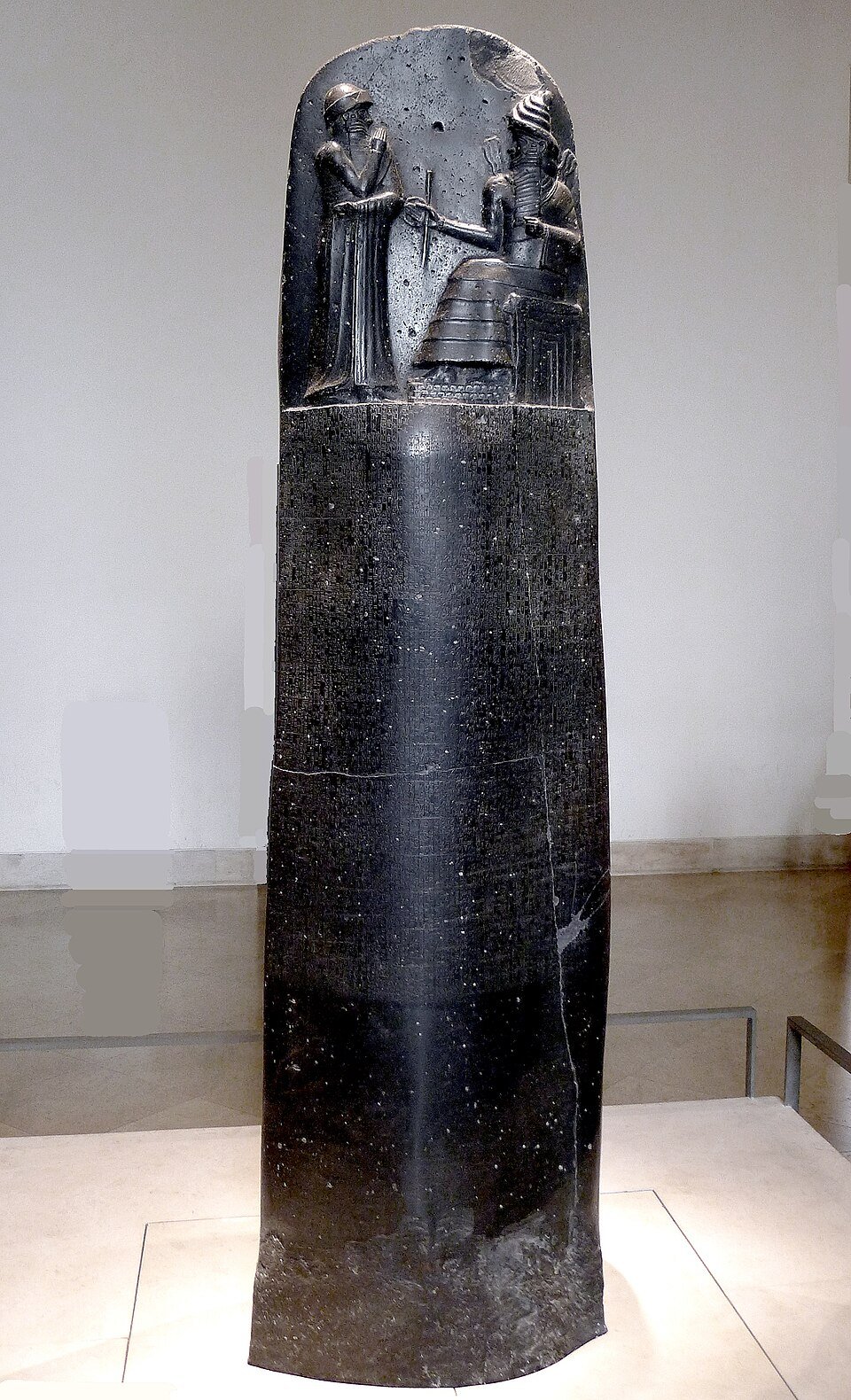
The code was not written on papyrus or hidden in royal archives; it was carved onto several public monuments. The most famous surviving copy is a 2.25-meter (7.4-foot) tall basalt stele, discovered in 1901 by French archaeologists at Susa (modern Iran, where it had been carried as war booty by the Elamites in antiquity) and currently housed in the Louvre Museum in Paris.
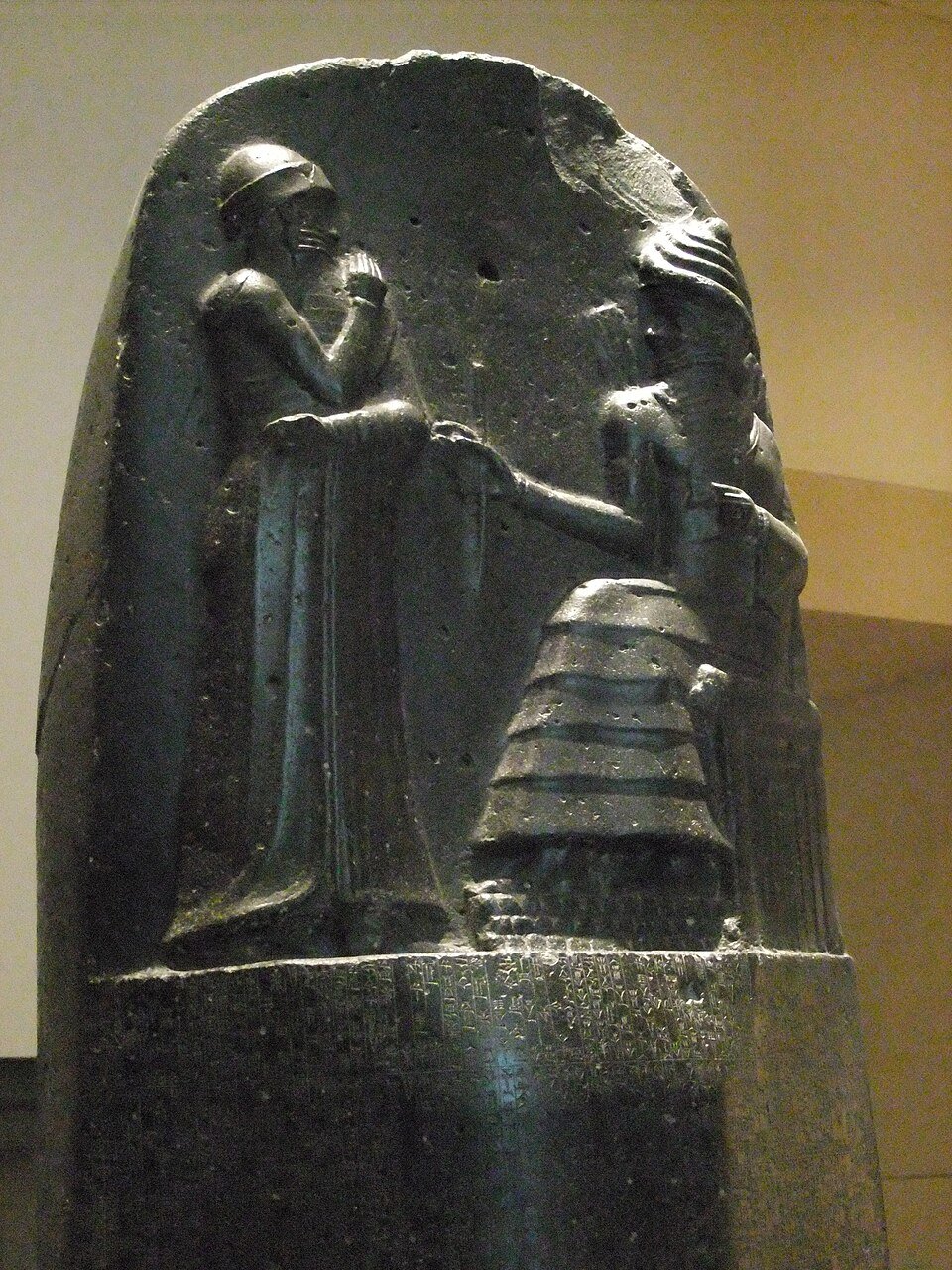
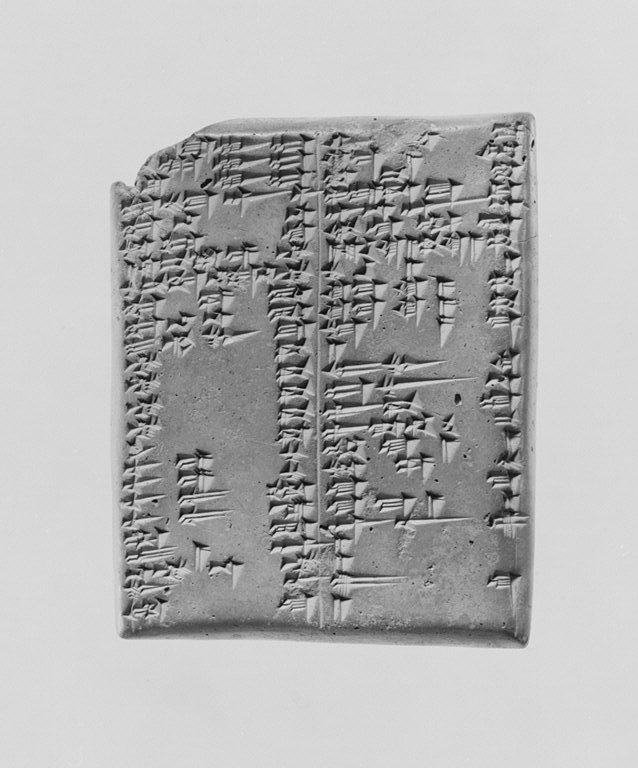
The stele is shaped like a giant index finger, carved in relief at the top. The carving depicts Hammurabi standing before Shamash, the Babylonian god of justice and the sun. Shamash is seated on a throne, wearing a horned crown and holding the ring and staffβthe symbols of royal authority and measurement. By showing Shamash presenting the laws to Hammurabi, the relief establishes the divine origin of the code. The rest of the stele is covered in 4,130 lines of cuneiform text, written in the classical Babylonian dialect of Akkadian, outlining the laws and declaring in the prologue:
"Hammurabi, the prince, called by the gods to bring about the rule of righteousness in the land, to destroy the wicked and the evil-doers; so that the strong should not harm the weak; so that I should rule over the people like Shamash."
The authentic basalt stele of the Code of Hammurabi on display in the Louvre Museum, Paris, containing 282 laws written in cuneiform script.The iconic relief at the top of the Code of Hammurabi stele: King Hammurabi stands reverently before Shamash, the Babylonian god of justice and the sun, who presents the ring and staff β symbols of royal authority. This scene established the divine origin of the 282 laws carved in cuneiform below.
Lex Talionis and Social Stratification
The criminal law of the Code of Hammurabi is guided by the philosophy of Lex Talionis (the law of retaliation), commonly summarized as "an eye for an eye, a tooth for a tooth."
However, the application of this retaliatory justice was not democratic; it was stratified based on the social class of the victim and the perpetrator. The code recognized three distinct social classes in Babylonian society:
Awilu: The free, property-owning elite, including nobles, priests, military officers, and wealthy merchants.
Mushkenu: Free commoners, state dependents, and peasants who did not own land but were not enslaved.
Wardu: Enslaved people, who were treated as property under the law and could be bought, sold, and inherited.
If an Awilu noble blinded another Awilu noble, the law was applied strictly: "If a man put out the eye of another man, his eye shall be put out" (Law 196). However, if an Awilu blinded a Mushkenu commoner, he faced no physical punishment, paying a fine of one mina of silver instead (Law 198). If an Awilu blinded a Wardu slave, he had to pay half the slave's purchase value to the slave's owner to compensate for the property damage (Law 199).
Trial by Ordeal: The River God
For crimes where evidence was lacking or accusations of witchcraft were made, the code utilized the Trial by Ordeal. The accused was taken to the Euphrates River and thrown in. If the River God swept them away and they drowned, it was proof of guilt, and their property was awarded to the accuser. If they survived and swam to shore, it was proof of innocence; the accuser was executed for making a false charge, and their property was awarded to the survivor (Law 2).
Civil and Commercial Law: The Mechanics of Trade
While the criminal penalties were severe, the majority of the code's clauses deal with civil, commercial, and family law, providing a detailed window into the Babylonian economy:
Agricultural Liability: In an economy dependent on irrigation, neglect was penalized. Law 53 states that if a farmer fails to maintain his dyke, and the dyke breaches and floods his neighbors' crops, he must sell his property and family to compensate his neighbors for the lost grain.
Debt and Slavery Limits: To prevent debt from destroying the social structure, Hammurabi limited debt slavery. Law 117 states that if a man pawns his wife, son, or daughter to settle a debt, they could only work for the creditor for three years, receiving their freedom in the fourth year.
Commercial Contracts: Scribes were required for all transactions. Law 7 states that if a merchant purchases silver, gold, or sheep from a man's son or slave without witnesses and a written contract, the merchant is treated as a thief and executed.
Price and Wage Controls: The code established minimum wages and rent controls, detailing the daily pay for harvest laborers, bricklayers, tailors, and boat captains, and setting the standard rental rates for oxen and cargo boats.
Professional Malpractice and Liability
The code held professionals to a standard of liability, with severe penalties for negligence:
Builders: If a builder constructed a house poorly, and the house collapsed and killed the owner, the builder was executed. If the collapse killed the owner's son, the builder's son was executed (Law 230), reflecting a concept of dynastic liability.
Physicians: If a surgeon performed a major operation with a bronze lancet on a noble and caused their death or blinded them, the surgeon's hands were cut off (Law 218), ensuring that only highly skilled practitioners attempted risky operations.
Family and Marriage Law
The code treated marriage as a legal, commercial contract. Law 128 states: "If a man take a woman to wife, but write no contract, she is not a wife." The code detailed dowry protection, divorce alimony (the husband had to return the wife's dowry and provide child support), and severe penalties for adultery (the guilty couple was bound and thrown into the river).
Comparison with the Mosaic Covenant Codes
Historical legal scholars frequently compare the Code of Hammurabi with the biblical Mosaic Covenant Code found in the Book of Exodus (particularly chapters 21β23). Carved several centuries after Hammurabi's stele, the Hebrew legal tradition shares many structural similarities, including the "eye for an eye" (Lex Talionis) formulation for physical injuries. However, the two codes differ in their social and theological foundations. While Hammurabi's Code was highly stratified, dictating different punishments based on the class of the victim (Awilu, Mushkenu, or Wardu), the Mosaic Code did not recognize class distinctions for physical harm, establishing that all free members of the community were equal under God's law. Furthermore, the Mosaic Code placed a higher value on human life than property: whereas Hammurabi's Code prescribed the death penalty for theft, housebreaking, and harboring runaway slaves, the Hebrew code relied primarily on financial restitution for property crimes, reflecting a different moral and administrative philosophy.
The code also highlights the administrative networks of the Babylonian state. Scribes copied the laws as a standard textbook in scribal schools, and royal letters show that Hammurabi monitored local courts, reprimanding governors who failed to enforce the code's guidelines. The archaeological recovery of cuneiform archives at cities like Ebla, Mari, and Nineveh has confirmed that Hammurabi's legal framework served as the administrative template for subsequent Mesopotamian empires, demonstrating that the codification of laws was the primary tool used to secure state stability and coordinate trade across diverse populations.
Babylonian scribes at work in a palace courtyard, carefully inscribing cuneiform law texts onto clay tablets. The Code of Hammurabi was copied for centuries as a standard textbook in scribal schools, ensuring that its legal framework served as the administrative template for successive Mesopotamian empires.
Class Stratification and Legal Protections
The legal philosophy of the Code of Hammurabi was fundamentally rooted in a highly stratified social hierarchy, where the application of justice and the severity of punishments were determined by an individual's social class. The Code divided Babylonian society into three distinct legal classes:
The Awilu (Patricians): The wealthy, land-owning aristocracy, including royal officials, high priests, and military commanders. They enjoyed the highest social status and protections, but also faced heavy financial fines for administrative misconduct.
The Mushkenu (Commoners): Free citizens who did not own land but worked as state tenants, artisans, merchants, or farmers. They possessed legal rights and could own property, but their injuries were valued at lower rates than those of the aristocracy.
The Wardu (Slaves): The unfree labor force, consisting of prisoners of war, debtors, and individuals born into slavery. Slaves were treated under the law as the personal property of their masters, though they could marry free citizens, conduct business, and eventually purchase their freedom.
This class system meant that the famous principle of lex talionis (an eye for an eye) applied only when the offender and the victim were of equal social status. If a member of the awilu blinded another aristocrat, his own eye was blinded in return. However, if an aristocrat blinded a mushkenu, he was merely required to pay a fine of one silver shekel. If he blinded a slave, he had to pay half of the slave's market value to the slave's owner. By standardizing these unequal valuations, the Code of Hammurabi stabilized class relations, protected property rights, and secured the social hierarchies necessary to administer the Babylonian state.
Legacy of Legal Continuity
The administrative structure established by the Code of Hammurabi created a template of legal continuity that outlived the Old Babylonian Empire. Scribes copied the code for centuries as a standard textbook to learn cuneiform and legal terminology. Archaeological excavations have recovered copies of the code dating to the Neo-Babylonian and Assyrian periods, proving that the legal framework remained influential for over a thousand years. By establishing written precedent, liability, and state enforcement, Hammurabi's Code served as the institutional foundation for the evolution of statutory law, demonstrating that the administration of justice is the primary tool used to coordinate trade and maintain social order in complex civilisations.
Conclusion and Legal Legacy
The Code of Hammurabi was a landmark in the evolution of administration. By codifying laws onto stone monuments, Hammurabi established that the law was public, consistent, and independent of the personal whims of local judges. Although the code was harsh and socially unequal by modern standards, its emphasis on contract enforcement, written records, and statutory liability laid the foundations for the rule of law, proving that an empire's stability depends on a transparent and codified legal system.
βοΈ
Historian Debate: Was Hammurabi's Code Actually Enforced?
State Penal Code
Traditional legal historians argue the stele was a binding penal code used by royal judges to resolve real disputes across Mesopotamia, establishing standard sentences.
A Royal Apologia and Self-Praise
Modern revisionists suggest the code was a work of royal propaganda designed to present Hammurabi as a 'just king' to the gods and posterity, rather than a statute book used in court.
The basalt stele of Hammurabi contains 282 laws, detailing class-based retributive justice.
"If a man destroy the eye of another man, his eye shall be destroyed. If he break another man's bone, his bone shall be broken."
β Code of Hammurabi, Laws 196 and 197, Basalt Stele, Babylon (c. 1750 BCE).
Related Civilizations & Contexts
Babylonian EmpireAssyrian EmpireSumerian Ur DynastyElamite Kingdom
Further Reading
King Hammurabi of Babylon β by Marc Van De Mieroop. A detailed political and social biography of the lawgiving king.
Mesopotamian Law and Society β by Samuel Greengus. An analysis of legal documents and court cases in the ancient Near East.
π Scholar Mode Active β Click to exit focused reading
History Lab π§ͺ
Run simulated matches between civilizations and convert ancient currencies.
π΅οΈ Who Am I? (The Historical Guess Game)
A secret historical figure has been selected. Ask yes/no questions to narrow down the pool of candidates. Click any active card to make your accusation!
Secret Identity
β Who Am I?
Ask questions using the board below to narrow down my identity.
Ask a Question:
Question LogQuestions: 0 / 7
No questions asked yet.
Candidate Board:
πΊοΈ Timeline Scramble
Five historical events appear out of order. Click them in the correct chronological sequence β from oldest to most recent. How well do you know your history?
πΊ Relic or Fake?
Is this a real historical artifact or a convincing fabrication? Judge each one based on its description and era β then see the truth revealed!
Artifact 1 / 10Score: 0
Empire Matchup Simulator
Empire ATerritory Size (Peak, M kmΒ²)Empire B
00
Empire APopulation (Peak, Millions)Empire B
00
Empire AMilitary Power (Army Size)Empire B
00
Tactical Battle Analysis
Select empires and click simulate to run evaluations.
Historical Purchasing Power Converter
See what ancient coins are worth in modern terms and check their historical purchasing power.
Modern Value Equivalent
$0.00 USD
Historical Purchasing Power:
Select currency to view purchasing capability.
Historical Identity Generator
Forge an authentic historical identity from ancient civilisations, complete with linguistic meaning and biography.
Neutral
Gaius Julius
Meaning:Descendant of Jupiter
Historical Background:
A Roman citizen and clerk who worked in the forum under Roman republic rule.
Chrono-Cultural Fusion Simulator
Fuse the culture, technology, and governance of two legendary civilizations to synthesize a unique hybrid society.
Cohesion & Coexistence Rate
85%
ποΈ Hybrid Architecture
βοΈ Synthesized Asset
π Synthetic Governance
Historical Tactics & Trivia Quiz
Test your historical knowledge and battle tactics to claim your administrative rank.
8 Questions β’ Multi-Era
You will be presented with random scenarios and trivia spanning ancient Egypt, classical Rome, Islamic Golden Age, and the modern industrial era. Complete the evaluation to see your historical title!
Question 1 of 8Score: 0
What was the Code of Hammurabi written on?
Correct!
Evaluation Complete!
6 / 8
Correct
Rank Attained
Imperial Legionary
Your knowledge of classical strategy and administrative structures is respectable.
Selected Era
Prehistoric Era
Millions of years ago to ~3000 BCE
The dawn of humanity. From the evolutionary split of early hominids to the mastery of stone tools, fire, and the birth of language.
Landmark Milestones
Welcome to Historia
Enter your Scholar Name to synchronize your chronicles and save your journey.