Examine the tangible relics, physical tokens, and revolutionary machines that shaped civilizational growth.
🎥 VIDEO HUB & SHORTS
Watch visual summaries, site intros, and mini-documentaries chronicling 300,000 years of world history.
📊 HISTORICAL INFOGRAPHICS ARCHIVE
Museum-grade visual graphics, civilizational timelines, and architectural breakdowns curated for educators and history lovers.
THE HISTORIA CIRCLE
Join the collective discussion, study logs, and contributions of fellow historians mapping humanity's path.
Historia Forum Discussions
Start a Discussion Thread
THEMATIC PATHWAYS
Trace a single thread — disease, trade, energy, migration — across all eras and civilizations.
History is not just a sequence of events — it is a network of patterns. These thematic pathways allow you to follow a single concept across thousands of years: how agriculture spread, how warfare evolved, how trade routes shaped civilizations. Each pathway collects the most relevant chronicles across all eras.
🧩
How is this different from the sidebar Topics?
While the sidebar Topics (like Science & Tech or Empires) filter articles within your selected historical Era, Thematic Pathways cut horizontally across all eras (from Prehistoric to the Future). Use Themes to trace a single concept's evolutionary line across 300,000 years.
CIVILIZATION HUBS
Comprehensive profiles of the world's greatest civilizations and empires — from ancient cradles to global super-states.
Human Historia provides an academically rich exploration of the world's most influential civilizations. From the monumental achievements of ancient Egypt, Han China, and the Roman Empire, to the sophisticated societies of the Maya, the Islamic Caliphates, and West African empires, these hubs offer deep insights into the cultural, political, and technological legacies that continue to shape our global story.
EVOLUTION OF HUMAN SKILLS
Trace the compounding technologies, practical capabilities, and cognitive milestones of the human species.
Human progress is a story of compounding skills. Every breakthrough, from the spark of prehistoric fire to modern silicon transistors, builds directly on previous generations of ingenuity. Hover over a skill node to trace its historical prerequisites, and click it to explore its development timeline, species-wide impact, and related chronicles.
Prehistoric Ancient Medieval Modern Future
🧠
Select any skill node in the tree to explore its evolutionary path, development timeline, and historical impact.
ACADEMIC PASSPORT
Track your intellectual journey, quiz outcomes, and historical badges of honor.
HISTORIA PASSPORT⏳
👤Scribe Novice
Scholar NameHistoria Explorer
Rank RatingSumerian Record Scribe
Chronicles Read0 / 48
Study Guide Pins0 Guides
Security AccessLevel 1 (Novice)
Earned Badges of Honor
🔥
Fire Keeper
Unlock 3 prehistoric chronicles.
🏛️
Codex Keeper
Unlock 3 ancient chronicles.
🏰
Guild Master
Unlock 3 medieval chronicles.
⚙️
Steam Engineer
Unlock 3 modern chronicles.
🚀
Singularity Sage
Unlock 3 future chronicles.
👑
Grand Scholar
Score 5/5 on the Lab Quiz.
Recent Lab Activities
No recent activities recorded. Take a quiz or bookmark articles!
Curated Exhibition
Human Historia
An immersive graphical anthology tracing the paths of civilizations, breakthroughs, and conflicts that forged the modern consciousness.
25Chronicles
Showing all articles
House of Wisdom Baghdad 800 CE: Translation Movement & Medieval Science
Written by Historia ScienceHistorical Era: MEDIEVAL
🎨 Historical Illustration (AI)
* Note: Cover image is an AI-generated historical illustration.
🧠Key Chronicle Takeaway (Atomic Summary)
How the Islamic Golden Age preserved and expanded global science, culminating in Al-Biruni's calculation of the Earth's circumference.
During the medieval period, while Western Europe experienced the collapse of centralized administration following the fall of the Western Roman Empire, the Islamic world entered a golden age of intellectual expansion. Center stage in this scientific renaissance was the House of Wisdom (Bayt al-Hikma) in Baghdad. Under the patronage of the Abbasid Caliphs, this institution drove the Translation Movement, preserving and expanding classical Greek, Persian, Indian, and Syriac knowledge. Scholars operating within this network, most notably the polymath Abu Rayhan al-Biruni, did not merely copy ancient texts, but established the experimental scientific method, revolutionized mathematics, and calculated the physical properties of the Earth with unprecedented accuracy.
The Abbasid Renaissance: Baghdad as the Center of the World
The foundation of the Islamic Golden Age was laid by the Abbasid Revolution of 750 CE, which shifted the focus of the Caliphate away from Damascus toward the east. In 762 CE, Caliph Al-Mansur founded the new capital of Baghdad along the banks of the Tigris River. Designed as a round city, Baghdad sat at the crossroads of the Silk Road and the Indian Ocean trade networks. Within a generation, it grew into a cosmopolitan metropolis of over one million residents, housing merchants, diplomats, and scholars from diverse ethnic and religious backgrounds.
To support this administration, the Abbasid rulers recognized the need for translation. They established the House of Wisdom as a royal library and academy. It was expanded by Caliph Al-Ma'mun (reigned 813–833 CE), who was a patron of the sciences. Al-Ma'mun funded international scientific expeditions, built astronomical observatories in Baghdad and Damascus, and sent diplomatic missions to Constantinople to acquire rare Byzantine manuscripts of Plato, Aristotle, Euclid, and Ptolemy.
The Translation Movement and the Paper Revolution
The Translation Movement (c. 750–950 CE) was a massive, state-sponsored effort to translate the scientific and philosophical corpus of antiquity into Arabic. The movement was characterized by its religious and ethnic inclusivity. The director of the translation department at the House of Wisdom was Hunayn ibn Ishaq (808–873 CE), a Nestorian Christian scholar who spoke Arabic, Greek, Syriac, and Persian. Hunayn established rigorous standards of textual criticism, comparing multiple Greek manuscripts to create accurate translations. Caliph Al-Ma'mun reportedly paid Hunayn the weight of each translated manuscript in pure gold.
This academic progress was accelerated by a crucial technological transfer: the Paper Revolution. In 751 CE, at the Battle of Talas (fought in modern Kyrgyzstan), Abbasid forces captured Chinese papermakers. The prisoners were brought to Samarkand and Baghdad, where they demonstrated the technique of making paper from rags and hemp. Unlike expensive animal parchment or fragile Egyptian papyrus, paper was cheap, durable, and easy to bind into books. Within decades, Baghdad housed dozens of paper mills and book markets, reducing the cost of books and democratizing literacy and education throughout the empire.
The Birth of Algebra: Al-Khwarizmi
Operating out of the House of Wisdom, the Persian mathematician Muhammad ibn Musa al-Khwarizmi (c. 780–850 CE) wrote the foundational treatise Al-Kitab al-mukhtasar fi hisab al-jabr wal-muqabala ("The Compendious Book on Calculation by Completion and Balancing"). The term al-jabr (completion) gave rise to the modern word algebra. Al-Khwarizmi introduced the decimal positional system and the use of zero (originating in India) to the Western world, and his name was Latinized as Algoritmi, giving us the word algorithm.
Al-Biruni: The Prince of Polymaths
Among the brilliant minds of this golden age, Abu Rayhan al-Biruni (973–1048 CE) stands as a monument to scientific inquiry. Born in Khwarazm (modern Uzbekistan), Al-Biruni was a master of astronomy, mathematics, physics, geography, linguistics, and history. Unlike many medieval scholars who relied on philosophical speculation, Al-Biruni was an empiricist, asserting that natural phenomena should be verified through direct observation and measurement.
Al-Biruni’s career was shaped by his relationship with Sultan Mahmud of Ghazni, who captured him during his conquests. Al-Biruni accompanied Mahmud’s military campaigns into India, where he spent years studying Sanskrit, translating Indian scientific works into Arabic, and researching Hindu philosophy. This culminated in his masterpiece Kitab al-Hind (Indica), the first systematic study of India’s culture, religion, and geography, earning him the title of the "first anthropologist."
Calculating the Earth's Circumference
Al-Biruni’s most famous scientific achievement was his precise calculation of the Earth’s radius and circumference. Ancient Greek scholars, most notably Eratosthenes, had calculated the circumference by measuring the angle of the sun's shadow at two separate cities (Alexandria and Syene) and measuring the distance between them. However, measuring the geographic distance between cities in antiquity was inaccurate, relying on walking paces or camel transit times.
Al-Biruni developed a new method that bypassed the need to measure horizontal distances across land, relying instead on trigonometry and observation from a single high point. He traveled to the Nandana Fort in the Salt Range (modern Pakistan), situated near a high hill overlooking a flat plain. His calculation involved two steps:
Measuring Hill Height: Using an astrolabe and a surveyor's sighting tool, he stood at two points on the plain, measured the angle of elevation to the hilltop, and calculated the hill's height using the trigonometry of right triangles.
Measuring Horizon Dip: He ascended the hill and measured the angle of dip—the angle between the horizontal line of sight and the visible horizon line where the sky met the flat plain.
Using these variables, Al-Biruni formulated a trigonometric equation that linked the hill’s height and the horizon dip angle to the Earth's radius. His calculation determined the Earth’s radius to be 6,335.7 kilometers, which is within 1% of the modern satellite-measured equatorial radius of 6,378.1 kilometers. His method demonstrated the power of mathematical abstraction to solve planetary-scale questions.
Ibn al-Haytham: The Father of Optics
While Al-Biruni calculated the Earth, his contemporary Ibn al-Haytham (Alhazen, 965–1040 CE) revolutionized physics. Working in Cairo, he wrote the Book of Optics, proving through experiments with light rays and the camera obscura (pinhole camera) that vision occurs because light reflects off objects into the eye, correcting the ancient Greek theories of emission. He established the modern scientific method by insisting on experimental proof for physical laws.
Interdisciplinary Achievements of the Golden Age
The House of Wisdom served as a hub for other scientific leaps:
Medicine:Ibn Sina (Avicenna, 980–1037 CE) compiled the Canon of Medicine, a systematic medical encyclopedia that introduced clinical drug trials, quarantined disease control, and diagnosed meningitis, serving as the standard textbook in European universities for 500 years.
Chemistry:Jabir ibn Hayyan (Geber, c. 721–815 CE) established experimental chemistry, inventing the alembic still for distillation and isolating sulfuric, nitric, and hydrochloric acids.
Engineering: The Banū Mūsā brothers published the Book of Ingenious Devices in the 9th century, designing automated valves, feedback controllers, and mechanical musical instruments.
The Preservation and Transmission of Knowledge
In 1258 CE, the golden age of Baghdad was brought to a violent end when the Mongol leader Hulagu Khan besieged and sacked the city. The House of Wisdom was destroyed, and its books were thrown into the Tigris River, reportedly turning the water black with ink. However, the intellectual legacy of the Translation Movement had already escaped the capital.
Through translation centers in Cordoba and Toledo in Islamic Spain (Al-Andalus) and the Kingdom of Sicily, Christian, Jewish, and Muslim scholars translated the Arabic scientific corpus into Latin. The works of Al-Khwarizmi, Ibn Sina, Ibn al-Haytham, and Al-Biruni were integrated into the curricula of early European universities (such as Paris, Oxford, and Bologna), serving as the intellectual spark that triggered the Renaissance and the Scientific Revolution.
Islamic Medical Science and the Bimaristans
The intellectual developments of the House of Wisdom extended into medical science and chemistry. The Persian physician Al-Razi (Rhazes, 865–925 CE) wrote the first clinical description of smallpox and measles, proving through experiments that the diseases were distinct. He was also a pioneer in pediatrics, writing the first book on children's diseases.
The Islamic Golden Age also witnessed the creation of the first modern hospitals, known as Bimaristans. Unlike medieval European hospices, which were places for the dying, Bimaristans were medical centers dedicated to healing, research, and education. They featured separate wards for different diseases (including isolation wards for infectious cases), pharmacies, lecture halls, and libraries. Doctors were required to pass licensing exams, and patients received free care funded by state endowments (waqf), demonstrating an early model of public health administration.
Al-Kindi and the Birth of Cryptography
The intellectual expansion of the House of Wisdom drove breakthroughs in cryptography—the science of secret writing. The Arab polymath Al-Kindi (the philosopher of the Arabs, 801–873 CE) wrote the Manuscript on Deciphering Cryptographic Messages. In this treatise, Al-Kindi invented the technique of frequency analysis. He realized that in any written language, certain letters occur more frequently than others. By counting the letter frequencies in an encrypted text, he could match them to the standard letter frequencies of the language, cracking the code. This mathematical method laid the foundation for modern cryptography and code-breaking.
The Astrolabe: Space-Time Calculator
The intellectual expansion of the House of Wisdom was applied to navigation through the refinement of the Astrolabe (al-asturlab). Originally invented in ancient Greece, the astrolabe was a complex brass instrument used to calculate the positions of the sun, moon, and stars, serving as an early analog computer. Scholars in Baghdad, such as the astronomer Maryam al-Ijliya (known as Al-Astrolabiya), refined its construction, making it highly accurate and portable.
The astrolabe worked by projecting the celestial sphere onto a flat plate. By adjusting the instrument's rotating components (rete) to match the height of a star above the horizon, users could determine the local time (day or night), latitude, sunrise/sunset times, and the direction of Mecca (qibla). This technology was crucial for Islamic administration, allowing governors to synchronize prayer times and merchants to navigate trade ships across the Indian Ocean. The mathematical and metalworking skills required to build astrolabes were later transmitted to medieval Europe, shaping the development of maritime navigation and scientific instruments during the Age of Discovery.
Legacy
The House of Wisdom and scholars like Al-Biruni proved that science is a collective, global odyssey. By translating, preserving, and expanding the knowledge of antiquity, they built the bridge between the ancient world and modern science, establishing the quantitative, experimental methods that continue to drive technological progress today.
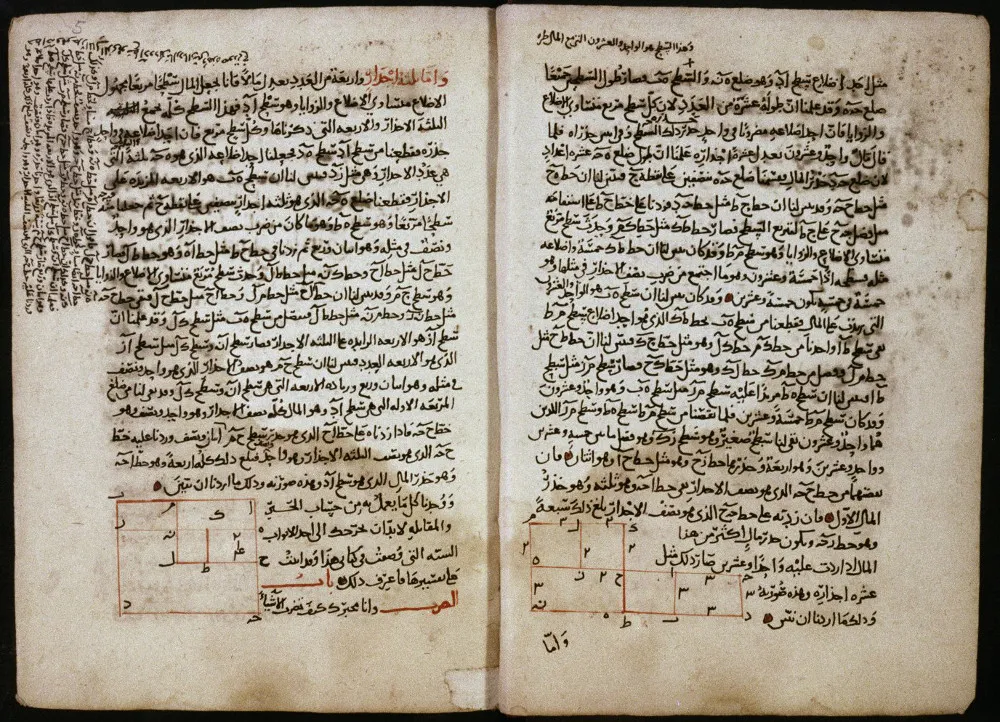
A page from a medieval Arabic mathematical treatise, demonstrating the algebra and geometric calculations compiled in Baghdad's House of Wisdom.
⚖️
Historian Debate: The Scale of the Translation Movement
State-Sponsored Scientific Renaissance
Historians like Dimitri Gutas argue the Translation Movement was a systematic, massive state project that saved classical science and laid the foundations for modern algebra and optics.
A Political and Religious Instrument
Critics argue the translation projects were primarily ideological tools used by Mutazilite Caliphs to justify their political authority over traditionalist religious factions.
Baghdad's Translation Movement (8th-11th centuries) synthesized Greek, Persian, and Indian knowledge systems.
"The ink of the scholar is more sacred than the blood of the martyr... Seeking knowledge is a duty upon every believer."
— Attributed to the Prophet Muhammad; frequently inscribed on manuscripts in the House of Wisdom.
Greek Thought, Arabic Culture — by Dimitri Gutas. The definitive study of the social and political context of the translation movement in Baghdad.
The House of Wisdom — by Jim Al-Khalili. An accessible exploration of the golden age of Arabic science and its legacy.
📖 Scholar Mode Active — Click to exit focused reading
History Lab 🧪
Run simulated matches between civilizations and convert ancient currencies.
🕵️ Who Am I? (The Historical Guess Game)
A secret historical figure has been selected. Ask yes/no questions to narrow down the pool of candidates. Click any active card to make your accusation!
Secret Identity
❓ Who Am I?
Ask questions using the board below to narrow down my identity.
Ask a Question:
Question LogQuestions: 0 / 7
No questions asked yet.
Candidate Board:
🗺️ Timeline Scramble
Five historical events appear out of order. Click them in the correct chronological sequence — from oldest to most recent. How well do you know your history?
🏺 Relic or Fake?
Is this a real historical artifact or a convincing fabrication? Judge each one based on its description and era — then see the truth revealed!
Artifact 1 / 10Score: 0
Empire Matchup Simulator
Empire ATerritory Size (Peak, M km²)Empire B
00
Empire APopulation (Peak, Millions)Empire B
00
Empire AMilitary Power (Army Size)Empire B
00
Tactical Battle Analysis
Select empires and click simulate to run evaluations.
Historical Purchasing Power Converter
See what ancient coins are worth in modern terms and check their historical purchasing power.
Modern Value Equivalent
$0.00 USD
Historical Purchasing Power:
Select currency to view purchasing capability.
Historical Identity Generator
Forge an authentic historical identity from ancient civilisations, complete with linguistic meaning and biography.
Neutral
Gaius Julius
Meaning:Descendant of Jupiter
Historical Background:
A Roman citizen and clerk who worked in the forum under Roman republic rule.
Chrono-Cultural Fusion Simulator
Fuse the culture, technology, and governance of two legendary civilizations to synthesize a unique hybrid society.
Cohesion & Coexistence Rate
85%
🏛️ Hybrid Architecture
⚙️ Synthesized Asset
📜 Synthetic Governance
Historical Tactics & Trivia Quiz
Test your historical knowledge and battle tactics to claim your administrative rank.
8 Questions • Multi-Era
You will be presented with random scenarios and trivia spanning ancient Egypt, classical Rome, Islamic Golden Age, and the modern industrial era. Complete the evaluation to see your historical title!
Question 1 of 8Score: 0
What was the Code of Hammurabi written on?
Correct!
Evaluation Complete!
6 / 8
Correct
Rank Attained
Imperial Legionary
Your knowledge of classical strategy and administrative structures is respectable.
🎲 Counterfactual "What If?" Scenario Simulator
Explore alternative historical trajectories by tweaking key civilizational pivot points.
Simulated Shift
Selected Era
Prehistoric Era
Millions of years ago to ~3000 BCE
The dawn of humanity. From the evolutionary split of early hominids to the mastery of stone tools, fire, and the birth of language.
Landmark Milestones
Welcome to Historia
Enter your Scholar Name to synchronize your chronicles and save your journey.