~7,000 Years from farming to writing
πŸ›οΈ

Ancient Ages

c. 3,200 BCE β€” 500 CE Β· Empires, Laws & Philosophy
~400 Years from Roman fall to medieval rebirth
🏰

Medieval Period

c. 500 CE β€” 1500 CE Β· Empires of Faith, Trade & Castles
~50 Years from printing press to Scientific Revolution
βš™οΈ

Modern Age

c. 1450 CE β€” 2000 CE Β· Revolutions, Industry & Discovery
~50 Years from computers to quantum age

THE ARTIFACT GALLERY

Examine the tangible relics, physical tokens, and revolutionary machines that shaped civilizational growth.

THE HISTORIA CIRCLE

Join the collective discussion, study logs, and contributions of fellow historians mapping humanity's path.

Historia Forum Discussions

Start a Discussion Thread

THEMATIC PATHWAYS

Trace a single thread β€” disease, trade, energy, migration β€” across all eras and civilizations.

History is not just a sequence of events β€” it is a network of patterns. These thematic pathways allow you to follow a single concept across thousands of years: how agriculture spread, how warfare evolved, how trade routes shaped civilizations. Each pathway collects the most relevant chronicles across all eras.

🧩
How is this different from the sidebar Topics?
While the sidebar Topics (like Science & Tech or Empires) filter articles within your selected historical Era, Thematic Pathways cut horizontally across all eras (from Prehistoric to the Future). Use Themes to trace a single concept's evolutionary line across 300,000 years.

CIVILIZATION HUBS

Comprehensive profiles of the world's greatest civilizations and empires β€” from ancient cradles to global super-states.

Human Historia provides an academically rich exploration of the world's most influential civilizations. From the monumental achievements of ancient Egypt, Han China, and the Roman Empire, to the sophisticated societies of the Maya, the Islamic Caliphates, and West African empires, these hubs offer deep insights into the cultural, political, and technological legacies that continue to shape our global story.

ACADEMIC PASSPORT

Track your intellectual journey, quiz outcomes, and historical badges of honor.
HISTORIA PASSPORT ⏳
πŸ‘€ Scribe Novice
Scholar Name Historia Explorer
Rank Rating Sumerian Record Scribe
Chronicles Read 0 / 48
Study Guide Pins 0 Guides
Security Access Level 1 (Novice)

Earned Badges of Honor

πŸ”₯
Fire Keeper
Unlock 3 prehistoric chronicles.
πŸ›οΈ
Codex Keeper
Unlock 3 ancient chronicles.
🏰
Guild Master
Unlock 3 medieval chronicles.
βš™οΈ
Steam Engineer
Unlock 3 modern chronicles.
πŸš€
Singularity Sage
Unlock 3 future chronicles.
πŸ‘‘
Grand Scholar
Score 5/5 on the Lab Quiz.

Recent Lab Activities

No recent activities recorded. Take a quiz or bookmark articles!
Curated Exhibition

Human Historia

An immersive graphical anthology tracing the paths of civilizations, breakthroughs, and conflicts that forged the modern consciousness.

25Chronicles
Showing all articles

The French Revolution: The Declaration of the Rights of Man

Written by Historia Administration Historical Era: Modern Age
* Note: Cover images and unreferenced inline images are AI-generated illustrations for illustrative purposes.

The political landscapes of early modern Europe were dominated by the concept of the Divine Right of Kings, where absolute monarchs held unquestioned power, and society was structured in rigid feudal estates. This traditional order was shattered in 1789 by the French Revolution, a political and social upheaval that dismantled the monarchy, abolished feudal privileges, and declared that all human beings are born free and equal. At the heart of this revolution lay a single, historic document: the Declaration of the Rights of Man and of the Citizen (DΓ©claration des droits de l'homme et du citoyen). By codifying the natural rights of liberty, property, security, and resistance to oppression, French reformers created a universal manifesto of human rights that permanently reshaped modern constitutional governance.

The Crisis of the Three Estates

Prior to 1789, French society was divided into three rigid estates: the First Estate (the Catholic Clergy), the Second Estate (the Nobility), and the Third Estate (everyone else, representing 98% of the population, from wealthy merchants to poor peasants). The first two estates owned the majority of the land and were exempt from taxation, while the Third Estate bore the entire tax burden of a state bankrupt from expensive wars (such as funding the American Revolution) and court luxuries. This system created deep class anger, which was intensified by a series of crop failures that caused widespread food shortages and inflation across Paris, pushing the working class to the brink of rebellion.

Faced with financial collapse, King Louis XVI convened the Estates-General in May 1789, a legislative assembly that had not met for 175 years. Scribes recorded that when the king refused to grant the Third Estate equal voting rights, the Third Estate broke away, declaring itself the National Assembly. They swore the Tennis Court Oath, promising not to disband until they had drafted a new constitution for France. Scribes and leaders realized they were embarking on a path of absolute transformation, challenging the roots of royal sovereignty.

Delegates debating in the National Assembly
Depiction of the National Assembly delegates debating heatedly under the ideals of liberty and equality, laying the foundation for a new constitutional order.

The Fall of the Bastille and the Declaration

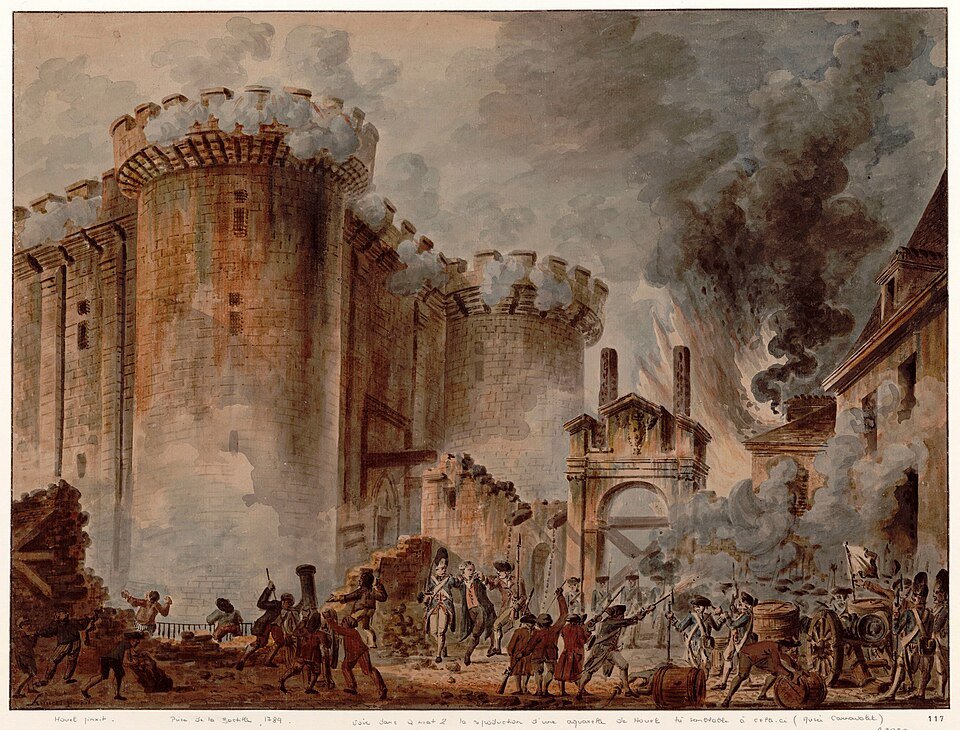
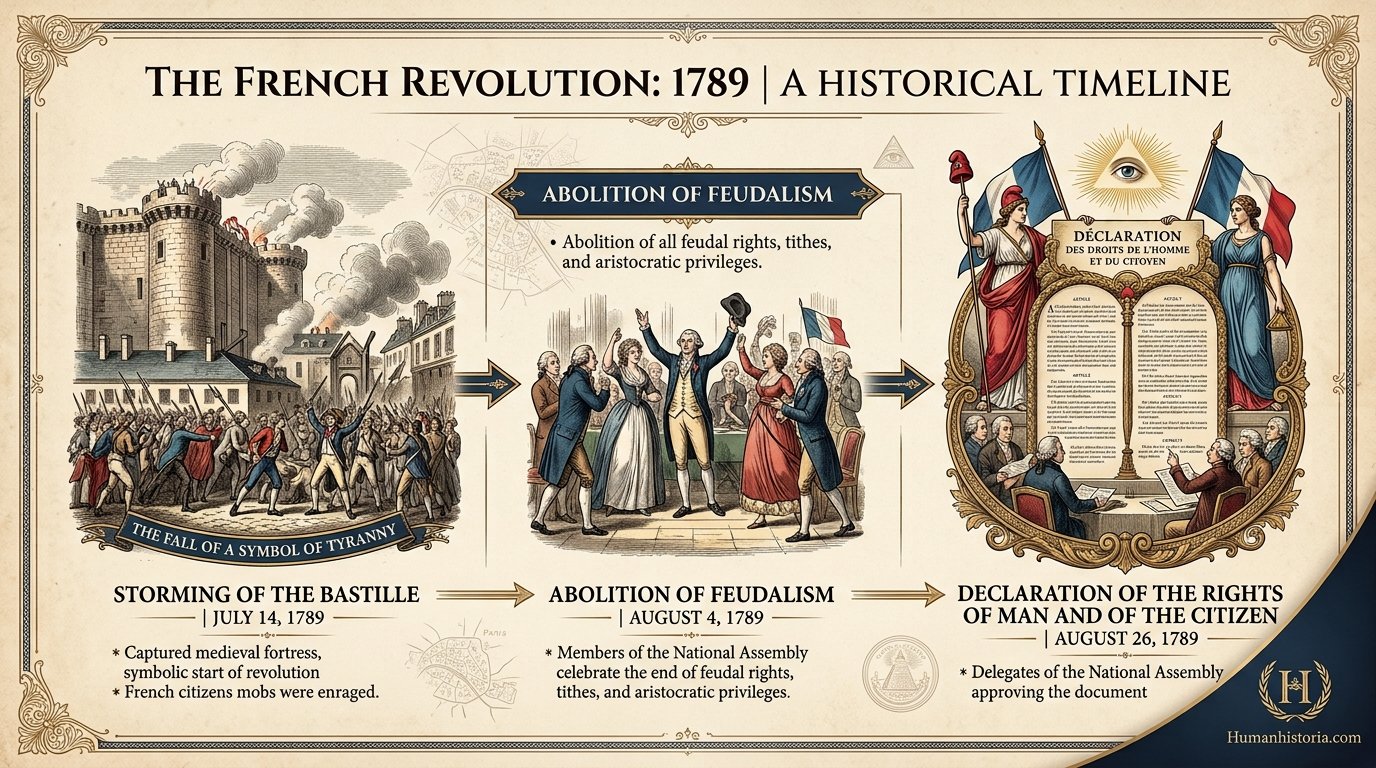
As the king massed troops around Paris, the citizens of Paris took action. On July 14, 1789, a crowd attacked and captured the Bastille, a medieval stone fortress that served as a state prison and armory. The fall of the Bastille was a massive symbolic event, showing that absolute royal authority had collapsed. The National Assembly immediately moved to dismantle the feudal system, passing decrees that abolished aristocratic tax exemptions, seigneurial dues, and personal servitude.

To establish the moral and philosophical foundation of their new order, the Assembly drafted the Declaration of the Rights of Man, adopting it on August 26, 1789. Written primarily by the Marquis de Lafayette in consultation with Thomas Jefferson, the Declaration was heavily inspired by the ideals of the Enlightenmentβ€”specifically the political philosophies of Jean-Jacques Rousseau (popular sovereignty) and John Locke (natural rights). The document was a direct attack on absolute monarchy: it declared that sovereignty did not reside in the king, but in the Nation, and that laws must express the general will of the citizens, establishing the principles of modern democracy.

Olympe de Gouges and the Rights of Woman

The Declaration of the Rights of Man, despite its universal language, was applied only to men, excluding women from political rights and citizenship. In response, in 1791, the writer and activist Olympe de Gouges published the Declaration of the Rights of Woman and of the Female Citizen. In it, she famously wrote: "Woman is born free and remains equal to man in rights." She argued for equal education, voting rights, and property ownership. Gouges was arrested during the Reign of Terror and executed by guillotine in 1793, but her document remains the foundational text of modern feminist political theory.

The Principles of Liberty and Equality

The Declaration consisted of 17 brief articles that codified the core concepts of the new republic:

  • Universal Equality: Article 1 declared that "men are born and remain free and equal in rights," dismantling the legal estates and noble titles that had structured France for centuries.
  • Natural Rights: The purpose of all political association was defined as the preservation of natural, inalienable rights: liberty, property, security, and resistance to oppression.
  • Freedom of Expression: Scribes guaranteed the free communication of ideas and opinions, allowing for the rapid expansion of a free press and political debate.
  • Due Process: The document established legal protections, including the presumption of innocence, the prohibition of arbitrary arrest, and the requirement of written laws, ending the king's power to imprison citizens without trial.

The Universal Declaration of Human Rights

The principles of the 1789 French Declaration served as the direct inspiration for the Universal Declaration of Human Rights (UDHR), drafted by the United Nations in 1948 following the horrors of World War II. Led by RenΓ© Cassin, the UN commission adopted the structure and language of the French document, declaring that all human beings are born free and equal in dignity and rights, proving that the ideals chiseled in the crucible of Paris became the ethical standard for the modern global community.

The Global Ripple Effect of the Revolution

The Declaration was translated into multiple languages and printed in thousands of pamphlets, spreading across Europe and the Americas. Scribes in neighboring kingdoms read the document with excitement, while monarchs viewed it as a mortal threat, forming military coalitions to crush the young French Republic. The revolutionary wars that followed reshaped the political geography of Europe, as French armies spread the concepts of the Napoleonic Code and civil equality across conquered territories, dismantling feudal structures in Germany, Italy, and the Low Countries.

1789 Paris print shop producing Declaration of the Rights of Man pamphlets
A printing workshop in Paris producing cheap pamphlets and posters of the Declaration of the Rights of Man, accelerating the spread of revolutionary ideals.

The most dramatic ripple effect occurred in the wealthy French colony of Saint-Domingue. Scribes and enslaved laborers read the Declaration's opening line: "Men are born free and equal." Under the leadership of Toussaint Louverture, the enslaved population launched the Haitian Revolution in 1791, defeating French, British, and Spanish armies to establish Haiti in 1804 as the first independent republic ruled by formerly enslaved people, showing that the principles of human rights could not be restricted by race or geography.

The Reign of Terror and the Paradox of Liberty

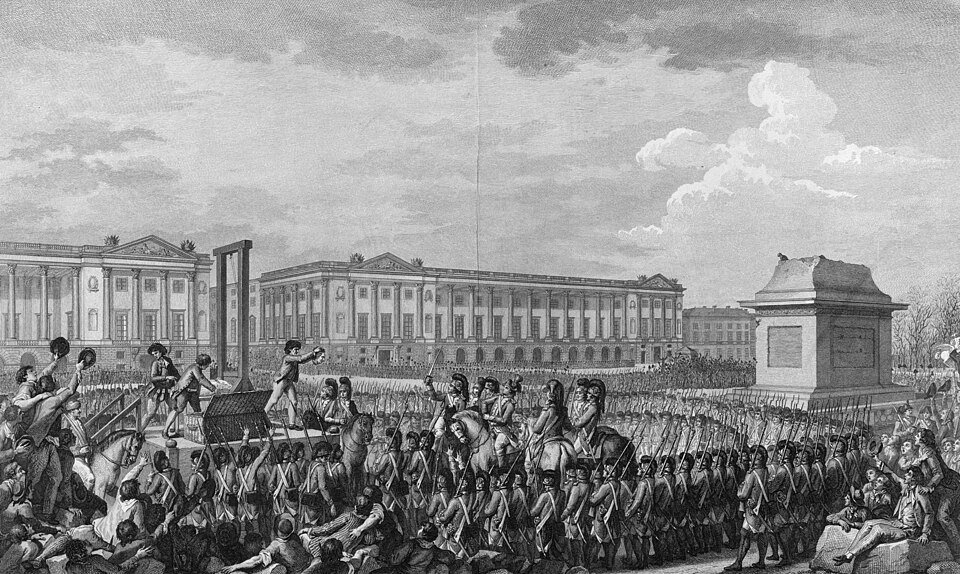
The radicalization of the French Revolution highlighted the dramatic tension between maintaining public security and protecting individual liberty. Following the execution of King Louis XVI in January 1793, the young French Republic faced military invasions from foreign coalitions and internal royalist rebellions. In response, the National Convention established the Committee of Public Safety, led by Maximilien Robespierre. Scribes recorded that the Committee suspended the protections of the Declaration of the Rights of Man, launching the Reign of Terror (1793–1794). During this bloody period, the state executed over 17,000 suspected counter-revolutionaries by guillotine, demonstrating how a government created to protect human rights could descend into state violence when threatened by instability.

This paradox of liberty led to a critical debate among political philosophers: *can a state destroy individual rights to preserve the collective republic?* Robespierre argued that terror was nothing other than justice, prompt, severe, and inflexible, and was therefore an emanation of virtue. Scribes and historians, however, pointed out that the suppression of due process and freedom of expression dismantled the core principles of the 1789 Declaration, creating a climate of fear that eventually led to Robespierre's own downfall and execution. This dark chapter served as a warning to future constitutional governments that human rights must remain absolute, even in times of national crisis, and cannot be suspended without destroying the moral legitimacy of the state.

The Abolition of Slavery and the Colonial Response

The universal principles of the Declaration of the Rights of Man also sparked intense political debate regarding slavery in the French colonies. In 1789, France was one of the world's leading colonial powers, generating immense wealth from sugar and coffee plantations worked by enslaved labor, particularly in Saint-Domingue (modern Haiti). While the Declaration stated that all men are born free and equal, the National Assembly was reluctant to apply this rule to the colonies due to pressure from wealthy plantation owners. Scribes recorded that this hypocrisy led to the formation of the Society of the Friends of the Blacks (*SociΓ©tΓ© des Amis des Noirs*), which lobbied for the abolition of the slave trade and equal rights for free people of color.

As the revolution radicalized and slave rebellions broke out in Saint-Domingue, the National Convention officially abolished slavery in all French colonies in February 1794. Scribes celebrated this as a triumph of universal human rights. Although Napoleon Bonaparte later attempted to restore slavery in 1802, the initial revolutionary decree demonstrated that the principles of liberty and equality possessed an inherent logical momentum that could not be restricted by national borders or racial categories, forcing the global community to confront the ethical necessity of universal emancipation.

Painting of the Declaration of the Rights of Man and of the Citizen 1789
The official representation of the Declaration of the Rights of Man and of the Citizen, painted in 1789 by Jean-Jacques-FranΓ§ois Le Barbier.

Conclusion: The Code of Human Liberty

The French Revolution and the Declaration of the Rights of Man represented a political and social revolution that transformed the nature of sovereignty. By replacing the subject with the citizen, the divine right of kings with popular sovereignty, and feudal privileges with universal rights, the revolution constructed the ethical foundations of modern democracies. The principles chiseled in Paris in 1789 remain the core standards of human rights today, a statement that the human odyssey is a constant climb toward liberty, equality, and justice.

βš–οΈ

Historian Debate: Was the French Revolution Inevitable?

Systemic Social and Financial Collapse

Marxist and structural historians argue that the bankruptcy of the state, combined with the rigidity of the Three Estates and crop failures, made revolution inevitable.

Accidental Escalation and Contingency

Revisionists suggest that if Louis XVI had possessed political competence, he could have implemented tax reforms, avoiding the escalation to revolution.

The French Revolution dismantled the Divine Right of Kings, creating the modern citizen.

"Men are born and remain free and equal in rights. Social distinctions may be founded only upon the general good."

β€” Declaration of the Rights of Man and of the Citizen, Article 1, Paris (August 1789).

Further Reading

  • Citizens: A Chronicle of the French Revolution β€” by Simon Schama. A narrative masterpiece examining the human and violent reality of the revolution.
  • The French Revolution: A History β€” by Thomas Carlyle. The classic 19th-century history that shaped the romantic view of the event.
πŸ“– Scholar Mode Active β€” Click to exit focused reading
Selected Era

Prehistoric Era

Millions of years ago to ~3000 BCE

The dawn of humanity. From the evolutionary split of early hominids to the mastery of stone tools, fire, and the birth of language.

Landmark Milestones

Welcome to Historia

Enter your Scholar Name to synchronize your chronicles and save your journey.