~7,000 Years from farming to writing
๐Ÿ›๏ธ

Ancient Ages

c. 3,200 BCE โ€” 500 CE ยท Empires, Laws & Philosophy
~400 Years from Roman fall to medieval rebirth
๐Ÿฐ

Medieval Period

c. 500 CE โ€” 1500 CE ยท Empires of Faith, Trade & Castles
~50 Years from printing press to Scientific Revolution
โš™๏ธ

Modern Age

c. 1450 CE โ€” 2000 CE ยท Revolutions, Industry & Discovery
~50 Years from computers to quantum age

THE ARTIFACT GALLERY

Examine the tangible relics, physical tokens, and revolutionary machines that shaped civilizational growth.

๐ŸŽฅ VIDEO HUB & SHORTS

Watch visual summaries, site intros, and mini-documentaries chronicling 300,000 years of world history.

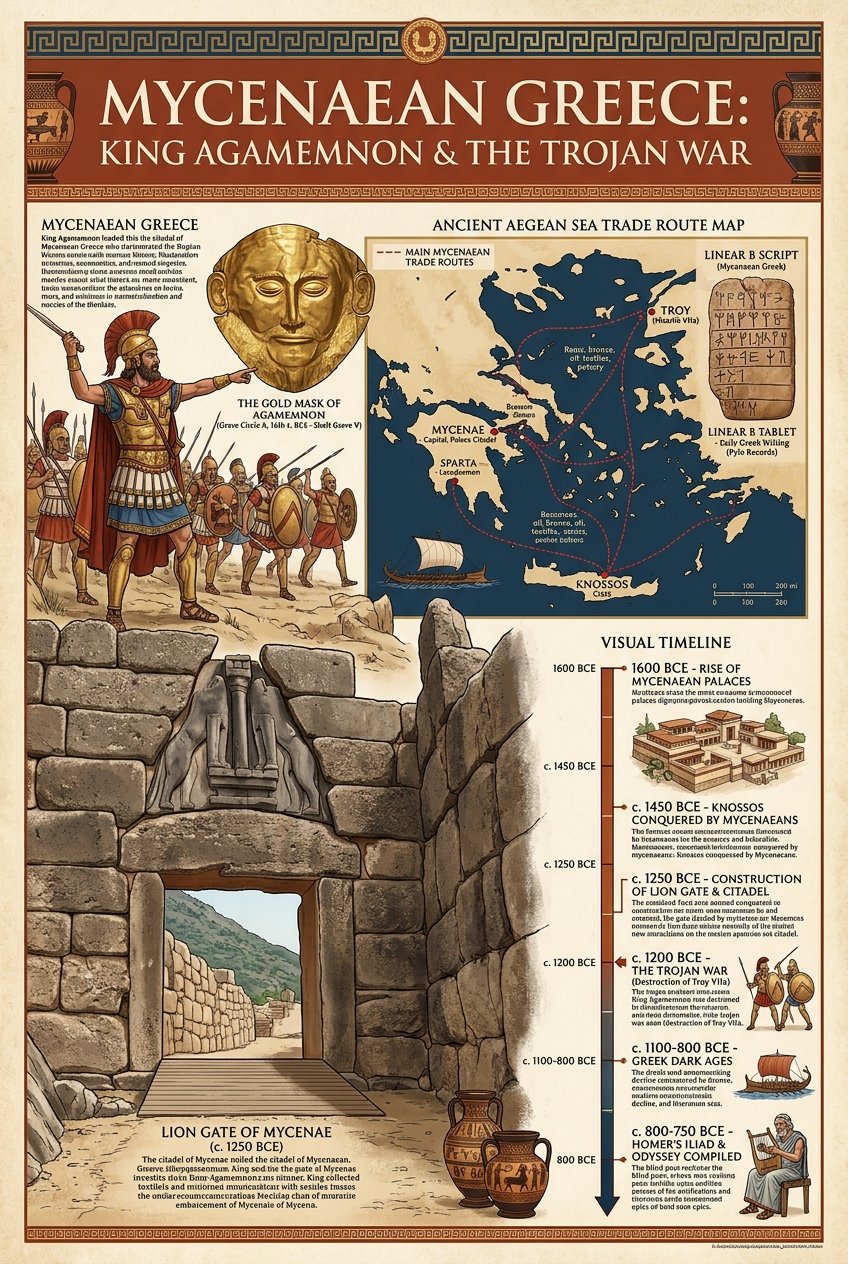
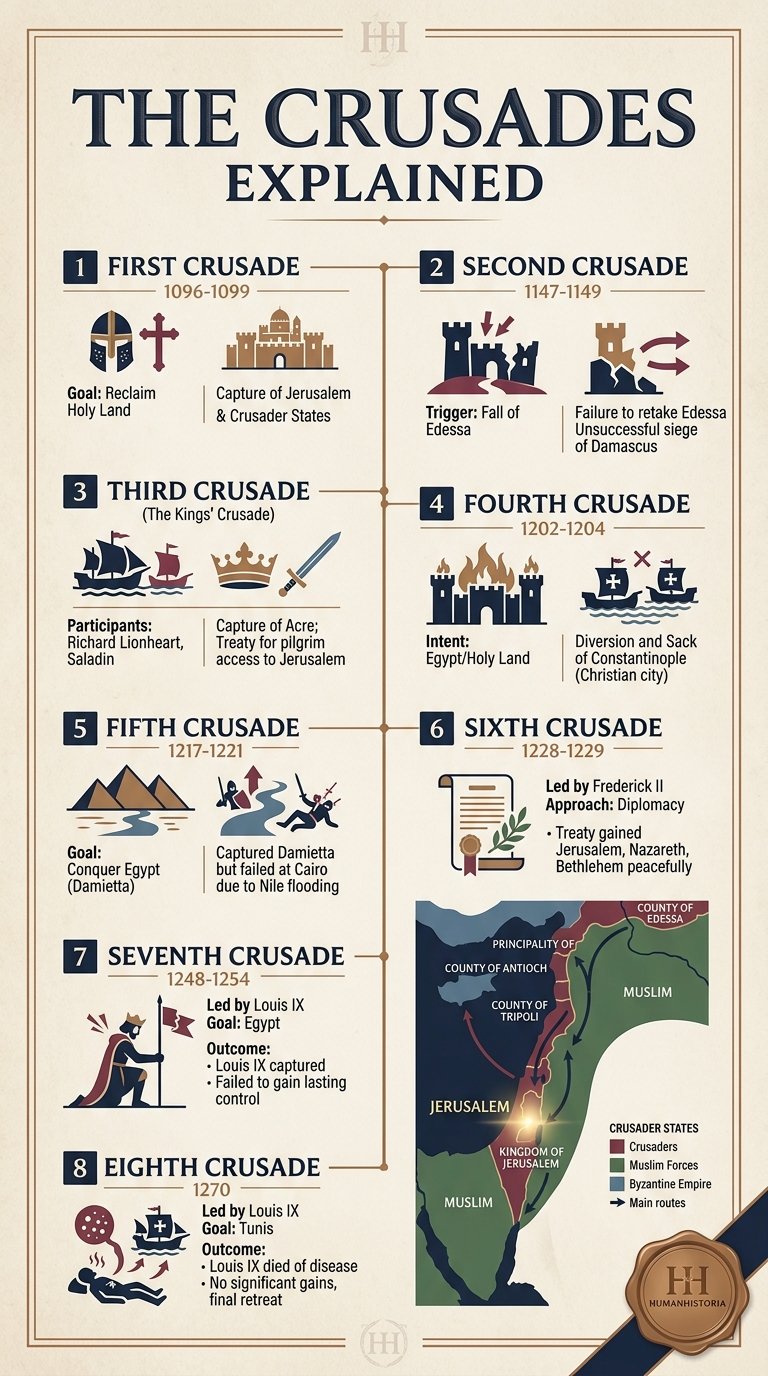
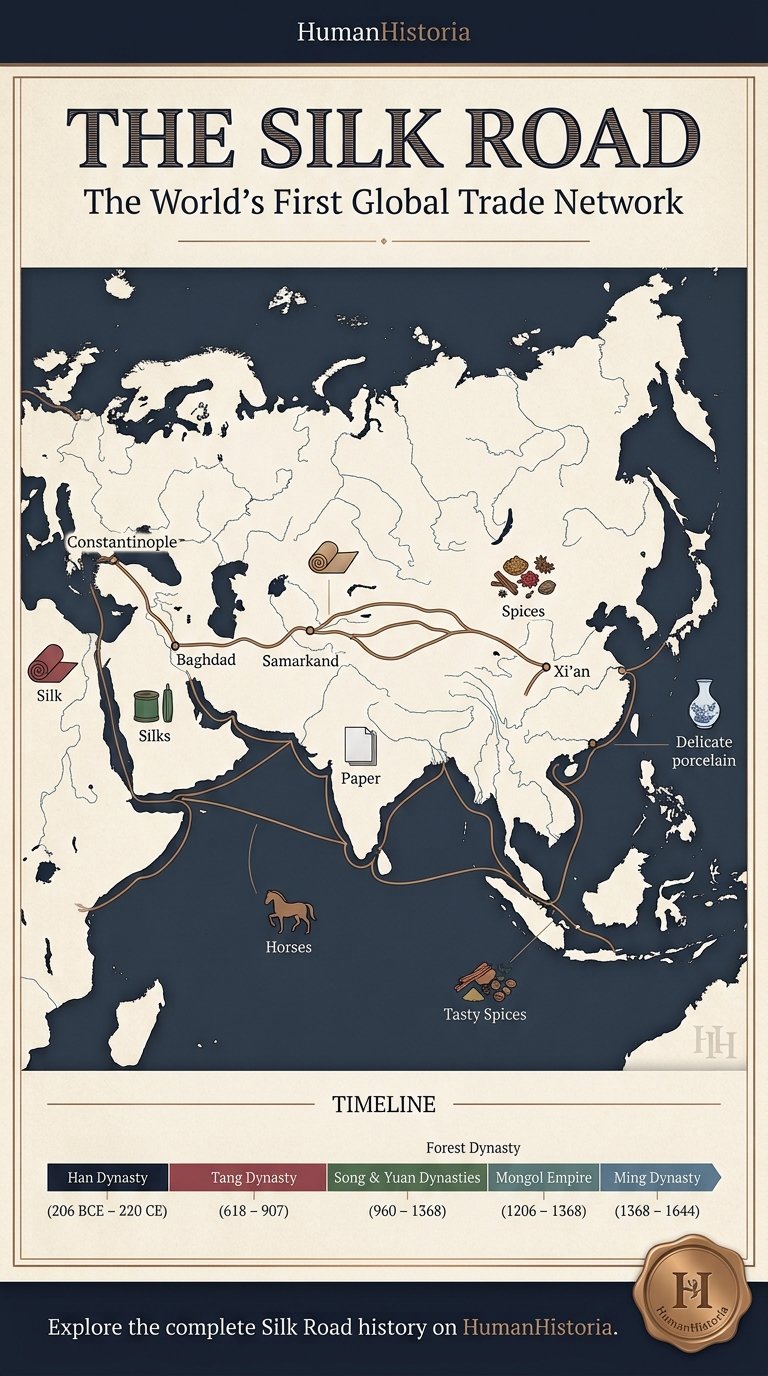
๐Ÿ“Š HISTORICAL INFOGRAPHICS ARCHIVE

Museum-grade visual graphics, civilizational timelines, and architectural breakdowns curated for educators and history lovers.

THE HISTORIA CIRCLE

Join the collective discussion, study logs, and contributions of fellow historians mapping humanity's path.

Historia Forum Discussions

Start a Discussion Thread

THEMATIC PATHWAYS

Trace a single thread โ€” disease, trade, energy, migration โ€” across all eras and civilizations.

History is not just a sequence of events โ€” it is a network of patterns. These thematic pathways allow you to follow a single concept across thousands of years: how agriculture spread, how warfare evolved, how trade routes shaped civilizations. Each pathway collects the most relevant chronicles across all eras.

๐Ÿงฉ
How is this different from the sidebar Topics?
While the sidebar Topics (like Science & Tech or Empires) filter articles within your selected historical Era, Thematic Pathways cut horizontally across all eras (from Prehistoric to the Future). Use Themes to trace a single concept's evolutionary line across 300,000 years.

CIVILIZATION HUBS

Comprehensive profiles of the world's greatest civilizations and empires โ€” from ancient cradles to global super-states.

Human Historia provides an academically rich exploration of the world's most influential civilizations. From the monumental achievements of ancient Egypt, Han China, and the Roman Empire, to the sophisticated societies of the Maya, the Islamic Caliphates, and West African empires, these hubs offer deep insights into the cultural, political, and technological legacies that continue to shape our global story.

EVOLUTION OF HUMAN SKILLS

Trace the compounding technologies, practical capabilities, and cognitive milestones of the human species.

Human progress is a story of compounding skills. Every breakthrough, from the spark of prehistoric fire to modern silicon transistors, builds directly on previous generations of ingenuity. Hover over a skill node to trace its historical prerequisites, and click it to explore its development timeline, species-wide impact, and related chronicles.

Prehistoric Ancient Medieval Modern Future
๐Ÿง 

Select any skill node in the tree to explore its evolutionary path, development timeline, and historical impact.

ACADEMIC PASSPORT

Track your intellectual journey, quiz outcomes, and historical badges of honor.
HISTORIA PASSPORT โณ
๐Ÿ‘ค Scribe Novice
Scholar Name Historia Explorer
Rank Rating Sumerian Record Scribe
Chronicles Read 0 / 48
Study Guide Pins 0 Guides
Security Access Level 1 (Novice)

Earned Badges of Honor

๐Ÿ”ฅ
Fire Keeper
Unlock 3 prehistoric chronicles.
๐Ÿ›๏ธ
Codex Keeper
Unlock 3 ancient chronicles.
๐Ÿฐ
Guild Master
Unlock 3 medieval chronicles.
โš™๏ธ
Steam Engineer
Unlock 3 modern chronicles.
๐Ÿš€
Singularity Sage
Unlock 3 future chronicles.
๐Ÿ‘‘
Grand Scholar
Score 5/5 on the Lab Quiz.

Recent Lab Activities

No recent activities recorded. Take a quiz or bookmark articles!
Curated Exhibition

Human Historia

An immersive graphical anthology tracing the paths of civilizations, breakthroughs, and conflicts that forged the modern consciousness.

25Chronicles
Showing all articles

History of Quantum Mechanics (1900โ€“Present): Planck, Einstein & Computing

Written by Historia Science Historical Era: FUTURE
* Note: Cover image is an AI-generated historical illustration.

๐Ÿง Key Chronicle Takeaway (Atomic Summary)

Explore how quantum superposition and cryogenic dilution refrigerators are unlocking computing power beyond classical silicon limits.

The computational power of the modern era is built on the silicon transistor. By etching billions of microscopic gates onto silicon chips, engineers created classical computers that execute logic operations using binary digits (bits), which exist as either a 0 or a 1. However, as transistors shrink to the size of a few atoms, they hit a physical barrier: quantum tunneling, where electrons leak through gates, rendering classical computing limits absolute. The transition to the future of computation lies in Quantum Computing. By exploiting the principles of quantum mechanicsโ€”such as superposition, entanglement, and interferenceโ€”quantum computers utilize quantum bits (qubits) to process vast amounts of complex data in parallel, promising computational leaps that will revolutionize cryptography, material science, and artificial intelligence, breaking the boundaries of silicon.

Superposition and Entanglement: The Qubit Advantage

To understand quantum computing, one must move beyond the binary logic of classical machines. A classical bit is like a light switch: it can be either off (0) or on (1). A quantum bit, or Qubit, is like a spinning coin: while it is spinning, it exists in a state of Superposition, representing both heads and tails (0 and 1) simultaneously. Only when the coin stops (when a measurement is made) does it collapse into a definite 0 or 1. This capability allows a quantum computer to evaluate millions of possibilities at the same time, turning linear processing into exponential computation.

The power of superposition is multiplied by Quantum Entanglementโ€”a phenomenon Albert Einstein called "spooky action at a distance." When two qubits become entangled, the state of one instantly determines the state of the other, no matter how far apart they are. Scribes and quantum engineers construct networks of entangled qubits that act as a single, unified processor. If you add one qubit to a classical computer, its power increases linearly. If you add one qubit to a quantum system, its processing capacity doubles, meaning a system with only 300 perfectly entangled qubits could hold more data states than there are atoms in the observable universe.

The Cryogenic Challenge: Dilution Refrigerators

Building a physical quantum computer is one of the most difficult engineering challenges in human history. Qubits are extremely fragile. They are highly sensitive to their surrounding environmentโ€”including temperature fluctuations, electromagnetic noise, and physical vibrations. This sensitivity causes Decoherence, where the qubits lose their quantum properties and collapse into classical errors before a calculation is finished. Scribes and physicists must shield the processor from the universe to preserve its quantum state.

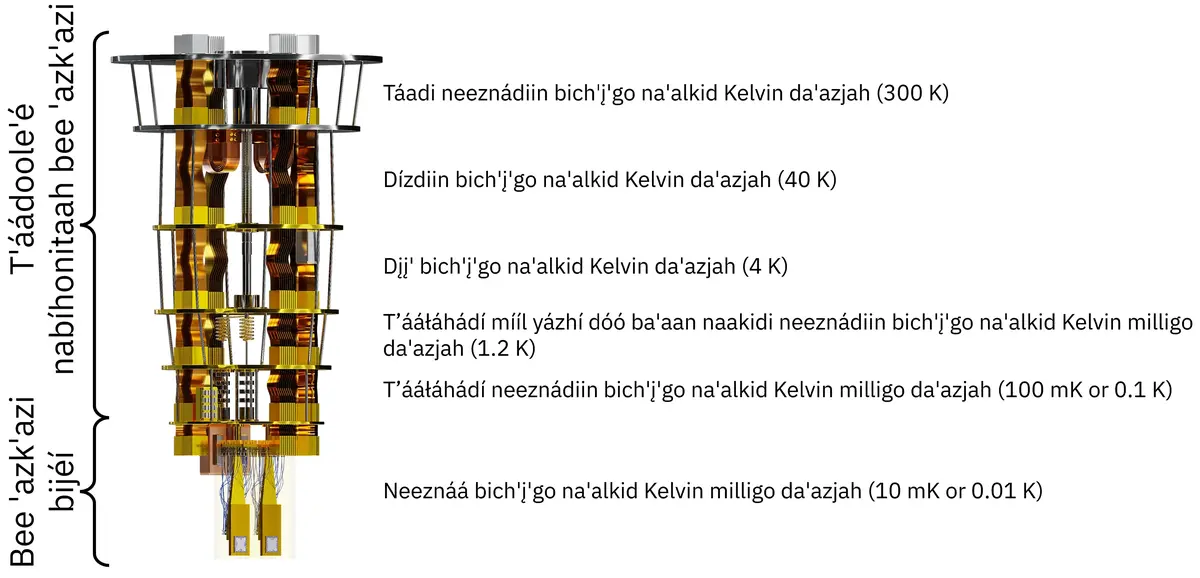
To prevent decoherence, quantum computers are housed inside massive, metallic Dilution Refrigerators. These golden cylinders look like high-tech chandeliers: they use a mixture of helium isotopes to cool the quantum processor down to 10 millikelvins (0.01 degrees above absolute zero). This temperature is colder than deep space, reducing all atomic motion to a near-complete stop. Qubits are fabricated using superconducting materials (like niobium or aluminum) or trapped ions held in place by laser grids. Control lines feed microwave pulses down the refrigerator to manipulate the qubits and execute quantum algorithms, creating a delicate interface between classical commands and quantum states.

Quantum Supremacy: Sycamore's Demonstration

In 2019, Google's quantum computing team announced that their 53-qubit processor, Sycamore, had achieved Quantum Supremacyโ€”the point where a quantum computer solves a calculation that is practically impossible for any classical supercomputer. Sycamore completed a specific mathematical check in 200 seconds, a calculation that Google estimated would take the world's most powerful classical supercomputer 10,000 years to solve, proving that quantum computing is not just a theory, but a physical reality.

Applications: Cryptography, Chemistry, and Optimization

Quantum computers are not designed to replace home laptops or speed up standard web browsing. Instead, they are specialized engines designed to solve specific mathematical problems that are too complex for classical machines:

  • Shor's Algorithm and Cryptography: Quantum computers can factor large numbers exponentially faster than classical machines. This capability means a large-scale quantum computer could easily break RSA encryption, the security system that protects global banking, military communications, and internet traffic, forcing the development of post-quantum cryptography.
  • Molecular Simulation: Classical supercomputers cannot accurately simulate the quantum interactions of atoms in a molecule. Quantum computers can model these interactions directly, allowing scientists to discover new drugs, design highly efficient solar panels, and create room-temperature superconductors in days rather than decades.
  • Universal Optimization: Quantum systems can solve complex logistical challenges, such as optimizing global shipping routes, modeling financial markets, or training massive artificial neural networks, driving economic efficiency.

The Quantum Internet and QKD

To secure communication in the quantum age, scientists are developing the Quantum Internet using Quantum Key Distribution (QKD). QKD uses entangled photons to transmit encryption keys. Because of the quantum observer effect, any attempt by an eavesdropper to intercept the key would alter its quantum state, instantly alerting the communicators and rendering the hack useless, creating a system of absolute, physics-backed communications security.

Quantum Sensors and Cryogenic Telemetry

The engineering of quantum computers has driven breakthroughs in Quantum Sensorsโ€”devices that measure physical properties with atomic-scale precision. While qubits are fragile and easily disrupted by environmental noise, this sensitivity can be harnessed to build sensors that detect tiny magnetic, gravitational, or temperature fields. Scribes and physicists utilize quantum sensors to map the brain's electrical activity, inspect microchips for defects, and detect mineral deposits deep underground, proving that quantum engineering has applications beyond computation.

Additionally, controlling a quantum computer requires advanced Cryogenic Telemetry. The control lines running down the dilution refrigerator must transmit high-frequency microwave pulses to the qubits without transferring heat from the outside environment. Scribes and engineers develop specialized coaxial cables and superconducting filters that operate at near absolute zero. This cryogenic infrastructure is essential to scale quantum systems from dozens of qubits to millions, a technological leap that will allow for the construction of fault-tolerant quantum computers that can run complex algorithms without errors, securing the future of computation.

Quantum Error Correction and the Scale Problem

To build a universal quantum computer that can solve real-world problems, quantum engineers must solve the Scale Problem through Quantum Error Correction (QEC). Physical qubits are highly sensitive to noise, resulting in an error rate that is millions of times higher than that of classical transistors. Under these conditions, a quantum computer running a long algorithm would quickly accumulate errors, rendering the final calculation useless. Scribes and computer scientists have developed QEC codes to protect quantum information from decoherence.

QEC works by distributing the information of a single "logical qubit" across a network of hundreds or thousands of "physical qubits." By checking the collective state of the physical qubits without measuring their individual values, the system can detect and correct errors without destroying the superposition. Scribes calculate that to run Shor's algorithm to break modern cryptography, a quantum computer would need roughly 10,000 logical qubits, which translates to millions of physical qubits. Scaling dilution refrigerators, control electronics, and qubit fabrication to this level is the primary engineering challenge of the coming decades, a leap that will transition quantum computing from a laboratory demo into a global utility.

The Quantum Race and Geopolitical Tech Sovereignty

In the 21st century, the development of quantum computing has become a high-stakes arena for geopolitical technology sovereignty. Governments and massive technology corporations across the world are investing billions of dollars in quantum research, viewing the first country to build a fault-tolerant quantum computer as the holder of a massive strategic and economic advantage. Scribes and security analysts warn that the nation that achieves this breakthrough will be able to decrypt all classical communication, giving them total intelligence dominance.

To prepare for this scenario, international agencies and standards bodies are working to develop Post-Quantum Cryptography (PQC)โ€”encryption algorithms that are secure against attacks by both classical and quantum computers. These new algorithms are based on complex mathematical problems, such as lattice-based cryptography, that do not have fast quantum solutions. This global race to secure information demonstrates that the transition to the era of quantum computation is not just an academic pursuit, but a vital national security priority that will shape the balance of power in the future society.

Gold-plated interior wiring of a quantum computer dilution refrigerator
The intricate gold-plated wiring inside a quantum dilution refrigerator cryostat, used to keep quantum processors near absolute zero.

Conclusion: The Quantum Odyssey

Quantum computing represents a fundamental shift in how humanity processes information. By moving beyond the binary limits of classical bits to tap into the fundamental rules of the subatomic universe, quantum engineers are constructing machines that calculate at the speed of reality. The dilution refrigerators standing in research laboratories today are the cathedrals of the future, housing processors that will navigate the next frontier of human knowledge, proving that the ultimate computer is the universe itself. As these systems mature, they will reshape the digital and physical landscapes, guiding our species into a new epoch of technological mastery.

โš–๏ธ

Historian Debate: The Interpretation of Quantum Mechanics

The Copenhagen Interpretation

Bohr and Heisenberg argued that particles exist in a probability wave function until observed, meaning reality is fundamentally non-deterministic at the subatomic scale.

Einstein's Deterministic Realism

Einstein rejected quantum indeterminacy, asserting that 'hidden variables' must exist to determine particle states, famously declaring that God does not play dice.

Quantum mechanics revolutionized physics, chemistry, and modern computing technology.

"God does not play dice with the universe. Reality must be objective and knowable."

โ€” Albert Einstein, Letter to Max Born (1926).

Further Reading

  • Quantum: Einstein, Bohr, and the Great Debate About reality โ€” by Manjit Kumar. A gripping history of the intellectual battles that shaped modern physics.
  • The Making of the Atomic Bomb โ€” by Richard Rhodes. A monumental history of how quantum physics transformed into military technology.
๐Ÿ“– Scholar Mode Active โ€” Click to exit focused reading
Selected Era

Prehistoric Era

Millions of years ago to ~3000 BCE

The dawn of humanity. From the evolutionary split of early hominids to the mastery of stone tools, fire, and the birth of language.

Landmark Milestones

Welcome to Historia

Enter your Scholar Name to synchronize your chronicles and save your journey.