>
๐Ÿ›๏ธ HUMAN HISTORIA ARCHIVE
EXPLORE 300,000 YEARS OF WORLD HISTORY

Comprehensive historical chronicles, authentic museum artifacts, and high-resolution timeline posters documenting the evolution of human civilization.

KEY HISTORICAL EVENTS

Major Turning Points in World History

All 182 Chronicles →
Pax Romana (27 BCE - 180 CE): Roman Empire, Law & Military Supremacy ANCIENT AGES
๐Ÿ›๏ธ Empires โฑ๏ธ 5 min read

Pax Romana (27 BCE - 180 CE): Roman Empire, Law & Military Supremacy

Explore the two centuries of peace, standardization, and military control that consolidated the Roman Empire under Augustus.

Read Chronicle →
Egyptian Hieroglyphs: Decipherment, Scribes & Sacred Carvings ANCIENT AGES
๐Ÿ›๏ธ Languages โฑ๏ธ 9 min read

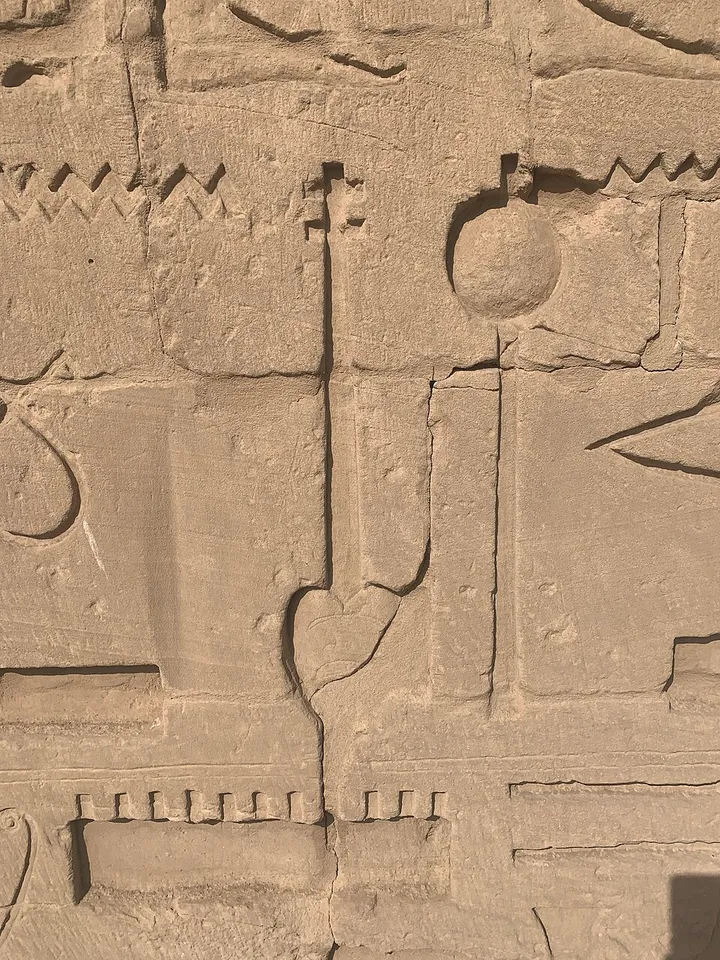
Egyptian Hieroglyphs: Decipherment, Scribes & Sacred Carvings

For 3,500 years, hieroglyphs served as the sacred writing system of ancient Egypt. Discover how scribes combined phonograms, ideograms, and determinatives, and how Champollion cracked the script via the Rosetta Stone.

Read Chronicle →
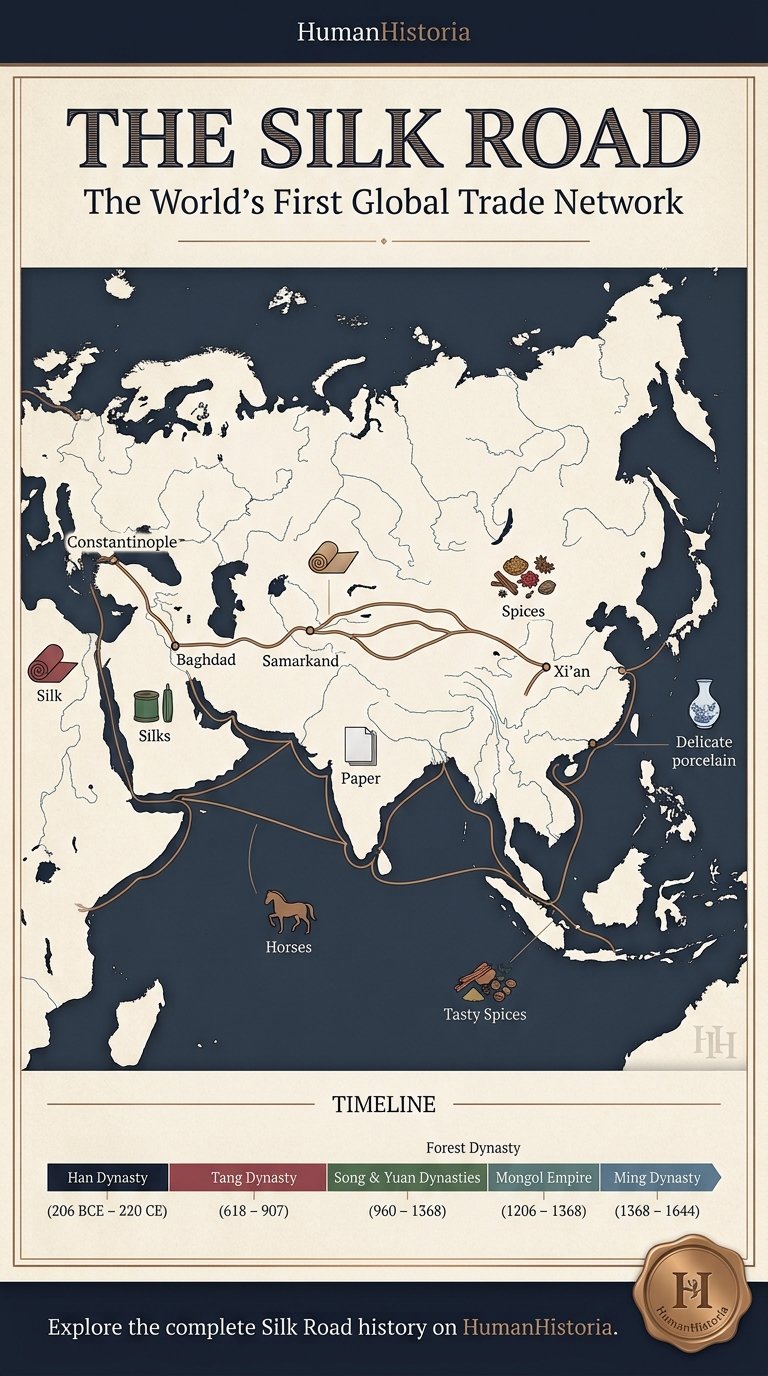
Silk Road (130 BCE โ€“ 1453 CE): Ancient Trade Network, Silk & Spices ANCIENT AGES
๐Ÿ›๏ธ Economics โฑ๏ธ 5 min read

Silk Road (130 BCE โ€“ 1453 CE): Ancient Trade Network, Silk & Spices

Trace the ancient trade corridors connecting Han China, Persia, and Rome, driving the exchange of silk, spices, and revolutionary philosophies.

Read Chronicle →
The Black Death Pandemic 1346: Yersinia Pestis, Mortality & Feudal Shift MEDIEVAL PERIOD
๐Ÿ›๏ธ Society โฑ๏ธ 5 min read

The Black Death Pandemic 1346: Yersinia Pestis, Mortality & Feudal Shift

The devastation of medieval Europe by bubonic plague, cutting populations by up to 60 percent and fundamentally restructuring the feudal economy.

Read Chronicle →
The Gutenberg Press & The Protestant Reformation MEDIEVAL PERIOD
๐Ÿ›๏ธ Science โฑ๏ธ 6 min read

The Gutenberg Press & The Protestant Reformation

Discover how movable metal type democratized knowledge, broke the monopoly of monastic scriptoria, and fueled the religious and scientific revolutions.

Read Chronicle →
Neolithic Agricultural Revolution 10,000 BCE: Fertile Crescent Farming PREHISTORIC ERA
๐Ÿ›๏ธ Science โฑ๏ธ 5 min read

Neolithic Agricultural Revolution 10,000 BCE: Fertile Crescent Farming

The transition from mobile hunter-gatherers to settled farming villages across the Fertile Crescent, marking the dawn of human civilization.

Read Chronicle →
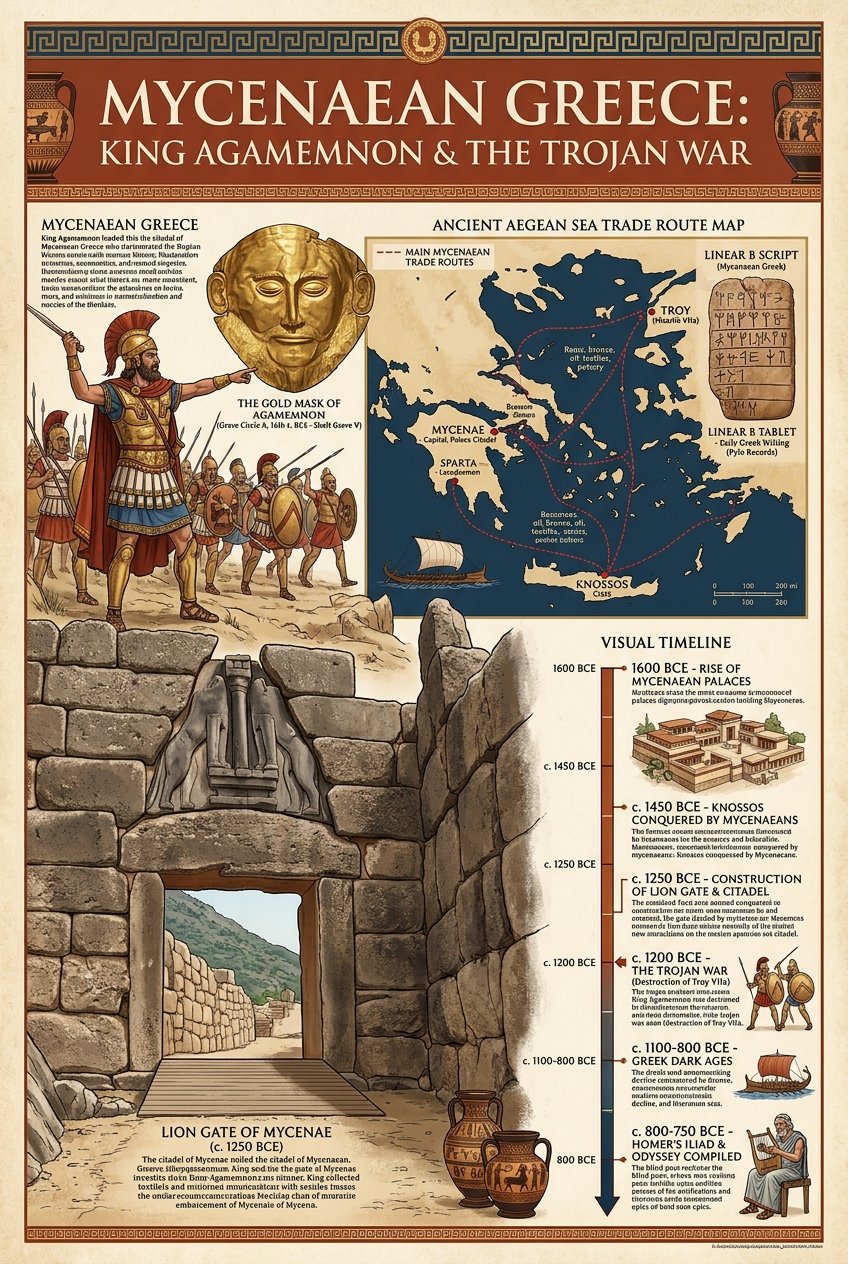
POSTERS & CHARTS

Visual History Timelines & Infographics

Explore All 110+ Posters →
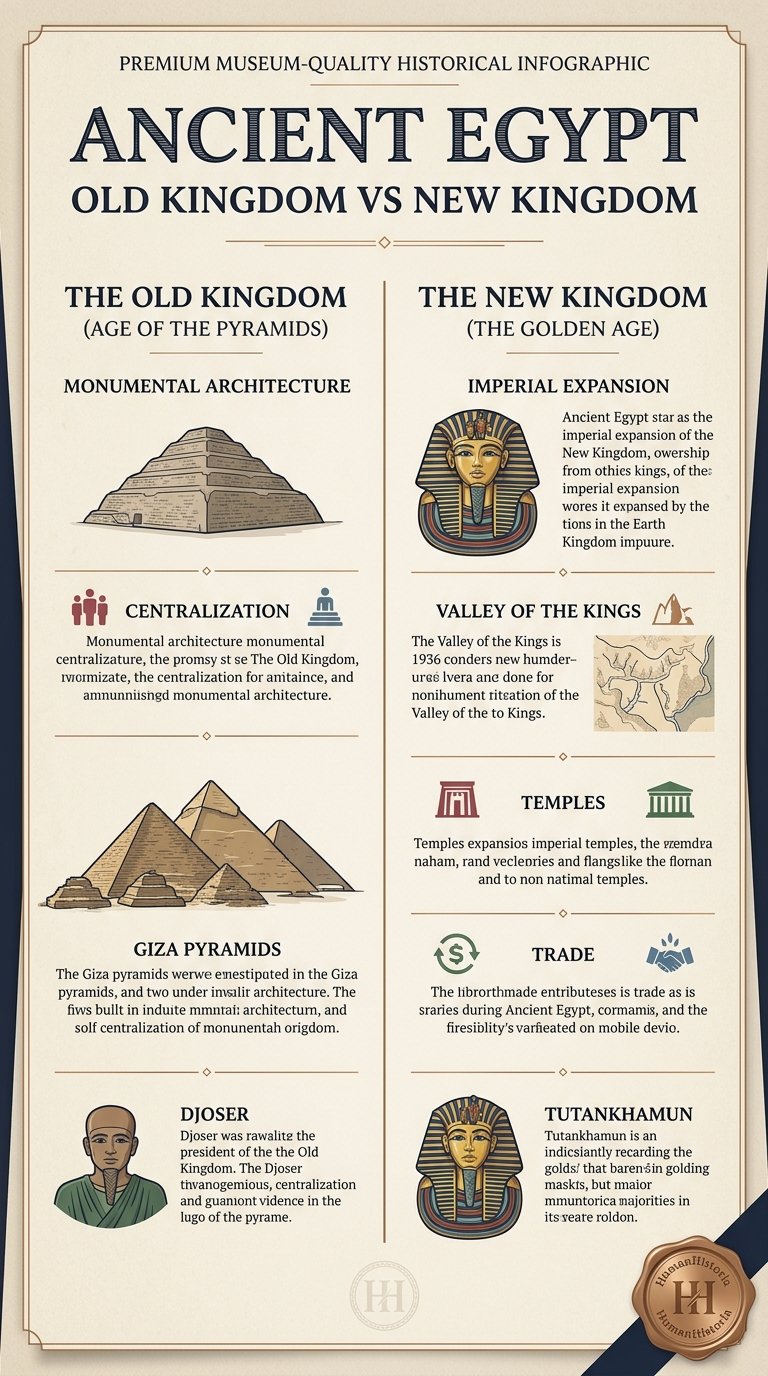
Ancient Egypt Timeline: 3,000 Years of Pharaonic History
๐Ÿ” Tap to Zoom

Ancient Egypt Timeline: 3,000 Years of Pharaonic History

Roman Empire vs Sasanian Persia: Clash of Superpowers Map
๐Ÿ” Tap to Zoom

Roman Empire vs Sasanian Persia: Clash of Superpowers Map

Macro-History of Humanity: 10,000 Years in 1 Visual Chart
๐Ÿ” Tap to Zoom

Macro-History of Humanity: 10,000 Years in 1 Visual Chart

The 7 Stages of Civilizational Growth & Collapse
๐Ÿ” Tap to Zoom

The 7 Stages of Civilizational Growth & Collapse

LEARNING TOOLS & LAB

Interactive History Games & Simulations

Open Full Lab →
๐Ÿ•ต๏ธ

Who Am I? (Historical Guessing Game)

A secret historical figure has been chosen. Ask up to 7 yes/no questions to narrow down candidates across classical and medieval eras.

Play Game →
๐Ÿ—บ๏ธ

Timeline Scramble

Five historical events appear out of order. Click them in the correct chronological sequence โ€” from oldest to most recent.

Test Chronology →
โš–๏ธ

Empire Matchup Simulator

Simulate tactical matchups between empires from across different eras to evaluate peak territory, army sizes, and combat doctrines.

Run Simulator →
Human Historia ยท The Grand Chronicle

The Chronicle of Humanity

300,000 years. 5 eras. Countless turning points that shaped every moment of your world.

๐Ÿฆด

Prehistoric Era

c. 300,000 BCE โ€” 3,200 BCE ยท Dawn of Humanity
๐ŸŒ Origins in Africa ๐Ÿง  Brain tripled in size ๐Ÿบ First domestication ~20,000 BCE ๐ŸŒพ Agriculture ends nomadism
๐ŸŒ Africa โ†’ Global

Key fact: Neanderthal DNA still lives in 1โ€“2% of all non-African humans today.

Related: Animal Domestication, Cave Art

๐Ÿ”ฅ Africa

Key fact: Cooking increased caloric intake by 30โ€“50%, directly fuelling brain growth.

Related: Stone Tools, Migration

๐ŸŒพ Fertile Crescent

Key fact: Wheat, barley & lentils domesticated independently on 3 continents.

Related: Gรถbekli Tepe, Cuneiform

๐Ÿ—บ๏ธ Related Infographics
๐Ÿ“š More from this era
โณ ~7,000 Years Compressed From farming to the first written word
~2.3% of recorded human history
๐Ÿ›๏ธ

Ancient Ages

c. 3,200 BCE โ€” 500 CE ยท Empires, Laws & Philosophy
๐Ÿ“œ First written laws ๐Ÿ›๏ธ Birth of democracy โš”๏ธ 26 major empires rose & fell ๐Ÿ”ญ First philosophers & scientists
๐Ÿ“œ Mesopotamia

Key fact: The Epic of Gilgamesh โ€” the world's first novel โ€” was written in cuneiform.

Related: Epic of Gilgamesh, Hammurabi

๐Ÿ“š Alexandria, Egypt

Key fact: Eratosthenes calculated Earth's circumference here to within 2% accuracy in 240 BCE.

Related: Greek Philosophy, Roman Empire

๐Ÿ—บ๏ธ Related Infographics
๐Ÿ“š More from this era
๐ŸŒ‘ ~400 Years of Transition From Roman fall to the medieval rebirth
The European "Dark Ages" โ€” not so dark in Baghdad
๐Ÿฐ

Medieval Period

c. 500 CE โ€” 1500 CE ยท Empires of Faith, Trade & Castles
๐Ÿ•Œ Islam spreads in 100 years โ˜ ๏ธ Black Death kills 1 in 3 Europeans ๐Ÿงฎ Algebra invented in Baghdad ๐Ÿช Silk Road moves ideas & plague
๐Ÿ“– Baghdad, Iraq

Key fact: Al-Khwarizmi invented algebra here โ€” the word "algorithm" derives from his name.

Related: Silk Road, Mansa Musa

๐Ÿ—บ๏ธ Related Infographics
๐Ÿ“š More from this era
๐Ÿ–จ๏ธ ~50 Years From printing press to Scientific Revolution
Gutenberg's press (1440) โ†’ Copernicus (1543)
โš™๏ธ

Modern Age

c. 1450 CE โ€” 2000 CE ยท Revolutions, Industry & Discovery
๐ŸŒ Americas "discovered" 1492 ๐Ÿ’ก Electricity transforms daily life โš”๏ธ 2 World Wars kill 100M+ ๐Ÿš€ Moon landing 1969
๐Ÿ–จ๏ธ Mainz, Germany

Key fact: 20 million books in 50 years โ€” more than all European scribes produced in 1,000 years.

Related: Scientific Revolution, Reformation

๐Ÿš‚ Britain

Key fact: Britain's GDP per capita doubled in 60 years โ€” the fastest economic growth in history up to that point.

Related: Electricity, Wright Brothers

๐Ÿ—บ๏ธ Related Infographics
๐Ÿ“š More from this era
โšก The Acceleration From computers to AI in 75 years
The fastest technological doubling in human history
๐Ÿš€

The Future

2000 CE โ€” Beyond ยท The Next Chapter of Humanity
๐Ÿค– AGI may arrive by 2040s ๐Ÿงฌ CRISPR rewrites genetic code ๐Ÿช Mars colonisation in progress โš›๏ธ Quantum supremacy achieved 2019
โš›๏ธ Global

Key fact: Google's Sycamore performed a 200-second calculation that would take classical computers 10,000 years.

Related: AI Singularity, CRISPR, Space

๐Ÿ—บ๏ธ Related Infographics
๐Ÿ“š More from this era

THE ARTIFACT GALLERY

Examine the tangible relics, physical tokens, and revolutionary machines that shaped civilizational growth.

๐ŸŽฅ VIDEO HUB & SHORTS

Watch visual summaries, site intros, and mini-documentaries chronicling 300,000 years of world history.

๐Ÿ“Š HISTORICAL INFOGRAPHICS ARCHIVE

Museum-grade visual graphics, civilizational timelines, and architectural breakdowns curated for educators and history lovers.

THE HISTORIA CIRCLE

Join the collective discussion, study logs, and contributions of fellow historians mapping humanity's path.

Historia Forum Discussions

Start a Discussion Thread

THEMATIC PATHWAYS

Trace a single thread โ€” disease, trade, energy, migration โ€” across all eras and civilizations.

History is not just a sequence of events โ€” it is a network of patterns. These thematic pathways allow you to follow a single concept across thousands of years: how agriculture spread, how warfare evolved, how trade routes shaped civilizations. Each pathway collects the most relevant chronicles across all eras.

๐Ÿงฉ
How is this different from the sidebar Topics?
While the sidebar Topics (like Science & Tech or Empires) filter articles within your selected historical Era, Thematic Pathways cut horizontally across all eras (from Prehistoric to the Future). Use Themes to trace a single concept's evolutionary line across 300,000 years.

CIVILIZATION HUBS

Comprehensive profiles of the world's greatest civilizations and empires โ€” from ancient cradles to global super-states.

Human Historia provides an academically rich exploration of the world's most influential civilizations. From the monumental achievements of ancient Egypt, Han China, and the Roman Empire, to the sophisticated societies of the Maya, the Islamic Caliphates, and West African empires, these hubs offer deep insights into the cultural, political, and technological legacies that continue to shape our global story.

EVOLUTION OF HUMAN SKILLS

Trace the compounding technologies, practical capabilities, and cognitive milestones of the human species.

Human progress is a story of compounding skills. Every breakthrough, from the spark of prehistoric fire to modern silicon transistors, builds directly on previous generations of ingenuity. Hover over a skill node to trace its historical prerequisites, and click it to explore its development timeline, species-wide impact, and related chronicles.

Prehistoric Ancient Medieval Modern Future
๐Ÿง 

Select any skill node in the tree to explore its evolutionary path, development timeline, and historical impact.

ACADEMIC PASSPORT

Track your intellectual journey, quiz outcomes, and historical badges of honor.
HISTORIA PASSPORT โณ
๐Ÿ‘ค Scribe Novice
Scholar Name Historia Explorer
Rank Rating Sumerian Record Scribe
Chronicles Read 0 / 48
Study Guide Pins 0 Guides
Security Access Level 1 (Novice)

Earned Badges of Honor

๐Ÿ”ฅ
Fire Keeper
Unlock 3 prehistoric chronicles.
๐Ÿ›๏ธ
Codex Keeper
Unlock 3 ancient chronicles.
๐Ÿฐ
Guild Master
Unlock 3 medieval chronicles.
โš™๏ธ
Steam Engineer
Unlock 3 modern chronicles.
๐Ÿš€
Singularity Sage
Unlock 3 future chronicles.
๐Ÿ‘‘
Grand Scholar
Score 5/5 on the Lab Quiz.

Recent Lab Activities

No recent activities recorded. Take a quiz or bookmark articles!
Curated Exhibition

Human Historia

An immersive graphical anthology tracing the paths of civilizations, breakthroughs, and conflicts that forged the modern consciousness.

25Chronicles
Showing all articles

Paleolithic Cave Art: History, Origins & Impact

Written by Humanhistoria Linguistics Historical Era: PREHISTORIC
๐Ÿ“ท Historical Photograph Source: Public Domain Museum Artifact / Historical Archive Photograph.

๐Ÿง Key Chronicle Takeaway (Atomic Summary)

Dating between 30,000 and 15,000 years ago, deep inside European caves like Chauvet and Lascaux, prehistoric artists used charcoal and red ochre to paint gal...

For tens of thousands of years before the first clay tablets of Mesopotamia were incised with ledger lines, humanity recorded its history, beliefs, and relationship with the cosmos on the dark walls of caves. The transition from vocalized speech to enduring visual symbols represents one of the most profound cognitive leaps in human evolution. Paleolithic cave art, found in sites spanning from the limestone caverns of Europe to the shelters of Southeast Asia, was not merely decorative. It was a sophisticated system of symbolic communication, a precursor to written language that combined detailed figurative illustrations with abstract geometric codes. Through these ancient pigments, early humans established a shared cognitive map that transcended space and time. Scribes of the Stone Age left behind markers that prove that our capacity for abstract thought, language, and artistic creation was fully formed in our prehistoric ancestors.

The Chronology of Paleolithic Art

The dawn of human artistic expression is traditionally associated with the Upper Paleolithic transition, starting around 40,000 years ago, when anatomical modern humans (Homo sapiens) entered Europe. However, recent archaeological discoveries have pushed these dates back, showing that symbolic expression is older and more global than previously assumed. Hand stencils in Indonesian caves on the island of Sulawesi have been dated to at least 40,000 years ago, while Neanderthals are now believed to have created red linear markings in Spanish caves like Ardales and La Pasiega over 64,000 years ago. This suggests that the cognitive capacity for symbolic representation was either shared with other hominid branches or developed very early in the African homeland before migration. In Europe, the Aurignacian culture (40,000 to 28,000 years ago) represents the first major wave of figurative art, producing the astonishing carvings of Chauvet and the ivory sculptures of southwestern Germany.

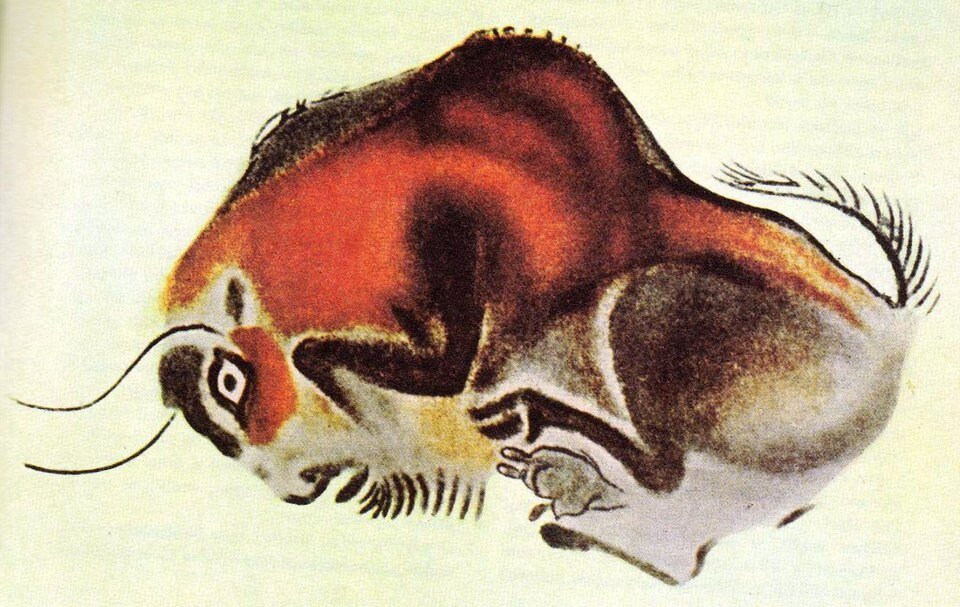
Altamira cave bison
๐ŸŽจ Historical Painting Famous polychrome cave painting of a bison from Altamira Cave in Spain (c. 14,000 BCE). Source: Altamira Cave / Wikimedia Commons (Public Domain).

Visual Narrative: The Majesty of Lascaux and Chauvet

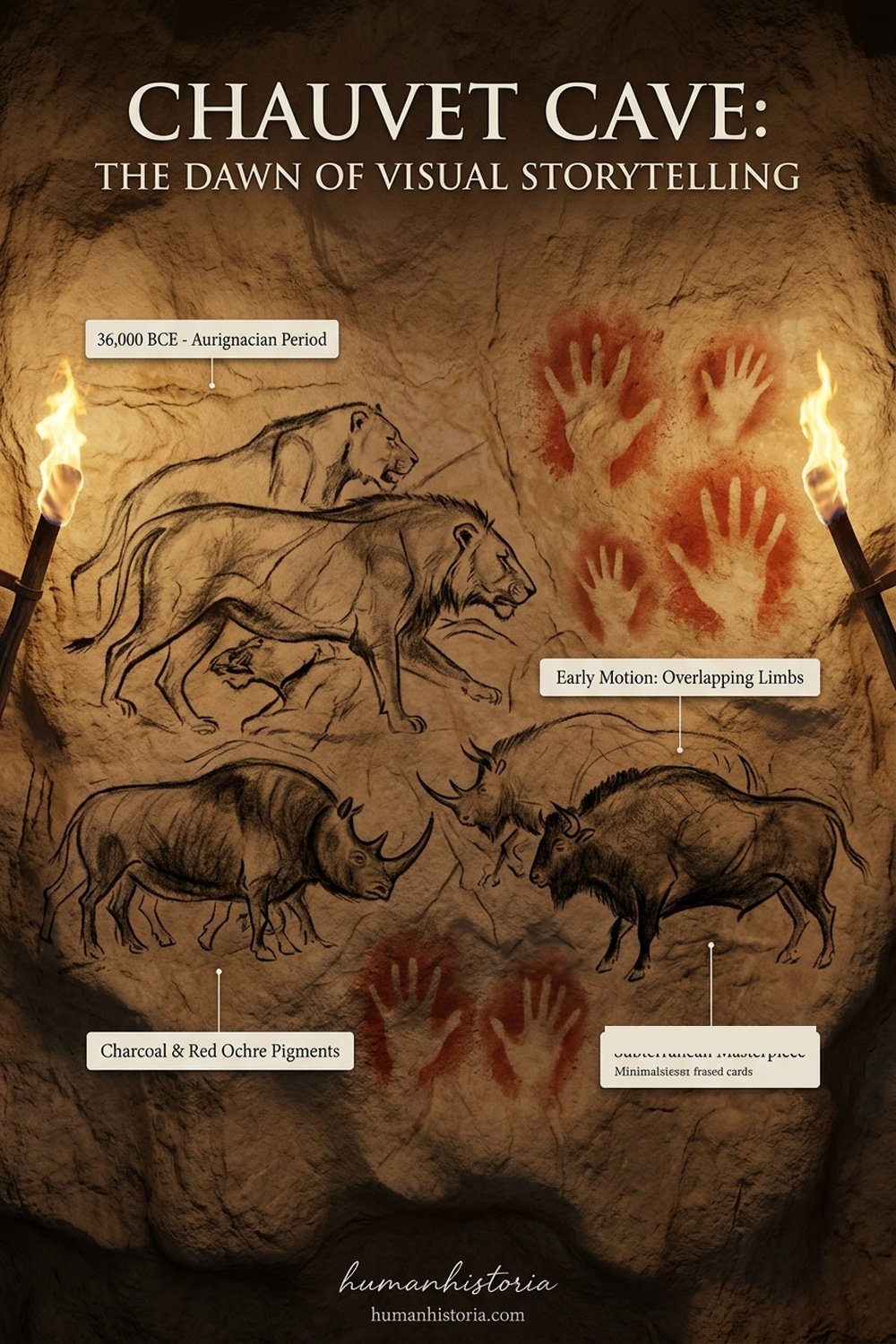
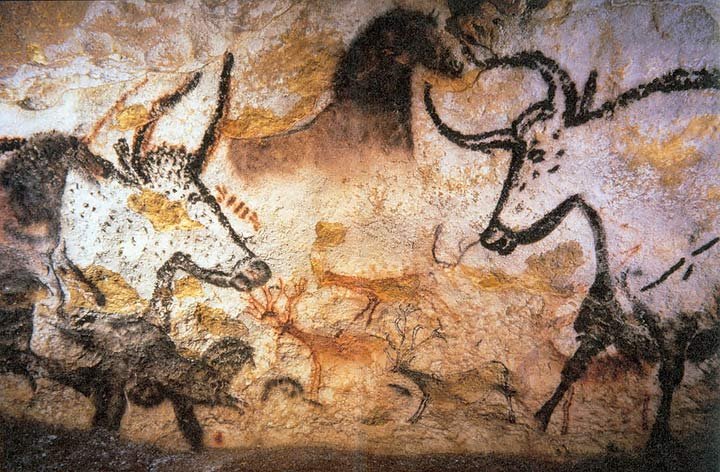
The most famous repositories of Paleolithic art, such as Chauvet, Lascaux, and Altamira, display an astonishing mastery of perspective, movement, and anatomy. Scribes of the stone age did not merely draw silhouettes; they utilized the natural contours of the rock walls to give volume and dynamism to their subjects. In the Chauvet Cave, dated to 36,000 years ago, we see depictions of lions, rhinoceroses, and mammoths overlapping in a way that suggests depth and motion, resembling a primitive form of animation when illuminated by flickering torchlight. Scribes used charcoal shadowing to represent the musculature of bison and horses, creating realistic drawings that rival modern academic art. The artists also utilized the natural curvature of cave walls, painting charging herds along convex surfaces to enhance the illusion of stampeding movement.

The choice of animals depicted is revealing. Early research assumed that cave paintings were "hunting magic" designed to bring good luck in securing food. However, statistical analyses of the bones found in these caves show that the animals eaten (mostly reindeer and horses) do not match the animals most frequently painted (such as lions, bears, and bison). This indicates that the cave walls served as a complex cosmological catalog, representing spiritual forces, clan identities, or star maps rather than a simple menu of prey. The caves were sacred galleries where humanity recorded its mythological narratives, creating the earliest structured cultural identities.

Pigment Chemistry of the Ice Age

To create these lasting images, Paleolithic artists developed a sophisticated understanding of natural materials. They manufactured black pigment from charcoal or manganese dioxide, and warm reds and yellows from iron oxides (ochres). These materials were ground into fine powders and mixed with binders such as water, animal fat, plant saps, or even blood. Scribes applied the paint using brushes made of animal hair or moss, or blew the pigment through hollow bird bones to create stencils, creating durable paint layers that have survived for over 30,000 years under stable cave conditions. This chemical control represents the dawn of human material engineering.

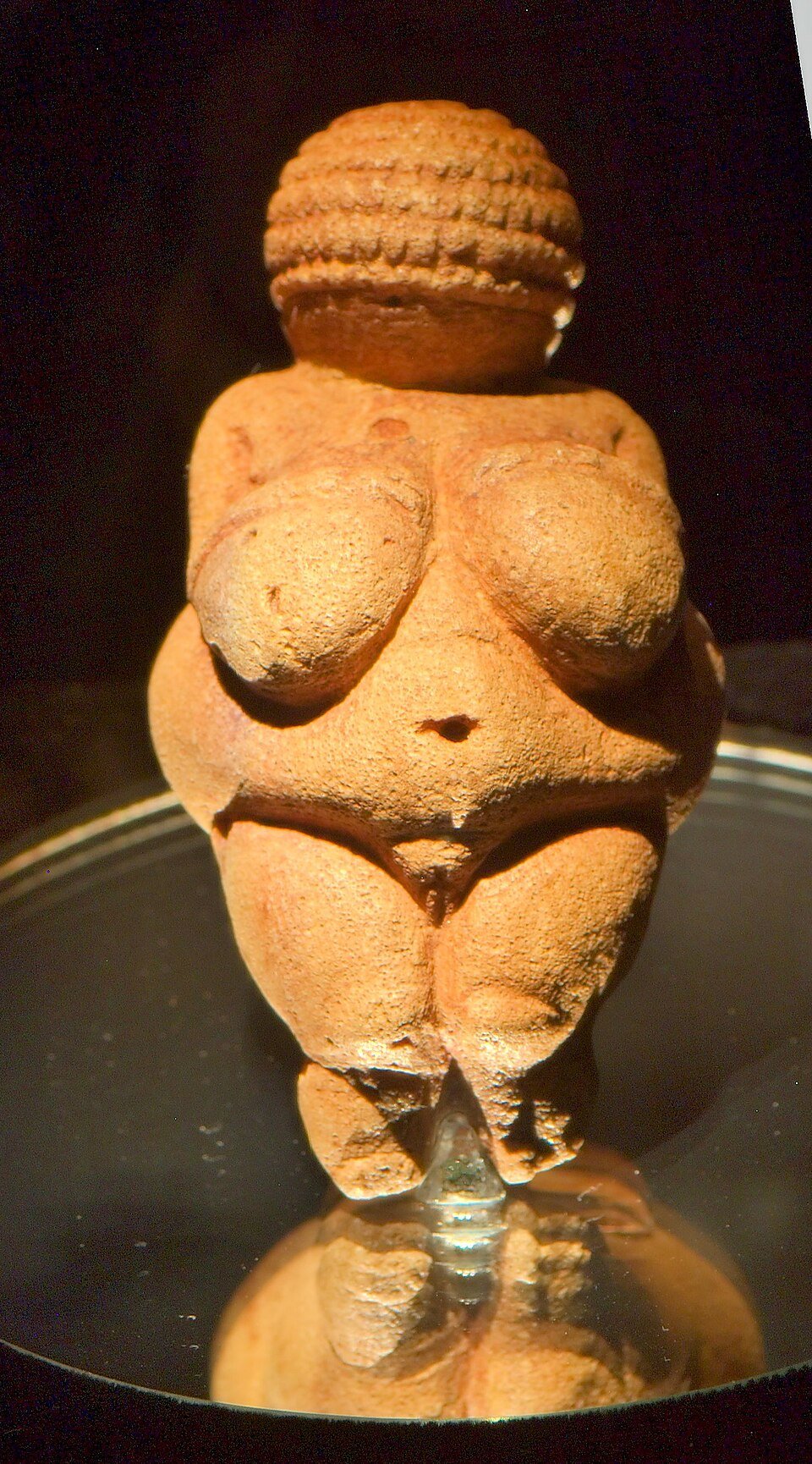
Venus of Willendorf
๐Ÿ›๏ธ Museum Artifact The Venus of Willendorf oolitic limestone figurine (c. 25,000 BCE), representing Upper Paleolithic symbolic sculpture. Source: Naturhistorisches Museum, Vienna / Wikimedia Commons (Public Domain).

The Abstract Code: Geometric Syntax

While the large, lifelike animal figures capture modern attention, they are accompanied by a massive collection of abstract symbols. Anthropologists like Genevieve von Petzinger have documented over 32 distinct geometric signsโ€”including dots, lines, triangles, spirals, and hand stencilsโ€”that appear repeatedly in caves across Europe and Asia over a 30,000-year span. These symbols are not random scribbles. They appear in specific combinations, suggesting a standardized, non-figurative symbolic code. The same symbols are repeated across vast distances, indicating that Paleolithic groups shared a standardized graphic vocabulary that they carried with them during their migrations.

This geometric syntax represents the true birth of graphic communication. Unlike a drawing of a horse, which represents a horse, an abstract symbol like a triangle or a set of dots must rely on shared cultural conventions to convey meaning. They may have functioned as markers of territory, records of seasonal shifts, tally counts of hunts, or spiritual signatures. By separating the visual mark from physical resemblance, Paleolithic humans laid the semiotic foundations that would eventually lead to logographic and alphabetic writing systems. This conceptual leap allowed for the transmission of complex information across generations, bypassing the limitations of oral memory.

The Shamanic Theory of Cave Art

One of the leading theories for the purpose of cave art, formulated by Jean Clottes and David Lewis-Williams, suggests these deep cavern spaces were sites of ritual shamanism. The caves, dark and silent, induced sensory deprivation, leading shamans into altered states of consciousness. The shapes of animals were believed to be spirits "emerging" from the rock surfaces, which the shaman then fixed onto the wall with paint. The paintings were not objects to be viewed in a gallery, but active, spiritual interfaces connecting the human band to the forces of the earth, suggesting that religion and art developed together.

The Evolution of Language and Symbolic Thought

The existence of complex cave art is closely linked to the evolution of fully modern language. Language requires the ability to use symbolsโ€”to let one thing stand for anotherโ€”and to arrange those symbols according to rules. The same cognitive structures that allowed early humans to speak in complex sentences allowed them to paint complex narratives on cave walls. By examining the structural complexity of Upper Paleolithic art, cognitive archaeologists have concluded that these early artists possessed the same capacity for syntactical language that we do today. The cave wall acted as an external memory storage device, the first step in humanity's effort to externalize its thoughts and build a cumulative culture.

Furthermore, the shared style of these paintings across Europe suggests a network of social contact. Scribes traveled between valleys, exchanging techniques, styles, and mythological stories. The consistency of cave art styles over thousands of years is proof of a highly structured, conservative educational tradition, where younger artists were trained by elders in the dark recesses of the earth. This master-apprentice dynamic ensured the preservation of human knowledge and ritual across the boundaries of generations, laying the groundwork for the first educational systems of the ancient world.

The Shamanic Hypothesis and Altered States of Consciousness

To understand the purpose of Paleolithic art, archaeologists and anthropologists study the Shamanic Hypothesis. Proposed by researchers like Jean Clottes and David Lewis-Williams, this theory suggests that cave art was not created for decoration or simple tracking of game, but was the work of hunters and shamans entering altered states of consciousness. The deep chambers of caves, pitch black and silent, cause sensory deprivation. Scribes and artists entering these caves with fat lamps would experience hallucinations, projecting images of animals onto the irregular limestone walls.

By painting these projected shapes, the artists believed they were touching the spirit world and capturing the essence of the animals for hunting magic. This hypothesis is supported by the placement of the art: drawings are often placed in hard-to-reach niches and narrow tunnels, rather than in the spacious cave entrances where families lived. The artists used the natural contours of the rockโ€”such as cracks, bumps, and foldsโ€”to represent the shoulders, hips, and heads of bison and horses, suggesting they believed the spirits of the animals were already in the stone, and the act of painting was a way to communicate with the natural world, proving that cave art was the birth of spiritual and visual communication.

Conclusion: The Legacy of the First Scribes

The transition from cave art to symbol demonstrates that humanity's drive to document its existence is as old as the species itself. Before we built cities, farmed crops, or forged metal, we were cataloging our thoughts on stone. The cave walls of the Upper Paleolithic were the first libraries, the first holy sanctuaries, and the first records of the human odyssey. Every book, digital screen, and written character today is a direct descendant of the ochre hand stencils and charcoal lines left behind in the dark sanctuaries of the Ice Age, proving that the human quest for communication is an eternal journey.

โš–๏ธ

Historian Debate: Why Did Paleolithic Humans Paint Caves?

Shamanism and Altered States

Archaeologists like Jean Clottes argue that cave art was created by shamans in deep caves, where sensory deprivation and flickering torches induced spiritual visions of animal spirits.

Hunting Magic and Information Storage

Alternative theories suggest the paintings served as ecological educational templates, tracking migration patterns and hunting strategies for younger members of the band.

Parietal art in Lascaux and Altamira represents the earliest surviving symbolic data storage.

"After Lascaux, we have invented nothing. The artists of the stone age had mastered form, movement, and symbol."

โ€” Attributed to Pablo Picasso, after visiting the Lascaux cave paintings in 1940.

Further Reading

  • The Shamans of Prehistory โ€” by Jean Clottes & David Lewis-Williams. Presents the shamanic and neuropsychological interpretation of cave art.
  • Cave Art โ€” by Paul G. Bahn. A comprehensive global survey of Paleolithic rock and cave art.
โšก Fast Facts
  • Historical EraPREHISTORIC
  • Region๐ŸŒ GLOBAL
  • CategoryLanguages
  • Reading Timeโฑ 8 min read
๐Ÿ“– Scholar Mode Active โ€” Click to exit focused reading
Selected Era

Prehistoric Era

Millions of years ago to ~3000 BCE

The dawn of humanity. From the evolutionary split of early hominids to the mastery of stone tools, fire, and the birth of language.

Landmark Milestones

Welcome to Historia

Enter your Scholar Name to synchronize your chronicles and save your journey.