~7,000 Years from farming to writing
๐Ÿ›๏ธ

Ancient Ages

c. 3,200 BCE โ€” 500 CE ยท Empires, Laws & Philosophy
~400 Years from Roman fall to medieval rebirth
๐Ÿฐ

Medieval Period

c. 500 CE โ€” 1500 CE ยท Empires of Faith, Trade & Castles
~50 Years from printing press to Scientific Revolution
โš™๏ธ

Modern Age

c. 1450 CE โ€” 2000 CE ยท Revolutions, Industry & Discovery
~50 Years from computers to quantum age

THE ARTIFACT GALLERY

Examine the tangible relics, physical tokens, and revolutionary machines that shaped civilizational growth.

๐ŸŽฅ VIDEO HUB & SHORTS

Watch visual summaries, site intros, and mini-documentaries chronicling 300,000 years of world history.

๐Ÿ“Š HISTORICAL INFOGRAPHICS ARCHIVE

Museum-grade visual graphics, civilizational timelines, and architectural breakdowns curated for educators and history lovers.

THE HISTORIA CIRCLE

Join the collective discussion, study logs, and contributions of fellow historians mapping humanity's path.

Historia Forum Discussions

Start a Discussion Thread

THEMATIC PATHWAYS

Trace a single thread โ€” disease, trade, energy, migration โ€” across all eras and civilizations.

History is not just a sequence of events โ€” it is a network of patterns. These thematic pathways allow you to follow a single concept across thousands of years: how agriculture spread, how warfare evolved, how trade routes shaped civilizations. Each pathway collects the most relevant chronicles across all eras.

๐Ÿงฉ
How is this different from the sidebar Topics?
While the sidebar Topics (like Science & Tech or Empires) filter articles within your selected historical Era, Thematic Pathways cut horizontally across all eras (from Prehistoric to the Future). Use Themes to trace a single concept's evolutionary line across 300,000 years.

CIVILIZATION HUBS

Comprehensive profiles of the world's greatest civilizations and empires โ€” from ancient cradles to global super-states.

Human Historia provides an academically rich exploration of the world's most influential civilizations. From the monumental achievements of ancient Egypt, Han China, and the Roman Empire, to the sophisticated societies of the Maya, the Islamic Caliphates, and West African empires, these hubs offer deep insights into the cultural, political, and technological legacies that continue to shape our global story.

EVOLUTION OF HUMAN SKILLS

Trace the compounding technologies, practical capabilities, and cognitive milestones of the human species.

Human progress is a story of compounding skills. Every breakthrough, from the spark of prehistoric fire to modern silicon transistors, builds directly on previous generations of ingenuity. Hover over a skill node to trace its historical prerequisites, and click it to explore its development timeline, species-wide impact, and related chronicles.

Prehistoric Ancient Medieval Modern Future
๐Ÿง 

Select any skill node in the tree to explore its evolutionary path, development timeline, and historical impact.

ACADEMIC PASSPORT

Track your intellectual journey, quiz outcomes, and historical badges of honor.
HISTORIA PASSPORT โณ
๐Ÿ‘ค Scribe Novice
Scholar Name Historia Explorer
Rank Rating Sumerian Record Scribe
Chronicles Read 0 / 48
Study Guide Pins 0 Guides
Security Access Level 1 (Novice)

Earned Badges of Honor

๐Ÿ”ฅ
Fire Keeper
Unlock 3 prehistoric chronicles.
๐Ÿ›๏ธ
Codex Keeper
Unlock 3 ancient chronicles.
๐Ÿฐ
Guild Master
Unlock 3 medieval chronicles.
โš™๏ธ
Steam Engineer
Unlock 3 modern chronicles.
๐Ÿš€
Singularity Sage
Unlock 3 future chronicles.
๐Ÿ‘‘
Grand Scholar
Score 5/5 on the Lab Quiz.

Recent Lab Activities

No recent activities recorded. Take a quiz or bookmark articles!
Curated Exhibition

Human Historia

An immersive graphical anthology tracing the paths of civilizations, breakthroughs, and conflicts that forged the modern consciousness.

25Chronicles
Showing all articles

The History of Electricity: How Faraday, Tesla, and Edison Electrified the World

Written by Historia Science Historical Era: MODERN
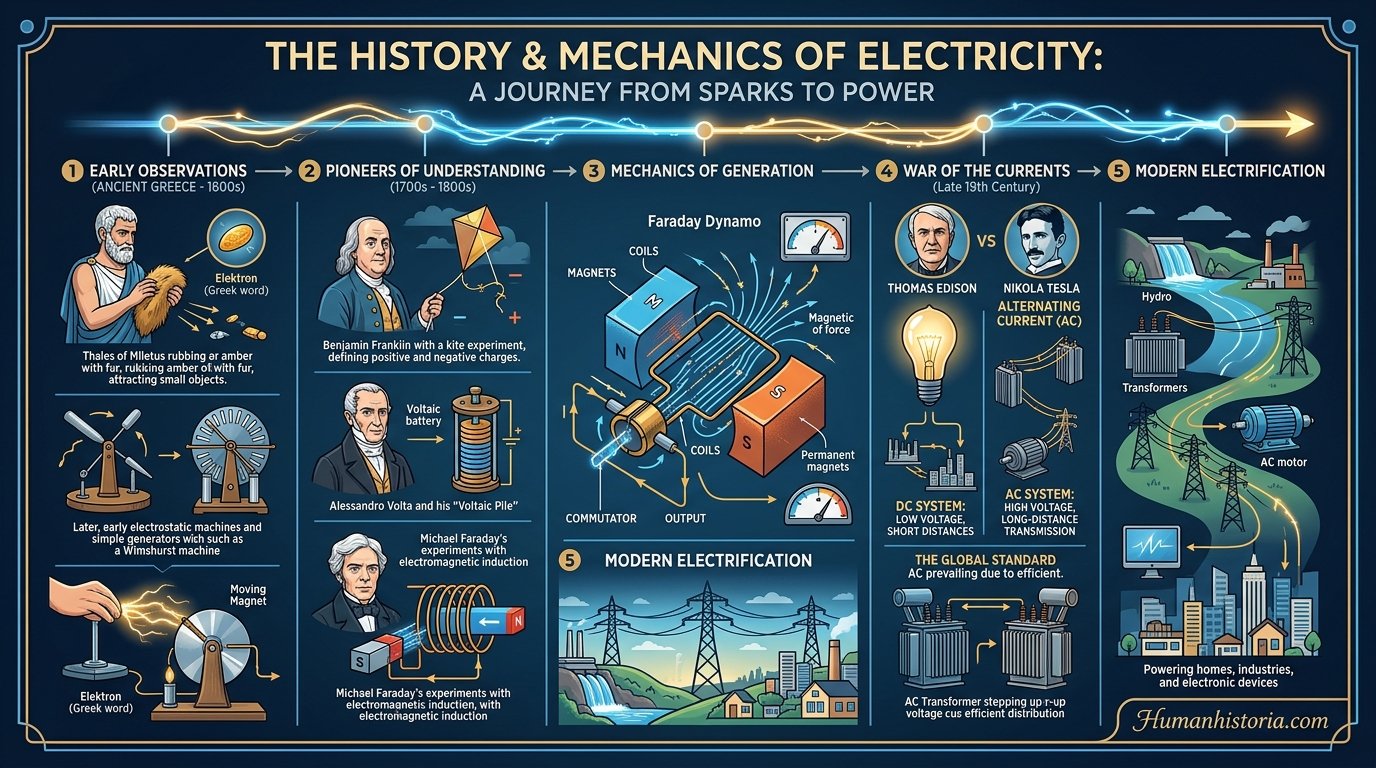
* Note: Cover image is an AI-generated historical illustration.

๐Ÿง Key Chronicle Takeaway (Atomic Summary)

The electrical induction physics of Michael Faraday and the AC grid engineering of Nikola Tesla that energized the modern world.

The industrialization of the modern era was initialized by the steam engine, which unlocked the energy of coal and mechanize manual labor. However, steam power had a critical limitation: it had to be used where it was generated, transmitted through noisy systems of belts, shafts, and gears. The transition to the second phase of the Industrial Revolution was driven by the taming of a mysterious, invisible force: Electricity. By discovering the relationship between electricity and magnetism, 19th-century scientistsโ€”such as Michael Faraday, James Clerk Maxwell, and Nikola Teslaโ€”transformed physics into civil engineering. Scribes and industrialists constructed generators, dynamos, and power distribution grids, allowing mechanical power to be transmitted instantly across miles, turning cities into illuminated hubs of productivity and communication, shaping the foundations of the modern electronic age.

The Discovery of Electromagnetism: Faraday's Breakthrough

Before the 19th century, electricity was viewed as a curiosity, associated with lightning, static shocks, and simple batteries developed by Alessandro Volta in 1800. The breakthrough occurred in 1820, when Danish physicist Hans Christian ร˜rsted observed that an electric current in a wire deflected a nearby compass needle, proving that electric currents generate magnetic fields. Scribes and natural philosophers across Europe rushed to study this connection, seeking to reverse the effect: if electricity could make magnetism, could magnetism make electricity?

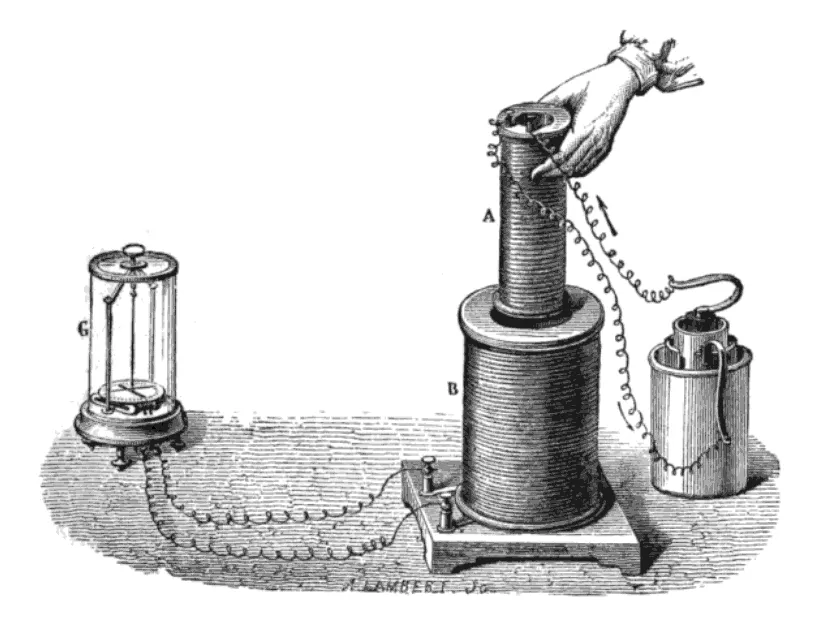
The answer was discovered in 1831 by the English scientist Michael Faraday. Scribes documented Faraday's historic experiment: he moved a permanent magnet through a coil of copper wire, observing a current flow in the wire. This process, known as Electromagnetic Induction, was a massive discovery. Scribes realized that by spinning a wire coil between magnetic poles using mechanical power (such as a steam piston or water wheel), they could generate a continuous flow of electrical current, creating the first Generator (dynamo). Faraday had discovered a way to convert mechanical energy into electrical energy, paving the way for high-volume electrical engineering.

The Battle of the Currents: AC vs. DC

By the late 1880s, the race to electrify cities was underway, resulting in a dramatic economic and scientific conflict known as the Battle of the Currents. Scribes documented the two competing systems:

  • Direct Current (DC): Championed by Thomas Edison, DC systems sent electrical current flowing in a single direction. DC was safe and functional for incandescent lighting, but it could not travel long distances. Because of resistance in copper wires, DC voltage dropped rapidly, requiring coal power plants every kilometer, making it expensive to electrify rural areas.
  • Alternating Current (AC): Championed by Nikola Tesla and funded by George Westinghouse, AC systems reversed direction dozens of times a second. Scribes noted that AC could be run through Transformers to step up the voltage to high levels, allowing it to travel long distances over thin wires with minimal energy loss, and then step it down for safe use in homes and factories.

Maxwell's Equations: Unifying Light and Electromagnetism

In 1865, Scottish physicist James Clerk Maxwell published a set of four mathematical equations that unified electricity, magnetism, and light into a single theory of electromagnetism. Scribes celebrated these equations as one of the greatest achievements of mathematical physics. Maxwell proved that electromagnetic waves travel through space at the speed of light, predicting the existence of radio waves, which would later make wireless communication, radar, and modern telecommunication systems possible.

The Electrification of the World: Grid Infrastructure

The Battle of the Currents ended at the World's Columbian Exposition in Chicago in 1893, where Westinghouse used Tesla's AC system to illuminate the entire fairgrounds, showing its superior scale and efficiency. This victory was cemented in 1896, when engineers built the first large-scale AC hydroelectric plant at Niagara Falls, transmitting electrical power over 40 kilometers to Buffalo, New York. This event proved that power could be generated in remote, natural locations and delivered directly to industrial cities, bypassing the need to haul coal to urban centers.

Industrialists and workers rapidly built Power Grids, stringing copper wires across landscapes and connecting homes, offices, and factories to central power plants. The impact on society was profound:

  • Industrial Flex: Factories replaced complex steam belt shafts with individual electric motors on every machine, improving safety, layout flexibility, and efficiency.
  • Urban Illumination: Electric streetlights replaced gas lamps, reducing crime, extending the working day, and creating a vibrant, nocturnal urban culture.
  • Domestic Transition: Home appliancesโ€”refrigerators, vacuum cleaners, and washing machinesโ€”freed up household labor time, transforming domestic social dynamics.

War of the Currents and the Electric Chair

To discredit the AC system, Thomas Edison launched a negative public relations campaign, claiming that alternating current was dangerous. Edison secretly funded the development of the Electric Chair, which used Westinghouse's AC generator, to prove that AC was lethal. He even publically electrocuted animals, including a circus elephant named Topsy, to spread fear. However, the economic benefits of AC's long-distance transmission were too great, and Edison's own company eventually merged to form General Electric, adopting AC technology.

The Foundation of the Digital Age

The taming of electricity was not just about lighting and motors; it was the birth of electronic communication. The Telegraph (invented by Samuel Morse in the 1830s) and the Telephone (Alexander Graham Bell in 1876) used electrical signals to transmit information across oceans and continents instantly, shrinking the globe in real time. Scribes no longer waited weeks for mail ships; they received market prices, diplomatic dispatches, and news reports in seconds. The electrical grid was the physical skeleton that made the computer age, the internet, and modern digital computation possible, turning electricity into the lifeblood of human civilization.

The Invention of the AC Induction Motor

While Nikola Tesla's alternating current system solved the problem of long-distance transmission, the grid still lacked a critical component: an efficient electric motor that could run on AC power. Direct current grids utilized DC motors, but these motors relied on brushes and commutators that generated friction and sparks, requiring constant maintenance and making them dangerous to use in factories. Scribes and engineers realized that to fully electrify industry, they had to build an AC motor.

The breakthrough was made by Tesla in 1887 with the invention of the AC Induction Motor. Scribes documented Tesla's design: instead of using physical brushes to transfer current to the rotor, the motor used alternating currents in the stator coils to generate a rotating magnetic field. This rotating field induced an electric current in the rotor, causing it to spin without physical contact. The induction motor was simple, durable, and highly efficient, allowing factories to power heavy machinery using the AC grid, and making Tesla's AC system the complete, standard technology for global electrification.

The Environmental Impact of the Power Grid

The construction of the electrical grid also initiated a major transition in how humanity interacts with the environment. Initially, the primary source of electrical power was coal, which was burned in urban power plants to spin steam turbines. This led to severe air pollution and acid rain in industrial cities. Scribes and conservationists warned of the ecological costs of fossilized energy, driving research into renewable power.

This research led to the construction of massive hydroelectric dams, such as the Hoover Dam in the 1930s, which converted the kinetic energy of rivers into electricity. While hydro power was clean, it altered river ecosystems and flooded valleys. In the late 20th century, the grid began integrating solar panels and wind turbines, which use the photovoltaic effect and aerodynamic force to generate electricity without emissions. The modern smart grid dynamically coordinates these diverse renewable sources in real-time, outlining a sustainable future where human energy needs are balanced with the preservation of the planetary biosphere.

The Electrical Grid and the Rise of Automation

The taming of electricity also enabled the development of automation in modern industrial systems. By using electrical relays, sensors, and feedback loops, engineers built machinery that could adjust its operations automatically without human intervention, leading to assembly-line production and robotic manufacturing. Scribes and engineers note that this automation was a direct descendant of the early electromagnetic motors designed by Michael Faraday and Nikola Tesla, proving that electricity was the primary force that transformed the physical work of the Industrial Revolution into the logical processing of the digital age.

Michael Faraday early induction coil apparatus
Michael Faraday's original induction coil apparatus, which demonstrated electromagnetic induction and paved the way for electrical engineering.

Conclusion: The Current of Progress

The electrification of the world transformed humanity's relationship with energy. By converting natural force into an invisible current that could be generated, transmitted, and controlled with microscopic precision, 19th-century engineers constructed the modern urban landscape. The power grids that outline our cities from space today are the direct descendants of the dynamos and transformers built by Tesla and Westinghouse, proving that the taming of electromagnetism was the spark that built the modern world. This massive network remains a testament to human innovation and a critical foundation for all future technological breakthroughs, powering our progress into the electronic and digital frontiers.

โš–๏ธ

Historian Debate: The War of the Currents

Edison's Direct Current (DC)

Edison advocated for DC power, arguing it was safer for domestic use, launching a public campaign (including electrocuting animals) to discredit alternating current.

Tesla and Westinghouse's Alternating Current (AC)

Tesla and Westinghouse proved that AC could travel long distances via transformers, making it the economically superior standard for industrial electrification.

Electrification catalyzed the second phase of the Industrial Revolution in the late 19th century.

"The present is theirs; the future, for which I really worked, is mine. Alternating current will light the world."

โ€” Nikola Tesla, Personal Diary (c. 1890).

Further Reading

  • Empires of Light โ€” by Jill Jonnes. The dramatic story of the battle between Edison, Tesla, and Westinghouse to electrify America.
  • Tesla: Inventor of the Electrical Age โ€” by W. Bernard Carlson. A detailed academic biography of the inventor.
๐Ÿ“– Scholar Mode Active โ€” Click to exit focused reading
Selected Era

Prehistoric Era

Millions of years ago to ~3000 BCE

The dawn of humanity. From the evolutionary split of early hominids to the mastery of stone tools, fire, and the birth of language.

Landmark Milestones

Welcome to Historia

Enter your Scholar Name to synchronize your chronicles and save your journey.