~7,000 Years from farming to writing
🏛️

Ancient Ages

c. 3,200 BCE — 500 CE · Empires, Laws & Philosophy
~400 Years from Roman fall to medieval rebirth
🏰

Medieval Period

c. 500 CE — 1500 CE · Empires of Faith, Trade & Castles
~50 Years from printing press to Scientific Revolution
⚙️

Modern Age

c. 1450 CE — 2000 CE · Revolutions, Industry & Discovery
~50 Years from computers to quantum age

THE ARTIFACT GALLERY

Examine the tangible relics, physical tokens, and revolutionary machines that shaped civilizational growth.

🎥 VIDEO HUB & SHORTS

Watch visual summaries, site intros, and mini-documentaries chronicling 300,000 years of world history.

📊 HISTORICAL INFOGRAPHICS ARCHIVE

Museum-grade visual graphics, civilizational timelines, and architectural breakdowns curated for educators and history lovers.

THE HISTORIA CIRCLE

Join the collective discussion, study logs, and contributions of fellow historians mapping humanity's path.

Historia Forum Discussions

Start a Discussion Thread

THEMATIC PATHWAYS

Trace a single thread — disease, trade, energy, migration — across all eras and civilizations.

History is not just a sequence of events — it is a network of patterns. These thematic pathways allow you to follow a single concept across thousands of years: how agriculture spread, how warfare evolved, how trade routes shaped civilizations. Each pathway collects the most relevant chronicles across all eras.

🧩
How is this different from the sidebar Topics?
While the sidebar Topics (like Science & Tech or Empires) filter articles within your selected historical Era, Thematic Pathways cut horizontally across all eras (from Prehistoric to the Future). Use Themes to trace a single concept's evolutionary line across 300,000 years.

CIVILIZATION HUBS

Comprehensive profiles of the world's greatest civilizations and empires — from ancient cradles to global super-states.

Human Historia provides an academically rich exploration of the world's most influential civilizations. From the monumental achievements of ancient Egypt, Han China, and the Roman Empire, to the sophisticated societies of the Maya, the Islamic Caliphates, and West African empires, these hubs offer deep insights into the cultural, political, and technological legacies that continue to shape our global story.

EVOLUTION OF HUMAN SKILLS

Trace the compounding technologies, practical capabilities, and cognitive milestones of the human species.

Human progress is a story of compounding skills. Every breakthrough, from the spark of prehistoric fire to modern silicon transistors, builds directly on previous generations of ingenuity. Hover over a skill node to trace its historical prerequisites, and click it to explore its development timeline, species-wide impact, and related chronicles.

Prehistoric Ancient Medieval Modern Future
🧠

Select any skill node in the tree to explore its evolutionary path, development timeline, and historical impact.

ACADEMIC PASSPORT

Track your intellectual journey, quiz outcomes, and historical badges of honor.
HISTORIA PASSPORT
👤 Scribe Novice
Scholar Name Historia Explorer
Rank Rating Sumerian Record Scribe
Chronicles Read 0 / 48
Study Guide Pins 0 Guides
Security Access Level 1 (Novice)

Earned Badges of Honor

🔥
Fire Keeper
Unlock 3 prehistoric chronicles.
🏛️
Codex Keeper
Unlock 3 ancient chronicles.
🏰
Guild Master
Unlock 3 medieval chronicles.
⚙️
Steam Engineer
Unlock 3 modern chronicles.
🚀
Singularity Sage
Unlock 3 future chronicles.
👑
Grand Scholar
Score 5/5 on the Lab Quiz.

Recent Lab Activities

No recent activities recorded. Take a quiz or bookmark articles!
Curated Exhibition

Human Historia

An immersive graphical anthology tracing the paths of civilizations, breakthroughs, and conflicts that forged the modern consciousness.

25Chronicles
Showing all articles

Napoleonic Empire (1804-1815): Code Napoléon, Expansion & Waterloo

Written by Historia Editorial Historical Era: MODERN
* Note: Cover image is an AI-generated historical illustration.

🧠Key Chronicle Takeaway (Atomic Summary)

How a Corsican artillery officer reshaped European borders, legal codes, and military strategies, leaving a blueprint for the modern nation-state.

Napoleon Bonaparte (reigned 1804–1814, 1815), who crowned himself Emperor of the French, was one of the most brilliant and controversial military commanders and statesmen in modern history. Rising from a minor Corsican noble family during the chaos of the French Revolution, he reshaped the political and physical borders of Europe through a series of legendary military campaigns. Yet, Napoleon's enduring legacy extends far beyond his battles. Through the Napoleonic Code, the establishment of administrative meritocracy, the centralization of public education, and the spread of standard legal reforms, he laid the institutional blueprint for the modern European nation-state, permanently dismantling the feudal structures of the continent.

The Revolutionary Crucible: Rise to Power

To understand Napoleon's rise, one must examine the French Revolution (1789–1799) and the wars that followed. The collapse of the Bourbon monarchy and the establishment of the French Republic threatened the monarchies of Europe, who formed coalitions to crush the revolution and restore the old order. In this environment of constant war, political instability, and social mobility, talent and merit replaced noble birth as the primary criteria for military advancement.

Napoleon,trained as an artillery officer at the Royal Military School in Paris, first demonstrated his tactical genius at the Siege of Toulon (1793). By positioning his artillery on heights overlooking the harbor, he forced the British fleet to evacuate, earning a promotion to brigadier general at the age of twenty-four. In 1796, he was given command of the neglected French Army of Italy. In a brilliant campaign, he utilized speed and surprise to defeat the larger Austrian and Sardinian forces, forcing Austria to sign the Treaty of Campo Formio and establishing French control over northern Italy. In 1798, Napoleon led an expedition to Egypt to disrupt British trade routes to India. Although the campaign ended in military failure after the British Admiral Nelson destroyed the French fleet at the Battle of the Nile, the expedition had a profound scientific and cultural impact, bringing back drawings of monuments and discovering the Rosetta Stone, which unlocked the translation of hieroglyphs.

French troops dragging cannons through a snowy Alpine pass
Napoleon's forces dragging heavy artillery through the Great St. Bernard Pass during the Alpine crossing of 1800, a key logistical feat of the Italian campaign.

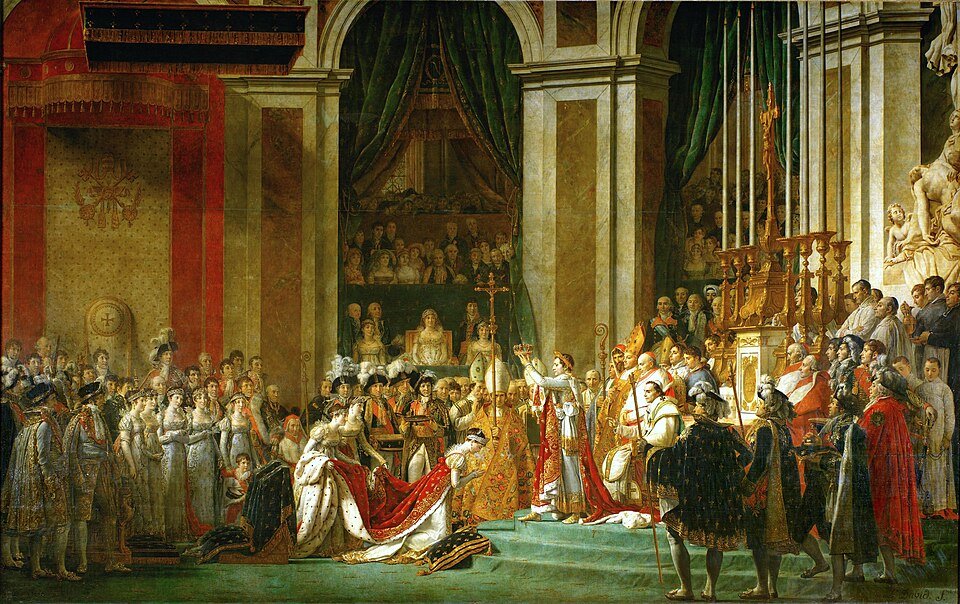
Returning to Paris in 1799, Napoleon exploited the political weakness of the Directory. On the Coup of 18 Brumaire (November 9, 1799), he overthrew the government and established the French Consulate, naming himself First Consul. In 1802, a national plebiscite confirmed him as First Consul for life, and on December 2, 1804, in a ceremony at Notre Dame Cathedral, Napoleon crowned himself Emperor of the French, seizing the crown from the hands of Pope Pius VII to demonstrate that his power was self-made and not dependent on divine right.

The Napoleonic Code: The Legal Blueprint of Modernity

Upon taking absolute power, Napoleon initiated administrative reforms. His most important achievement was the Napoleonic Code (the Civil Code of 1804). Before the code, France did not have a single, unified legal system; laws varied by region, based on local customs, royal decrees, or Roman law. The Civil Code replaced this fragmented system with a single, clear, written body of law that applied equally to all citizens. The code established several modern legal principles:

  • Equality Before the Law: It abolished all feudal privileges, hereditary class distinctions, and tax exemptions for the nobility and clergy.
  • Secularization of State and Law: It separated civil law from religious doctrine, establishing civil marriage, civil divorce, and freedom of religion.
  • Protection of Property Rights: It codified absolute rights to private property, contract freedom, and inheritance rights, encouraging industrial capitalism.
  • Patriarchal Family Law: While progressive in civic equality, the code was conservative regarding gender roles, reinforcing the father's absolute authority over his wife, children, and family property, and restricting women's legal rights in divorce and property ownership.

Napoleon exported the Civil Code to every territory conquered by his armies, including Belgium, the Netherlands, western Germany, and northern Italy. It served as the foundation for the modern civil law systems of Europe, Latin America, and parts of Asia, remaining Napoleon's most enduring monument.

The Grande Armée and Military Innovations

Napoleon's dominance on the battlefield was sustained by the Grande Armée and a series of revolutionary military innovations that transformed modern warfare. The most significant of these was the Corps System (corps d'armée).

Instead of organizing his army as a single, massive column that marched together, Napoleon divided his forces into independent, self-sufficient army corps, each numbering between 15,000 and 30,000 men. Each corps contained its own infantry, cavalry, artillery, engineers, and supply trains, and was commanded by a marshal. This allowed the corps to march along separate, parallel roads, accelerating logistics and movement. Napoleon's strategic doctrine was: "March divided, fight united." While the corps marched separately, they remained within a single day's march of each other. When one corps encountered the enemy, it would engage in defensive actions while the neighboring corps converged rapidly on the enemy's flanks and rear, catching them by surprise.

The Masterpiece of Austerlitz

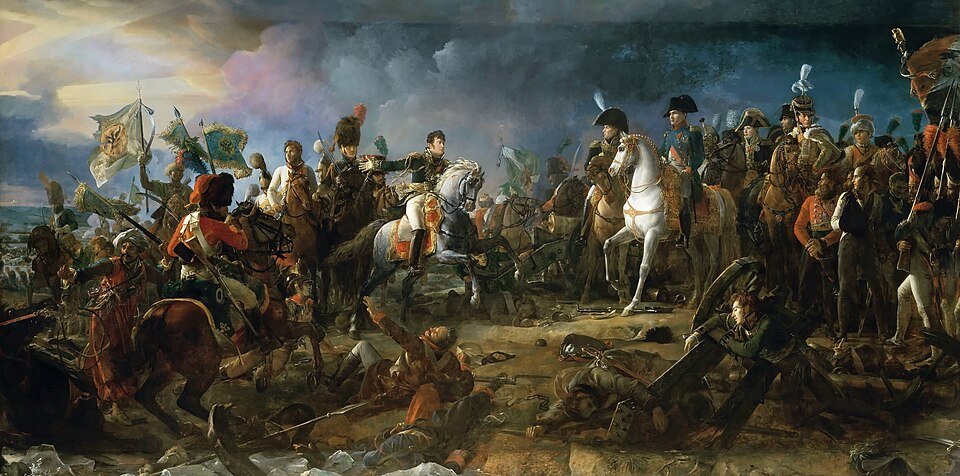
In December 1805, Napoleon fought the Battle of Austerlitz (the Battle of the Three Emperors) against the combined Austro-Russian coalition led by Emperor Francis II and Tsar Alexander I. Napoleon executed a brilliant deception: he deliberately weakened his right flank along the Goldbach stream to lure the Allied army off the high ground of the Pratzen Heights. As the Allies launched their assault on his right, French reinforcements (Davout's Corps) arrived after a rapid 70-mile march from Vienna to hold the line. Once the Allies had committed their forces to the flank, Napoleon unleashed Soult's Corps to charge the vacated Pratzen Heights, splitting the Allied army in two and turning the battle into a rout, forcing Austria to sue for peace and ending the Holy Roman Empire.

Napoleon also pioneered the concentration of artillery, organizing his cannons into a Grand Battery to breach the enemy lines at a decisive point (point décisif). He reformed the staff system to ensure rapid transmission of orders and utilized a meritocratic promotion system, declaring that "every French soldier carries a marshal's baton in his knapsack," which inspired immense loyalty and morale among his men.

Napoleon commanding at the Battle of Austerlitz
Napoleon Bonaparte directing operations at the Battle of Austerlitz (1805), his tactical masterpiece that dismantled the Third Coalition.

The Continental System and the Peninsular War

Following his victories at Austerlitz, Jena-Auerstedt (1806) against Prussia, and Friedland (1807) against Russia, Napoleon was the master of continental Europe. However, he remained unable to invade Great Britain due to the Royal Navy's dominance, confirmed at the Battle of Trafalgar (1805). To defeat Britain, Napoleon turned to economic warfare, establishing the Continental System—a Europe-wide blockade that prohibited all French vassals and allies from trading with British ports.

The blockade had unintended consequences. It disrupted continental economies and led to widespread smuggling. When Portugal refused to enforce the blockade, Napoleon invaded, marching through Spain. In 1808, he deposed the Spanish king and placed his brother Joseph Bonaparte on the throne. This sparked a popular uprising, initiating the Peninsular War (1808–1814). The Spanish forces, supported by British troops under Wellington, engaged in guerrilla warfare ("little war"), utilizing ambush tactics that tied down 300,000 French troops and drained French resources, an ulcer that weakened the empire's military strength.

The Russian Disaster, Abdication, and Waterloo

In 1812, Tsar Alexander I withdrew Russia from the Continental System due to its negative impact on Russian trade. In response, Napoleon assembled the largest army in European history—the Grande Armée of 600,000 men—and crossed the Niemen River into Russia. The Russian generals, realizing they could not defeat Napoleon in a pitched battle, adopted a scorched-earth policy. They retreated into the interior, burning crops, bridges, and villages to deny the French army food and shelter.

The two forces fought the bloody, indecisive Battle of Borodino near Moscow, resulting in over 70,000 casualties. Napoleon entered Moscow in September, but the city was burned by its residents, leaving the French army without winter shelter. After waiting a month for a peace offer that never arrived, Napoleon was forced to order a retreat. The retreat became one of the greatest military catastrophes in history. Caught in the freezing Russian winter, without winter gear, and harassed by Cossack cavalry, the Grande Armée collapsed. Less than 40,000 combat-ready soldiers survived the crossing of the Berezina River to return to Poland.

The Hundred Days and the St. Helena Exile

Following the Russian disaster, the monarchies of Europe formed the Sixth Coalition. Despite Napoleon's tactical brilliance in the Six Days' Campaign, Paris was captured, and Napoleon was forced to abdicate in April 1814, exiled to the Mediterranean island of Elba. In March 1815, he escaped Elba, landed in southern France, and marched to Paris. The soldiers sent to arrest him instead joined him, and he reclaimed the throne for a period known as the Hundred Days. His revival ended in June 1815 at the Battle of Waterloo in Belgium, where his forces were defeated by a combined Anglo-Allied and Prussian army under the Duke of Wellington and Gebhard Leberecht von Blücher. Napoleon was exiled to the remote South Atlantic island of St. Helena, where he died in 1821.

The Egyptian Campaign and the Discovery of Antiquity

Napoleon Bonaparte's administrative vision was not limited to Europe; in 1798, he launched the Egyptian Campaign to disrupt British trade routes to India. While the campaign was a military failure, ending with the destruction of the French fleet by Admiral Nelson at the Battle of the Nile, it was a triumph for science and history. Napoleon took a scientific corps of 167 scholars, engineers, artists, and mathematicians—known as the savants—including the mathematician Gaspard Monge and the chemist Claude Louis Berthollet.

These scholars founded the Institut d'Égypte in Cairo and set out to map the country, catalog its monuments, study its biology, and record its history. In 1799, French soldiers fortifying a fort near the port city of Rashid discovered the Rosetta Stone. The savants made ink squeezes and plaster casts of the inscriptions, sending them to Europe before the physical stone was captured by the British. The research of the scientific corps was published in the monumental Description de l'Égypte (1809–1829), a 24-volume work that cataloged the antiquities of Egypt, creating the modern discipline of Egyptology and sparking a worldwide fascination with ancient history.

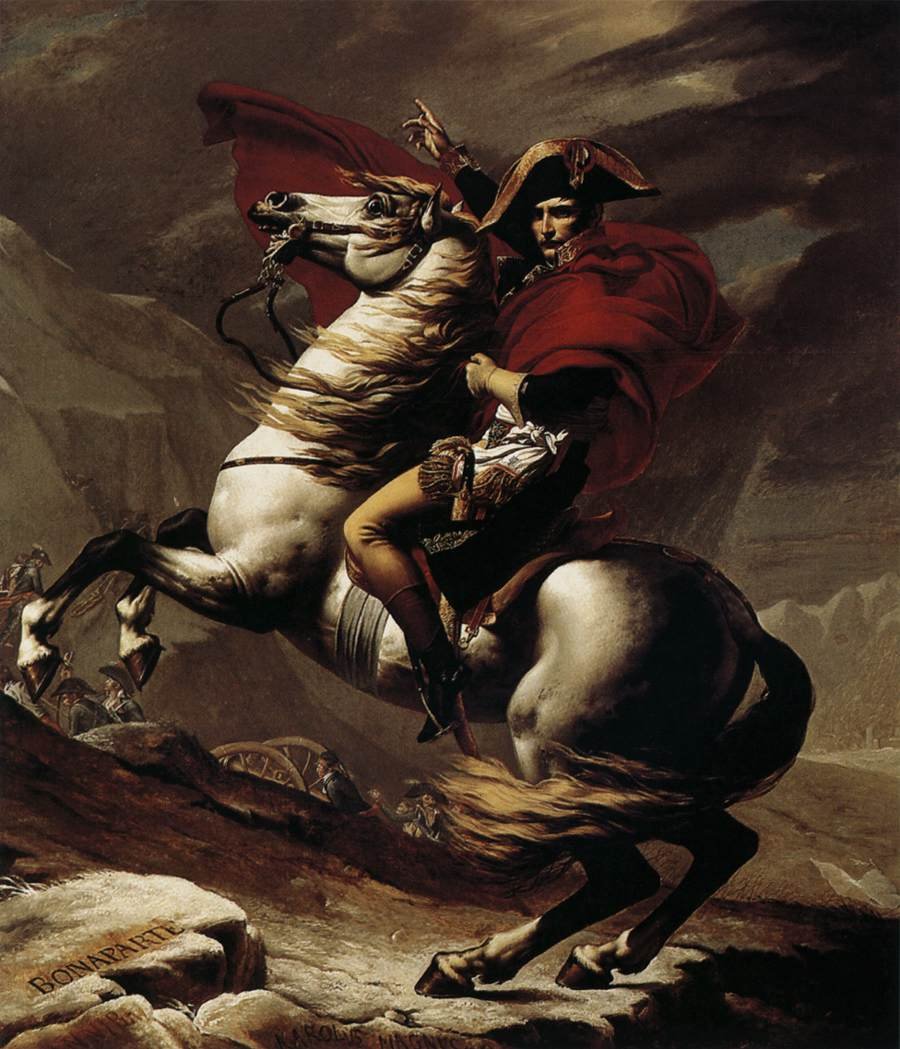
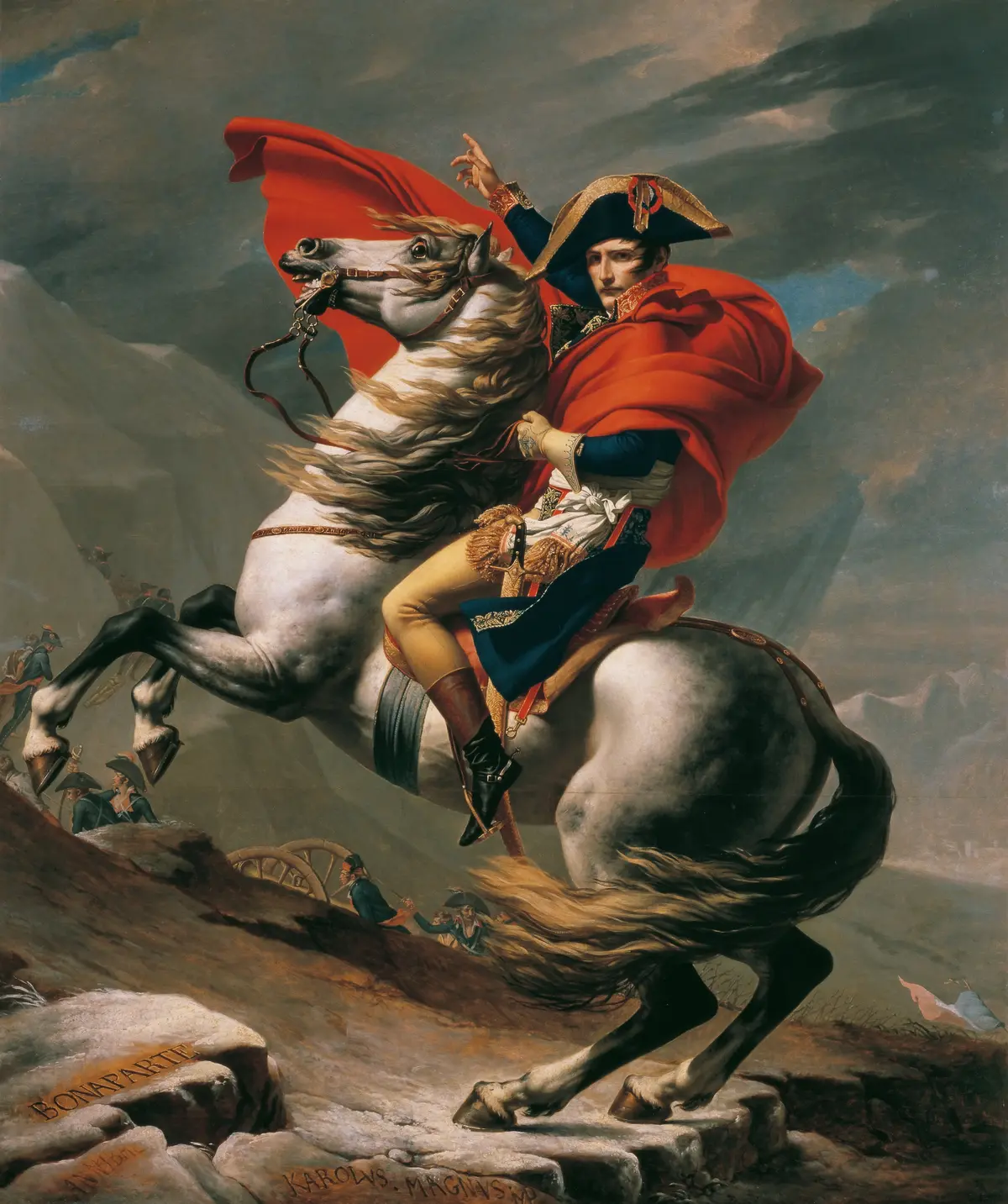
Napoleon Crossing the Alps painting by Jacques-Louis David
Jacques-Louis David's classic 1801 painting depicting Napoleon Bonaparte crossing the Alps on horseback.

Conclusion and Legacy

Napoleon Bonaparte's reign reshaped the modern world. By dismantling the Holy Roman Empire, consolidating dozens of small German states into the Confederation of the Rhine, and establishing the Napoleonic Code, he paved the way for the unification of Germany and Italy. His administrative reforms—including the metric system, centralized banking (Banque de France), merit-based public high schools (lycées), and civil registry offices—became standard systems across the globe. Although his campaigns cost millions of lives, his career proved that merit and talent could overcome hereditary privilege, leaving an institutional and cultural legacy that continues to define the administration of the modern state.

⚖️

Historian Debate: Was Napoleon the Heir or Destroyer of the Revolution?

The Heir of 1789

Proponents argue that Napoleon institutionalized the core reforms of the French Revolution, exporting civil equality, meritocracy, and secular law across Europe through the Napoleonic Code.

The Imperial Dictator

Critics emphasize that Napoleon crowned himself Emperor, abolished political freedom, restored slavery in the colonies (1802), and sacrificed millions of lives in wars of personal ambition.

Historians like Pieter Geyl and Andrew Roberts debate whether Napoleon's reign consolidated or hijacked the revolution.

"My true glory is not to have won forty battles... Waterloo will wipe out the memory of so many victories. But what will live forever is my Civil Code."

— Napoleon Bonaparte, Memoirs from Exile on Saint Helena (1818).

Further Reading

  • Napoleon: A Lifeby Andrew Roberts. A brilliant, modern biography utilizing Napoleon's thousands of personal letters.
  • Napoleon and the Rebellion in Haitiby Laurent Dubois. Explores the dark side of French imperial policy and the restoration of colonial slavery.
📖 Scholar Mode Active — Click to exit focused reading
Selected Era

Prehistoric Era

Millions of years ago to ~3000 BCE

The dawn of humanity. From the evolutionary split of early hominids to the mastery of stone tools, fire, and the birth of language.

Landmark Milestones

Welcome to Historia

Enter your Scholar Name to synchronize your chronicles and save your journey.