~7,000 Years from farming to writing
๐Ÿ›๏ธ

Ancient Ages

c. 3,200 BCE โ€” 500 CE ยท Empires, Laws & Philosophy
~400 Years from Roman fall to medieval rebirth
๐Ÿฐ

Medieval Period

c. 500 CE โ€” 1500 CE ยท Empires of Faith, Trade & Castles
~50 Years from printing press to Scientific Revolution
โš™๏ธ

Modern Age

c. 1450 CE โ€” 2000 CE ยท Revolutions, Industry & Discovery
~50 Years from computers to quantum age

THE ARTIFACT GALLERY

Examine the tangible relics, physical tokens, and revolutionary machines that shaped civilizational growth.

๐ŸŽฅ VIDEO HUB & SHORTS

Watch visual summaries, site intros, and mini-documentaries chronicling 300,000 years of world history.

๐Ÿ“Š HISTORICAL INFOGRAPHICS ARCHIVE

Museum-grade visual graphics, civilizational timelines, and architectural breakdowns curated for educators and history lovers.

THE HISTORIA CIRCLE

Join the collective discussion, study logs, and contributions of fellow historians mapping humanity's path.

Historia Forum Discussions

Start a Discussion Thread

THEMATIC PATHWAYS

Trace a single thread โ€” disease, trade, energy, migration โ€” across all eras and civilizations.

History is not just a sequence of events โ€” it is a network of patterns. These thematic pathways allow you to follow a single concept across thousands of years: how agriculture spread, how warfare evolved, how trade routes shaped civilizations. Each pathway collects the most relevant chronicles across all eras.

๐Ÿงฉ
How is this different from the sidebar Topics?
While the sidebar Topics (like Science & Tech or Empires) filter articles within your selected historical Era, Thematic Pathways cut horizontally across all eras (from Prehistoric to the Future). Use Themes to trace a single concept's evolutionary line across 300,000 years.

CIVILIZATION HUBS

Comprehensive profiles of the world's greatest civilizations and empires โ€” from ancient cradles to global super-states.

Human Historia provides an academically rich exploration of the world's most influential civilizations. From the monumental achievements of ancient Egypt, Han China, and the Roman Empire, to the sophisticated societies of the Maya, the Islamic Caliphates, and West African empires, these hubs offer deep insights into the cultural, political, and technological legacies that continue to shape our global story.

EVOLUTION OF HUMAN SKILLS

Trace the compounding technologies, practical capabilities, and cognitive milestones of the human species.

Human progress is a story of compounding skills. Every breakthrough, from the spark of prehistoric fire to modern silicon transistors, builds directly on previous generations of ingenuity. Hover over a skill node to trace its historical prerequisites, and click it to explore its development timeline, species-wide impact, and related chronicles.

Prehistoric Ancient Medieval Modern Future
๐Ÿง 

Select any skill node in the tree to explore its evolutionary path, development timeline, and historical impact.

ACADEMIC PASSPORT

Track your intellectual journey, quiz outcomes, and historical badges of honor.
HISTORIA PASSPORT โณ
๐Ÿ‘ค Scribe Novice
Scholar Name Historia Explorer
Rank Rating Sumerian Record Scribe
Chronicles Read 0 / 48
Study Guide Pins 0 Guides
Security Access Level 1 (Novice)

Earned Badges of Honor

๐Ÿ”ฅ
Fire Keeper
Unlock 3 prehistoric chronicles.
๐Ÿ›๏ธ
Codex Keeper
Unlock 3 ancient chronicles.
๐Ÿฐ
Guild Master
Unlock 3 medieval chronicles.
โš™๏ธ
Steam Engineer
Unlock 3 modern chronicles.
๐Ÿš€
Singularity Sage
Unlock 3 future chronicles.
๐Ÿ‘‘
Grand Scholar
Score 5/5 on the Lab Quiz.

Recent Lab Activities

No recent activities recorded. Take a quiz or bookmark articles!
Curated Exhibition

Human Historia

An immersive graphical anthology tracing the paths of civilizations, breakthroughs, and conflicts that forged the modern consciousness.

25Chronicles
Showing all articles

Interstellar Space Travel: How Warp Physics and Fusion Engines Could Reach the Stars

Written by Historia Futurology Historical Era: FUTURE
* Note: Cover image is an AI-generated historical illustration.

๐Ÿง Key Chronicle Takeaway (Atomic Summary)

Trace the physics of antimatter engines and the Alcubierre metric that could warp space-time and carry humanity to the stars.

The transportation history of humanity has been a constant climb to increase speed, cargo capacity, and reach. From the domestication of horses and the invention of the wheel to the construction of steamships, locomotives, and jet aircraft, each leap in transport technology has integrated the globe, turning distant continents into neighboring communities. Today, humanity stands on the brink of its final transportation challenge: Interstellar Travel. The distances between stars are so vast that using chemical rocketryโ€”the technology that carried us to the Moonโ€”it would take over 75,000 years to reach the nearest stellar system, Alpha Centauri. To explore the galaxy, future transport must move beyond chemical propulsion to master relativistic engines and warp physics, transforming interstellar space from an impassable barrier into a new corridor of migration.

The Relativistic Frontier: Antimatter and fusion

To travel to other stars within a human lifetime, spacecraft must achieve relativistic speedsโ€”velocities representing a significant fraction of the speed of light (c). At these speeds, the laws of Einstein's special relativity become active, causing Time Dilation: time slows down for the travelers relative to those left behind on Earth, allowing a crew to travel light-years in what feels like months to them. To achieve relativistic speeds, future propulsion must utilize high-energy physical reactions:

  • Nuclear Fusion Propulsion: Magnetically confining deuterium-helium-3 fusion reactions to shoot high-energy plasma out of the exhaust, achieving speeds up to 10% of the speed of light, reducing the travel time to Alpha Centauri to roughly 40 years.
  • Antimatter Engines: Annihilating matter and antimatter (such as protons and antiprotons) to release the total mass-energy of the fuel, creating the most efficient propulsion possible, capable of reaching 50% of the speed of light.
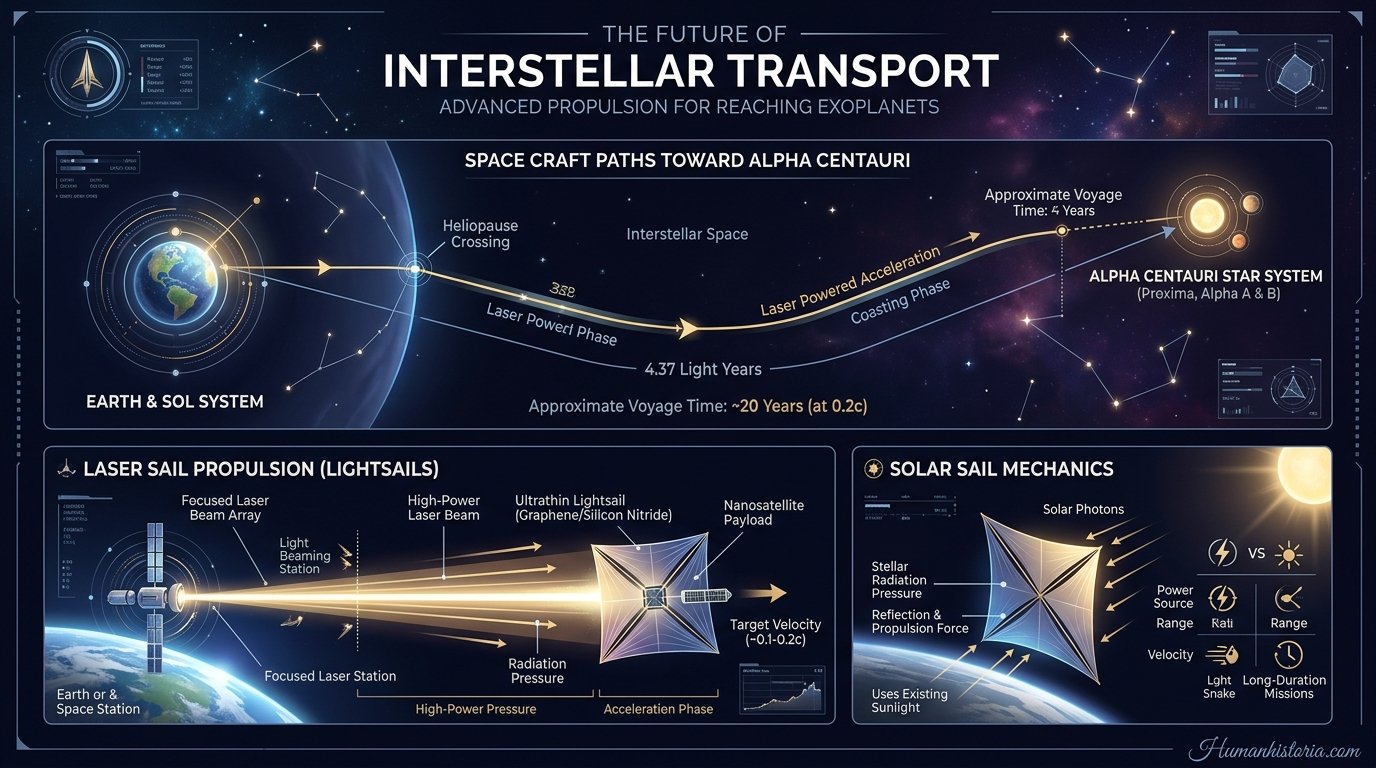
  • Laser-Driven Sails: Using arrayed gigawatt laser beams on Earth or the Moon to push ultra-light sailcraft (weighing a fraction of a gram) to 20% of the speed of light, a technology currently being explored by the Breakthrough Starshot project.

Breaking the Speed Limit: Warp Physics

Even at the speed of light, traveling across the galaxy is a slow process: it takes 4.3 years to reach Alpha Centauri, 26,000 years to reach the center of the Milky Way, and 2.5 million years to reach the Andromeda galaxy. To explore the wider universe, future physics must seek to bypass the light-speed limit. According to Einstein's general relativity, nothing can travel through space faster than light. However, space itself can expand or contract at any speed.

In 1994, Mexican physicist Miguel Alcubierre formulated a mathematical model for a faster-than-light drive: the Alcubierre Warp Drive. The drive does not push the ship through space; instead, it uses a ring of exotic matter to compress space in front of the ship and expand space behind it. The ship sits inside a "warp bubble" of flat space, which is carried along by the wave of space-time. Because the ship remains stationary inside the bubble, it does not experience time dilation or extreme accelerations, allowing it to traverse light-years in days without violating the laws of physics, turning sci-fi warp travel into a theoretical reality.

The Negative Energy Problem

The primary barrier to constructing an Alcubierre Warp Drive is the requirement for Negative Energy (or exotic matter with negative mass). Negative energy is needed to generate the gravitational repulsion that expands space behind the ship. While negative energy has been demonstrated in microscopic volumes in laboratories (the Casimir Effect), a warp drive would require an amount of negative energy equivalent to the mass of the planet Jupiter, representing a massive engineering challenge that future quantum gravity theories must resolve.

The Interstellar Colony Ship

Until warp drives are constructed, the first interstellar journeys will require Generation Ships or Sleeper Ships. Generation ships are massive, self-sustaining ecosystems carrying thousands of colonists. Scribes and structural planners design these ships as rotating cylinders to simulate gravity, equipped with closed-loop agricultural arrays, water recycling systems, and fusion power plants. The original crew would spend their lives aboard the vessel, training their children to maintain the ship's systems, so that the third or fourth generation would finally land on the target world.

Sleeper ships, by contrast, utilize Cryogenic Hibernation. Scribes and medical researchers are developing techniques to lower the body temperature of the crew to a state of suspended animation, slowing all biological processes to a crawl. The ship's computer system, managed by an advanced artificial intelligence, would navigate the ship across light-years, waking the crew only when the ship enters orbit around the habitable target planet, reducing the resource demands of the long journey.

The O'Neill Cylinder Design

Formulated by physicist Gerard K. O'Neill in 1976, the O'Neill Cylinder is a space settlement design consisting of two counter-rotating cylinders, each 30 kilometers long and 8 kilometers wide. The rotation generates artificial gravity on the inner surfaces through centrifugal force. The interior is landscaped with soil, trees, lakes, and hills, creating a stable, human-friendly ecosystem. This design serves as the primary blueprint for both generation ships and orbital space colonies, showing how humans can live in space permanently.

The Relativistic Shielding Problem

To travel at relativistic speeds, future spacecraft must solve the Relativistic Shielding Problem. Space is not completely empty; it contains hydrogen gas, dust grains, and cosmic radiation. When a ship travels at 20% or 50% of the speed of light, these stationary particles collide with the ship at extreme velocities. Scribes and physicists calculate that a collision with a tiny dust grain at relativistic speeds would release energy equivalent to a bomb blast, vaporizing the ship's hull.

To protect the ship, engineers must design active shielding systems. These include Magnetic Deflectors that generate powerful magnetic fields to steer ionized gas away from the hull and thick Whipple Shieldsโ€”multi-layered bumper plates made of beryllium or carbon-fiber that absorb the impact of dust grains. Scribes also suggest using laser arrays to vaporize debris ahead of the ship. Solving this shielding problem is essential to build starships that can survive the decades-long journey across interstellar space, securing the safety of the colonists traveling to new worlds.

The Interstellar Dust Hazard and Whipple Shields

To survive relativistic journeys, starships must also solve the Interstellar Dust Hazard. Even at 10% or 20% of the speed of light, colliding with a tiny grain of sand or dust in the interstellar medium would release energy equivalent to a massive explosion, easily breaching the ship's hull. Scribes and aerospace engineers have proposed several passive shielding designs to protect the vessel.

The primary design is the Whipple Shieldโ€”a multi-layered bumper plate mounted on the ship's nose. The first layer is a thin bumper sheet that vaporizes the dust grain on impact, turning it into a cloud of plasma. This plasma cloud expands as it travels through the empty space between the sheets, and its kinetic energy is absorbed by the thicker inner plates without breaching the main hull. Scribes also suggest using magnetic fields to deflect ionized gas and dust away from the ship, showing how passive and active shielding systems are essential to build starships that can navigate the galaxy safely.

The Relativistic Time Dilation Experience

The relativistic speeds required for interstellar travel would expose the crew to the physical reality of time dilation predicted by Einstein's special relativity. Scribes and physicists calculate that if a ship travels to the star system Vega (25 light-years away) at 99% of the speed of light, the journey would take 25 years to an observer on Earth. However, to the crew inside the ship, time would slow down, and the journey would feel like it took only 3.5 years. This time difference means that when the colonists return to Earth, they would find that 50 years had passed, while they had aged only 7 years.

This time difference creates a psychological and social barrier for the travelers, who would return to a home planet where their friends and family had aged or passed away, and society had moved on without them. Interstellar exploration would require colonists to accept a complete break with their home planet, establishing self-sufficient societies that look forward to the cosmic frontier rather than backward to Earth, transforming the crew into the first true citizens of the galaxy.

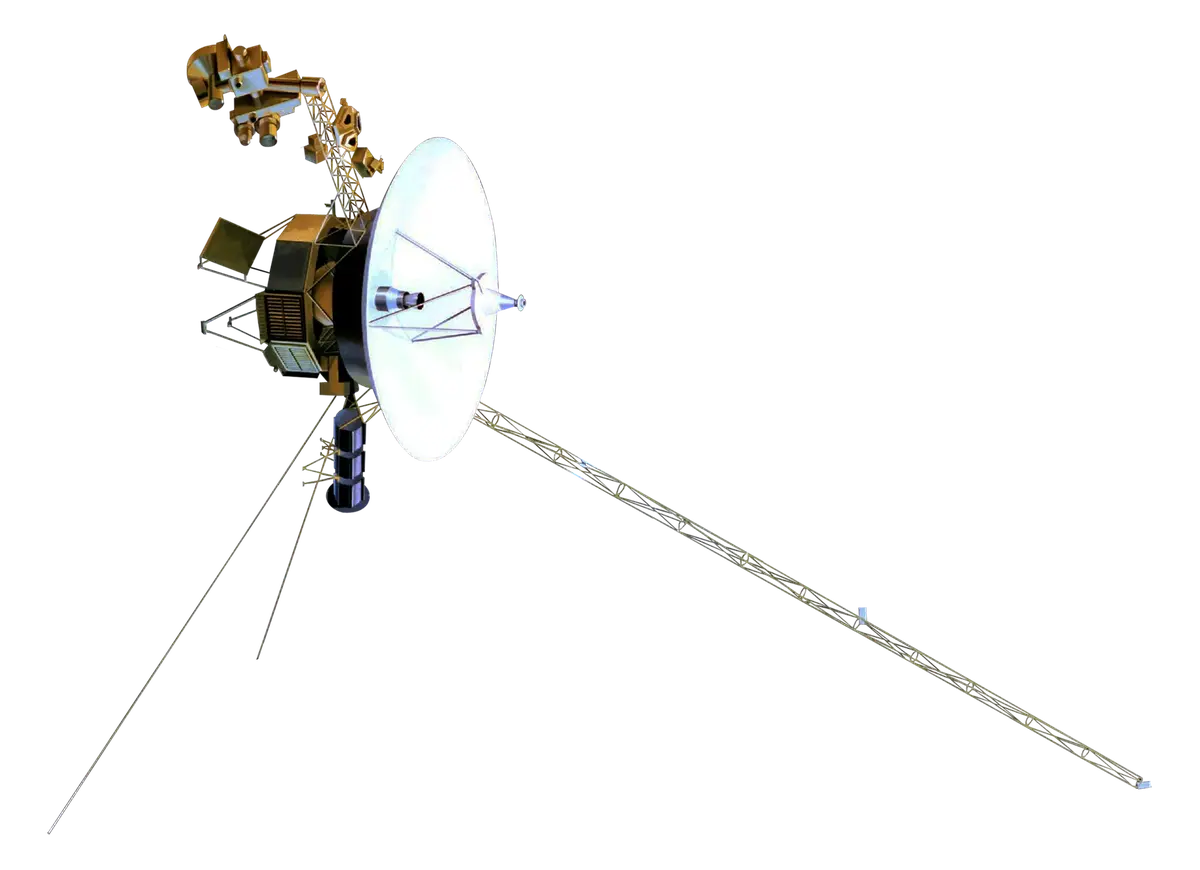
Voyager spacecraft model showcasing deep space communication dish
A model of NASA's Voyager 1 spacecraft, the first human-made object to cross into interstellar space.

Conclusion: The Cosmic Odyssey

Interstellar travel represents the ultimate transportation leap in the human odyssey. By developing propulsion systems that tap into the mass-energy equivalence of antimatter and exploring the boundaries of space-time geometry through warp physics, future engineers will build the vessels that carry humanity beyond the solar cradle. The starships that leave Earth's orbit in the coming centuries are the direct descendants of the prehistoric logs, Roman roads, and Wright flyers that defined our transport history, proving that the human drive to cross the horizon is an unstoppable force that will eventually claim the stars.

โš–๏ธ

Historian Debate: Is Interstellar Colonization Possible?

Technological Feasibility

Proponents argue that fusion propulsion, light sails, or sleeper ships will allow humanity to cross interstellar distances to settle exoplanets within a few centuries.

The Biological and Physics Barriers

Skeptics assert that cosmic radiation, microgravity degeneration, and the immense distances (light years) represent insurmountable barriers for biological humans.

The expansion to other star systems marks the final boundary of human migration.

"To settle the stars is to guarantee that the flame of human consciousness will burn until the end of the universe."

โ€” Attributed to Freeman Dyson, Lectures on Space Colonization (1979).

Further Reading

  • Centauri Dreams: Imagining Interstellar Travel โ€” by Paul Gilster. An exploration of the propulsion systems needed to reach another star.
  • The Starflight Handbook โ€” by Eugene Mallove. A technical manual of interstellar propulsion and navigation.
๐Ÿ“– Scholar Mode Active โ€” Click to exit focused reading
Selected Era

Prehistoric Era

Millions of years ago to ~3000 BCE

The dawn of humanity. From the evolutionary split of early hominids to the mastery of stone tools, fire, and the birth of language.

Landmark Milestones

Welcome to Historia

Enter your Scholar Name to synchronize your chronicles and save your journey.