From prehistoric origins to the modern era—discover the turning points, lost empires, and breakthroughs of world history through interactive timelines and visual guides.
Examine the tangible relics, physical tokens, and revolutionary machines that shaped civilizational growth.
🎥 VIDEO HUB & SHORTS
Watch visual summaries, site intros, and mini-documentaries chronicling 300,000 years of world history.
📊 HISTORICAL INFOGRAPHICS ARCHIVE
Museum-grade visual graphics, civilizational timelines, and architectural breakdowns curated for educators and history lovers.
THE HISTORIA CIRCLE
Join the collective discussion, study logs, and contributions of fellow historians mapping humanity's path.
Historia Forum Discussions
Start a Discussion Thread
THEMATIC PATHWAYS
Trace a single thread — disease, trade, energy, migration — across all eras and civilizations.
History is not just a sequence of events — it is a network of patterns. These thematic pathways allow you to follow a single concept across thousands of years: how agriculture spread, how warfare evolved, how trade routes shaped civilizations. Each pathway collects the most relevant chronicles across all eras.
🧩
How is this different from the sidebar Topics?
While the sidebar Topics (like Science & Tech or Empires) filter articles within your selected historical Era, Thematic Pathways cut horizontally across all eras (from Prehistoric to the Future). Use Themes to trace a single concept's evolutionary line across 300,000 years.
CIVILIZATION HUBS
Comprehensive profiles of the world's greatest civilizations and empires — from ancient cradles to global super-states.
Human Historia provides an academically rich exploration of the world's most influential civilizations. From the monumental achievements of ancient Egypt, Han China, and the Roman Empire, to the sophisticated societies of the Maya, the Islamic Caliphates, and West African empires, these hubs offer deep insights into the cultural, political, and technological legacies that continue to shape our global story.
EVOLUTION OF HUMAN SKILLS
Trace the compounding technologies, practical capabilities, and cognitive milestones of the human species.
Human progress is a story of compounding skills. Every breakthrough, from the spark of prehistoric fire to modern silicon transistors, builds directly on previous generations of ingenuity. Hover over a skill node to trace its historical prerequisites, and click it to explore its development timeline, species-wide impact, and related chronicles.
Prehistoric Ancient Medieval Modern Future
🧠
Select any skill node in the tree to explore its evolutionary path, development timeline, and historical impact.
ACADEMIC PASSPORT
Track your intellectual journey, quiz outcomes, and historical badges of honor.
HISTORIA PASSPORT⏳
👤Scribe Novice
Scholar NameHistoria Explorer
Rank RatingSumerian Record Scribe
Chronicles Read0 / 48
Study Guide Pins0 Guides
Security AccessLevel 1 (Novice)
Earned Badges of Honor
🔥
Fire Keeper
Unlock 3 prehistoric chronicles.
🏛️
Codex Keeper
Unlock 3 ancient chronicles.
🏰
Guild Master
Unlock 3 medieval chronicles.
⚙️
Steam Engineer
Unlock 3 modern chronicles.
🚀
Singularity Sage
Unlock 3 future chronicles.
👑
Grand Scholar
Score 5/5 on the Lab Quiz.
Recent Lab Activities
No recent activities recorded. Take a quiz or bookmark articles!
🏛️ MISSION & ARCHIVAL STANDARDS
About Human Historia
A visual encyclopedia and timeline of human history, dedicated to documenting 300,000 years of civilizational evolution through rigorous research, authentic artifacts, and visual clarity.
🌍
The 300,000-Year Story
Human Historia traces our collective journey across five historical epochs: Prehistory, Ancient Worlds, Middle Ages, Modern Age, and Future Horizons. From the first control of fire to quantum computation, we organize turning points into interconnected timelines.
📜
Historiographical Rigor
Every chronicle is built upon primary historical manifests, contemporary excavation reports, and peer-reviewed historical consensus. We prioritize authentic public domain artifacts and clearly identify scholarly debates surrounding major civilizational transitions.
🎨
Museum-Grade Visuals
Complex historical transitions demand visual understanding. We develop high-resolution infographics, architectural cutaways, and comparative territorial maps to transform abstract timelines into vivid, unforgettable learning experiences.
📖
Educational Access
Knowledge belongs to humanity. Human Historia is free, ad-light, and engineered as an educational resource for students, classroom educators, academic researchers, and curious minds across all continents.
Editorial Governance & Inquiries
We welcome peer reviews, academic corrections, museum archival collaborations, and educational partnerships. To submit historical inquiries or provide archival feedback, reach our editorial desk directly.
Written by Humanhistoria ScienceHistorical Era: PREHISTORIC
Sometime around 10,000 BCE, in several independent regions across the globe, human groups began to transition from a nomadic lifestyle of hunting and gathering to a sedentary life based on the cultivation of plants and the domestication of animals. This transition, known as the Neolithic Agricultural Revolution, represents the most profound ecological and social transformation in human history. It fundamentally altered humanity's relationship with the natural world, turning humans from passive foragers into active modifiers of their environments. By generating storable food surpluses, agriculture enabled the rise of permanent settlements, specialized labor, social hierarchies, and eventually the first urban civilizations. Yet, recent archaeological and bio-archaeological research suggests that this "progress" came at a severe cost: a decline in human health, an increase in disease, the institutionalization of social and gender inequality, and the first major human-induced ecological crises.
🎯 Quick Historical Summary
What Caused the Neolithic Agricultural Revolution?
Around 12,000 years ago, as the Ice Age ended, changing weather and shrinking wild herds pushed nomadic families across the Middle East to make a daring choice. Instead of constantly roaming, they settled down, sowed wild grains, and tamed sheep and goats. That gamble created the world's first permanent villages and forever changed how humanity survived.
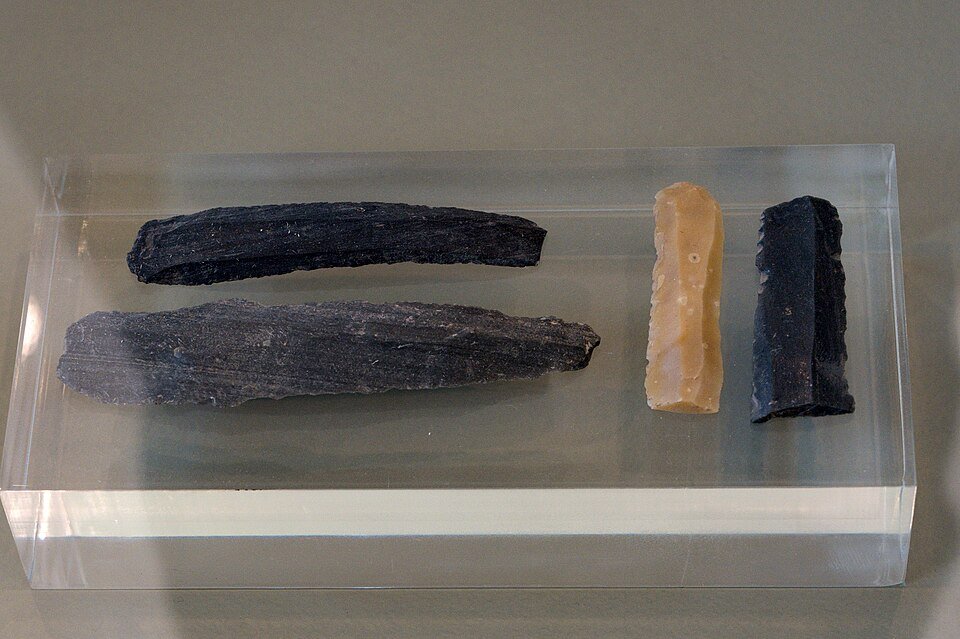
Archival visual record and historical depiction representing Neolithic Agricultural Revolution: Fertile Crescent Farming.
Historical Context: The Dawn of Sahul and the Fertile Crescent
For roughly 95% of their evolutionary history, modern humans lived as hunter-gatherers, moving in small, egalitarian bands and relying on a diverse diet of wild plants and animals. However, at the end of the last Ice Age (around 11,700 years ago), the Earth entered the Holocene epoch, characterized by a warmer, more stable climate. In the Fertile Crescent of the Middle East (spanning modern Iraq, Syria, Jordan, Turkey, and Israel), hunter-gatherers began settling down in areas of abundant wild cereal grasses, such as emmer wheat, einkorn wheat, and barley.
Similar transitions occurred independently in other parts of the world over the next few millennia: in the Yangtze and Yellow River valleys of China (rice and millet), in Mesoamerica (maize, beans, and squash), in the Andes of South America (potatoes and quinoa), in New Guinea (taro and bananas), and in sub-Saharan Africa (sorghum and yams). Rather than being a sudden discovery, agriculture was a slow, co-evolutionary process. Humans gradually selected and cultivated plants with desirable traits, such as non-shattering seed shafts (which kept seeds on the stalk for harvesting) and larger seed sizes, eventually making the plants dependent on human cultivation for survival.
The Global Agricultural Leap: 5 Independent Domestication Centers
Rather than a single invention that radiated from one cradle, agriculture was invented independently across several continents by human communities who had zero contact with one another. Each region forged a distinct ecological bargain based on its native plants and wild fauna:
Drainage ditch grids, arboriculture; remained non-hierarchical tribal society
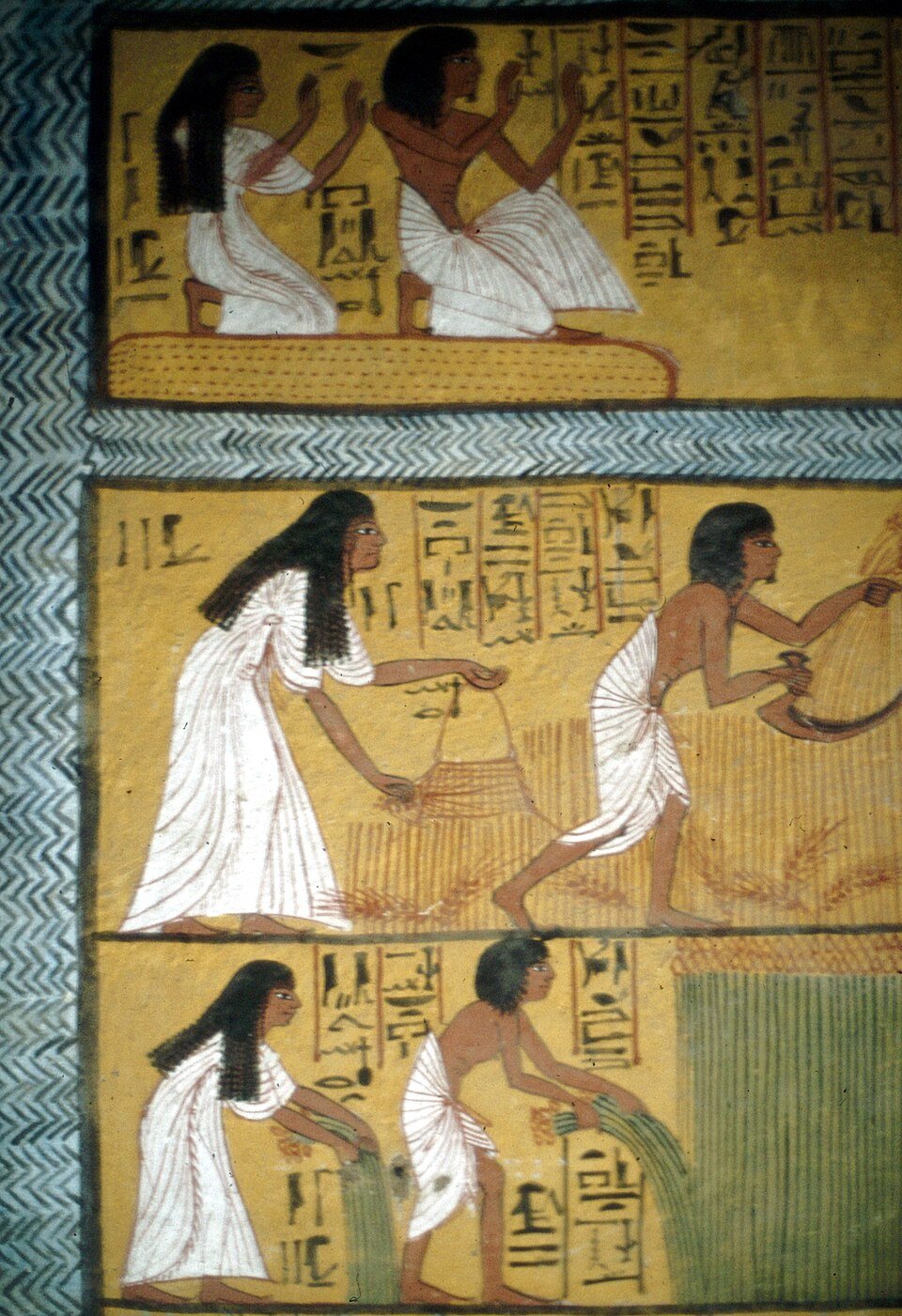
Ancient Egyptian tomb mural from the Tomb of Sennedjem (c. 1200 BCE) showing the harvesting of emmer wheat with curved sickles. (Deir el-Medina)
Why It Happened: Climate Shifts and Population Traps
Why did humans abandon a highly diverse, low-effort foraging lifestyle for the backbreaking labor of farming? The most prominent theory links the transition to the Younger Dryas (c. 10,900 – 9,700 BCE)—a sudden, temporary return to cold, dry Ice Age conditions. In the Fertile Crescent, this drought reduced the availability of wild foods, forcing semi-sedentary communities to actively cultivate the wild grains they had previously gathered to sustain their populations. Once these communities began farming, their populations grew rapidly, fueled by the higher caloric output of agricultural lands and the shorter birth intervals permitted by sedentary life.
This growth created a demographic "population trap." While a hunter-gatherer band could simply move when resources became scarce, a farming village of several hundred people could not revert to foraging without facing mass starvation, as the surrounding wild environment could no longer support their increased numbers. Humanity was locked into agriculture, forced to intensify production through clearing more land, digging irrigation canals, and domesticating more animals to feed their expanding communities.
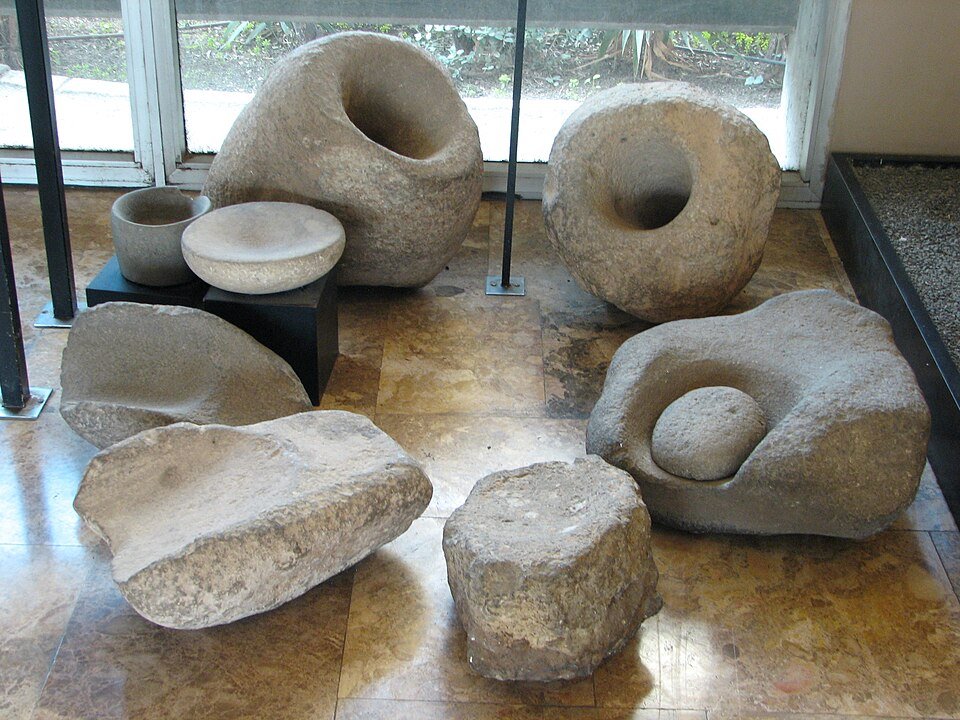
A Neolithic basalt saddle quern (grinding stone) and hand rubber stone used for processing wild cereals into flour. Grinding grain for hours daily left telltale wear facets and osteoarthritis on female skeletons across early farming settlements. (Dagon Museum)
Key Development: Domestication and the First Ecological Crises
The domestication of plants was accompanied by the domestication of animals: sheep and goats in the Middle East, pigs and cattle in Eurasia, and llamas and alpacas in the Andes. While animals provided meat, milk, wool, and traction power for plows, their close proximity to human settlements created a major epidemiological crisis. Most of humanity's major infectious diseases—including smallpox, measles, influenza, tuberculosis, and malaria—are zoonotic diseases that jumped from domesticated animals to humans in high-density farming villages. Crowded, unsanitary conditions and poor waste management turned Neolithic settlements into breeding grounds for disease.
Farming also triggered the first major human-induced ecological crises. Clearing forests for fields and overgrazing by sheep and goats led to massive soil erosion and deforestation across the Mediterranean and Middle East. Early irrigation networks, while boosting crop yields, caused waterlogging and salinization of the soil—the accumulation of toxic salts in the root zone. In ancient Mesopotamia, agricultural records show a gradual shift from wheat to the more salt-tolerant barley, followed by a decline in overall crop yields that contributed to the collapse of the early Akkadian and Sumerian city-states.
10,000 BCE — End of the last Ice Age; warmer Holocene climate begins; wild cereals expand in the Fertile Crescent
9,500 BCE — The earliest evidence of systematic crop cultivation at sites like Jericho and Tell Abu Hureyra
8,500 BCE — Domestication of founder crops (wheat, barley, peas) and livestock (sheep, goats) is completed in the Middle East
7,500 BCE — Rice cultivation is established along the Yangtze River in China; expansion of Neolithic villages
5,000 BCE — Maize domestication begins in the Balsas Valley of Mexico; emergence of agricultural societies in the Americas
4,000 BCE — Soil salinization and erosion documented in southern Mesopotamia due to intensive canal irrigation
3,000 BCE — Domestication of the horse and invention of the plow accelerate agricultural intensification across Eurasia
The Osteological Paradox: The Skeletal Toll of Farming
For decades, progress narratives assumed that the transition to farming improved human well-being. However, bio-archaeologists analyzing Neolithic skeletons have uncovered a stark "osteological paradox." Compared to their hunter-gatherer ancestors, early farmers were shorter, had weaker bones, and suffered from chronic health problems. Dental analysis shows a massive increase in cavities (caries) due to the storable starchy grain diet, as well as enamel hypoplasia—lines on the teeth indicating periods of severe childhood malnutrition or disease. Skeletons also reveal high rates of porotic hyperostosis, a bone condition caused by iron-deficiency anemia resulting from a grain-heavy diet lacking fresh meat and leafy greens.
Social & Human Effects: Inequality and the Rise of the State
Hunter-gatherer societies were highly egalitarian; since they owned only what they could carry, there was little capacity for wealth accumulation. Agriculture changed this by creating storable, excludable food surpluses. Grains like wheat and rice could be kept in central granaries for years. Those who controlled the storage and redistribution of this surplus acquired immense political and social power, giving rise to a ruling class of priests, kings, and administrators who stood above the agricultural producers.
This stratification was codified into early legal systems, such as the Code of Hammurabi, which protected private property and established social classes. Gender roles were also restructured: while foraging women played a major role in food collection and enjoyed relatively high social status, agricultural labor (especially plow agriculture) concentrated work in the fields, while sedentary life encouraged higher birth rates, restricting women to domestic spheres and child-rearing. This shift established the patriarchal family structures that characterized early state societies.
Economic Consequences: Surplus and the Division of Labor
The economic consequence of agriculture was the creation of a "food surplus." When a single farming family could produce more food than they needed to survive, it became possible for a portion of the population to abandon food production entirely. This division of labor enabled the emergence of full-time specialists: metalworkers, potters, weavers, builders, soldiers, and scribes.
These specialists lived in dense, urban settlements, leading to the rise of the first cities in Mesopotamia (such as Uruk and Ur), Egypt, and the Indus Valley. The need to record grain storage, tax payments, and land boundaries led directly to the invention of writing (cuneiform in Sumer) and mathematics, turning agriculture into the primary catalyst for the development of administrative bureaucracy and state organization.
⚖️
Historian Debate: Was Agriculture a Mistake?
The Progress Narrative
Traditional historians, such as V. Gordon Childe, have viewed the Neolithic Revolution as a triumphant step forward for humanity. On this view, agriculture freed humans from the precarious, hand-to-mouth existence of foraging, allowing them the leisure time to develop science, art, writing, and complex architecture. Without agriculture, the intellectual and technological achievements of modern civilization would be impossible.
The Revisionist Narrative
Conversely, revisionist scholars like Jared Diamond and James C. Scott argue that agriculture was a catastrophe. Diamond famously called it "the worst mistake in the history of the human race," pointing to the rise of epidemic diseases, class warfare, and chronic malnutrition. Scott argues that early agricultural states were "domestication cages" where rulers coerced populations into growing easily taxable cereal crops, reducing human freedom and health.
Scholars such as Jared Diamond and James C. Scott have shaped this debate through works like Diamond's essay The Worst Mistake in the History of the Human Race (1987) and Scott's Against the Grain: A Deep History of the Earliest States (2017).
"The wheat did not domesticate us; we domesticated the wheat. Or did we? Wheat did not like rocks, so we cleared the fields. Wheat did not like weeds, so we weeded. Wheat was thirsty, so we dug irrigation canals. Our backs ached, our joints wore out, and our diet narrowed. The average farmer worked far harder than the average hunter-gatherer, and received a worse diet in return."
— Yuval Noah Harari, Sapiens: A Brief History of Humankind (2011). Harari's perspective popularizes the evolutionary view that plants manipulated humans to spread their DNA, rather than the reverse.
Long-Term Legacy
The Neolithic Revolution established the basic economic and ecological patterns that still define our world. Today, over 90% of the calories consumed by the global population derive from a handful of crops domesticated by Neolithic farmers: wheat, rice, maize, potatoes, and barley. Our modern agricultural systems, with their reliance on monoculture, chemical fertilizers, and intensive irrigation, are direct descendants of the practices initiated 10,000 years ago.
Furthermore, scientists now argue that the Neolithic Revolution marked the true beginning of the Anthropocene—the geological epoch in which human activity became the dominant influence on climate and the environment. Early deforestation and wet-rice cultivation released enough carbon dioxide and methane into the atmosphere to alter global climate cycles, forestalling a natural cooling period. The history of agriculture is thus the history of how humanity began to rewrite the ecological rules of the planet, establishing a path that has led to our current global climate crisis.
James C. Scott — Against the Grain: A Deep History of the Earliest States (2017). A provocative re-evaluation of early states, detailing how agriculture was used as an instrument of state control and tax extraction.
Jared Diamond — Guns, Germs, and Steel: The Fates of Human Societies (1997). The classic text explaining how geographic differences in domesticable plants and animals shaped global history.
David Graeber & David Wengrow — The Dawn of Everything: A New History of Humanity (2021). Challenges the linear progress narrative of the agricultural transition, showing the variety of early social experiments.
Mark Nathan Cohen — The Food Crisis in Prehistory: Overpopulation and the Origins of Agriculture (1977). A foundational academic study linking the agricultural transition to global population pressure.
V. Gordon Childe — Man Makes Himself (1936). The classic work that coined the term "Neolithic Revolution" and established the traditional progress-oriented framework.
📊 Museum-Grade Infographic Poster
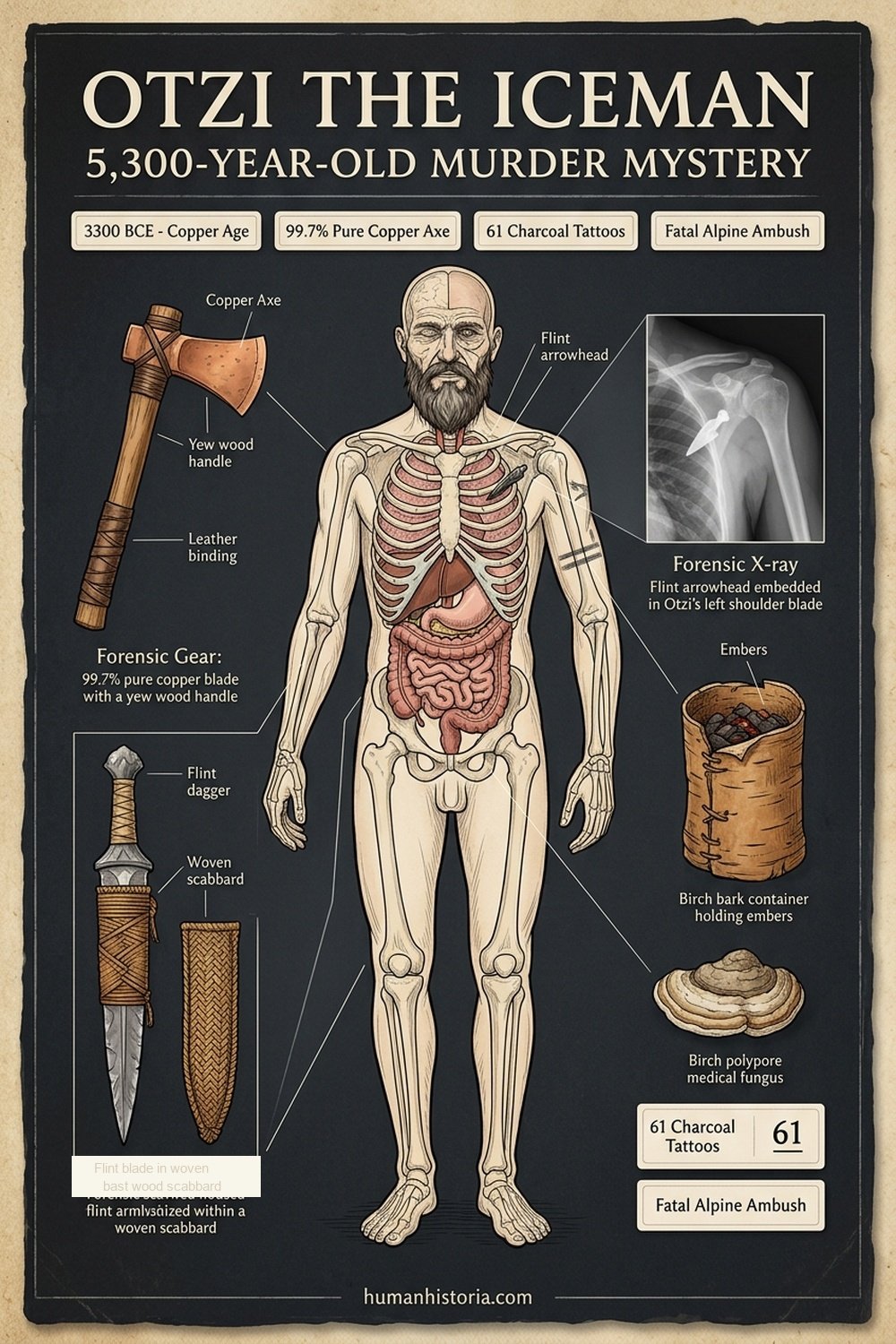
Ötzi the Iceman: 5,300-Year-Old Alpine Murder Mystery (3300 BCE)
💡 Click anywhere on poster to expand in high resolution🔎 Expand Lightbox
Preserved under the Schnalstal glacier for over 5,300 years, Ötzi represents Europe's oldest natural human mummy. Forensic investigation reveals he died from an ambush: an arrowhead shattered his left subclavian artery. His gear includes a 99.7% pure copper axe, 61 charcoal therapeutic tattoos, a flint dagger, and birch polypore medical fungi.
📖 SCHOLARLY INQUIRIES
Frequently Asked Questions
Essential historical questions and evidence-based answers concerning this chronicle.
Q.Where did the Neolithic Revolution begin?
Agriculture emerged independently in multiple global centers, beginning around 10,000 BCE in the Fertile Crescent of the Middle East with wheat and barley, followed by East Asia, Mesoamerica, and the Andes.
Q.Why did hunter-gatherers switch to farming?
Climate shocks during the Younger Dryas reduced wild foraging yields, forcing semi-nomadic groups to actively cultivate wild cereal grasses, creating a demographic trap that prevented a return to foraging.
📚 Academic Sources & Scholarly Bibliography
Weisdorf, J. (2005).
From foraging to farming: Explaining the neolithic revolution.
Journal of Economic Surveys 19(4): 561-586. doi:10.1111/J.0950-0804.2005.00259.X
Dow, G. K., Olewiler, N., & Reed, C. G. (2005).
The transition to agriculture: Climate reversals, population density, and technical change.
Social Science Research Network. doi:10.2139/ssrn.698342
Gupta, A. K. (2004).
Origin of agriculture and domestication of plants and animals linked to early holocene climate amelioration.
Current Science 87(1): 54-59. doi:10.4324/9781315131825-6
📖 Scholar Mode Active — Click to exit focused reading
History Lab 🧪
Interactive historical deduction games, tactical matchup simulators, and currency calculators.
🕵️ Who Am I? (The Historical Guess Game)
A secret historical figure has been selected. Ask yes/no questions to narrow down the pool of candidates. Click any active card to make your accusation!
Secret Identity
❓ Who Am I?
Ask questions using the board below to narrow down my identity.
Ask a Question:
Question LogQuestions: 0 / 7
No questions asked yet.
Candidate Board:
🗺️ Timeline Scramble
Five historical events appear out of order. Click them in the correct chronological sequence — from oldest to most recent. How well do you know your history?
🏺 Relic or Fake?
Is this a real historical artifact or a convincing fabrication? Judge each one based on its description and era — then see the truth revealed!
Artifact 1 / 10Score: 0
Empire Matchup Simulator
Empire ATerritory Size (Peak, M km²)Empire B
00
Empire APopulation (Peak, Millions)Empire B
00
Empire AMilitary Power (Army Size)Empire B
00
Tactical Battle Analysis
Select empires and click simulate to run evaluations.
Historical Purchasing Power Converter
See what ancient coins are worth in modern terms and check their historical purchasing power.
Modern Value Equivalent
$0.00 USD
Historical Purchasing Power:
Select currency to view purchasing capability.
Historical Identity Generator
Forge an authentic historical identity from ancient civilisations, complete with linguistic meaning and biography.
Neutral
Gaius Julius
Meaning:Descendant of Jupiter
Historical Background:
A Roman citizen and clerk who worked in the forum under Roman republic rule.
Chrono-Cultural Fusion Simulator
Fuse the culture, technology, and governance of two legendary civilizations to synthesize a unique hybrid society.
Cohesion & Coexistence Rate
85%
🏛️ Hybrid Architecture
⚙️ Synthesized Asset
📜 Synthetic Governance
Historical Tactics & Trivia Quiz
Test your historical knowledge and battle tactics to claim your administrative rank.
8 Questions • Multi-Era
You will be presented with random scenarios and trivia spanning ancient Egypt, classical Rome, Islamic Golden Age, and the modern industrial era. Complete the evaluation to see your historical title!
Question 1 of 8Score: 0
What was the Code of Hammurabi written on?
Correct!
Evaluation Complete!
6 / 8
Correct
Rank Attained
Imperial Legionary
Your knowledge of classical strategy and administrative structures is respectable.
🎲 Counterfactual "What If?" Scenario Simulator
Explore alternative historical trajectories by tweaking key civilizational pivot points.
Simulated Shift
Selected Era
Prehistoric Era
Millions of years ago to ~3000 BCE
The dawn of humanity. From the evolutionary split of early hominids to the mastery of stone tools, fire, and the birth of language.
Landmark Milestones
Welcome to Historia
Enter your Scholar Name to synchronize your chronicles and save your journey.
 ⭐ Featured Chronicle

 ANCIENT AGES
 ANCIENT AGES
 ANCIENT AGES
 MEDIEVAL PERIOD
 MEDIEVAL PERIOD
 PREHISTORIC ERA