From prehistoric origins to the modern era—discover the turning points, lost empires, and breakthroughs of world history through interactive timelines and visual guides.
Examine the tangible relics, physical tokens, and revolutionary machines that shaped civilizational growth.
🎥 VIDEO HUB & SHORTS
Watch visual summaries, site intros, and mini-documentaries chronicling 300,000 years of world history.
📊 HISTORICAL INFOGRAPHICS ARCHIVE
Museum-grade visual graphics, civilizational timelines, and architectural breakdowns curated for educators and history lovers.
THE HISTORIA CIRCLE
Join the collective discussion, study logs, and contributions of fellow historians mapping humanity's path.
Historia Forum Discussions
Start a Discussion Thread
THEMATIC PATHWAYS
Trace a single thread — disease, trade, energy, migration — across all eras and civilizations.
History is not just a sequence of events — it is a network of patterns. These thematic pathways allow you to follow a single concept across thousands of years: how agriculture spread, how warfare evolved, how trade routes shaped civilizations. Each pathway collects the most relevant chronicles across all eras.
🧩
How is this different from the sidebar Topics?
While the sidebar Topics (like Science & Tech or Empires) filter articles within your selected historical Era, Thematic Pathways cut horizontally across all eras (from Prehistoric to the Future). Use Themes to trace a single concept's evolutionary line across 300,000 years.
CIVILIZATION HUBS
Comprehensive profiles of the world's greatest civilizations and empires — from ancient cradles to global super-states.
Human Historia provides an academically rich exploration of the world's most influential civilizations. From the monumental achievements of ancient Egypt, Han China, and the Roman Empire, to the sophisticated societies of the Maya, the Islamic Caliphates, and West African empires, these hubs offer deep insights into the cultural, political, and technological legacies that continue to shape our global story.
EVOLUTION OF HUMAN SKILLS
Trace the compounding technologies, practical capabilities, and cognitive milestones of the human species.
Human progress is a story of compounding skills. Every breakthrough, from the spark of prehistoric fire to modern silicon transistors, builds directly on previous generations of ingenuity. Hover over a skill node to trace its historical prerequisites, and click it to explore its development timeline, species-wide impact, and related chronicles.
Prehistoric Ancient Medieval Modern Future
🧠
Select any skill node in the tree to explore its evolutionary path, development timeline, and historical impact.
ACADEMIC PASSPORT
Track your intellectual journey, quiz outcomes, and historical badges of honor.
HISTORIA PASSPORT⏳
👤Scribe Novice
Scholar NameHistoria Explorer
Rank RatingSumerian Record Scribe
Chronicles Read0 / 48
Study Guide Pins0 Guides
Security AccessLevel 1 (Novice)
Earned Badges of Honor
🔥
Fire Keeper
Unlock 3 prehistoric chronicles.
🏛️
Codex Keeper
Unlock 3 ancient chronicles.
🏰
Guild Master
Unlock 3 medieval chronicles.
⚙️
Steam Engineer
Unlock 3 modern chronicles.
🚀
Singularity Sage
Unlock 3 future chronicles.
👑
Grand Scholar
Score 5/5 on the Lab Quiz.
Recent Lab Activities
No recent activities recorded. Take a quiz or bookmark articles!
🏛️ MISSION & ARCHIVAL STANDARDS
About Human Historia
A visual encyclopedia and timeline of human history, dedicated to documenting 300,000 years of civilizational evolution through rigorous research, authentic artifacts, and visual clarity.
🌍
The 300,000-Year Story
Human Historia traces our collective journey across five historical epochs: Prehistory, Ancient Worlds, Middle Ages, Modern Age, and Future Horizons. From the first control of fire to quantum computation, we organize turning points into interconnected timelines.
📜
Historiographical Rigor
Every chronicle is built upon primary historical manifests, contemporary excavation reports, and peer-reviewed historical consensus. We prioritize authentic public domain artifacts and clearly identify scholarly debates surrounding major civilizational transitions.
🎨
Museum-Grade Visuals
Complex historical transitions demand visual understanding. We develop high-resolution infographics, architectural cutaways, and comparative territorial maps to transform abstract timelines into vivid, unforgettable learning experiences.
📖
Educational Access
Knowledge belongs to humanity. Human Historia is free, ad-light, and engineered as an educational resource for students, classroom educators, academic researchers, and curious minds across all continents.
Editorial Governance & Inquiries
We welcome peer reviews, academic corrections, museum archival collaborations, and educational partnerships. To submit historical inquiries or provide archival feedback, reach our editorial desk directly.
An immersive graphical anthology tracing the paths of civilizations, breakthroughs, and conflicts that forged the modern consciousness.
25Chronicles
Showing all articles
Julius Caesar: Crossing the Rubicon and the Fall of the Roman Republic
Written by Humanhistoria EditorialHistorical Era: ANCIENT
On a bitterly cold night in early January, 49 BCE, a small detachment of Roman cavalry accompanied by a single legion paused on the muddy northern bank of a narrow, nondescript stream in northern Italy. The river was the Rubicon, the sacred boundary marking the legal frontier between the province of Cisalpine Gaul and the sovereign territory of the Roman Republic. To cross it under arms without the sanction of the Roman Senate was an unforgivable act of treason, carrying the statutory penalty of death and declaring oneself an enemy of the state (hostis publicus). At the water's edge stood proconsul Gaius Julius Caesar, contemplating a fateful choice: submit to political ruin and criminal trial at the hands of his senatorial enemies in Rome, or plunge the Mediterranean world into civil war. Murmuring the Greek proverb of Menander—"Alea iacta est" ("The die is cast")—Caesar spurred his horse into the current, striking the deathblow to five centuries of Roman Republican liberty.
🎯 Quick Historical Summary
Why Did Julius Caesar Cross the Rubicon and What Were the Consequences?
On January 10, 49 BCE, Julius Caesar crossed the Rubicon river with his veteran 13th Legion, defying the Senate's order to lay down his command. This treasonous act triggered the Great Roman Civil War, resulting in the defeat of Pompey the Great and the collapse of the Roman Republic.
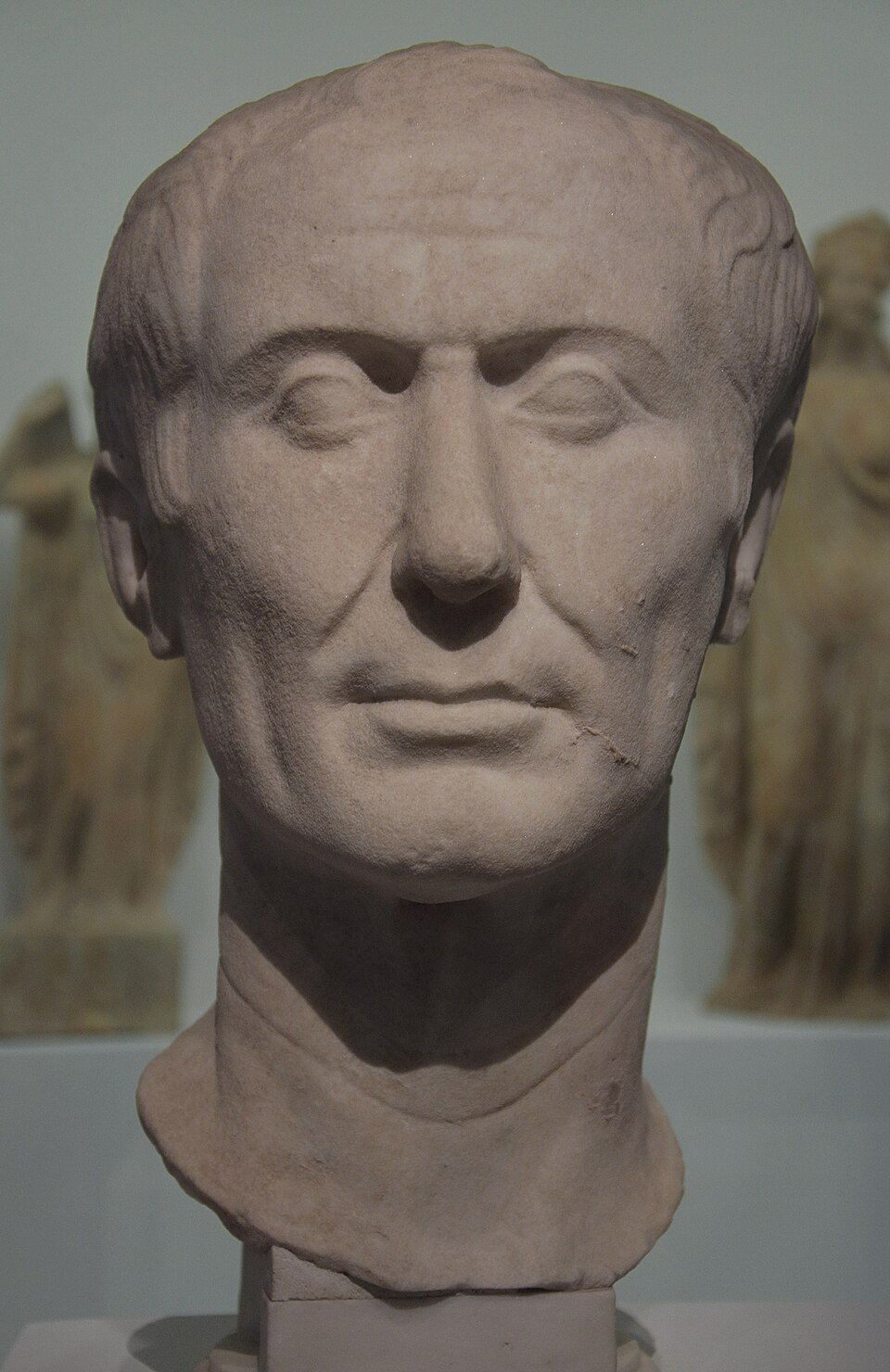
The Tusculum portrait bust of Gaius Julius Caesar, sculpted in fine marble during his lifetime (c. 50–44 BCE), discovered at Tusculum. (Museo di Antichità, Turin)
The Dying Republic: Senatorial Oligarchy vs. Popular Ambition
The crisis at the Rubicon was the explosive culmination of a century of structural decay within the Roman Republican constitution. Following the destruction of Carthage in 146 BCE, immense wealth poured into Rome, but it was monopolized by a narrow aristocratic oligarchy known as the Optimates ("the best men"). Wealthy senatorial patricians swallowed up small family farms across Italy, replacing citizen-soldiers with hundreds of thousands of enslaved foreign captives. When populist reformers like the Gracchi brothers attempted to redistribute public land to impoverished citizens, the senatorial elite assassinated them in the streets, inaugurating an era of political violence.
In 107 BCE, the military reformer Gaius Marius abolished the traditional property requirements for legionary service, opening the army to the landless urban poor. While this democratized recruitment, it carried a catastrophic constitutional side effect: soldiers no longer fought out of civic loyalty to the Senate, but out of personal allegiance to their commanding generals, who alone could promise them cash bonuses and farm allotments upon discharge. This created the era of client armies—swords for hire wielded by warlords like Sulla, who marched on Rome in 88 BCE and instituted bloody proscription lists.
In 60 BCE, seeking to bypass senatorial obstruction, three powerful men formed an informal political alliance known to modern historians as the First Triumvirate:
Gaius Julius Caesar: A charismatic, debt-ridden patrician aligned with the populist faction (Populares).
Gnaeus Pompeius Magnus (Pompey the Great): Rome's most celebrated military hero, seeking land for his veterans and ratification of his eastern treaties.
Marcus Licinius Crassus: Rome's wealthiest plutocrat, seeking lucrative tax-farming contracts and military glory.
The alliance dominated Roman politics for a decade. In 59 BCE, Caesar served as consul, ramming through Pompey and Crassus' legislative priorities through ruthless political intimidation. In return, Caesar was granted a five-year proconsular command over Cisalpine Gaul, Illyricum, and Transalpine Gaul—later extended for an additional five years. Between 58 and 50 BCE, in the grueling Gallic Wars, Caesar subdued hundreds of Celtic tribes, crossed the Rhine into Germania, raided Britain, and annexed modern France and Belgium to the Roman realm, killing or enslaving an estimated two million Gauls while accumulating immense personal wealth and the fanatical devotion of ten veteran legions.
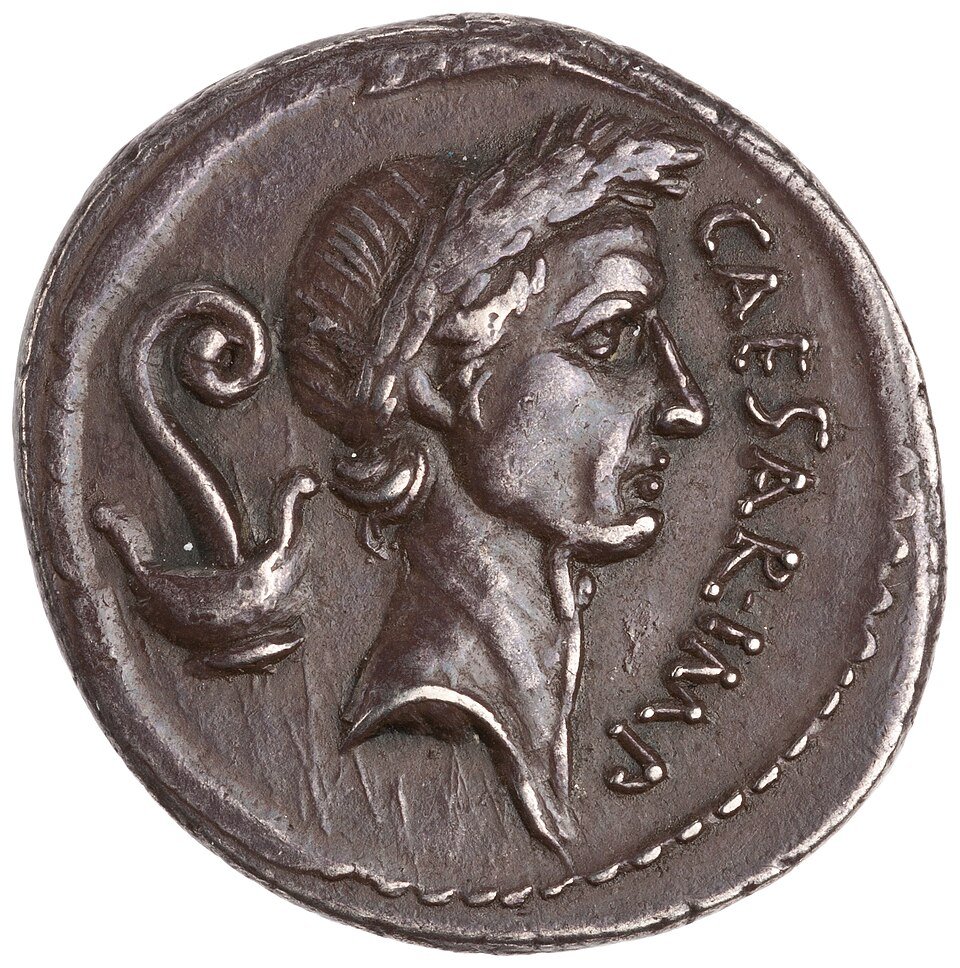
Silver denarius struck at Rome in February 44 BCE, bearing the laureate profile of Julius Caesar with the inscription CAESAR DICT PERPETVO—the first time a living Roman was depicted on Republican currency. (British Museum, London)
The Legal Trap: The Ultimatum of January 49 BCE
The Triumvirate began unraveling in 54 BCE with the death of Caesar's daughter Julia, who was married to Pompey and had served as the personal emotional bond between the two men. In 53 BCE, Crassus led seven legions into the Syrian desert and was slaughtered by Parthian horse archers at the catastrophic Battle of Carrhae. With Crassus dead, only Caesar and Pompey remained, and as the historian Lucan observed: "Caesar could no longer endure a superior, nor Pompey an equal."
Alarmed by Caesar's rising popularity and military power, the conservative Optimates in the Senate—led by the rigid moralist Marcus Porcius Cato the Younger—courted Pompey, convincing him that Caesar sought tyrannical monarchy. In 52 BCE, following mob riots in Rome, the Senate appointed Pompey sole consul, cementing his alliance with the aristocracy.
As Caesar's proconsulship neared its end, the Optimates laid an inescapable legal snare. Roman law granted sitting magistrates immunity from prosecution, but once a proconsul stepped down and re-entered Rome as a private citizen, he could be indicted for past illegalities—specifically Caesar's high-handed consular actions in 59 BCE. Cato openly boasted that the moment Caesar laid down his command, he would be prosecuted before juries packed with senatorial partisans, resulting in political exile and total ruin.
Caesar offered compromises: he would disband eight of his legions and surrender Transalpine Gaul if the Senate allowed him to stand for the consulship in absentia. The Senate refused. On January 1, 49 BCE, the Senate issued the Senatus Consultum Ultimum (the Final Decree of the Senate), ordering Caesar to surrender his remaining troops by a fixed date or be declared an enemy of the Republic. When Caesar's young tribunes of the plebs, Mark Antony and Quintus Cassius Longinus, exercised their constitutional right of veto, senatorial mobs threatened their lives. Antony and Cassius fled Rome disguised as slaves, riding post-haste north to Caesar's headquarters at Ravenna.
"Alea Iacta Est": Crossing the River
When the battered tribunes arrived in Ravenna, Caesar had his pretext. Assembling the veterans of his favorite legion, Legio XIII Gemina ("The Twin 13th"), Caesar addressed them with fiery rhetoric, arguing that the corrupt senatorial faction had violated the sacrosanct office of the Roman tribunate and dishonored the soldiers who had conquered Gaul.
On the evening of January 10, 49 BCE, Caesar sent advance cohorts forward to secure the bridge over the Rubicon near modern Rimini. After dining with guests, he slipped away in a carriage drawn by mules. Arriving at the river's edge, Caesar hesitated, turning to his staff officers, including Asinius Pollio: "Even yet we may turn back; but if we cross this little bridge, all must be decided by the sword."
According to Suetonius, an apparition of supernatural stature suddenly appeared by the riverbank, snatched a trumpet from a military bugler, and sounded a blast of advance across the water. Turning to his men, Caesar declared in Greek: "Let the die be cast!" (Alea iacta est). The 13th Legion splashed through the icy shallows, invading Roman Italy.
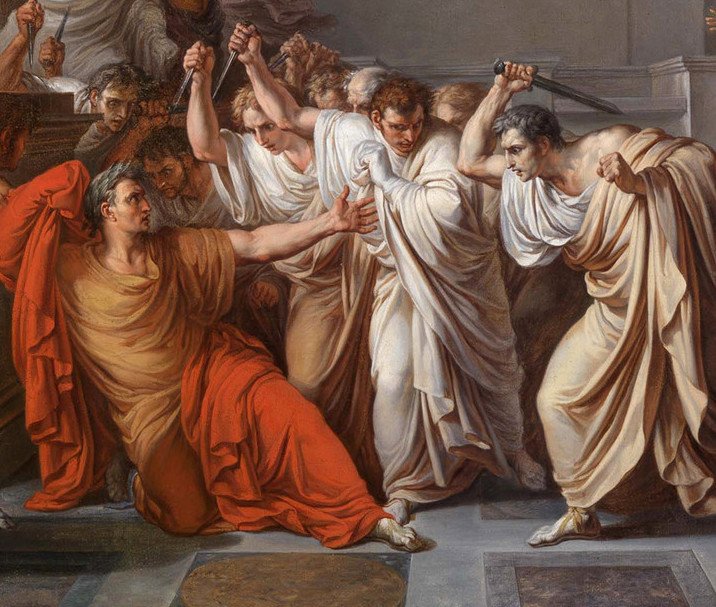
'The Death of Caesar' (1798) by Vincenzo Camuccini, depicting the assassination of Julius Caesar on the Ides of March, 44 BCE, beneath the statue of Pompey. (Galleria Nazionale d'Arte Moderna, Rome)
The Lightning Campaign: Pharsalus, Dictatorship, and the Fall
Expecting Caesar to wait for his remaining Gallic legions to assemble, Pompey and the Senate were paralyzed by the speed of his advance. Caesar raced down the Adriatic coast at the head of a single legion, covering up to forty miles a day. Town after town opened their gates without bloodshed; Caesar adopted a radical policy of personal clemency (clementia), releasing captured senatorial officers unharmed rather than executing them as Sulla had done.
Realizing that Italy was indefensible, Pompey ordered the evacuation of Rome. Senators, magistrates, and aristocratic families fled in blind panic to Brundisium (Brindisi), where Pompey ferried his forces across the Adriatic to Greece to mobilize the vast wealth and armies of the East. Entering Rome unopposed, Caesar seized the state treasury inside the Temple of Saturn to finance his campaign.
The Climax at Pharsalus (48 BCE)
After securing his rear by marching to Spain and defeating Pompeian legions in forty days ("I go to fight an army without a general, and I return to fight a general without an army"), Caesar crossed the Adriatic in winter with an undersupplied force of 22,000 veterans.
On August 9, 48 BCE, on the dry plain of Pharsalus in central Greece, Caesar faced Pompey's grand army of 45,000 infantry and 7,000 aristocratic cavalry. Knowing that Pompey planned to sweep away his meager cavalry on the right wing and flank his infantry, Caesar devised a secret tactical masterstroke: he concealed six cohorts of veteran legionaries behind his horsemen, ordering them to use their heavy throwing spears (pila) not as missiles, but as stabbing pikes aimed directly at the faces of the young Roman aristocratic cavalrymen.
When Pompey's cavalry charged, Caesar's horse feigned retreat, unmasking the fourth line. The sight of veteran infantry stabbing aggressively at their eyes broke the panicked aristocratic horsemen, who fled the field. Caesar's fourth line then wheeled into the unprotected flank of Pompey's infantry center, triggering a general collapse. Pompey fled the field in disguise, sailing to Egypt, where he was murdered on the beach by the advisors of the teenage Pharaoh Ptolemy XIII.
Political Faction
Social & Economic Base
Constitutional Philosophy
Key Leaders
Ultimate Historical Fate
Optimates ("The Best Men")
Patrician senatorial nobility, wealthy latifundia landowners, conservative religious colleges
Preserve senatorial supremacy; resist agrarian land reform; limit power of tribunes and popular assemblies
Cato the Younger, Pompey the Great, Metellus Scipio, Cicero
Defeated at Pharsalus, Thapsus, and Munda; wiped out during civil wars and triumviral proscriptions
Populares ("The People's Men")
Urban plebeian masses, landless veteran soldiers, Italian municipal equestrian elites
Utilize popular assemblies (Comitia Tributa) to pass debt relief, grain subsidies, and land distribution over senatorial vetoes
Julius Caesar, Mark Antony, Gaius Marius, Publius Clodius Pulcher
Triumphant militarily; provided the populist framework that Augustus forged into the Roman Principate
"When the news arrived that the tribunes had been driven from Rome, Caesar brought down his men to the bank of the Rubicon. Pausing for a moment, he weighed in his mind the greatness of the enterprise, and turning to those with him, said: 'Even now we may turn back; but once across that little bridge, the sword must decide everything.' Then, crying out 'Let the die be cast!' he led his army across."
— Suetonius, The Twelve Caesars, Life of Julius Caesar, 31–32 (Vatican Library, MS Lat. 1904)
Dictatorship and the Tragic Irony of the Ides of March
Following final victories over senatorial remnants at Thapsus in Africa (where Cato committed suicide) and Munda in Spain, Caesar returned to Rome as uncontested master of the Mediterranean. Appointed dictator first for ten years and then, in February 44 BCE, Dictator Perpetuo ("Dictator in Perpetuity"), Caesar enacted sweeping administrative reforms:
Calendar Reform: Replaced the chaotic lunar calendar with the solar Julian Calendar of 365.25 days, developed with the Alexandrian astronomer Sosigenes.
Debt & Economic Relief: Cancelled accumulated interest, instituted rent ceilings, and funded public works to employ the plebeians.
Agrarian Resettlement: Settled over 80,000 veteran soldiers and urban poor in overseas colonies, including rebuilt Carthage and Corinth, without expropriating Italian lands.
Provincial Integration: Granted Roman citizenship to doctors, teachers, and Gallic provincial aristocrats, expanding the Senate to 900 members to dilute the power of the old patrician families.
Yet in hoarding supreme political authority, Caesar alienated conservative senators who viewed his royal robes, golden throne, and divine honors as a return to monarchy. On the Ides of March (March 15), 44 BCE, inside the Curia of Pompey, a conspiracy of sixty senators led by Marcus Junius Brutus and Gaius Cassius Longinus attacked Caesar with concealed daggers, stabbing him twenty-three times beneath the statue of his old rival Pompey.
Archival Fact: The Geography of the Rubicon
For centuries, the exact geographical identity of the Rubicon was lost to history, as torrential floods frequently altered riverbeds across the Romagna plain. In 1933, Italian historians and hydrologists confirmed that the ancient Rubicon corresponded to the modern River Fiumicino, which flows into the Adriatic near Cesenatico. A bronze statue of Julius Caesar stands today on the bridge at San Mauro Pascoli marking the historic crossing point.
⚖️
Historian Debate: Revolutionary Visionary vs. Ruthless Opportunist
The Democratic Visionary
19th-century historians like Theodor Mommsen celebrated Caesar as the democratic savior of Rome, who recognized that the corrupt senatorial oligarchy was structurally incapable of governing a global empire and replaced it with an efficient, meritocratic imperial monarchy that served the welfare of the common people.
The Selfish Aristocratic Destroyer
Modern historians like Ronald Syme and Mary Beard emphasize that Caesar was an ultra-patrician driven primarily by aristocratic pride (dignitas). Caesar did not cross the Rubicon to liberate the common people; he crossed it to protect his own personal prestige and save himself from public disgrace, bringing down an ancient constitutional democracy in the process.
Contemporary scholarship highlights that the assassination failed completely: instead of restoring the Republic, it caused fourteen more years of civil slaughter that ended with Caesar's adopted heir Octavian becoming Emperor Augustus.
Long-Term Legacy: The Death of the Republic
The tragedy of the Ides of March was that Caesar's assassins mistook a personal symptom for the underlying institutional disease. The Roman Republic did not fall because one ambitious general crossed a river; it fell because its political institutions were unable to adapt to the economic realities of world empire, because its senatorial elite refused peaceful compromise, and because its armies were loyal to silver and commanders rather than laws.
In the civil wars that followed, Caesar's veterans rallied around his adopted son, eighteen-year-old Octavian. In 31 BCE, at the Battle of Actium, Octavian eliminated Mark Antony and Cleopatra, establishing the Pax Romana and assuming the title of Augustus. The river crossed by the 13th Legion in 49 BCE was narrow and shallow, but across its waters, human history passed irreversibly from the era of the Roman Republic into the age of the Caesars.
📖 SCHOLARLY INQUIRIES
Frequently Asked Questions
Essential historical questions and evidence-based answers concerning this chronicle.
Q.What does 'crossing the Rubicon' mean?
The Rubicon River marked the official border between Cisalpine Gaul and Roman Italy. By crossing it with armed legions, Caesar committed high treason, uttering 'Alea iacta est' (The die is cast).
Q.Why did the Roman Senate oppose Caesar?
Optimates senators led by Pompey and Cato feared Caesar's immense popularity, wealth from the Gallic Wars, and ambition to rule as dictator.
Q.How did Caesar's assassination lead to the Empire?
Instead of restoring the Republic, Caesar's assassination on the Ides of March (44 BCE) sparked civil war, resulting in his adopted heir Octavian becoming Rome's first Emperor (Augustus) in 27 BCE.
📚 Academic Sources & Scholarly Bibliography
Suetonius (2008).
The Twelve Caesars (Julius Caesar).
Penguin Classics.
Goldsworthy, A. (2006).
Caesar: Life of a Colossus.
Yale University Press.
Meier, C. (1996).
Caesar: A Biography.
Basic Books.
📖 Scholar Mode Active — Click to exit focused reading
History Lab 🧪
Interactive historical deduction games, tactical matchup simulators, and currency calculators.
🕵️ Who Am I? (The Historical Guess Game)
A secret historical figure has been selected. Ask yes/no questions to narrow down the pool of candidates. Click any active card to make your accusation!
Secret Identity
❓ Who Am I?
Ask questions using the board below to narrow down my identity.
Ask a Question:
Question LogQuestions: 0 / 7
No questions asked yet.
Candidate Board:
🗺️ Timeline Scramble
Five historical events appear out of order. Click them in the correct chronological sequence — from oldest to most recent. How well do you know your history?
🏺 Relic or Fake?
Is this a real historical artifact or a convincing fabrication? Judge each one based on its description and era — then see the truth revealed!
Artifact 1 / 10Score: 0
Empire Matchup Simulator
Empire ATerritory Size (Peak, M km²)Empire B
00
Empire APopulation (Peak, Millions)Empire B
00
Empire AMilitary Power (Army Size)Empire B
00
Tactical Battle Analysis
Select empires and click simulate to run evaluations.
Historical Purchasing Power Converter
See what ancient coins are worth in modern terms and check their historical purchasing power.
Modern Value Equivalent
$0.00 USD
Historical Purchasing Power:
Select currency to view purchasing capability.
Historical Identity Generator
Forge an authentic historical identity from ancient civilisations, complete with linguistic meaning and biography.
Neutral
Gaius Julius
Meaning:Descendant of Jupiter
Historical Background:
A Roman citizen and clerk who worked in the forum under Roman republic rule.
Chrono-Cultural Fusion Simulator
Fuse the culture, technology, and governance of two legendary civilizations to synthesize a unique hybrid society.
Cohesion & Coexistence Rate
85%
🏛️ Hybrid Architecture
⚙️ Synthesized Asset
📜 Synthetic Governance
Historical Tactics & Trivia Quiz
Test your historical knowledge and battle tactics to claim your administrative rank.
8 Questions • Multi-Era
You will be presented with random scenarios and trivia spanning ancient Egypt, classical Rome, Islamic Golden Age, and the modern industrial era. Complete the evaluation to see your historical title!
Question 1 of 8Score: 0
What was the Code of Hammurabi written on?
Correct!
Evaluation Complete!
6 / 8
Correct
Rank Attained
Imperial Legionary
Your knowledge of classical strategy and administrative structures is respectable.
🎲 Counterfactual "What If?" Scenario Simulator
Explore alternative historical trajectories by tweaking key civilizational pivot points.
Simulated Shift
Selected Era
Prehistoric Era
Millions of years ago to ~3000 BCE
The dawn of humanity. From the evolutionary split of early hominids to the mastery of stone tools, fire, and the birth of language.
Landmark Milestones
Welcome to Historia
Enter your Scholar Name to synchronize your chronicles and save your journey.

 ⭐ Featured Chronicle

 ANCIENT AGES
 ANCIENT AGES
 ANCIENT AGES
 MEDIEVAL PERIOD
 MEDIEVAL PERIOD
 PREHISTORIC ERA