From prehistoric origins to the modern era—discover the turning points, lost empires, and breakthroughs of world history through interactive timelines and visual guides.
Examine the tangible relics, physical tokens, and revolutionary machines that shaped civilizational growth.
🎥 VIDEO HUB & SHORTS
Watch visual summaries, site intros, and mini-documentaries chronicling 300,000 years of world history.
📊 HISTORICAL INFOGRAPHICS ARCHIVE
Museum-grade visual graphics, civilizational timelines, and architectural breakdowns curated for educators and history lovers.
THE HISTORIA CIRCLE
Join the collective discussion, study logs, and contributions of fellow historians mapping humanity's path.
Historia Forum Discussions
Start a Discussion Thread
THEMATIC PATHWAYS
Trace a single thread — disease, trade, energy, migration — across all eras and civilizations.
History is not just a sequence of events — it is a network of patterns. These thematic pathways allow you to follow a single concept across thousands of years: how agriculture spread, how warfare evolved, how trade routes shaped civilizations. Each pathway collects the most relevant chronicles across all eras.
🧩
How is this different from the sidebar Topics?
While the sidebar Topics (like Science & Tech or Empires) filter articles within your selected historical Era, Thematic Pathways cut horizontally across all eras (from Prehistoric to the Future). Use Themes to trace a single concept's evolutionary line across 300,000 years.
CIVILIZATION HUBS
Comprehensive profiles of the world's greatest civilizations and empires — from ancient cradles to global super-states.
Human Historia provides an academically rich exploration of the world's most influential civilizations. From the monumental achievements of ancient Egypt, Han China, and the Roman Empire, to the sophisticated societies of the Maya, the Islamic Caliphates, and West African empires, these hubs offer deep insights into the cultural, political, and technological legacies that continue to shape our global story.
EVOLUTION OF HUMAN SKILLS
Trace the compounding technologies, practical capabilities, and cognitive milestones of the human species.
Human progress is a story of compounding skills. Every breakthrough, from the spark of prehistoric fire to modern silicon transistors, builds directly on previous generations of ingenuity. Hover over a skill node to trace its historical prerequisites, and click it to explore its development timeline, species-wide impact, and related chronicles.
Prehistoric Ancient Medieval Modern Future
🧠
Select any skill node in the tree to explore its evolutionary path, development timeline, and historical impact.
ACADEMIC PASSPORT
Track your intellectual journey, quiz outcomes, and historical badges of honor.
HISTORIA PASSPORT⏳
👤Scribe Novice
Scholar NameHistoria Explorer
Rank RatingSumerian Record Scribe
Chronicles Read0 / 48
Study Guide Pins0 Guides
Security AccessLevel 1 (Novice)
Earned Badges of Honor
🔥
Fire Keeper
Unlock 3 prehistoric chronicles.
🏛️
Codex Keeper
Unlock 3 ancient chronicles.
🏰
Guild Master
Unlock 3 medieval chronicles.
⚙️
Steam Engineer
Unlock 3 modern chronicles.
🚀
Singularity Sage
Unlock 3 future chronicles.
👑
Grand Scholar
Score 5/5 on the Lab Quiz.
Recent Lab Activities
No recent activities recorded. Take a quiz or bookmark articles!
🏛️ MISSION & ARCHIVAL STANDARDS
About Human Historia
A visual encyclopedia and timeline of human history, dedicated to documenting 300,000 years of civilizational evolution through rigorous research, authentic artifacts, and visual clarity.
🌍
The 300,000-Year Story
Human Historia traces our collective journey across five historical epochs: Prehistory, Ancient Worlds, Middle Ages, Modern Age, and Future Horizons. From the first control of fire to quantum computation, we organize turning points into interconnected timelines.
📜
Historiographical Rigor
Every chronicle is built upon primary historical manifests, contemporary excavation reports, and peer-reviewed historical consensus. We prioritize authentic public domain artifacts and clearly identify scholarly debates surrounding major civilizational transitions.
🎨
Museum-Grade Visuals
Complex historical transitions demand visual understanding. We develop high-resolution infographics, architectural cutaways, and comparative territorial maps to transform abstract timelines into vivid, unforgettable learning experiences.
📖
Educational Access
Knowledge belongs to humanity. Human Historia is free, ad-light, and engineered as an educational resource for students, classroom educators, academic researchers, and curious minds across all continents.
Editorial Governance & Inquiries
We welcome peer reviews, academic corrections, museum archival collaborations, and educational partnerships. To submit historical inquiries or provide archival feedback, reach our editorial desk directly.
An immersive graphical anthology tracing the paths of civilizations, breakthroughs, and conflicts that forged the modern consciousness.
25Chronicles
Showing all articles
Rapa Nui Easter Island: History, Origins & Impact
Written by Humanhistoria AdministrationHistorical Era: MODERN
The most famous island in the world is also one of the most misread. Easter Island — Rapa Nui to the Polynesian people who settled it, Te Pito o Te Henua ("the navel of the world") in their own tradition — has become a parable, a cautionary tale so neat and morally satisfying that it is repeated in environmental textbooks, political speeches, and TED Talks with the confidence of established fact. The story goes: a clever people arrived, flourished, built monumental statues, destroyed their forest, starved, and collapsed — a miniature rehearsal of what industrial civilization is doing to the planet. It is a powerful story. It is also, in several of its most important details, wrong. The real history of Rapa Nui is more complicated, more ambiguous, and in the end far sadder than the ecological morality tale — because the catastrophic population collapse that reduced the island from perhaps twelve thousand people to fewer than two thousand was caused not primarily by what the Rapanui did to their island, but by what the outside world did to the Rapanui.
🎯 Quick Historical Summary
How Were the Moai of Easter Island Built?
Between 1200 and 1600 CE, Polynesian settlers on Rapa Nui (Easter Island) carved nearly 1,000 colossal stone statues called moai from volcanic tuff. Representing deified ancestral chiefs, these multi-ton monoliths were transported across the island using wooden rollers and rope teams, demonstrating remarkable maritime engineering.
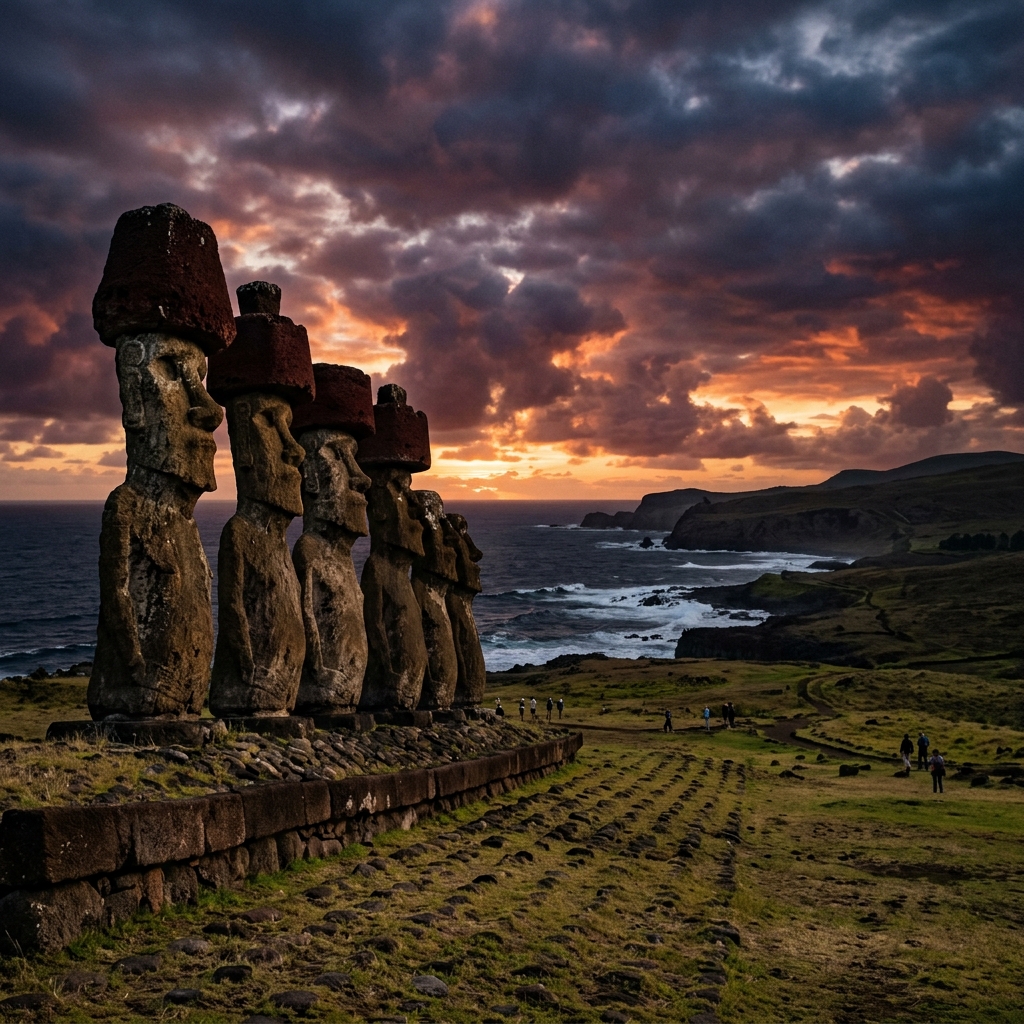
Archival visual record and historical depiction representing Rapa Nui Easter Island: History, Origins & Impact.
Historical Context
Rapa Nui lies at the southeastern apex of the Polynesian triangle, roughly 3,500 kilometers west of Chile and 2,000 kilometers from the nearest inhabited island. It is one of the most remote permanently inhabited places on earth. The Polynesian settlers who reached it — probably from the Marquesas or Mangareva, sometime between 700 and 1200 CE (the dating remains debated, with different methodologies producing different results) — were the greatest maritime navigators in human history, navigating thousands of miles of open Pacific using stars, ocean swells, bird behavior, and cloud formations, without instruments, in double-hulled sailing canoes. Their arrival on Rapa Nui was not an accident. It was an achievement of almost incomprehensible navigational skill.
What they found was a subtropical island of roughly 163 square kilometers, covered in subtropical forest dominated by a species now known as Paschalococos disperta — the Easter Island palm — along with toromiro trees, hauhau shrubs, and other woody vegetation. The island had rich soils, an absence of terrestrial predators, and enormous seabird colonies. It was, by the standards of remote Pacific islands, relatively hospitable. The settlers established a community, developed agriculture, and over several centuries built one of the most distinctive artistic cultures in human prehistory: the moai — massive stone figures, carved from the volcanic tuff of Rano Raraku quarry, some weighing over eighty tons, transported across the island and erected on ceremonial platforms called ahu.
The moai are extraordinary. Standing in front of the largest — Paro, at nearly ten meters tall — requires a recalibration of one's sense of what a pre-industrial community could accomplish. The engineering solutions the Rapanui developed for quarrying, transporting, and erecting these figures — using systems of rope, lever, and coordinated human labor — are still not fully understood. Experimental archaeology has demonstrated that the "walking" transport method (rocking the statues upright on their bases using ropes, as Rapanui oral tradition describes) is physically viable for smaller figures, but the logistics of moving multi-ton monoliths across kilometers of uneven terrain without wheeled vehicles or draft animals remain impressive regardless of method. The island community that built them was, by any reasonable measure, sophisticated, organized, and creative.
The Rats, the Palms, and the Real Sequence of Events
The deforestation of Rapa Nui is real. Palynological evidence — pollen cores from the island's crater lakes — clearly documents the progressive replacement of palm forest with grass and agricultural vegetation over the centuries following Polynesian settlement. By the time European ships arrived in 1722, the landscape was largely treeless. This much of the standard narrative is accurate. What is disputed is the cause, the timeline, and crucially, the relationship between deforestation and population collapse.
The revisionist argument, developed most forcefully by archaeologists Terry Hunt and Carl Lipo in their 2011 book The Statues That Walked, begins with the rats. Polynesian voyagers throughout the Pacific carried the Pacific rat (Rattus exulans) as both an intentional food source and an inadvertent stowaway. These rats, which reproduce with extraordinary speed, are voracious consumers of seeds — including palm seeds. Hunt and Lipo's analysis of the paleoecological evidence suggests that rat predation on palm seeds played a significant, possibly dominant, role in the failure of the Easter Island palm to regenerate after any disturbance. A forest whose seeds are systematically consumed cannot recover from the clearance that agriculture requires. The Rapanui may have been participants in their forest's decline, but they were not the only agents.
Crucially, Hunt and Lipo's revised dating of the initial settlement — arguing for a relatively late arrival of around 1200 CE rather than the earlier dates some other researchers propose — compresses the timeline between settlement and European contact to roughly five centuries. In this compressed timeline, the forest was declining rapidly from the beginning, driven by the combination of rat predation and human clearance, and the population had adapted to a treeless or near-treeless landscape well before 1722. The island community that Dutch explorer Jacob Roggeveen encountered in 1722 was not a society in demographic free-fall. Contemporary accounts describe healthy, well-nourished people in apparently adequate numbers — roughly three thousand, not the devastated remnant of a collapsed society.
Jared Diamond's influential account in Collapse (2005) presented the classic ecocide narrative: the Rapanui, driven by competitive clan rivalry to build ever-larger moai, clear-cut their island, could no longer build canoes to fish or escape, descended into clan warfare and possibly cannibalism, and collapsed from perhaps twenty thousand people to two thousand before European contact. Diamond's version was compelling, widely read, and fits a satisfying template for environmental cautionary tales. It has also been substantially challenged on the empirical evidence. The population figures (Diamond's "twenty thousand" figure is disputed; most current estimates for peak population range from six to twelve thousand), the timing of the population decline, and the direct causal chain from deforestation to collapse have all come under significant scholarly criticism.
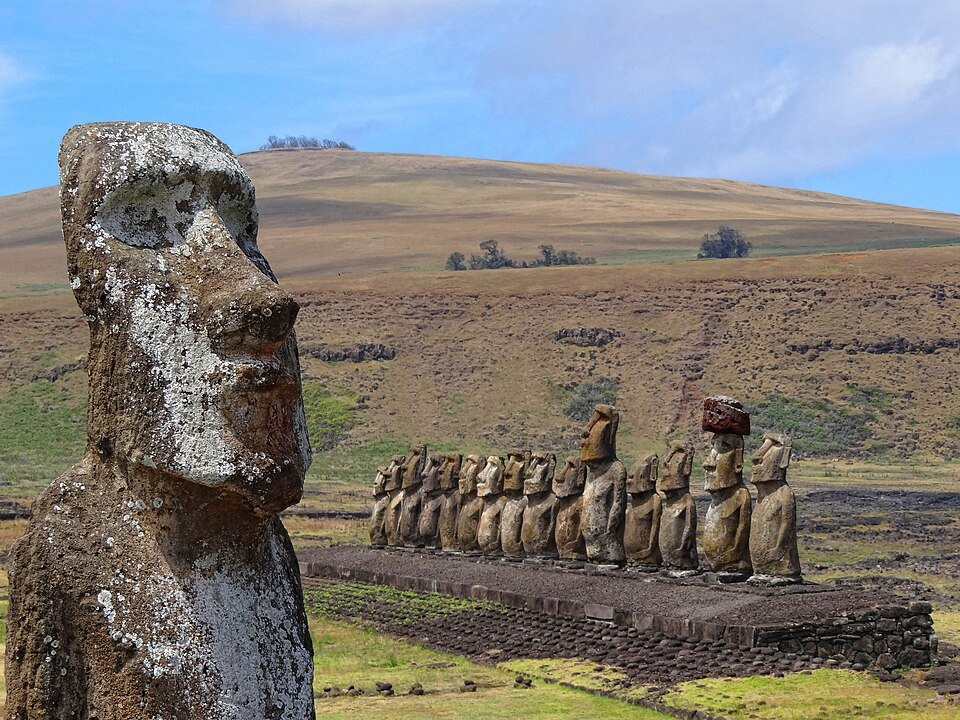
The fifteen moai of Ahu Tongariki, restored after being toppled by a tsunami in 1960. The platform represents the largest ahu on the island. The statue-building tradition appears to have declined before European contact — the Rano Raraku quarry contains nearly 400 statues in various stages of completion, suggesting the work stopped rather than concluded.
The Catastrophe That Actually Happened
The population of Rapa Nui at European contact — whatever its precise figure — was not the remnant of a pre-contact ecological collapse. The catastrophic demographic decline happened afterward, and its primary causes were external. In December 1862 and January 1863, a fleet of Peruvian slave ships descended on the island and captured somewhere between 1,000 and 1,500 people — estimates vary, but the figure represents between a quarter and a third of the total population. The raids targeted preferentially the island's leadership class: the ariki (hereditary chiefs), the tangata rongorongo (keepers of the rongorongo script — Rapa Nui's unique writing system, still undeciphered), and other high-status community members. The raiders had been told that island leaders wore more elaborate clothing and could be identified by their social deference from others.
The captives were transported to Peru and forced to work in the guano deposits on the Chincha Islands, in conditions of extreme brutality. Mortality was catastrophic: of the approximately 1,400 Rapanui people taken, fewer than 100 survived to 1863, when international pressure — particularly from the French and British governments — forced Peru to return surviving captives. The survivors carried smallpox. When the handful who remained alive were repatriated to Rapa Nui, they brought the disease with them into a population that had no immunity. The epidemic that followed killed an estimated two-thirds of the remaining population. By 1877, when a census was conducted, 111 Rapanui people remained alive on the island.
One hundred and eleven. From a community that had sustained itself on this remote island for five centuries or more, building some of the most remarkable monuments in the Pacific, maintaining a unique writing system, developing sophisticated agricultural techniques for a resource-limited environment. The rongorongo script — possibly the only independent invention of writing in the Pacific — effectively died with the captives taken to Peru, because the people who could read it were disproportionately among those killed. The few surviving rongorongo tablets (twenty-six are known, scattered across museums in Rome, Honolulu, and elsewhere) remain undeciphered, a linguistic orphan with no Rosetta Stone and no living speakers to bridge the gap.
1,400+ people taken by Peruvian slave raids in 1862–63, representing perhaps one-third of the population
Fewer than 100 of those captured survived to be repatriated — and they brought smallpox
111 people remained alive in 1877 census — the lowest point of Rapanui demographic survival
26 rongorongo tablets survive; the script remains undeciphered, its last fluent readers lost in the slave raids
1888 — Chile annexed Rapa Nui, confining remaining population to Hanga Roa village; rest of island used as sheep ranch until 1966
Rongorongo: The Writing That Died
Rapa Nui's rongorongo script — carved on wooden tablets in a reverse-boustrophedon format (alternating direction, with the tablet rotated 180° for every other line) — may represent an independent invention of writing in the Pacific, though some scholars argue it was inspired by contact with Spanish documents after 1770. What is certain is that only a small class of specialists could read it, that those specialists were disproportionately killed or enslaved in the 1862–63 raids, and that by the time European scholars began seriously attempting to document and decipher the tablets, there was no one left on earth who could read them. The tablets record something — possibly astronomical data, possibly genealogies, possibly ritual chants. We may never know.
Social & Human Effects
The clan warfare that the standard narrative places at the center of the pre-contact collapse also deserves more careful treatment than it typically receives. There is archaeological evidence of conflict on Rapa Nui: obsidian mata'a (spear points or tools) are abundant in the surface record, and some skeletal remains show trauma consistent with violence. The moai on many ahu were toppled — whether by rival clans, by tsunamis, or by the deliberate abandonment of the ancestral cult following resource stress is debated. Oral traditions collected by early European visitors do reference inter-clan conflict. None of this is disputed. What is disputed is whether this conflict reached a scale, and caused population losses, that constituted a civilizational collapse before European contact.
The revisionist archaeologists argue that the obsidian mata'a were more likely agricultural tools than weapons — their morphology is inconsistent with effective projectile use — and that the evidence for large-scale pre-contact violence is much thinner than the popular narrative implies. The toppling of the moai, in this reading, was more likely a gradual cultural shift away from the ancestor cult toward other religious practices, not a dramatic act of inter-clan destruction. The Rapanui who met Roggeveen in 1722 were living in a society that had adapted to a changed environment. They were not living in the ruins of a destroyed one.
Post-annexation colonial history added further layers of suffering. Chilean administration confined the remaining Rapanui population to the village of Hanga Roa and leased the rest of the island to a Scottish wool company, which ran it as a sheep ranch. The Rapanui were effectively prisoners on their own island, with movement restricted and cultural practices suppressed, until 1966. The Chilean Easter Island Exploitation Company held a lease on the island that was, in its economic logic, not entirely different from the plantation systems operating elsewhere in the Pacific under colonial regimes. The full history of Rapa Nui is not a single cautionary tale about ecological self-destruction. It is a complex, layered tragedy involving human adaptation, colonial violence, epidemic disease, and cultural erasure.
Economic Consequences
The resource constraints of Rapa Nui were real and shaped every aspect of its economy in ways that distinguished it from most other Polynesian societies. The absence of large timber by the time of European contact meant that the deep-sea canoe technology that Polynesian cultures typically relied upon for pelagic fishing was not available. The Rapanui fished primarily in coastal waters and developed intensive land-based agriculture to compensate — the island's rock garden system, in which stones were arranged to protect crops from wind and retain soil moisture, is a sophisticated adaptation to both the treeless landscape and the island's persistent wind exposure. These rock gardens, called manavai, cover significant portions of the island's surface and represent an enormous investment of labor in agricultural infrastructure.
The moai-building economy itself had an economic logic that the simple "competitive excess" narrative obscures. Anthropologist Jo Anne Van Tilburg and archaeologist Carl Lipo have argued that the moai served as an institutional framework for organizing and rewarding communal labor — the clans that successfully erected moai demonstrated their capacity for collective action and their ability to provision work parties, which had practical political-economic functions beyond pure prestige competition. The construction stopped — the Rano Raraku quarry still contains nearly four hundred statues in various stages of completion, as if work simply ceased one day — but whether this represents resource crisis, political disruption, or a shift in religious practice remains unclear.
The economic integration of post-annexation Rapa Nui into the Chilean and global economy occurred entirely on external terms. The wool trade enriched the Williamson-Balfour Company and its successors; the Rapanui who provided the labor for sheep herding received minimal return. Tourism, which now dominates the island economy, has brought prosperity of a sort but also new pressures: the island's population has grown rapidly in recent decades (currently around 7,000), straining fresh water resources and raising new questions about carrying capacity that the moai-builders themselves never had to confront in the same form.
⚖️
Historian Debate: Ecocide or Colonialism?
The Ecocide Narrative
Jared Diamond's Collapse (2005) presented Rapa Nui as history's most compelling example of environmental self-destruction, driven by competitive clan dynamics and rational short-term decision-making that produced irrational long-term outcomes. Diamond acknowledged European contact damage but argued the society had already undergone severe demographic collapse before 1722. This narrative resonated powerfully because it offered an apparently clear historical warning about resource management. Its influence on environmental discourse has been enormous.
The Revisionist Narrative
Terry Hunt, Carl Lipo, and scholars including Benny Peiser and Catherine Orliac argue that the evidence for a pre-contact collapse is far weaker than Diamond claimed, and that the demographic catastrophe was caused primarily by the Peruvian slave raids and subsequent smallpox epidemic of the 1860s. They further argue that the ecocide narrative participates in a longer tradition of blaming colonized peoples for their own dispossession — attributing to indigenous agency the outcomes of external violence. The rats (not the Rapanui alone) drove deforestation; colonialism (not ecological failure) drove collapse.
Scholars such as Terry Hunt, Carl Lipo, and Jared Diamond have shaped this debate through works like The Statues That Walked (2011) and Collapse (2005). The question of pre-contact versus post-contact causation remains contested, though the scholarly consensus has shifted significantly toward the revisionist position on the timing and causes of demographic collapse.
"The men of Rapa were of very large stature... they were clothed in white and yellow cloth... In each ear there hung an ornament some four inches long, resembling a thick white plug... They came quite without weapons or any warlike preparation, and they received us with no sign of hostility, even helping to haul up our boats."
— Carl Friedrich Behrens, officer on Jacob Roggeveen's expedition, 1722. One of the earliest European accounts of the Rapanui people at first contact. Published in Der Wohlversuchte Südländer, Leipzig, 1739.
Long-Term Legacy
The lesson that Rapa Nui is usually made to teach — that human societies will destroy their resource base if they are not constrained by institutional mechanisms — is not false. But it is too simple, and it is applied to the wrong causation. The environmental stress on Rapa Nui was real. The resource limitations shaped Rapanui culture profoundly. But the community that those limitations produced was not a failed society. It was an adaptive one — a group of people who had developed, over centuries, sophisticated techniques for living on a small, treeless island in the middle of the ocean. The catastrophe that reduced them from thousands to 111 was not the culmination of their own choices. It was an event done to them, by outsiders, with specific economic motives.
The distinction matters for the lesson we draw. If Rapa Nui is a story of self-destruction, it teaches that resource limits require better internal governance of consumption. If it is a story of colonial violence, it teaches something different: that the vulnerability of small, isolated, resource-constrained societies makes them targets for extraction, and that the costs of that extraction are borne entirely by the communities from which the resources are taken. Both lessons are important. But conflating them — telling the ecocide story while the slave-raid story goes largely untold — has the effect of directing moral responsibility entirely inward, away from the structures that actually produced the catastrophe.
The Rapanui people today are Chilean citizens with a growing political movement seeking greater autonomy over their island. Population has recovered, though many Rapanui feel that the island is now being overwhelmed by tourism and Chilean immigration in ways that threaten cultural continuity. The moai, still imposing, still somewhat mysterious in their transit logistics, still unmatched as expressions of what a small, remote community can accomplish when it directs its collective energy toward monumental ambition, stand across the island's hillsides and coastal platforms. They are a remarkable inheritance — of a people, it is worth remembering, who survived not only their island's resource limits, but everything the wider world did to them.
Terry Hunt & Carl Lipo — The Statues That Walked: Unraveling the Mystery of Easter Island (2011). The primary revisionist account, arguing for later settlement dating, rat-driven deforestation, and colonial-era population collapse; essential counterpoint to Diamond.
Jared Diamond — Collapse: How Societies Choose to Fail or Succeed (2005). The influential ecocide narrative; important to read as the text the revisionist literature is responding to, even where its empirical claims have been challenged.
Jo Anne Van Tilburg — Easter Island: Archaeology, Ecology, and Culture (1994). The standard archaeological monograph, with the most detailed treatment of moai construction and transport logistics available.
Steven Roger Fischer — Island at the End of the World: The Turbulent History of Easter Island (2005). The most complete narrative history of the island through colonial and modern periods, including the slave raids and their aftermath.
Benny Peiser — "From Genocide to Ecocide: The Rape of Rapa Nui," Energy & Environment 16 (2005). Polemical but useful critique of the Diamond narrative, with particular attention to the evidentiary basis for pre-contact collapse claims.
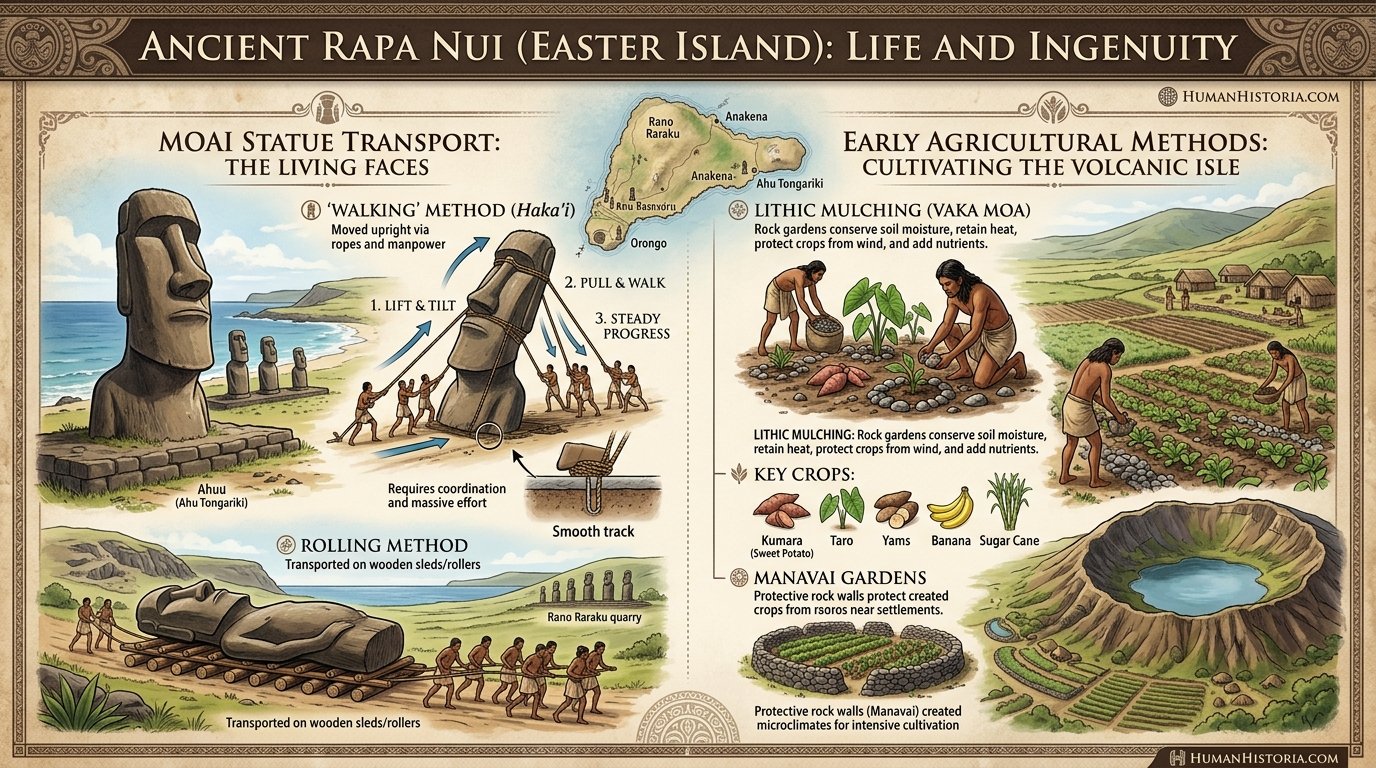
📊 Museum-Grade Infographic Poster
Easter Island Moai Transport & Agriculture Infographic
💡 Click anywhere on poster to expand in high resolution🔎 Expand Lightbox
Detailed visual diagram showcasing the rock mulching farming method, quarry carvers, and the "walking moai" transit theory.
📖 SCHOLARLY INQUIRIES
Frequently Asked Questions
Essential historical questions and evidence-based answers concerning this chronicle.
Q.Why is Rapa Nui Easter Island significant in world history?
Rapa Nui Easter Island played a pivotal role by transforming technology, social structure, and regional connection, serving as a vital link in human civilization.
Q.How did Easter Islanders move the moai statues?
2012 experimental archaeology (Hunt & Lipo) demonstrated that the moai were moved upright using ropes and a rocking walking technique—teams pulled the statue forward while others steadied it from collapsing sideways. Islanders say the statues 'walked', and this technique literally makes them appear to do so. Earlier hypotheses requiring enormous log rollers misunderstood the mechanics and the deforested state of the island.
Q.Were the moai faces really just heads?
No—archaeological excavations from 2012 onward revealed that Easter Island's iconic moai heads have full bodies buried beneath the surface, many decorated with petroglyphs. The statues were buried gradually over centuries as soil accumulated around their bases. The famous 'heads' are the visible portions of complete human-form statues, some reaching 9 metres tall with buried bodies.
Q.What is the real lesson of Easter Island?
The lesson is contested. Jared Diamond uses it as a parable of human ecological self-destruction. Carl Lipo and Terry Hunt argue the collapse was primarily caused by introduced rats rather than human failure, and that Rapa Nui people managed their environment relatively well. The more nuanced lesson is that even sophisticated societies embedded in closed resource systems are vulnerable to cascading ecological and social failure—especially when external shocks (like the Peruvian slave trade) compound internal stress.
📚 Academic Sources & Scholarly Bibliography
Diamond, J. (2005).
Collapse: How Societies Choose to Fail or Succeed.
Viking Press.
Hunt, T.L. & Lipo, C.P. (2011).
The Statues that Walked: Unraveling the Mystery of Easter Island.
Free Press.
Bahn, P. & Flenley, J. (1992).
Easter Island, Earth Island.
Thames & Hudson.
📖 Scholar Mode Active — Click to exit focused reading
History Lab 🧪
Interactive historical deduction games, tactical matchup simulators, and currency calculators.
🕵️ Who Am I? (The Historical Guess Game)
A secret historical figure has been selected. Ask yes/no questions to narrow down the pool of candidates. Click any active card to make your accusation!
Secret Identity
❓ Who Am I?
Ask questions using the board below to narrow down my identity.
Ask a Question:
Question LogQuestions: 0 / 7
No questions asked yet.
Candidate Board:
🗺️ Timeline Scramble
Five historical events appear out of order. Click them in the correct chronological sequence — from oldest to most recent. How well do you know your history?
🏺 Relic or Fake?
Is this a real historical artifact or a convincing fabrication? Judge each one based on its description and era — then see the truth revealed!
Artifact 1 / 10Score: 0
Empire Matchup Simulator
Empire ATerritory Size (Peak, M km²)Empire B
00
Empire APopulation (Peak, Millions)Empire B
00
Empire AMilitary Power (Army Size)Empire B
00
Tactical Battle Analysis
Select empires and click simulate to run evaluations.
Historical Purchasing Power Converter
See what ancient coins are worth in modern terms and check their historical purchasing power.
Modern Value Equivalent
$0.00 USD
Historical Purchasing Power:
Select currency to view purchasing capability.
Historical Identity Generator
Forge an authentic historical identity from ancient civilisations, complete with linguistic meaning and biography.
Neutral
Gaius Julius
Meaning:Descendant of Jupiter
Historical Background:
A Roman citizen and clerk who worked in the forum under Roman republic rule.
Chrono-Cultural Fusion Simulator
Fuse the culture, technology, and governance of two legendary civilizations to synthesize a unique hybrid society.
Cohesion & Coexistence Rate
85%
🏛️ Hybrid Architecture
⚙️ Synthesized Asset
📜 Synthetic Governance
Historical Tactics & Trivia Quiz
Test your historical knowledge and battle tactics to claim your administrative rank.
8 Questions • Multi-Era
You will be presented with random scenarios and trivia spanning ancient Egypt, classical Rome, Islamic Golden Age, and the modern industrial era. Complete the evaluation to see your historical title!
Question 1 of 8Score: 0
What was the Code of Hammurabi written on?
Correct!
Evaluation Complete!
6 / 8
Correct
Rank Attained
Imperial Legionary
Your knowledge of classical strategy and administrative structures is respectable.
🎲 Counterfactual "What If?" Scenario Simulator
Explore alternative historical trajectories by tweaking key civilizational pivot points.
Simulated Shift
Selected Era
Prehistoric Era
Millions of years ago to ~3000 BCE
The dawn of humanity. From the evolutionary split of early hominids to the mastery of stone tools, fire, and the birth of language.
Landmark Milestones
Welcome to Historia
Enter your Scholar Name to synchronize your chronicles and save your journey.
 ⭐ Featured Chronicle

 ANCIENT AGES
 ANCIENT AGES
 ANCIENT AGES
 MEDIEVAL PERIOD
 MEDIEVAL PERIOD
 PREHISTORIC ERA