~7,000 Years from farming to writing
๐Ÿ›๏ธ

Ancient Ages

c. 3,200 BCE โ€” 500 CE ยท Empires, Laws & Philosophy
~400 Years from Roman fall to medieval rebirth
๐Ÿฐ

Medieval Period

c. 500 CE โ€” 1500 CE ยท Empires of Faith, Trade & Castles
~50 Years from printing press to Scientific Revolution
โš™๏ธ

Modern Age

c. 1450 CE โ€” 2000 CE ยท Revolutions, Industry & Discovery
~50 Years from computers to quantum age

THE ARTIFACT GALLERY

Examine the tangible relics, physical tokens, and revolutionary machines that shaped civilizational growth.

๐ŸŽฅ VIDEO HUB & SHORTS

Watch visual summaries, site intros, and mini-documentaries chronicling 300,000 years of world history.

๐Ÿ“Š HISTORICAL INFOGRAPHICS ARCHIVE

Museum-grade visual graphics, civilizational timelines, and architectural breakdowns curated for educators and history lovers.

THE HISTORIA CIRCLE

Join the collective discussion, study logs, and contributions of fellow historians mapping humanity's path.

Historia Forum Discussions

Start a Discussion Thread

THEMATIC PATHWAYS

Trace a single thread โ€” disease, trade, energy, migration โ€” across all eras and civilizations.

History is not just a sequence of events โ€” it is a network of patterns. These thematic pathways allow you to follow a single concept across thousands of years: how agriculture spread, how warfare evolved, how trade routes shaped civilizations. Each pathway collects the most relevant chronicles across all eras.

๐Ÿงฉ
How is this different from the sidebar Topics?
While the sidebar Topics (like Science & Tech or Empires) filter articles within your selected historical Era, Thematic Pathways cut horizontally across all eras (from Prehistoric to the Future). Use Themes to trace a single concept's evolutionary line across 300,000 years.

CIVILIZATION HUBS

Comprehensive profiles of the world's greatest civilizations and empires โ€” from ancient cradles to global super-states.

Human Historia provides an academically rich exploration of the world's most influential civilizations. From the monumental achievements of ancient Egypt, Han China, and the Roman Empire, to the sophisticated societies of the Maya, the Islamic Caliphates, and West African empires, these hubs offer deep insights into the cultural, political, and technological legacies that continue to shape our global story.

EVOLUTION OF HUMAN SKILLS

Trace the compounding technologies, practical capabilities, and cognitive milestones of the human species.

Human progress is a story of compounding skills. Every breakthrough, from the spark of prehistoric fire to modern silicon transistors, builds directly on previous generations of ingenuity. Hover over a skill node to trace its historical prerequisites, and click it to explore its development timeline, species-wide impact, and related chronicles.

Prehistoric Ancient Medieval Modern Future
๐Ÿง 

Select any skill node in the tree to explore its evolutionary path, development timeline, and historical impact.

ACADEMIC PASSPORT

Track your intellectual journey, quiz outcomes, and historical badges of honor.
HISTORIA PASSPORT โณ
๐Ÿ‘ค Scribe Novice
Scholar Name Historia Explorer
Rank Rating Sumerian Record Scribe
Chronicles Read 0 / 48
Study Guide Pins 0 Guides
Security Access Level 1 (Novice)

Earned Badges of Honor

๐Ÿ”ฅ
Fire Keeper
Unlock 3 prehistoric chronicles.
๐Ÿ›๏ธ
Codex Keeper
Unlock 3 ancient chronicles.
๐Ÿฐ
Guild Master
Unlock 3 medieval chronicles.
โš™๏ธ
Steam Engineer
Unlock 3 modern chronicles.
๐Ÿš€
Singularity Sage
Unlock 3 future chronicles.
๐Ÿ‘‘
Grand Scholar
Score 5/5 on the Lab Quiz.

Recent Lab Activities

No recent activities recorded. Take a quiz or bookmark articles!
Curated Exhibition

Human Historia

An immersive graphical anthology tracing the paths of civilizations, breakthroughs, and conflicts that forged the modern consciousness.

25Chronicles
Showing all articles

The Invention of Money: How Lydia Minted the World's First Coins

Written by Historia Economics Historical Era: ANCIENT
* Note: Cover image is an AI-generated historical illustration.

๐Ÿง Key Chronicle Takeaway (Atomic Summary)

How an Anatolian kingdom standardized electrum bullion with royal stamps, replacing weights with trust and launching market trade.

The transition from barter trade and informal commodity ledgers to a standardized, state-backed currency is one of the most critical turning points in human economic history. For millennia, ancient societies conducted trade using weight-based commodities, such as barley in Mesopotamia, cowrie shells in China, or raw silver bullion in the Levant. While functional, these systems suffered from high transaction costs: merchants had to weigh metals at every trade point, and verify the purity of the bullion, which was easily diluted. This economic friction was resolved in the 7th century BCE in the kingdom of Lydia, located in western Anatolia (modern Turkey), where the world's first true coins were minted. By stamping standardized weights of electrum (a natural alloy of gold and silver) with a royal seal, the Lydian kings invented metallic currency, creating a global revolution in market efficiency, state taxation, and trade speed.

The Problem of Peso-Bullion Trade

Before the invention of coinage, trade was governed by commodity-money or bullion weight. Under the Babylonian and Egyptian economies, silver was treated as a raw material. Merchants carried chunks of cut silver, known as Hacksilber, which had to be weighed on scales using stone weights during every transaction. This process was slow and open to fraud: traders could use fraudulent scale weights, or mix silver with cheaper base metals like lead or copper. To verify purity, buyers had to physically cut into the silver or perform chemical tests, creating significant friction in daily market transactions. This weighing requirement limited the speed of trade, restricted the participation of lower social classes in regional markets, and made long-distance merchant networks highly risky and expensive to operate.

Lydia, occupying a wealthy geographic position at the crossroads of the Aegean and the interior empires of Anatolia, faced massive volumes of trade. The rivers of Lydia, particularly the Pactolus, were rich in Electrum, a natural gold-silver alloy. Scribes and kings realized that the state could use its authority to solve the bullion trust problem. If the king guaranteed both the weight and the purity of a piece of metal, merchants would no longer need to weigh or test it. The transaction could proceed based on visual trust alone, turning trade from a slow negotiation into a rapid transaction.

The Reign of Alyattes and the First Mints

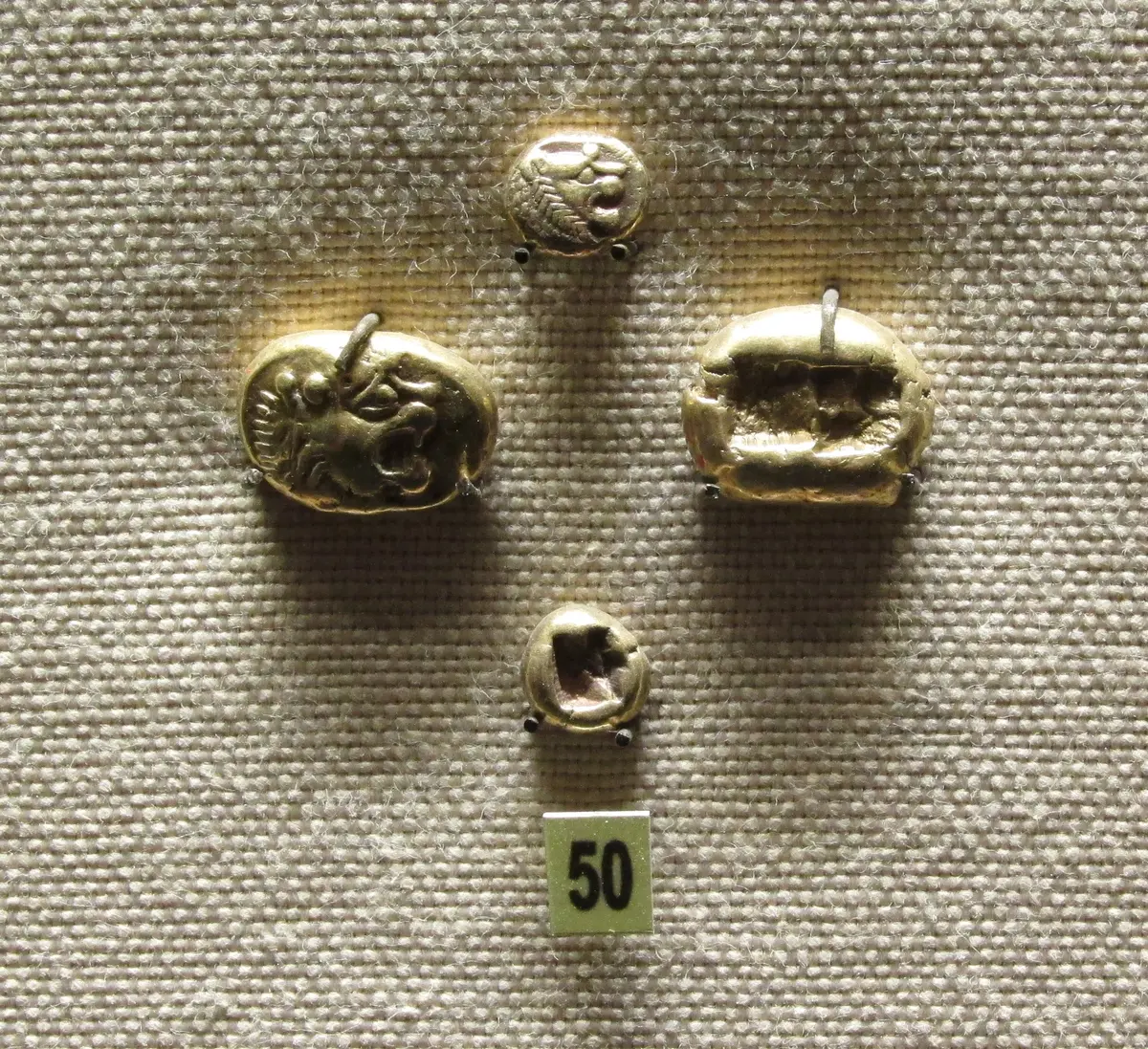
The earliest Lydian coins were minted during the reign of King Alyattes (around 610โ€“560 BCE) in the capital city of Sardis. These coins, known as Staters, were made of electrum and stamped on one side with the symbol of the royal house: a roaring lion's head with a sunburst on its forehead. The reverse side featured simple punch marks made by the iron dies during stamping.

The minting process was a lesson in metallurgy:

  • Alloy Standardization: Because natural electrum varied in its gold-to-silver ratio, the Lydian mint standardized the mix, fixing it at roughly 54% gold, 44% silver, and 2% copper. This standard ensured that every coin of a specific denomination carried identical metal value.
  • Denomination Hierarchy: Scribes established a fraction-based coin system, ranging from a full stater (weighing about 14 grams) down to a 1/96th stater (weighing a fraction of a gram). This division allowed coins to be used for both large wholesale transactions and daily retail market purchases.
  • The Die Hammer: Flans of cast metal were heated, placed on an anvil containing the lion design, and hammered with an iron punch from above, locking the image into the metal structure.

Croesus and the Bimetallic Revolution

Alyattes' son, King Croesus (reigned 560โ€“546 BCE), went down in history as a symbol of immense wealth. Croesus realized that electrum was difficult to trade internationally because other cultures valued pure gold and pure silver differently. He revolutionized the monetary system by introducing the world's first bimetallic currency. Croesus ordered the refining of electrum into pure gold coins (Croeseids) and pure silver coins, establishing a fixed exchange rate between them. This bimetallic standard spread rapidly across the Aegean, becoming the model for Persian, Greek, and Roman monetary systems.

The Economic Boom of Sardis

The introduction of coinage triggered an immediate economic expansion in Sardis and the surrounding Aegean. By removing the need for scales, coinage allowed for the creation of the world's first permanent retail marketsโ€”the predecessors of the Greek Agora. Herodotus, the Greek historian, noted that the Lydians were the first people to establish permanent retail shops, a development directly linked to the convenience of coinage. Anyone, from a wealthy merchant to a poor laborer, could buy food, clothing, and pottery rapidly using coins. The speed of domestic trade increased exponentially, driving local production and specialization.

The Lydian state also benefited massively from its invention. The crown charged a fee for minting coins, taking a profit (known as Seigniorage) on the difference between the face value of the coin and the raw value of the metal. Furthermore, coinage simplified tax collection: instead of collecting grain, sheep, or irregular bullion, the royal treasury could collect standardized coins. This predictable tax stream allowed the Lydian kings to fund professional standing armies, build massive fortifications around Sardis, and hire mercenary units, transforming their kingdom into a regional superpower.

Debasement: The Dark Side of Coinage

While coinage brought market efficiency, it also introduced a new vulnerability: Monetary Debasement. Because coins carried a face value guaranteed by the state, rulers soon realized they could melt down currency, mix it with cheaper base metals like copper, and reissue the coins at the same face value. This allowed the state to pay off debts or fund expensive wars, but it invariably triggered inflation and currency distrust. This practice was widely exploited by Roman emperors, who systematically reduced the silver content of the Denarius from 95% under Augustus to less than 2% during the Crisis of the Third Century, causing the collapse of the Roman market economy.

The Global Expansion of Coinage

The Lydian invention did not remain isolated. Following the conquest of Lydia by Cyrus the Great of Persia in 546 BCE, the Persian Empire adopted bimetallic coinage, issuing the gold Daric and silver Siglos across their vast empire. Greek city-states like Athens and Corinth quickly set up their own mints, using silver from local mines to strike iconic coins like the Athenian Owl, which became the first international reserve currency of the Mediterranean. By the time of Alexander the Great, metallic coinage was the standard medium of exchange from the Aegean Sea to the Indus Valley, facilitating the integration of the ancient world.

Simultaneously and independently, coin systems developed in ancient China and India, using different shapesโ€”such as bronze spade-money in China and punch-marked silver bars in India. However, the Lydian model of circular, stamped coins with raised designs proved to be the most durable and adaptable design. It established the principles of currency that still govern physical cash today: state monopoly on issuance, standardization of denominations, and the replacement of weight negotiation with visual trust.

Gresham's Law and the Dual Electrum Standard

The introduction of standardized coins in Lydia highlighted the economic principle that later became known as Gresham's Lawโ€”the rule that "bad money drives out good." Before the invention of the royal mint, merchants traded using electrum nuggets, which were natural alloys of gold and silver. However, the ratio of gold to silver in natural electrum varied from 40% to 90%, allowing dishonest traders to pass off silver-heavy nuggets as gold-heavy ones. To stop this, King Alyattes standardized the royal electrum coin at 54% gold and 44% silver, stamping them with the lion's head to guarantee this ratio.

By establishing this standard, the Lydian state removed the need for merchants to assay every nugget, which drastically reduced the time needed to complete transactions. Scribes recorded that merchants preferred the royal coins over raw electrum, because they knew the state would accept them for tax payments at face value. This standard currency drove raw electrum out of circulation and into the state mints, allowing the Lydian kings to control the money supply and build a wealthy merchant empire, proving that standardized legal standards are essential to build public trust in money.

Lydian electrum stater coin showing a roaring lion
An authentic Lydian electrum stater coin from Sardis, stamped with a roaring lion profile as a state guarantee of value.

Conclusion: The Invention of Cash

The creation of coinage in Lydia was more than a technical upgrade in trade; it was a cognitive revolution that transformed how humanity values labor, goods, and time. By converting raw metal into a standardized symbol of trust, the Lydian kings unlocked the potential of free markets, enabling rapid transactions, specialized labor, and predictable state finance. The coins chiseled in Sardis twenty-six centuries ago laid the monetary foundations that built the ancient, medieval, and modern worlds, proving that trust is the ultimate currency of human progress.

โš–๏ธ

Historian Debate: Why Did Lydia Invent Coins?

Facilitating Retail Trade

Traditional economists argue that Lydian kings minted electrum coins to reduce transaction costs in local markets, replacing awkward bullion bars.

State Payments and Mercenary Hire

Modern revisionists suggest coins were invented specifically to pay mercenaries and collect taxes, serving as a political accounting unit rather than a commercial tool.

Lydia (c. 600 BCE) issued the first standardized, state-guaranteed electrum coinage.

"The Lydians were the first people we know of to use gold and silver coins, and the first to establish retail shops."

โ€” Herodotus, The Histories (c. 440 BCE).

Further Reading

  • The Invention of Coinage โ€” by J.H. Kagan. An academic analysis of the transition from bullion to coin in the Aegean.
  • Lydia and Sardis โ€” by G.M.A. Hanfmann. An archaeological history of the Lydian capital.
๐Ÿ“– Scholar Mode Active โ€” Click to exit focused reading
Selected Era

Prehistoric Era

Millions of years ago to ~3000 BCE

The dawn of humanity. From the evolutionary split of early hominids to the mastery of stone tools, fire, and the birth of language.

Landmark Milestones

Welcome to Historia

Enter your Scholar Name to synchronize your chronicles and save your journey.