Examine the tangible relics, physical tokens, and revolutionary machines that shaped civilizational growth.
🎥 VIDEO HUB & SHORTS
Watch visual summaries, site intros, and mini-documentaries chronicling 300,000 years of world history.
📊 HISTORICAL INFOGRAPHICS ARCHIVE
Museum-grade visual graphics, civilizational timelines, and architectural breakdowns curated for educators and history lovers.
THE HISTORIA CIRCLE
Join the collective discussion, study logs, and contributions of fellow historians mapping humanity's path.
Historia Forum Discussions
Start a Discussion Thread
THEMATIC PATHWAYS
Trace a single thread — disease, trade, energy, migration — across all eras and civilizations.
History is not just a sequence of events — it is a network of patterns. These thematic pathways allow you to follow a single concept across thousands of years: how agriculture spread, how warfare evolved, how trade routes shaped civilizations. Each pathway collects the most relevant chronicles across all eras.
🧩
How is this different from the sidebar Topics?
While the sidebar Topics (like Science & Tech or Empires) filter articles within your selected historical Era, Thematic Pathways cut horizontally across all eras (from Prehistoric to the Future). Use Themes to trace a single concept's evolutionary line across 300,000 years.
CIVILIZATION HUBS
Comprehensive profiles of the world's greatest civilizations and empires — from ancient cradles to global super-states.
Human Historia provides an academically rich exploration of the world's most influential civilizations. From the monumental achievements of ancient Egypt, Han China, and the Roman Empire, to the sophisticated societies of the Maya, the Islamic Caliphates, and West African empires, these hubs offer deep insights into the cultural, political, and technological legacies that continue to shape our global story.
EVOLUTION OF HUMAN SKILLS
Trace the compounding technologies, practical capabilities, and cognitive milestones of the human species.
Human progress is a story of compounding skills. Every breakthrough, from the spark of prehistoric fire to modern silicon transistors, builds directly on previous generations of ingenuity. Hover over a skill node to trace its historical prerequisites, and click it to explore its development timeline, species-wide impact, and related chronicles.
Prehistoric Ancient Medieval Modern Future
🧠
Select any skill node in the tree to explore its evolutionary path, development timeline, and historical impact.
ACADEMIC PASSPORT
Track your intellectual journey, quiz outcomes, and historical badges of honor.
HISTORIA PASSPORT⏳
👤Scribe Novice
Scholar NameHistoria Explorer
Rank RatingSumerian Record Scribe
Chronicles Read0 / 48
Study Guide Pins0 Guides
Security AccessLevel 1 (Novice)
Earned Badges of Honor
🔥
Fire Keeper
Unlock 3 prehistoric chronicles.
🏛️
Codex Keeper
Unlock 3 ancient chronicles.
🏰
Guild Master
Unlock 3 medieval chronicles.
⚙️
Steam Engineer
Unlock 3 modern chronicles.
🚀
Singularity Sage
Unlock 3 future chronicles.
👑
Grand Scholar
Score 5/5 on the Lab Quiz.
Recent Lab Activities
No recent activities recorded. Take a quiz or bookmark articles!
Curated Exhibition
Human Historia
An immersive graphical anthology tracing the paths of civilizations, breakthroughs, and conflicts that forged the modern consciousness.
25Chronicles
Showing all articles
Song Dynasty Paper Money 1024 CE: Invention of Paper Currency & Jiaozi
Written by Historia EconomicsHistorical Era: MEDIEVAL
🎨 Historical Illustration (AI)
* Note: Cover image is an AI-generated historical illustration.
🧠Key Chronicle Takeaway (Atomic Summary)
How a copper shortage in Song Dynasty China led to the creation of the Jiaozi—the first government-issued fiat currency.
The invention of paper currency by the Song Dynasty in 11th-century China represents one of the most significant intellectual and structural leaps in economic history. By decoupling the money supply from the physical limits of mining precious metals, this innovation—originally known as Jiaozi—introduced the concept of representative credit and fiat currency to human trade. This transition allowed for the rapid expansion of markets, funded state military defense, and established the administrative systems of printing security, capital reserve ratios, and monetary policy that define modern central banking today.
The Song Dynasty Commercial Revolution
To understand the invention of paper money, one must examine the economic conditions of China during the Song Dynasty (960–1279 CE). This era is characterized by historians as a medieval commercial revolution, marked by:
Agricultural Leap: The introduction of fast-ripening Champa rice from Vietnam allowed farmers to harvest two or three crops a year, doubling food production and driving population growth.
Urbanization: Cities like Hangzhou and Kaifeng grew into metropolises of over one million residents, housing markets, guilds, restaurants, and entertainment districts that operated day and night.
Proto-Industrialization: Iron and coal production expanded, and state workshops manufactured standardized weapons, agricultural tools, and ceramics on an industrial scale.
This rapid growth of trade created an unprecedented demand for money. The standard currency of the era was the copper coin (known as cash or tongqian), which had a square hole in the center so coins could be strung together in bundles of 1,000. However, the Song economy outgrew the supply of copper. Despite minting billions of coins annually, the government faced a persistent currency shortage, as coins were smuggled out of the country to pay for foreign trade or melted down to manufacture bronze tools and statues.
The Iron Coin Crisis in Sichuan
The currency crisis was most severe in the southwestern province of Sichuan. Because of its geographic isolation and strategic location bordering foreign kingdoms, the Song government prohibited the export of copper coins from Sichuan, mandating instead that all local trade be conducted using heavy iron coins.
Iron was cheap and abundant, but it possessed low value. To purchase high-value goods, such as a bolt of silk or a horse, merchants had to carry dozens of pounds of iron coins. A single transaction could require a horse-drawn cart loaded with iron cash. Trading became slow, physically demanding, and vulnerable to theft. The economic growth of Sichuan was restricted by the physical weight of its currency.
The Jiaozi: Private Receipts to Public Currency
To solve this logistics problem, the merchant guilds of Chengdu developed a private deposit system in the early 11th century. Sixteen wealthy merchant houses established secure warehouses where traders could deposit their heavy iron coins. In exchange, the deposit houses issued a paper receipt written on mulberry bark paper, indicating the amount of iron cash deposited.
These receipts, called Jiaozi ("exchange medium" or "flying cash"), began to circulate as currency. Rather than withdrawing their heavy iron coins to make a purchase, merchants traded the paper Jiaozi receipts from hand to hand, as the recipient knew they could present the note to the deposit house at any time to redeem it for physical iron cash. This represented the transition from commodity money to representative paper money, backed by physical metal reserves.
1024 CE: The First Government Paper Currency
In the 1020s, several private deposit houses went bankrupt or were caught issuing notes without metallic backing, which threatened to collapse Sichuan's trade. Realizing the potential of paper money to fund the state and simplify trade, the Song government took over the system. In 1024 CE, the government established the State Jiaozi Bureau in Chengdu, revoking the private guilds' monopoly and issuing the first official, government-backed paper currency in human history.
Administrative Safeguards and Anti-Counterfeiting
The Song administration understood that the value of paper money depended on public trust and the prevention of counterfeiting. They established security measures:
Fractional Reserve Backing: The government maintained a metallic reserve (consisting of copper or iron coins) equal to roughly 28% to 30% of the total value of paper notes issued, ensuring that citizens could redeem their notes for cash.
Multicolor Woodblock Printing: Jiaozi notes were printed using detailed woodblocks, combining multiple colors of ink (usually black, red, and blue) on paper made from the bark of the mulberry tree (chu), which was a state-controlled resource.
Complex Graphic Designs: The notes featured intricate drawings of palaces, coins, and natural landscapes, along with official seals, calligraphy, and serial numbers written by royal scribes.
Capital Punishment for Forgery: The notes carried printed warnings stating that counterfeiters would be executed by decapitation, and informants who reported counterfeiters would receive a substantial reward of gold.
Expiration Cycles: Jiaozi notes were issued with strict expiration dates, usually in 2-to-3-year cycles (called jie). At the end of a cycle, citizens had to exchange their old notes for new ones, allowing the government to retire worn bills and adjust the money supply to control inflation.
Mongol Conquest and the Chao Fiat Currency
As the Song Dynasty faced invasions from the Jurchen Jin Dynasty and the Mongol Empire, it printed paper money (Huizi) to fund military expenses without maintaining metallic reserves. This led to inflation and a drop in the value of the paper currency, which contributed to the dynastic collapse.
The conquering Mongol Yuan Dynasty (1271–1368 CE) adopted and expanded the paper money system. Under Kublai Khan, the government issued the Chao, the first paper currency that was declared sole legal tender (fiat money). Kublai Khan prohibited the use of gold, silver, and copper coins for domestic trade, forcing all merchants to use the paper Chao. When the Venetian merchant Marco Polo visited China in the late 13th century, he was astonished by this system, writing in his Travels:
"You might say that the Great Khan is a perfect alchemist, for he makes money out of bark... All these pieces of paper are issued with as much solemnity and authority as if they were of pure gold or silver... and they are accepted throughout the empire."
The Late Yuan Hyperinflation
To fund expensive military campaigns in Japan and Java, and to build palaces in Dadu (Beijing), the late Yuan emperors printed massive amounts of Chao without maintaining reserves or enforcing limits. Trust in the paper currency collapsed, resulting in hyperinflation. Prices rose tenfold in a few years, and the economy returned to barter. This hyperinflation destroyed the regime's legitimacy, contributing to the peasant uprisings that overthrew the Mongol dynasty in 1368 CE. The subsequent Ming Dynasty, fearing paper currency, returned to a silver-based economy.
The Gold Standard and the Modern Fiat Transition
The concept of paper currency traveled from East Asia to Europe in the 17th century. The Bank of England (founded in 1694) began issuing paper banknotes that were redeemable for gold or silver coins on demand, establishing the Gold Standard. Under this system, the value of paper money was tied to a physical reserve of gold, which limited inflation but also tied the growth of the money supply to the extraction of gold from mines. If a nation faced an economic crisis, it could not print more paper money to stimulate trade without acquiring more gold, leading to deflationary crises.
The final transition in the evolution of paper money occurred on August 15, 1971, in an event known as the Nixon Shock. Faced with high inflation and a decline in US gold reserves, US President Richard Nixon ended the Bretton Woods system by suspending the convertibility of the US dollar into gold. This action permanently decoupled the dollar—and subsequently all global currencies—from precious metals, transitioning the world to a system of pure Fiat Money. Today, modern paper and digital currencies are backed by no physical commodity; their value is determined by the stability of the issuing government and the public's trust in the currency's purchasing power, completing the journey from Sumerian barley and Lydian coins to abstract digital ledgers.
Weimar Germany and the Danger of Hyperinflation
The structural danger of fiat paper money was demonstrated in Weimar Germany in 1923. Faced with massive war reparations after World War I, the German government printed paper marks without limit to pay its debts. Trust in the currency collapsed, resulting in hyperinflation. Prices doubled every few days, and workers were paid twice a day, carrying their cash in wheelbarrows. The currency became worthless, and citizens used paper banknotes as kindling for stoves or wallpaper. This crisis wiped out the savings of the middle class, collapsed the economy, and contributed to the political instability that led to the rise of the Nazi regime, proving that the stability of paper money depends on strict monetary limits.
The Assignats of the French Revolution
The structural vulnerability of representative paper money decoupled from strict monetary limits was demonstrated by the Assignats during the French Revolution. In 1789, the bankrupt French National Assembly confiscated all lands owned by the Catholic Church. To monetize this asset, the government issued Assignats—interest-bearing paper bonds that could be used by citizens to purchase the nationalized church lands. Initially, the assignats were intended to be retired from circulation once the land sales were completed.
However, faced with mounting war costs and administrative deficits, the revolutionary government began printing assignats as a standard paper currency, bypassing land backing. Trust in the currency quickly collapsed. As the printing presses ran day and night, the value of the assignat plummeted, triggering hyperinflation. By 1795, the purchasing power of the assignat had dropped by over 99%, forcing merchants to reject paper money and return to silver coins. The government attempted to enforce price controls (Maximum General) on food, which resulted in shortages and peasant hoarding. This monetary collapse contributed to the social instability that fueled the Reign of Terror and eventually led to the rise of Napoleon Bonaparte, illustrating the danger of unbacked state paper currencies.
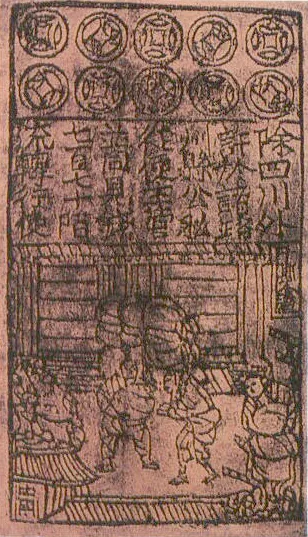
An authentic printing plate used to produce Jiaozi, the world's first paper currency, during the Song Dynasty.
Conclusion and Legacy
The invention of paper money by the Song Dynasty proved that the value of money is not determined by its physical substance (such as gold or copper), but by the trust of the population and the stability of the state. By inventing fractional reserves, multicolor printing, and fiat currency cycles, medieval China established the institutional tools that drive modern global finance and banking systems.
⚖️
Historian Debate: What Caused the Hyperinflation of Song Paper Money?
Military Spending and Overprinting
Economic historians argue that the Song state, desperate to finance wars against the Jurchen Jin and Mongols, abandoned silver reserves and overprinted Jiaozi currency, destroying public trust.
Loss of Territory and Reserve Collapse
Alternative views emphasize that the loss of northern agricultural lands to invaders reduced the state's tax capacity, causing the cash reserve system to collapse.
The Song Dynasty (1024 CE) issued the first state-backed paper currency, pioneering fiat money.
"The paper money of China is made from the bark of the mulberry tree... The Great Khan issues it in such quantities that he could purchase all the treasures of the world."
— Marco Polo, The Travels of Marco Polo (c. 1300).
Related Civilizations & Contexts
Song Dynasty ChinaMongol EmpireJurchen Jin DynastyGoryeo Dynasty
Further Reading
Money and Monetary Policy in China — by Richard von Glahn. The definitive economic history of Chinese currency systems from antiquity to the modern era.
The Age of Confucian Rule — by Dieter Kuhn. A comprehensive history of the Song Dynasty's technological and financial innovations.
📖 Scholar Mode Active — Click to exit focused reading
History Lab 🧪
Run simulated matches between civilizations and convert ancient currencies.
🕵️ Who Am I? (The Historical Guess Game)
A secret historical figure has been selected. Ask yes/no questions to narrow down the pool of candidates. Click any active card to make your accusation!
Secret Identity
❓ Who Am I?
Ask questions using the board below to narrow down my identity.
Ask a Question:
Question LogQuestions: 0 / 7
No questions asked yet.
Candidate Board:
🗺️ Timeline Scramble
Five historical events appear out of order. Click them in the correct chronological sequence — from oldest to most recent. How well do you know your history?
🏺 Relic or Fake?
Is this a real historical artifact or a convincing fabrication? Judge each one based on its description and era — then see the truth revealed!
Artifact 1 / 10Score: 0
Empire Matchup Simulator
Empire ATerritory Size (Peak, M km²)Empire B
00
Empire APopulation (Peak, Millions)Empire B
00
Empire AMilitary Power (Army Size)Empire B
00
Tactical Battle Analysis
Select empires and click simulate to run evaluations.
Historical Purchasing Power Converter
See what ancient coins are worth in modern terms and check their historical purchasing power.
Modern Value Equivalent
$0.00 USD
Historical Purchasing Power:
Select currency to view purchasing capability.
Historical Identity Generator
Forge an authentic historical identity from ancient civilisations, complete with linguistic meaning and biography.
Neutral
Gaius Julius
Meaning:Descendant of Jupiter
Historical Background:
A Roman citizen and clerk who worked in the forum under Roman republic rule.
Chrono-Cultural Fusion Simulator
Fuse the culture, technology, and governance of two legendary civilizations to synthesize a unique hybrid society.
Cohesion & Coexistence Rate
85%
🏛️ Hybrid Architecture
⚙️ Synthesized Asset
📜 Synthetic Governance
Historical Tactics & Trivia Quiz
Test your historical knowledge and battle tactics to claim your administrative rank.
8 Questions • Multi-Era
You will be presented with random scenarios and trivia spanning ancient Egypt, classical Rome, Islamic Golden Age, and the modern industrial era. Complete the evaluation to see your historical title!
Question 1 of 8Score: 0
What was the Code of Hammurabi written on?
Correct!
Evaluation Complete!
6 / 8
Correct
Rank Attained
Imperial Legionary
Your knowledge of classical strategy and administrative structures is respectable.
🎲 Counterfactual "What If?" Scenario Simulator
Explore alternative historical trajectories by tweaking key civilizational pivot points.
Simulated Shift
Selected Era
Prehistoric Era
Millions of years ago to ~3000 BCE
The dawn of humanity. From the evolutionary split of early hominids to the mastery of stone tools, fire, and the birth of language.
Landmark Milestones
Welcome to Historia
Enter your Scholar Name to synchronize your chronicles and save your journey.