~7,000 Years from farming to writing
πŸ›οΈ

Ancient Ages

c. 3,200 BCE β€” 500 CE Β· Empires, Laws & Philosophy
~400 Years from Roman fall to medieval rebirth
🏰

Medieval Period

c. 500 CE β€” 1500 CE Β· Empires of Faith, Trade & Castles
~50 Years from printing press to Scientific Revolution
βš™οΈ

Modern Age

c. 1450 CE β€” 2000 CE Β· Revolutions, Industry & Discovery
~50 Years from computers to quantum age

THE ARTIFACT GALLERY

Examine the tangible relics, physical tokens, and revolutionary machines that shaped civilizational growth.

THE HISTORIA CIRCLE

Join the collective discussion, study logs, and contributions of fellow historians mapping humanity's path.

Historia Forum Discussions

Start a Discussion Thread

THEMATIC PATHWAYS

Trace a single thread β€” disease, trade, energy, migration β€” across all eras and civilizations.

History is not just a sequence of events β€” it is a network of patterns. These thematic pathways allow you to follow a single concept across thousands of years: how agriculture spread, how warfare evolved, how trade routes shaped civilizations. Each pathway collects the most relevant chronicles across all eras.

🧩
How is this different from the sidebar Topics?
While the sidebar Topics (like Science & Tech or Empires) filter articles within your selected historical Era, Thematic Pathways cut horizontally across all eras (from Prehistoric to the Future). Use Themes to trace a single concept's evolutionary line across 300,000 years.

CIVILIZATION HUBS

Comprehensive profiles of the world's greatest civilizations and empires β€” from ancient cradles to global super-states.

Human Historia provides an academically rich exploration of the world's most influential civilizations. From the monumental achievements of ancient Egypt, Han China, and the Roman Empire, to the sophisticated societies of the Maya, the Islamic Caliphates, and West African empires, these hubs offer deep insights into the cultural, political, and technological legacies that continue to shape our global story.

ACADEMIC PASSPORT

Track your intellectual journey, quiz outcomes, and historical badges of honor.

HISTORIA PASSPORT ⏳
πŸ‘€ Scribe Novice
Scholar Name Historia Explorer
Rank Rating Sumerian Record Scribe
Chronicles Read 0 / 48
Study Guide Pins 0 Guides
Security Access Level 1 (Novice)

Earned Badges of Honor

πŸ”₯
Fire Keeper
Unlock 3 prehistoric chronicles.
πŸ›οΈ
Codex Keeper
Unlock 3 ancient chronicles.
🏰
Guild Master
Unlock 3 medieval chronicles.
βš™οΈ
Steam Engineer
Unlock 3 modern chronicles.
πŸš€
Singularity Sage
Unlock 3 future chronicles.
πŸ‘‘
Grand Scholar
Score 5/5 on the Lab Quiz.

Recent Lab Activities

No recent activities recorded. Take a quiz or bookmark articles!
Curated Exhibition

Human Historia

An immersive graphical anthology tracing the paths of civilizations, breakthroughs, and conflicts that forged the modern consciousness.

25Chronicles
Showing all articles

Meritocracy and Administration in the Han Dynasty

Written by Historia Administration Historical Era: Ancient Ages
* Note: Cover images and unreferenced inline images are AI-generated illustrations for illustrative purposes.

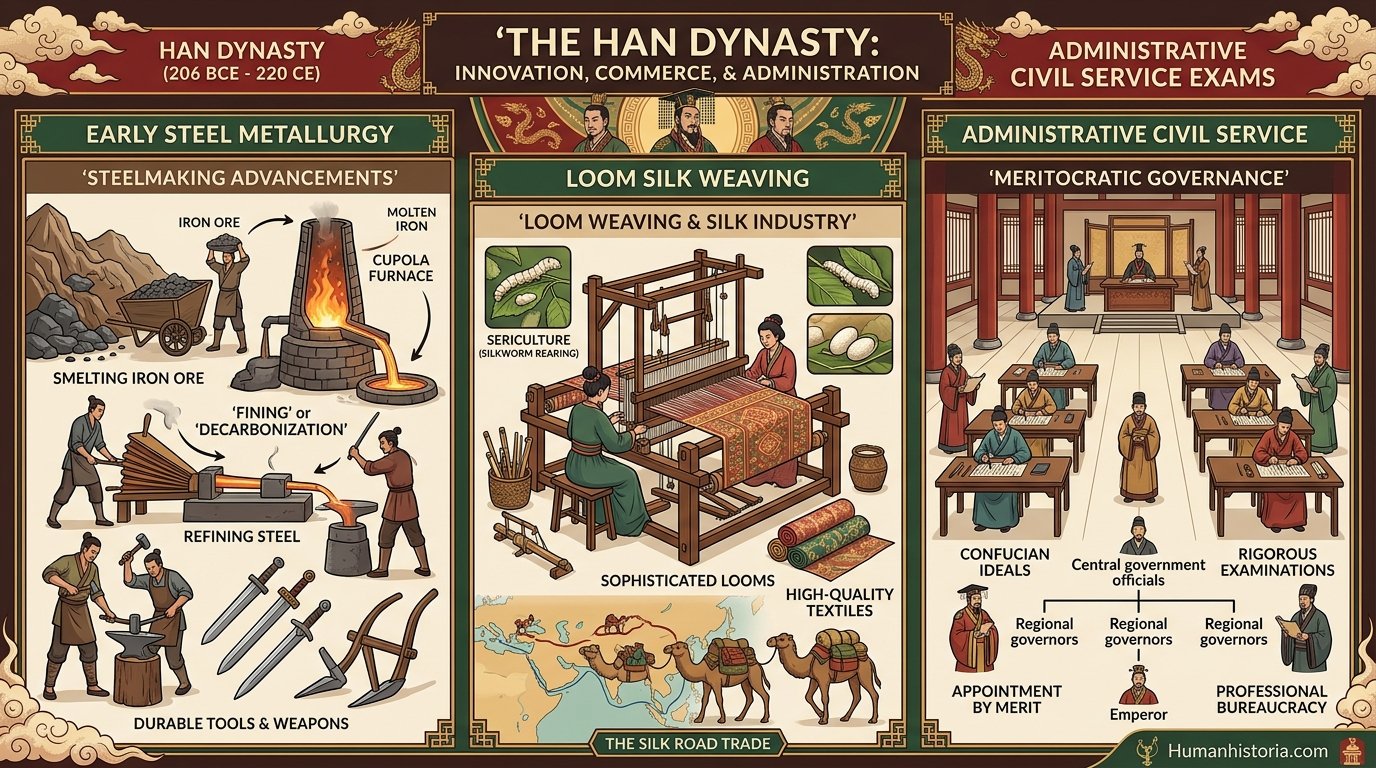
The administrative integration of the Han Dynasty (202 BCE – 220 CE) represents one of the most successful experiments in imperial governance in human history. Following the rapid collapse of the repressive Qin Dynasty, which had unified China through brutal legalism, the Han emperors sought a more stable and humane administrative model. By combining Qin's centralized structural framework with Confucian philosophy, the Han developed a professional, merit-based Civil Service. Through the establishment of the imperial examinations and administrative registries, the Han replaced hereditary aristocracy with educated bureaucrats, creating a centralized administrative system that survived for two millennia and bound a vast, ethnically diverse empire into a single cultural consciousness.

The Qin Legacy and the Han Synthesis

Before the Han Dynasty, Chinese governance was local and aristocratic. The Qin Dynasty (221–206 BCE) shattered this system by conquering all warring states, replacing feudal lords with appointed military governors, and standardizing writing, weights, and measures. However, the Qin relied on Legalismβ€”a philosophy that maintained order through harsh punishments and total state control. This extreme repression triggered massive rebellions, leading to the dynasty's collapse after only fifteen years. The Han founder, Liu Bang (Emperor Gaozu), realized that an empire could be conquered on horseback, but it could not be governed from horseback.

To secure the loyalty of the population while maintaining centralized control, the Han developed the Han Synthesis. They kept the structural machinery of the Qinβ€”the division of the empire into commanderies, the centralized civil hierarchy, and the standardized legal codesβ€”but replaced Legalist ideology with Confucianism. Under the patronage of Emperor Wu of Han (reigned 141–87 BCE), Confucianism was declared the official state philosophy. The government was no longer viewed as a repressive police state, but as a moral family, where the emperor was the father and the bureaucrats were moral exemplars who governed through education, ritual, and benevolence.

Han Dynasty civil service exam candidate writing on silk
An imperial exam candidate drafting administrative strategies on a silk scroll, testing their deep knowledge of Confucian classics and law codes.

The Imperial University and the Exams

The core of the Han administrative system was the Civil Service Examination, established in 136 BCE. To staff the bureaucracy with qualified officials, Emperor Wu founded the Taixue (Imperial University) in the capital city of Chang'an. The university trained students in the Five Classics of Confucius, preparing them for examinations on administration, law, and classic texts.

The civil service system introduced key innovations that defined modern administration:

  • Meritocracy over Aristocracy: In theory, any free male in the empire, regardless of birth, could attend the university or sit for the examinations. Wealthy merchant families and provincial landowners could elevate their sons into the ruling class through education, reducing the power of hereditary lords.
  • Standardized Curricula: The examination tested knowledge of Confucian texts, ensuring that every official across the empire shared an identical ethical vocabulary, administrative philosophy, and written language.
  • The Rule of Avoidance: To prevent local corruption and nepotism, officials were prohibited from serving in their home provinces, and their terms were limited to three years, ensuring their loyalty remained with the central emperor rather than local clans.

The Imperial Examination System (Keju)

The Civil Service Exam system initiated by the Han was refined by later dynasties, culminating in the Keju system of the Tang and Song. The exams became exceptionally competitive, requiring candidates to memorize hundreds of thousands of characters of classic literature. The system created an elite class of "scholar-officials" (literati) who dominated Chinese politics and culture. It was widely admired by European observers in the 17th century, inspiring the civil service models adopted by Britain and France in the 19th century, making it China's most influential administrative export.

Documentary Governance: The Power of the Scroll

The Han civil service was a documentary bureaucracy. Every administrative actβ€”tax collections, court trials, population censuses, and military ordersβ€”had to be recorded in writing and filed with central offices. Because paper was only invented in the late Han (traditionally attributed to Cai Lun in 105 CE), Han scribes wrote on bamboo slips or wooden boards, which were linked together with cords to form scrolls. This system required a massive class of professional scribes who spent their lives copying, filing, and transporting official documents.

Excavated Han Dynasty bamboo slips scroll containing cavalry documents
Authentic excavated Han Dynasty bamboo slips linked by string to form a scroll, containing military and administrative documents from the northwest frontiers.

The scale of this documentary system was vast. Scribes maintained a universal Imperial Census that counted the population and land ownership of every household in China. The census of 2 CE recorded a population of 57.6 million people living in 12.2 million households. This census allowed the government to collect taxes, coordinate corvΓ©e labor projects (such as repairing the Great Wall or building roads), and draft men for military service, establishing a level of social control that was unmatched by the contemporary Roman Empire.

Bamboo slips linked with string forming tax records
An administrative ledger constructed from linked bamboo slips, used by Han Dynasty tax officials to record agricultural yields and household censuses.

The Discovery of Jε»Ά Han Bamboo Slips

In the early 20th century, archaeologists excavating Han-era military fortresses along the Silk Road in Juyan (Inner Mongolia) discovered over 30,000 intact bamboo slips. These documents, preserved by the dry desert air, contain the daily logs of border guards, listing tax returns, food rations, horse inventories, and even personal letters. These findings prove that the Han administrative system functioned with high efficiency even in the most remote corners of the empire, showing the power of the documentary bureaucracy.

Cultural Integration and the Legacy of Han

The most lasting achievement of the Han civil service was the cultural integration of China. By recruiting provincial elites into the imperial administration, the Han turned potential rebels into stakeholders in the imperial system. A scholar from the far south and an official from the northern border shared the same written script, read the same Confucian texts, and answered to the same administrative hierarchy in Chang'an. This shared elite culture survived the political collapse of the Han Dynasty, ensuring that during periods of division, Chinese leaders always sought to reunify the empire under a single administrative model.

The civil service established a pattern of governance that defined Chinese history for two thousand years. The term "Han" became synonymous with Chinese identity, with the majority ethnic group still calling themselves Han Chinese today. The Han dynasty proved that the survival of a large empire depends not just on military power, but on the creation of a professional, merit-based administration that coordinates the resources of the state while providing a shared moral framework for its citizens.

The Bamboo Annals and the Imperial Census

The administrative efficiency of the Han civil service was maintained by the compilation of the Imperial Census. Scribes recorded that the first comprehensive census of China was completed in 2 CE, registering a population of 59,594,978 people across 12,233,062 households. This massive undertaking required local officials to record the names, ages, occupations, and taxable property of every citizen on slips of bamboo bound by thread. These census slips were sent to the capital in Chang'an, providing the imperial court with the data necessary to calculate tax revenues, coordinate labor service (*corvΓ©e*), and draft soldiers for the frontier armies.

This administrative system turned China into one of the most documented societies of antiquity. By using standardized weights, measures, and writing characters, the Han administration minimized communication errors between the imperial center and the provinces. Local officials served as the link between the emperor and the commoners, managing grain storage bins to prevent famines, resolving property disputes, and administering justice. This civil service structure survived the collapse of the Han Dynasty itself, serving as the administrative blueprint for successive dynasties and proving that bureaucratic standardization is the key to maintaining empire across a vast continent.

The Confucian State Philosophy and Administrative Morality

The administrative structure of the Han Dynasty was unified by the adoption of Confucianism as the official state philosophy. Scribes and scholars noted that the Emperor Wu of Han established the Imperial Academy (*Taixue*) in 124 BCE to train administrative candidates in the Confucian Classics. Scribes learned the virtues of filial piety (*xiao*), ritual propriety (*li*), and benevolence (*ren*), which were applied to daily government work. This philosophical standard created a shared administrative morality among civil servants. The ideal official was not just a tax collector or judge, but a moral exemplar who ruled by virtue and set a model for the commoners, establishing a stable social hierarchy that balanced legal rules with moral consensus.

The Imperial Legacy of Han Administration

Ultimately, the administrative systems designed during the Han Dynasty laid the organizational foundations for the next two millennia of Chinese imperial history. Scribes and historians note that subsequent dynasties, including the Tang, Song, Ming, and Qing, all maintained the core structures of civil service examination, imperial academy training, and detailed census registration. By establishing a professional, merit-based bureaucracy that was decoupled from aristocratic birth, Han administration created a remarkably resilient state structure that could survive dynastic transitions, barbarian invasions, and peasant rebellions, proving that systematic administration is the most durable tool of large-scale human governance.

Conclusion: The Bureaucratic Standard

The Han Dynasty civil service was the world's first modern professional administration. By replacing family ties with educational merit, standardizing administrative procedures, and maintaining exhaustive census and tax records, the Han created a stable state structure that outlasted the rise and fall of dynasties. The system demonstrated that the true strength of an empire lies in its civil administration, showing that a society guided by moral education and institutional standardization can achieve levels of stability and cultural unity that survive the test of time.

βš–οΈ

Historian Debate: Confucianism vs. Legalism in Han Rule

Confucian Moral Administration

Official Han histories credit Emperor Wu with establishing Confucianism as the state ideology, creating a bureaucracy based on virtue and classical scholarship.

Pragmatic Legalist Realism

Modern historians note that behind the Confucian facade, the Han state operated via Legalist principlesβ€”harsh punishments, state monopolies (salt/iron), and strict bureaucratic surveillance.

The Han Dynasty consolidated the bureaucratic structure that governed China for two millennia.

"To govern by virtue is like the North Star β€” it keeps its place while all the other stars bow to it."

β€” The Analects of Confucius; adopted as the foundational text for Han civil service examinations.

Further Reading

  • The Han Empire β€” by Mark Edward Lewis. An excellent study of the social, military, and administrative structures of the Han state.
  • Records of the Grand Historian β€” by Sima Qian. The primary historical source for early Chinese history, written by the Han court historian.
πŸ“– Scholar Mode Active β€” Click to exit focused reading
Selected Era

Prehistoric Era

Millions of years ago to ~3000 BCE

The dawn of humanity. From the evolutionary split of early hominids to the mastery of stone tools, fire, and the birth of language.

Landmark Milestones

Welcome to Historia

Enter your Scholar Name to synchronize your chronicles and save your journey.