Examine the tangible relics, physical tokens, and revolutionary machines that shaped civilizational growth.
🎥 VIDEO HUB & SHORTS
Watch visual summaries, site intros, and mini-documentaries chronicling 300,000 years of world history.
📊 HISTORICAL INFOGRAPHICS ARCHIVE
Museum-grade visual graphics, civilizational timelines, and architectural breakdowns curated for educators and history lovers.
THE HISTORIA CIRCLE
Join the collective discussion, study logs, and contributions of fellow historians mapping humanity's path.
Historia Forum Discussions
Start a Discussion Thread
THEMATIC PATHWAYS
Trace a single thread — disease, trade, energy, migration — across all eras and civilizations.
History is not just a sequence of events — it is a network of patterns. These thematic pathways allow you to follow a single concept across thousands of years: how agriculture spread, how warfare evolved, how trade routes shaped civilizations. Each pathway collects the most relevant chronicles across all eras.
🧩
How is this different from the sidebar Topics?
While the sidebar Topics (like Science & Tech or Empires) filter articles within your selected historical Era, Thematic Pathways cut horizontally across all eras (from Prehistoric to the Future). Use Themes to trace a single concept's evolutionary line across 300,000 years.
CIVILIZATION HUBS
Comprehensive profiles of the world's greatest civilizations and empires — from ancient cradles to global super-states.
Human Historia provides an academically rich exploration of the world's most influential civilizations. From the monumental achievements of ancient Egypt, Han China, and the Roman Empire, to the sophisticated societies of the Maya, the Islamic Caliphates, and West African empires, these hubs offer deep insights into the cultural, political, and technological legacies that continue to shape our global story.
EVOLUTION OF HUMAN SKILLS
Trace the compounding technologies, practical capabilities, and cognitive milestones of the human species.
Human progress is a story of compounding skills. Every breakthrough, from the spark of prehistoric fire to modern silicon transistors, builds directly on previous generations of ingenuity. Hover over a skill node to trace its historical prerequisites, and click it to explore its development timeline, species-wide impact, and related chronicles.
Prehistoric Ancient Medieval Modern Future
🧠
Select any skill node in the tree to explore its evolutionary path, development timeline, and historical impact.
ACADEMIC PASSPORT
Track your intellectual journey, quiz outcomes, and historical badges of honor.
HISTORIA PASSPORT⏳
👤Scribe Novice
Scholar NameHistoria Explorer
Rank RatingSumerian Record Scribe
Chronicles Read0 / 48
Study Guide Pins0 Guides
Security AccessLevel 1 (Novice)
Earned Badges of Honor
🔥
Fire Keeper
Unlock 3 prehistoric chronicles.
🏛️
Codex Keeper
Unlock 3 ancient chronicles.
🏰
Guild Master
Unlock 3 medieval chronicles.
⚙️
Steam Engineer
Unlock 3 modern chronicles.
🚀
Singularity Sage
Unlock 3 future chronicles.
👑
Grand Scholar
Score 5/5 on the Lab Quiz.
Recent Lab Activities
No recent activities recorded. Take a quiz or bookmark articles!
Curated Exhibition
Human Historia
An immersive graphical anthology tracing the paths of civilizations, breakthroughs, and conflicts that forged the modern consciousness.
25Chronicles
Showing all articles
Age of Steam Navigation: Robert Fulton, Transatlantic Travel & Iron Hulls
Written by Historia TransportHistorical Era: MODERN
🎨 Historical Illustration (AI)
* Note: Cover image is an AI-generated historical illustration.
🧠Key Chronicle Takeaway (Atomic Summary)
How steel rails and steam pistons accelerated global shipping and travel times.
During the 19th century, the adaptation of the steam engine to transportation compressed global space and time. By replacing wind-dependent sailing vessels with coal-powered Steamships, and replacing horse-drawn wagons with iron Locomotives, humanity built the first global logistics network. Led by inventors like Robert Fulton and visionary engineers like Isambard Kingdom Brunel, this transportation revolution freed maritime trade from the whims of weather, enabled the mass migration of millions of people across oceans, facilitated the expansion of global empires, and established the international supply chains that integrated the global economy.
Pre-Steam Maritime Trade: The Tyranny of the Wind
For millennia, maritime trade and travel were restricted by the wind. Sailing vessels—from ancient Roman merchant galleys to Spanish galleons and the fast 19th-century Clipper Ships—depended on trade winds, monsoons, and ocean currents.
This organic transport regime suffered from structural limits:
Unpredictable Schedules: A transatlantic crossing under sail could take anywhere from four to eight weeks, depending on weather. Ships could be delayed for weeks by calm winds in the Horse Latitudes (subtropical ridges where high pressure creates still air) or wrecked by sudden ocean storms.
Geographic Constraints: Sailing ships struggled to navigate narrow, windless river channels or travel against swift river currents, limiting trade with the interior of continents.
Physical Limits of Wood: Wooden hulls could not exceed a length of roughly 80 meters without flexing and leaking under wave action, limiting cargo capacity.
Robert Fulton and the Clermont
The breakthrough in steam-powered navigation occurred on the rivers of North America. Early inventors, most notably John Fitch in the 1780s, had successfully built steam-powered boats, but they were mechanical failures that could not compete with horse-drawn transport.
In 1807, the American inventor Robert Fulton built the Clermont (officially the North River Steamboat). Fulton purchased a Boulton & Watt steam engine from England and fitted it to a wooden hull equipped with two side paddle wheels.
The Clermont’s maiden voyage along the Hudson River from New York City to Albany—a distance of 150 miles—was completed in 32 hours, traveling against the river’s current at an average speed of 5 miles per hour. A sailing sloop typically required up to four days to make the same trip. The Clermont proved the commercial viability of steam propulsion for passengers and cargo on inland waterways, sparking a steamboat boom along the Mississippi, Ohio, and Hudson rivers, which accelerated the settlement and economic integration of the American interior.
From Paddle Wheels to Screw Propellers
While paddle wheel steamboats dominated rivers, they were unsuited for the open ocean. In rough seas, waves lifted one paddle wheel completely out of the water while submerging the other, straining the engine. Furthermore, paddle wheels were vulnerable to damage from waves and sat too high in the water, making them easy targets for enemy cannons in naval warfare.
This limitation prompted the invention of the Screw Propeller in the 1830s, developed independently by the Swedish inventor John Ericsson and the English inventor Francis Pettit Smith. The screw propeller placed a rotating, metal screw-shaped blade fully submerged at the rear of the ship’s hull, directly in front of the rudder.
The screw propeller was more efficient than paddle wheels:
It remained fully submerged under wave action, providing continuous thrust.
It was protected from collision and gunfire by the ship's hull.
By accelerating water directly past the rudder, it improved the ship's steering and maneuverability.
Isambard Kingdom Brunel: The Leviathans of Steel
The English engineer Isambard Kingdom Brunel drove the development of ocean-going steamships. In 1837, he built the SS Great Western, the first steamship designed for regular transatlantic service. In 1843, he launched the SS Great Britain—the first iron-hulled, screw-propelled steamship to cross the Atlantic. The Great Britain proved that iron hulls were stronger and more buoyant than wood, allowing ships to scale to massive sizes. His final ship, the SS Great Eastern (1858), was five times larger than any vessel of its era, constructed to carry enough coal to sail to Australia and back without refueling. In 1866, the Great Eastern successfully laid the first permanent transatlantic telegraph cable, linking Europe and America in real time.
Locomotives and the Expansion of Land Trade
Simultaneously, the steam engine was adapted to land transport. In 1804, the Cornish engineer Richard Trevithick built the first high-pressure steam locomotive, running it on iron rails designed for horse-drawn mining carts. This was refined by George Stephenson, whose locomotive The Rocket won the Rainhill Trials in 1829, establishing the standard features of locomotives (such as the multi-tubular boiler and the steam blast pipe).
The opening of the Liverpool and Manchester Railway in 1830 initiated the railway age. Railways bypassed the limits of river routes, linking inland coal mines directly to manufacturing centers and ports. By reducing land shipping costs by up to 90%, railways created integrated national markets, accelerated urbanization, and allowed agricultural produce to be shipped to urban centers before spoiling, transforming the geography of the modern state.
Canal Expansion: Suez and Panama
The rise of the steamship drove the construction of massive global canals. The Suez Canal (opened in 1869) connected the Mediterranean to the Red Sea, cutting the voyage distance between Europe and Asia by 4,000 miles. Because the Red Sea was narrow and subject to unpredictable winds, sailing ships could not easily use the canal. The Suez Canal was designed for steamships, accelerating the transition to steam power. The Panama Canal (opened in 1914) similarly bypassed the dangerous voyage around Cape Horn, linking the Atlantic and Pacific Oceans.
Socio-Economic Consequences: The Shrinking Globe
The steamship and locomotive compressed global travel times, transforming human society:
Mass Migration: Between 1850 and 1914, steamships carried over 40 million European immigrants to the Americas. The voyage was safe, scheduled, and cheap, allowing working-class families to seek new lives in the Western Hemisphere.
Global Supply Chains: Steamships equipped with refrigeration systems (such as the SS Paraguay in 1877) transported Argentine beef, Australian mutton, and New Zealand butter to European markets, establishing the first international agricultural supply chains.
Imperial Integration: Steamships allowed imperial powers (such as Great Britain) to move troops, administrators, and gunboats rapidly to remote colonies, enforcing control and integrating colonial raw materials into industrial economies.
The Laying of the Transatlantic Telegraph Cable
The expansion of the steamship was coupled with the development of telecommunications. In 1858, Cyrus West Field led the first attempt to lay a telegraph cable across the Atlantic Ocean floor. However, early cables failed due to poor insulation and high voltage damage.
In 1865, Brunel’s massive steamship, the SS Great Eastern, was chartered for the task. The Great Eastern was the only vessel large enough to hold the 2,300 miles of heavy copper cable. In 1866, the ship successfully laid the cable, linking Valentia Island in Ireland to Heart's Content in Newfoundland. This coupled steam transport with electrical communication, compressing information transfer times between Europe and America from a 10-day steamship voyage to a few seconds, establishing the infrastructure of the modern information age.
The Ironclads: The Battle of Hampton Roads
The transition of the steamship into naval warfare was marked by the Battle of Hampton Roads (1862) during the American Civil War. The battle featured the clash of the USS Monitor and the CSS Virginia (formerly the USS Merrimack)—two iron-armored, steam-powered warships. The battle ended in a draw, as neither ship's cannons could breach the other's iron plating. However, the battle demonstrated that wooden sailing warships were obsolete. Overnight, naval powers across the globe halted the construction of wooden ships, transitioning to steam-powered, iron-hulled war fleets, reshaping naval strategy.
The Great Western Steamship Company
The commercialization of transatlantic steam travel was driven by the Great Western Steamship Company, founded in 1836 to operate liners designed by Isambard Kingdom Brunel. The company’s flagship, the SS Great Western, was a paddle steamer that made its maiden voyage to New York in 15 days, beating the fastest sailing pack ships. Although the company faced competition and financial challenges, its regular schedules proved that steamships could sustain international trade and travel, establishing the business models that structured the shipping lines of the late 19th century.
In summary, the historical and structural developments explored in this chronicle demonstrate that human progress is a collective, cumulative endeavor. No single technology, empire, law, or language arose in a vacuum; each milestone built directly upon the achievements, resources, and failures of the civilizations that came before it. By examining these complex connections, we can see how early hominids mastering fire initiated a chain of technological innovations that led to the steam engine, heavy industry, and the digital age. As humanity stands on the brink of interplanetary exploration and artificial superintelligence, understanding these historical precedents provides us with the perspective needed to navigate the ethical, social, and technological challenges of the future. The human odyssey remains an ongoing, choices-driven journey across space and time, shaping the destiny of our species and the universe.
Brunel's Transatlantic Legacy: Great Western and Great Britain
The commercialization of transatlantic steam travel was accelerated by the work of the legendary British engineer Isambard Kingdom Brunel. In 1838, Brunel’s Great Western Steamship Company launched the SS Great Western, a wooden paddle-wheel steamer that made its maiden voyage from Bristol to New York in 15 days, proving that steam vessels could carry enough coal to cross the Atlantic. Building on this success, Brunel designed the SS Great Britain (launched in 1843), which revolutionized maritime architecture.
The Great Britain was the first ship to combine an iron hull with a screw propeller rather than paddle wheels. The iron hull made the vessel stronger and larger than wooden ships, while the screw propeller was far more efficient in rough ocean waves. Brunel’s designs proved that large steamships could sustain regular transatlantic commerce and passenger travel, establishing the business models that structured the shipping lines of the late 19th century and proving that ocean travel could run on precise, industrial schedules.
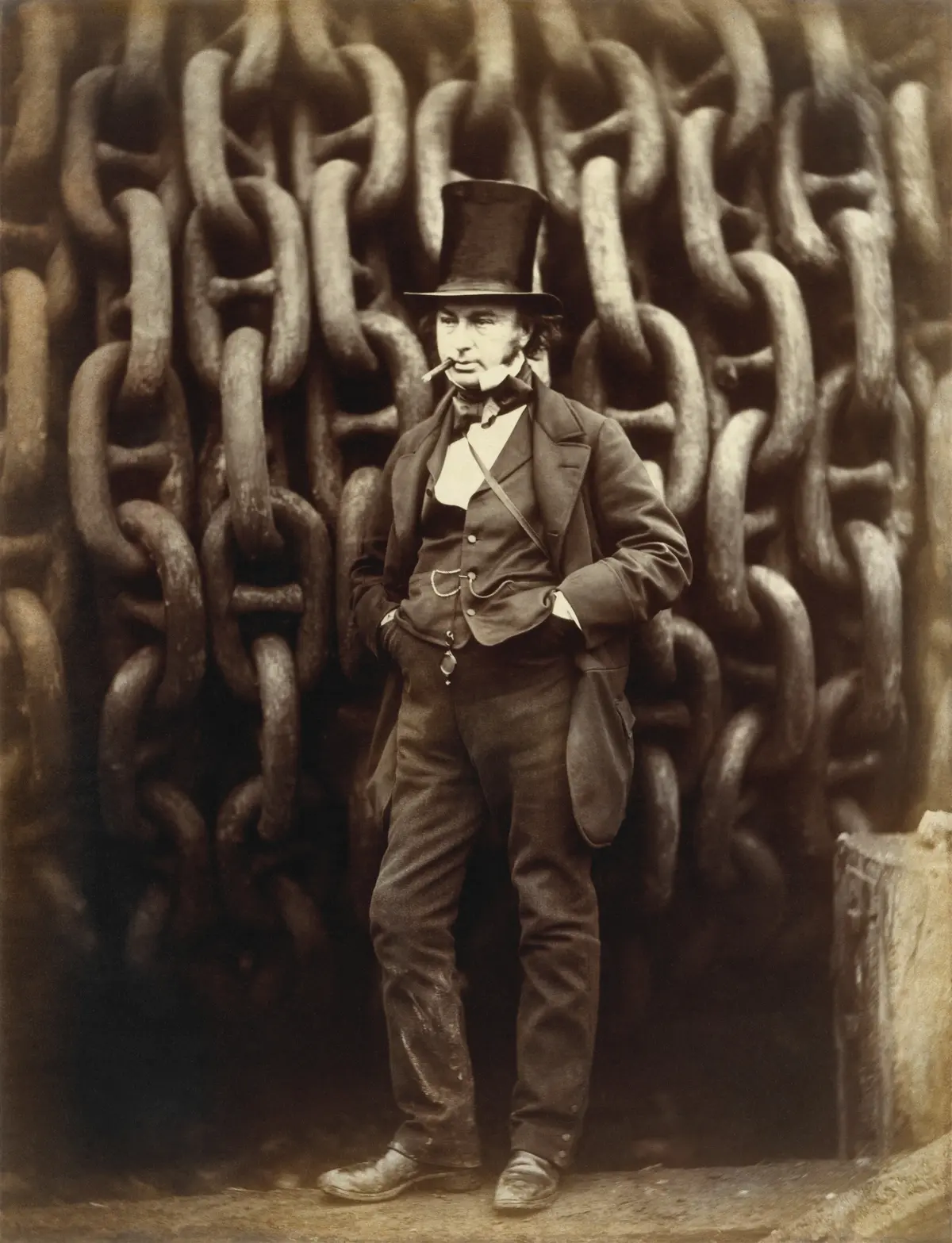
Historical photograph of the massive iron hull and paddle-wheel of the SS Great Eastern during its launch phase in Victorian England.
Conclusion and Legacy
By replacing sails with coal boilers and screw propellers, the steamship compressed the distance between continents. Along with the railway, it created the infrastructure of globalization, proving that human engineering can overcome geographic limits and construct a unified, real-time global economy.
⚖️
Historian Debate: Did Steamships Enable 19th-Century Imperialism?
The Tool of Empire
Historians like Daniel Headrick argue that steamships, particularly shallow-draft gunboats, were the decisive technology that allowed European powers to penetrate African and Asian rivers, enforcing colonial rule.
Economic Integration and Free Trade
Alternative views suggest steamships were primarily economic tools that lowered global cargo rates, integrating agricultural regions into the world market.
Steamships ended human dependence on trade winds, stabilizing maritime schedules.
"The steamship has abolished the ocean. We are now connected to every continent by a bridge of coal and iron."
— Isambard Kingdom Brunel, Address to the Great Western Railway shareholders (1852).
Related Civilizations & Contexts
British EmpireQing Dynasty ChinaUnited StatesOttoman Empire
Further Reading
The Tools of Empire: Technology and European Imperialism — by Daniel R. Headrick. The classic study detailing how steamships, quinine, and rifles enabled colonization.
Brunel: The Life and Times of the Great Engineer — by Angus Buchanan. A biography of the engineer who built the Great Western steamships.
📖 Scholar Mode Active — Click to exit focused reading
History Lab 🧪
Run simulated matches between civilizations and convert ancient currencies.
🕵️ Who Am I? (The Historical Guess Game)
A secret historical figure has been selected. Ask yes/no questions to narrow down the pool of candidates. Click any active card to make your accusation!
Secret Identity
❓ Who Am I?
Ask questions using the board below to narrow down my identity.
Ask a Question:
Question LogQuestions: 0 / 7
No questions asked yet.
Candidate Board:
🗺️ Timeline Scramble
Five historical events appear out of order. Click them in the correct chronological sequence — from oldest to most recent. How well do you know your history?
🏺 Relic or Fake?
Is this a real historical artifact or a convincing fabrication? Judge each one based on its description and era — then see the truth revealed!
Artifact 1 / 10Score: 0
Empire Matchup Simulator
Empire ATerritory Size (Peak, M km²)Empire B
00
Empire APopulation (Peak, Millions)Empire B
00
Empire AMilitary Power (Army Size)Empire B
00
Tactical Battle Analysis
Select empires and click simulate to run evaluations.
Historical Purchasing Power Converter
See what ancient coins are worth in modern terms and check their historical purchasing power.
Modern Value Equivalent
$0.00 USD
Historical Purchasing Power:
Select currency to view purchasing capability.
Historical Identity Generator
Forge an authentic historical identity from ancient civilisations, complete with linguistic meaning and biography.
Neutral
Gaius Julius
Meaning:Descendant of Jupiter
Historical Background:
A Roman citizen and clerk who worked in the forum under Roman republic rule.
Chrono-Cultural Fusion Simulator
Fuse the culture, technology, and governance of two legendary civilizations to synthesize a unique hybrid society.
Cohesion & Coexistence Rate
85%
🏛️ Hybrid Architecture
⚙️ Synthesized Asset
📜 Synthetic Governance
Historical Tactics & Trivia Quiz
Test your historical knowledge and battle tactics to claim your administrative rank.
8 Questions • Multi-Era
You will be presented with random scenarios and trivia spanning ancient Egypt, classical Rome, Islamic Golden Age, and the modern industrial era. Complete the evaluation to see your historical title!
Question 1 of 8Score: 0
What was the Code of Hammurabi written on?
Correct!
Evaluation Complete!
6 / 8
Correct
Rank Attained
Imperial Legionary
Your knowledge of classical strategy and administrative structures is respectable.
🎲 Counterfactual "What If?" Scenario Simulator
Explore alternative historical trajectories by tweaking key civilizational pivot points.
Simulated Shift
Selected Era
Prehistoric Era
Millions of years ago to ~3000 BCE
The dawn of humanity. From the evolutionary split of early hominids to the mastery of stone tools, fire, and the birth of language.
Landmark Milestones
Welcome to Historia
Enter your Scholar Name to synchronize your chronicles and save your journey.