From prehistoric origins to the modern era—discover the turning points, lost empires, and breakthroughs of world history through interactive timelines and visual guides.
Examine the tangible relics, physical tokens, and revolutionary machines that shaped civilizational growth.
🎥 VIDEO HUB & SHORTS
Watch visual summaries, site intros, and mini-documentaries chronicling 300,000 years of world history.
📊 HISTORICAL INFOGRAPHICS ARCHIVE
Museum-grade visual graphics, civilizational timelines, and architectural breakdowns curated for educators and history lovers.
THE HISTORIA CIRCLE
Join the collective discussion, study logs, and contributions of fellow historians mapping humanity's path.
Historia Forum Discussions
Start a Discussion Thread
THEMATIC PATHWAYS
Trace a single thread — disease, trade, energy, migration — across all eras and civilizations.
History is not just a sequence of events — it is a network of patterns. These thematic pathways allow you to follow a single concept across thousands of years: how agriculture spread, how warfare evolved, how trade routes shaped civilizations. Each pathway collects the most relevant chronicles across all eras.
🧩
How is this different from the sidebar Topics?
While the sidebar Topics (like Science & Tech or Empires) filter articles within your selected historical Era, Thematic Pathways cut horizontally across all eras (from Prehistoric to the Future). Use Themes to trace a single concept's evolutionary line across 300,000 years.
CIVILIZATION HUBS
Comprehensive profiles of the world's greatest civilizations and empires — from ancient cradles to global super-states.
Human Historia provides an academically rich exploration of the world's most influential civilizations. From the monumental achievements of ancient Egypt, Han China, and the Roman Empire, to the sophisticated societies of the Maya, the Islamic Caliphates, and West African empires, these hubs offer deep insights into the cultural, political, and technological legacies that continue to shape our global story.
EVOLUTION OF HUMAN SKILLS
Trace the compounding technologies, practical capabilities, and cognitive milestones of the human species.
Human progress is a story of compounding skills. Every breakthrough, from the spark of prehistoric fire to modern silicon transistors, builds directly on previous generations of ingenuity. Hover over a skill node to trace its historical prerequisites, and click it to explore its development timeline, species-wide impact, and related chronicles.
Prehistoric Ancient Medieval Modern Future
🧠
Select any skill node in the tree to explore its evolutionary path, development timeline, and historical impact.
ACADEMIC PASSPORT
Track your intellectual journey, quiz outcomes, and historical badges of honor.
HISTORIA PASSPORT⏳
👤Scribe Novice
Scholar NameHistoria Explorer
Rank RatingSumerian Record Scribe
Chronicles Read0 / 48
Study Guide Pins0 Guides
Security AccessLevel 1 (Novice)
Earned Badges of Honor
🔥
Fire Keeper
Unlock 3 prehistoric chronicles.
🏛️
Codex Keeper
Unlock 3 ancient chronicles.
🏰
Guild Master
Unlock 3 medieval chronicles.
⚙️
Steam Engineer
Unlock 3 modern chronicles.
🚀
Singularity Sage
Unlock 3 future chronicles.
👑
Grand Scholar
Score 5/5 on the Lab Quiz.
Recent Lab Activities
No recent activities recorded. Take a quiz or bookmark articles!
🏛️ MISSION & ARCHIVAL STANDARDS
About Human Historia
A visual encyclopedia and timeline of human history, dedicated to documenting 300,000 years of civilizational evolution through rigorous research, authentic artifacts, and visual clarity.
🌍
The 300,000-Year Story
Human Historia traces our collective journey across five historical epochs: Prehistory, Ancient Worlds, Middle Ages, Modern Age, and Future Horizons. From the first control of fire to quantum computation, we organize turning points into interconnected timelines.
📜
Historiographical Rigor
Every chronicle is built upon primary historical manifests, contemporary excavation reports, and peer-reviewed historical consensus. We prioritize authentic public domain artifacts and clearly identify scholarly debates surrounding major civilizational transitions.
🎨
Museum-Grade Visuals
Complex historical transitions demand visual understanding. We develop high-resolution infographics, architectural cutaways, and comparative territorial maps to transform abstract timelines into vivid, unforgettable learning experiences.
📖
Educational Access
Knowledge belongs to humanity. Human Historia is free, ad-light, and engineered as an educational resource for students, classroom educators, academic researchers, and curious minds across all continents.
Editorial Governance & Inquiries
We welcome peer reviews, academic corrections, museum archival collaborations, and educational partnerships. To submit historical inquiries or provide archival feedback, reach our editorial desk directly.
An immersive graphical anthology tracing the paths of civilizations, breakthroughs, and conflicts that forged the modern consciousness.
25Chronicles
Showing all articles
Great Zimbabwe: History, Origins & Impact's Monumental Stone City
Written by Humanhistoria AdministrationHistorical Era: MEDIEVAL
In 1871, a British archaeologist named Carl Mauch stood before the greatest stone structures in sub-Saharan Africa and decided, after some reflection, that they had been built by ancient Phoenicians. His reasoning was not complicated: the walls were too well-made, the city too large, the engineering too sophisticated to have been produced by the Bantu-speaking Africans who lived around the site. Therefore, Africans could not have built it. Mauch's conclusion was not challenged by his professional contemporaries, not because the evidence supported it — it did not — but because the conclusion fit the intellectual and political architecture of the age. The site he was examining was Great Zimbabwe, a complex of granite enclosures and towers in the southeastern lowlands of modern Zimbabwe whose principal structure — the Great Enclosure — remains the largest ancient stone building in sub-Saharan Africa. It was built, we now know beyond any reasonable doubt, by the ancestors of the Shona-speaking people who still live in the region, reaching its architectural and political peak between approximately 1100 and 1450 CE. Getting to that "we now know" took a century of systematic falsification, colonial propaganda, career destruction, and eventually the weight of physical evidence so overwhelming that no alternative interpretation could survive.
🎯 Quick Historical Summary
What Was the Civilization of Great Zimbabwe?
Constructed between the 11th and 15th centuries in southern Africa, Great Zimbabwe was the stone capital of a prosperous Shona kingdom. Its massive curving granite walls—built entirely without mortar—housed up to 18,000 residents, serving as the inland hub for gold and ivory trade reaching as far as Arabia and China.
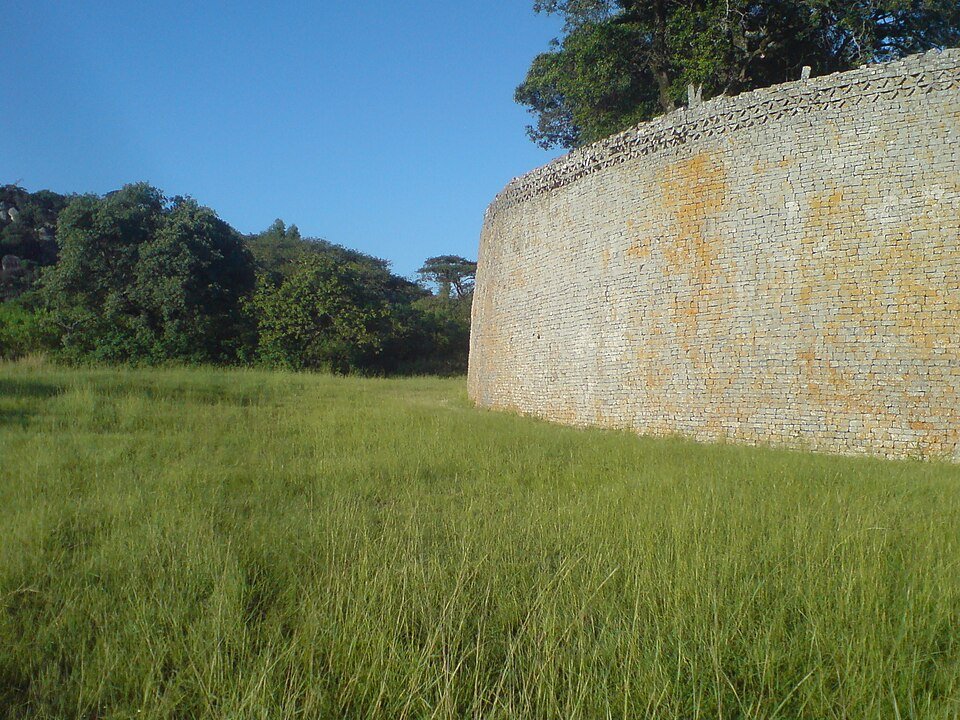
Archival visual record and historical depiction representing Great Zimbabwe: History, Origins & Impact's Monumental Stone City.
Historical Context
The word "Zimbabwe" derives from the Shona phrase dzimba dza mabwe — "houses of stone" — and it was not a single site but a tradition. Across the southeastern African plateau, archaeologists have identified over two hundred stone enclosure sites built in the same unmortared coursed-granite style, ranging from small hilltop enclosures to the massive complex at Great Zimbabwe itself. The tradition of stone enclosure building emerged among Bantu-speaking cattle-keeping communities sometime in the 11th century CE, likely growing from an earlier tradition of stone-walling at Mapungubwe (in the Limpopo Valley, in what is now South Africa), which represents the first known southern African polity with strong evidence of social stratification and long-distance trade.
Great Zimbabwe — the term now used specifically for the central site — occupied a strategic position on the plateau between the Zambezi River to the north and the Limpopo to the south, in a region of reliable rainfall and good grazing for cattle. By the 13th century, archaeological evidence shows it had become a center of significant regional power: its elite inhabitants were consuming ceramics, glass beads, and cloth that originated in Indian Ocean trade networks, implying their integration into a commerce that connected the southern African interior to the Swahili coast ports of Kilwa, Sofala, and Mombasa, and through those ports to the Persian Gulf, India, and China. Chinese celadon porcelain — the greenish glazed stoneware associated with the Song dynasty — has been recovered in excavations at Great Zimbabwe. So has Persian glass. So have carnelian beads from Gujarat.
At its height in the 14th century, Great Zimbabwe may have housed a population of ten to eighteen thousand people — not large by Asian or Middle Eastern urban standards but remarkable by the standards of southern Africa at the time, and sustainable only because the surrounding agricultural and pastoral economy was producing consistent surpluses managed by a political authority capable of concentrating and redistributing wealth.
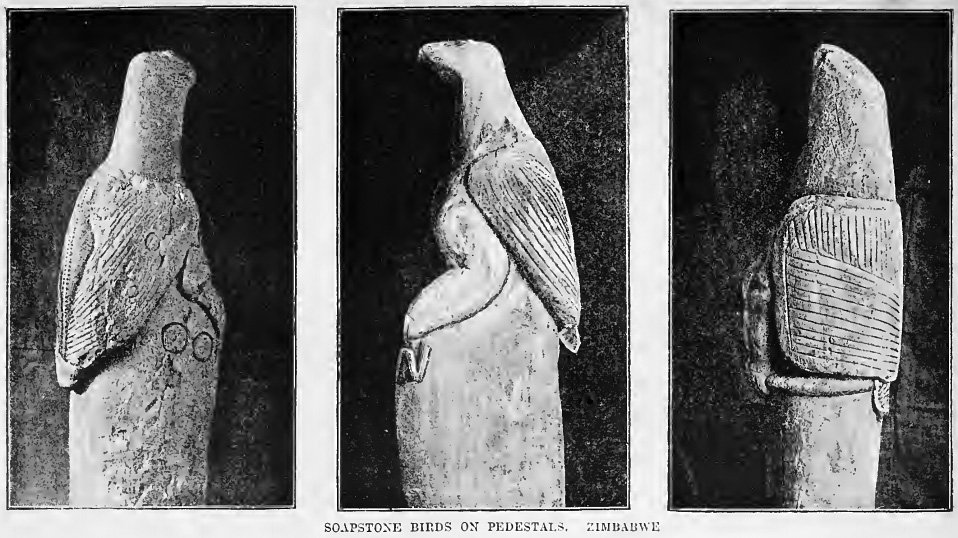
Soapstone bird sculptures discovered on pedestals in the ruins of Great Zimbabwe, serving as the historical national symbol. (Great Zimbabwe Museum)
Why It Happened: Gold, Cattle, and the Indian Ocean
Great Zimbabwe controlled the gold trade. The southeastern African plateau sits atop one of the richest gold-bearing geological formations in the world — the same formation that would eventually make the Witwatersrand (and its modern descendant, the Johannesburg mining industry) the most productive gold-mining region in history. In the medieval period, this gold was worked by small-scale mining and panning communities across the plateau, and it found its way, through intermediary traders and tribute systems, to the chiefs at Great Zimbabwe, who then exchanged it with Swahili coast traders for the prestige goods — Indian Ocean beads, cloth, porcelain — whose presence in elite burials and palace contexts confirms the transaction.
The archaeologist David Beach, who spent decades mapping the political geography of medieval Zimbabwe, argued that Great Zimbabwe's rulers — known in later Shona tradition as the Mwene Mutapa (a term the Portuguese corrupted into "Monomotapa") — derived their authority from a combination of cattle wealth, control of trade routes, and ritual power associated with spirit mediumship. Cattle in Shona society were not merely food animals but the primary measure of wealth, the medium of marriage payments, and the object of ritual sacrifice: a chief who could acquire and redistribute large numbers of cattle could sustain enormous networks of political allegiance. Gold, controlled and traded strategically, converted into Indian Ocean prestige goods, which were redistributed at court to signal the ruler's access to a wider world — this was the political economy of Great Zimbabwe.
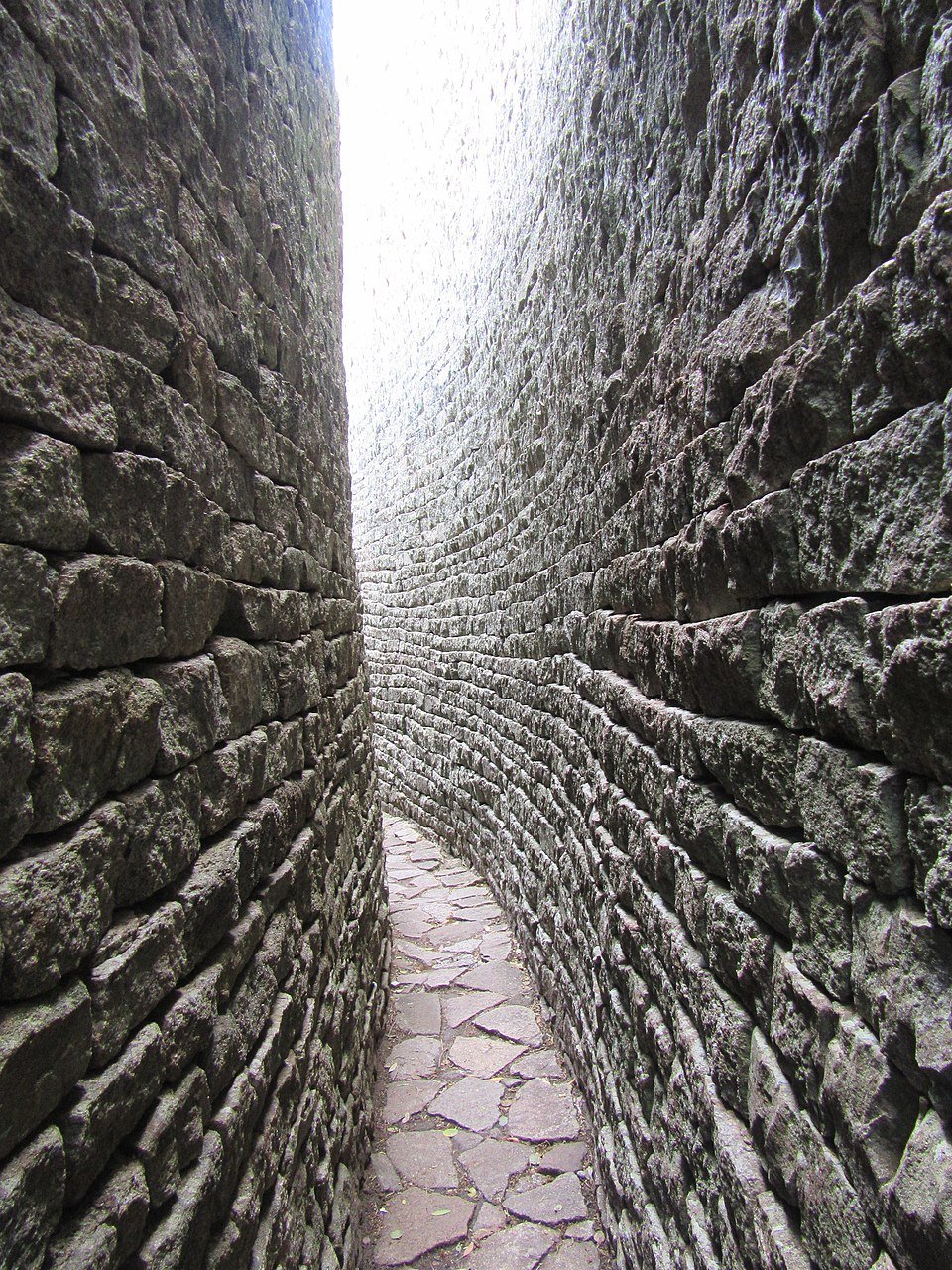
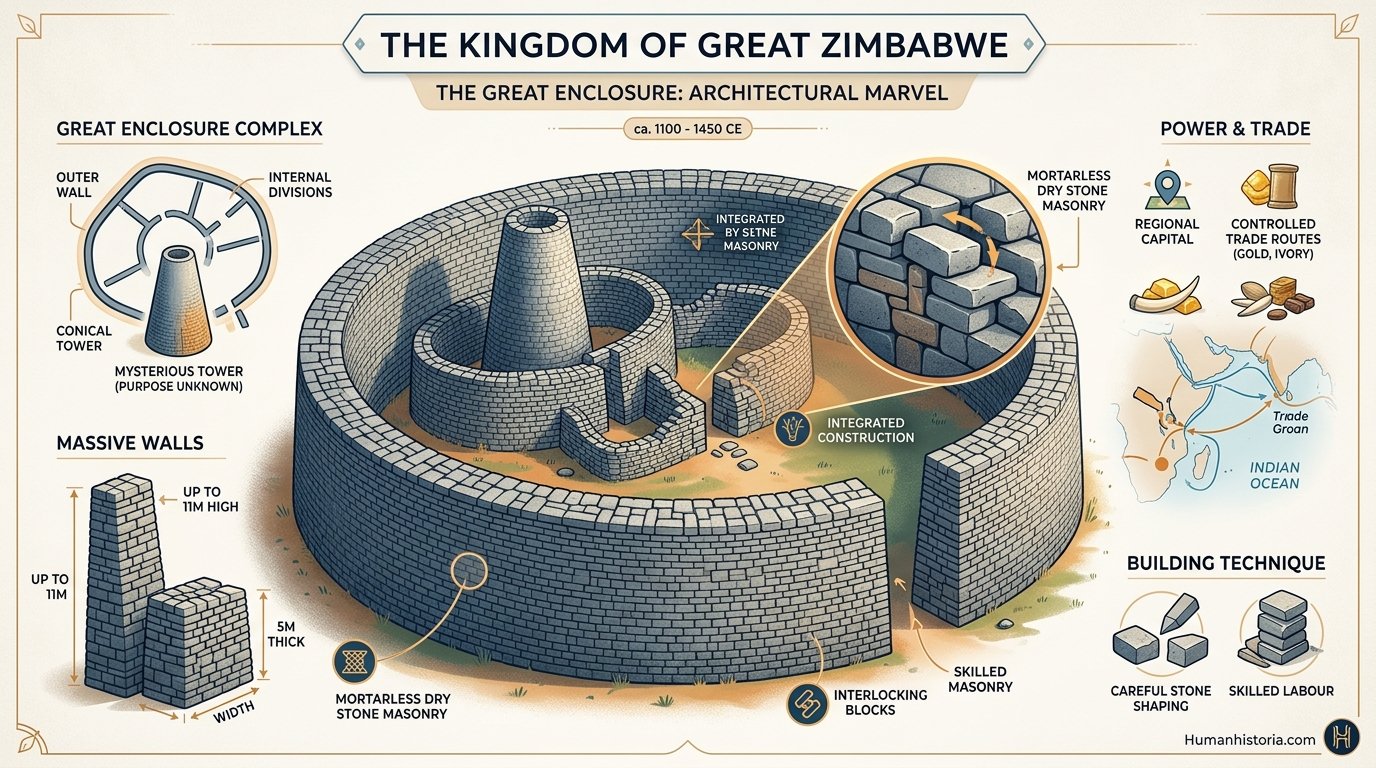
The architecture encoded this power. The Great Enclosure — whose outer wall stands over nine meters high, eleven meters thick at the base, and runs for nearly 250 meters in circumference — required an estimated fifteen thousand tonnes of dressed granite and many thousands of person-hours of skilled labor to construct. There was no mortar; the builders relied entirely on the precision of their granite block selection and placement, exploiting the natural exfoliation of the plateau's granite to obtain flat-faced slabs that could be stacked to create walls so stable that they have survived seven centuries largely intact. The engineering is not lucky — it required accumulated knowledge of how granite behaves, how to select sound blocks from weathered ones, and how to calculate the angle of slope needed to keep such massive walls from collapsing under their own weight.
The narrow, high curved stone passageway circling the interior walls of the Great Enclosure at Great Zimbabwe. (Zimbabwe)
The Archaeology of Denial: How Colonialism Falsified History
Carl Mauch's 1871 Phoenician theory was merely the first in a long line of alternative attributions that colonial-era commentators invented for Great Zimbabwe. Over the following decades, the site was variously attributed to Phoenicians, Arabs, ancient Israelites (specifically the Queen of Sheba), Persians, ancient Egyptians, and a vague "Semitic race" who had supposedly come from the north and then vanished. Each new theory shared a single feature: it located the builders somewhere other than sub-Saharan Africa. The possibility that indigenous Shona-speaking Africans — the ancestors of people then living under British colonial rule — had built the structures was treated not as a hypothesis requiring disproof but as an absurdity requiring no examination.
Cecil Rhodes, who had read Mauch's account and subsequent commentary, incorporated the Great Zimbabwe myth directly into the political ideology of his British South Africa Company's occupation of the territory (eventually named Rhodesia in his honor). If Great Zimbabwe had been built by ancient Phoenicians or Arabs, then the land on which it stood had no continuous indigenous claim — it was simply territory that had, like the empires of the ancient Mediterranean, risen and fallen. Rhodes funded archaeological investigations of Great Zimbabwe with the explicit instruction that the investigators should find evidence of ancient Semitic or Phoenician occupation, and when the site's first systematic excavator, James Theodore Bent, came back with results that were ambiguous rather than confirmatory, Rhodes was displeased. Bent's 1892 publication, The Ruined Cities of Mashonaland, hedged its claims but still gestured toward non-African builders, partly from genuine uncertainty and partly from the professional danger of saying anything too definitive.
The definitive archaeological case for indigenous Shona construction was made — and then suppressed — remarkably early. In 1905, David Randall-MacIver conducted the first stratigraphically rigorous excavation of Great Zimbabwe and concluded, on the basis of the pottery evidence alone, that the site was medieval and indigenous African. His findings were met with outrage. The British Association for the Advancement of Science commissioned another investigation, by Gertrude Caton-Thompson, who conducted meticulous excavations between 1929 and 1931 and emerged with a conclusion identical to Randall-MacIver's: Great Zimbabwe was built by indigenous Bantu-speaking Africans in the medieval period. She presented her results to the British Association in 1931 with the observation that the ruins showed "on every hand traces of a civilization which, however elementary, was unquestionably African in origin." The response from the white Rhodesian settler community was fury.
1871 — Carl Mauch attributes Great Zimbabwe to ancient Phoenicians; his conclusions are adopted wholesale by the settler community
1892 — James Theodore Bent's Ruined Cities of Mashonaland hedges but implies non-African builders, satisfying Rhodes's ideological requirements
1905 — David Randall-MacIver's stratigraphic excavation establishes the medieval, indigenous date; findings are ignored or dismissed
1931 — Gertrude Caton-Thompson's definitive excavations confirm indigenous African construction; the Rhodesian settler government moves to suppress the results in local publication
1970s — The white minority government of Rhodesia officially suppresses the indigenous-builder interpretation in government publications and school curricula; archaeologists who assert it risk career consequences
The Soapstone Birds: Symbols of a Lost Kingdom
Among the most significant artifacts recovered from Great Zimbabwe are eight carved soapstone birds, each about 30–40 cm tall, originally mounted on stone columns in the Hill Complex (the earliest and most sacred part of the site). The birds — which appear to depict the bateleur eagle, a species with strong significance in Shona spirit beliefs — represent the ancestors of the royal lineage and their connection to the spirit world. Cecil Rhodes removed six of them from the site in the 1890s and had them sent to his home in Cape Town. Zimbabwe's flag today features a stylized version of one of these birds — they are the national symbol — and the Zimbabwean government has repeatedly requested their return from museums and private collections where some still reside. Only two remain on the original site; others are scattered between the Museum of Human Science in Harare, a private collector's estate, and Cape Town.
Social & Human Effects: Living with the Myth
The political consequences of the Great Zimbabwe denial myth were not merely academic. In colonial Rhodesia, the official government position that the ruins had been built by a non-African people served as a cornerstone of the ideological justification for minority white rule: if the indigenous population had no connection to the great civilization that had once occupied the land, then the land itself had no prior legitimate claim holder. Textbooks published in Rhodesia during the 1960s and 1970s presented the Phoenician or "ancient Oriental" origin theory as established fact; museum displays in Bulawayo and Salisbury (now Harare) were curated to avoid mentioning indigenous African builders; and archaeologists working in the country who publicly stated the obvious — that Shona-speaking people had built Great Zimbabwe — faced professional censure and, in some cases, expulsion.
The Zimbabwean scholar and archaeologist Paul Sinclair, who worked at Great Zimbabwe in the 1970s and 1980s, has described the difficulty of doing honest archaeological work under these conditions: grant funding was tied to the government's ideological preferences, publication in local venues required self-censorship, and even the physical preservation of the site reflected colonial priorities — the "most photogenic" walls were maintained while the domestic and agricultural evidence that most clearly demonstrated the site's indigenous character was allowed to deteriorate. The archaeology of Great Zimbabwe was, during the Rhodesian period, an archaeology conducted under political duress.
When Zimbabwe achieved independence in 1980 under Robert Mugabe, the new government immediately adopted Great Zimbabwe as a national symbol — the country renamed itself after the site, the currency bore the name, the flag bore the bird — and the official interpretation shifted just as completely in the other direction: now only the indigenous African origin narrative was officially sanctioned, and the complexity of the site's trading connections (which involved real Arab and Swahili Coast intermediaries, just not Arab builders) was sometimes downplayed in favor of a simpler story of purely indigenous achievement. The pendulum of political instrumentalization swung rather than stopped.
Economic Consequences: Gold, Trade, and the Wider World
Great Zimbabwe's integration into the Indian Ocean trade network was more extensive than even the archaeological finds initially suggested. The Swahili coast port of Kilwa Kisiwani, on an island off the coast of modern Tanzania, was in the 13th and 14th centuries one of the wealthiest trading cities in the western Indian Ocean, and its prosperity was substantially underwritten by its role as the primary intermediary between the gold of the southern African plateau and the merchants of Arabia, Persia, and India who desperately wanted it. Ibn Battuta visited Kilwa in 1331 — nearly twenty years before his visit to Mali — and described it as "one of the most beautiful and well-constructed towns in the world," with a sultan of great liberality and a considerable Islamic scholarly community. The gold that sustained Kilwa's merchants passed through Great Zimbabwe's trading system.
The economic geography of this trade has been meticulously reconstructed by the archaeologist Graham Connah, whose work on African urbanism has done more than any other single body of scholarship to situate Great Zimbabwe in its proper continental and global context. Connah traces the flow of gold from small-scale mining operations across the plateau, through the tribute-and-trade networks that concentrated it at Great Zimbabwe, down the Save and Buzi rivers to the port of Sofala on the Mozambican coast (the nearest Swahili coast outlet), and from Sofala northward to Kilwa, where it entered the wider Indian Ocean circulation. In the return direction, cowrie shells, glass beads, and Indian cloth moved southward along the same routes, arriving at Great Zimbabwe as evidence of its participation in a trading world that stretched from the African interior to the Song dynasty's southern workshops.
The collapse of this trading system — or rather its spatial reorganization — may have contributed directly to Great Zimbabwe's 15th-century decline. When Portuguese traders arrived on the Mozambican coast in the early 16th century and attempted to capture the gold trade by force, they disrupted the Swahili coast intermediary system that had made the plateau-to-coast connection work. At roughly the same time, the Mwene Mutapa kingdom — the political successor to Great Zimbabwe's rulers — shifted its center of gravity northward toward the Zambezi, possibly following the trade routes to new Portuguese contacts or responding to the exhaustion of local agricultural and grazing land.
⚖️
Historian Debate: What Caused Great Zimbabwe's Decline?
Environmental Collapse View
Several archaeologists, including Thomas Huffman, have argued that Great Zimbabwe's 15th-century decline was driven primarily by environmental factors: the cattle herds that supported the elite's political economy had overgrazed the surrounding woodland, local gold deposits were becoming exhausted, and the water table may have dropped as forest cover was removed. In a cattle-keeping society, land degradation is both an economic and a political crisis — a chief who cannot maintain his herds loses the material basis of his authority. On this view, the political center of gravity simply moved to better-resourced territory to the north.
Trade Disruption View
Other historians, including David Beach, have emphasized the role of trade route reorganization and political competition from emerging rival powers to the north. The rise of the Torwa state to the southwest and the Mwene Mutapa kingdom to the north drew away both the political allegiance of subordinate chiefs and the trade connections that had concentrated Indian Ocean goods at Great Zimbabwe. On this view, the site's decline was less an environmental collapse than a political and economic reorientation — the network moved rather than collapsed, and Great Zimbabwe simply found itself no longer at its center.
Scholars such as Thomas Huffman and David Beach have shaped this debate through works like Huffman's Snakes and Crocodiles: Power and Symbolism in Ancient Zimbabwe (1996) and Beach's The Shona and Zimbabwe 900–1850 (1980).
"I found the ruins as reported, but could see no reason to believe them to be less ancient than they were said to be... The civilisation, though of a mediaeval date, is unquestionably African... the objects found on the site were not of Arabian or Phoenician workmanship, but were locally made in the African tradition, and identical in character to those found throughout Rhodesia."
— David Randall-MacIver, Mediaeval Rhodesia (1906). Randall-MacIver's 1905 excavation at Great Zimbabwe was the first stratigraphically rigorous investigation of the site and reached the correct conclusion 25 years before the official scientific consensus accepted it.
Long-Term Legacy
The story of Great Zimbabwe is, at one level, an archaeological detective story with a happy ending: the correct interpretation was established, the falsifications were exposed, and the monument now stands as a UNESCO World Heritage Site with its Shona origins officially and internationally recognized. At another level, it is a story about the persistence of political will in shaping what counts as historical knowledge — and about the institutional courage required to resist that pressure.
Gertrude Caton-Thompson's 1931 stand, in particular, deserves more recognition than it typically receives. She was a woman presenting findings that were professionally unwelcome to a scientific audience that was itself embedded in the colonial world — and she did not hedge, qualify, or retreat. Her Shona conclusion was correct and she knew it was correct and she said so clearly, with full knowledge of the professional and political consequences. That she was able to do so at all is partly explained by the fact that she had no career ties to Rhodesian colonial society; her institutional base was in Britain. It is a reminder that scientific independence from political authority is not an abstract virtue but a specific institutional arrangement that requires active maintenance.
For the discipline of African archaeology, Great Zimbabwe remains a touchstone — a case study in how colonial ideology shaped (and in some ways still shapes) the questions researchers ask, the evidence they prioritize, and the audiences they feel they must persuade. The ongoing effort to understand Great Zimbabwe's full complexity — its gold trade, its agricultural system, its religious life, its linguistic continuities with modern Shona communities — is also, necessarily, an effort to rebuild a historical consciousness that colonialism deliberately tried to destroy.
Related Civilizations & Contexts
Mapungubwe KingdomMwene Mutapa EmpireKilwa KisiwaniSwahili Coast CitiesMali EmpireIndian Ocean Trade NetworkTorwa StatePortuguese East Africa
Further Reading
Gertrude Caton-Thompson — The Zimbabwe Culture: Ruins and Reactions (1931). The foundational scientific refutation of colonial attribution myths; remarkable both as archaeology and as intellectual courage under political pressure.
David Beach — The Shona and Zimbabwe 900–1850 (1980). The authoritative political and economic history of the Zimbabwe plateau by the scholar who most systematically reconstructed its medieval power structures.
Thomas Huffman — Snakes and Crocodiles: Power and Symbolism in Ancient Zimbabwe (1996). An analysis of the symbolic and spatial organization of Great Zimbabwe in relation to Shona cosmology and political ceremony.
Graham Connah — African Civilizations: An Archaeological Perspective (3rd ed., 2016). The best single-volume survey of African urbanism and state formation; situates Great Zimbabwe in continental context.
Joann McGregor & Terence Ranger (eds.) — Violence, Memory and the Boundaries of History (2000). Includes essays on how Great Zimbabwe's history has been contested in post-independence Zimbabwe's political culture.
📊 Museum-Grade Infographic Poster
Great Zimbabwe Dry Stone Walls Infographic
💡 Click anywhere on poster to expand in high resolution🔎 Expand Lightbox
Detailed architectural and spatial layout mapping the massive mortarless granite dry-stone enclosures of Great Zimbabwe, illustrating the Great Enclosure, Hill Ruin, and medieval Shona trading networks.
📖 SCHOLARLY INQUIRIES
Frequently Asked Questions
Essential historical questions and evidence-based answers concerning this chronicle.
Q.Why is Great Zimbabwe significant in world history?
Great Zimbabwe played a pivotal role by transforming technology, social structure, and regional connection, serving as a vital link in human civilization.
Q.Who actually built Great Zimbabwe?
Great Zimbabwe was built by the Shona people's ancestors—specifically the Karanga, a Shona-speaking group—between approximately 1100 and 1450 CE. This was established conclusively by archaeology in the early 20th century. Colonial authorities in Rhodesia (now Zimbabwe) systematically suppressed this finding and banned archaeologists from publishing it, as it contradicted the racial ideology underpinning white minority rule.
Q.How were the walls built without mortar?
Great Zimbabwe's walls use a technique called dry-stone construction—granite blocks split by fire-and-water thermal fracturing are stacked using carefully selected stones that interlock through weight and friction. The builders exploited local granite's natural tendency to split into flat slabs. The walls are thicker at the base than the top (battered) for stability. No mortar was used, yet some sections have stood for 700 years.
Q.Why was Great Zimbabwe abandoned?
Great Zimbabwe's abandonment around 1420–1450 CE appears to have been caused by a combination of: depletion of local gold deposits, environmental degradation from intensive cattle grazing (deforestation and soil erosion around the settlement), and the shifting of trade routes to favour other regional powers (the Mutapa state to the north). The population dispersed rather than collapsed catastrophically.
📚 Academic Sources & Scholarly Bibliography
Pikirayi, I. (2001).
The Zimbabwe Culture: Origins and Decline of Southern Zambezian States.
AltaMira Press.
Huffman, T.N. (2007).
Handbook to the Iron Age: The Archaeology of Pre-Colonial Farming Societies in Southern Africa.
University of KwaZulu-Natal Press.
Beach, D. (1998).
Cognitive Archaeology and Imaginary History at Great Zimbabwe.
Current Anthropology 39(1): 47-72. doi:10.1086/204698
📖 Scholar Mode Active — Click to exit focused reading
History Lab 🧪
Interactive historical deduction games, tactical matchup simulators, and currency calculators.
🕵️ Who Am I? (The Historical Guess Game)
A secret historical figure has been selected. Ask yes/no questions to narrow down the pool of candidates. Click any active card to make your accusation!
Secret Identity
❓ Who Am I?
Ask questions using the board below to narrow down my identity.
Ask a Question:
Question LogQuestions: 0 / 7
No questions asked yet.
Candidate Board:
🗺️ Timeline Scramble
Five historical events appear out of order. Click them in the correct chronological sequence — from oldest to most recent. How well do you know your history?
🏺 Relic or Fake?
Is this a real historical artifact or a convincing fabrication? Judge each one based on its description and era — then see the truth revealed!
Artifact 1 / 10Score: 0
Empire Matchup Simulator
Empire ATerritory Size (Peak, M km²)Empire B
00
Empire APopulation (Peak, Millions)Empire B
00
Empire AMilitary Power (Army Size)Empire B
00
Tactical Battle Analysis
Select empires and click simulate to run evaluations.
Historical Purchasing Power Converter
See what ancient coins are worth in modern terms and check their historical purchasing power.
Modern Value Equivalent
$0.00 USD
Historical Purchasing Power:
Select currency to view purchasing capability.
Historical Identity Generator
Forge an authentic historical identity from ancient civilisations, complete with linguistic meaning and biography.
Neutral
Gaius Julius
Meaning:Descendant of Jupiter
Historical Background:
A Roman citizen and clerk who worked in the forum under Roman republic rule.
Chrono-Cultural Fusion Simulator
Fuse the culture, technology, and governance of two legendary civilizations to synthesize a unique hybrid society.
Cohesion & Coexistence Rate
85%
🏛️ Hybrid Architecture
⚙️ Synthesized Asset
📜 Synthetic Governance
Historical Tactics & Trivia Quiz
Test your historical knowledge and battle tactics to claim your administrative rank.
8 Questions • Multi-Era
You will be presented with random scenarios and trivia spanning ancient Egypt, classical Rome, Islamic Golden Age, and the modern industrial era. Complete the evaluation to see your historical title!
Question 1 of 8Score: 0
What was the Code of Hammurabi written on?
Correct!
Evaluation Complete!
6 / 8
Correct
Rank Attained
Imperial Legionary
Your knowledge of classical strategy and administrative structures is respectable.
🎲 Counterfactual "What If?" Scenario Simulator
Explore alternative historical trajectories by tweaking key civilizational pivot points.
Simulated Shift
Selected Era
Prehistoric Era
Millions of years ago to ~3000 BCE
The dawn of humanity. From the evolutionary split of early hominids to the mastery of stone tools, fire, and the birth of language.
Landmark Milestones
Welcome to Historia
Enter your Scholar Name to synchronize your chronicles and save your journey.
 ⭐ Featured Chronicle

 ANCIENT AGES
 ANCIENT AGES
 ANCIENT AGES
 MEDIEVAL PERIOD
 MEDIEVAL PERIOD
 PREHISTORIC ERA