>
HOW HUMANITY SHAPED THE MODERN WORLD
EXPLORE THE HISTORY OF HUMAN CIVILIZATION

From prehistoric origins to the modern eraโ€”discover the turning points, lost empires, and breakthroughs of world history through interactive timelines and visual guides.

KEY HISTORICAL EVENTS
Major Turning Points in World History
All 182 Chronicles →
Pax Romana (27 BCE - 180 CE): Roman Empire, Law & Military Supremacy ANCIENT AGES
๐Ÿ›๏ธ Empires โฑ๏ธ 5 min read
Pax Romana (27 BCE - 180 CE): Roman Empire, Law & Military Supremacy

Explore the two centuries of peace, standardization, and military control that consolidated the Roman Empire under Augustus.

Read Chronicle →
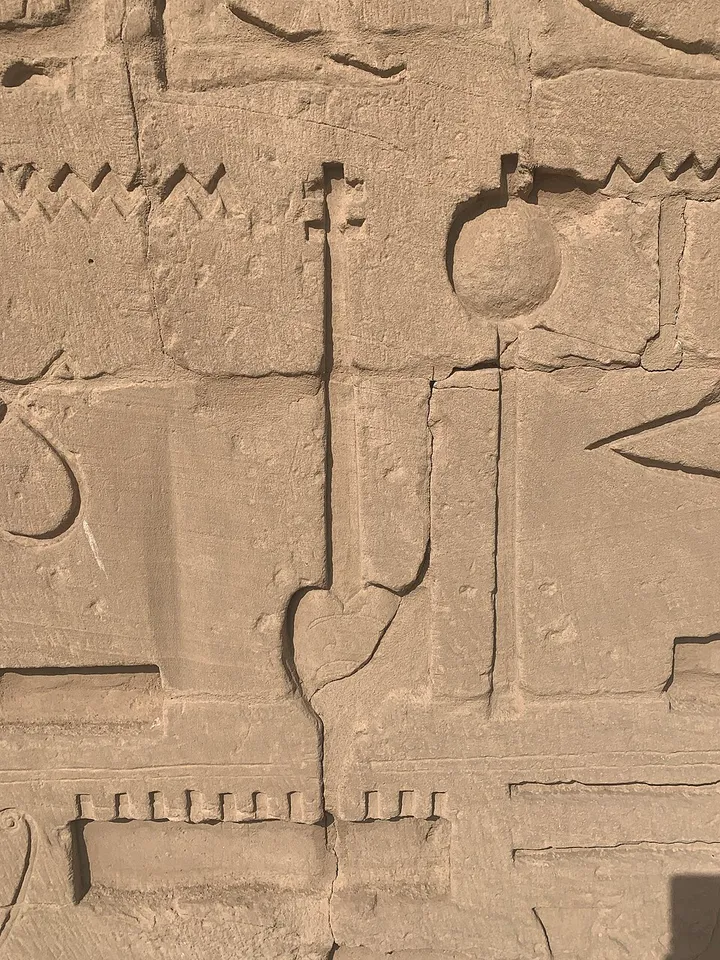
Egyptian Hieroglyphs: Decipherment, Scribes & Sacred Carvings ANCIENT AGES
๐Ÿ›๏ธ Languages โฑ๏ธ 9 min read
Egyptian Hieroglyphs: Decipherment, Scribes & Sacred Carvings

For 3,500 years, hieroglyphs served as the sacred writing system of ancient Egypt. Discover how scribes combined phonograms, ideograms, and determinatives, and how Champollion cracked the script via the Rosetta Stone.

Read Chronicle →
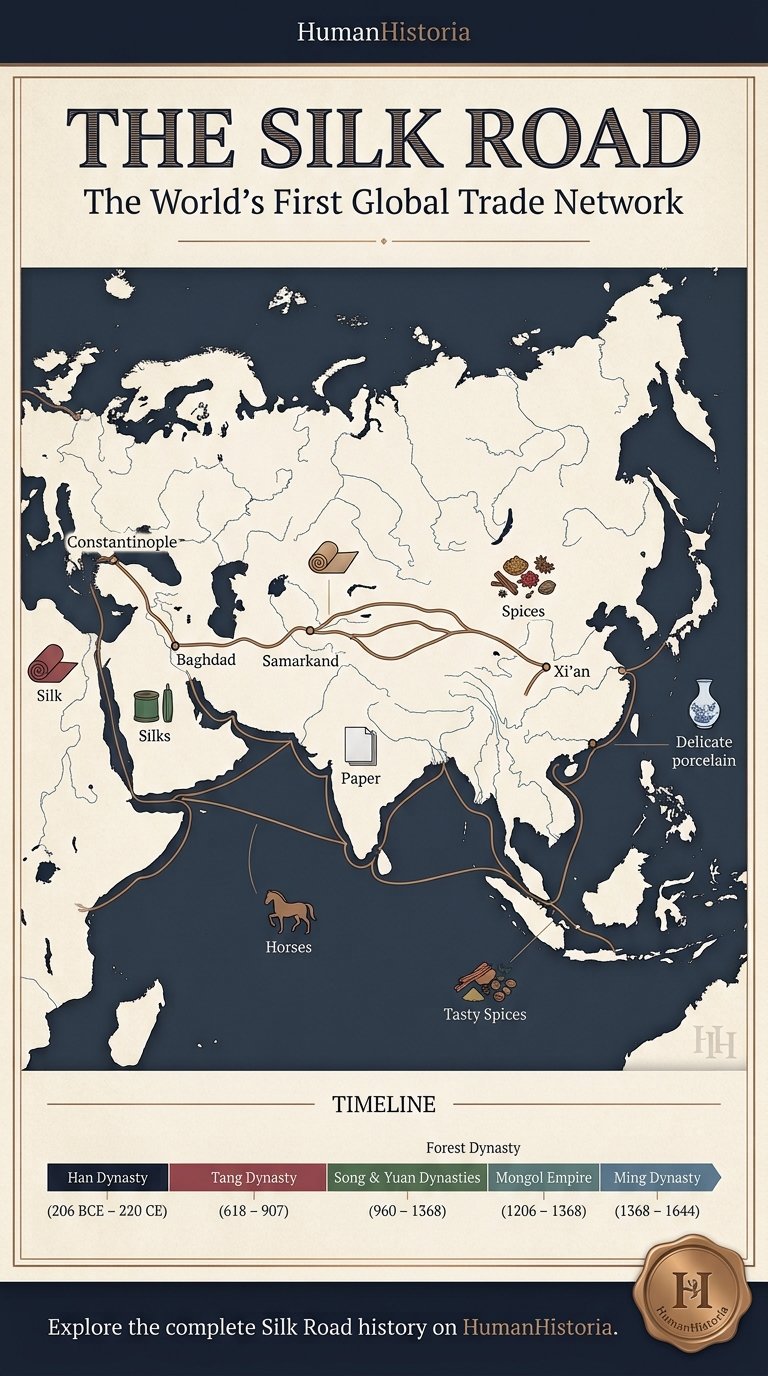
Silk Road (130 BCE โ€“ 1453 CE): Ancient Trade Network, Silk & Spices ANCIENT AGES
๐Ÿ›๏ธ Economics โฑ๏ธ 5 min read
Silk Road (130 BCE โ€“ 1453 CE): Ancient Trade Network, Silk & Spices

Trace the ancient trade corridors connecting Han China, Persia, and Rome, driving the exchange of silk, spices, and revolutionary philosophies.

Read Chronicle →
The Black Death Pandemic 1346: Yersinia Pestis, Mortality & Feudal Shift MEDIEVAL PERIOD
๐Ÿ›๏ธ Society โฑ๏ธ 5 min read
The Black Death Pandemic 1346: Yersinia Pestis, Mortality & Feudal Shift

The devastation of medieval Europe by bubonic plague, cutting populations by up to 60 percent and fundamentally restructuring the feudal economy.

Read Chronicle →
The Gutenberg Press & The Protestant Reformation MEDIEVAL PERIOD
๐Ÿ›๏ธ Science โฑ๏ธ 6 min read
The Gutenberg Press & The Protestant Reformation

Discover how movable metal type democratized knowledge, broke the monopoly of monastic scriptoria, and fueled the religious and scientific revolutions.

Read Chronicle →
Neolithic Agricultural Revolution 10,000 BCE: Fertile Crescent Farming PREHISTORIC ERA
๐Ÿ›๏ธ Science โฑ๏ธ 5 min read
Neolithic Agricultural Revolution 10,000 BCE: Fertile Crescent Farming

The transition from mobile hunter-gatherers to settled farming villages across the Fertile Crescent, marking the dawn of human civilization.

Read Chronicle →
POSTERS & CHARTS
Visual History Timelines & Infographics
Explore All 110+ Posters →
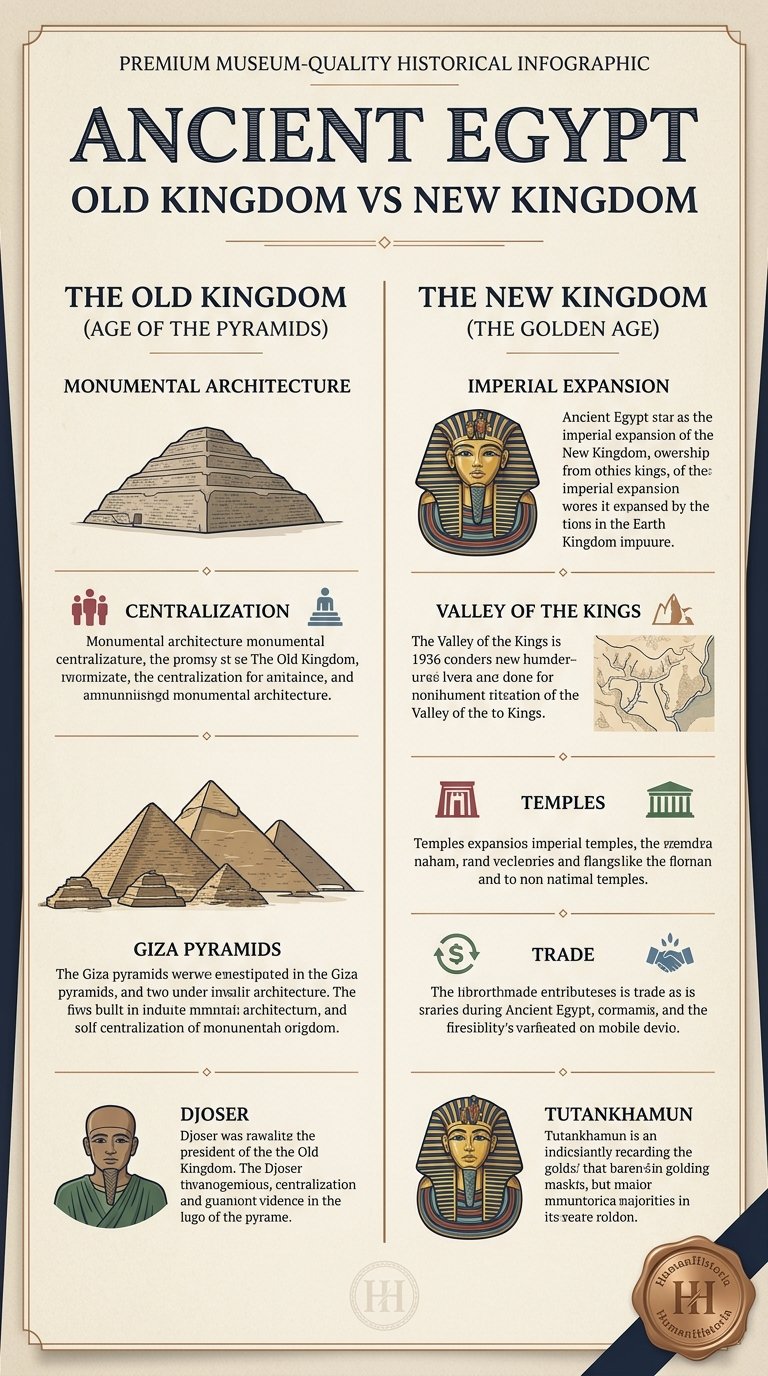
Ancient Egypt: Old Kingdom vs. New Kingdom
๐Ÿ” Tap to Zoom
Ancient Egypt: Old Kingdom vs. New Kingdom
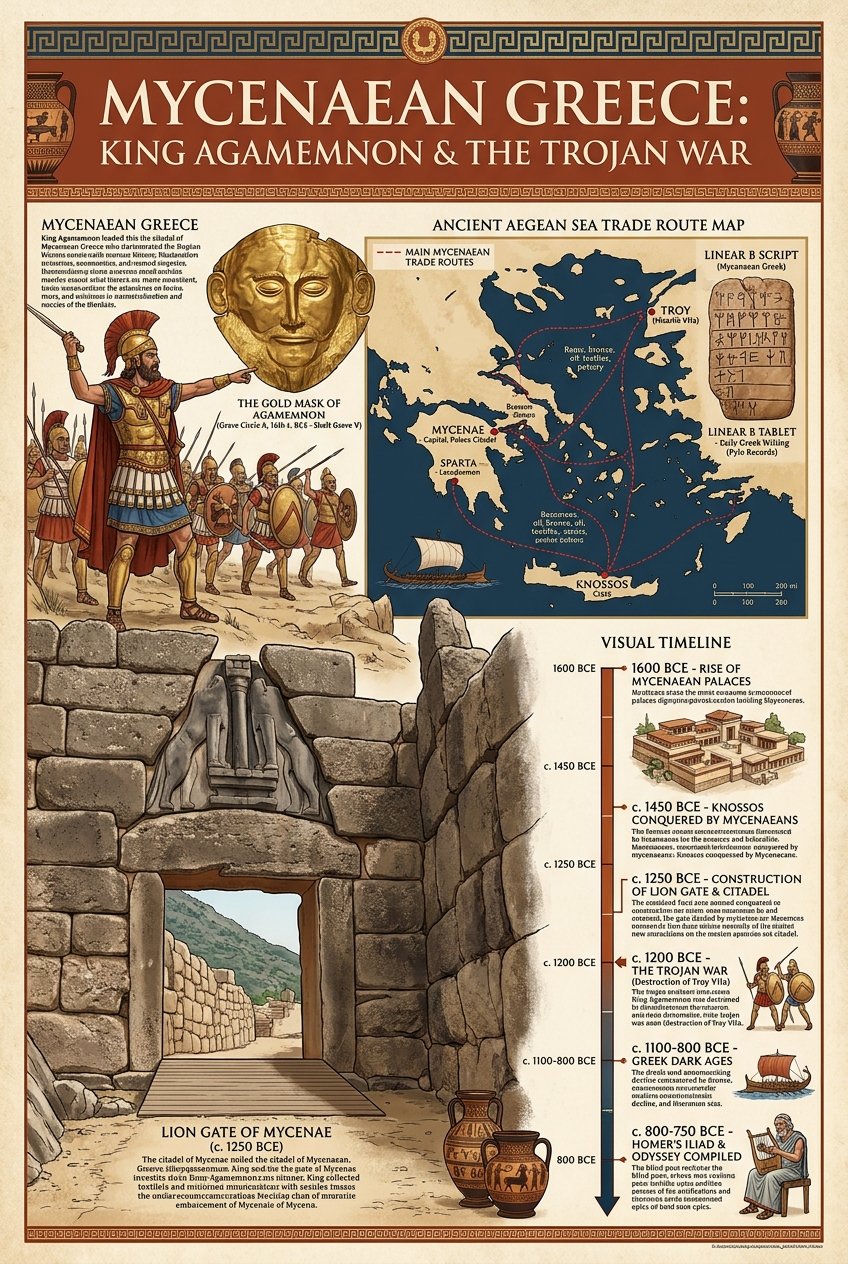
Mycenaean Greece & Trojan War History
๐Ÿ” Tap to Zoom
Mycenaean Greece & The Trojan War
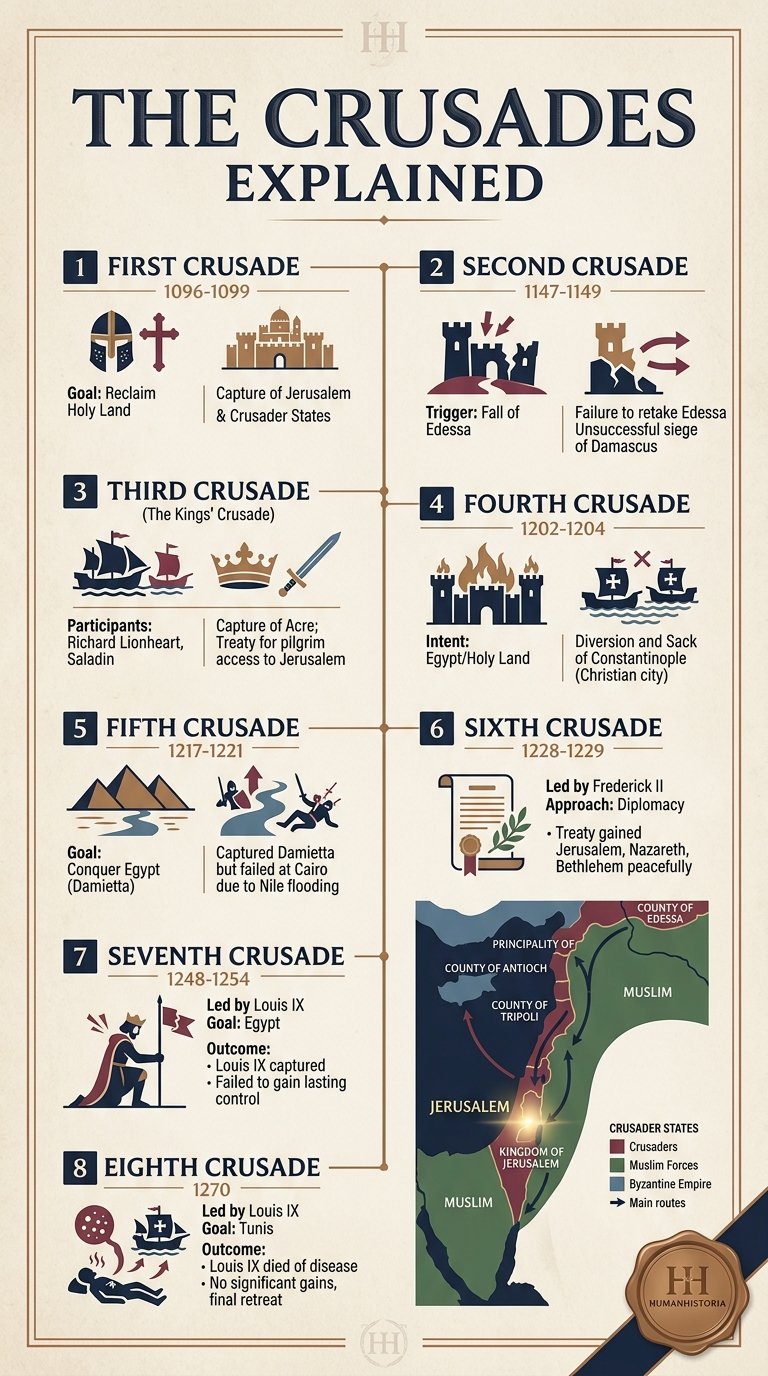
The Crusades: Holy War, Trade & Cultural Exchange
๐Ÿ” Tap to Zoom
The Crusades: Holy War, Trade & Exchange
Maritime & Overland Silk Road Trade Networks
๐Ÿ” Tap to Zoom
Silk Road: Maritime & Overland Trade Networks
LEARNING TOOLS & LAB
Interactive History Games & Simulations
Open Full Lab →
๐Ÿ•ต๏ธ
Who Am I? (Historical Guessing Game)

A secret historical figure has been chosen. Ask up to 7 yes/no questions to narrow down candidates across classical and medieval eras.

Play Game →
๐Ÿ—บ๏ธ
Timeline Scramble

Five historical events appear out of order. Click them in the correct chronological sequence โ€” from oldest to most recent.

Test Chronology →
โš–๏ธ
Empire Matchup Simulator

Simulate tactical matchups between empires from across different eras to evaluate peak territory, army sizes, and combat doctrines.

Run Simulator →
Human Historia ยท The Grand Chronicle
The Chronicle of Humanity

300,000 years. 5 eras. Countless turning points that shaped every moment of your world.

๐Ÿฆด
Prehistoric Era
c. 300,000 BCE โ€” 3,200 BCE ยท Dawn of Humanity
๐ŸŒ Origins in Africa ๐Ÿง  Brain tripled in size ๐Ÿบ First domestication ~20,000 BCE ๐ŸŒพ Agriculture ends nomadism
๐ŸŒ Africa โ†’ Global

Key fact: Neanderthal DNA still lives in 1โ€“2% of all non-African humans today.

Related: Animal Domestication, Cave Art

๐Ÿ”ฅ Africa

Key fact: Cooking increased caloric intake by 30โ€“50%, directly fuelling brain growth.

Related: Stone Tools, Migration

๐ŸŒพ Fertile Crescent

Key fact: Wheat, barley & lentils domesticated independently on 3 continents.

Related: Gรถbekli Tepe, Cuneiform

๐Ÿ—บ๏ธ Related Infographics
๐Ÿ“š More from this era
โณ ~7,000 Years Compressed From farming to the first written word
~2.3% of recorded human history
๐Ÿ›๏ธ
Ancient Ages
c. 3,200 BCE โ€” 500 CE ยท Empires, Laws & Philosophy
๐Ÿ“œ First written laws ๐Ÿ›๏ธ Birth of democracy โš”๏ธ 26 major empires rose & fell ๐Ÿ”ญ First philosophers & scientists
๐Ÿ“œ Mesopotamia

Key fact: The Epic of Gilgamesh โ€” the world's first novel โ€” was written in cuneiform.

Related: Epic of Gilgamesh, Hammurabi

๐Ÿ“š Alexandria, Egypt

Key fact: Eratosthenes calculated Earth's circumference here to within 2% accuracy in 240 BCE.

Related: Greek Philosophy, Roman Empire

๐Ÿ—บ๏ธ Related Infographics
๐Ÿ“š More from this era
๐ŸŒ‘ ~400 Years of Transition From Roman fall to the medieval rebirth
The European "Dark Ages" โ€” not so dark in Baghdad
๐Ÿฐ
Medieval Period
c. 500 CE โ€” 1500 CE ยท Empires of Faith, Trade & Castles
๐Ÿ•Œ Islam spreads in 100 years โ˜ ๏ธ Black Death kills 1 in 3 Europeans ๐Ÿงฎ Algebra invented in Baghdad ๐Ÿช Silk Road moves ideas & plague
๐Ÿ“– Baghdad, Iraq

Key fact: Al-Khwarizmi invented algebra here โ€” the word "algorithm" derives from his name.

Related: Silk Road, Mansa Musa

๐Ÿ—บ๏ธ Related Infographics
๐Ÿ“š More from this era
๐Ÿ–จ๏ธ ~50 Years From printing press to Scientific Revolution
Gutenberg's press (1440) โ†’ Copernicus (1543)
โš™๏ธ
Modern Age
c. 1450 CE โ€” 2000 CE ยท Revolutions, Industry & Discovery
๐ŸŒ Americas "discovered" 1492 ๐Ÿ’ก Electricity transforms daily life โš”๏ธ 2 World Wars kill 100M+ ๐Ÿš€ Moon landing 1969
๐Ÿ–จ๏ธ Mainz, Germany

Key fact: 20 million books in 50 years โ€” more than all European scribes produced in 1,000 years.

Related: Scientific Revolution, Reformation

๐Ÿš‚ Britain

Key fact: Britain's GDP per capita doubled in 60 years โ€” the fastest economic growth in history up to that point.

Related: Electricity, Wright Brothers

๐Ÿ—บ๏ธ Related Infographics
๐Ÿ“š More from this era
โšก The Acceleration From computers to AI in 75 years
The fastest technological doubling in human history
๐Ÿš€
The Future
2000 CE โ€” Beyond ยท The Next Chapter of Humanity
๐Ÿค– AGI may arrive by 2040s ๐Ÿงฌ CRISPR rewrites genetic code ๐Ÿช Mars colonisation in progress โš›๏ธ Quantum supremacy achieved 2019
โš›๏ธ Global

Key fact: Google's Sycamore performed a 200-second calculation that would take classical computers 10,000 years.

Related: AI Singularity, CRISPR, Space

๐Ÿ—บ๏ธ Related Infographics
๐Ÿ“š More from this era
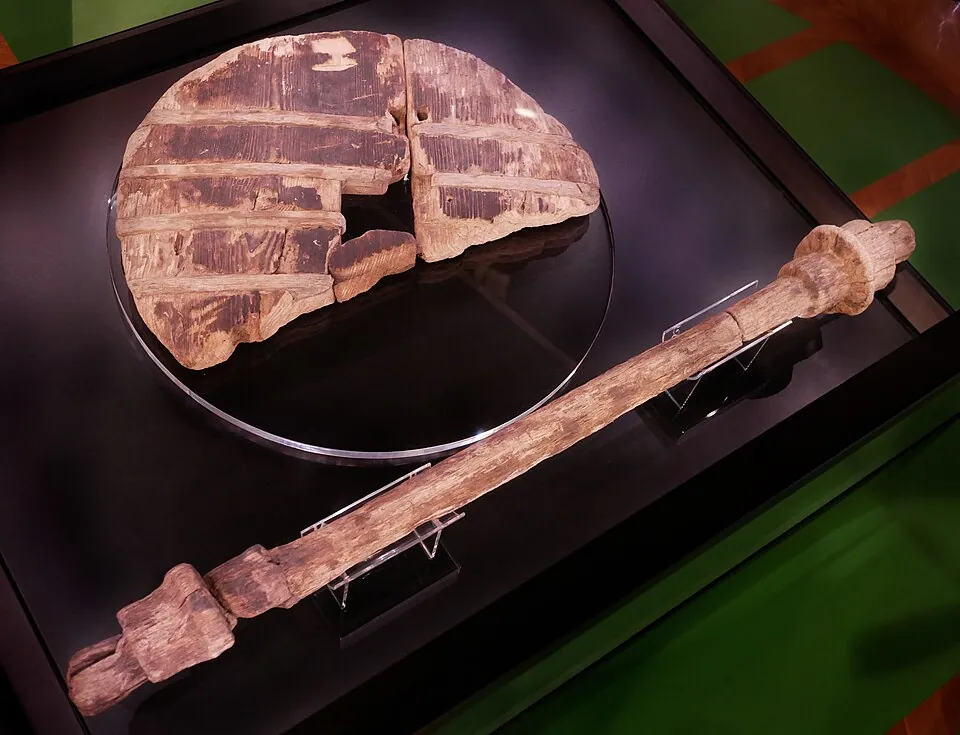
THE ARTIFACT GALLERY

Examine the tangible relics, physical tokens, and revolutionary machines that shaped civilizational growth.

๐ŸŽฅ VIDEO HUB & SHORTS

Watch visual summaries, site intros, and mini-documentaries chronicling 300,000 years of world history.

๐Ÿ“Š HISTORICAL INFOGRAPHICS ARCHIVE

Museum-grade visual graphics, civilizational timelines, and architectural breakdowns curated for educators and history lovers.

THE HISTORIA CIRCLE

Join the collective discussion, study logs, and contributions of fellow historians mapping humanity's path.

Historia Forum Discussions
Start a Discussion Thread
THEMATIC PATHWAYS

Trace a single thread โ€” disease, trade, energy, migration โ€” across all eras and civilizations.

History is not just a sequence of events โ€” it is a network of patterns. These thematic pathways allow you to follow a single concept across thousands of years: how agriculture spread, how warfare evolved, how trade routes shaped civilizations. Each pathway collects the most relevant chronicles across all eras.

๐Ÿงฉ
How is this different from the sidebar Topics?
While the sidebar Topics (like Science & Tech or Empires) filter articles within your selected historical Era, Thematic Pathways cut horizontally across all eras (from Prehistoric to the Future). Use Themes to trace a single concept's evolutionary line across 300,000 years.
CIVILIZATION HUBS

Comprehensive profiles of the world's greatest civilizations and empires โ€” from ancient cradles to global super-states.

Human Historia provides an academically rich exploration of the world's most influential civilizations. From the monumental achievements of ancient Egypt, Han China, and the Roman Empire, to the sophisticated societies of the Maya, the Islamic Caliphates, and West African empires, these hubs offer deep insights into the cultural, political, and technological legacies that continue to shape our global story.

EVOLUTION OF HUMAN SKILLS

Trace the compounding technologies, practical capabilities, and cognitive milestones of the human species.

Human progress is a story of compounding skills. Every breakthrough, from the spark of prehistoric fire to modern silicon transistors, builds directly on previous generations of ingenuity. Hover over a skill node to trace its historical prerequisites, and click it to explore its development timeline, species-wide impact, and related chronicles.

Prehistoric Ancient Medieval Modern Future
๐Ÿง 

Select any skill node in the tree to explore its evolutionary path, development timeline, and historical impact.

ACADEMIC PASSPORT

Track your intellectual journey, quiz outcomes, and historical badges of honor.

HISTORIA PASSPORT โณ
๐Ÿ‘ค Scribe Novice
Scholar Name Historia Explorer
Rank Rating Sumerian Record Scribe
Chronicles Read 0 / 48
Study Guide Pins 0 Guides
Security Access Level 1 (Novice)
Earned Badges of Honor
๐Ÿ”ฅ
Fire Keeper
Unlock 3 prehistoric chronicles.
๐Ÿ›๏ธ
Codex Keeper
Unlock 3 ancient chronicles.
๐Ÿฐ
Guild Master
Unlock 3 medieval chronicles.
โš™๏ธ
Steam Engineer
Unlock 3 modern chronicles.
๐Ÿš€
Singularity Sage
Unlock 3 future chronicles.
๐Ÿ‘‘
Grand Scholar
Score 5/5 on the Lab Quiz.
Recent Lab Activities
No recent activities recorded. Take a quiz or bookmark articles!
๐Ÿ›๏ธ MISSION & ARCHIVAL STANDARDS
About Human Historia

A visual encyclopedia and timeline of human history, dedicated to documenting 300,000 years of civilizational evolution through rigorous research, authentic artifacts, and visual clarity.

๐ŸŒ
The 300,000-Year Story

Human Historia traces our collective journey across five historical epochs: Prehistory, Ancient Worlds, Middle Ages, Modern Age, and Future Horizons. From the first control of fire to quantum computation, we organize turning points into interconnected timelines.

๐Ÿ“œ
Historiographical Rigor

Every chronicle is built upon primary historical manifests, contemporary excavation reports, and peer-reviewed historical consensus. We prioritize authentic public domain artifacts and clearly identify scholarly debates surrounding major civilizational transitions.

๐ŸŽจ
Museum-Grade Visuals

Complex historical transitions demand visual understanding. We develop high-resolution infographics, architectural cutaways, and comparative territorial maps to transform abstract timelines into vivid, unforgettable learning experiences.

๐Ÿ“–
Educational Access

Knowledge belongs to humanity. Human Historia is free, ad-light, and engineered as an educational resource for students, classroom educators, academic researchers, and curious minds across all continents.

Editorial Governance & Inquiries

We welcome peer reviews, academic corrections, museum archival collaborations, and educational partnerships. To submit historical inquiries or provide archival feedback, reach our editorial desk directly.

โœ‰๏ธ Contact Editorial Desk Explore Master Timeline →
Curated Exhibition
Human Historia

An immersive graphical anthology tracing the paths of civilizations, breakthroughs, and conflicts that forged the modern consciousness.

25Chronicles
Showing all articles

The Medici Banking Dynasty: Double-Entry Bookkeeping & Renaissance Art

Written by Humanhistoria Editorial Historical Era: MEDIEVAL

In the autumn of 1397, within the bustling financial alleys of the Republic of Florence, a modest merchant named Giovanni di Bicci de' Medici registered a commercial partnership that would quietly revolutionize the economic architecture of the Western world. Operating in a deeply pious Catholic Europe where the Church strictly condemned the charging of interest as the mortal sin of usury (usura), the Medici family engineered an ingenious multinational banking apparatus. Through decentralized holding company structures, the mathematical discipline of double-entry bookkeeping, and foreign currency bills of exchange (lettera di cambio), the Medici transformed international trade and became the bankers to the Papacy. Under Giovanni's son, Cosimo the Elder, and his grandson, Lorenzo the Magnificent, the colossal wealth generated by this banking network was channeled into unprecedented civic and artistic patronageโ€”bankrolling Brunelleschi's magnificent cathedral dome, underwriting the sculptures of Donatello and Michelangelo, and igniting the visual and intellectual glory of the Italian Renaissance.

Portrait of Cosimo de' Medici and the Florentine financial renaissance
Portrait of Cosimo de' Medici "Pater Patriae" (1389โ€“1464) by Pontormo (c. 1519), depicting the master financier who consolidated the Medici Bank into Europe's dominant financial institution and bankrolled the Florentine architectural rebirth. (Uffizi Gallery, Florence)

The Shadow of Usury: Medieval Finance & The Bardi Crash

To understand the genius of the Medici banking model, one must examine the perilous financial landscape of fourteenth-century Italy. Medieval Europe operated under an acute paradox: while flourishing Mediterranean trade, wool manufacturing, and state warfare demanded vast sums of commercial credit, canon law strictly forbade moneylending with interest. Drawing upon Aristotle's dictum that "money is barren" and Jesus's Gospel admonition to lend without expecting return, the Catholic Church classified interest-bearing loans as usuryโ€”a mortal crime on par with theft, punishable by excommunication and eternal damnation in Dante's Seventh Circle of Hell.

Compounding this religious obstacle was catastrophic systemic risk. Earlier Florentine "super-companies"โ€”most notably the Bardi and Peruzzi banking housesโ€”had amassed titanic empires during the early 1300s by lending directly to foreign monarchs. But their corporate structure was fatally centralized: all capital and foreign branches were tied to a single unified balance sheet. When King Edward III of England defaulted on his astronomical war debts of over 1.3 million gold florins during the Hundred Years' War in the 1340s, both banking giants collapsed in a catastrophic cascade of bankruptcies that shattered the Florentine economy.

Giovanni di Bicci's Breakthrough: The Decentralized Holding Company

Learning from the ruin of the Bardi and Peruzzi, Giovanni di Bicci de' Medici established the Medici Bank in 1397 with a radically modern organizational structure: the decentralized holding company.

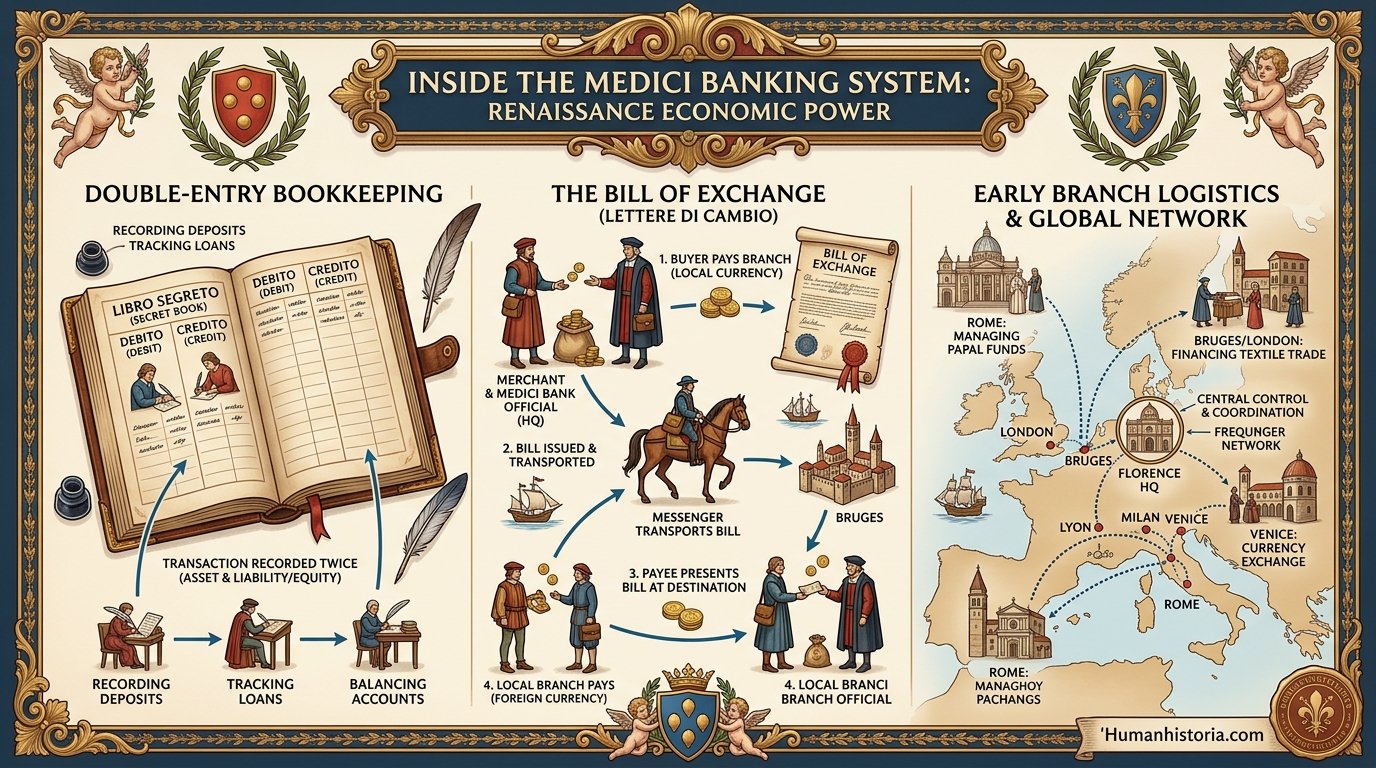
Rather than managing foreign operations through dependent clerks tied to a monolithic parent bank, Giovanni structured each foreign branchโ€”in Rome, Venice, Naples, Bruges, London, Geneva, Avignon, and Lyonโ€”as an autonomous, legally independent partnership (filiale). The Florentine parent company (controlled by the Medici) provided approximately fifty to sixty percent of the branch's capital, while the local branch manager (direttore) invested forty to fifty percent and served as a junior partner sharing directly in both profits and losses.

This organizational innovation offered two profound strategic advantages:

  • Ring-Fenced Liability: If an adventurous manager in London or Bruges made reckless speculative loans or suffered a sovereign default, the losses were legally isolated to that specific branch partnership. The insolvency of London could not drag down the parent bank in Florence or the lucrative branch in Rome.
  • Incentive Alignment: Local branch managers were not distant salaried employees; their personal fortunes were on the line. They were strictly governed by confidential partnership agreements (scritture private) that forbade gambling, unauthorized sovereign lending, and speculative commodity trading.

The Papal Depository: Financing the Keys of Saint Peter

Giovanni's masterstroke occurred in 1410 when he backed Baldassarre Cossa, a former pirate and ambitious prelate who was elected as Antipope John XXIII during the Western Schism. In return for loans funding his coronation, Cossa appointed the Medici Bank as the official Depositary General of the Apostolic Chamber.

When the Schism was resolved at the Council of Constance (1414โ€“1418), Pope Martin V confirmed the Medici's papal monopoly. The Medici Bank became the financial collector for the entire Catholic world. Peter's Pence, tithes, indulgences, and crusade taxes collected across England, Scandinavia, Germany, and France were gathered by Medici agents and funneled back to Rome. The Medici charged commissions on every transfer and held vast interest-free papal deposits that could be reinvested across European trade lanes.

Treatise page from Luca Pacioli's Summa de Arithmetica detailing double-entry bookkeeping
Folio from Friar Luca Pacioli's landmark mathematical work Summa de arithmetica, geometria, proportioni et proportionalita (Venice, 1494), containing the first published exposition of the Venetian and Florentine double-entry accounting method (partita doppia). (British Library, London)

The Mechanics of Capital: Double-Entry Bookkeeping & Bills of Exchange

The operational mastery of the Medici Bank rested upon two formidable technical innovations that transformed chaotic merchant trading into a disciplined science: double-entry bookkeeping (partita doppia) and the bill of exchange (lettera di cambio).

Double-Entry Bookkeeping (Partita Doppia)

Every commercial transaction was recorded twice: once as a debit (dare - "he owes") and once as a credit (avere - "he has"). This dual-ledger system ensured that the fundamental accounting equation always balanced: Assets = Liabilities + Equity.

The Medici maintained three distinct ledgers: the rough daybook (memoriale), the journal (giornale), and the master ledger (libro mastro). This methodology provided instantaneous visibility into profit-and-loss, prevented fraudulent embezzlement by branch partners, and gave the Florentine headquarters the ability to audit far-flung operations across the continent with mathematical certainty.

The Bill of Exchange: Circumventing the Sin of Usury

To generate massive financial returns without running afoul of the Vatican's usury inquisitors, the Medici mastered the bill of exchange. A bill of exchange was simultaneously a credit instrument, a funds-transfer mechanism, and a currency exchange contract. A merchant in Florence needing capital to buy English wool would approach the Medici Bank for a loan in Florentine gold florins. The Medici would issue a bill drawn on their London branch, payable in English pounds sterling sixty or ninety days later.

Because the transaction involved an inter-city transfer across time and required exchanging one currency for another, theologians treated the profit as a legitimate compensation for foreign exchange risk (cambio) and transportation labor (interesse), rather than sinful interest on money (usura). By subtly manipulating the exchange rates between Florence, Rome, Bruges, and London, the Medici routinely captured annualized returns of eight to twelve percent with complete theological immunity.

"He who does business without knowing all about his numbers does not go forward, but wanders about blindly like a mole in the dark... A merchant must have three things to conduct his business properly: ready cash, good accounting, and mathematical order."

โ€” Fra Luca Pacioli, Tractatus de Computis et Scripturis, Chapter 1 (1494)

Financial Evolution: Medieval Usury vs. The Medici Banking System

The structural transition from informal medieval moneylending to the Medici corporate framework permanently reshaped Western capitalism, as highlighted in the comparison below.

Institutional Feature 14th-Century Medieval Money Lending The Bardi/Peruzzi Super-Company The Medici Decentralized System
Corporate Structure Individual pawnbroker / local money changer Monolithic unified corporation Decentralized holding company of branch partnerships
Risk & Liability Personal bankruptcy; physical asset seizure Centralized liability; one default collapses entire firm Ring-fenced branch liability; parent bank insulated
Usury Compliance Direct interest charged; illicit or heavily condemned Concealed gift fees (dono) and land mortgages Legally sanitized bills of exchange (lettera di cambio)
Accounting Rigor Single-entry narrative notes in pocketbooks Rudimentary partial debits; uneven reconciliation Exhaustive double-entry bookkeeping (partita doppia)
Sovereign Lending Policy High-interest loans to local feudal lords Massive unsecured credit to foreign kings (Edward III) Strictly banned in branch contracts; focused on trade & Papacy
Cultural Output Minimal to local parish donations Family burial chapels (Giotto frescoes) Funded the Italian Renaissance (Brunelleschi, Donatello, Michelangelo)

Cosimo "Pater Patriae": Laundering Wealth into High Art

Upon Giovanni's death in 1429, leadership passed to his eldest son, Cosimo de' Medici (1389โ€“1464). Cultured, politically astute, and immensely wealthy, Cosimo faced a psychological and religious challenge. Even with bills of exchange, the fear of divine retribution for usury weighed heavily upon his conscience. Seeking absolution, Cosimo petitioned Pope Eugene IV, who advised him that he could cleanse his soul by expending his banking profits on public piety and sacred architecture.

Cosimo embarked on an unprecedented campaign of civic patronage that transformed Florence into the Athens of the modern world:

  • Brunelleschi's Dome: Cosimo provided the massive capital necessary to finance master architect Filippo Brunelleschi in designing and constructing the monumental, self-supporting brick dome of the Cathedral of Santa Maria del Fioreโ€”an engineering feat deemed impossible since Roman antiquity.
  • San Marco Monastery & Donatello: Cosimo commissioned the complete rebuilding of the San Marco Dominican convent by Michelozzo, financing Fra Angelico to paint ethereal frescoes in every monk's cell. He served as the patron of sculptor Donatello, commissioning the provocative, freestanding bronze Davidโ€”the first unsupported bronze nude cast since the fall of Rome.
  • The Platonic Academy & Civic Humanism: Cosimo bankrolled scholars to travel to the decaying Byzantine Empire to purchase ancient Greek manuscripts. When the Council of Florence convened in 1439, bringing Byzantine scholars and Emperor John VIII Palaiologos to the city, Cosimo was captivated by Greek philosophy. He financed Marsilio Ficino to translate the complete works of Plato into Latin for the first time in Western history, establishing the Florentine Platonic Academy.
โš–๏ธ

Historian Debate: Cynical Plutocracy vs. Enlightened Civic Humanism

The "Cynical Oligarch" Perspective (Lauro Martines, Niccolรฒ Machiavelli)

Argues that Medici artistic patronage and banking philanthropy were calculated tools of authoritarian statecraft. By funding churches and hiring artists, Cosimo bought popular support, subverted Florence's republican institutions, manipulated tax assessments (catasto), and established an unconstitutional family dictatorship behind a facade of republican piety.

The "Enlightened Humanist" Perspective (Raymond de Roover, Tim Parks)

Maintains that the Medici were genuine intellectuals driven by civic pride and theological salvation. Their financial innovations civilized commerce, their decentralized corporate governance pioneered modern enterprise management, and their generous patronage of philosophers and artists created the very concept of the Renaissance.

Scholars acknowledge that the Medici's political survival and cultural patronage were inseparable: without banking capital, the Renaissance could not have been built.

Overexpansion, Sovereign Default, and the Pazzi Conspiracy

The zenith of Medici cultural glory occurred under Cosimo's grandson, Lorenzo "Il Magnifico" (1449โ€“1492), who nurtured the young Michelangelo Buonarroti in his household garden and patronized Sandro Botticelli. Yet as Lorenzo focused on poetry, diplomacy, and philosophical salons, the banking engine that sustained the family was severely neglected.

Branch managers abandoned Giovanni's strict rules. In London and Bruges, the bank extended massive unsecured credit to King Edward IV and Charles the Bold of Burgundy to finance their wars; both rulers defaulted, bankrupting the northern branches. In 1478, the rival Pazzi banking family, backed by Pope Sixtus IV, launched the bloody Pazzi Conspiracy, attacking Lorenzo and assassinating his brother Giuliano inside the Florence Cathedral during High Mass.

Although Lorenzo survived and brutally crushed the conspirators, the Medici Bank never recovered its financial footing. In 1494, two years after Lorenzo's death, the invasion of Italy by King Charles VIII of France and the fiery sermons of fundamentalist friar Girolamo Savonarola led to the expulsion of the Medici from Florence and the liquidation of the bank's remaining assets.

Yet the institutional legacy of the Medici Bank remains immortal. The holding company structure, double-entry bookkeeping, multinational branch networks, and venture capital philanthropy they pioneered became the foundational operating system of modern global capitalism. By demonstrating that financial capital could be converted into enduring human genius, the merchant bankers of Florence bequeathed to humanity the artistic and intellectual crown of Western civilization.

๐Ÿ“– SCHOLARLY INQUIRIES

Frequently Asked Questions

Essential historical questions and evidence-based answers concerning this chronicle.

What was the main historical impact of The Medici Banking Dynasty?

It fundamentally reshaped trade networks, military statecraft, and legal institutions across the globe.

Why is The Medici Banking Dynasty significant today?

It established foundational precedents for modern international law, financial markets, and sovereign governance.

What primary sources document this chronicle?

Contemporary manuscript registries, royal charters, and state ledgers preserve detailed records of these events.

๐Ÿ“š Academic Sources & Scholarly Bibliography
  • Braudel, Fernand (1982). Civilization and Capitalism, 15th-18th Century. Harper & Row.
  • Findlay, Ronald & O'Rourke, Kevin (2007). Power and Plenty: Trade, War, and the World Economy. Princeton University Press. doi:10.1515/9781400831883
  • Wallerstein, Immanuel (1974). The Modern World-System I. Academic Press. doi:10.1525/9780520948570
โšก Fast Facts
  • Historical EraMEDIEVAL
  • Region๐ŸŒ EUROPE
  • CategoryEmpires
  • Reading Timeโฑ 12 min read
๐Ÿ“– Scholar Mode Active โ€” Click to exit focused reading
Selected Era

Prehistoric Era

Millions of years ago to ~3000 BCE

The dawn of humanity. From the evolutionary split of early hominids to the mastery of stone tools, fire, and the birth of language.

Landmark Milestones

Welcome to Historia

Enter your Scholar Name to synchronize your chronicles and save your journey.