From prehistoric origins to the modern era—discover the turning points, lost empires, and breakthroughs of world history through interactive timelines and visual guides.
Examine the tangible relics, physical tokens, and revolutionary machines that shaped civilizational growth.
🎥 VIDEO HUB & SHORTS
Watch visual summaries, site intros, and mini-documentaries chronicling 300,000 years of world history.
📊 HISTORICAL INFOGRAPHICS ARCHIVE
Museum-grade visual graphics, civilizational timelines, and architectural breakdowns curated for educators and history lovers.
THE HISTORIA CIRCLE
Join the collective discussion, study logs, and contributions of fellow historians mapping humanity's path.
Historia Forum Discussions
Start a Discussion Thread
THEMATIC PATHWAYS
Trace a single thread — disease, trade, energy, migration — across all eras and civilizations.
History is not just a sequence of events — it is a network of patterns. These thematic pathways allow you to follow a single concept across thousands of years: how agriculture spread, how warfare evolved, how trade routes shaped civilizations. Each pathway collects the most relevant chronicles across all eras.
🧩
How is this different from the sidebar Topics?
While the sidebar Topics (like Science & Tech or Empires) filter articles within your selected historical Era, Thematic Pathways cut horizontally across all eras (from Prehistoric to the Future). Use Themes to trace a single concept's evolutionary line across 300,000 years.
CIVILIZATION HUBS
Comprehensive profiles of the world's greatest civilizations and empires — from ancient cradles to global super-states.
Human Historia provides an academically rich exploration of the world's most influential civilizations. From the monumental achievements of ancient Egypt, Han China, and the Roman Empire, to the sophisticated societies of the Maya, the Islamic Caliphates, and West African empires, these hubs offer deep insights into the cultural, political, and technological legacies that continue to shape our global story.
EVOLUTION OF HUMAN SKILLS
Trace the compounding technologies, practical capabilities, and cognitive milestones of the human species.
Human progress is a story of compounding skills. Every breakthrough, from the spark of prehistoric fire to modern silicon transistors, builds directly on previous generations of ingenuity. Hover over a skill node to trace its historical prerequisites, and click it to explore its development timeline, species-wide impact, and related chronicles.
Prehistoric Ancient Medieval Modern Future
🧠
Select any skill node in the tree to explore its evolutionary path, development timeline, and historical impact.
ACADEMIC PASSPORT
Track your intellectual journey, quiz outcomes, and historical badges of honor.
HISTORIA PASSPORT⏳
👤Scribe Novice
Scholar NameHistoria Explorer
Rank RatingSumerian Record Scribe
Chronicles Read0 / 48
Study Guide Pins0 Guides
Security AccessLevel 1 (Novice)
Earned Badges of Honor
🔥
Fire Keeper
Unlock 3 prehistoric chronicles.
🏛️
Codex Keeper
Unlock 3 ancient chronicles.
🏰
Guild Master
Unlock 3 medieval chronicles.
⚙️
Steam Engineer
Unlock 3 modern chronicles.
🚀
Singularity Sage
Unlock 3 future chronicles.
👑
Grand Scholar
Score 5/5 on the Lab Quiz.
Recent Lab Activities
No recent activities recorded. Take a quiz or bookmark articles!
🏛️ MISSION & ARCHIVAL STANDARDS
About Human Historia
A visual encyclopedia and timeline of human history, dedicated to documenting 300,000 years of civilizational evolution through rigorous research, authentic artifacts, and visual clarity.
🌍
The 300,000-Year Story
Human Historia traces our collective journey across five historical epochs: Prehistory, Ancient Worlds, Middle Ages, Modern Age, and Future Horizons. From the first control of fire to quantum computation, we organize turning points into interconnected timelines.
📜
Historiographical Rigor
Every chronicle is built upon primary historical manifests, contemporary excavation reports, and peer-reviewed historical consensus. We prioritize authentic public domain artifacts and clearly identify scholarly debates surrounding major civilizational transitions.
🎨
Museum-Grade Visuals
Complex historical transitions demand visual understanding. We develop high-resolution infographics, architectural cutaways, and comparative territorial maps to transform abstract timelines into vivid, unforgettable learning experiences.
📖
Educational Access
Knowledge belongs to humanity. Human Historia is free, ad-light, and engineered as an educational resource for students, classroom educators, academic researchers, and curious minds across all continents.
Editorial Governance & Inquiries
We welcome peer reviews, academic corrections, museum archival collaborations, and educational partnerships. To submit historical inquiries or provide archival feedback, reach our editorial desk directly.
An immersive graphical anthology tracing the paths of civilizations, breakthroughs, and conflicts that forged the modern consciousness.
25Chronicles
Showing all articles
The Dutch East India Company (VOC): The Birth of the Stock Market in Amsterdam
Written by Humanhistoria EditorialHistorical Era: MEDIEVAL
On March 20, 1602, in the canal-laced port city of Amsterdam, the legislative assembly of the young Dutch Republic ratified a commercial charter that fundamentally rewrote the rules of global finance and geopolitical power. The Vereenigde Oostindische Compagnie (VOC)—known in English as the Dutch East India Company—was not merely a syndicate of merchant adventurers sailing in search of Indonesian spices; it was the world's first publicly traded, joint-stock megacorporation, endowed with permanent capital, fractional shares, and sovereign state powers to wage offensive war, construct overseas fortresses, and mint its own gold and silver coinage. Operating from the busy floor of the newly founded Amsterdam Stock Exchange, the VOC mobilized unprecedented domestic capital, constructed a ruthless maritime commercial empire spanning from South Africa to Japan, and created the institutional architecture of modern global capitalism.
🎯 Quick Historical Summary
How Did the Dutch East India Company (VOC) Revolutionize Global Capitalism?
Chartered in 1602 by the Dutch Republic, the Dutch East India Company (VOC) invented the modern corporation by issuing the world's first publicly traded company shares on the Amsterdam Stock Exchange. Operating with its own private armies, navies, and coin-minting rights, the VOC dominated the Asian spice trade for two centuries.
The oldest known surviving company share of stock in the world, issued by the Enkhuizen chamber of the Dutch East India Company (VOC) to Pieter Harmensz on September 9, 1606. (Westfries Archief, Hoorn, Netherlands)
The Geopolitical Catalyst: Spices, Spanish Embargoes, and the Voorcompagnieën
To understand the creation of the VOC, one must look to the bitter geopolitical struggle of the Eighty Years' War (1568–1648), in which seven Calvinist provinces of the northern Netherlands rebelled against the Catholic Habsburg monarchy of Philip II of Spain. For decades, Dutch merchants had accumulated immense wealth through the "mother trade" (moedernegotie)—the bulk shipment of Baltic grain, timber, and herring across Western Europe. In Lisbon, Dutch ships purchased exotic Asian spices—principally black pepper, nutmeg, mace, and cloves—brought back by Portuguese caravels, distributing them throughout European markets.
In 1580, Philip II inherited the Portuguese crown, uniting the Iberian empires. Seeking to strangle the Dutch rebellion economically, Philip banned Dutch ships from entering Lisbon and Seville. Cut off from their primary supply of spices, Dutch merchant oligarchs took an audacious gamble: they would sail directly to the East Indies themselves, shattering Portugal's century-old maritime monopoly over the Indian Ocean.
Between 1595 and 1601, private consortiums known as voorcompagnieën ("pre-companies") financed sixty-five ships in fourteen armed expeditions to the Indonesian archipelago. The first voyage, commanded by the hot-tempered Cornelis de Houtman in 1595, lost more than half its crew to scurvy and tropical fevers, but returned with just enough pepper to yield a profit and prove that Portuguese defenses in Asia were fragile. Subsequent voyages generated astronomical profits of up to 400%. Yet unbridled domestic competition soon threatened to destroy the trade: rival Dutch expeditions bid against each other in Javanese ports, driving local spice prices sky-high while flooding the domestic market in Amsterdam, causing European retail prices to collapse.
'Courtyard of the Exchange in Amsterdam' (1653) by Emanuel de Witte, depicting merchants, financiers, and brokers of all nations trading VOC shares under the classical porticos. (Museum Boijmans Van Beuningen, Rotterdam)
The Financial Revolution: Permanent Capital and Public Shares
Recognizing that cutthroat domestic rivalry played directly into Spanish hands, the leading Dutch statesman Johan van Oldenbarnevelt, Grand Pensionary of Holland, intervened. Over months of intense political negotiations, Oldenbarnevelt pressured the competing merchant syndicates of six maritime cities—Amsterdam, Zeeland (Middelburg), Enkhuizen, Delft, Hoorn, and Rotterdam—to merge their capital into a single unified entity. On March 20, 1602, the States-General granted the VOC an exclusive twenty-one-year monopoly on all Dutch maritime trade east of the Cape of Good Hope and west of the Strait of Magellan.
The Invention of the Modern Shareholder
Prior to 1602, maritime commercial voyages operated on temporary partnerships: investors pooled funds for a specific fleet, and upon the fleet's return, the venture was completely liquidated—ships were sold, profits and initial capital were distributed, and the company ceased to exist. If a merchant wished to invest again, a completely new enterprise had to be organized.
The VOC introduced two revolutionary financial innovations that invented the corporate economy:
Permanent, Locked-in Capital: The initial capital of 6.42 million guilders raised in August 1602 was not liquidated after voyages returned. Instead, it was permanently retained by the company to build fortified docks, establish naval shipyards, and maintain standing garrisons in Asia. Investors could not demand their money back from the company.
Liquid, Freely Tradable Shares: Because investors could not redeem their capital, the VOC charter permitted shareholders to sell or transfer their ownership certificates to third parties. In September 1602, open subscription ledgers in Amsterdam allowed ordinary citizens—from wealthy burgomasters and Portuguese Jewish refugees to humble domestic servants, bakers, and sailors—to purchase shares in denominations of any size.
To facilitate the trading of these shares, Amsterdam municipal authorities established the Amsterdam Stock Exchange (Beurs van Hendrick de Keyser) in 1611. In the open-air courtyard of the Beurs, brokers invented modern financial instruments: continuous open trading, forward contracts, short selling, stock options, and margin borrowing. To stabilize the money supply, the Bank of Amsterdam (Amsterdamsche Wisselbank) was founded in 1609, providing a 100%-backed reserve system of standardized bank money (bancogulden) that made Amsterdam the financial hub of early modern Europe.
The Sovereign Corporation: Armies, Fortresses, and the Spice Monopoly
What distinguished the VOC from a modern corporation was its unprecedented grant of sovereign geopolitical authority. The States-General empowered the company's governing board of seventeen directors—the Heeren XVII ("The Gentlemen Seventeen")—with the statutory authority to declare offensive war, recruit private standing armies, commission heavily armed warships, construct stone fortresses, annex foreign territory, and negotiate binding international treaties in the name of the Dutch Republic.
Jan Pieterszoon Coen and the Iron Fist at Batavia
In Asia, the VOC was not content with passive merchant trading; it sought an absolute, unchallengeable monopoly over the world's supply of nutmeg, mace, and cloves. The architect of this violent corporate hegemony was Jan Pieterszoon Coen, appointed Governor-General in 1618. Coen operated under a chillingly candid mercantile maxim: "Trade cannot be conducted without war, nor war without trade."
In 1619, Coen led a naval fleet against the Javanese port of Jayakarta, burned the town to the ground, and erected Batavia (modern Jakarta)—a fortified stone citadel protected by water canals, which served as the administrative headquarters of the VOC's commercial network across Asia for two centuries.
In 1621, determined to monopolize nutmeg, Coen sailed with an armada of nineteen ships to the remote Banda Islands, the only place on earth where the nutmeg tree grew naturally. Accusing the native Bandanese chieftains of violating trade exclusivity by selling nutmeg to English merchants, Coen executed forty-four village elders, deployed Japanese mercenary samurai to hunt down fleeing inhabitants, and systematically eradicated the native population through forced starvation, deportation, and massacre. Out of an estimated native population of 15,000 Bandanese, fewer than 1,000 survived. Coen divided the depopulated islands into sixty-eight plantation estates (perken), handing them to company officers (perkeniers) who operated them with thousands of enslaved African and Asian laborers.
Institutional Feature
Medieval Merchant Guilds (e.g. Hanseatic League)
Dutch East India Company / VOC (1602–1799)
Modern Public Corporations (21st Century)
Capital Structure
Temporary family partnerships; capital liquidated after single voyage; unlimited personal liability
Permanent locked-in capital; fractional, freely tradable public shares; limited liability for passive shareholders
Global equity markets; multi-class common and preferred stock; strict limited liability
Market Institution
Periodic regional trade fairs; commodity barter; no secondary securities exchange
First continuous public stock exchange (Amsterdam Beurs, 1611); futures, options, short-selling
Digital electronic stock exchanges (NYSE, NASDAQ); high-frequency algorithmic liquidity
Sovereign State Powers
City-state municipal defense; no authority to declare foreign wars or annex overseas territory
Full sovereign powers: right to wage war, build stone fortresses, recruit armies, mint coinage, sign treaties
Strict separation: corporations have no legal right to wage war, mint national currency, or administer penal law
Monopoly Enforcement
Local city market privileges enforced by municipal guilds
Royal monopoly charter; military elimination of foreign competition and indigenous suppliers
Statutory antitrust regulation; competition law enforced by sovereign regulatory bodies
Peak Economic Scale
Regional European maritime network
Valuation estimated at over $7.9 trillion (modern equiv.); 4,700 ships; 50,000+ personnel
Multi-trillion dollar market caps (e.g. Apple, Microsoft, Saudi Aramco)
"No one, of whatever quality or condition he may be, shall be permitted, without the consent of this United Company, to sail from these United Provinces, or from any port within them, to the East Indies, or past the Cape of Good Hope, on pain of forfeiture of the ships and goods... And the said Company shall have authority in our name to make contracts with princes and potentates in the East Indies, to build fortresses, to maintain armed men, and to appoint governors and officers of justice."
— The Charter of the United East India Company (Octrooi van de VOC), States-General of the United Netherlands, March 20, 1602 (National Archives, The Hague, 1.04.02, Inv. 1)
The Inter-Asian Intra-Port Network and the Isolation of Japan
A common misconception is that the VOC merely shipped Asian spices back to Europe. In reality, the company's greatest profits were generated by its intra-Asian trade network—an intricate multilateral commercial system that connected the distinct economies of the Indian Ocean and the China Seas:
The VOC used New World silver obtained in Europe to purchase finely woven cotton textiles in Gujarat and the Coromandel coast of India.
These Indian textiles were shipped to the Moluccas to barter for cloves and nutmeg at negligible cash cost.
Spices were shipped to China and Japan, where they were exchanged for raw silk, porcelain, and Japanese silver and copper.
In 1639, when the Tokugawa Shogunate expelled Portuguese Jesuits and instituted its closed-country policy (Sakoku), the VOC was the only European power permitted to remain in Japan, operating from the tiny artificial fan-shaped island of Dejima in Nagasaki harbor. Dutch ships traded silk for Japanese copper bars, which were shipped back to India to mint local coinage.
At its zenith in 1669, the VOC was the wealthiest private enterprise in world history. It maintained an active fleet of 150 merchantmen, 40 dedicated warships, 50,000 employees, and a private army of 10,000 European soldiers, paying an uninterrupted annual cash dividend averaging 18% for over two centuries.
Archival Fact: The Tulip Mania Connection
The vast wealth generated by VOC share dividends and maritime trade fueled the extreme financial speculation of the Dutch Golden Age. In the 1630s, liquidity spilled into the market for exotic striped tulip bulbs, culminating in the infamous Tulip Mania crash of February 1637, where rare single bulbs like the Semper Augustus traded for the price of a grand canal townhouse before plummeting to zero.
⚖️
Historian Debate: Pioneers of Modern Enterprise vs. State-Sanctioned Piracy
The Institutional Modernizer
Economic historians like Fernand Braudel and Niall Ferguson view the VOC as the decisive institutional leap toward modern prosperity. By creating liquid equity markets, locked-in capital, and rational accounting, the Dutch overcame the capital constraints of family firms, demonstrating how public investment could fund long-term global infrastructure.
The Imperial Monopolist
Postcolonial historians like Eric Wolf and Amitav Ghosh emphasize that the VOC was not a free-market enterprise, but a violent mercantilist monopoly. Its profits depended on gunboat diplomacy, brutal ethnic cleansing (such as the Banda massacre), chattel slavery, and artificial trade restrictions that stifled indigenous Asian merchant networks.
In Dutch popular culture, the abbreviation VOC was bitterly satirized in its final years as Vergaan Onder Corruptie ("Perished Under Corruption").
Decline, Bankruptcy, and the Modern Corporate Legacy
The very features that made the VOC powerful ultimately caused its collapse. By the late 18th century, the company was paralyzed by astronomical administrative overhead, massive smuggling by underpaid employees, and fierce naval competition from the British East India Company. Furthermore, European consumer tastes shifted away from expensive luxury spices toward bulk commodities like Indian tea, Chinese porcelain, Caribbean sugar, and American tobacco—markets that the VOC failed to dominate.
When the Fourth Anglo-Dutch War (1780–1784) devastated its shipping fleet, the VOC was drowning in over 100 million guilders of debt. On December 31, 1799, its charter expired; the bankrupt company was formally dissolved and nationalized by the revolutionary Batavian Republic, with its territorial possessions becoming the state colony of the Dutch East Indies (modern Indonesia).
Yet the institutional DNA of the Dutch East India Company lives on in every modern public company. Every time an investor purchases shares on an electronic exchange, every time a company issues quarterly dividends, and every time a business secures limited liability under statutory corporate law, they are operating within the financial ecosystem engineered four hundred years ago along the foggy canals of Amsterdam.
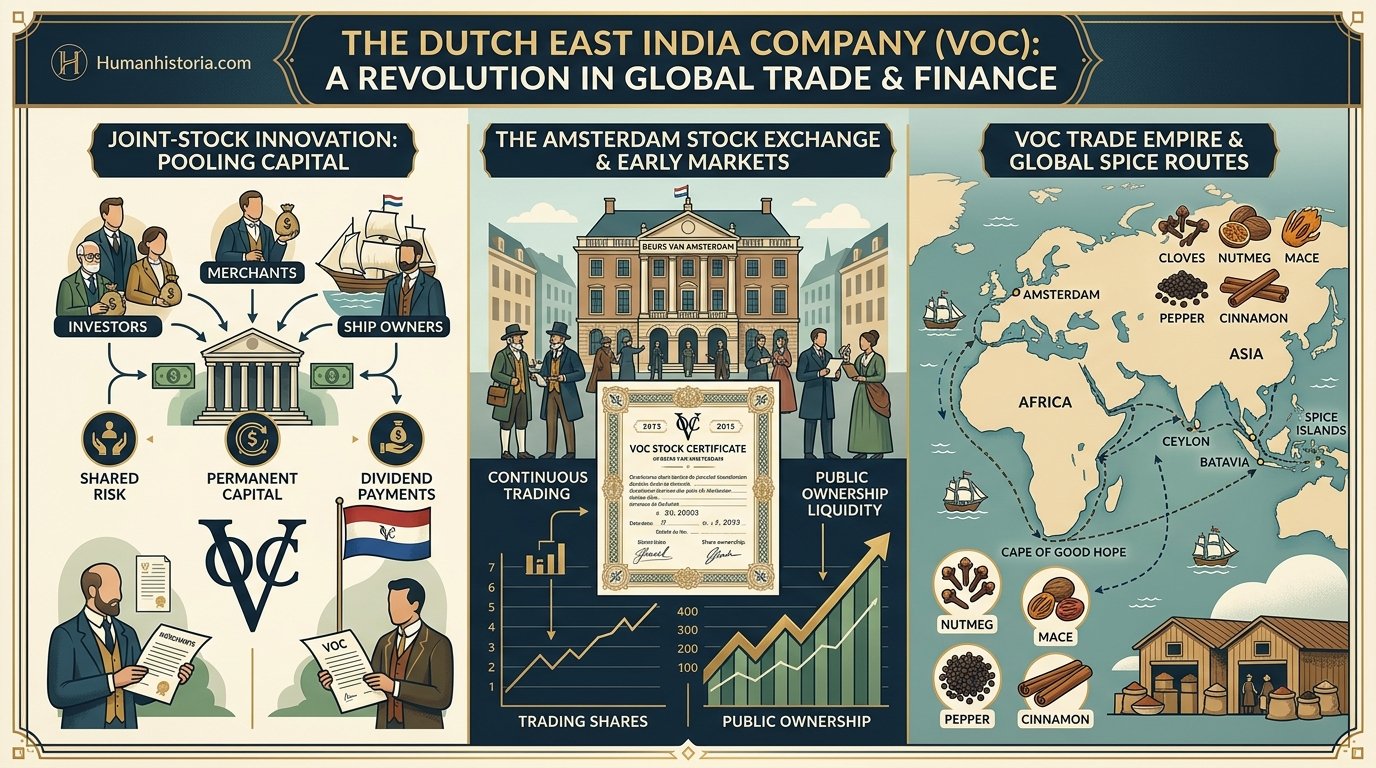
📊 Museum-Grade Infographic Poster
The Dutch East India Company (VOC) Monopolies Infographic
💡 Click anywhere on poster to expand in high resolution🔎 Expand Lightbox
Map and schematic detailing the VOC's spice shipping networks, Batavia harbor fortifications, and armed East Indiaman ships.
📖 SCHOLARLY INQUIRIES
Frequently Asked Questions
Essential historical questions and evidence-based answers concerning this chronicle.
Q.What was the main historical impact of The Dutch East India Company (VOC)?
It fundamentally reshaped trade networks, military statecraft, and legal institutions across the globe.
Q.Why is The Dutch East India Company (VOC) significant today?
It established foundational precedents for modern international law, financial markets, and sovereign governance.
Q.What primary sources document this chronicle?
Contemporary manuscript registries, royal charters, and state ledgers preserve detailed records of these events.
📖 Scholar Mode Active — Click to exit focused reading
History Lab 🧪
Interactive historical deduction games, tactical matchup simulators, and currency calculators.
🕵️ Who Am I? (The Historical Guess Game)
A secret historical figure has been selected. Ask yes/no questions to narrow down the pool of candidates. Click any active card to make your accusation!
Secret Identity
❓ Who Am I?
Ask questions using the board below to narrow down my identity.
Ask a Question:
Question LogQuestions: 0 / 7
No questions asked yet.
Candidate Board:
🗺️ Timeline Scramble
Five historical events appear out of order. Click them in the correct chronological sequence — from oldest to most recent. How well do you know your history?
🏺 Relic or Fake?
Is this a real historical artifact or a convincing fabrication? Judge each one based on its description and era — then see the truth revealed!
Artifact 1 / 10Score: 0
Empire Matchup Simulator
Empire ATerritory Size (Peak, M km²)Empire B
00
Empire APopulation (Peak, Millions)Empire B
00
Empire AMilitary Power (Army Size)Empire B
00
Tactical Battle Analysis
Select empires and click simulate to run evaluations.
Historical Purchasing Power Converter
See what ancient coins are worth in modern terms and check their historical purchasing power.
Modern Value Equivalent
$0.00 USD
Historical Purchasing Power:
Select currency to view purchasing capability.
Historical Identity Generator
Forge an authentic historical identity from ancient civilisations, complete with linguistic meaning and biography.
Neutral
Gaius Julius
Meaning:Descendant of Jupiter
Historical Background:
A Roman citizen and clerk who worked in the forum under Roman republic rule.
Chrono-Cultural Fusion Simulator
Fuse the culture, technology, and governance of two legendary civilizations to synthesize a unique hybrid society.
Cohesion & Coexistence Rate
85%
🏛️ Hybrid Architecture
⚙️ Synthesized Asset
📜 Synthetic Governance
Historical Tactics & Trivia Quiz
Test your historical knowledge and battle tactics to claim your administrative rank.
8 Questions • Multi-Era
You will be presented with random scenarios and trivia spanning ancient Egypt, classical Rome, Islamic Golden Age, and the modern industrial era. Complete the evaluation to see your historical title!
Question 1 of 8Score: 0
What was the Code of Hammurabi written on?
Correct!
Evaluation Complete!
6 / 8
Correct
Rank Attained
Imperial Legionary
Your knowledge of classical strategy and administrative structures is respectable.
🎲 Counterfactual "What If?" Scenario Simulator
Explore alternative historical trajectories by tweaking key civilizational pivot points.
Simulated Shift
Selected Era
Prehistoric Era
Millions of years ago to ~3000 BCE
The dawn of humanity. From the evolutionary split of early hominids to the mastery of stone tools, fire, and the birth of language.
Landmark Milestones
Welcome to Historia
Enter your Scholar Name to synchronize your chronicles and save your journey.

 ⭐ Featured Chronicle

 ANCIENT AGES
 ANCIENT AGES
 ANCIENT AGES
 MEDIEVAL PERIOD
 MEDIEVAL PERIOD
 PREHISTORIC ERA