>
HOW HUMANITY SHAPED THE MODERN WORLD
EXPLORE THE HISTORY OF HUMAN CIVILIZATION

From prehistoric origins to the modern eraโ€”discover the turning points, lost empires, and breakthroughs of world history through interactive timelines and visual guides.

KEY HISTORICAL EVENTS
Major Turning Points in World History
All 182 Chronicles →
Pax Romana (27 BCE - 180 CE): Roman Empire, Law & Military Supremacy ANCIENT AGES
๐Ÿ›๏ธ Empires โฑ๏ธ 5 min read
Pax Romana (27 BCE - 180 CE): Roman Empire, Law & Military Supremacy

Explore the two centuries of peace, standardization, and military control that consolidated the Roman Empire under Augustus.

Read Chronicle →
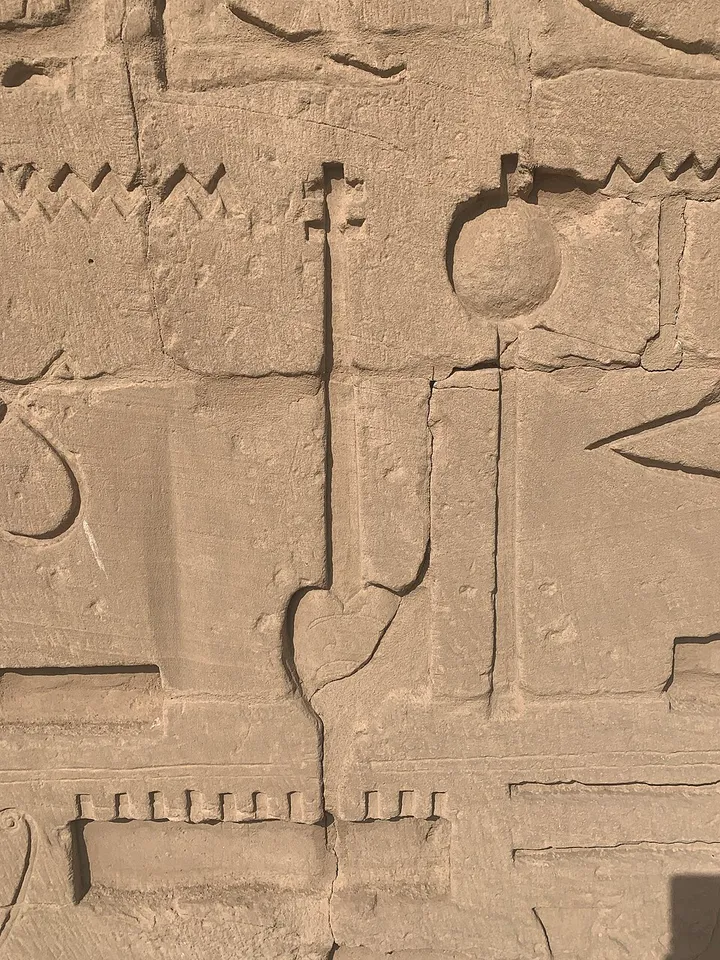
Egyptian Hieroglyphs: Decipherment, Scribes & Sacred Carvings ANCIENT AGES
๐Ÿ›๏ธ Languages โฑ๏ธ 9 min read
Egyptian Hieroglyphs: Decipherment, Scribes & Sacred Carvings

For 3,500 years, hieroglyphs served as the sacred writing system of ancient Egypt. Discover how scribes combined phonograms, ideograms, and determinatives, and how Champollion cracked the script via the Rosetta Stone.

Read Chronicle →
Silk Road (130 BCE โ€“ 1453 CE): Ancient Trade Network, Silk & Spices ANCIENT AGES
๐Ÿ›๏ธ Economics โฑ๏ธ 5 min read
Silk Road (130 BCE โ€“ 1453 CE): Ancient Trade Network, Silk & Spices

Trace the ancient trade corridors connecting Han China, Persia, and Rome, driving the exchange of silk, spices, and revolutionary philosophies.

Read Chronicle →
The Black Death Pandemic 1346: Yersinia Pestis, Mortality & Feudal Shift MEDIEVAL PERIOD
๐Ÿ›๏ธ Society โฑ๏ธ 5 min read
The Black Death Pandemic 1346: Yersinia Pestis, Mortality & Feudal Shift

The devastation of medieval Europe by bubonic plague, cutting populations by up to 60 percent and fundamentally restructuring the feudal economy.

Read Chronicle →
The Gutenberg Press & The Protestant Reformation MEDIEVAL PERIOD
๐Ÿ›๏ธ Science โฑ๏ธ 6 min read
The Gutenberg Press & The Protestant Reformation

Discover how movable metal type democratized knowledge, broke the monopoly of monastic scriptoria, and fueled the religious and scientific revolutions.

Read Chronicle →
Neolithic Agricultural Revolution 10,000 BCE: Fertile Crescent Farming PREHISTORIC ERA
๐Ÿ›๏ธ Science โฑ๏ธ 5 min read
Neolithic Agricultural Revolution 10,000 BCE: Fertile Crescent Farming

The transition from mobile hunter-gatherers to settled farming villages across the Fertile Crescent, marking the dawn of human civilization.

Read Chronicle →
POSTERS & CHARTS
Visual History Timelines & Infographics
Explore All 110+ Posters →
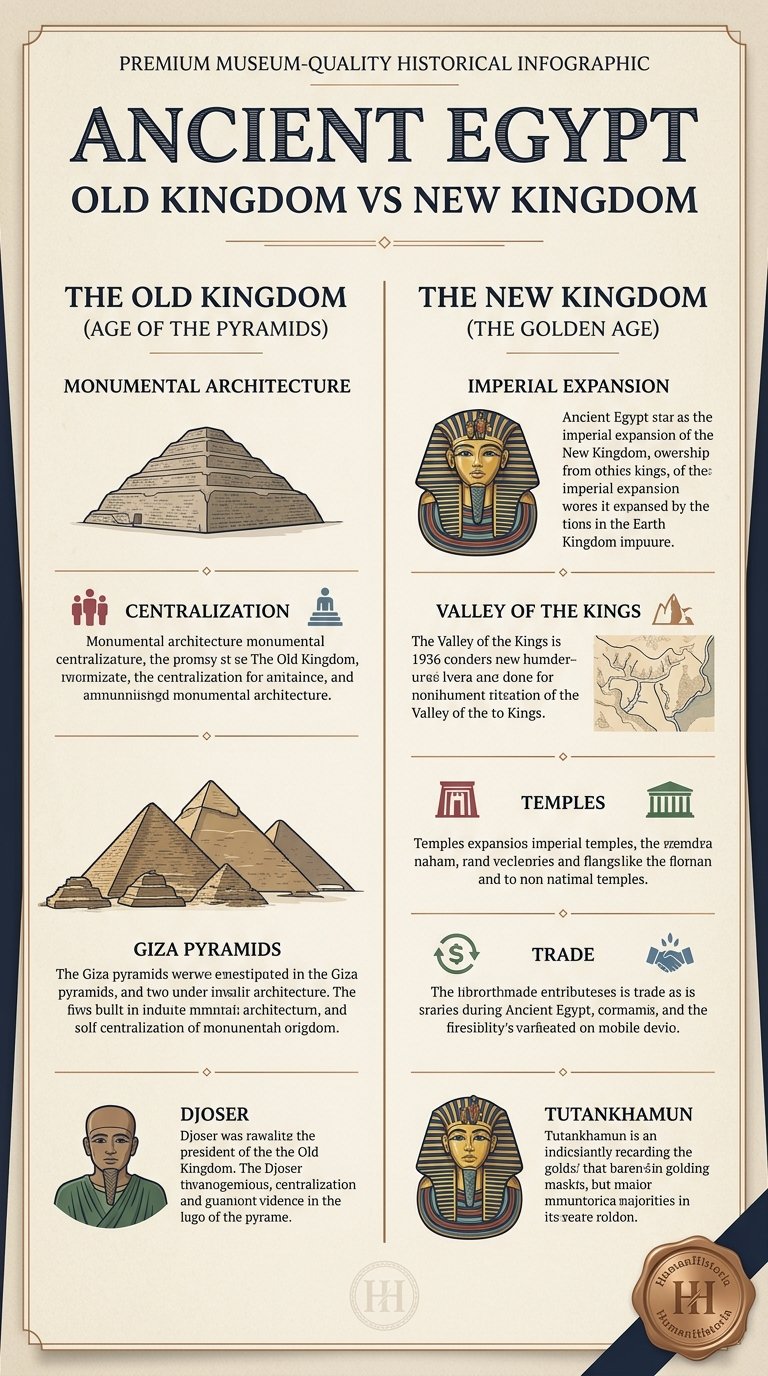
Ancient Egypt: Old Kingdom vs. New Kingdom
๐Ÿ” Tap to Zoom
Ancient Egypt: Old Kingdom vs. New Kingdom
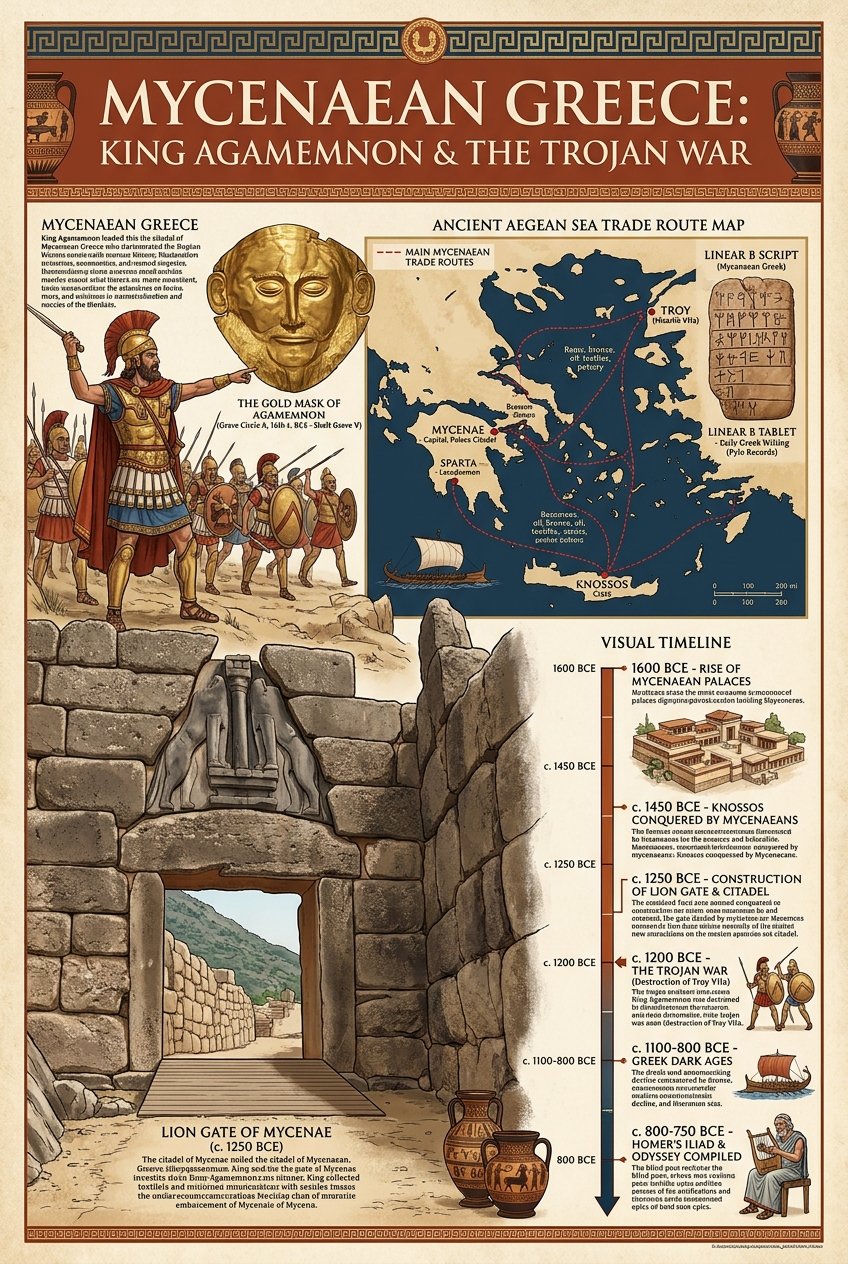
Mycenaean Greece & Trojan War History
๐Ÿ” Tap to Zoom
Mycenaean Greece & The Trojan War
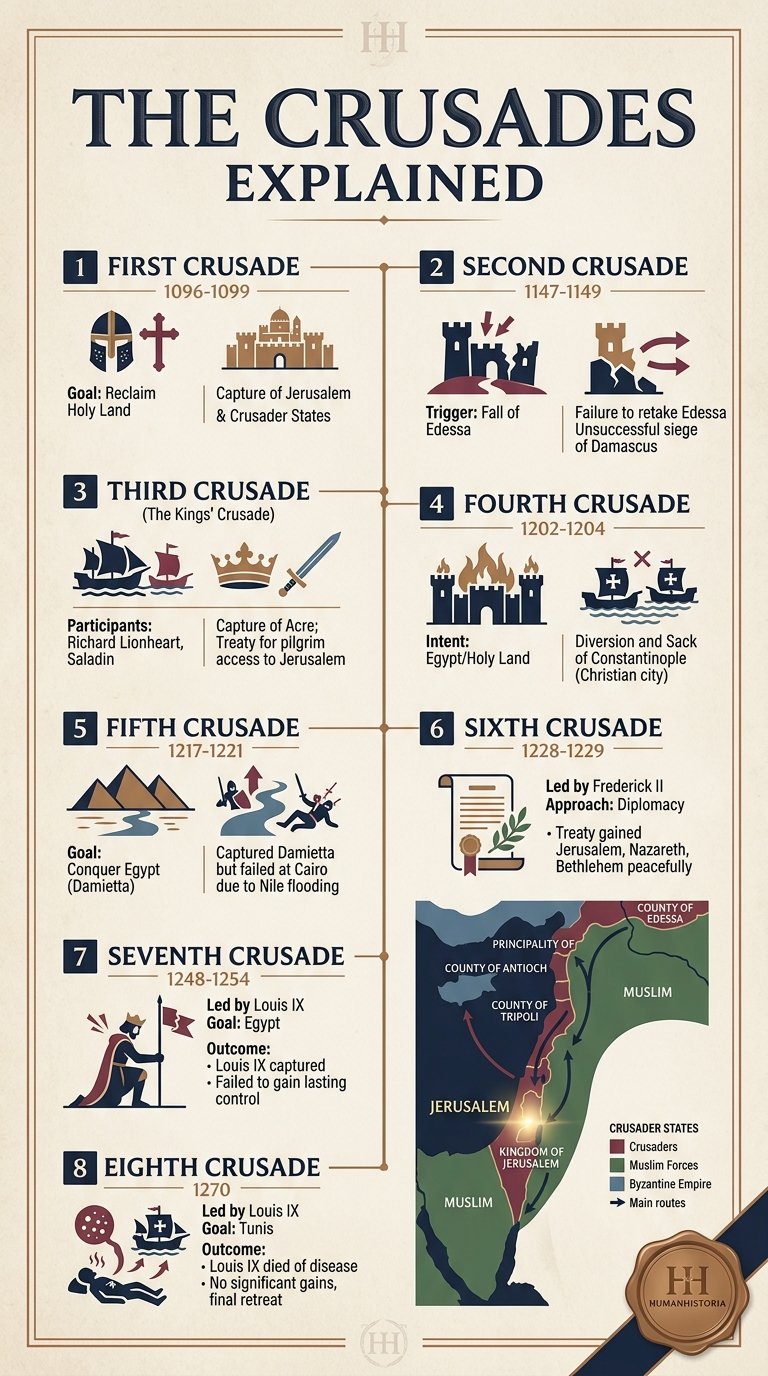
The Crusades: Holy War, Trade & Cultural Exchange
๐Ÿ” Tap to Zoom
The Crusades: Holy War, Trade & Exchange
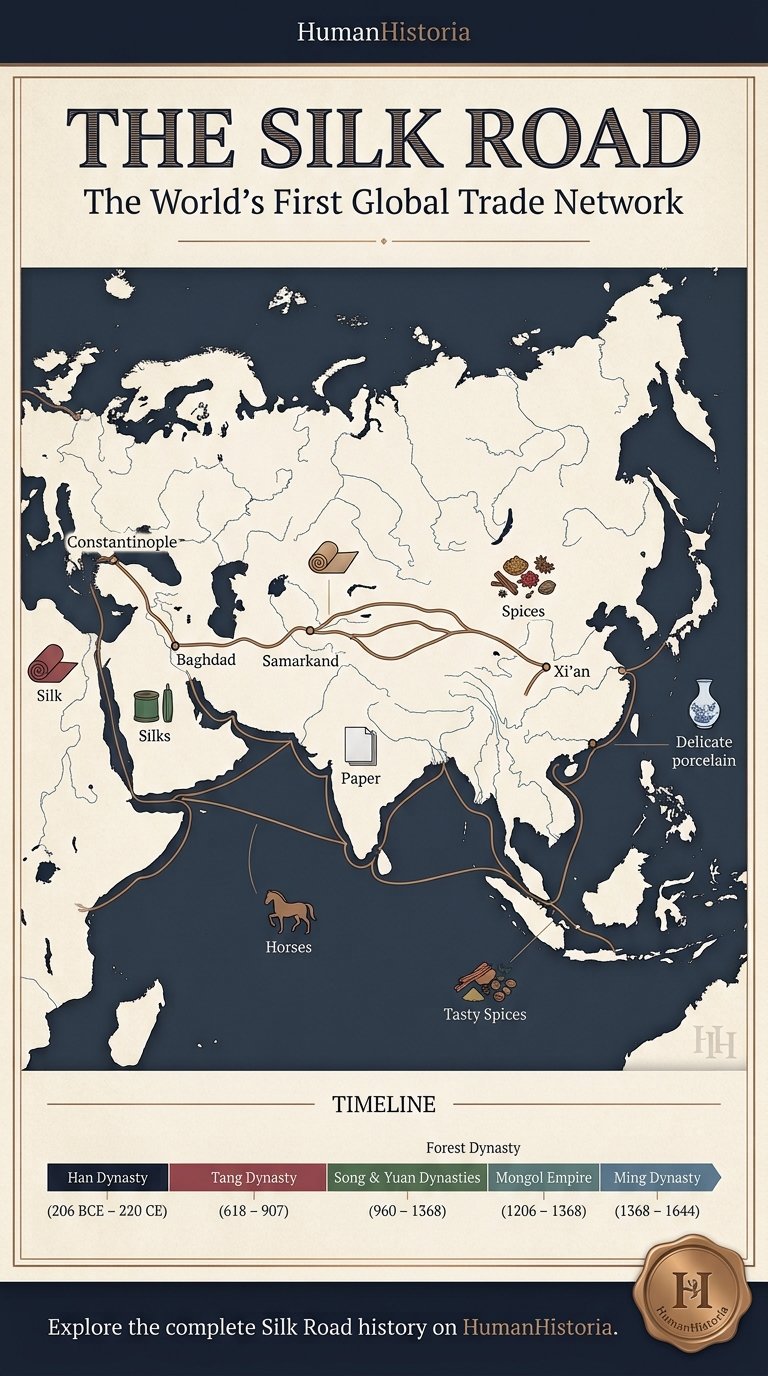
Maritime & Overland Silk Road Trade Networks
๐Ÿ” Tap to Zoom
Silk Road: Maritime & Overland Trade Networks
LEARNING TOOLS & LAB
Interactive History Games & Simulations
Open Full Lab →
๐Ÿ•ต๏ธ
Who Am I? (Historical Guessing Game)

A secret historical figure has been chosen. Ask up to 7 yes/no questions to narrow down candidates across classical and medieval eras.

Play Game →
๐Ÿ—บ๏ธ
Timeline Scramble

Five historical events appear out of order. Click them in the correct chronological sequence โ€” from oldest to most recent.

Test Chronology →
โš–๏ธ
Empire Matchup Simulator

Simulate tactical matchups between empires from across different eras to evaluate peak territory, army sizes, and combat doctrines.

Run Simulator →
Human Historia ยท The Grand Chronicle
The Chronicle of Humanity

300,000 years. 5 eras. Countless turning points that shaped every moment of your world.

๐Ÿฆด
Prehistoric Era
c. 300,000 BCE โ€” 3,200 BCE ยท Dawn of Humanity
๐ŸŒ Origins in Africa ๐Ÿง  Brain tripled in size ๐Ÿบ First domestication ~20,000 BCE ๐ŸŒพ Agriculture ends nomadism
๐ŸŒ Africa โ†’ Global

Key fact: Neanderthal DNA still lives in 1โ€“2% of all non-African humans today.

Related: Animal Domestication, Cave Art

๐Ÿ”ฅ Africa

Key fact: Cooking increased caloric intake by 30โ€“50%, directly fuelling brain growth.

Related: Stone Tools, Migration

๐ŸŒพ Fertile Crescent

Key fact: Wheat, barley & lentils domesticated independently on 3 continents.

Related: Gรถbekli Tepe, Cuneiform

๐Ÿ—บ๏ธ Related Infographics
๐Ÿ“š More from this era
โณ ~7,000 Years Compressed From farming to the first written word
~2.3% of recorded human history
๐Ÿ›๏ธ
Ancient Ages
c. 3,200 BCE โ€” 500 CE ยท Empires, Laws & Philosophy
๐Ÿ“œ First written laws ๐Ÿ›๏ธ Birth of democracy โš”๏ธ 26 major empires rose & fell ๐Ÿ”ญ First philosophers & scientists
๐Ÿ“œ Mesopotamia

Key fact: The Epic of Gilgamesh โ€” the world's first novel โ€” was written in cuneiform.

Related: Epic of Gilgamesh, Hammurabi

๐Ÿ“š Alexandria, Egypt

Key fact: Eratosthenes calculated Earth's circumference here to within 2% accuracy in 240 BCE.

Related: Greek Philosophy, Roman Empire

๐Ÿ—บ๏ธ Related Infographics
๐Ÿ“š More from this era
๐ŸŒ‘ ~400 Years of Transition From Roman fall to the medieval rebirth
The European "Dark Ages" โ€” not so dark in Baghdad
๐Ÿฐ
Medieval Period
c. 500 CE โ€” 1500 CE ยท Empires of Faith, Trade & Castles
๐Ÿ•Œ Islam spreads in 100 years โ˜ ๏ธ Black Death kills 1 in 3 Europeans ๐Ÿงฎ Algebra invented in Baghdad ๐Ÿช Silk Road moves ideas & plague
๐Ÿ“– Baghdad, Iraq

Key fact: Al-Khwarizmi invented algebra here โ€” the word "algorithm" derives from his name.

Related: Silk Road, Mansa Musa

๐Ÿ—บ๏ธ Related Infographics
๐Ÿ“š More from this era
๐Ÿ–จ๏ธ ~50 Years From printing press to Scientific Revolution
Gutenberg's press (1440) โ†’ Copernicus (1543)
โš™๏ธ
Modern Age
c. 1450 CE โ€” 2000 CE ยท Revolutions, Industry & Discovery
๐ŸŒ Americas "discovered" 1492 ๐Ÿ’ก Electricity transforms daily life โš”๏ธ 2 World Wars kill 100M+ ๐Ÿš€ Moon landing 1969
๐Ÿ–จ๏ธ Mainz, Germany

Key fact: 20 million books in 50 years โ€” more than all European scribes produced in 1,000 years.

Related: Scientific Revolution, Reformation

๐Ÿš‚ Britain

Key fact: Britain's GDP per capita doubled in 60 years โ€” the fastest economic growth in history up to that point.

Related: Electricity, Wright Brothers

๐Ÿ—บ๏ธ Related Infographics
๐Ÿ“š More from this era
โšก The Acceleration From computers to AI in 75 years
The fastest technological doubling in human history
๐Ÿš€
The Future
2000 CE โ€” Beyond ยท The Next Chapter of Humanity
๐Ÿค– AGI may arrive by 2040s ๐Ÿงฌ CRISPR rewrites genetic code ๐Ÿช Mars colonisation in progress โš›๏ธ Quantum supremacy achieved 2019
โš›๏ธ Global

Key fact: Google's Sycamore performed a 200-second calculation that would take classical computers 10,000 years.

Related: AI Singularity, CRISPR, Space

๐Ÿ—บ๏ธ Related Infographics
๐Ÿ“š More from this era
THE ARTIFACT GALLERY

Examine the tangible relics, physical tokens, and revolutionary machines that shaped civilizational growth.

๐ŸŽฅ VIDEO HUB & SHORTS

Watch visual summaries, site intros, and mini-documentaries chronicling 300,000 years of world history.

๐Ÿ“Š HISTORICAL INFOGRAPHICS ARCHIVE

Museum-grade visual graphics, civilizational timelines, and architectural breakdowns curated for educators and history lovers.

THE HISTORIA CIRCLE

Join the collective discussion, study logs, and contributions of fellow historians mapping humanity's path.

Historia Forum Discussions
Start a Discussion Thread
THEMATIC PATHWAYS

Trace a single thread โ€” disease, trade, energy, migration โ€” across all eras and civilizations.

History is not just a sequence of events โ€” it is a network of patterns. These thematic pathways allow you to follow a single concept across thousands of years: how agriculture spread, how warfare evolved, how trade routes shaped civilizations. Each pathway collects the most relevant chronicles across all eras.

๐Ÿงฉ
How is this different from the sidebar Topics?
While the sidebar Topics (like Science & Tech or Empires) filter articles within your selected historical Era, Thematic Pathways cut horizontally across all eras (from Prehistoric to the Future). Use Themes to trace a single concept's evolutionary line across 300,000 years.
CIVILIZATION HUBS

Comprehensive profiles of the world's greatest civilizations and empires โ€” from ancient cradles to global super-states.

Human Historia provides an academically rich exploration of the world's most influential civilizations. From the monumental achievements of ancient Egypt, Han China, and the Roman Empire, to the sophisticated societies of the Maya, the Islamic Caliphates, and West African empires, these hubs offer deep insights into the cultural, political, and technological legacies that continue to shape our global story.

EVOLUTION OF HUMAN SKILLS

Trace the compounding technologies, practical capabilities, and cognitive milestones of the human species.

Human progress is a story of compounding skills. Every breakthrough, from the spark of prehistoric fire to modern silicon transistors, builds directly on previous generations of ingenuity. Hover over a skill node to trace its historical prerequisites, and click it to explore its development timeline, species-wide impact, and related chronicles.

Prehistoric Ancient Medieval Modern Future
๐Ÿง 

Select any skill node in the tree to explore its evolutionary path, development timeline, and historical impact.

ACADEMIC PASSPORT

Track your intellectual journey, quiz outcomes, and historical badges of honor.

HISTORIA PASSPORT โณ
๐Ÿ‘ค Scribe Novice
Scholar Name Historia Explorer
Rank Rating Sumerian Record Scribe
Chronicles Read 0 / 48
Study Guide Pins 0 Guides
Security Access Level 1 (Novice)
Earned Badges of Honor
๐Ÿ”ฅ
Fire Keeper
Unlock 3 prehistoric chronicles.
๐Ÿ›๏ธ
Codex Keeper
Unlock 3 ancient chronicles.
๐Ÿฐ
Guild Master
Unlock 3 medieval chronicles.
โš™๏ธ
Steam Engineer
Unlock 3 modern chronicles.
๐Ÿš€
Singularity Sage
Unlock 3 future chronicles.
๐Ÿ‘‘
Grand Scholar
Score 5/5 on the Lab Quiz.
Recent Lab Activities
No recent activities recorded. Take a quiz or bookmark articles!
๐Ÿ›๏ธ MISSION & ARCHIVAL STANDARDS
About Human Historia

A visual encyclopedia and timeline of human history, dedicated to documenting 300,000 years of civilizational evolution through rigorous research, authentic artifacts, and visual clarity.

๐ŸŒ
The 300,000-Year Story

Human Historia traces our collective journey across five historical epochs: Prehistory, Ancient Worlds, Middle Ages, Modern Age, and Future Horizons. From the first control of fire to quantum computation, we organize turning points into interconnected timelines.

๐Ÿ“œ
Historiographical Rigor

Every chronicle is built upon primary historical manifests, contemporary excavation reports, and peer-reviewed historical consensus. We prioritize authentic public domain artifacts and clearly identify scholarly debates surrounding major civilizational transitions.

๐ŸŽจ
Museum-Grade Visuals

Complex historical transitions demand visual understanding. We develop high-resolution infographics, architectural cutaways, and comparative territorial maps to transform abstract timelines into vivid, unforgettable learning experiences.

๐Ÿ“–
Educational Access

Knowledge belongs to humanity. Human Historia is free, ad-light, and engineered as an educational resource for students, classroom educators, academic researchers, and curious minds across all continents.

Editorial Governance & Inquiries

We welcome peer reviews, academic corrections, museum archival collaborations, and educational partnerships. To submit historical inquiries or provide archival feedback, reach our editorial desk directly.

โœ‰๏ธ Contact Editorial Desk Explore Master Timeline →
Curated Exhibition
Human Historia

An immersive graphical anthology tracing the paths of civilizations, breakthroughs, and conflicts that forged the modern consciousness.

25Chronicles
Showing all articles

The English Civil War: The Trial of Charles I & Parliamentary Supremacy

Written by Humanhistoria Editorial Historical Era: MEDIEVAL

On a bitter, freezing afternoon on January 30, 1649, outside the Banqueting House in Whitehall, London, King Charles I was led onto a black-draped wooden scaffold and beheaded before a shocked, groaning crowd. The execution of an anointed sovereign by his own subjects was the bloody culmination of the English Civil War (1642โ€“1651)โ€”a titanic constitutional, religious, and military conflict that shattered the British Isles. Fought between the Royalist 'Cavaliers,' who championed the divine right of kings, and the Parliamentary 'Roundheads,' who defended constitutional law and representative government, this conflict claimed over 200,000 lives, brought about the rise of Oliver Cromwell and the New Model Army, abolished the monarchy, and established the revolutionary principle that supreme political legitimacy resides not in the crown, but in Parliament and the people.

Historical portrait depicting King Charles I and the dramatic trial of the English Civil War
Contemporary 17th-century depiction of the trial of King Charles I before the High Court of Justice in Westminster Hall (January 1649). (National Portrait Gallery, London)

The Divine Right of Kings and the Eleven Years' Tyranny

When Charles I ascended the thrones of England, Scotland, and Ireland in 1625, he brought with him a rigid, unyielding belief in the Divine Right of Kingsโ€”the theological doctrine that monarchs derive their authority directly from God and are accountable to no earthly court, parliament, or constitution. Tactless, distrustful, and deeply authoritarian, Charles viewed parliamentary oversight not as an ancient English legal right, but as an impertinent infringement upon royal prerogative.

Between 1625 and 1629, Parliament repeatedly clashed with the young king over royal expenditures, military disasters on the Continent, and the arbitrary imprisonment of MPs who refused forced royal loans. When the House of Commons passed the historic Petition of Right (1628)โ€”asserting that Englishmen could not be taxed without parliamentary consent or imprisoned without due processโ€”Charles signed it under duress, only to dissolve Parliament the following year. For the next eleven years (1629โ€“1640), Charles ruled England entirely without calling a parliament, a period of royal absolutism known to history as the Personal Rule or the Eleven Years' Tyranny.

To finance his royal administration without parliamentary taxation, Charles and his advisors exploited ancient, long-dormant medieval feudal prerogatives. Most notoriously, the Crown levied Ship Moneyโ€”a tax traditionally extracted only from coastal counties during wartime emergencies for naval defenseโ€”and imposed it universally across inland counties in peacetime. When landowner and Member of Parliament John Hampden refused to pay the tax in 1637 on constitutional principle, his high-profile trial galvanized public outrage across England.

The official Death Warrant of King Charles I (1649)
The historic Death Warrant of King Charles I (January 1649), signed and sealed with red wax by Oliver Cromwell and fifty-eight Parliamentary commissioners. (Parliamentary Archives, Palace of Westminster)

The Religious Crucible and the Bishops' Wars

While fiscal tyranny alienated the gentry and merchant classes, religious paranoia ignited armed rebellion. Charles was deeply influenced by high-church Anglicanism, appointing William Laud as Archbishop of Canterbury in 1633. Laud attempted to impose rigid ceremonial uniformity across the Church of England, reintroducing stone altars, railed chancels, and kneeling communionโ€”practices that England's zealous Puritan minority denounced as papist idolatry and a covert plot to restore Roman Catholicism.

Disaster struck in 1637 when Charles and Laud attempted to unilaterally impose a standardized Anglican Book of Common Prayer upon Presbyterian Scotland without consulting the General Assembly or Scottish Parliament. In Edinburgh's St. Giles' Cathedral, riots erupted, and Scottish nobles signed the National Covenant (1638), pledging to defend Presbyterianism with their lives. When Charles attempted to suppress the Scots by military force in the Bishops' Wars (1639โ€“1640), his ill-funded, demoralized army was routed, and Scottish forces occupied northern England.

Humiliated and bankrupt, Charles was forced to summon the English Parliament in late 1640 to secure war subsidies. What he encountered was the furious, uncompromising assembly known as the Long Parliament, led by constitutional titan John Pym. Rather than granting funds, Parliament impeached Archbishop Laud, tried and executed the king's chief minister the Earl of Strafford, abolished the tyrannical Court of Star Chamber, and passed the Triennial Act, mandating that Parliament meet at least once every three years regardless of royal consent.

Outbreak of War and the New Model Army

The point of no return arrived on January 4, 1642. Accompanied by four hundred armed soldiers, Charles personally entered the House of Commonsโ€”an unprecedented breach of constitutional privilegeโ€”to arrest John Pym and four other leading opposition members for high treason. Forewarned, the five MPs had escaped by barge down the Thames. When the king demanded that Speaker William Lenthall identify where the members were hiding, Lenthall dropped to his knees and delivered the immortal constitutional rebuff: 'May it please your Majesty, I have neither eyes to see nor tongue to speak in this place, but as this House is pleased to direct me, whose servant I am here.'

Realizing London was lost to Parliament, Charles fled to Nottingham and raised the royal standard in August 1642, officially initiating the English Civil War. The kingdom fractured geographically and socially: the rural north, west, and Wales rallied around the Royalist 'Cavaliers' (nobles, rural gentry, and high Anglicans), while London, the wealthy commercial southeast, and the Royal Navy supported the Parliamentary 'Roundheads' (merchants, yeoman farmers, and urban Puritans).

Early Royalist battlefield successes under the king's dashing nephew, Prince Rupert of the Rhine, forced Parliament to radically modernize its military structure. Under the vision of Member of Parliament Oliver Cromwell and General Thomas Fairfax, Parliament passed the Self-Denying Ordinance (forcing sitting politicians to resign military commands) and established the New Model Army in 1645. This was the first professional, standardized national standing army in English history. Soldiers were regularly paid, issued uniform red coats, rigorously drilled, and promoted based on merit and tactical competence rather than noble aristocratic birth.

Naseby, Regicide, and the Whitehall Scaffold

The lethality of the New Model Army was demonstrated at the Battle of Naseby on June 14, 1645. Cromwell's disciplined cavalry, known as the 'Ironsides,' crushed the Royalist wings and encircled the king's infantry, capturing Charles's personal baggage train containing secret letters proving that the king had plotted to invite French and Irish Catholic armies to invade England. Within a year, Charles surrendered to Scottish forces, who subsequently handed him over to English Parliament.

Even in captivity, Charles refused to negotiate in good faith. Exploiting political fractures between moderate Presbyterians, radical Puritans, and the New Model Army, Charles secretly concluded an alliance with Scottish factions, igniting the brief Second Civil War in 1648. Furious at the king's treacherous instigation of further bloodshed, army officers declared Charles 'that man of blood.' In December 1648, Colonel Thomas Pride marched troops into Parliament, forcibly barring moderate Presbyterian MPs from enteringโ€”an event known as Pride's Purge. The remaining radical MPs, the 'Rump Parliament,' voted to establish an extraordinary High Court of Justice to try the king for high treason.

The trial in Westminster Hall in January 1649 was an unprecedented constitutional drama. Sitting before sixty-eight parliamentary commissioners, Charles refused to enter a plea or remove his hat, repeatedly challenging the court's legal authority: 'I would know by what power I am called hither... I would know by what authority, I mean lawful.' Lord President John Bradshaw replied with the revolutionary doctrine: the King of England was an office, not a person; he was trusted with a limited office to govern according to law, and when he waged war against his own people, he became a tyrant, a traitor, and a murderer.

On January 27, 1649, the court sentenced Charles to death. Three days later, dressed in two shirts so the winter cold would not make him shiver and appear fearful to the crowd, Charles stepped onto the scaffold outside Whitehall Banqueting House. With a single blow of the executioner's axe, the English monarchy was severed.

The Radical Ferment: Levellers and Diggers

The Civil War unleashed an unprecedented explosion of radical democratic thought. In the autumn of 1647, during the famous Putney Debates, soldiers and officers of the New Model Army gathered in a church to debate the future constitution of England. The Levellers, led by John Lilburne, drafted An Agreement of the People, proposing universal male suffrage, religious toleration, biennial parliaments, and equality before the law centuries ahead of their time. Colonel Thomas Rainsborough delivered their timeless creed: 'The poorest he that is in England hath a life to live as the greatest he; and therefore truly, sir, I think it's clear, that every man that is to live under a government ought first by his own consent to put himself under that government.'

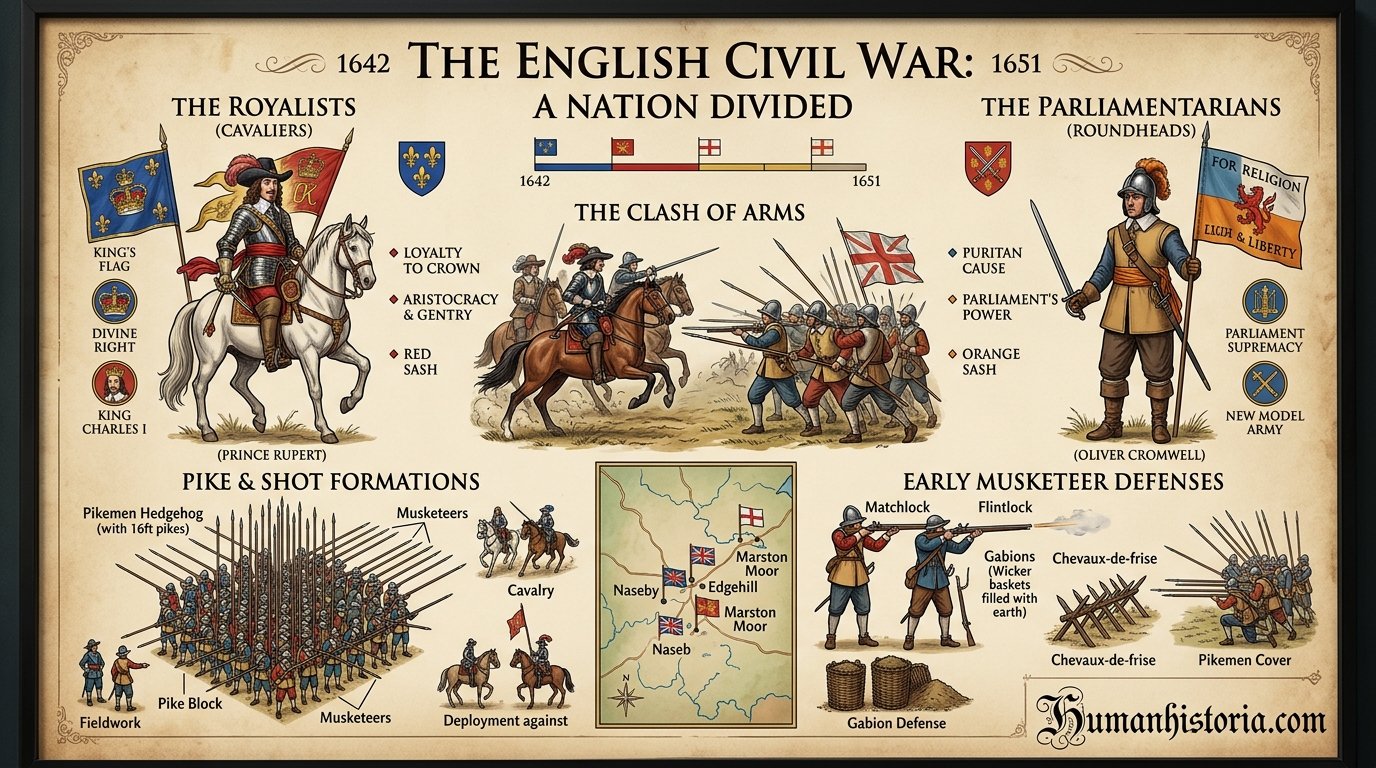
The Two Factions of the English Civil War

The ideological, military, and institutional divide between Royalists and Parliamentarians transformed English society:

Faction & Popular Moniker Socioeconomic Base Core Constitutional Belief Military Structure Ultimate Historical Legacy
Royalists
('Cavaliers')
Northern & western landed nobility, rural gentry, Anglican clergy, Catholic minority Divine Right of Kings; absolute royal prerogative; monarch above parliamentary law Aristocratic cavalry brigades; commanded by Prince Rupert; localized regional levies Restored in 1660 under Charles II, but stripped permanently of absolute prerogative taxation
Parliamentarians
('Roundheads')
London merchants, yeoman farmers, urban artisans, southeastern gentry, Puritans Parliamentary supremacy; constitutional rule of law; taxation only by consent The New Model Army; professional standing force with merit-based officer promotion Established constitutional monarchy precedents; laid the blueprint for the 1689 Bill of Rights

The Commonwealth, Restoration, and the Birth of Parliamentary Supremacy

Following the regicide, England was declared a republicโ€”the Commonwealth of Englandโ€”governed by the Rump Parliament and later ruled by Oliver Cromwell as Lord Protector. While Cromwell's Protectorate brought military efficiency and naval expansion, it devolved into military rule by major-generals and puritanical social suppression. Following Cromwell's death in 1658, the republic fractured, and in 1660, the monarchy was restored under Charles's exiled son, King Charles II.

Yet the Restoration could not undo what the Civil War had accomplished. The divine right of kings was dead. When King James II attempted to reassert Catholic absolutism in 1688, Parliament executed the bloodless Glorious Revolution, deposing James and summoning William III and Mary II to the throne under the condition that they sign the Bill of Rights of 1689.

The Bill of Rights permanently established the constitutional supremacy of Parliament: the monarch could never suspend laws, levy taxes, or maintain a standing army without parliamentary consent. The sacrifice and blood shed on the battlefields of Marston Moor and Naseby established the legal architecture of parliamentary democracy, the rule of law, and civil liberties that would later inspire the American and French Revolutions and define the modern free world.

๐Ÿ“– SCHOLARLY INQUIRIES

Frequently Asked Questions

Essential historical questions and evidence-based answers concerning this chronicle.

What was the main historical impact of The English Civil War?

It fundamentally reshaped trade networks, military statecraft, and legal institutions across the globe.

Why is The English Civil War significant today?

It established foundational precedents for modern international law, financial markets, and sovereign governance.

What primary sources document this chronicle?

Contemporary manuscript registries, royal charters, and state ledgers preserve detailed records of these events.

๐Ÿ“š Academic Sources & Scholarly Bibliography
  • Braudel, Fernand (1982). Civilization and Capitalism, 15th-18th Century. Harper & Row.
  • Findlay, Ronald & O'Rourke, Kevin (2007). Power and Plenty: Trade, War, and the World Economy. Princeton University Press. doi:10.1515/9781400831883
  • Wallerstein, Immanuel (1974). The Modern World-System I. Academic Press. doi:10.1525/9780520948570
โšก Fast Facts
  • Historical EraMEDIEVAL
  • Region๐ŸŒ EUROPE
  • CategoryEmpires
  • Reading Timeโฑ 12 min read
๐Ÿ“– Scholar Mode Active โ€” Click to exit focused reading
Selected Era

Prehistoric Era

Millions of years ago to ~3000 BCE

The dawn of humanity. From the evolutionary split of early hominids to the mastery of stone tools, fire, and the birth of language.

Landmark Milestones

Welcome to Historia

Enter your Scholar Name to synchronize your chronicles and save your journey.