From prehistoric origins to the modern era—discover the turning points, lost empires, and breakthroughs of world history through interactive timelines and visual guides.
Examine the tangible relics, physical tokens, and revolutionary machines that shaped civilizational growth.
🎥 VIDEO HUB & SHORTS
Watch visual summaries, site intros, and mini-documentaries chronicling 300,000 years of world history.
📊 HISTORICAL INFOGRAPHICS ARCHIVE
Museum-grade visual graphics, civilizational timelines, and architectural breakdowns curated for educators and history lovers.
THE HISTORIA CIRCLE
Join the collective discussion, study logs, and contributions of fellow historians mapping humanity's path.
Historia Forum Discussions
Start a Discussion Thread
THEMATIC PATHWAYS
Trace a single thread — disease, trade, energy, migration — across all eras and civilizations.
History is not just a sequence of events — it is a network of patterns. These thematic pathways allow you to follow a single concept across thousands of years: how agriculture spread, how warfare evolved, how trade routes shaped civilizations. Each pathway collects the most relevant chronicles across all eras.
🧩
How is this different from the sidebar Topics?
While the sidebar Topics (like Science & Tech or Empires) filter articles within your selected historical Era, Thematic Pathways cut horizontally across all eras (from Prehistoric to the Future). Use Themes to trace a single concept's evolutionary line across 300,000 years.
CIVILIZATION HUBS
Comprehensive profiles of the world's greatest civilizations and empires — from ancient cradles to global super-states.
Human Historia provides an academically rich exploration of the world's most influential civilizations. From the monumental achievements of ancient Egypt, Han China, and the Roman Empire, to the sophisticated societies of the Maya, the Islamic Caliphates, and West African empires, these hubs offer deep insights into the cultural, political, and technological legacies that continue to shape our global story.
EVOLUTION OF HUMAN SKILLS
Trace the compounding technologies, practical capabilities, and cognitive milestones of the human species.
Human progress is a story of compounding skills. Every breakthrough, from the spark of prehistoric fire to modern silicon transistors, builds directly on previous generations of ingenuity. Hover over a skill node to trace its historical prerequisites, and click it to explore its development timeline, species-wide impact, and related chronicles.
Prehistoric Ancient Medieval Modern Future
🧠
Select any skill node in the tree to explore its evolutionary path, development timeline, and historical impact.
ACADEMIC PASSPORT
Track your intellectual journey, quiz outcomes, and historical badges of honor.
HISTORIA PASSPORT⏳
👤Scribe Novice
Scholar NameHistoria Explorer
Rank RatingSumerian Record Scribe
Chronicles Read0 / 48
Study Guide Pins0 Guides
Security AccessLevel 1 (Novice)
Earned Badges of Honor
🔥
Fire Keeper
Unlock 3 prehistoric chronicles.
🏛️
Codex Keeper
Unlock 3 ancient chronicles.
🏰
Guild Master
Unlock 3 medieval chronicles.
⚙️
Steam Engineer
Unlock 3 modern chronicles.
🚀
Singularity Sage
Unlock 3 future chronicles.
👑
Grand Scholar
Score 5/5 on the Lab Quiz.
Recent Lab Activities
No recent activities recorded. Take a quiz or bookmark articles!
🏛️ MISSION & ARCHIVAL STANDARDS
About Human Historia
A visual encyclopedia and timeline of human history, dedicated to documenting 300,000 years of civilizational evolution through rigorous research, authentic artifacts, and visual clarity.
🌍
The 300,000-Year Story
Human Historia traces our collective journey across five historical epochs: Prehistory, Ancient Worlds, Middle Ages, Modern Age, and Future Horizons. From the first control of fire to quantum computation, we organize turning points into interconnected timelines.
📜
Historiographical Rigor
Every chronicle is built upon primary historical manifests, contemporary excavation reports, and peer-reviewed historical consensus. We prioritize authentic public domain artifacts and clearly identify scholarly debates surrounding major civilizational transitions.
🎨
Museum-Grade Visuals
Complex historical transitions demand visual understanding. We develop high-resolution infographics, architectural cutaways, and comparative territorial maps to transform abstract timelines into vivid, unforgettable learning experiences.
📖
Educational Access
Knowledge belongs to humanity. Human Historia is free, ad-light, and engineered as an educational resource for students, classroom educators, academic researchers, and curious minds across all continents.
Editorial Governance & Inquiries
We welcome peer reviews, academic corrections, museum archival collaborations, and educational partnerships. To submit historical inquiries or provide archival feedback, reach our editorial desk directly.
An immersive graphical anthology tracing the paths of civilizations, breakthroughs, and conflicts that forged the modern consciousness.
25Chronicles
Showing all articles
The Inca Empire: How Andean Builders Carved Machu Picchu and 40,000 km of Mountain Roads
Written by Humanhistoria EditorialHistorical Era: MEDIEVAL
In 1438, a Spanish soldier named Francisco Pizarro had not yet been born. The Inca Empire he would eventually destroy was, in that year, still expanding — its armies moving south along the Andean spine toward what would become northern Chile, its administrators extending the quipu-recorded census to new provinces, its engineers laying yet more kilometers of road through landscapes that would challenge any modern construction crew. That road network, which would eventually stretch some forty thousand kilometers through deserts, cloud forests, and Andean passes over five thousand meters in altitude, was built without iron tools, without wheeled transport, without draft animals larger than llamas, and without a written language. The civilization that built it was simultaneously one of the most sophisticated administrative states in pre-modern history and, by the categories that European scholarship applied to such things, inexplicably "primitive." The paradox of the Inca Empire is not simply that it did extraordinary things with limited technology. It is that its extraordinary things were possible precisely because its people had developed alternative solutions — the quipu, the mit'a, the ceque system, the freeze-dried potato — to problems that the Old World had solved through writing, money, and metallurgy. What happened when Spanish conquistadors arrived in 1532 was not, as it has often been framed, the collision of civilization with its absence. It was the collision of two completely alien civilizational models, one of which happened to have smallpox.
🎯 Quick Historical Summary
What Was the Inca Empire?
The paradox of a continent-spanning empire that operated without an alphabet, wheeled transport, or iron tools — and why the quipu knotted-string system may have been more sophisticated than historians assumed.
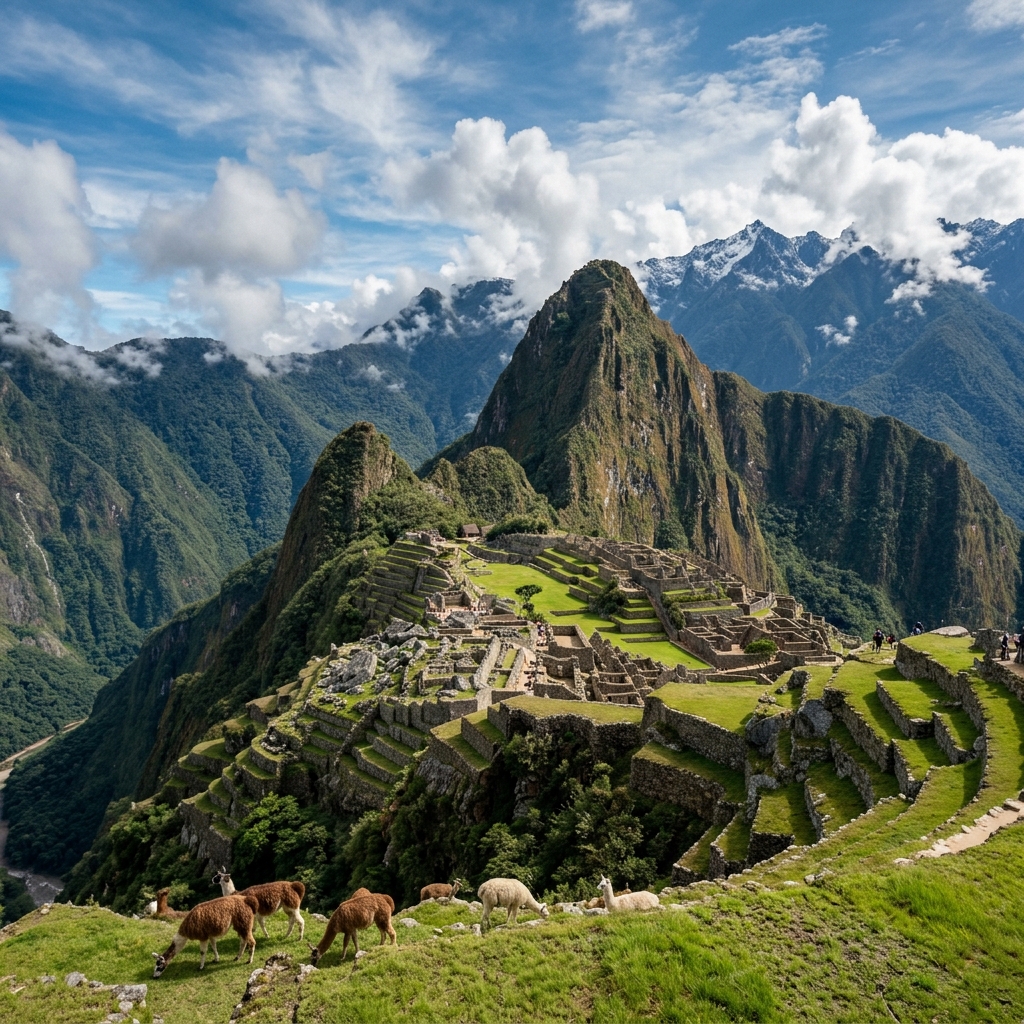
Archival visual record and historical depiction representing The Inca Empire: How Andean Builders Carved Machu Picchu and 40,000 km of Mountain Roads.
Historical Context
The Inca state, known in its own language (Quechua) as Tawantinsuyu — "the four parts together" — emerged from the Cusco Valley of southern Peru sometime in the early 14th century. The Inca origin tradition, recorded by both Inca-descended chroniclers and Spanish clerics after the conquest, describes the founding ancestor Manco Capac emerging from Lake Titicaca (or, in other versions, from a cave called Pacariqtambo) to establish the first settlement at Cusco, which the Inca understood as the navel of the world — literally, in Quechua, the qosqo. These origin stories, like the Sundiata epic of Mali, encode real historical memory in mythological form, and the genealogy of Inca rulers (Sapa Inca) that follows them is generally treated by Andeanists as containing reliable information about the sequence of rulers if not always their precise dates.
The explosive expansion that created the empire recognizable to Pizarro happened remarkably fast. Under Pachacuti Inca Yupanqui, who took the throne around 1438, the Inca began a program of military conquest and administrative incorporation that within a century brought the entire Andean coastal strip and highland zone — roughly the western edge of South America from modern Ecuador to central Chile and northwestern Argentina — under Cusco's authority. Pachacuti is also credited with rebuilding Cusco itself in its monumental form and with constructing Machu Picchu, the royal estate whose dramatic preservation is due primarily to the fact that the Spanish never knew it existed.
At its maximum extent around 1520, Tawantinsuyu governed a territory of roughly 1.8 million square kilometers and a population estimated between 10 and 12 million people — a number that would be halved within two decades of Spanish arrival, not primarily by warfare but by the epidemics of smallpox, measles, and typhus that moved faster than any army.
Why It Happened: Altitude, Agriculture, and State Power
The Andean environment is extraordinary in its vertical diversity. Within a few dozen kilometers, moving from the Pacific coast through the western cordillera and down into the Amazon basin, altitude changes from sea level to over six thousand meters. Each altitude band produces different crops, different animals, different building materials, and different climate regimes. The Inca empire was, among other things, a mechanism for integrating these ecological zones — moving freeze-dried potatoes from the high puna grasslands to coastal settlements, carrying dried fish from the coast to the highland cities, redistributing the specialized production of dozens of micro-climates through a state system of storehouses, roads, and runners.
The potato — native to the Andes and cultivated there for at least seven thousand years before Inca state formation — was the caloric foundation of this system, and the Inca contribution to potato agriculture was the development of freeze-drying: chuño, made by exposing potatoes to the extreme cold of high-altitude nights and the heat of Andean days in alternating cycles, wrung out the moisture, and produced a product that could be stored for years and transported across the empire's road network without spoiling. The Andean storehouses (qollqas), whose ruins dot the hillsides above Inca administrative centers, were filled with chuño, dried meat, textiles, weapons, and other commodities — a state reserve system that the Spanish, when they eventually understood it, compared favorably to anything in Europe.
Terraced agriculture (andenes) on steep Andean slopes was not an Inca invention — its roots go back thousands of years in the Andes — but the Inca state systematized and extended it dramatically. By carefully engineering the soils and irrigation channels of terraced fields, Inca agronomists could grow maize (a politically and ritually prestige crop) at altitudes where it would otherwise not survive, and could extract two or three crops per year from well-managed terraces in the Cusco Valley. Modern agronomists studying these terraces have found that they incorporated drainage layers, soil amendments, and microclimate modification techniques that represent centuries of accumulated experimental knowledge.
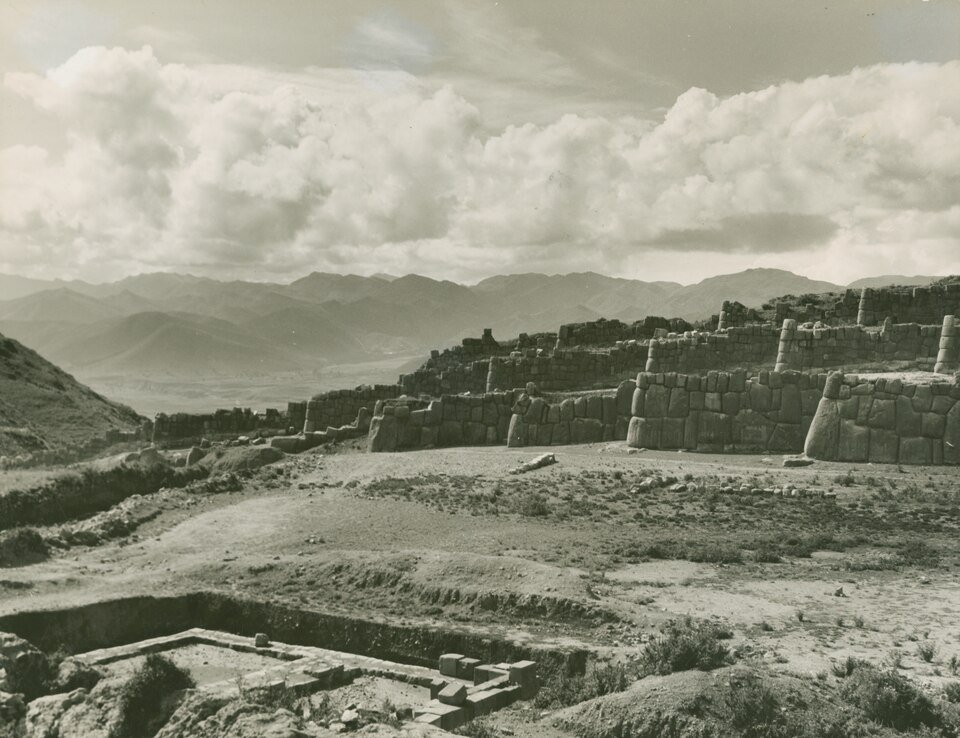
The massive stone walls of the Sacsahuaman fortress in Cusco, Peru, demonstrating advanced Inca masonry. .
The Quipu and the Road: Governing Without Writing
The quipu (sometimes spelled khipu — Quechua for "knot") is a data-recording device consisting of a main cord from which hang subsidiary cords of varying colors, twists, plying directions, and attached knots arranged in decimal-positional groups. They were used by Inca state administrators — the quipucamayoqs, or "quipu keepers" — to record census data, tribute inventories, calendrical information, astronomical observations, and the contents of the qollqas storehouses. Quipus survive in significant numbers — over nine hundred are known from museum collections and ongoing archaeological finds — and their numerical function has been well-understood since the 1920s.
What has remained stubbornly mysterious is whether quipus could also encode narrative text. The colonial chronicler Felipe Guaman Poma de Ayala, himself of Andean noble descent, described quipucamayoqs who could "read" historical accounts from their devices, and several Spanish clerics reported that Inca histories, genealogies, and poetry were stored in quipu form. The anthropologist Gary Urton, who has spent decades building a database of quipu structural elements, has identified what he calls a "binary code" of 24 distinct structural choices that, in combination, could theoretically encode enough distinct signs to represent a syllabic writing system. His 2003 book Signs of the Inka Khipu is the most systematic argument for the quipu-as-writing hypothesis, though it remains controversial.
Sabine Hyland's 2017 analysis of a phonetic quipu from a remote Peruvian village, published in Current Anthropology, provided what may be the strongest evidence yet: a quipu that appears to use cord structure to encode phonetic (rather than numerical) signs, possibly representing syllables of Quechua names. If Hyland's reading is correct, the Inca system was a fully developed writing technology that happened to use knotted strings rather than marks on flat surfaces — a reminder that writing is defined by what it can record, not by the substrate it uses.
The road network that these quipu-keepers administered was the physical backbone of the empire:
Two main highways — the Qhapaq Ñan: a highland road running along the Andean spine and a coastal road, connected by lateral routes, totaling approximately 40,000 km
Suspension bridges — woven from native ichu grass, some spanning over 60 meters over Andean gorges; the last surviving example at Huinchiri is still rebuilt annually by the local community
Relay runners (chaski) — a system of trained runners stationed at intervals of approximately 2 km along the road, capable of moving messages or small goods (including fresh fish from the coast to Cusco) at speeds of roughly 240 km per day
Tambos (way stations) — administrative posts every 20–30 km providing food, lodging, and fresh llama caravans for state traffic
The road surface — paved with flat stones in highland sections, packed earth or sand in desert areas, with stone curbs and drainage channels throughout
The Mit'a: Labor as Currency
The Inca state had no money in the conventional sense — no coins, no commodity currency beyond certain prestige goods. What it had instead was labor. The mit'a (from the Quechua word for "turn" or "season") was a rotational labor obligation owed by every adult household to the state: typically sixty to ninety days per year of work on state projects — building roads, staffing armies, farming state land, weaving textiles, mining — in return for food, clothing, and equipment provided by the state during the period of service. It was emphatically not slavery; mit'a workers retained their land and social status, served for limited periods, and worked under local supervisors who were themselves often community leaders. The Spanish colonizers who arrived after conquest recognized something like the mit'a's organizational logic and immediately corrupted it, converting the rotational labor obligation into effectively permanent forced labor in the silver mines of Potosí — one of the most consequential acts of institutional perversion in colonial history.
Social & Human Effects: The World Guaman Poma Saw
Felipe Guaman Poma de Ayala, an Andean noble who claimed descent from the pre-Inca rulers of the Chinchaysuyu region, wrote between approximately 1600 and 1615 a letter to the King of Spain that was also, simultaneously, one of the most remarkable documents produced anywhere in the early modern world. The Nueva corónica y buen gobierno ("New Chronicle and Good Government") runs to nearly 1,200 pages in its original manuscript (rediscovered in the Royal Danish Library in Copenhagen in 1908 — it had apparently never been delivered or read by the king) and contains nearly four hundred line drawings depicting Inca society, history, and ritual alongside withering criticism of Spanish colonial abuse.
Guaman Poma's drawings — of Inca rulers and their consorts, of agricultural workers in each season, of quipucamayoqs reading their cords, of the punishments meted out to those who violated Inca law — provide an irreplaceable visual record of a society in the act of remembering itself through colonial trauma. He describes a pre-conquest world organized around reciprocal obligation: the state fed those who served it, the Sapa Inca participated in agricultural rituals to demonstrate his care for the land, storehouses ensured that famine did not destroy those whom drought or frost had stripped of harvest. He is obviously idealizing — the Inca empire also practiced human sacrifice, maintained a rigid social hierarchy, and conducted brutal military campaigns against resistant populations — but his idealization is a form of political argument, a demonstration that the world before the Spanish was not, as the colonizers claimed, a chaos requiring Christian order, but a functioning civilization with its own ethical framework.
Women in Inca society occupied a formally subordinate but practically complex position. The acllacuna — "chosen women," selected in childhood for their beauty and talent — were taken from their communities to live in state institutions where they wove the finest textiles, prepared chicha (maize beer) for state ceremonies, and were allocated as wives or concubines to nobles and successful soldiers. This system was exploitative by modern standards, but it also meant that a skilled weaver from a provincial village could end up as the wife of a regional governor or as a temple attendant with access to resources far beyond anything available in her home community. The ambiguity is characteristic of Inca social organization more broadly: a system of extraordinary administrative sophistication layered over a foundation of coercive power.
Economic Consequences: The Storehouse State
The Inca economy is one of the most intensively debated topics in Andeanist scholarship because it fits so poorly into standard categories. It was not a market economy: there were no markets in the European sense, no merchant class trading for profit, no price mechanism setting exchange ratios. It was not purely a command economy: local communities retained their land, organized their own internal exchange through kin-based reciprocity networks, and produced for themselves as well as for the state. The economic historian John Murra, in his foundational 1955 dissertation (published in expanded form as The Economic Organization of the Inka State in 1980), proposed the concept of "verticality" to describe the Andean pattern: communities in different altitude zones maintained access to multiple ecological zones through kinship networks, colony settlements, and trade, while the state superimposed a redistribution layer on top of this base.
The state's redistribution mechanism — the qollqas-mit'a-tambo system — was extraordinary in its scope. Archaeological surveys of major Inca administrative centers have found storehouses whose combined capacity runs into tens of thousands of cubic meters. At Huánuco Pampa, excavated by Craig Morris in the 1960s and 1970s, over five hundred qollqas surround the central plaza — enough storage to supply an army of tens of thousands for months. Morris's analysis showed that the storehouses contained not just food but finished goods: woven textiles in thousands of units, bronze tools, ceramics, and dried food of dozens of varieties, each category stored separately in structures whose wall design (some with ventilation holes, some sealed) was adapted to the specific preservation requirements of its contents. This was not a primitive food reserve but a sophisticated logistics system.
⚖️
Historian Debate: Did Quipus Encode Narrative Text?
Numerical-Only View
The majority of quipu scholars have historically argued that quipus were purely numerical recording devices — sophisticated abacuses made of string — and that Spanish colonial accounts of narrative or historical quipus reflect either misunderstanding or the use of separate mnemonic aids that accompanied the quipu but were not contained within it. Marcia and Robert Ascher, who produced the first systematic survey of surviving quipus in the 1970s and 1980s, were skeptical that the known structural elements of quipus could encode the phonemic distinctions needed for syllabic writing.
Narrative Encoding View
Gary Urton, Sabine Hyland, and a growing number of researchers argue that some quipus — particularly those with complex non-numerical structures — may encode phonetic or narrative information using the multi-dimensional "semiotic" possibilities of cord color, ply direction, attachment type, and knot position. Hyland's 2017 analysis of a specific "phonetic quipu" from Tupicocha, Peru, which appears to encode syllable-like signs corresponding to known Quechua terms, has been the most compelling single piece of evidence yet offered for this view, though it awaits replication with other specimens.
Scholars such as Gary Urton and Sabine Hyland have shaped this debate through works like Signs of the Inka Khipu (2003) and Hyland's "Writing with Twisted Cords: The Inscriptive Capacity of Andean Khipus" (2017, Current Anthropology).
"The roads were well-built and level. From Cusco to Quito — which is over five hundred leagues — there was not a stone out of place, not an arroyo that was not bridged, not a hill that was not smoothed or a valley that was not graded. Along both sides of this road ran a wall, and between the wall and the road there grew many trees that gave shade to the road."
— Pedro Cieza de León, Crónica del Perú (Chronicle of Peru), 1553. Cieza de León traveled extensively through Peru in the 1540s and left one of the most reliable early Spanish accounts of Inca infrastructure and society, remarkable for its relative respect toward the civilization he was documenting.
An Inca gold llama figurine, a sacred offering representing the importance of pastoralism in the Andes. (American Museum of Natural History)
Long-Term Legacy
Tawantinsuyu as a political entity ended in 1572, when the last Sapa Inca, Tupac Amaru I, was captured and beheaded in Cusco's central plaza by the Spanish viceroy Francisco de Toledo. But the civilization he represented did not end. Quechua is today spoken by approximately nine million people across Peru, Bolivia, Ecuador, and parts of Argentina and Chile — making it one of the largest indigenous language families in the Americas. The terraced fields that Inca engineers constructed are still farmed in many Andean valleys. Chuño is still made and eaten. The grass rope bridges are still maintained by communal labor in at least one location. And the mit'a, in corrupted form, structured Andean labor relations for three centuries of Spanish colonial rule and shaped the economic geography of the region in ways that are still visible in patterns of poverty and inequality.
The quipu's mystery has acquired new urgency in the age of computational analysis. In 2020, a research team led by Manny Medrano announced the first proposed direct correspondence between a quipu's knot structure and a specific historical account in a colonial document — in this case, a census quipu from the village of San Juan de Collata whose structure appears to match a written record of the same census. If this correspondence holds up to scrutiny, it suggests that the key to reading narrative quipus may lie not in abstract structural analysis but in cross-referencing with the colonial documents that the Spanish produced at the same time that quipus were still being made. The decipherment of the Inca writing system — if it was a writing system — may still be possible.
Perhaps the most enduring legacy of the Inca Empire is the demonstration that the assumptions embedded in the phrase "writing and wheels" — the standard shorthand for the technologies that supposedly separate complex from simple civilizations — are artifacts of particular historical and geographic trajectories rather than universal prerequisites. The Inca did without both and still managed roads, cities, armies, censuses, storehouses, and long-distance trade across one of the most geographically challenging environments on earth. That this was possible should, by now, have retired the notion that complexity requires any particular toolkit. It requires, instead, human ingenuity applied persistently to specific problems — and of that, the Inca had an abundance.
John V. Murra — The Economic Organization of the Inka State (1980). The foundational study of Inca political economy; Murra's "verticality" concept has shaped every subsequent analysis.
Gary Urton — Signs of the Inka Khipu: Binary Coding in the Andean Knotted-String Records (2003). The most systematic argument for the quipu as a complex encoding system capable of narrative storage.
Felipe Guaman Poma de Ayala — The First New Chronicle and Good Government (trans. Roland Hamilton, 2009). Guaman Poma's illustrated letter to the King of Spain is the most remarkable indigenous account of the Inca world and Spanish conquest.
Kim MacQuarrie — The Last Days of the Incas (2007). A narrative history of the Spanish conquest that treats the Inca side seriously; accessible and well-researched.
Brian S. Bauer — The Sacred Landscape of the Inca: The Cusco Ceque System (1998). A study of the ceque system — the network of sacred lines radiating from Cusco — that organized Inca cosmology, ritual, and irrigation management simultaneously.
📖 SCHOLARLY INQUIRIES
Frequently Asked Questions
Essential historical questions and evidence-based answers concerning this chronicle.
Q.How did the Inca govern without writing?
The Inca used the quipu—knotted strings encoding numerical data (census figures, tribute totals, llama counts) in a base-10 decimal system. Quipu kamayuqs (specialists) maintained and read these records. Recent scholarship suggests some quipus may have encoded narrative information as well, functioning as a form of proto-writing, though this remains debated.
Q.What happened to the Inca when the Spanish arrived?
Inca emperor Atahualpa was captured by Francisco Pizarro's 168 conquistadors in 1532, despite commanding an army of 80,000. Atahualpa paid a ransom room filled with gold and silver—the largest ransom in history—then was executed anyway. Spanish military technology (steel, horses, firearms), European diseases (smallpox killed up to 90% of the Andean population), and the exploitation of a civil war between Atahualpa and his brother Huáscar made the conquest possible.
Q.What is Machu Picchu?
Machu Picchu (built c. 1450 CE, abandoned c. 1572 CE) was likely a royal estate and ceremonial centre for Inca emperor Pachacuti. Its isolation at 2,430 metres altitude made it invisible to Spanish conquistadors—it was not 'discovered' by outsiders until Hiram Bingham's 1911 expedition (local Quechua communities knew of it continuously). Its precise dry-stone masonry is fitted without mortar to millimetre tolerances.
📚 Academic Sources & Scholarly Bibliography
D'Altroy, T.N. (2002).
The Incas.
Blackwell Publishing.
Bauer, B.S. (2004).
Ancient Cuzco: Heartland of the Inca.
University of Texas Press.
Moseley, M.E. (1992).
The Incas and Their Ancestors.
Thames & Hudson.
📖 Scholar Mode Active — Click to exit focused reading
History Lab 🧪
Interactive historical deduction games, tactical matchup simulators, and currency calculators.
🕵️ Who Am I? (The Historical Guess Game)
A secret historical figure has been selected. Ask yes/no questions to narrow down the pool of candidates. Click any active card to make your accusation!
Secret Identity
❓ Who Am I?
Ask questions using the board below to narrow down my identity.
Ask a Question:
Question LogQuestions: 0 / 7
No questions asked yet.
Candidate Board:
🗺️ Timeline Scramble
Five historical events appear out of order. Click them in the correct chronological sequence — from oldest to most recent. How well do you know your history?
🏺 Relic or Fake?
Is this a real historical artifact or a convincing fabrication? Judge each one based on its description and era — then see the truth revealed!
Artifact 1 / 10Score: 0
Empire Matchup Simulator
Empire ATerritory Size (Peak, M km²)Empire B
00
Empire APopulation (Peak, Millions)Empire B
00
Empire AMilitary Power (Army Size)Empire B
00
Tactical Battle Analysis
Select empires and click simulate to run evaluations.
Historical Purchasing Power Converter
See what ancient coins are worth in modern terms and check their historical purchasing power.
Modern Value Equivalent
$0.00 USD
Historical Purchasing Power:
Select currency to view purchasing capability.
Historical Identity Generator
Forge an authentic historical identity from ancient civilisations, complete with linguistic meaning and biography.
Neutral
Gaius Julius
Meaning:Descendant of Jupiter
Historical Background:
A Roman citizen and clerk who worked in the forum under Roman republic rule.
Chrono-Cultural Fusion Simulator
Fuse the culture, technology, and governance of two legendary civilizations to synthesize a unique hybrid society.
Cohesion & Coexistence Rate
85%
🏛️ Hybrid Architecture
⚙️ Synthesized Asset
📜 Synthetic Governance
Historical Tactics & Trivia Quiz
Test your historical knowledge and battle tactics to claim your administrative rank.
8 Questions • Multi-Era
You will be presented with random scenarios and trivia spanning ancient Egypt, classical Rome, Islamic Golden Age, and the modern industrial era. Complete the evaluation to see your historical title!
Question 1 of 8Score: 0
What was the Code of Hammurabi written on?
Correct!
Evaluation Complete!
6 / 8
Correct
Rank Attained
Imperial Legionary
Your knowledge of classical strategy and administrative structures is respectable.
🎲 Counterfactual "What If?" Scenario Simulator
Explore alternative historical trajectories by tweaking key civilizational pivot points.
Simulated Shift
Selected Era
Prehistoric Era
Millions of years ago to ~3000 BCE
The dawn of humanity. From the evolutionary split of early hominids to the mastery of stone tools, fire, and the birth of language.
Landmark Milestones
Welcome to Historia
Enter your Scholar Name to synchronize your chronicles and save your journey.
 ⭐ Featured Chronicle

 ANCIENT AGES
 ANCIENT AGES
 ANCIENT AGES
 MEDIEVAL PERIOD
 MEDIEVAL PERIOD
 PREHISTORIC ERA