From prehistoric origins to the modern era—discover the turning points, lost empires, and breakthroughs of world history through interactive timelines and visual guides.
Examine the tangible relics, physical tokens, and revolutionary machines that shaped civilizational growth.
🎥 VIDEO HUB & SHORTS
Watch visual summaries, site intros, and mini-documentaries chronicling 300,000 years of world history.
📊 HISTORICAL INFOGRAPHICS ARCHIVE
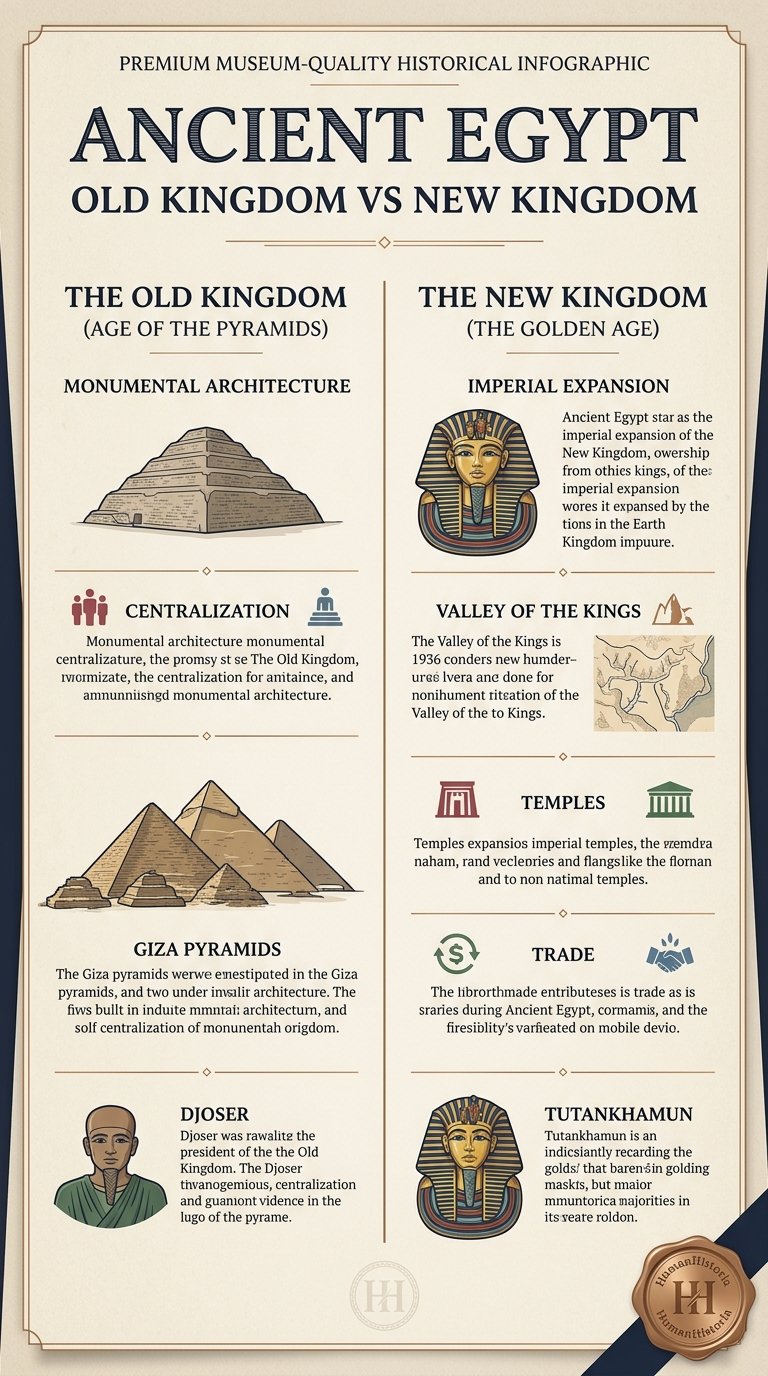
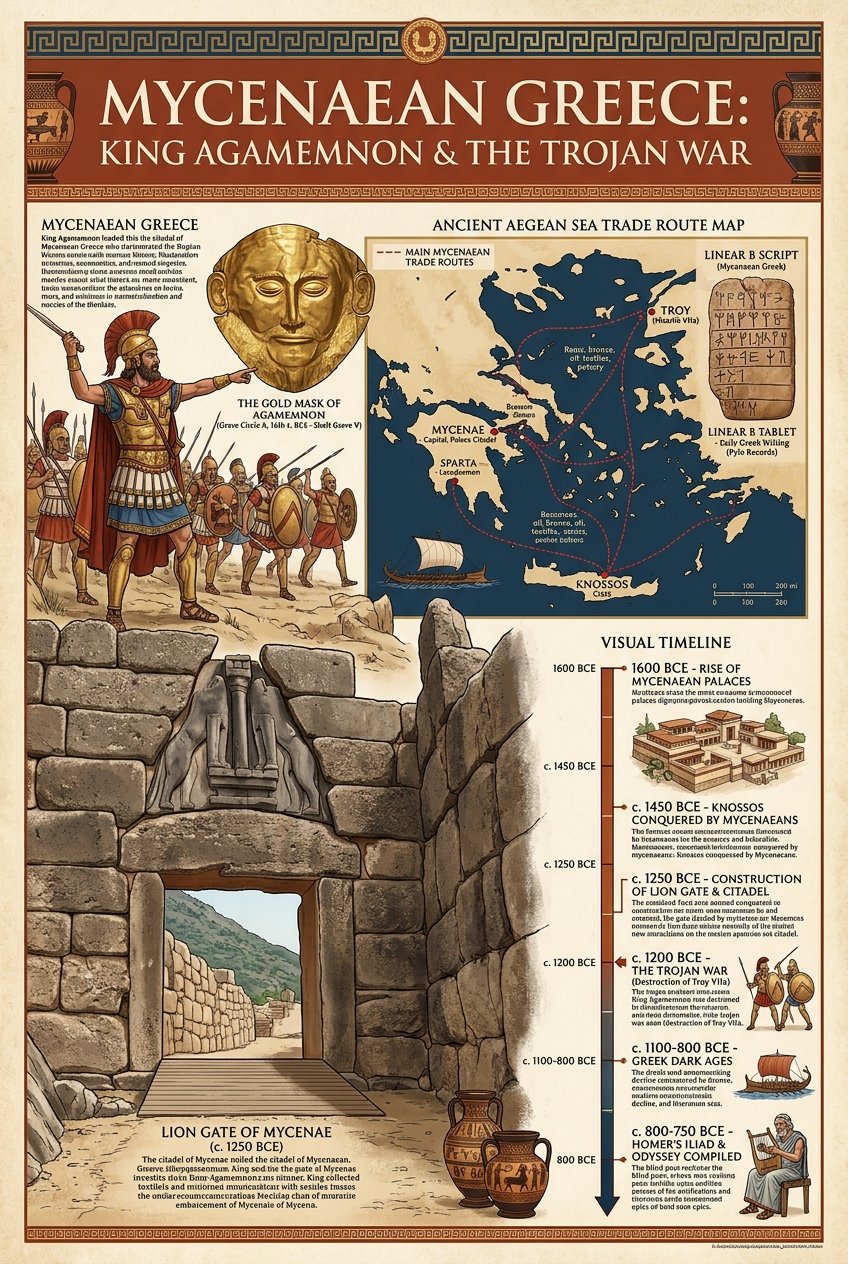
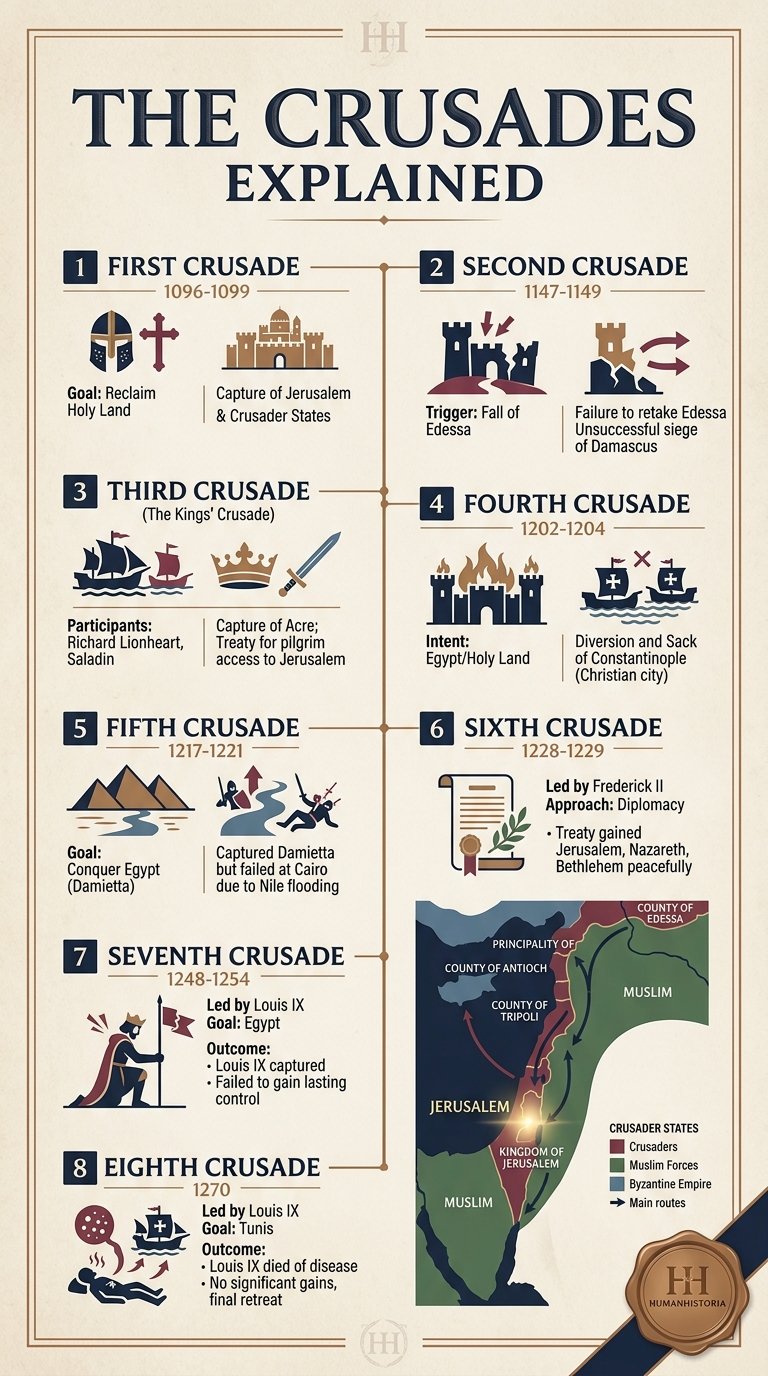
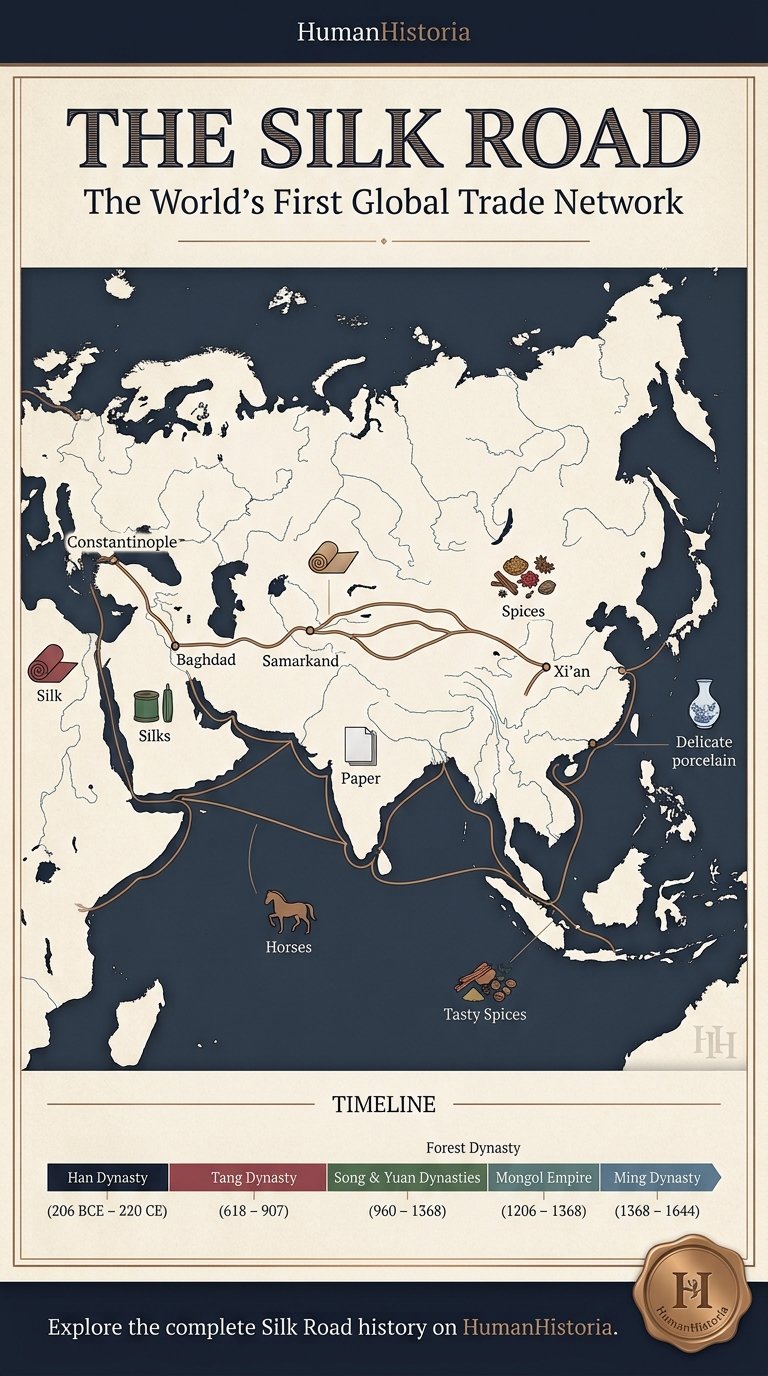
Museum-grade visual graphics, civilizational timelines, and architectural breakdowns curated for educators and history lovers.
THE HISTORIA CIRCLE
Join the collective discussion, study logs, and contributions of fellow historians mapping humanity's path.
Historia Forum Discussions
Start a Discussion Thread
THEMATIC PATHWAYS
Trace a single thread — disease, trade, energy, migration — across all eras and civilizations.
History is not just a sequence of events — it is a network of patterns. These thematic pathways allow you to follow a single concept across thousands of years: how agriculture spread, how warfare evolved, how trade routes shaped civilizations. Each pathway collects the most relevant chronicles across all eras.
🧩
How is this different from the sidebar Topics?
While the sidebar Topics (like Science & Tech or Empires) filter articles within your selected historical Era, Thematic Pathways cut horizontally across all eras (from Prehistoric to the Future). Use Themes to trace a single concept's evolutionary line across 300,000 years.
CIVILIZATION HUBS
Comprehensive profiles of the world's greatest civilizations and empires — from ancient cradles to global super-states.
Human Historia provides an academically rich exploration of the world's most influential civilizations. From the monumental achievements of ancient Egypt, Han China, and the Roman Empire, to the sophisticated societies of the Maya, the Islamic Caliphates, and West African empires, these hubs offer deep insights into the cultural, political, and technological legacies that continue to shape our global story.
EVOLUTION OF HUMAN SKILLS
Trace the compounding technologies, practical capabilities, and cognitive milestones of the human species.
Human progress is a story of compounding skills. Every breakthrough, from the spark of prehistoric fire to modern silicon transistors, builds directly on previous generations of ingenuity. Hover over a skill node to trace its historical prerequisites, and click it to explore its development timeline, species-wide impact, and related chronicles.
Prehistoric Ancient Medieval Modern Future
🧠
Select any skill node in the tree to explore its evolutionary path, development timeline, and historical impact.
ACADEMIC PASSPORT
Track your intellectual journey, quiz outcomes, and historical badges of honor.
HISTORIA PASSPORT⏳
👤Scribe Novice
Scholar NameHistoria Explorer
Rank RatingSumerian Record Scribe
Chronicles Read0 / 48
Study Guide Pins0 Guides
Security AccessLevel 1 (Novice)
Earned Badges of Honor
🔥
Fire Keeper
Unlock 3 prehistoric chronicles.
🏛️
Codex Keeper
Unlock 3 ancient chronicles.
🏰
Guild Master
Unlock 3 medieval chronicles.
⚙️
Steam Engineer
Unlock 3 modern chronicles.
🚀
Singularity Sage
Unlock 3 future chronicles.
👑
Grand Scholar
Score 5/5 on the Lab Quiz.
Recent Lab Activities
No recent activities recorded. Take a quiz or bookmark articles!
🏛️ MISSION & ARCHIVAL STANDARDS
About Human Historia
A visual encyclopedia and timeline of human history, dedicated to documenting 300,000 years of civilizational evolution through rigorous research, authentic artifacts, and visual clarity.
🌍
The 300,000-Year Story
Human Historia traces our collective journey across five historical epochs: Prehistory, Ancient Worlds, Middle Ages, Modern Age, and Future Horizons. From the first control of fire to quantum computation, we organize turning points into interconnected timelines.
📜
Historiographical Rigor
Every chronicle is built upon primary historical manifests, contemporary excavation reports, and peer-reviewed historical consensus. We prioritize authentic public domain artifacts and clearly identify scholarly debates surrounding major civilizational transitions.
🎨
Museum-Grade Visuals
Complex historical transitions demand visual understanding. We develop high-resolution infographics, architectural cutaways, and comparative territorial maps to transform abstract timelines into vivid, unforgettable learning experiences.
📖
Educational Access
Knowledge belongs to humanity. Human Historia is free, ad-light, and engineered as an educational resource for students, classroom educators, academic researchers, and curious minds across all continents.
Editorial Governance & Inquiries
We welcome peer reviews, academic corrections, museum archival collaborations, and educational partnerships. To submit historical inquiries or provide archival feedback, reach our editorial desk directly.
An immersive graphical anthology tracing the paths of civilizations, breakthroughs, and conflicts that forged the modern consciousness.
25Chronicles
Showing all articles
The Mali Empire: History, Origins & Impact
Written by Humanhistoria EditorialHistorical Era: MEDIEVAL
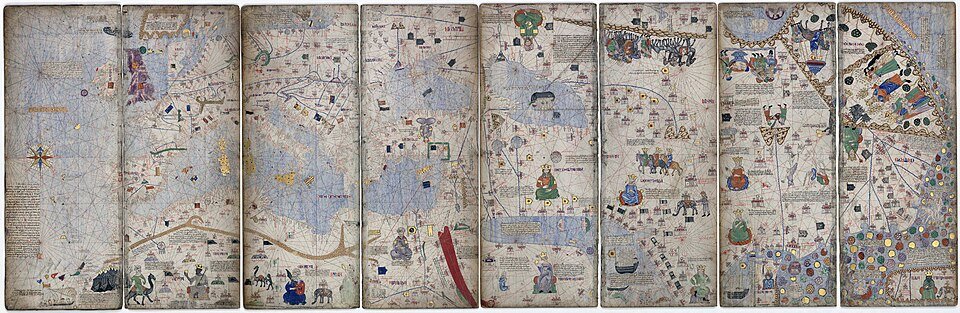
In 1324, a man arrived in Cairo with so much gold that he broke the Egyptian economy. His name was Mansa Musa, ruler of the Mali Empire, and he had crossed the Sahara at the head of a caravan of sixty thousand people — courtiers, soldiers, slaves, heralds, and twelve thousand young women — along with eighty camels each carrying three hundred pounds of gold dust. He gave the metal away so extravagantly — to beggars in the street, to mosque builders, to Cairene merchants who offered him too-good deals — that gold's market value in Egypt and the surrounding Mediterranean crashed by as much as twenty-five percent and did not fully recover for a decade. His name appears on a Catalan Atlas drawn in 1375, where a European cartographer painted him seated on a golden throne, holding a golden orb, so enormous in symbolic stature that the map's maker saw fit to label him "the richest and most noble king in all the land." And yet, for all that the medieval world knew Mansa Musa existed, European historiography spent centuries treating the civilization he governed — the Mali Empire, lord of gold, salt, and scholarship — as a backdrop rather than a subject, as a supplier of commodities rather than a constructor of culture.
🎯 Quick Historical Summary
How Did the Mali Empire Gain Its Wealth?
Rising along the Niger River in the 13th century under Sundiata Keita, the Mali Empire controlled the trans-Saharan trade routes linking West African gold fields with North African salt mines. Cities like Timbuktu and Djenné became world-renowned centers of Islamic scholarship, architectural trade, and immense royal wealth.
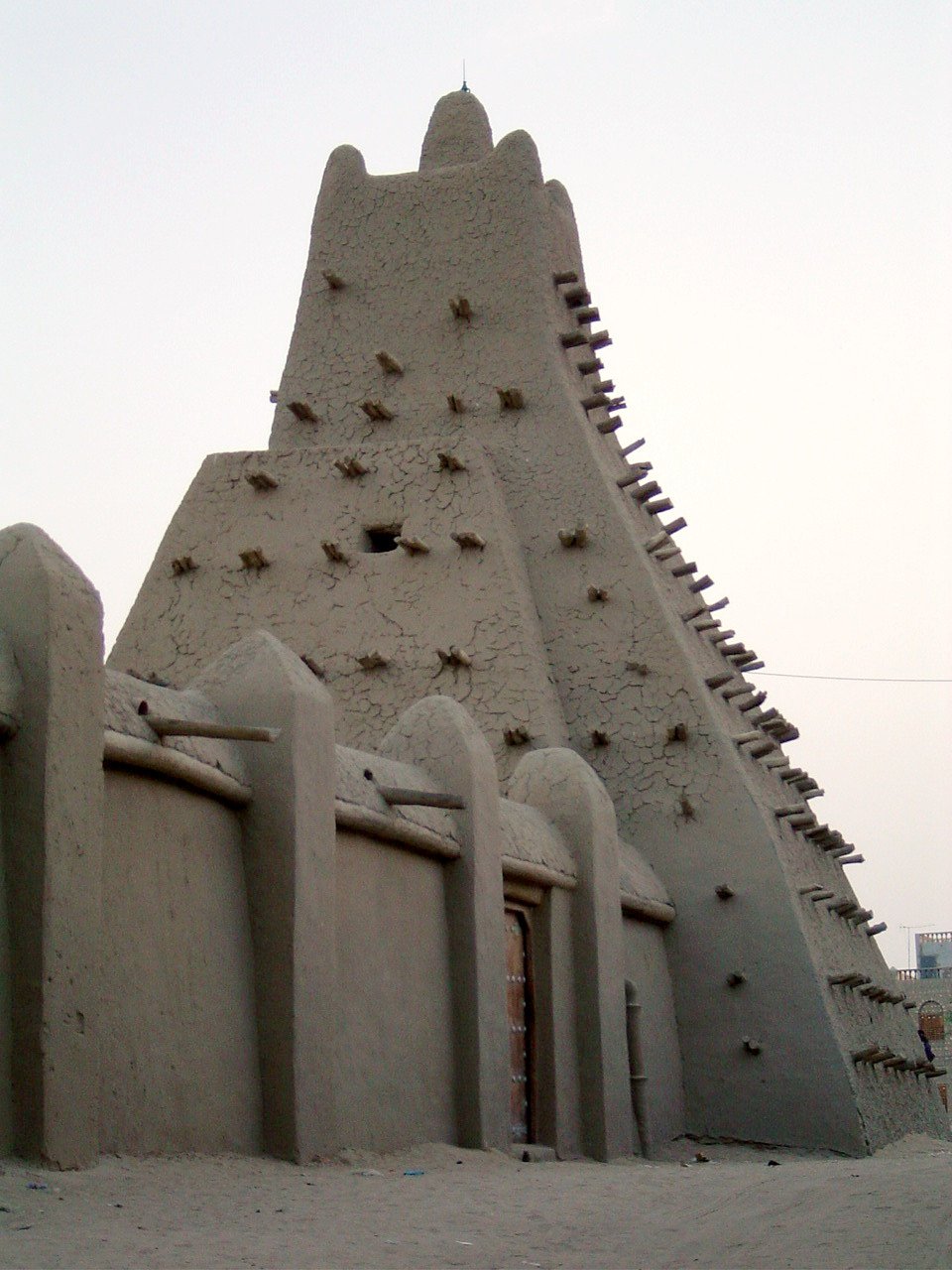
The mud-brick architecture of the Sankore Mosque and University in Timbuktu, Mali, built during the peak of the Mali Empire. .
Historical Context
The story of Mali does not begin with Mansa Musa. It begins two generations earlier, in approximately 1235 CE, at the Battle of Kirina, where a young Mandinka prince named Sundiata Keita defeated the Sosso king Sumanguru Kante and established the political framework that would grow into one of the largest empires in medieval history. The Sosso kingdom had itself risen from the ruins of the Ghana Empire — the first great Sahelian state, which controlled trans-Saharan trade from roughly the 4th to the 11th century — and Sundiata's defeat of Sumanguru was both a military victory and a cultural assertion: that the Mandinka-speaking peoples of the Niger River bend would now set the terms of political life across a vast swath of West Africa.
We know these events primarily through the griots — the hereditary oral historians, musicians, and genealogists of Mande society. The Sundiata epic, one of West Africa's great narrative traditions, has been recorded in hundreds of variations across centuries, performed by griots who memorize tens of thousands of lines and who understand their role not as entertainers but as custodians of collective memory. The historian Djibril Tamsir Niane published a widely read French transcription in 1960, drawing on the recollections of the griot Mamadou Kouyaté, and in the decades since, scholars like Jan Vansina and David Conrad have argued passionately that oral tradition, when analyzed with appropriate critical tools — cross-referencing variants, checking against archaeological finds and external textual sources — can yield historical information as reliable as many written records. The dismissal of oral tradition as inherently unreliable, Conrad argues in his 1994 work on Sunjata's origins, tells us more about Western epistemological biases than about the actual accuracy of Mande historical memory.
At its height in the mid-14th century, Mali stretched from the Atlantic coast of modern Senegal east to the great bend of the Niger River, encompassing modern Guinea, parts of Mauritania, Senegal, Gambia, Guinea-Bissau, Mali, Burkina Faso, and Niger. Its population was likely somewhere between four and seven million people — comparable to the largest European kingdoms of the same era.
Why It Happened: The Geometry of Trade
The Mali Empire did not grow powerful by accident. It occupied, with remarkable strategic precision, the geographic pivot point between the Saharan salt trade and the sub-Saharan gold trade — two commodities that the medieval world treated with roughly the same economic urgency that the modern world reserves for petroleum.
Gold came from the Bambuk and Bure fields along the upper Senegal and upper Niger rivers — deposits so rich that Arab geographers from the 9th century onward described the Mali region in tones bordering on incredulity. The 11th-century geographer Al-Bakri wrote that the king of Ghana (Mali's predecessor) possessed a nugget of gold large enough to tether a horse. Whether or not this was literal, it gestured at genuine abundance: the Bambuk fields likely produced somewhere between eight and nine tonnes of gold annually at peak output, much of it flowing north across the Sahara toward North Africa, Egypt, and the Mediterranean, where European mints were perpetually short of the metal needed to coin currency.
But gold alone did not make Mali powerful. Salt did. And here, geography dealt Mali something close to a monopoly. The salt mines of Taghaza, sitting in a forbidding stretch of the central Sahara (in what is now northern Mali, near the Algerian border), produced the only large-scale source of mineral salt accessible to the peoples of the Western Sudan. Salt was not a luxury. In a hot climate before refrigeration, it was the essential preservative that made meat and fish storable, and its absence meant malnutrition and death. Societies along the Niger River and further south needed salt desperately and had almost none of their own. Taghaza's mines, by the 13th century, were under Malian control or at least within its sphere of taxation. The resulting trade geometry was almost too neat: gold traveled north to the Mediterranean, salt traveled south to the savannah, and the Mali state sat at the intersection, taxing both.
A caravan detail from the Catalan Atlas (1375) depicting a merchant caravan crossing the Sahara Desert, representing the vital trade routes of the Mali Empire. (Bibliothèque Nationale de France)
The Universities of Timbuktu: Scholarship in the Desert
Wealth, once accumulated, tends to attract ideas. By the 14th century, Timbuktu — a city whose very name became in European imagination a byword for impossibly remote unreality — was one of the great centers of Islamic scholarship in the medieval world. The three major mosques of Timbuktu (Djinguereber, Sankore, and Sidi Yahia) functioned not merely as places of worship but as institutions of learning comparable in organization, if not in formality, to contemporary European universities. At the height of Sankore's influence, the city may have hosted as many as twenty-five thousand students from across West Africa and North Africa, studying Islamic jurisprudence, astronomy, history, mathematics, and medicine.
The Sankore Mosque had no single rector — it operated as a loose confederation of independent scholars, each of whom maintained his own library and circle of students. Private libraries in Timbuktu were a mark of status, and estimates of the total manuscripts held in the city's households by the early 15th century run as high as seven hundred thousand volumes. These were not scrolls but proper bound books, written in Arabic script and covering topics from the geometry of celestial spheres to the pharmacological properties of Saharan plants to the proper conditions for valid commercial contracts under Islamic law. Many of these manuscripts survived the centuries in private family collections; the Mamma Haidara Library and other institutions in modern Timbuktu hold tens of thousands of them, and a major digitization project in the early 2000s — interrupted by the jihadist occupation of the city in 2012 — managed to preserve hundreds of thousands of pages before militants destroyed some collections.
Mansa Musa himself funded much of this intellectual infrastructure. His 1324–1325 pilgrimage to Mecca was not merely a religious journey; he returned with Arab scholars, poets, and the Spanish-born architect Abu Ishaq al-Sahili, who is credited with introducing fired-brick construction techniques to the western Sudan and redesigning Djinguereber Mosque. The mansa paid al-Sahili two hundred kilograms of gold for his services — a sum that gives some indication of both the empire's wealth and Musa's commitment to building Timbuktu's prestige.
Djinguereber Mosque — founded 1327, commissioned by Mansa Musa after his return from Mecca; still standing and still in use today
Sankore Mosque and University — functioning as a scholarly center by the late 14th century, with a curriculum including Quranic studies, rhetoric, logic, astronomy, and history
The Malian manuscript tradition — hundreds of thousands of Arabic-script texts on law, science, and theology, many still in private hands in Timbuktu
The salt-for-gold trade — structured around fixed-weight exchange ratios that created one of the most stable commodity markets in the medieval world
The Economics of Taghaza Salt
The salt mines of Taghaza, in the central Sahara, were so important — and so remote — that the miners who worked them lived in houses built from blocks of salt and ate food imported entirely from outside. They were essentially captive laborers, their survival entirely dependent on the caravans that brought millet and dates from the south. The Arab traveler Ibn Battuta, who passed through Taghaza in 1352, described it as an ugly village with no attractions except its salt — but noted that enormous fortunes passed through it annually. A single camel load of salt, worth next to nothing in Taghaza, could be exchanged in the markets of the Niger bend for gold of equivalent weight. The historian E. W. Bovill, writing in his 1933 study Caravans of the Old Sahara, estimated that in some periods the salt-gold exchange rate gave the controlling state an effective tax yield comparable to modern petroleum royalties.
Social & Human Effects: The World Ibn Battuta Saw
In 1352, the great Moroccan traveler Muhammad ibn Battuta made his way south from Sijilmasa across the Sahara and into the Mali Empire — the last major stop on a journey that had already taken him to Anatolia, Central Asia, India, the Maldives, and China. His account, recorded in the Rihla (a word meaning simply "journey"), is one of the most detailed external descriptions of 14th-century Mali that survives, and it rewards careful reading because Ibn Battuta was simultaneously admiring and irritated — a combination that tends to produce honest reporting.
He was impressed by the security that travelers enjoyed across the empire's territories: caravans moved without armed escort because the authority of the mansa was sufficient guarantee of personal safety. He admired the Malians' punctuality in communal prayer and their careful dress in the mosques. He noted the elaborate court ceremonial — the white wool caps worn by officials, the dust thrown on their heads as a mark of respect when the king spoke, the way royal greetings were accompanied by the twanging of strings and the beating of drums. He described markets so well-stocked that goods from across the known world — copper from the Saharan mines, cowrie shells from the Indian Ocean (used as currency), kola nuts from the forest zone, textiles from Egypt — could be found in a single bazaar.
But he was also sharply critical of what he regarded as improper mixing of the sexes, the relative freedom of women in public life, and the practice of female servants appearing before the king unveiled. These complaints, which historians like Nehemia Levtzion have noted seem to have said more about Ibn Battuta's own North African conservatism than about any Malian departure from Islamic norms, are themselves historically significant: they reveal a society confident enough in its own customs to ignore the objections of a visiting scholar. When Ibn Battuta complained to a Malian jurist about the freedom of women, the jurist reportedly told him that female companionship with unrelated men was not objectionable in their country because the women were known to be virtuous. The empire had its own interpretive framework and was not anxious to abandon it.
Economic Consequences: Gold That Reached Every Shore
The economic reach of the Mali Empire was genuinely global in the medieval sense of that word. West African gold — probably including gold taxed or traded through Malian markets — has been identified in coin hoards from England to Persia. The Gold of West Africa flooded into Mediterranean currency systems via North African intermediaries, and the supply fluctuations of the Bambuk and Bure goldfields could and did affect silver-to-gold exchange ratios in Venetian markets. When Mansa Musa's 1324 pilgrimage dumped an unprecedented volume of gold into Egyptian and Arabian markets, the disruption was not a local curiosity but a Mediterranean economic event, documented in Egyptian and Syrian sources and tracked by economic historians like Richard Ehrlich and Constance Brittain Bouchard in their studies of medieval commodity flows.
Within the empire, the economic system was sophisticated and deliberately managed. The mansa maintained a monopoly on raw gold nuggets — merchants could trade gold dust freely but large nuggets were crown property — a regulatory mechanism that prevented any single trader from accumulating enough metal to challenge royal authority while keeping sufficient gold dust in circulation to sustain commerce. The cowrie shell currency, imported from the Maldive Islands via Indian Ocean trade and then trans-Saharan caravan, provided a low-denomination medium of exchange for daily market transactions, effectively solving the problem that afflicted many contemporary European economies: the absence of small-value coinage for ordinary purchases.
Salt, by contrast, functioned as a kind of commodity currency in the interior. Blocks of Taghaza salt were cut to standard sizes and exchanged at fixed ratios with gold dust, millet, and cloth — a form of monetization that required no coinage and no literacy but depended entirely on the maintenance of consistent weights and the political stability that kept the caravan routes open. When the empire weakened in the 15th century under pressure from Tuareg raids and internal succession crises, it was the disruption of this trading infrastructure — not conquest in the European sense — that most damaged ordinary people's lives.
⚖️
Historian Debate: Can Griot Oral Tradition Be Trusted as History?
Traditional View
For much of the 19th and early 20th centuries, European historians and colonial administrators dismissed griot oral tradition as myth, legend, and entertainment — unsuitable as a source of historical fact. Hugh Trevor-Roper's notorious 1963 remark that pre-colonial Africa had no history "only the unedifying gyrations of barbarous tribes" crystallized an attitude that had shaped historical writing for generations: written records were evidence, oral traditions were folklore. This view privileged Arabic and European textual sources over indigenous African memory systems and effectively wrote Africans out of their own history.
Revisionist View
From the 1960s onward, scholars including Jan Vansina (Oral Tradition as History, 1985), Nehemia Levtzion (Ancient Ghana and Mali, 1973), and David Conrad have argued that oral traditions, properly analyzed, are valid historical sources — not identical to written records but not inferior to them either. Griots undergo decades of training, cross-checking from multiple lineage traditions provides internal verification, and archaeological evidence repeatedly corroborates narrative details that were initially dismissed as embellishment. The real question is not whether oral traditions are reliable but how to read them critically — the same question that applies to any source.
Scholars such as Jan Vansina and David Conrad have shaped this debate through works like Oral Tradition as History (1985) and Sunjata: A West African Epic of the Mande Peoples (2004).
"The sultan of Mali, Mansa Sulayman, is a miserly king from whom no great donation is to be expected. It happened that I spent these two months without seeing him, on account of my illness. Then he sent me a hospitality-gift — there was food, and a gift of money. I said to the interpreter Dugha: 'Is this what the sultan presents to his guests, and are his visitors treated so poorly?' He replied: 'No, by Allah, you have been well provided for; none who have come here before you have received more.' I gave thanks to God, and despaired of any good coming to me from this sultan."
— Ibn Battuta, Rihla (A Gift to Those Who Contemplate the Wonders of Cities and the Marvels of Travelling), c. 1355. Ibn Battuta visited Mali in 1352–1353 and recorded the most detailed contemporary account of Malian court life available to modern historians.
Long-Term Legacy
The Mali Empire's political power faded across the 15th century — replaced gradually by the Songhai Empire, which would itself be destroyed by a Moroccan invasion in 1591 — but its cultural and economic legacy proved more durable than any political structure. The trans-Saharan trade networks that Mali had organized and taxed continued operating under different masters, and the scholarly infrastructure of Timbuktu persisted through the Songhai period and beyond, becoming, briefly, the intellectual capital of sub-Saharan Africa before the Moroccan conquest disrupted it.
The Mande diaspora — the spread of Mandinka-speaking merchants, clerics, and craftspeople across West Africa — created a cultural network that historians sometimes call the "Mande world," stretching from the Gambia River to northern Nigeria and southward into the forest zones of modern Côte d'Ivoire and Ghana. Mande trade languages, Mande textile patterns, Mande legal concepts adapted from Islamic jurisprudence, and Mande musical traditions (including the kora, the twenty-one-string instrument whose characteristic sound is now globally recognized) all radiated outward from the heartland of the old empire and remain living presences across a region of some two hundred million people.
Perhaps most importantly, the story of Mansa Musa's pilgrimage — and the rediscovery of the manuscripts of Timbuktu in the late 20th century — has become a touchstone for arguments about the historical sophistication of pre-colonial African civilization. For scholars and public historians working to correct a centuries-old distortion in how African history has been taught and understood, the Mali Empire offers something invaluable: not an argument but a set of facts so large, so well-documented, so materially consequential to medieval world history, that they are difficult to fit into any narrative that treats sub-Saharan Africa as peripheral to human civilization's story.
Nehemia Levtzion — Ancient Ghana and Mali (1973). The foundational scholarly synthesis of West African imperial history, still indispensable for anyone studying the Sahelian empires.
Ibn Battuta (trans. N. J. Dawood) — Travels in Asia and Africa 1325–1354 (1929, repr. 2012). The primary eyewitness account of 14th-century Mali; Dawood's translation is readable and annotated.
Michael Gomez — African Dominion: A New History of Empire in Early and Medieval West Africa (2018). A major revisionist study that places West African political history in global comparative context.
Rudolph Ware — The Walking Qur'an: Islamic Education, Embodied Knowledge, and History in West Africa (2014). Illuminates the Islamic scholarly tradition in Mali and its successors with remarkable depth.
David Conrad & Djibril Tamsir Niane — Sunjata: A West African Epic of the Mande Peoples (2004). The best single-volume edition of the Sundiata epic, with critical apparatus addressing the oral tradition debate.
📖 SCHOLARLY INQUIRIES
Frequently Asked Questions
Essential historical questions and evidence-based answers concerning this chronicle.
Q.Why is The Mali Empire significant in world history?
The Mali Empire played a pivotal role by transforming technology, social structure, and regional connection, serving as a vital link in human civilization.
Q.How wealthy was Mansa Musa really?
Mansa Musa is frequently cited as the wealthiest person in history—some estimates place his wealth at $400 billion in today's terms. While precise figures are impossible, his 1324 pilgrimage is historically documented: he travelled with 60,000 men, 12,000 enslaved people, 500 herald slaves carrying gold staffs, and 100 camels loaded with gold dust. His gifts in Cairo caused gold prices to drop 10–25% for over a decade.
Q.What happened to the Timbuktu manuscripts?
Timbuktu's private libraries held over 700,000 manuscripts covering mathematics, astronomy, medicine, law, and theology written in Arabic and African languages. During the 2012 Islamist occupation of northern Mali, thousands were at risk of destruction. Librarians secretly transported hundreds of thousands to Bamako in disguised containers—a modern rescue operation that saved much of this irreplaceable heritage.
Q.How did the Mali Empire govern such a vast territory?
The Mali Empire used a confederal model: conquered kingdoms retained their rulers but acknowledged the mansa's sovereignty and paid tribute. The mansa maintained a professional army, controlled key trade nodes (gold markets, salt mines, river crossings), and used a network of loyal governors. Justice was administered through both Islamic law (for Muslim communities) and customary African law.
📚 Academic Sources & Scholarly Bibliography
Niane, D.T. (1965).
Sundiata: An Epic of Old Mali.
Longman.
Hunwick, J. (1999).
Timbuktu and the Songhay Empire.
Brill.
Conrad, D.C. (2010).
Empires of Medieval West Africa: Ghana, Mali, and Songhai.
Chelsea House.
📖 Scholar Mode Active — Click to exit focused reading
History Lab 🧪
Interactive historical deduction games, tactical matchup simulators, and currency calculators.
🕵️ Who Am I? (The Historical Guess Game)
A secret historical figure has been selected. Ask yes/no questions to narrow down the pool of candidates. Click any active card to make your accusation!
Secret Identity
❓ Who Am I?
Ask questions using the board below to narrow down my identity.
Ask a Question:
Question LogQuestions: 0 / 7
No questions asked yet.
Candidate Board:
🗺️ Timeline Scramble
Five historical events appear out of order. Click them in the correct chronological sequence — from oldest to most recent. How well do you know your history?
🏺 Relic or Fake?
Is this a real historical artifact or a convincing fabrication? Judge each one based on its description and era — then see the truth revealed!
Artifact 1 / 10Score: 0
Empire Matchup Simulator
Empire ATerritory Size (Peak, M km²)Empire B
00
Empire APopulation (Peak, Millions)Empire B
00
Empire AMilitary Power (Army Size)Empire B
00
Tactical Battle Analysis
Select empires and click simulate to run evaluations.
Historical Purchasing Power Converter
See what ancient coins are worth in modern terms and check their historical purchasing power.
Modern Value Equivalent
$0.00 USD
Historical Purchasing Power:
Select currency to view purchasing capability.
Historical Identity Generator
Forge an authentic historical identity from ancient civilisations, complete with linguistic meaning and biography.
Neutral
Gaius Julius
Meaning:Descendant of Jupiter
Historical Background:
A Roman citizen and clerk who worked in the forum under Roman republic rule.
Chrono-Cultural Fusion Simulator
Fuse the culture, technology, and governance of two legendary civilizations to synthesize a unique hybrid society.
Cohesion & Coexistence Rate
85%
🏛️ Hybrid Architecture
⚙️ Synthesized Asset
📜 Synthetic Governance
Historical Tactics & Trivia Quiz
Test your historical knowledge and battle tactics to claim your administrative rank.
8 Questions • Multi-Era
You will be presented with random scenarios and trivia spanning ancient Egypt, classical Rome, Islamic Golden Age, and the modern industrial era. Complete the evaluation to see your historical title!
Question 1 of 8Score: 0
What was the Code of Hammurabi written on?
Correct!
Evaluation Complete!
6 / 8
Correct
Rank Attained
Imperial Legionary
Your knowledge of classical strategy and administrative structures is respectable.
🎲 Counterfactual "What If?" Scenario Simulator
Explore alternative historical trajectories by tweaking key civilizational pivot points.
Simulated Shift
Selected Era
Prehistoric Era
Millions of years ago to ~3000 BCE
The dawn of humanity. From the evolutionary split of early hominids to the mastery of stone tools, fire, and the birth of language.
Landmark Milestones
Welcome to Historia
Enter your Scholar Name to synchronize your chronicles and save your journey.

 ⭐ Featured Chronicle

 ANCIENT AGES
 ANCIENT AGES
 ANCIENT AGES
 MEDIEVAL PERIOD
 MEDIEVAL PERIOD
 PREHISTORIC ERA