From prehistoric origins to the modern era—discover the turning points, lost empires, and breakthroughs of world history through interactive timelines and visual guides.
Examine the tangible relics, physical tokens, and revolutionary machines that shaped civilizational growth.
🎥 VIDEO HUB & SHORTS
Watch visual summaries, site intros, and mini-documentaries chronicling 300,000 years of world history.
📊 HISTORICAL INFOGRAPHICS ARCHIVE
Museum-grade visual graphics, civilizational timelines, and architectural breakdowns curated for educators and history lovers.
THE HISTORIA CIRCLE
Join the collective discussion, study logs, and contributions of fellow historians mapping humanity's path.
Historia Forum Discussions
Start a Discussion Thread
THEMATIC PATHWAYS
Trace a single thread — disease, trade, energy, migration — across all eras and civilizations.
History is not just a sequence of events — it is a network of patterns. These thematic pathways allow you to follow a single concept across thousands of years: how agriculture spread, how warfare evolved, how trade routes shaped civilizations. Each pathway collects the most relevant chronicles across all eras.
🧩
How is this different from the sidebar Topics?
While the sidebar Topics (like Science & Tech or Empires) filter articles within your selected historical Era, Thematic Pathways cut horizontally across all eras (from Prehistoric to the Future). Use Themes to trace a single concept's evolutionary line across 300,000 years.
CIVILIZATION HUBS
Comprehensive profiles of the world's greatest civilizations and empires — from ancient cradles to global super-states.
Human Historia provides an academically rich exploration of the world's most influential civilizations. From the monumental achievements of ancient Egypt, Han China, and the Roman Empire, to the sophisticated societies of the Maya, the Islamic Caliphates, and West African empires, these hubs offer deep insights into the cultural, political, and technological legacies that continue to shape our global story.
EVOLUTION OF HUMAN SKILLS
Trace the compounding technologies, practical capabilities, and cognitive milestones of the human species.
Human progress is a story of compounding skills. Every breakthrough, from the spark of prehistoric fire to modern silicon transistors, builds directly on previous generations of ingenuity. Hover over a skill node to trace its historical prerequisites, and click it to explore its development timeline, species-wide impact, and related chronicles.
Prehistoric Ancient Medieval Modern Future
🧠
Select any skill node in the tree to explore its evolutionary path, development timeline, and historical impact.
ACADEMIC PASSPORT
Track your intellectual journey, quiz outcomes, and historical badges of honor.
HISTORIA PASSPORT⏳
👤Scribe Novice
Scholar NameHistoria Explorer
Rank RatingSumerian Record Scribe
Chronicles Read0 / 48
Study Guide Pins0 Guides
Security AccessLevel 1 (Novice)
Earned Badges of Honor
🔥
Fire Keeper
Unlock 3 prehistoric chronicles.
🏛️
Codex Keeper
Unlock 3 ancient chronicles.
🏰
Guild Master
Unlock 3 medieval chronicles.
⚙️
Steam Engineer
Unlock 3 modern chronicles.
🚀
Singularity Sage
Unlock 3 future chronicles.
👑
Grand Scholar
Score 5/5 on the Lab Quiz.
Recent Lab Activities
No recent activities recorded. Take a quiz or bookmark articles!
🏛️ MISSION & ARCHIVAL STANDARDS
About Human Historia
A visual encyclopedia and timeline of human history, dedicated to documenting 300,000 years of civilizational evolution through rigorous research, authentic artifacts, and visual clarity.
🌍
The 300,000-Year Story
Human Historia traces our collective journey across five historical epochs: Prehistory, Ancient Worlds, Middle Ages, Modern Age, and Future Horizons. From the first control of fire to quantum computation, we organize turning points into interconnected timelines.
📜
Historiographical Rigor
Every chronicle is built upon primary historical manifests, contemporary excavation reports, and peer-reviewed historical consensus. We prioritize authentic public domain artifacts and clearly identify scholarly debates surrounding major civilizational transitions.
🎨
Museum-Grade Visuals
Complex historical transitions demand visual understanding. We develop high-resolution infographics, architectural cutaways, and comparative territorial maps to transform abstract timelines into vivid, unforgettable learning experiences.
📖
Educational Access
Knowledge belongs to humanity. Human Historia is free, ad-light, and engineered as an educational resource for students, classroom educators, academic researchers, and curious minds across all continents.
Editorial Governance & Inquiries
We welcome peer reviews, academic corrections, museum archival collaborations, and educational partnerships. To submit historical inquiries or provide archival feedback, reach our editorial desk directly.
An immersive graphical anthology tracing the paths of civilizations, breakthroughs, and conflicts that forged the modern consciousness.
25Chronicles
Showing all articles
The Ottoman Siege of Vienna 1683's Winged Hussars Charge
Written by Humanhistoria EditorialHistorical Era: MEDIEVAL
In the dawn twilight of September 12, 1683, along the wooded crest of the Kahlenberg heights overlooking the Danube Valley, forty-seven-year-old King Jan III Sobieski of Poland looked through the morning mist at the vast, shimmering tent city of the Ottoman Empire surrounding the walls of Vienna. For sixty grueling days, an Ottoman imperial army of one hundred and fifty thousand soldiers under Grand Vizier Merzifonlu Kara Mustafa Pasha had besieged the Habsburg capital, digging miles of zig-zagging sapper trenches and detonating colossal subterranean gunpowder mines that had shattered the city's outer stone bastions. Inside, Count Ernst Rüdiger von Starhemberg’s garrison of barely twelve thousand defenders had reached their final hour, their ammunition nearly exhausted, awaiting an imminent final assault. At 5:00 PM, Sobieski raised his sword. Lowering their twenty-foot gilded lances, eighteen thousand allied horsemen—spearheaded by three thousand elite Polish Winged Hussars wearing steel breastplates and towering wooden back-frames lined with eagle feathers that roared in the wind—surged down the vineyard slopes in the largest cavalry charge in recorded human history. In a single thunderous avalanche of steel and horseflesh, the Hussars shattered the Ottoman lines, routed the Grand Vizier’s army, and permanently broke the peak of Ottoman expansion into Western Europe.
🎯 Quick Historical Summary
What Was the Significance of the Siege of Vienna and the Winged Hussars in 1683?
On September 12, 1683, King Jan III Sobieski led an 18,000-strong cavalry charge, spearheaded by the Polish Winged Hussars, to break the two-month Ottoman siege of Vienna. The victory shattered the Ottoman advance into Central Europe, ending centuries of expansion and launching the Holy League counter-offensive.
Historical painting of King Jan III Sobieski leading the legendary Polish Winged Hussars down the heights of Kahlenberg into the Ottoman camp, breaking the two-month siege of Vienna on September 12, 1683. (National Museum, Warsaw)
The Ottoman Ambition: Kara Mustafa and the Golden Apple
To understand the high-stakes confrontation at Vienna, one must trace the imperial ambitions of the Ottoman Empire in the late seventeenth century. Under the influential Köprülü family of Grand Viziers, the Ottoman state experienced a dramatic military resurgence. Ottoman eyes turned toward the ultimate prize in Central Europe: Vienna, which Turkish chroniclers called Kızıl Elma—the "Golden Apple"—the symbolic gateway to Christian Europe and the capital of their historic rivals, the Austrian Habsburgs.
In 1682, taking advantage of a Protestant rebellion in Upper Hungary led by Count Imre Thököly against Habsburg rule, Sultan Mehmed IV appointed his ambitious brother-in-law, Grand Vizier Merzifonlu Kara Mustafa Pasha, as supreme commander of the imperial expedition. In the spring of 1683, an enormous host of approximately one hundred and fifty thousand men—comprising Ottoman Janissaries, Sipahi heavy cavalry, Crimean Tatar horse archers, and auxiliary divisions from Wallachia and Moldavia—marched north along the Danube.
Habsburg Emperor Leopold I fled the capital with his court for Passau, leaving sixty-six-year-old Count Ernst Rüdiger von Starhemberg in command of Vienna with just eleven thousand soldiers and five thousand armed citizens. On July 14, 1683, the Ottoman vanguard surrounded Vienna, encircling the city in a dense crescent of twenty-five thousand multi-colored silk tents.
The Sapper War: Subterranean Mines Beneath the Bastions
Kara Mustafa chose not to launch a frontal storm against Vienna's formidable Renaissance bastions. Instead, he deployed the Ottoman army’s greatest technical specialty: sapper warfare. Thousands of skilled miners from the Balkans dug deep, zig-zagging trench approaches, slowly advancing within yards of the counterscarp.
Beneath the earth, a terrifying subterranean war erupted. Ottoman sappers tunneled deep beneath the Burg and Löwel bastions, packing chambers with tons of gunpowder to collapse the stone walls from below. Austrian counter-miners dug counter-tunnels, listening with their ears pressed to the earth for the sound of Turkish pickaxes. In suffocating, pitch-black subterranean galleries, men fought hand-to-hand with knives, short axes, and pistols.
By early September, the situation inside Vienna was desperate. Ottoman mines had blown enormous breaches in the Burg bastion; dysentery and starvation ravaged the defenders; and Starhemberg had exhausted his artillery shot, firing paving stones and broken glass from his remaining cannons. On September 8, the Turks detonated a colossal mine that shattered the outer defenses, leaving a gaping thirty-foot breach. The garrison was down to barely four thousand combat-ready men, firing their muskets until the barrels melted.
The Holy League Coalition: The Gathering on the Kahlenberg
Salvation for Vienna came through an emergency diplomatic alliance orchestrated by Pope Innocent XI. In March 1683, Emperor Leopold and King Jan III Sobieski of the Polish-Lithuanian Commonwealth had signed a mutual defense pact: if either capital—Vienna or Kraków—was besieged, the other monarch was legally bound to march to its relief in person.
Honoring his oath with chivalric urgency, Sobieski gathered twenty-seven thousand veteran Polish troops, marching four hundred miles across Central Europe in under five weeks. At Tulln on the Danube, Sobieski united with the Imperial German relief army commanded by Duke Charles of Lorraine, Prince John George III of Saxony, and Prince Max Emmanuel of Bavaria. The combined Christian relief force numbered seventy-five thousand men, with supreme command granted to King Sobieski.
On September 11, the allied army scaled the precipitous, densely forested slopes of the Vienna Woods, dragging cannons up muddy trails. At dawn on September 12, they deployed along the crest of the Kahlenberg, looking down directly into the flank of the Ottoman siege encampment.
The lavishly embroidered silk battle tent of Grand Vizier Merzifonlu Kara Mustafa Pasha, captured by King Jan III Sobieski following the Battle of Vienna on September 12, 1683. (Wien Museum, Vienna, Austria)
September 12, 1683: The Charge of the Winged Hussars
Throughout the morning and early afternoon, Charles of Lorraine led the German and Austrian infantry down the northern slopes, clearing Ottoman skirmishers from the fortified villages of Nussdorf and Heiligenstadt. Kara Mustafa committed his elite Janissaries to hold the infantry, while stubbornly ordering continued assaults against the battered breaches of Vienna, refusing to reposition his heavy artillery to face the relief army.
By 4:00 PM, the German infantry had secured the staging slopes. On the high ridge, King Jan III Sobieski prepared the hammer blow. Emerging from the forest came eighteen thousand allied cavalrymen—the largest single massed cavalry charge in recorded human history. At the vanguard rode three thousand elite Polish Winged Hussars (Husaria):
The Anatomy of the Winged Hussar: Heavily armored noble cavalry wearing steel cuirasses, riding gigantic, specially bred Polish-Arabian warhorses. Fastened to the back of their saddles were one or two curved wooden frames adorned with real eagle, vulture, or swan feathers. As they charged at a dead gallop, the feathers vibrated in the wind, producing a terrifying, whistling roar designed to panic enemy horses.
The Kopia Lance: The Hussars carried the kopia—a hollowed-out, lightweight pine lance measuring up to twenty feet in length, reinforced with silk cords and tipped with a steel armor-piercing point. Because the kopia was five feet longer than Ottoman pikes and infantry spears, the Hussar could impale enemy soldiers before their weapons could touch him.
At 5:00 PM, King Sobieski led the charge down the vineyard-covered slopes. The earth trembled beneath seventy-two thousand galloping hooves. The Hussars smashed into the Ottoman lines with catastrophic kinetic shock, their long lances shattering through Turkish armor and shields. In less than thirty minutes, the Ottoman battle line fractured completely. Kara Mustafa fled the field on a fast horse, abandoning his imperial battle tent, his gold treasury, and hundreds of artillery pieces. The victorious Hussars swept into the siege camp, relieving Vienna as the sun sank below the horizon.
"Our Lord God and Father of our nation has granted us a victory and glory such as past ages have never seen... The Grand Vizier fled so precipitately that he left behind all his tents, his gold, his camels, his harem, and his magnificent battle standards. He has left me his sole heir. I have entered his tent; it is a palace of silk and embroidery... God has granted us a triumph beyond all human expectation. We came, we saw, God conquered!"
— King Jan III Sobieski, Letter to his wife, Queen Marie Casimire (Queen Marysieńka), from the Grand Vizier’s captured tent (September 13, 1683)
Military Anatomy: Ottoman Siege Army vs. Holy League Relief Force
The tactical parameters and composition of the opposing armies at the Battle of Vienna are contrasted below.
Battle Dimension
Ottoman Imperial Siege Army
Holy League Relief Coalition
Total Force Strength
~130,000–150,000 men (Janissaries, Sipahis, Tatar cavalry)
18,000 heavy cavalry (spearheaded by 3,000 Winged Hussars)
Tactical Posture
Divided focus: assaulting city breaches while defending rear flank
Unified downhill shock attack from high ground of Kahlenberg
Artillery Deployment
Heavy siege guns fixed facing city walls; unable to traverse
Light field cannons dragged down mountain trails to support cavalry
Casualties & Outcome
~15,000 dead/wounded; 5,000 prisoners; entire baggage camp lost
~4,500 allied casualties; total relief of Vienna
The Turning Tide: From Vienna to Karlowitz (1699 CE)
For Kara Mustafa, failure carried the absolute penalty of Ottoman dynastic law. Fleeing to Belgrade, he was met on Christmas Day 1683 by imperial executioners dispatched by Sultan Mehmed IV; the Grand Vizier knelt upon a carpet and was strangled to death with a silk bowstring.
The relief of Vienna launched a sixteen-year counter-offensive by the Holy League. Commanded by brilliant military geniuses like Prince Eugene of Savoy, allied armies reconquered Buda (Budapest), drove the Turks across the Danube, and annihilated the Ottoman field army at the Battle of Zenta in 1697.
In 1699, the Ottoman Empire was forced to sign the landmark Treaty of Karlowitz. For the first time in its four-hundred-year history, the Ottoman Empire ceded vast territorial provinces to Christian European powers: surrendering Hungary, Transylvania, and Croatia to the Austrian Habsburgs, and Podolia to Poland. The Treaty of Karlowitz marked the permanent end of Ottoman expansion into Europe, transforming the empire from an existential threat into the defensive "Sick Man of Europe."
⚖️
Historian Debate: The "Clash of Civilizations" vs. Pragmatic Imperial Hegemony
The "Civilizational Clash" School (Samuel Huntington, Traditional Western Historiography)
Frames the Siege of Vienna as the supreme apocalyptic duel between Christian Western civilization and Islamic imperial jihad, arguing that Sobieski’s charge saved European democracy, culture, and religious liberty from Islamic subjugation.
The "Early Modern Imperial Rivalry" School (Gábor Ágoston, Rhoads Murphey)
Demonstrates that the conflict was primarily an early modern territorial power struggle between rival dynastic empires. Protestant Hungarians fought on the side of the Muslim Ottomans against the Catholic Habsburgs, while Catholic France secretly cheered for an Ottoman victory to humble Austrian power.
Military historians emphasize that Vienna was the ultimate logistical boundary of the Ottoman military system: campaigns launched from Istanbul in spring could not sustain winter operations in Central Europe.
Coffeehouses, Croissants, and the Dawn of Austrian Dominance
The cultural imprint of the Siege of Vienna remains woven into everyday modern life. Following the battle, an Austrian-Polish officer named Georg Franz Kolschitzky (Jerzy Franciszek Kulczycki) was rewarded for his espionage services during the siege with hundreds of sacks of mysterious dark beans abandoned in the Ottoman camp, which the soldiers believed were camel feed. Kolschitzky recognized them as coffee beans, opening one of Vienna’s earliest celebrated coffeehouses, Zur Blauen Flasche ("At the Blue Bottle"), where he pioneered adding honey and milk to invent the Viennese café tradition.
Similarly, Viennese bakers celebrated the defeat of the Turkish invaders by baking a new pastry shaped in the form of the Ottoman heraldic crescent—the Kipferl, which French Queen Marie Antoinette later brought to Versailles, evolving into the modern croissant.
The Battle of Vienna altered the geopolitical landscape of Europe. It established the Austrian Habsburg Monarchy as the dominant imperial superpower of Central and Southeastern Europe, saved Western Christendom from siege warfare, and forged the immortal legend of the Winged Hussars as history's supreme cavalry masters.
📊 Museum-Grade Infographic Poster
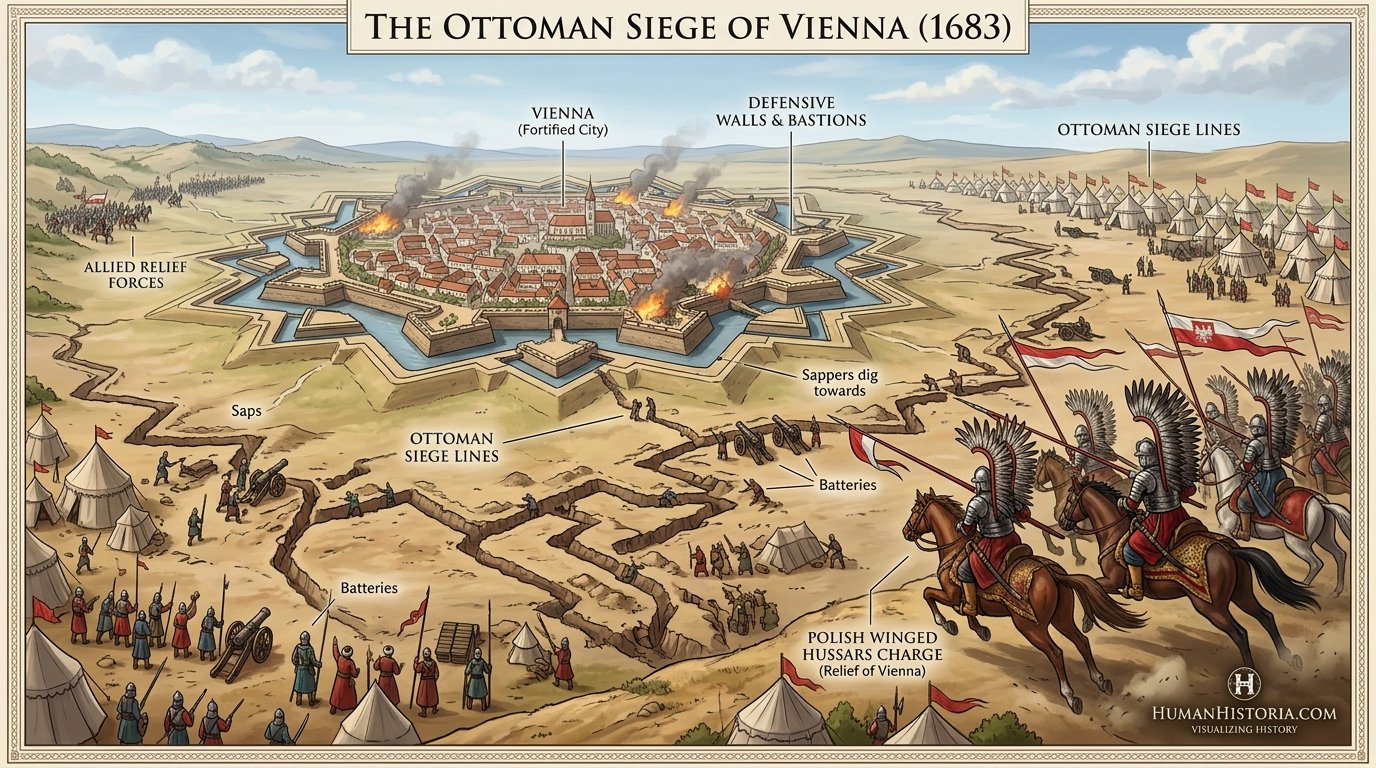
The Ottoman Siege of Vienna (1683) Infographic
💡 Click anywhere on poster to expand in high resolution🔎 Expand Lightbox
Strategic siege schematic illustrating Ottoman mining trenches, Vienna's defense walls, and John III Sobieski's hussar charge.
📖 SCHOLARLY INQUIRIES
Frequently Asked Questions
Essential historical questions and evidence-based answers concerning this chronicle.
Q.Why is The Ottoman Siege of Vienna 1683 significant in world history?
The Ottoman Siege of Vienna 1683 played a pivotal role by transforming technology, social structure, and regional connection, serving as a vital link in human civilization.
Q.Why did the Ottoman Empire besiege Vienna in 1683?
Grand Vizier Merzifonlu Kara Mustafa Pasha sought to expand Ottoman dominion into Central Europe, exploit anti-Habsburg Protestant rebellions in Upper Hungary (led by Imre Thököly), and capture Vienna—known in Istanbul as the 'Golden Apple' (Kızıl Elma)—to establish Ottoman mastery over Danube river trade routes.
Q.How close did the Ottoman forces come to breaching Vienna's walls?
Extremely close. Over two months of siege, Ottoman sappers dug intricate networks of trenches and detonated massive subterranean gunpowder mines beneath the Burg and Löbl bastions. By September 11, the outer ravelin was obliterated and Viennese defenders, reduced to roughly 4,000 battle-ready men, were preparing for a desperate last stand in the city streets.
Q.What was the significance of King Jan III Sobieski's cavalry charge?
On September 12, 1683, Polish King Jan III Sobieski led an allied relief army of Polish, Austrian, and German troops descending from the Kahlenberg heights. Around 6:00 PM, Sobieski launched 18,000 heavy cavalrymen—spearheaded by 3,000 Winged Hussars—in the largest cavalry charge in recorded history, shattering the Ottoman battle lines and capturing Kara Mustafa's camp in under an hour.
Q.What happened to Grand Vizier Kara Mustafa after the defeat?
Following the catastrophic collapse and loss of the imperial green banner, Sultan Mehmed IV ordered Kara Mustafa's execution. On December 25, 1683, in Belgrade, imperial executioners strangled him with a silk cord in accordance with Ottoman court tradition.
📚 Academic Sources & Scholarly Bibliography
Stoye, John (2006).
The Siege of Vienna: The Last Great Trial Between Cross & Crescent.
Pegasus Books.
Wheatcroft, Andrew (2008).
The Enemy at the Gate: Habsburgs, Ottomans, and the Battle for Europe.
Basic Books.
Finkel, Caroline (2006).
Osman's Dream: The History of the Ottoman Empire.
Basic Books.
Inalcik, Halil (1973).
The Ottoman Empire: The Classical Age 1300–1600.
Phoenix.
📖 Scholar Mode Active — Click to exit focused reading
History Lab 🧪
Interactive historical deduction games, tactical matchup simulators, and currency calculators.
🕵️ Who Am I? (The Historical Guess Game)
A secret historical figure has been selected. Ask yes/no questions to narrow down the pool of candidates. Click any active card to make your accusation!
Secret Identity
❓ Who Am I?
Ask questions using the board below to narrow down my identity.
Ask a Question:
Question LogQuestions: 0 / 7
No questions asked yet.
Candidate Board:
🗺️ Timeline Scramble
Five historical events appear out of order. Click them in the correct chronological sequence — from oldest to most recent. How well do you know your history?
🏺 Relic or Fake?
Is this a real historical artifact or a convincing fabrication? Judge each one based on its description and era — then see the truth revealed!
Artifact 1 / 10Score: 0
Empire Matchup Simulator
Empire ATerritory Size (Peak, M km²)Empire B
00
Empire APopulation (Peak, Millions)Empire B
00
Empire AMilitary Power (Army Size)Empire B
00
Tactical Battle Analysis
Select empires and click simulate to run evaluations.
Historical Purchasing Power Converter
See what ancient coins are worth in modern terms and check their historical purchasing power.
Modern Value Equivalent
$0.00 USD
Historical Purchasing Power:
Select currency to view purchasing capability.
Historical Identity Generator
Forge an authentic historical identity from ancient civilisations, complete with linguistic meaning and biography.
Neutral
Gaius Julius
Meaning:Descendant of Jupiter
Historical Background:
A Roman citizen and clerk who worked in the forum under Roman republic rule.
Chrono-Cultural Fusion Simulator
Fuse the culture, technology, and governance of two legendary civilizations to synthesize a unique hybrid society.
Cohesion & Coexistence Rate
85%
🏛️ Hybrid Architecture
⚙️ Synthesized Asset
📜 Synthetic Governance
Historical Tactics & Trivia Quiz
Test your historical knowledge and battle tactics to claim your administrative rank.
8 Questions • Multi-Era
You will be presented with random scenarios and trivia spanning ancient Egypt, classical Rome, Islamic Golden Age, and the modern industrial era. Complete the evaluation to see your historical title!
Question 1 of 8Score: 0
What was the Code of Hammurabi written on?
Correct!
Evaluation Complete!
6 / 8
Correct
Rank Attained
Imperial Legionary
Your knowledge of classical strategy and administrative structures is respectable.
🎲 Counterfactual "What If?" Scenario Simulator
Explore alternative historical trajectories by tweaking key civilizational pivot points.
Simulated Shift
Selected Era
Prehistoric Era
Millions of years ago to ~3000 BCE
The dawn of humanity. From the evolutionary split of early hominids to the mastery of stone tools, fire, and the birth of language.
Landmark Milestones
Welcome to Historia
Enter your Scholar Name to synchronize your chronicles and save your journey.

 ⭐ Featured Chronicle

 ANCIENT AGES
 ANCIENT AGES
 ANCIENT AGES
 MEDIEVAL PERIOD
 MEDIEVAL PERIOD
 PREHISTORIC ERA