>
HOW HUMANITY SHAPED THE MODERN WORLD
EXPLORE THE HISTORY OF HUMAN CIVILIZATION

From prehistoric origins to the modern era—discover the turning points, lost empires, and breakthroughs of world history through interactive timelines and visual guides.
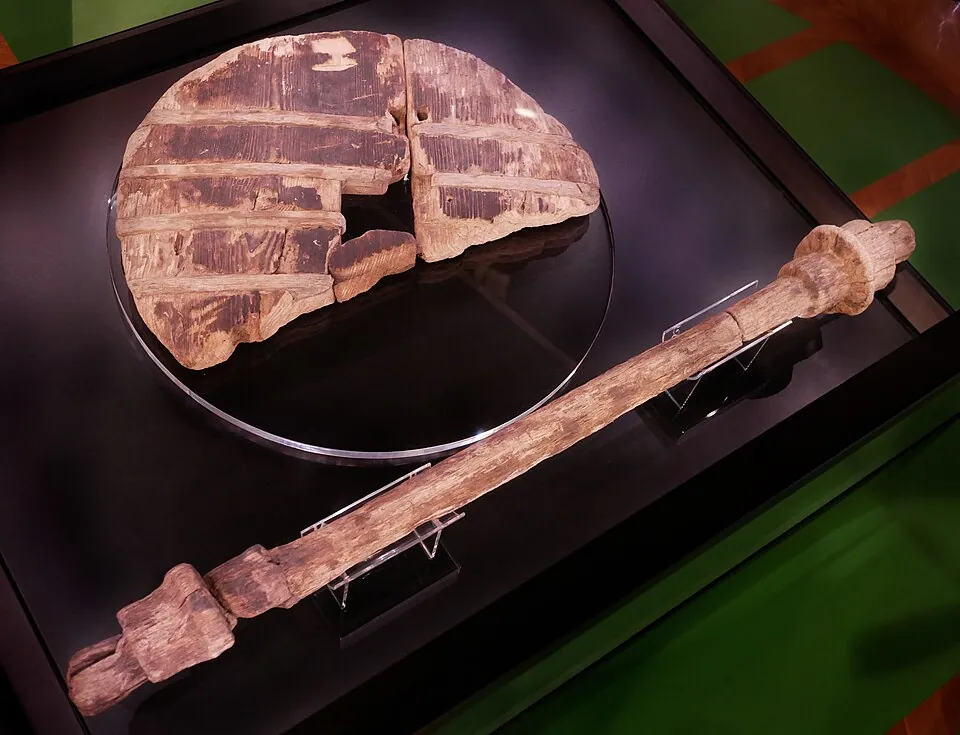
KEY HISTORICAL EVENTS
Major Turning Points in World History
All 182 Chronicles →
Pax Romana (27 BCE - 180 CE): Roman Empire, Law & Military Supremacy ANCIENT AGES
🏛️ Empires ⏱️ 5 min read
Pax Romana (27 BCE - 180 CE): Roman Empire, Law & Military Supremacy

Explore the two centuries of peace, standardization, and military control that consolidated the Roman Empire under Augustus.

Read Chronicle →
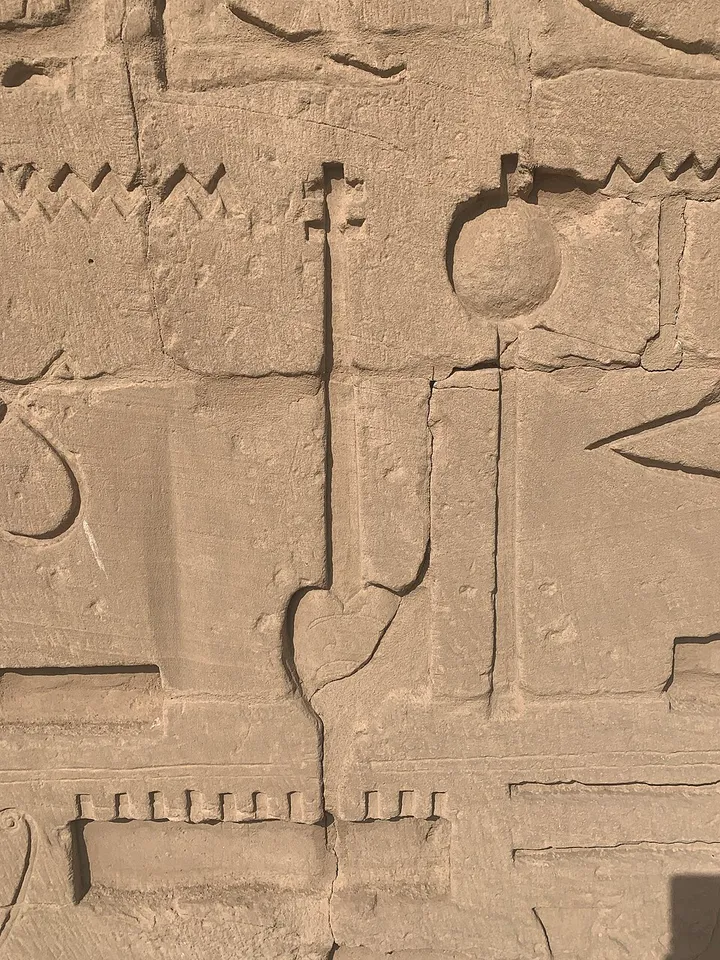
Egyptian Hieroglyphs: Decipherment, Scribes & Sacred Carvings ANCIENT AGES
🏛️ Languages ⏱️ 9 min read
Egyptian Hieroglyphs: Decipherment, Scribes & Sacred Carvings

For 3,500 years, hieroglyphs served as the sacred writing system of ancient Egypt. Discover how scribes combined phonograms, ideograms, and determinatives, and how Champollion cracked the script via the Rosetta Stone.

Read Chronicle →
Silk Road (130 BCE – 1453 CE): Ancient Trade Network, Silk & Spices ANCIENT AGES
🏛️ Economics ⏱️ 5 min read
Silk Road (130 BCE – 1453 CE): Ancient Trade Network, Silk & Spices

Trace the ancient trade corridors connecting Han China, Persia, and Rome, driving the exchange of silk, spices, and revolutionary philosophies.

Read Chronicle →
The Black Death Pandemic 1346: Yersinia Pestis, Mortality & Feudal Shift MEDIEVAL PERIOD
🏛️ Society ⏱️ 5 min read
The Black Death Pandemic 1346: Yersinia Pestis, Mortality & Feudal Shift

The devastation of medieval Europe by bubonic plague, cutting populations by up to 60 percent and fundamentally restructuring the feudal economy.

Read Chronicle →
The Gutenberg Press & The Protestant Reformation MEDIEVAL PERIOD
🏛️ Science ⏱️ 6 min read
The Gutenberg Press & The Protestant Reformation

Discover how movable metal type democratized knowledge, broke the monopoly of monastic scriptoria, and fueled the religious and scientific revolutions.

Read Chronicle →
Neolithic Agricultural Revolution 10,000 BCE: Fertile Crescent Farming PREHISTORIC ERA
🏛️ Science ⏱️ 5 min read
Neolithic Agricultural Revolution 10,000 BCE: Fertile Crescent Farming

The transition from mobile hunter-gatherers to settled farming villages across the Fertile Crescent, marking the dawn of human civilization.

Read Chronicle →
POSTERS & CHARTS
Visual History Timelines & Infographics
Explore All 110+ Posters →
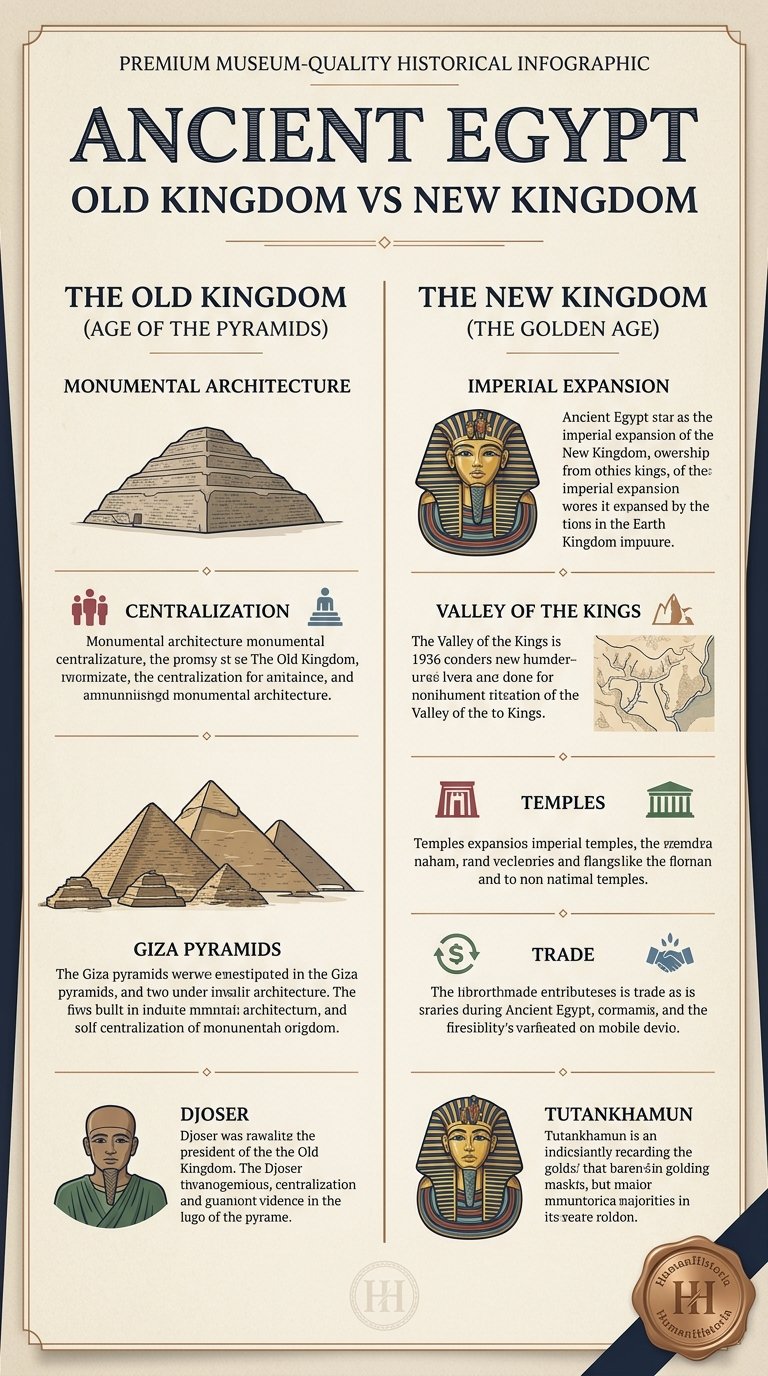
Ancient Egypt: Old Kingdom vs. New Kingdom
🔍 Tap to Zoom
Ancient Egypt: Old Kingdom vs. New Kingdom
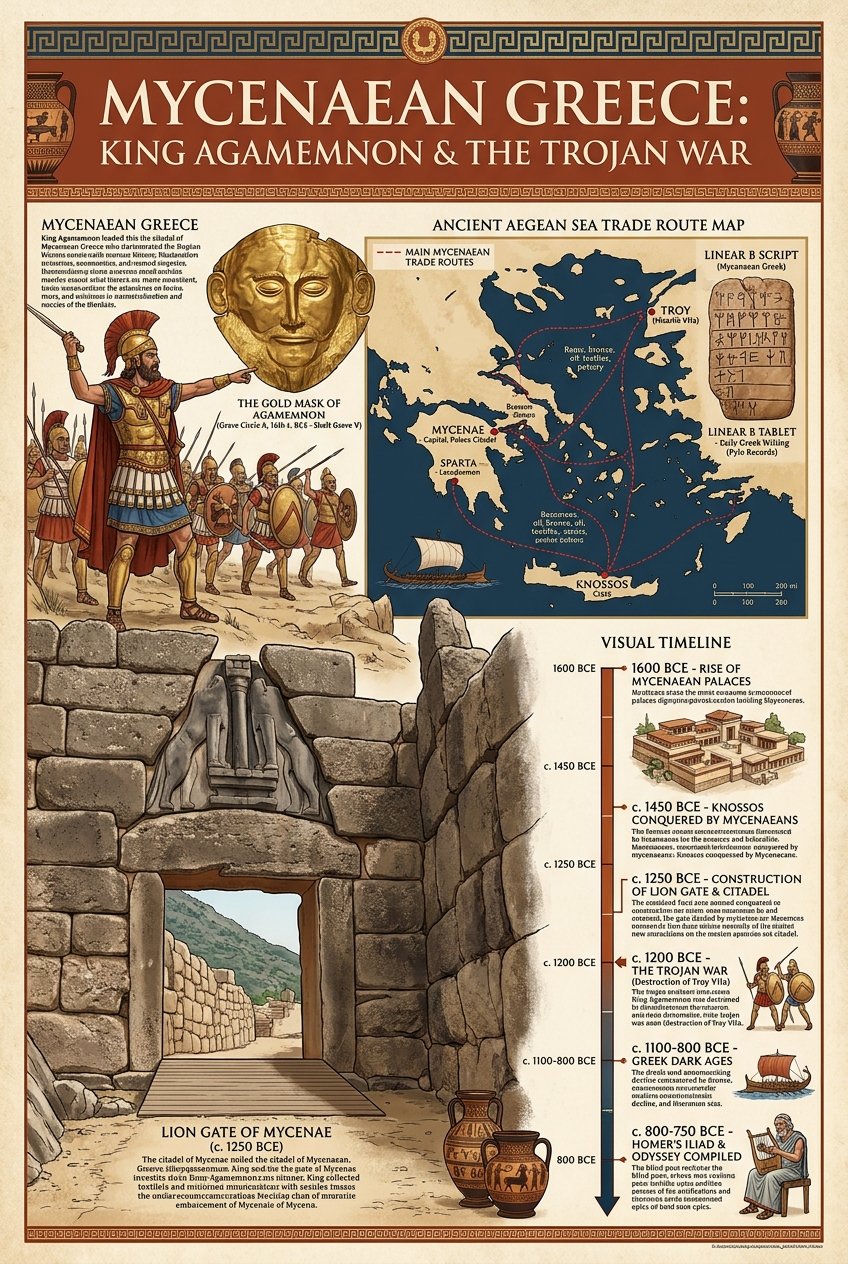
Mycenaean Greece & Trojan War History
🔍 Tap to Zoom
Mycenaean Greece & The Trojan War
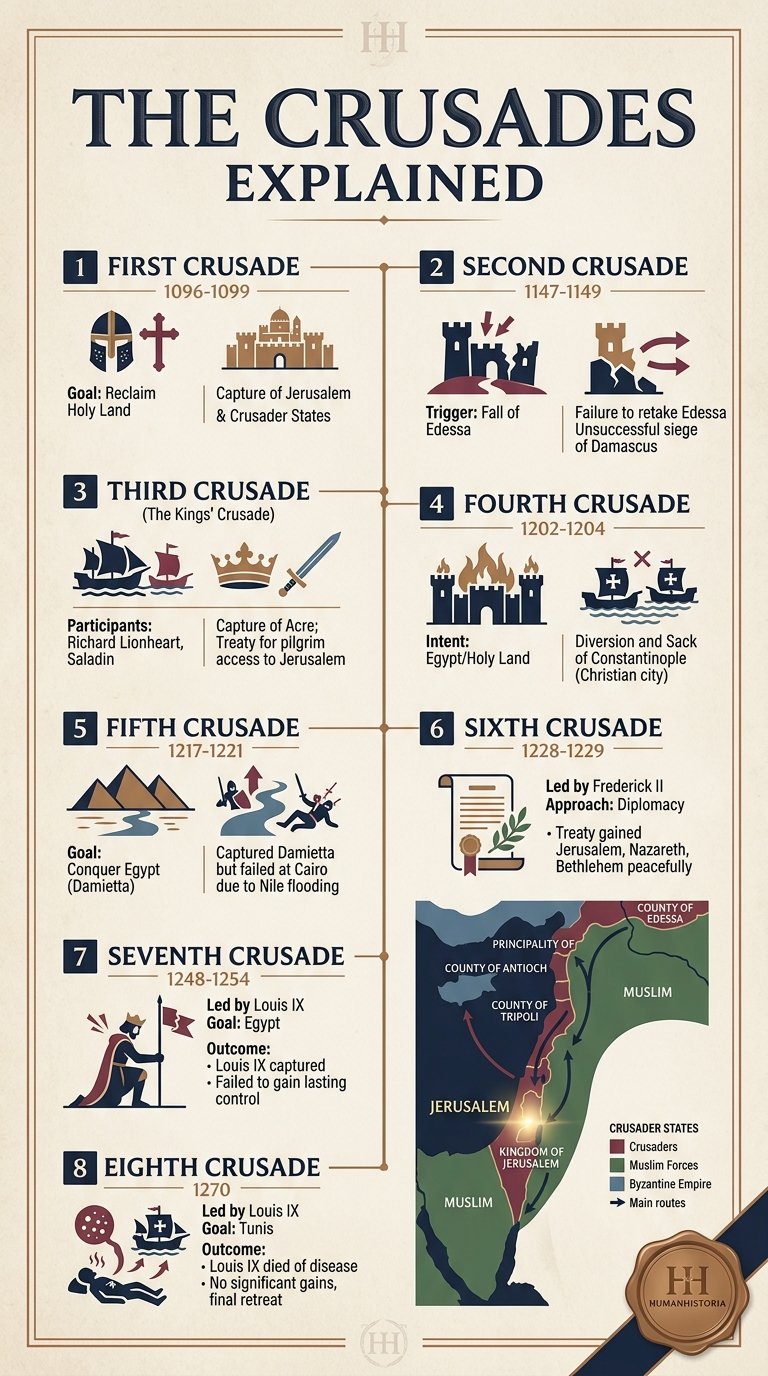
The Crusades: Holy War, Trade & Cultural Exchange
🔍 Tap to Zoom
The Crusades: Holy War, Trade & Exchange
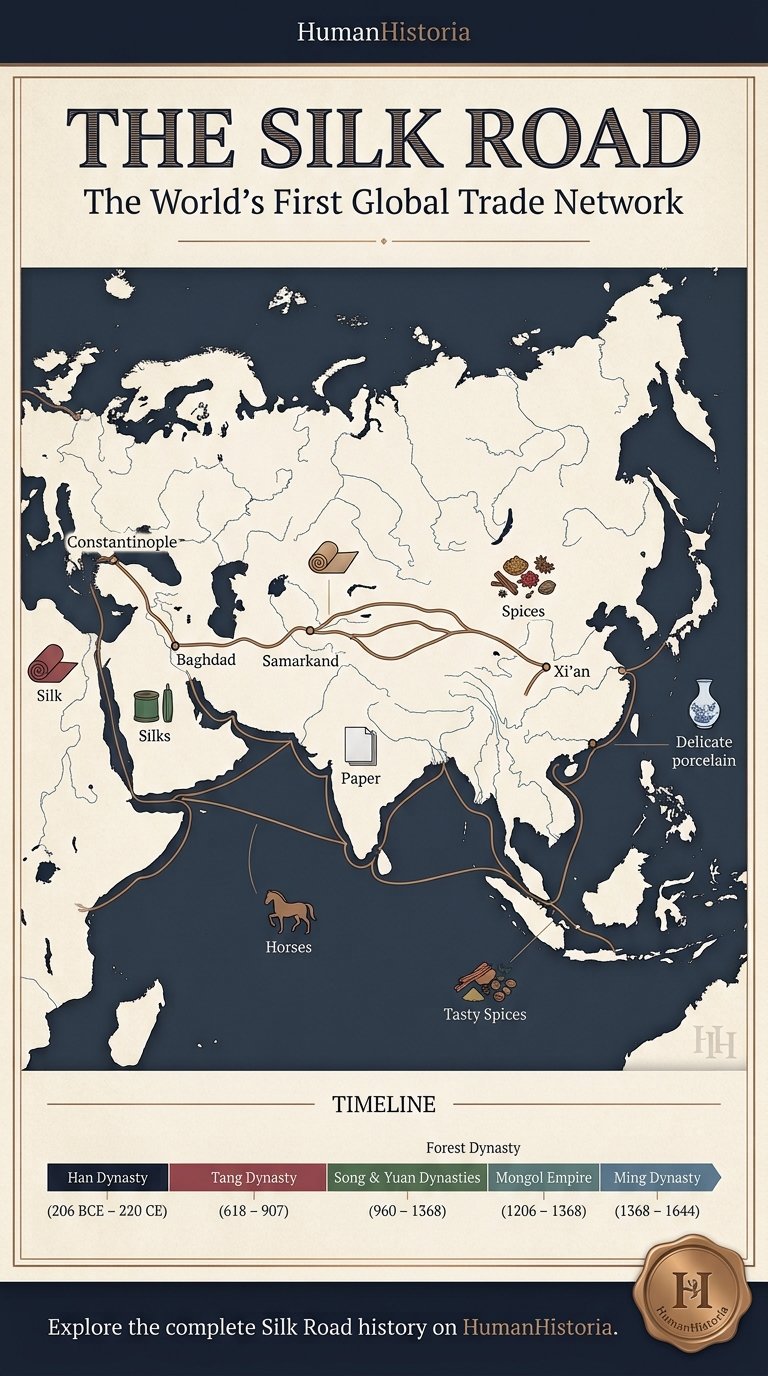
Maritime & Overland Silk Road Trade Networks
🔍 Tap to Zoom
Silk Road: Maritime & Overland Trade Networks
LEARNING TOOLS & LAB
Interactive History Games & Simulations
Open Full Lab →
🕵️
Who Am I? (Historical Guessing Game)

A secret historical figure has been chosen. Ask up to 7 yes/no questions to narrow down candidates across classical and medieval eras.

Play Game →
🗺️
Timeline Scramble

Five historical events appear out of order. Click them in the correct chronological sequence — from oldest to most recent.

Test Chronology →
⚖️
Empire Matchup Simulator

Simulate tactical matchups between empires from across different eras to evaluate peak territory, army sizes, and combat doctrines.

Run Simulator →
Human Historia · The Grand Chronicle
The Chronicle of Humanity

300,000 years. 5 eras. Countless turning points that shaped every moment of your world.

🦴
Prehistoric Era
c. 300,000 BCE — 3,200 BCE · Dawn of Humanity
🌍 Origins in Africa 🧠 Brain tripled in size 🐺 First domestication ~20,000 BCE 🌾 Agriculture ends nomadism
🌍 Africa → Global

Key fact: Neanderthal DNA still lives in 1–2% of all non-African humans today.

Related: Animal Domestication, Cave Art

🔥 Africa

Key fact: Cooking increased caloric intake by 30–50%, directly fuelling brain growth.

Related: Stone Tools, Migration

🌾 Fertile Crescent

Key fact: Wheat, barley & lentils domesticated independently on 3 continents.

Related: Göbekli Tepe, Cuneiform

🗺️ Related Infographics
📚 More from this era
⏳ ~7,000 Years Compressed From farming to the first written word
~2.3% of recorded human history
🏛️
Ancient Ages
c. 3,200 BCE — 500 CE · Empires, Laws & Philosophy
📜 First written laws 🏛️ Birth of democracy ⚔️ 26 major empires rose & fell 🔭 First philosophers & scientists
📜 Mesopotamia

Key fact: The Epic of Gilgamesh — the world's first novel — was written in cuneiform.

Related: Epic of Gilgamesh, Hammurabi

📚 Alexandria, Egypt

Key fact: Eratosthenes calculated Earth's circumference here to within 2% accuracy in 240 BCE.

Related: Greek Philosophy, Roman Empire

🗺️ Related Infographics
📚 More from this era
🌑 ~400 Years of Transition From Roman fall to the medieval rebirth
The European "Dark Ages" — not so dark in Baghdad
🏰
Medieval Period
c. 500 CE — 1500 CE · Empires of Faith, Trade & Castles
🕌 Islam spreads in 100 years ☠️ Black Death kills 1 in 3 Europeans 🧮 Algebra invented in Baghdad 🐪 Silk Road moves ideas & plague
📖 Baghdad, Iraq

Key fact: Al-Khwarizmi invented algebra here — the word "algorithm" derives from his name.

Related: Silk Road, Mansa Musa

🗺️ Related Infographics
📚 More from this era
🖨️ ~50 Years From printing press to Scientific Revolution
Gutenberg's press (1440) → Copernicus (1543)
⚙️
Modern Age
c. 1450 CE — 2000 CE · Revolutions, Industry & Discovery
🌍 Americas "discovered" 1492 💡 Electricity transforms daily life ⚔️ 2 World Wars kill 100M+ 🚀 Moon landing 1969
🖨️ Mainz, Germany

Key fact: 20 million books in 50 years — more than all European scribes produced in 1,000 years.

Related: Scientific Revolution, Reformation

🚂 Britain

Key fact: Britain's GDP per capita doubled in 60 years — the fastest economic growth in history up to that point.

Related: Electricity, Wright Brothers

🗺️ Related Infographics
📚 More from this era
⚡ The Acceleration From computers to AI in 75 years
The fastest technological doubling in human history
🚀
The Future
2000 CE — Beyond · The Next Chapter of Humanity
🤖 AGI may arrive by 2040s 🧬 CRISPR rewrites genetic code 🪐 Mars colonisation in progress ⚛️ Quantum supremacy achieved 2019
⚛️ Global

Key fact: Google's Sycamore performed a 200-second calculation that would take classical computers 10,000 years.

Related: AI Singularity, CRISPR, Space

🗺️ Related Infographics
📚 More from this era
THE ARTIFACT GALLERY

Examine the tangible relics, physical tokens, and revolutionary machines that shaped civilizational growth.

🎥 VIDEO HUB & SHORTS

Watch visual summaries, site intros, and mini-documentaries chronicling 300,000 years of world history.

📊 HISTORICAL INFOGRAPHICS ARCHIVE

Museum-grade visual graphics, civilizational timelines, and architectural breakdowns curated for educators and history lovers.

THE HISTORIA CIRCLE

Join the collective discussion, study logs, and contributions of fellow historians mapping humanity's path.

Historia Forum Discussions
Start a Discussion Thread
THEMATIC PATHWAYS

Trace a single thread — disease, trade, energy, migration — across all eras and civilizations.

History is not just a sequence of events — it is a network of patterns. These thematic pathways allow you to follow a single concept across thousands of years: how agriculture spread, how warfare evolved, how trade routes shaped civilizations. Each pathway collects the most relevant chronicles across all eras.

🧩
How is this different from the sidebar Topics?
While the sidebar Topics (like Science & Tech or Empires) filter articles within your selected historical Era, Thematic Pathways cut horizontally across all eras (from Prehistoric to the Future). Use Themes to trace a single concept's evolutionary line across 300,000 years.
CIVILIZATION HUBS

Comprehensive profiles of the world's greatest civilizations and empires — from ancient cradles to global super-states.

Human Historia provides an academically rich exploration of the world's most influential civilizations. From the monumental achievements of ancient Egypt, Han China, and the Roman Empire, to the sophisticated societies of the Maya, the Islamic Caliphates, and West African empires, these hubs offer deep insights into the cultural, political, and technological legacies that continue to shape our global story.

EVOLUTION OF HUMAN SKILLS

Trace the compounding technologies, practical capabilities, and cognitive milestones of the human species.

Human progress is a story of compounding skills. Every breakthrough, from the spark of prehistoric fire to modern silicon transistors, builds directly on previous generations of ingenuity. Hover over a skill node to trace its historical prerequisites, and click it to explore its development timeline, species-wide impact, and related chronicles.

Prehistoric Ancient Medieval Modern Future
🧠

Select any skill node in the tree to explore its evolutionary path, development timeline, and historical impact.

ACADEMIC PASSPORT

Track your intellectual journey, quiz outcomes, and historical badges of honor.

HISTORIA PASSPORT ⏳
👤 Scribe Novice
Scholar Name Historia Explorer
Rank Rating Sumerian Record Scribe
Chronicles Read 0 / 48
Study Guide Pins 0 Guides
Security Access Level 1 (Novice)
Earned Badges of Honor
🔥
Fire Keeper
Unlock 3 prehistoric chronicles.
🏛️
Codex Keeper
Unlock 3 ancient chronicles.
🏰
Guild Master
Unlock 3 medieval chronicles.
⚙️
Steam Engineer
Unlock 3 modern chronicles.
🚀
Singularity Sage
Unlock 3 future chronicles.
👑
Grand Scholar
Score 5/5 on the Lab Quiz.
Recent Lab Activities
No recent activities recorded. Take a quiz or bookmark articles!
🏛️ MISSION & ARCHIVAL STANDARDS
About Human Historia

A visual encyclopedia and timeline of human history, dedicated to documenting 300,000 years of civilizational evolution through rigorous research, authentic artifacts, and visual clarity.

🌍
The 300,000-Year Story

Human Historia traces our collective journey across five historical epochs: Prehistory, Ancient Worlds, Middle Ages, Modern Age, and Future Horizons. From the first control of fire to quantum computation, we organize turning points into interconnected timelines.

📜
Historiographical Rigor

Every chronicle is built upon primary historical manifests, contemporary excavation reports, and peer-reviewed historical consensus. We prioritize authentic public domain artifacts and clearly identify scholarly debates surrounding major civilizational transitions.

🎨
Museum-Grade Visuals

Complex historical transitions demand visual understanding. We develop high-resolution infographics, architectural cutaways, and comparative territorial maps to transform abstract timelines into vivid, unforgettable learning experiences.

📖
Educational Access

Knowledge belongs to humanity. Human Historia is free, ad-light, and engineered as an educational resource for students, classroom educators, academic researchers, and curious minds across all continents.

Editorial Governance & Inquiries

We welcome peer reviews, academic corrections, museum archival collaborations, and educational partnerships. To submit historical inquiries or provide archival feedback, reach our editorial desk directly.

✉️ Contact Editorial Desk Explore Master Timeline →
Curated Exhibition
Human Historia

An immersive graphical anthology tracing the paths of civilizations, breakthroughs, and conflicts that forged the modern consciousness.

25Chronicles
Showing all articles

The Peace of Westphalia 1648: The Birth of Modern Sovereign Nation-States

Written by Humanhistoria Editorial Historical Era: MEDIEVAL

On October 24, 1648, within the wood-paneled chambers of the municipal town halls of Münster and Osnabrück in northwestern Germany, ambassadorial envoys representing one hundred and nine diplomatic delegations dipped quill pens into ink and pressed heavy wax seals onto the parchment folios of the Instrumentum Pacis Westphalicae. With those signatures, the Peace of Westphalia brought a definitive end to the Thirty Years' War (1618–1648)—the most catastrophic, apocalyptic conflict in European history prior to the World Wars, which had wiped out an estimated twenty to forty percent of the population of the Holy Roman Empire through mercenary pillage, burning cities, famine, and typhus. Yet Westphalia was infinitely more than a war-weary ceasefire; it was the constitutional crucible of the modern international order. By formalizing the principle of Westphalian Sovereignty—the revolutionary legal doctrine that sovereign nation-states possess exclusive territorial jurisdiction and that foreign powers have no right to interfere in a state's internal affairs or religious doctrines (cuius regio, eius religio)—the peace demolished the medieval ideal of a universal Christian empire, establishing the secular system of nation-states that governs global diplomacy to this day.

The Ratification of the Treaty of Munster by Gerard ter Borch
Gerard ter Borch's 1648 painting The Ratification of the Treaty of Münster, depicting Spanish and Dutch delegates swearing solemn oaths to conclude the Eighty Years' War and establish Dutch sovereign independence. (National Gallery, London)

The European Apocalypse: From Prague Defenestration to Total War

The origins of the Westphalian settlement lay in three decades of unmitigated catastrophe. In May 1618, Protestant Bohemian nobles hurled two Catholic imperial regents out of the third-story window of Prague Castle (the Defenestration of Prague), rebelling against the newly elected Catholic Habsburg Emperor, Ferdinand II. What began as a localized religious revolt quickly spiraled into a pan-European conflagration, escalating through four bloody phases: the Bohemian, Danish, Swedish, and French periods.

The Thirty Years' War was fought primarily across the fractured territories of the Holy Roman Empire by massive mercenary armies that lived by looting the countryside (—"war feeds itself"). Notorious commanders like Albrecht von Wallenstein and Count Tilly led tens of thousands of undisciplined mercenaries who burned thousands of towns and villages. In May 1631, imperial troops stormed the Protestant city of Magdeburg; over twenty thousand men, women, and children were slaughtered in a single day, reducing one of Germany's richest cities to smoldering ruins and inventing the horror-word Magdeburgization.

By the 1640s, economic exhaustion was total. Farmland had returned to wilderness; wolves roamed abandoned villages in Pomerania and the Palatinate; and inflation had ruined international trade. It became universally obvious that neither the Catholic Habsburg coalition nor the Protestant-French alliance could achieve total military victory.

Raison d'État: Cardinal Richelieu's Secular Realpolitik

The ideological turning point that paved the way for Westphalia was engineered by a prince of the Roman Catholic Church: France's Chief Minister, Cardinal Richelieu (and his successor, Cardinal Mazarin). Although a devout Catholic prelate, Richelieu recognized that France’s supreme geopolitical danger was encirclement by the Catholic Habsburg dynasties of Spain and Austria.

Subordinating religious dogma to cold national interest, Richelieu developed the revolutionary doctrine of Raison d'État ("Reason of State"). France funded the Protestant army of King Gustavus Adolphus of Sweden with millions of gold livres, and in 1635, Catholic France openly entered the war on the side of Protestant princes against the Catholic Holy Roman Emperor. By demonstrating that national survival and balance of power superseded sectarian religious unity, Richelieu severed European statecraft from the spiritual authority of the Pope.

Opening parchment page of the Treaty of Westphalia bearing ambassadorial seals
Parchment folios of the Instrumentum Pacis Westphalicae (October 1648), bearing the red wax seals and signatures of the imperial, French, and Swedish ambassadorial envoys at Osnabrück and Münster. (State Archives of North Rhine-Westphalia, Germany)

The Congress of Westphalia: History's First Multilateral Summit

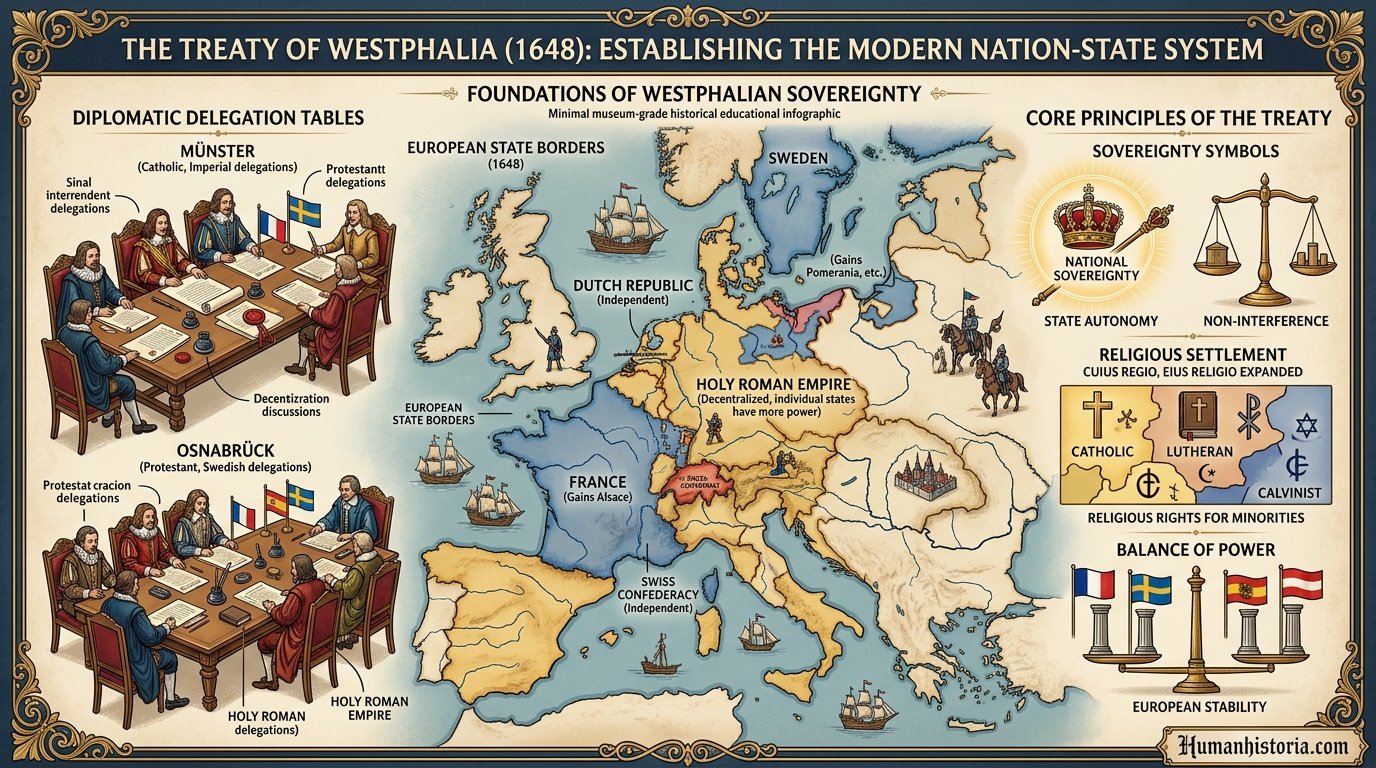
Beginning in 1643, diplomats converged upon the neighboring Westphalian cities of Münster and Osnabrück for history’s first modern multilateral diplomatic congress. To navigate bitter religious animosities and avoid questions of precedence, the summit was partitioned into two neutral zones:

  • Catholic Münster: Housed the ambassadors of Catholic powers—the Holy Roman Empire, the Kingdom of France, the Kingdom of Spain, and the Papacy, mediated by the Papal Nuncio Fabio Chigi (the future Pope Alexander VII) and Venetian envoy Alvise Contarini.
  • Protestant Osnabrück: Housed the Protestant delegations—the Kingdom of Sweden and the German Protestant territorial princes, meeting with imperial ambassadors.

For five exhausting years, couriers shuttled continuously along the thirty-mile road between Münster and Osnabrück. Negotiators invented the foundational protocols of modern diplomacy: formal letters of credence, diplomatic immunity, extraterritoriality for embassies, and the recognition that all sovereign states, regardless of geographic size or military might, were legally equal at the negotiating table.

The Four Pillars of the Westphalian Order

The twin treaties of Münster and Osnabrück (the Instrumentum Pacis Monasteriense and Instrumentum Pacis Osnabrugense) established four radical institutional precedents:

  1. Sovereign Statehood (): Codified the principle that a sovereign government possesses supreme, exclusive legal and political authority over its physical territory and domestic population. No external entity—neither the Holy Roman Emperor nor the Roman Catholic Pope—had the legal right to dictate domestic laws or taxes.
  2. The Non-Intervention Principle: Established the bedrock rule of international law that foreign states are prohibited from invading or intervening in another sovereign nation’s domestic governance, border policies, or judicial proceedings.
  3. Permanent Religious Pluralism: Reaffirmed and expanded the 1555 principle of cuius regio, eius religio ("whose realm, his religion"). Calvinism was officially recognized alongside Lutheranism and Catholicism as a legal confession. Crucially, the treaty protected the private freedom of conscience: if a subject practiced a different Christian confession from their territorial prince, they were legally permitted to worship privately in their homes without state persecution or exile.
  4. Recognition of Sovereign Republics: The peace formally recognized the absolute sovereign independence of two rising democratic powers: the Dutch Republic (United Provinces), ending Spain’s eighty-year attempt to reconquer the Netherlands, and the Old Swiss Confederacy, detaching both realms permanently from the Holy Roman Empire.

"There shall be a Christian, universal, and perpetual peace, and a true and sincere friendship, between His Imperial Majesty and His Most Christian Majesty, as also between all and each of the allies... and that this peace may be so honestly and sincerely observed and maintained, that each party shall endeavor to procure the benefit, honor, and advantage of the other... And let all injuries, damages, and hostilities which have been committed on either side during these troubles be buried in eternal oblivion."

— Instrumentum Pacis Monasteriense (Treaty of Münster), Article I (October 24, 1648)

Geopolitical Paradigm Shift: Medieval Empire vs. Westphalian Sovereignty

The transformation from medieval feudal hierarchy to the modern international sovereign state framework is detailed below.

Governance Metric Medieval Imperial Order (Pre-1648) Westphalian Sovereign Order (Post-1648)
Supreme Sovereign Authority Universal hierarchical: Pope (spiritual) & Holy Roman Emperor (temporal) Independent sovereign nation-states legally equal under international law
Religious Policy Compulsory religious uniformity enforced by imperial inquisition and war Domestic religious autonomy; state secularization; private conscience
Foreign Intervention Legitimate duty of Emperor and Pope to suppress heresy anywhere in Europe Strict non-intervention in domestic affairs of sovereign states
Mechanisms of War & Peace Holy crusades and dynastic feuds decided by papal bulls and divine right Multilateral diplomacy, peace congresses, formal treaty ratifications
Geopolitical Balance Model Striving for universal Christian monarchy () Dynamic Balance of Power () preventing single hegemony
Modern Institutional Descendant Feudal monarchies; the Papal States The United Nations Charter (Article 2(7)); modern international law

The Pope's Vain Curse: The Death of Papal Temporal Power

The definitive sign that Westphalia had inaugurated a modern secular age was the impotent fury of the Papacy. Outraged that Catholic monarchs had signed treaties granting equal legal standing to Protestant heretics and seizing church properties, Pope Innocent X issued the papal bull Zelo Domus Dei in November 1648. The Pope declared the treaties to be "null, void, invalid, iniquitous, unjust, damnable, reprobate, inane, empty of meaning and effect for all time."

For the first time in European history, the monarchs of Europe—Catholic and Protestant alike—completely ignored the Pope’s condemnation. The bull was not even published in Catholic France or Austria. The temporal supremacy of the Vatican was permanently broken; statecraft had evolved into a secular realm governed by international treaty, national interest, and military balance.

⚖️

Historian Debate: The Birth of Modern Sovereignty vs. The "Westphalian Myth"

The Traditional "Genesis of Sovereignty" School (Leo Gross, Hedley Bull)

Argues that Westphalia was the majestic turning point of global history. By creating the concept of territorial sovereignty, state equality, and mutual non-intervention, it dismantled feudal chaos and established the legal operating system of the modern international system.

The Revisionist "Westphalian Myth" School (Stephen Krasner, Andreas Osiander)

Maintains that 1648 did not create pure sovereignty overnight. The treaty actually bound the 350 German princes to imperial constitutional courts, and foreign interventions continued routinely. They argue that "Westphalian sovereignty" is an idealized nineteenth-century intellectual construct retroactively projected onto a practical compromise.

Scholars agree that whether evolutionary or revolutionary, Westphalia established the enduring normative standard against which all modern international relations are evaluated.

From Osnabrück to San Francisco: The Modern World Order

The principles negotiated in the candle-lit chambers of Münster and Osnabrück became the bedrock of global international law. When fifty-one nations assembled in San Francisco in 1945 to draft the Charter of the United Nations, they embedded the Westphalian core directly into Article 2(1): "The Organization is based on the principle of the sovereign equality of all its Members," and Article 2(7): "Nothing contained in the present Charter shall authorize the United Nations to intervene in matters which are essentially within the domestic jurisdiction of any state."

From the rise of nineteenth-century nation-states to decolonization in Asia and Africa in the twentieth century, every passport, every national embassy, and every international treaty operates upon the legal foundations drafted in Westphalia three hundred and seventy-eight years ago.

📖 SCHOLARLY INQUIRIES

Frequently Asked Questions

Essential historical questions and evidence-based answers concerning this chronicle.

What was the Peace of Westphalia?

The Peace of Westphalia refers to two diplomatic treaties signed in October 1648 in the Westphalian cities of Münster and Osnabrück. Negotiated by over 100 diplomatic delegations representing the Holy Roman Empire, France, Sweden, Spain, and the Dutch Republic, the treaties ended the Thirty Years' War and the Eighty Years' War.

What is the concept of Westphalian Sovereignty?

Westphalian sovereignty is the principle in international law that each sovereign state has absolute jurisdiction over its territory and domestic affairs, and that foreign powers have no legal right to intervene. It replaced the medieval feudal concept of universal Christian empire (imperium) overseen by the Pope and Holy Roman Emperor.

How did the treaties resolve religious warfare in Europe?

Westphalia reaffirmed and expanded the 1555 principle of 'cuius regio, eius religio' ('whose realm, his religion'), extending formal legal recognition to Calvinism alongside Catholicism and Lutheranism. Crucially, it established the right of religious minorities to practice their faith privately without persecution or forfeiture of property.

Which states emerged as the primary winners and losers of Westphalia?

France and Sweden emerged as the dominant continental superpowers, gaining strategic border territories (Alsace, Western Pomerania). The Dutch Republic and Swiss Confederation secured formal sovereign independence. The primary loser was the Austrian Habsburg dynasty, whose dream of a centralized, Catholic Holy Roman Empire was permanently shattered.

📚 Academic Sources & Scholarly Bibliography
  • Croxton, Derek (2013). Westphalia: The Last Christian Peace. Palgrave Macmillan.
  • Wilson, Peter H. (2009). The Thirty Years War: Europe's Tragedy. Belknap Press.
  • Krasner, Stephen D. (1999). Sovereignty: Organized Hypocrisy. Princeton University Press.
  • Wedgwood, C.V. (1938). The Thirty Years War. Jonathan Cape.
⚡ Fast Facts
  • Historical EraMEDIEVAL
  • Region🌍 EUROPE
  • CategoryEmpires
  • Reading Time⏱ 12 min read
📖 Scholar Mode Active — Click to exit focused reading
Selected Era

Prehistoric Era

Millions of years ago to ~3000 BCE

The dawn of humanity. From the evolutionary split of early hominids to the mastery of stone tools, fire, and the birth of language.

Landmark Milestones

Welcome to Historia

Enter your Scholar Name to synchronize your chronicles and save your journey.