>
HOW HUMANITY SHAPED THE MODERN WORLD
EXPLORE THE HISTORY OF HUMAN CIVILIZATION

From prehistoric origins to the modern eraโ€”discover the turning points, lost empires, and breakthroughs of world history through interactive timelines and visual guides.
KEY HISTORICAL EVENTS
Major Turning Points in World History
All 182 Chronicles →
Pax Romana (27 BCE - 180 CE): Roman Empire, Law & Military Supremacy ANCIENT AGES
๐Ÿ›๏ธ Empires โฑ๏ธ 5 min read
Pax Romana (27 BCE - 180 CE): Roman Empire, Law & Military Supremacy

Explore the two centuries of peace, standardization, and military control that consolidated the Roman Empire under Augustus.

Read Chronicle →
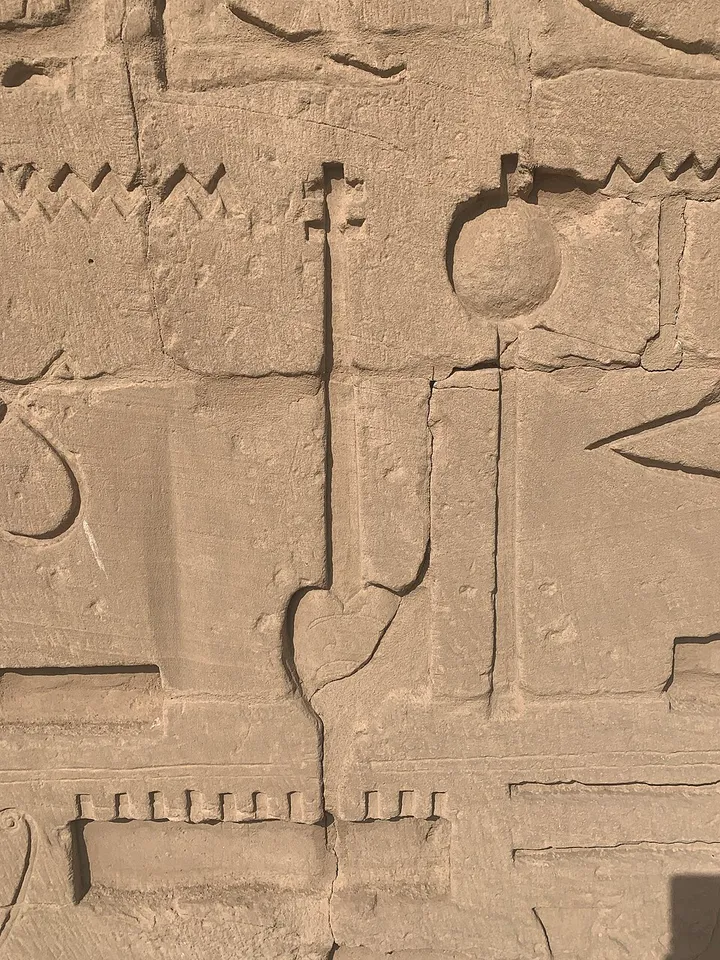
Egyptian Hieroglyphs: Decipherment, Scribes & Sacred Carvings ANCIENT AGES
๐Ÿ›๏ธ Languages โฑ๏ธ 9 min read
Egyptian Hieroglyphs: Decipherment, Scribes & Sacred Carvings

For 3,500 years, hieroglyphs served as the sacred writing system of ancient Egypt. Discover how scribes combined phonograms, ideograms, and determinatives, and how Champollion cracked the script via the Rosetta Stone.

Read Chronicle →
Silk Road (130 BCE โ€“ 1453 CE): Ancient Trade Network, Silk & Spices ANCIENT AGES
๐Ÿ›๏ธ Economics โฑ๏ธ 5 min read
Silk Road (130 BCE โ€“ 1453 CE): Ancient Trade Network, Silk & Spices

Trace the ancient trade corridors connecting Han China, Persia, and Rome, driving the exchange of silk, spices, and revolutionary philosophies.

Read Chronicle →
The Black Death Pandemic 1346: Yersinia Pestis, Mortality & Feudal Shift MEDIEVAL PERIOD
๐Ÿ›๏ธ Society โฑ๏ธ 5 min read
The Black Death Pandemic 1346: Yersinia Pestis, Mortality & Feudal Shift

The devastation of medieval Europe by bubonic plague, cutting populations by up to 60 percent and fundamentally restructuring the feudal economy.

Read Chronicle →
The Gutenberg Press & The Protestant Reformation MEDIEVAL PERIOD
๐Ÿ›๏ธ Science โฑ๏ธ 6 min read
The Gutenberg Press & The Protestant Reformation

Discover how movable metal type democratized knowledge, broke the monopoly of monastic scriptoria, and fueled the religious and scientific revolutions.

Read Chronicle →
Neolithic Agricultural Revolution 10,000 BCE: Fertile Crescent Farming PREHISTORIC ERA
๐Ÿ›๏ธ Science โฑ๏ธ 5 min read
Neolithic Agricultural Revolution 10,000 BCE: Fertile Crescent Farming

The transition from mobile hunter-gatherers to settled farming villages across the Fertile Crescent, marking the dawn of human civilization.

Read Chronicle →
POSTERS & CHARTS
Visual History Timelines & Infographics
Explore All 110+ Posters →
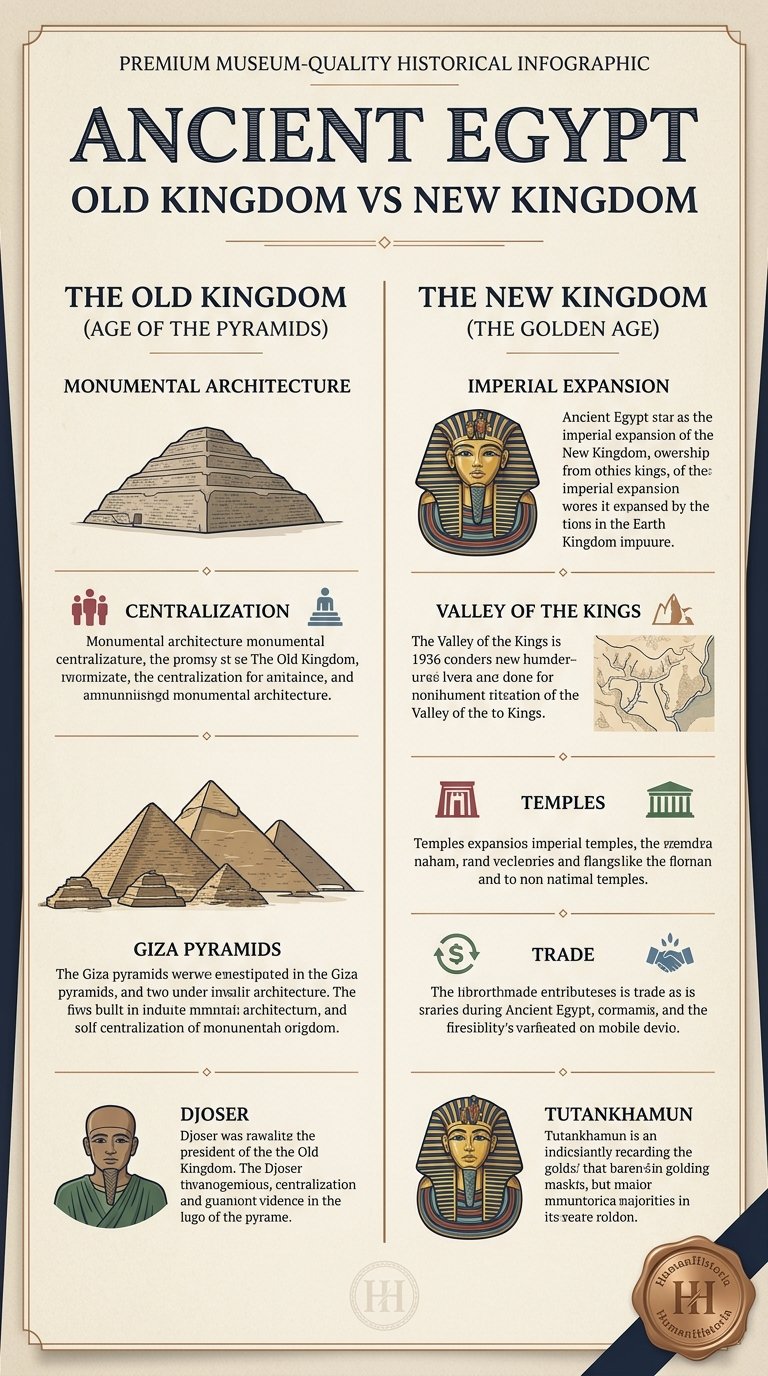
Ancient Egypt: Old Kingdom vs. New Kingdom
๐Ÿ” Tap to Zoom
Ancient Egypt: Old Kingdom vs. New Kingdom
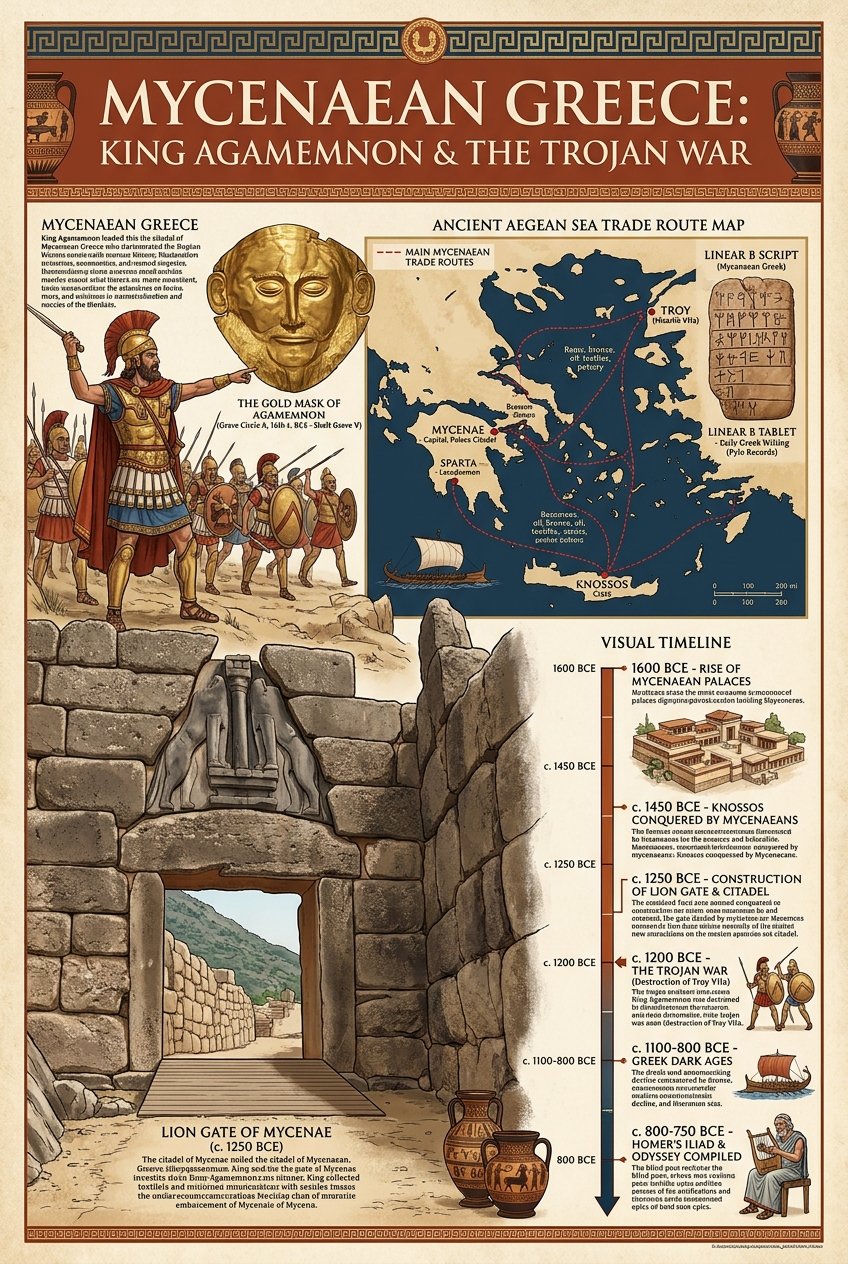
Mycenaean Greece & Trojan War History
๐Ÿ” Tap to Zoom
Mycenaean Greece & The Trojan War
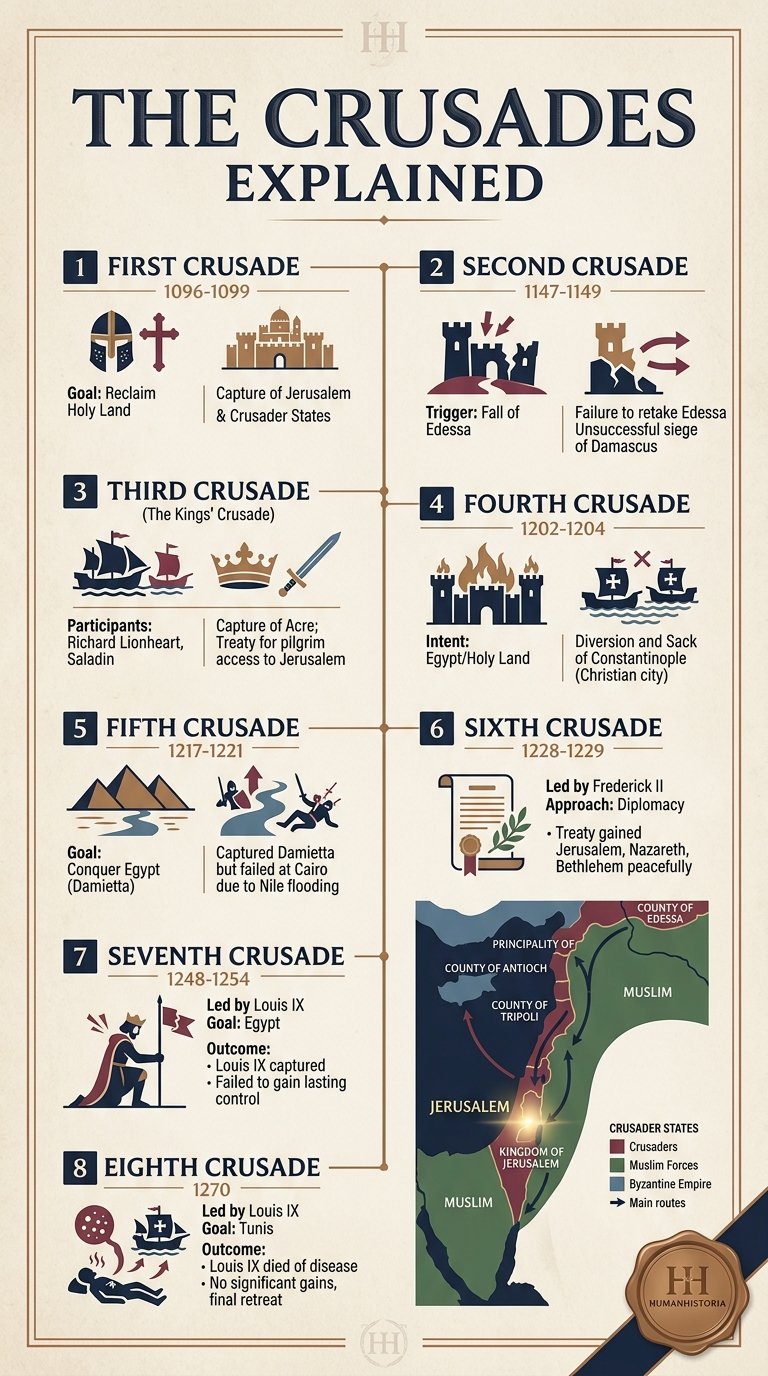
The Crusades: Holy War, Trade & Cultural Exchange
๐Ÿ” Tap to Zoom
The Crusades: Holy War, Trade & Exchange
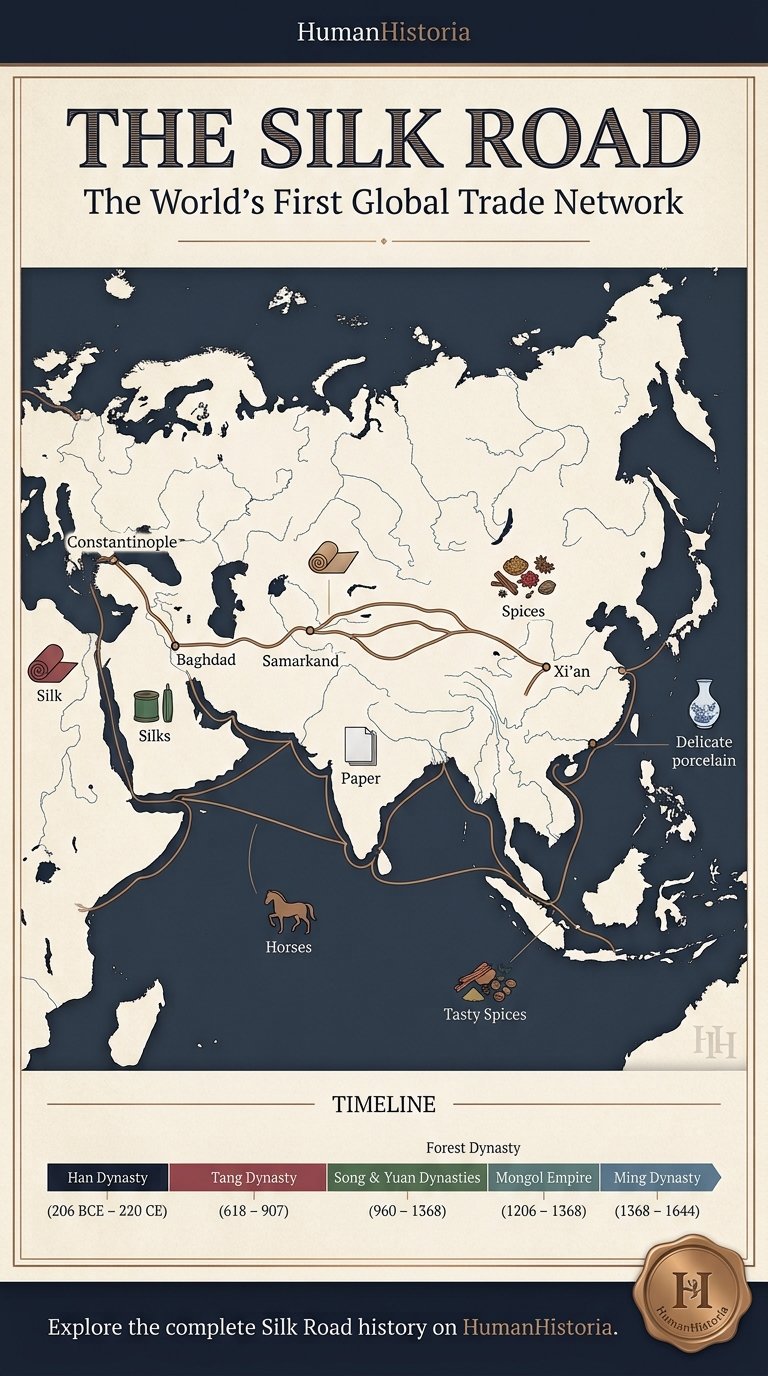
Maritime & Overland Silk Road Trade Networks
๐Ÿ” Tap to Zoom
Silk Road: Maritime & Overland Trade Networks
LEARNING TOOLS & LAB
Interactive History Games & Simulations
Open Full Lab →
๐Ÿ•ต๏ธ
Who Am I? (Historical Guessing Game)

A secret historical figure has been chosen. Ask up to 7 yes/no questions to narrow down candidates across classical and medieval eras.

Play Game →
๐Ÿ—บ๏ธ
Timeline Scramble

Five historical events appear out of order. Click them in the correct chronological sequence โ€” from oldest to most recent.

Test Chronology →
โš–๏ธ
Empire Matchup Simulator

Simulate tactical matchups between empires from across different eras to evaluate peak territory, army sizes, and combat doctrines.

Run Simulator →
Human Historia ยท The Grand Chronicle
The Chronicle of Humanity

300,000 years. 5 eras. Countless turning points that shaped every moment of your world.

๐Ÿฆด
Prehistoric Era
c. 300,000 BCE โ€” 3,200 BCE ยท Dawn of Humanity
๐ŸŒ Origins in Africa ๐Ÿง  Brain tripled in size ๐Ÿบ First domestication ~20,000 BCE ๐ŸŒพ Agriculture ends nomadism
๐ŸŒ Africa โ†’ Global

Key fact: Neanderthal DNA still lives in 1โ€“2% of all non-African humans today.

Related: Animal Domestication, Cave Art

๐Ÿ”ฅ Africa

Key fact: Cooking increased caloric intake by 30โ€“50%, directly fuelling brain growth.

Related: Stone Tools, Migration

๐ŸŒพ Fertile Crescent

Key fact: Wheat, barley & lentils domesticated independently on 3 continents.

Related: Gรถbekli Tepe, Cuneiform

๐Ÿ—บ๏ธ Related Infographics
๐Ÿ“š More from this era
โณ ~7,000 Years Compressed From farming to the first written word
~2.3% of recorded human history
๐Ÿ›๏ธ
Ancient Ages
c. 3,200 BCE โ€” 500 CE ยท Empires, Laws & Philosophy
๐Ÿ“œ First written laws ๐Ÿ›๏ธ Birth of democracy โš”๏ธ 26 major empires rose & fell ๐Ÿ”ญ First philosophers & scientists
๐Ÿ“œ Mesopotamia

Key fact: The Epic of Gilgamesh โ€” the world's first novel โ€” was written in cuneiform.

Related: Epic of Gilgamesh, Hammurabi

๐Ÿ“š Alexandria, Egypt

Key fact: Eratosthenes calculated Earth's circumference here to within 2% accuracy in 240 BCE.

Related: Greek Philosophy, Roman Empire

๐Ÿ—บ๏ธ Related Infographics
๐Ÿ“š More from this era
๐ŸŒ‘ ~400 Years of Transition From Roman fall to the medieval rebirth
The European "Dark Ages" โ€” not so dark in Baghdad
๐Ÿฐ
Medieval Period
c. 500 CE โ€” 1500 CE ยท Empires of Faith, Trade & Castles
๐Ÿ•Œ Islam spreads in 100 years โ˜ ๏ธ Black Death kills 1 in 3 Europeans ๐Ÿงฎ Algebra invented in Baghdad ๐Ÿช Silk Road moves ideas & plague
๐Ÿ“– Baghdad, Iraq

Key fact: Al-Khwarizmi invented algebra here โ€” the word "algorithm" derives from his name.

Related: Silk Road, Mansa Musa

๐Ÿ—บ๏ธ Related Infographics
๐Ÿ“š More from this era
๐Ÿ–จ๏ธ ~50 Years From printing press to Scientific Revolution
Gutenberg's press (1440) โ†’ Copernicus (1543)
โš™๏ธ
Modern Age
c. 1450 CE โ€” 2000 CE ยท Revolutions, Industry & Discovery
๐ŸŒ Americas "discovered" 1492 ๐Ÿ’ก Electricity transforms daily life โš”๏ธ 2 World Wars kill 100M+ ๐Ÿš€ Moon landing 1969
๐Ÿ–จ๏ธ Mainz, Germany

Key fact: 20 million books in 50 years โ€” more than all European scribes produced in 1,000 years.

Related: Scientific Revolution, Reformation

๐Ÿš‚ Britain

Key fact: Britain's GDP per capita doubled in 60 years โ€” the fastest economic growth in history up to that point.

Related: Electricity, Wright Brothers

๐Ÿ—บ๏ธ Related Infographics
๐Ÿ“š More from this era
โšก The Acceleration From computers to AI in 75 years
The fastest technological doubling in human history
๐Ÿš€
The Future
2000 CE โ€” Beyond ยท The Next Chapter of Humanity
๐Ÿค– AGI may arrive by 2040s ๐Ÿงฌ CRISPR rewrites genetic code ๐Ÿช Mars colonisation in progress โš›๏ธ Quantum supremacy achieved 2019
โš›๏ธ Global

Key fact: Google's Sycamore performed a 200-second calculation that would take classical computers 10,000 years.

Related: AI Singularity, CRISPR, Space

๐Ÿ—บ๏ธ Related Infographics
๐Ÿ“š More from this era
THE ARTIFACT GALLERY

Examine the tangible relics, physical tokens, and revolutionary machines that shaped civilizational growth.

๐ŸŽฅ VIDEO HUB & SHORTS

Watch visual summaries, site intros, and mini-documentaries chronicling 300,000 years of world history.

๐Ÿ“Š HISTORICAL INFOGRAPHICS ARCHIVE

Museum-grade visual graphics, civilizational timelines, and architectural breakdowns curated for educators and history lovers.

THE HISTORIA CIRCLE

Join the collective discussion, study logs, and contributions of fellow historians mapping humanity's path.

Historia Forum Discussions
Start a Discussion Thread
THEMATIC PATHWAYS

Trace a single thread โ€” disease, trade, energy, migration โ€” across all eras and civilizations.

History is not just a sequence of events โ€” it is a network of patterns. These thematic pathways allow you to follow a single concept across thousands of years: how agriculture spread, how warfare evolved, how trade routes shaped civilizations. Each pathway collects the most relevant chronicles across all eras.

๐Ÿงฉ
How is this different from the sidebar Topics?
While the sidebar Topics (like Science & Tech or Empires) filter articles within your selected historical Era, Thematic Pathways cut horizontally across all eras (from Prehistoric to the Future). Use Themes to trace a single concept's evolutionary line across 300,000 years.
CIVILIZATION HUBS

Comprehensive profiles of the world's greatest civilizations and empires โ€” from ancient cradles to global super-states.

Human Historia provides an academically rich exploration of the world's most influential civilizations. From the monumental achievements of ancient Egypt, Han China, and the Roman Empire, to the sophisticated societies of the Maya, the Islamic Caliphates, and West African empires, these hubs offer deep insights into the cultural, political, and technological legacies that continue to shape our global story.

EVOLUTION OF HUMAN SKILLS

Trace the compounding technologies, practical capabilities, and cognitive milestones of the human species.

Human progress is a story of compounding skills. Every breakthrough, from the spark of prehistoric fire to modern silicon transistors, builds directly on previous generations of ingenuity. Hover over a skill node to trace its historical prerequisites, and click it to explore its development timeline, species-wide impact, and related chronicles.

Prehistoric Ancient Medieval Modern Future
๐Ÿง 

Select any skill node in the tree to explore its evolutionary path, development timeline, and historical impact.

ACADEMIC PASSPORT

Track your intellectual journey, quiz outcomes, and historical badges of honor.

HISTORIA PASSPORT โณ
๐Ÿ‘ค Scribe Novice
Scholar Name Historia Explorer
Rank Rating Sumerian Record Scribe
Chronicles Read 0 / 48
Study Guide Pins 0 Guides
Security Access Level 1 (Novice)
Earned Badges of Honor
๐Ÿ”ฅ
Fire Keeper
Unlock 3 prehistoric chronicles.
๐Ÿ›๏ธ
Codex Keeper
Unlock 3 ancient chronicles.
๐Ÿฐ
Guild Master
Unlock 3 medieval chronicles.
โš™๏ธ
Steam Engineer
Unlock 3 modern chronicles.
๐Ÿš€
Singularity Sage
Unlock 3 future chronicles.
๐Ÿ‘‘
Grand Scholar
Score 5/5 on the Lab Quiz.
Recent Lab Activities
No recent activities recorded. Take a quiz or bookmark articles!
๐Ÿ›๏ธ MISSION & ARCHIVAL STANDARDS
About Human Historia

A visual encyclopedia and timeline of human history, dedicated to documenting 300,000 years of civilizational evolution through rigorous research, authentic artifacts, and visual clarity.

๐ŸŒ
The 300,000-Year Story

Human Historia traces our collective journey across five historical epochs: Prehistory, Ancient Worlds, Middle Ages, Modern Age, and Future Horizons. From the first control of fire to quantum computation, we organize turning points into interconnected timelines.

๐Ÿ“œ
Historiographical Rigor

Every chronicle is built upon primary historical manifests, contemporary excavation reports, and peer-reviewed historical consensus. We prioritize authentic public domain artifacts and clearly identify scholarly debates surrounding major civilizational transitions.

๐ŸŽจ
Museum-Grade Visuals

Complex historical transitions demand visual understanding. We develop high-resolution infographics, architectural cutaways, and comparative territorial maps to transform abstract timelines into vivid, unforgettable learning experiences.

๐Ÿ“–
Educational Access

Knowledge belongs to humanity. Human Historia is free, ad-light, and engineered as an educational resource for students, classroom educators, academic researchers, and curious minds across all continents.

Editorial Governance & Inquiries

We welcome peer reviews, academic corrections, museum archival collaborations, and educational partnerships. To submit historical inquiries or provide archival feedback, reach our editorial desk directly.

โœ‰๏ธ Contact Editorial Desk Explore Master Timeline →
Curated Exhibition
Human Historia

An immersive graphical anthology tracing the paths of civilizations, breakthroughs, and conflicts that forged the modern consciousness.

25Chronicles
Showing all articles

When and How Was the Internet Invented? From ARPANET to the World Wide Web

Written by Humanhistoria Digital Desk Historical Era: MODERN

At 10:30 PM on October 29, 1969, in a fluorescent-lit laboratory at UCLA, student programmer Charley Kline sat before an Interface Message Processor and attempted to transmit a single word to Stanford Research Institute: "LOGIN". He typed the letter "L" and confirmed over a telephone handset that Stanford received it. He typed "O", and Stanford received that too. But upon pressing "G", the entire system crashed. Yet those two ghostly lettersโ€”"LO"โ€”marked the birth of packet switching, proving that geographically separated computers could converse over a decentralized network without a single point of failure.

ARPANET Logical Map from March 1977 showing network nodes across the United States
ARPANET Logical Map from March 1977, illustrating the expanded decentralized network topology connecting universities, defense research labs, and transatlantic satellite circuits to London and Norway. (DARPA Archive)

The Cold War and the Crisis of Centralized Communications

The origins of the internet did not begin in a Silicon Valley garage, but inside the strategic anxiety of the Cold War. In October 1957, the Soviet Union launched the Sputnik 1 satellite, jolting the American defense establishment into the realization that Soviet rocketry could deliver nuclear payloads onto American soil in minutes. In response, President Dwight D. Eisenhower founded the Advanced Research Projects Agency (ARPA) in 1958, charged with funding high-risk, high-payoff scientific research that conventional military bureaucracies routinely dismissed.

By the early 1960s, amid escalating Cold War nuclear confrontations, American defense planners confronted a catastrophic vulnerability in national command infrastructure. The national telephone system, engineered by AT&T, relied entirely on centralized circuit-switching exchanges. If a single Soviet warhead struck a regional telephone switching center, entire commands would be severed, rendering strategic retaliation impossible. The Department of Defense urgently needed a telecommunications network capable of surviving multiple localized nuclear destructions.

Simultaneously, university research computers across the United States were expensive, isolated islands of computational power. A researcher at the University of Utah could not utilize programs written for an IBM mainframe at UCLA without physically flying to Los Angeles or mailing magnetic punch cards. Visionary psychologist and computer scientist J.C.R. Licklider, directing ARPA's Information Processing Techniques Office (IPTO), conceived a radical solution in his 1962 memorandum: an "Intergalactic Computer Network" where geographically scattered mainframes could communicate seamlessly and share resources in real time.

Why Packet Switching Outsmarted the Telephone Monopoly

Traditional telecommunications required a dedicated, unbroken physical copper circuit between two speakers for the entire duration of a phone call. If any link along that route severed, the call dropped instantly. In the early 1960s, independent thinkers Paul Baran at the RAND Corporation and Donald Davies at Britain's National Physical Laboratory conceptualized a revolutionary alternative: packet switching.

Instead of holding a continuous circuit open, digital data would be broken into small, standardized chunks called "packets." Each packet carried its payload, a sequence number, and addressing information for its final destination. Packets traveled dynamically across network nodes, taking whichever route was open. If one telephone trunk or relay station was destroyed, packets automatically routed around the obstruction and reassembled in correct numerical order at the destination.

When ARPA proposed testing packet switching over commercial telephone lines, AT&T's top engineers declared the concept impossible, insisting that packet switching violated fundamental telecommunication physics. Undeterred, ARPA director Bob Taylor secured $1 million in defense funding in 1968 and awarded the contract to build specialized network routing minicomputersโ€”dubbed Interface Message Processors (IMPs)โ€”to the Boston engineering firm Bolt Beranek and Newman (BBN).

Charley Kline handwritten IMP logbook entry October 29 1969
The original handwritten UCLA Interface Message Processor (IMP) logbook entry for October 29, 1969. Penned on a standard Scientific Data Systems (SDS) customer service maintenance form, it records the historic first host-to-host transmission ('LO') sent to Stanford Research Institute at 22:30. (UCLA Computer Science Archive)

When and How Was the Internet Invented? The Three Epochs of Digital Evolution

When inquiring when and how the internet was invented, technological historians emphasize that the global network did not emerge from a single Eureka moment, but through three sequential breakthroughs across two decades:

Pivotal Stage Year & Key Date Pioneering Architects Core Breakthrough & Architecture
1. ARPANET Network Foundation October 29, 1969 Leonard Kleinrock, Charley Kline, Bob Taylor First packet-switched transmission over dedicated 50 kbps lines between UCLA and Stanford Research Institute (SRI).
2. TCP/IP "Flag Day" (Modern Internet) January 1, 1983 Vinton Cerf, Robert Kahn ARPANET permanently switches from NCP to TCP/IP, creating an open network-of-networks linking satellite, radio, and landlines.
3. World Wide Web (Public Interface) 1989 โ€“ August 1991 Tim Berners-Lee, Robert Cailliau Invention of HTML, HTTP, and URLs at CERN in Switzerland, transforming military and academic computing into an open global library.

Without the foundational packet-switched architecture of 1969, the internet could not transmit data reliably across unpredictable physical wires. Without the 1983 TCP/IP protocol suite, distinct networks around the world could not interconnect into a unified "inter-net." And without Tim Berners-Lee's 1989 hypertext protocols, the internet would have remained an arcane terminal environment restricted to university scientists, defense engineers, and command-line specialists.

Archival Fact: The World's First Host-to-Host Log

The UCLA Computer Science Department maintains the original paper logbook entry for October 29, 1969. In blue ballpoint ink, student programmer Charley Kline noted: "10:30p Talked to SRI, Host to Host." Within two months, UC Santa Barbara and the University of Utah were wired into the network, forming the legendary four-node constellation that initiated the Information Age.

โš–๏ธ

Scholarly Debate: Military Survivability vs. Academic Resource Sharing

The Cold War Nuclear Defense Thesis

Proponents of the military thesis cite Paul Baran's foundational 1964 RAND memorandum, "On Distributed Communications," which explicitly designed packet switching to survive a multi-megaton Soviet nuclear strike against American command bunkers.

The Academic Resource-Sharing Thesis

ARPA program managers, including Bob Taylor and Larry Roberts, consistently testified that their primary objective was economic: pooling expensive supercomputing hardware among university contractors to prevent purchasing redundant mainframes for every campus.

Most modern historians conclude that while DARPA funding was secured through Cold War national defense appropriations, the engineering culture of ARPANET was deeply egalitarian, academic, and decentralized.

"In a few years, men will be able to communicate more effectively through a machine than face to face... The impact of the network on science and society will be profound."

โ€” J.C.R. Licklider & Robert W. Taylor, The Computer as a Communication Device (1968).

Long-Term Legacy: From Four Mainframes to Planetary Civilization

By 1971, ARPANET spanned fifteen research sites across the United States. That same year, computer engineer Ray Tomlinson invented network email, choosing the @ symbol to route messages between users on different machines. Within twenty-four months, electronic mail comprised over seventy-five percent of all traffic across ARPANET, proving that humanity's deepest appetite for networked computing was not numerical computation, but personal communication.

The decentralization of communications pioneered by ARPANET converged directly with the Personal Computer Revolution of 1977, placing processing power in private homes. As academic networks multiplied in the late 1970sโ€”including CSNET, NSFNET, and Britain's JANETโ€”computer scientists recognized that ARPANET's original Network Control Program (NCP) could not accommodate different physical networking mediums like mobile packet radio or transatlantic satellites. Vinton Cerf and Robert Kahn solved this by publishing the Transmission Control Protocol (TCP) and Internet Protocol (IP). By assigning a unique numerical IP address to every host and standardizing how packets traverse alien networks, TCP/IP allowed any computer, anywhere, running any operating system, to link into a single global fabric.

When the U.S. National Science Foundation decommissioned ARPANET in 1990 and commercialized network backbones in 1995, the decentralized architecture conceived during the Cold War became the global marketplace, public square, and geopolitical arena of the twenty-first century. Accelerated by the 2007 Smartphone Revolution and the modern Generative AI boom, over five billion human beings converse, conduct commerce, and store human memory across the distributed descendants of the four steel IMP cabinets deployed in 1969.

๐Ÿ“– SCHOLARLY INQUIRIES

Frequently Asked Questions

Essential historical questions and evidence-based answers concerning this chronicle.

What were the primary long-term causes of this historical turning point?

Systemic economic competition, technological innovations, and evolving international legal paradigms created the structural necessity for change.

How did key leaders and citizens influence the outcome?

Decisive leadership, strategic military/scientific planning, and broad civic movement accelerated the resolution of structural bottlenecks.

What is the primary legacy of this event in the 21st century?

It established foundational legal precedents, technological standards, and geopolitical security frameworks that remain active today.

๐Ÿ“š Academic Sources & Scholarly Bibliography
  • Hobsbawm, Eric (1994). The Age of Extremes: A History of the World, 1914-1991. Vintage Books.
  • Gaddis, John Lewis (2005). The Cold War: A New History. Penguin Press.
  • Westad, Odd Arne (2017). The Cold War: A World History. Basic Books.
โšก Fast Facts
  • Historical EraMODERN
  • Region๐ŸŒ AMERICAS
  • CategoryScience
  • Reading Timeโฑ 13 min read
๐Ÿ“– Scholar Mode Active โ€” Click to exit focused reading
Selected Era

Prehistoric Era

Millions of years ago to ~3000 BCE

The dawn of humanity. From the evolutionary split of early hominids to the mastery of stone tools, fire, and the birth of language.

Landmark Milestones

Welcome to Historia

Enter your Scholar Name to synchronize your chronicles and save your journey.