>
๐Ÿ›๏ธ HUMAN HISTORIA ARCHIVE
EXPLORE 300,000 YEARS OF WORLD HISTORY

Comprehensive historical chronicles, authentic museum artifacts, and high-resolution timeline posters documenting the evolution of human civilization.

KEY HISTORICAL EVENTS

Major Turning Points in World History

All 182 Chronicles →
Pax Romana (27 BCE - 180 CE): Roman Empire, Law & Military Supremacy ANCIENT AGES
๐Ÿ›๏ธ Empires โฑ๏ธ 5 min read

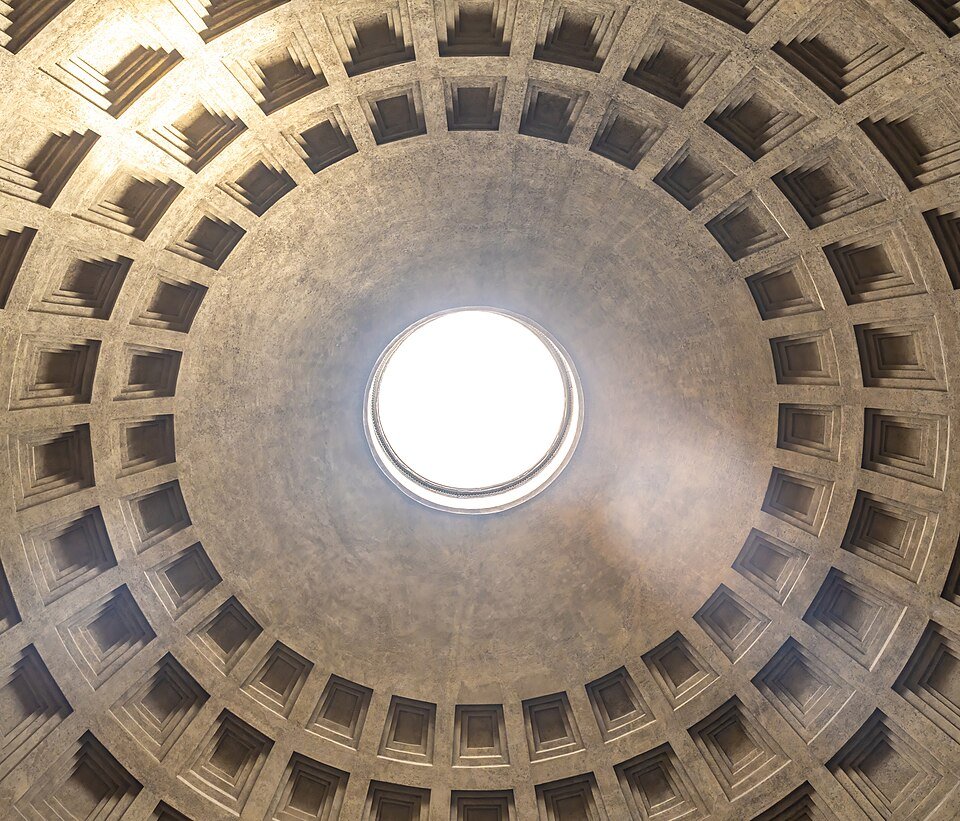
Pax Romana (27 BCE - 180 CE): Roman Empire, Law & Military Supremacy

Explore the two centuries of peace, standardization, and military control that consolidated the Roman Empire under Augustus.

Read Chronicle →
Egyptian Hieroglyphs: Decipherment, Scribes & Sacred Carvings ANCIENT AGES
๐Ÿ›๏ธ Languages โฑ๏ธ 9 min read

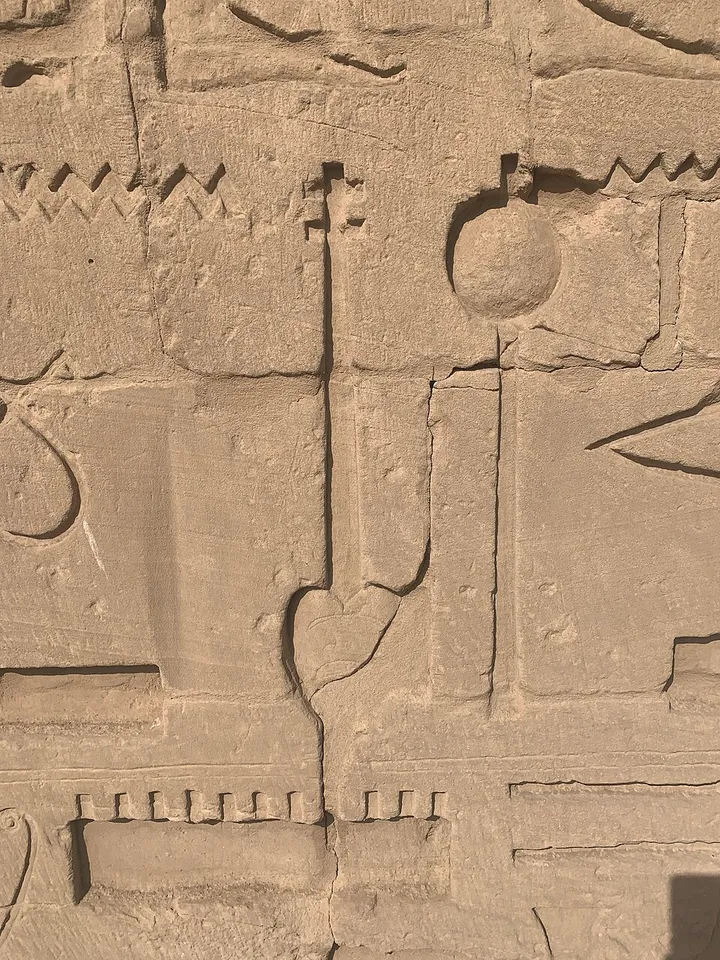
Egyptian Hieroglyphs: Decipherment, Scribes & Sacred Carvings

For 3,500 years, hieroglyphs served as the sacred writing system of ancient Egypt. Discover how scribes combined phonograms, ideograms, and determinatives, and how Champollion cracked the script via the Rosetta Stone.

Read Chronicle →
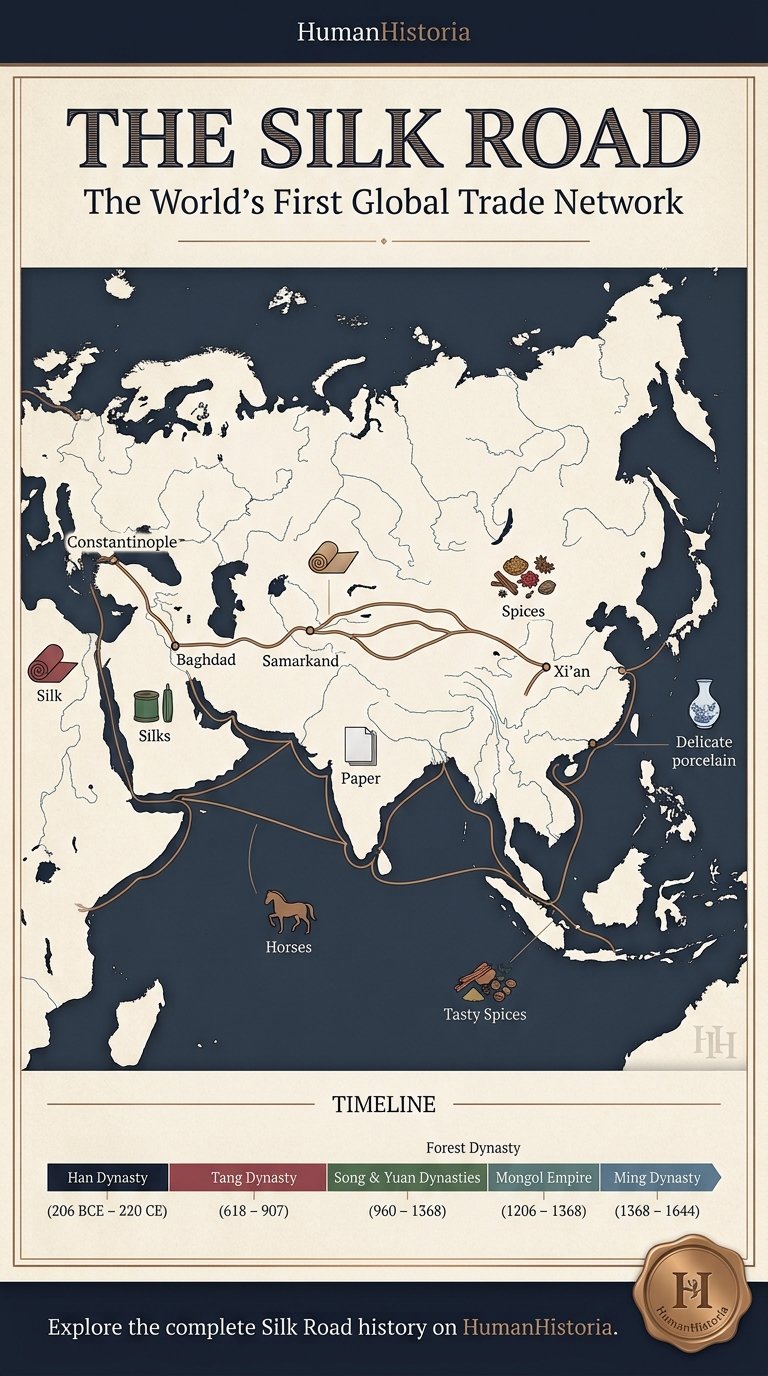
Silk Road (130 BCE โ€“ 1453 CE): Ancient Trade Network, Silk & Spices ANCIENT AGES
๐Ÿ›๏ธ Economics โฑ๏ธ 5 min read

Silk Road (130 BCE โ€“ 1453 CE): Ancient Trade Network, Silk & Spices

Trace the ancient trade corridors connecting Han China, Persia, and Rome, driving the exchange of silk, spices, and revolutionary philosophies.

Read Chronicle →
The Black Death Pandemic 1346: Yersinia Pestis, Mortality & Feudal Shift MEDIEVAL PERIOD
๐Ÿ›๏ธ Society โฑ๏ธ 5 min read

The Black Death Pandemic 1346: Yersinia Pestis, Mortality & Feudal Shift

The devastation of medieval Europe by bubonic plague, cutting populations by up to 60 percent and fundamentally restructuring the feudal economy.

Read Chronicle →
The Gutenberg Press & The Protestant Reformation MEDIEVAL PERIOD
๐Ÿ›๏ธ Science โฑ๏ธ 6 min read

The Gutenberg Press & The Protestant Reformation

Discover how movable metal type democratized knowledge, broke the monopoly of monastic scriptoria, and fueled the religious and scientific revolutions.

Read Chronicle →
Neolithic Agricultural Revolution 10,000 BCE: Fertile Crescent Farming PREHISTORIC ERA
๐Ÿ›๏ธ Science โฑ๏ธ 5 min read

Neolithic Agricultural Revolution 10,000 BCE: Fertile Crescent Farming

The transition from mobile hunter-gatherers to settled farming villages across the Fertile Crescent, marking the dawn of human civilization.

Read Chronicle →
POSTERS & CHARTS

Visual History Timelines & Infographics

Explore All 110+ Posters →
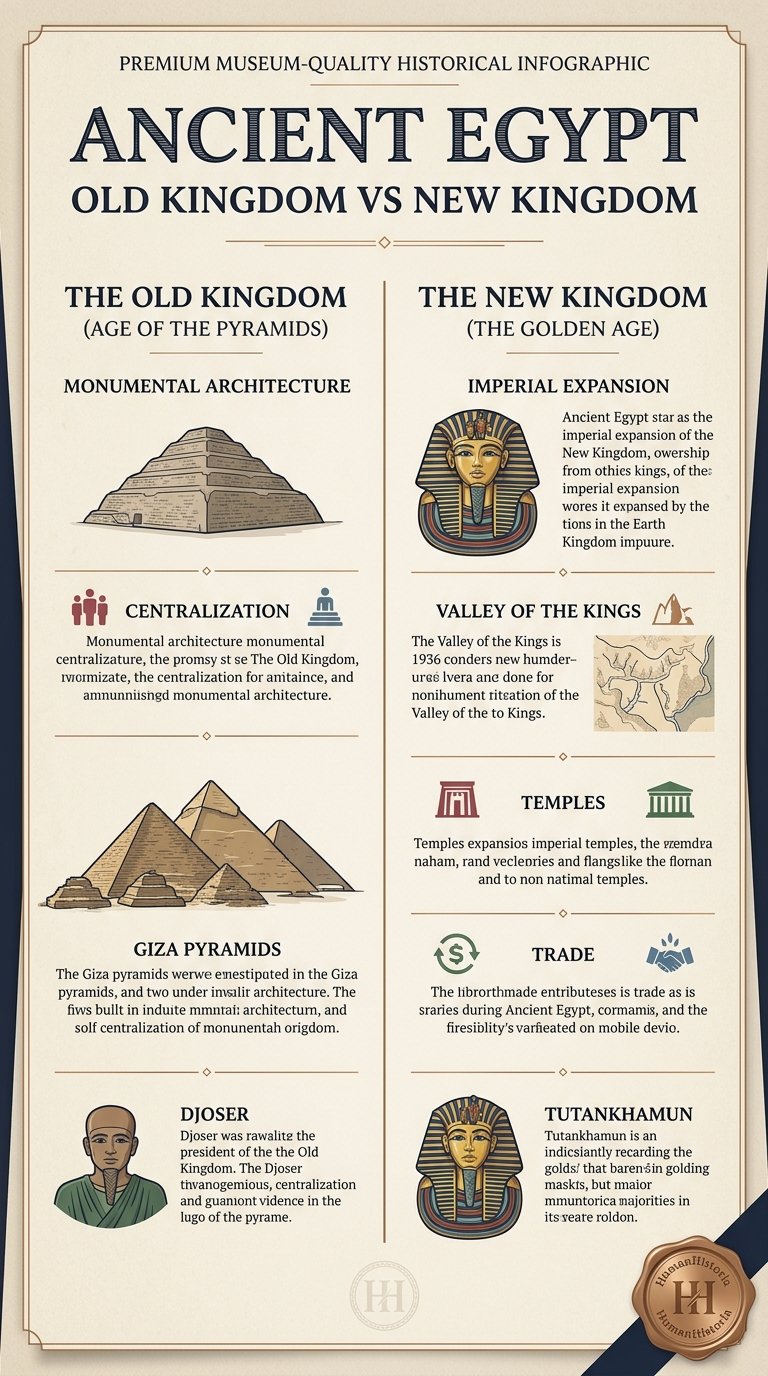
Ancient Egypt Timeline: 3,000 Years of Pharaonic History
๐Ÿ” Tap to Zoom

Ancient Egypt Timeline: 3,000 Years of Pharaonic History

Roman Empire vs Sasanian Persia: Clash of Superpowers Map
๐Ÿ” Tap to Zoom

Roman Empire vs Sasanian Persia: Clash of Superpowers Map

Macro-History of Humanity: 10,000 Years in 1 Visual Chart
๐Ÿ” Tap to Zoom

Macro-History of Humanity: 10,000 Years in 1 Visual Chart

The 7 Stages of Civilizational Growth & Collapse
๐Ÿ” Tap to Zoom

The 7 Stages of Civilizational Growth & Collapse

LEARNING TOOLS & LAB

Interactive History Games & Simulations

Open Full Lab →
๐Ÿ•ต๏ธ

Who Am I? (Historical Guessing Game)

A secret historical figure has been chosen. Ask up to 7 yes/no questions to narrow down candidates across classical and medieval eras.

Play Game →
๐Ÿ—บ๏ธ

Timeline Scramble

Five historical events appear out of order. Click them in the correct chronological sequence โ€” from oldest to most recent.

Test Chronology →
โš–๏ธ

Empire Matchup Simulator

Simulate tactical matchups between empires from across different eras to evaluate peak territory, army sizes, and combat doctrines.

Run Simulator →
Human Historia ยท The Grand Chronicle

The Chronicle of Humanity

300,000 years. 5 eras. Countless turning points that shaped every moment of your world.

๐Ÿฆด

Prehistoric Era

c. 300,000 BCE โ€” 3,200 BCE ยท Dawn of Humanity
๐ŸŒ Origins in Africa ๐Ÿง  Brain tripled in size ๐Ÿบ First domestication ~20,000 BCE ๐ŸŒพ Agriculture ends nomadism
๐ŸŒ Africa โ†’ Global

Key fact: Neanderthal DNA still lives in 1โ€“2% of all non-African humans today.

Related: Animal Domestication, Cave Art

๐Ÿ”ฅ Africa

Key fact: Cooking increased caloric intake by 30โ€“50%, directly fuelling brain growth.

Related: Stone Tools, Migration

๐ŸŒพ Fertile Crescent

Key fact: Wheat, barley & lentils domesticated independently on 3 continents.

Related: Gรถbekli Tepe, Cuneiform

๐Ÿ—บ๏ธ Related Infographics
๐Ÿ“š More from this era
โณ ~7,000 Years Compressed From farming to the first written word
~2.3% of recorded human history
๐Ÿ›๏ธ

Ancient Ages

c. 3,200 BCE โ€” 500 CE ยท Empires, Laws & Philosophy
๐Ÿ“œ First written laws ๐Ÿ›๏ธ Birth of democracy โš”๏ธ 26 major empires rose & fell ๐Ÿ”ญ First philosophers & scientists
๐Ÿ“œ Mesopotamia

Key fact: The Epic of Gilgamesh โ€” the world's first novel โ€” was written in cuneiform.

Related: Epic of Gilgamesh, Hammurabi

๐Ÿ“š Alexandria, Egypt

Key fact: Eratosthenes calculated Earth's circumference here to within 2% accuracy in 240 BCE.

Related: Greek Philosophy, Roman Empire

๐Ÿ—บ๏ธ Related Infographics
๐Ÿ“š More from this era
๐ŸŒ‘ ~400 Years of Transition From Roman fall to the medieval rebirth
The European "Dark Ages" โ€” not so dark in Baghdad
๐Ÿฐ

Medieval Period

c. 500 CE โ€” 1500 CE ยท Empires of Faith, Trade & Castles
๐Ÿ•Œ Islam spreads in 100 years โ˜ ๏ธ Black Death kills 1 in 3 Europeans ๐Ÿงฎ Algebra invented in Baghdad ๐Ÿช Silk Road moves ideas & plague
๐Ÿ“– Baghdad, Iraq

Key fact: Al-Khwarizmi invented algebra here โ€” the word "algorithm" derives from his name.

Related: Silk Road, Mansa Musa

๐Ÿ—บ๏ธ Related Infographics
๐Ÿ“š More from this era
๐Ÿ–จ๏ธ ~50 Years From printing press to Scientific Revolution
Gutenberg's press (1440) โ†’ Copernicus (1543)
โš™๏ธ

Modern Age

c. 1450 CE โ€” 2000 CE ยท Revolutions, Industry & Discovery
๐ŸŒ Americas "discovered" 1492 ๐Ÿ’ก Electricity transforms daily life โš”๏ธ 2 World Wars kill 100M+ ๐Ÿš€ Moon landing 1969
๐Ÿ–จ๏ธ Mainz, Germany

Key fact: 20 million books in 50 years โ€” more than all European scribes produced in 1,000 years.

Related: Scientific Revolution, Reformation

๐Ÿš‚ Britain

Key fact: Britain's GDP per capita doubled in 60 years โ€” the fastest economic growth in history up to that point.

Related: Electricity, Wright Brothers

๐Ÿ—บ๏ธ Related Infographics
๐Ÿ“š More from this era
โšก The Acceleration From computers to AI in 75 years
The fastest technological doubling in human history
๐Ÿš€

The Future

2000 CE โ€” Beyond ยท The Next Chapter of Humanity
๐Ÿค– AGI may arrive by 2040s ๐Ÿงฌ CRISPR rewrites genetic code ๐Ÿช Mars colonisation in progress โš›๏ธ Quantum supremacy achieved 2019
โš›๏ธ Global

Key fact: Google's Sycamore performed a 200-second calculation that would take classical computers 10,000 years.

Related: AI Singularity, CRISPR, Space

๐Ÿ—บ๏ธ Related Infographics
๐Ÿ“š More from this era

THE ARTIFACT GALLERY

Examine the tangible relics, physical tokens, and revolutionary machines that shaped civilizational growth.

๐ŸŽฅ VIDEO HUB & SHORTS

Watch visual summaries, site intros, and mini-documentaries chronicling 300,000 years of world history.

๐Ÿ“Š HISTORICAL INFOGRAPHICS ARCHIVE

Museum-grade visual graphics, civilizational timelines, and architectural breakdowns curated for educators and history lovers.

THE HISTORIA CIRCLE

Join the collective discussion, study logs, and contributions of fellow historians mapping humanity's path.

Historia Forum Discussions

Start a Discussion Thread

THEMATIC PATHWAYS

Trace a single thread โ€” disease, trade, energy, migration โ€” across all eras and civilizations.

History is not just a sequence of events โ€” it is a network of patterns. These thematic pathways allow you to follow a single concept across thousands of years: how agriculture spread, how warfare evolved, how trade routes shaped civilizations. Each pathway collects the most relevant chronicles across all eras.

๐Ÿงฉ
How is this different from the sidebar Topics?
While the sidebar Topics (like Science & Tech or Empires) filter articles within your selected historical Era, Thematic Pathways cut horizontally across all eras (from Prehistoric to the Future). Use Themes to trace a single concept's evolutionary line across 300,000 years.

CIVILIZATION HUBS

Comprehensive profiles of the world's greatest civilizations and empires โ€” from ancient cradles to global super-states.

Human Historia provides an academically rich exploration of the world's most influential civilizations. From the monumental achievements of ancient Egypt, Han China, and the Roman Empire, to the sophisticated societies of the Maya, the Islamic Caliphates, and West African empires, these hubs offer deep insights into the cultural, political, and technological legacies that continue to shape our global story.

EVOLUTION OF HUMAN SKILLS

Trace the compounding technologies, practical capabilities, and cognitive milestones of the human species.

Human progress is a story of compounding skills. Every breakthrough, from the spark of prehistoric fire to modern silicon transistors, builds directly on previous generations of ingenuity. Hover over a skill node to trace its historical prerequisites, and click it to explore its development timeline, species-wide impact, and related chronicles.

Prehistoric Ancient Medieval Modern Future
๐Ÿง 

Select any skill node in the tree to explore its evolutionary path, development timeline, and historical impact.

ACADEMIC PASSPORT

Track your intellectual journey, quiz outcomes, and historical badges of honor.
HISTORIA PASSPORT โณ
๐Ÿ‘ค Scribe Novice
Scholar Name Historia Explorer
Rank Rating Sumerian Record Scribe
Chronicles Read 0 / 48
Study Guide Pins 0 Guides
Security Access Level 1 (Novice)

Earned Badges of Honor

๐Ÿ”ฅ
Fire Keeper
Unlock 3 prehistoric chronicles.
๐Ÿ›๏ธ
Codex Keeper
Unlock 3 ancient chronicles.
๐Ÿฐ
Guild Master
Unlock 3 medieval chronicles.
โš™๏ธ
Steam Engineer
Unlock 3 modern chronicles.
๐Ÿš€
Singularity Sage
Unlock 3 future chronicles.
๐Ÿ‘‘
Grand Scholar
Score 5/5 on the Lab Quiz.

Recent Lab Activities

No recent activities recorded. Take a quiz or bookmark articles!
Curated Exhibition

Human Historia

An immersive graphical anthology tracing the paths of civilizations, breakthroughs, and conflicts that forged the modern consciousness.

25Chronicles
Showing all articles

Roman Engineering: Aqueducts, Arches & Self-Healing Stone

Written by Humanhistoria Science Historical Era: ANCIENT
๐Ÿ“ท Historical Photograph Source: Public Domain Museum Artifact / Historical Archive Photograph.

๐Ÿง Key Chronicle Takeaway (Atomic Summary)

Discover Roman engineering marvels: pozzolanic concrete that heals in seawater, gravity-fed aqueducts, arches, and the 2,000-year dome of the Pantheon.

The expansion of the Roman Empire was built on the discipline of its legions, but it was sustained by the genius of its engineers. Roman engineering transformed natural resources and terrain into an integrated, urbanized network that spanned three continents. At the heart of this physical infrastructure lay two revolutionary technologies: the mastery of Concrete (opus caementicium) and the development of gravity-fed Aqueducts. By inventing a highly durable, water-resistant concrete using volcanic ash, and building vast networks of elevated stone channels, Roman engineers raised sanitation, public health, and architectural design to levels unmatched in the ancient world, creating a physical blueprint for modern urban systems, linking the glory of Rome to the utility of its public works.

The Discovery of Pozzolana: Volcanic Concrete

Before the 2nd century BCE, Roman builders relied on cut stone, mud brick, and lime mortar. These materials were strong under compression but weak under tension, and they dissolved when exposed to water or earthquakes. The breakthrough came when engineers began using a volcanic sand found near Pozzuoli, near Mount Vesuvius, which they called pulvis puteolanus (Pozzolanic ash). Scribes and architects like Vitruvius documented the chemical properties of this material, paving the way for its standardized use across the empire.

When mixed with lime and water, Pozzolanic ash underwent a chemical reaction that created a highly crystalline cement matrix. This concrete had unique properties:

  • Hydraulic Set: Unlike standard lime mortar, which requires air to dry, Roman concrete could set underwater. This allowed engineers to construct massive harbor breakwaters, bridge piers, and underwater foundations.
  • Self-Healing: Recent studies show that "lime clasts" in the concrete dissolved during cracking, recrystallizing to seal fissures when rainwater entered, making Roman structures exceptionally durable over millennia.
  • Structural Freedom: When poured into wooden molds reinforced with brick ribs, concrete allowed Romans to move beyond flat ceilings to construct massive, vaulted arches and domes, culminating in the Pantheon, which still possesses the largest unreinforced concrete dome in the world.
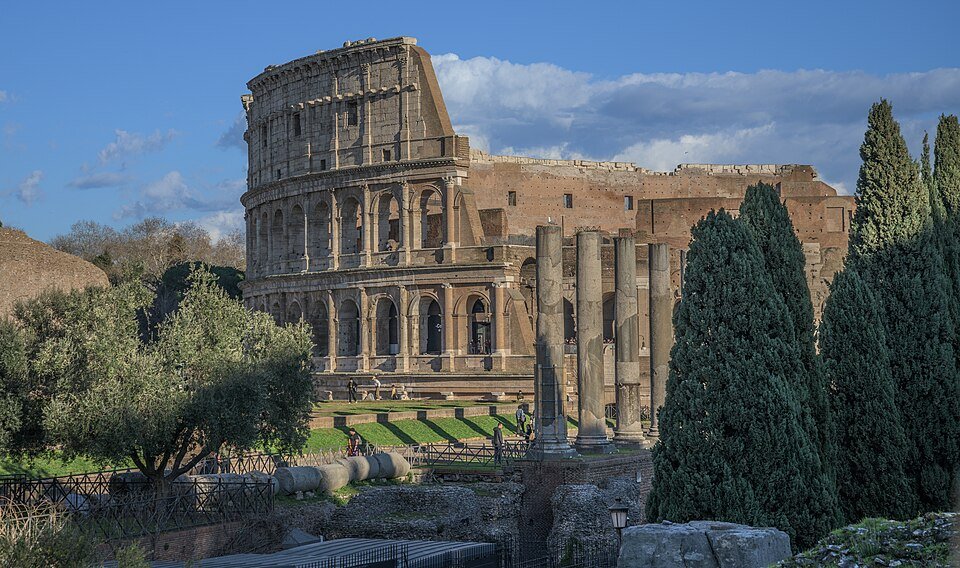
Colosseum Rome Exterior
๐Ÿ“ท Historical Photograph The outer travertine arcades of the Roman Colosseum, displaying the masterly use of concrete and arches. Source: Rome / Wikimedia Commons (Public Domain).

Aqueducts: Harnessing Gravity for High-Volume Water

To support high-density populations in cities like Rome, Carthage, and Ephesus, engineers had to solve the problem of water supply. While local wells and rivers sufficed for small towns, Roman lifestyle demanded huge volumes of water for public baths, fountains, and sewer systems. The solution was the construction of Aqueductsโ€”elevated stone and concrete channels that transported fresh water from mountain springs to city centers, transforming the urban landscape.

The engineering of aqueducts was a lesson in precision. Because pump technology was primitive, water had to flow using gravity alone. This meant the channel had to maintain a continuous, gradual downward slope over distances of up to 90 kilometers. The slope, or gradient, was often as gentle as 1 in 3000 (a drop of just 30 centimeters per kilometer). To achieve this accuracy, engineers used specialized tools:

  • Chorobates: A 6-meter-long wooden table with water channels used to align horizontal levels.
  • Dioptra: A sighting tube with plumb lines used to measure vertical angles and slopes.
  • Groma: A cross-like plumb-line layout tool used to trace straight lines and right angles.

When the aqueduct met a valley, engineers constructed majestic tiers of stone arches to carry the water channel across, maintaining the gradual slope. When valleys were too deep, they utilized a syphon system, using lead pipes to drop the water down and use hydrostatic pressure to push it up the opposite side, showing a deep grasp of fluid dynamics.

Aqua Appia and the Aqueduct System of Rome

The first aqueduct, the Aqua Appia, was built in 312 BCE by the censor Appius Claudius Caecus. By the height of the empire in the 2nd century CE, the city of Rome was fed by 11 major aqueducts delivering over 1 million cubic meters of fresh water daily. This volume is comparable to modern per capita water consumption in major Western cities. Water was directed to a central distribution tower (Castellum Aquae), which split the supply into three networks: public fountains for the general populace, public bath houses, and private villas for wealthy citizens who paid a water tax.

Pantheon Rome interior dome
๐Ÿ“ท Historical Photograph Interior view of the Pantheon dome in Rome (built c. 125 CE), the world's largest unreinforced concrete dome. Source: Rome / Wikimedia Commons (Public Domain).

Urban Sanitation: Hypocausts and Sewers

The massive volume of water brought by the aqueducts fed the Thermaeโ€”monumental public bath houses that served as the social and political hubs of Roman daily life. These complexes required advanced heating systems. Engineers developed the Hypocaust, a central heating system where the floors of hot rooms (Caldarium) were raised on brick pillars (pilae). A wood-burning furnace in the basement sent hot air circulating through this under-floor space and up through hollow clay tiles in the walls, venting out of the roof. This design heated both the room temperature and the water pools simultaneously.

Once used, the water did not go to waste. It flowed into public latrines and flushed through the city's main sewers, such as the Cloaca Maxima in Rome. This continuous flow of water flushed waste directly into the Tiber River, maintaining sanitation standards and reducing waterborne diseases, supporting urban populations that exceeded 1 million people, establishing hygiene levels that would not be replicated until the 19th century.

The Cloaca Maxima: Rome's Great Drain

The Cloaca Maxima ("Greatest Sewer") was originally built in the 6th century BCE as an open canal to drain the marshy valley between the hills of Rome, enabling the construction of the Forum. Under the Republic and Empire, it was covered with massive stone vaults and integrated with the city's public baths and street runoffs. Pliny the Elder described the sewers as a "city beneath a city," noting that they withstood raging floods and heavy cart traffic, standing as a silent monument to Rome's emphasis on public sanitation.

Standardization and Regional Integration

The success of Roman civil engineering lay not just in individual inventions, but in their standardized application across the empire. Whether in York, Timgad, or Damascus, Roman builders used identical layouts for roads, aqueducts, and municipal grids. Scribes in the military administration drafted manuals that cataloged standard building ratios, concrete mixtures, and pipe diameters, allowing local legions to build complex infrastructure without needing specialized architects from the capital.

This physical integration of the provinces fostered a shared urban culture. A provincial citizen entering a bathhouse in North Africa experienced the same heated floors, vaulted architecture, and running water as a citizen in Rome. Engineering became the silent administrator of the Pax Romana, binding diverse cultures to the imperial project through the shared benefits of sanitation, clean water, and civic pride, proving that concrete was as strong a binding force as the legions.

The Vitruvian Math and the Groma Leveling Tool

The precise leveling of Roman aqueducts was achieved using a surveying tool called the Groma and the mathematical principles outlined by the architect Vitruvius. Aqueducts relied on gravity to carry water across miles of rugged terrain; if the slope was too steep, the rushing water would erode the stone channels, but if the slope was too flat, the water would pool and stop. To prevent this, Roman surveyors aimed for a slope of roughly 1 in 5,000โ€”a drop of only 20 centimeters for every kilometer of distance.

To measure this gradient, surveyors used the gromaโ€”a wooden cross with plumb lines hanging from each arm, which allowed them to align straight sightlines. For leveling over long distances, they used the chorobatesโ€”a 6-meter wooden bench with water channels cut into the top to measure horizontal alignment. These simple tools, combined with Vitruvian math, allowed surveyors to plan the routes of aqueducts through mountains and over valleys, constructing the massive stone arches that stand today as monuments of engineering precision, proving that ancient science was built on practical observation and geometry.

The Arch and Vault: Architectural Mechanics

The structural scale of Roman engineering was achieved by mastering the mechanics of the Arch and Vault. Prior to the Roman era, builders relied on the post-and-lintel system, where horizontal stone beams were supported by vertical columns. This system had a critical limitation: stone has poor tensile strength, meaning a horizontal beam will crack under its own weight if it is placed over a wide span. Scribes and Roman architects solved this by using the semicircular arch.

The arch converts the tensile, downward weight of the stones into compressive force, pushing the weight sideways and downward along the arch curve into the massive supporting columns. By lining up multiple arches side-by-side, Roman engineers built massive bridges and aqueducts that could span wide rivers and deep valleys. By spinning the arch in a circle, they built the dome (as seen in the Pantheon), which could span wide halls without columns, demonstrating that mastering compressive mechanics was the key to engineering the Roman Empire.

Conclusion: The Engineering Legacy

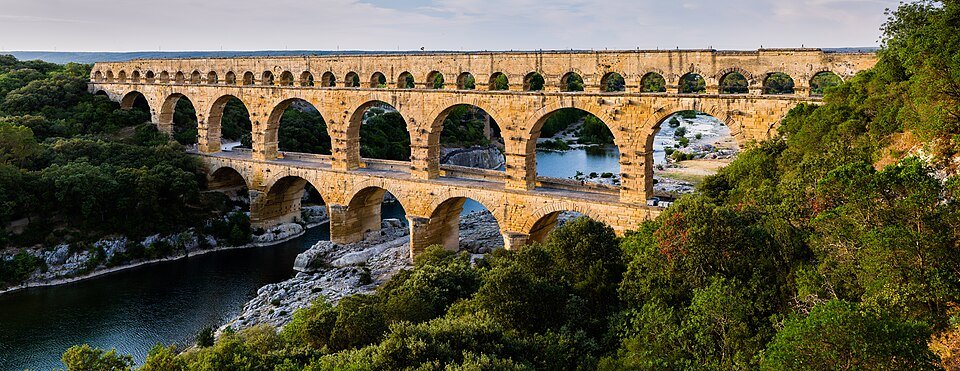
Roman concrete and aqueducts proved that the true strength of an empire lies not in its armies, but in its public works. By engineering solutions to the basic biological needs of water, hygiene, and shelter, Roman builders transformed cities from disease-ridden encampments into centers of culture and administration. The ruins of aqueducts still standing in France (Pont du Gard), Spain (Segovia), and Italy remind us that long after the emperors fell, the masonry, concrete, and hydraulic principles they mastered remain the foundations of modern civil engineering, proof of a legacy carved in stone.

โš–๏ธ

Historian Debate: Was Roman Engineering Scientifically Original?

Empirical Engineering Genius

Proponents argue that Roman concrete (pozzolana), arches, and hydraulic engineering represented massive, original breakthroughs that enabled unprecedented urban density.

Borrowing from Hellenistic Science

Critics argue that Romans were simple pragmatists who applied scientific principles developed by Hellenistic Greeks, without contributing to original scientific theory.

The use of volcanic pozzolana concrete allowed Romans to build permanent underwater structures.

"Concrete is a material that resists the force of the waves, turning into a solid mass of stone that grows stronger with the passage of time."

โ€” Vitruvius, De Architectura (c. 15 BCE).

Further Reading

  • Roman Engineering โ€” by M.J.T. Lewis. An analysis of the surveying tools, waterwheels, and construction methods of Rome.
  • Vitruvius: The Ten Books on Architecture โ€” by Vitruvius. The primary classical source describing Roman engineering and building materials.
โšก Fast Facts
  • Historical EraANCIENT
  • Region๐ŸŒ EUROPE
  • CategoryScience
  • Reading Timeโฑ 8 min read
๐Ÿ“– Scholar Mode Active โ€” Click to exit focused reading
Selected Era

Prehistoric Era

Millions of years ago to ~3000 BCE

The dawn of humanity. From the evolutionary split of early hominids to the mastery of stone tools, fire, and the birth of language.

Landmark Milestones

Welcome to Historia

Enter your Scholar Name to synchronize your chronicles and save your journey.