From prehistoric origins to the modern era—discover the turning points, lost empires, and breakthroughs of world history through interactive timelines and visual guides.
Examine the tangible relics, physical tokens, and revolutionary machines that shaped civilizational growth.
🎥 VIDEO HUB & SHORTS
Watch visual summaries, site intros, and mini-documentaries chronicling 300,000 years of world history.
📊 HISTORICAL INFOGRAPHICS ARCHIVE
Museum-grade visual graphics, civilizational timelines, and architectural breakdowns curated for educators and history lovers.
THE HISTORIA CIRCLE
Join the collective discussion, study logs, and contributions of fellow historians mapping humanity's path.
Historia Forum Discussions
Start a Discussion Thread
THEMATIC PATHWAYS
Trace a single thread — disease, trade, energy, migration — across all eras and civilizations.
History is not just a sequence of events — it is a network of patterns. These thematic pathways allow you to follow a single concept across thousands of years: how agriculture spread, how warfare evolved, how trade routes shaped civilizations. Each pathway collects the most relevant chronicles across all eras.
🧩
How is this different from the sidebar Topics?
While the sidebar Topics (like Science & Tech or Empires) filter articles within your selected historical Era, Thematic Pathways cut horizontally across all eras (from Prehistoric to the Future). Use Themes to trace a single concept's evolutionary line across 300,000 years.
CIVILIZATION HUBS
Comprehensive profiles of the world's greatest civilizations and empires — from ancient cradles to global super-states.
Human Historia provides an academically rich exploration of the world's most influential civilizations. From the monumental achievements of ancient Egypt, Han China, and the Roman Empire, to the sophisticated societies of the Maya, the Islamic Caliphates, and West African empires, these hubs offer deep insights into the cultural, political, and technological legacies that continue to shape our global story.
EVOLUTION OF HUMAN SKILLS
Trace the compounding technologies, practical capabilities, and cognitive milestones of the human species.
Human progress is a story of compounding skills. Every breakthrough, from the spark of prehistoric fire to modern silicon transistors, builds directly on previous generations of ingenuity. Hover over a skill node to trace its historical prerequisites, and click it to explore its development timeline, species-wide impact, and related chronicles.
Prehistoric Ancient Medieval Modern Future
🧠
Select any skill node in the tree to explore its evolutionary path, development timeline, and historical impact.
ACADEMIC PASSPORT
Track your intellectual journey, quiz outcomes, and historical badges of honor.
HISTORIA PASSPORT⏳
👤Scribe Novice
Scholar NameHistoria Explorer
Rank RatingSumerian Record Scribe
Chronicles Read0 / 48
Study Guide Pins0 Guides
Security AccessLevel 1 (Novice)
Earned Badges of Honor
🔥
Fire Keeper
Unlock 3 prehistoric chronicles.
🏛️
Codex Keeper
Unlock 3 ancient chronicles.
🏰
Guild Master
Unlock 3 medieval chronicles.
⚙️
Steam Engineer
Unlock 3 modern chronicles.
🚀
Singularity Sage
Unlock 3 future chronicles.
👑
Grand Scholar
Score 5/5 on the Lab Quiz.
Recent Lab Activities
No recent activities recorded. Take a quiz or bookmark articles!
🏛️ MISSION & ARCHIVAL STANDARDS
About Human Historia
A visual encyclopedia and timeline of human history, dedicated to documenting 300,000 years of civilizational evolution through rigorous research, authentic artifacts, and visual clarity.
🌍
The 300,000-Year Story
Human Historia traces our collective journey across five historical epochs: Prehistory, Ancient Worlds, Middle Ages, Modern Age, and Future Horizons. From the first control of fire to quantum computation, we organize turning points into interconnected timelines.
📜
Historiographical Rigor
Every chronicle is built upon primary historical manifests, contemporary excavation reports, and peer-reviewed historical consensus. We prioritize authentic public domain artifacts and clearly identify scholarly debates surrounding major civilizational transitions.
🎨
Museum-Grade Visuals
Complex historical transitions demand visual understanding. We develop high-resolution infographics, architectural cutaways, and comparative territorial maps to transform abstract timelines into vivid, unforgettable learning experiences.
📖
Educational Access
Knowledge belongs to humanity. Human Historia is free, ad-light, and engineered as an educational resource for students, classroom educators, academic researchers, and curious minds across all continents.
Editorial Governance & Inquiries
We welcome peer reviews, academic corrections, museum archival collaborations, and educational partnerships. To submit historical inquiries or provide archival feedback, reach our editorial desk directly.
An immersive graphical anthology tracing the paths of civilizations, breakthroughs, and conflicts that forged the modern consciousness.
25Chronicles
Showing all articles
The Fall of Constantinople 1453: How Mehmed II's Cannons Ended the Middle Ages
Written by Humanhistoria EditorialHistorical Era: MEDIEVAL
In the early morning darkness of May 29, 1453, the roar of sixty-nine massive bronze bombards reverberated across the Bosporus, shattering the ancient stone ramparts that had shielded the Roman world for over a millennium. The Fall of Constantinople to the Ottoman armies of Sultan Mehmed II was not merely the tactical conclusion of a fifty-three-day siege; it was an epochal watershed that formally extinguished the 1,123-year-old Byzantine Empire, dismantled the last institutional vestige of classical Rome, and sent profound shockwaves across Afro-Eurasia. As the double Theodosian Walls crumbled under gunpowder artillery, the medieval world collapsed with them, igniting the intellectual fire of the European Renaissance and forcing seafaring kingdoms to look westward across the uncharted Atlantic.
🎯 Quick Historical Summary
How Did the Fall of Constantinople in 1453 Change World History?
On May 29, 1453, Ottoman Sultan Mehmed II breached Constantinople's Theodosian Walls using massive bronze cannons and overland war galleys, ending the Byzantine Empire. The Ottoman control over eastern trade routes forced European powers to seek maritime ocean passages, directly launching the Age of Discovery.
Contemporary manuscript illumination of the 1453 Siege of Constantinople from Bertrandon de la Broquière's 'Voyage d'outremer' (c. 1455), showing Ottoman siege encampments and the boom chain guarding the Golden Horn. (Bibliothèque nationale de France, Paris, MS Français 9087, fol. 207v)
The Dying Empire: Constantinople on the Eve of 1453
By the spring of 1453, the once-colossal Eastern Roman (Byzantine) Empire had shrunk to a pathetic ghost of its imperial past. Centuries of civil wars, the devastating sack by Fourth Crusade Western crusaders in 1204, and the demographic devastation of the Black Death had hollowed out the imperial capital. Constantinople, which during the 10th century under the Macedonian emperors boasted over 500,000 residents, was reduced to an isolated urban archipelago of approximately 50,000 citizens scattered among decaying palaces, abandoned monasteries, and overgrown vegetable gardens.
The city's territories were entirely encircled by the expanding Ottoman state. Outside the fifth-century Theodosian Walls, Ottoman territory stretched across the Balkans to the Danube and eastward across the Anatolian plateau. The eighty-seventh Roman emperor, Constantine XI Palaiologos, ruled over little more than the city itself, the Peloponnesian despotate of the Morea, and a handful of Aegean islands. To maintain a desperate defense, Constantine XI could rally only 7,000 to 8,000 fighting men—approximately 5,000 native Greeks and 2,000 foreign mercenaries, primarily Genoese, Venetian, and Spanish soldiers led by the renowned defensive fortifications engineer Giovanni Giustiniani Longo.
Opposing them was the twenty-one-year-old Ottoman sovereign Sultan Mehmed II. Highly educated, multilingual, and relentlessly ambitious, Mehmed was determined to fulfill the historic Islamic prophecy regarding the conquest of the Roman capital (Kostantiniyye). Mehmed mobilized an imperial host numbering between 80,000 and 100,000 soldiers, including 10,000 to 15,000 elite Janissary shock troops, thousands of Sipahi heavy cavalry, Christian vassal contingents from Serbia, and a formidable fleet of over 120 war galleys and transport vessels.
The Great Dardanelles Gun, a colossal 16.8-ton bronze bombard cast in 1464 by Ottoman foundry master Munir Ali based on Orban's 1453 siege cannons, capable of firing 1,200-pound stone projectiles. (Royal Armouries, Fort Nelson, Hampshire)
Gunpowder Revolution: Orban's Super-Cannons and the 53-Day Siege
The military defining feature of the 1453 siege was the decisive application of super-heavy siege artillery. For nearly a thousand years, the triple-tier Theodosian Walls—consisting of a 60-foot-wide moat, an outer breastwork, an outer wall with 96 towers, and a massive 40-foot-high inner wall—had repelled twenty-two foreign sieges, from Avar and Persian armies to the Umayyad Arab sieges of 674 and 717 CE.
Recognizing that conventional siege engines could never pierce these limestone barriers, Mehmed commissioned Orban, an eccentric Hungarian iron founder who had previously offered his services to Constantine XI. When the cash-strapped Byzantine court proved unable to pay Orban's exorbitant fee or provide the necessary bronze casting materials, Orban defected to the Ottoman court at Edirne. Asked by Mehmed whether he could cast a cannon capable of breaching the walls of Babylon itself, Orban replied: "I can cast a gun in bronze that will reduce any stone wall on earth to powdered dust."
Orban cast the legendary Basilic (the "Imperial Gun")—a monster measuring 27 feet in length, with an eight-inch-thick bronze barrel and a thirty-inch bore capable of firing 1,200-pound granite balls up to a distance of one mile. It required a team of sixty oxen and two hundred men to transport it across Thrace. When the siege formally commenced on April 6, 1453, Mehmed arrayed sixty-nine siege cannons into fourteen batteries, maintaining an unceasing bombardment along the vulnerable Lycus river valley sector.
Overland Fleets and the Battle for the Golden Horn
While the Ottoman artillery battered the land walls, Constantinople's northern maritime flank along the Golden Horn remained impregnable, sealed behind a massive iron boom chain suspended from wooden floats stretching between Galata and the city. On April 20, four Christian relief galleys (three Genoese vessels chartered by the Papacy and an imperial Byzantine grain transport) fought their way through the entire Ottoman naval blockade in an astonishing demonstration of seamanship, anchoring safely behind the boom chain.
Furious at the naval humiliation, Mehmed executed one of the most audacious logistical maneuvers in military history. On the night of April 21–22, thousands of Ottoman engineers built a roadway of smoothed timber logs greased with animal tallow running from the Bosporus up the steep hills behind Pera and down into the upper Golden Horn. Over this road, over seventy Ottoman war galleys were hauled overland by oxen and teams of soldiers, complete with unfurled sails and playing flutes. By dawn, the stunned Byzantine defenders awoke to find an Ottoman fleet operating directly inside their harbor, forcing Constantine to strip troops from the battered land walls to defend the harbor perimeter.
The Final Assault: May 29, 1453
By late May, diplomatic overtures had failed; Constantine XI refused to surrender the city, replying to Mehmed's envoys: "To surrender the city to you is beyond my authority or that of anyone who lives in it; for by mutual consensus we have all decided to die by our own free will, without sparing our lives."
On the evening of May 28, the religious divisions that had poisoned relations between the Greek Orthodox and Roman Catholic churches dissolved in the face of annihilation. Inside the magnificent cathedral of Hagia Sophia, Orthodox priests and Latin cardinals concelebrated the Divine Liturgy together, offering communion to Genoese crossbowmen, Venetian merchants, and Byzantine nobility in an atmosphere of solemn lamentation.
At 1:30 AM on May 29, Mehmed launched the general assault in three relentless waves. The first wave of irregular bashi-bazouks was repulsed with terrible slaughter. The second wave of armored Anatolian infantry pressed into the breach at the St. Romanus gate but was held at bay by Giustiniani's veteran mercenaries. Finally, at dawn, Mehmed unleashed his personal guard: 12,000 pristine Janissaries marching in perfect discipline behind the clashing cymbals and horns of the mehter military band.
The turning point came when Giustiniani Longo was mortally wounded by a crossbow bolt or culverin ball that pierced his breastplate. As the bleeding Genoese commander was carried to a waiting galley for evacuation, panic tore through the Italian defenders, who believed the line was broken. Simultaneously, Ottoman skirmishers discovered that a small postern gate in the Blachernae sector, the Kerkoporta, had been left accidentally unbolted after a nighttime counter-sortie. Janissaries swarmed through the portal, raising the horse-tail banners of the Sultan upon the outer battlements. Tearing off his imperial purple mantle so that his body could not be distinguished from his fallen men, Emperor Constantine XI Palaiologos drew his sword and plunged into the melee, dying alongside his final guards.
Strategic Metric
Byzantine Defensive Coalition
Ottoman Imperial Siege Army
Commander-in-Chief
Emperor Constantine XI Palaiologos & Giovanni Giustiniani Longo
Sultan Mehmed II ("The Conqueror")
Total Combat Strength
~7,000–8,000 men (5,000 Greeks, 2,000 Italian mercenaries)
"On the twenty-ninth of May, 1453, the sun rose upon the end of an empire. The Sultan divided his army into three divisions, and the Janissaries came forward like wild beasts... Our men resisted bravely with pikes and stones, but when Giovanni Giustiniani was wounded and carried away, all courage abandoned the defenders. The Turks poured through the breach at the gate of Saint Romanus, and the slaughter was beyond all tears."
— Nicolò Barbaro, Venetian eye-witness and ship's surgeon, Giornale dell'assedio di Costantinopoli (Biblioteca Marciana, Venice)
World Historical Impact: The Renaissance and the Age of Exploration
The capture of Constantinople altered the geopolitical trajectory of the world in two monumental ways:
1. Flight of Greek Learning to Italy and the Renaissance Boom
In the decades preceding and immediately following 1453, a massive intellectual migration of Byzantine scholars, scribes, and churchmen fled the collapsing empire for the merchant republics of Italy—chiefly Venice, Padua, and Florence. Intellectual giants like Cardinal Bessarion, Gemistos Pletho, and John Argyropoulos carried with them thousands of original classical Greek manuscripts that had been lost to Western Europe for eight centuries, including the complete dialogues of Plato, Aristotle's ethical treatises, Homeric epics, and Euclid's mathematical theorems.
Under the patronage of Cosimo de' Medici in Florence, these texts stimulated the revival of Hellenic philosophy, the founding of the Platonic Academy, and the birth of Renaissance civic humanism. Byzantine scribes taught Greek grammar to Italian humanists, sparking the philological revolution that culminated in Erasmus' critical New Testament and Galileo's scientific breakthroughs.
2. The Chokehold on Eastern Spices and the Atlantic Age of Discovery
With the Ottoman Empire establishing an absolute customs monopoly over the Bosporus and the Black Sea, and subsequently conquering Mamluk Egypt and Syria in 1516–1517, Western European merchants faced astronomical tariffs on Levant silk, pepper, cinnamon, and nutmeg routes. Italian maritime powers like Venice were forced to pay ruinous trade concessions.
This economic reality compelled Atlantic-facing European monarchies—first Portugal under Prince Henry the Navigator and King John II, and subsequently Spain under Isabella and Ferdinand—to finance daring ocean voyages to bypass the Muslim-controlled land routes. In 1492, Christopher Columbus sailed west across the Atlantic in search of an Asian spice route, while in 1497–1498, Vasco da Gama rounded the Cape of Good Hope, opening the direct maritime sea route to India. The guns of Mehmed II had severed the old Eurasian overland highways, directly inaugurating the global maritime era.
Archival Fact: The Transformation of Hagia Sophia
Upon entering the conquered city on the afternoon of May 29, Mehmed II rode directly to Hagia Sophia. Forbidding his troops from looting the sacred structure, the Sultan climbed the marble altar, dusted his forehead with earth in an act of Islamic humility, and ordered the magnificent Byzantine basilica converted into an imperial mosque. The Byzantine gold mosaics were covered with white plaster, preserving them intact for nearly five centuries until American archaeologist Thomas Whittemore restored them in the 1930s under Mustafa Kemal Atatürk.
⚖️
Historian Debate: The Fall as a Cataclysm vs. Administrative Continuity
Cataclysm & Clash of Civilizations
Traditional Western European historiography (from Edward Gibbon to Steven Runciman) portrays 1453 as an unmitigated civilizational tragedy—the extinction of classical Greco-Roman liberty by Oriental despotism, marked by three days of looting, enslavement of 30,000 citizens, and destruction of priceless library codices.
Administrative Synthesis & Roman Renewal
Modern Ottomanist historians like Halil İnalcık and Franz Babinger emphasize that Mehmed II viewed himself not as the destroyer of Rome, but as its legitimate heir (Kayser-i Rûm, Caesar of Rome). Mehmed repopulated the desolate city with Greek, Armenian, and Jewish merchants, appointed a Greek Orthodox Patriarch (Gennadios Scholarios) with broad civic jurisdiction, and synthesized Byzantine court protocol with Ottoman administrative statecraft.
Contemporary scholarship views 1453 as the decisive catalyst that transitioned the late medieval Mediterranean world into the early modern global network.
Long-Term Legacy: From Rome to Istanbul
The fall of the city marked the definitive transfer of imperial power in Southeastern Europe. Renamed informally by its inhabitants as Istanbul (derived from the Greek phrase eis tḕn pólin, "into the city"), the metropolis was rebuilt over the next century by Ottoman architects like Mimar Sinan into the radiant multi-ethnic capital of an empire that spanned three continents.
The military lessons of May 29, 1453, were studied by every European general for the next two centuries. High, vertical stone battlements became obsolete overnight; military engineers rushed to design low-profile, angled star-forts (trace italienne) backed with earthen ramparts capable of absorbing artillery impact. The modern gunpowder state was born in the smoke of Constantinople's shattered gates.
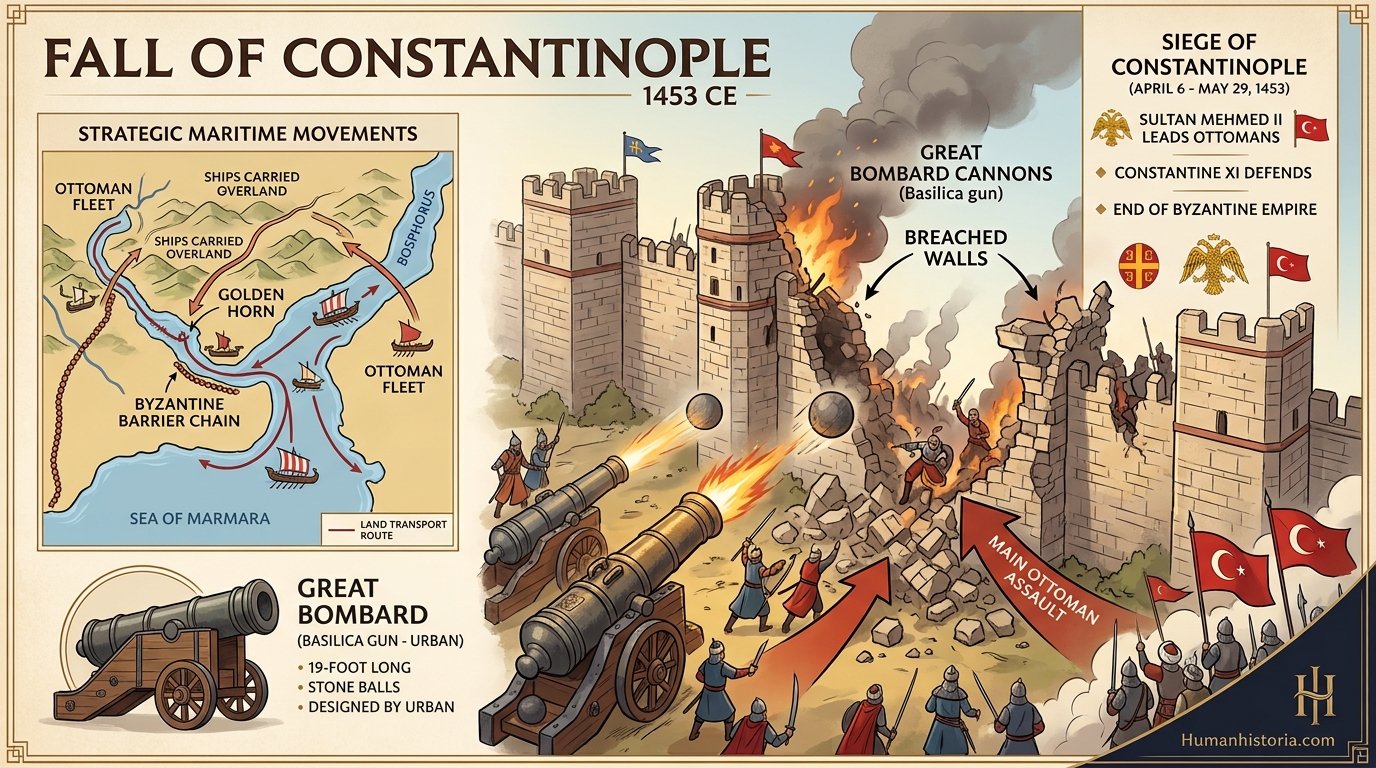
📊 Museum-Grade Infographic Poster
The Fall of Constantinople (1453) Infographic
💡 Click anywhere on poster to expand in high resolution🔎 Expand Lightbox
Explore the history of The Fall of Constantinople (1453) Infographic: milestones, society, cultural legacy, and artifacts. Read the full illustrated.'s transport of galleys overland, Ottoman basilic cannons, and Hagia Sophia alignments.
📖 SCHOLARLY INQUIRIES
Frequently Asked Questions
Essential historical questions and evidence-based answers concerning this chronicle.
Q.Why is The Fall of Constantinople 1453 significant in world history?
The Fall of Constantinople 1453 played a pivotal role by transforming technology, social structure, and regional connection, serving as a vital link in human civilization.
Q.What was the main historical impact of The Fall of Constantinople 1453?
It fundamentally reshaped trade networks, military statecraft, and legal institutions across the globe.
Q.Why is The Fall of Constantinople 1453 significant today?
It established foundational precedents for modern international law, financial markets, and sovereign governance.
Q.What primary sources document this chronicle?
Contemporary manuscript registries, royal charters, and state ledgers preserve detailed records of these events.
📖 Scholar Mode Active — Click to exit focused reading
History Lab 🧪
Interactive historical deduction games, tactical matchup simulators, and currency calculators.
🕵️ Who Am I? (The Historical Guess Game)
A secret historical figure has been selected. Ask yes/no questions to narrow down the pool of candidates. Click any active card to make your accusation!
Secret Identity
❓ Who Am I?
Ask questions using the board below to narrow down my identity.
Ask a Question:
Question LogQuestions: 0 / 7
No questions asked yet.
Candidate Board:
🗺️ Timeline Scramble
Five historical events appear out of order. Click them in the correct chronological sequence — from oldest to most recent. How well do you know your history?
🏺 Relic or Fake?
Is this a real historical artifact or a convincing fabrication? Judge each one based on its description and era — then see the truth revealed!
Artifact 1 / 10Score: 0
Empire Matchup Simulator
Empire ATerritory Size (Peak, M km²)Empire B
00
Empire APopulation (Peak, Millions)Empire B
00
Empire AMilitary Power (Army Size)Empire B
00
Tactical Battle Analysis
Select empires and click simulate to run evaluations.
Historical Purchasing Power Converter
See what ancient coins are worth in modern terms and check their historical purchasing power.
Modern Value Equivalent
$0.00 USD
Historical Purchasing Power:
Select currency to view purchasing capability.
Historical Identity Generator
Forge an authentic historical identity from ancient civilisations, complete with linguistic meaning and biography.
Neutral
Gaius Julius
Meaning:Descendant of Jupiter
Historical Background:
A Roman citizen and clerk who worked in the forum under Roman republic rule.
Chrono-Cultural Fusion Simulator
Fuse the culture, technology, and governance of two legendary civilizations to synthesize a unique hybrid society.
Cohesion & Coexistence Rate
85%
🏛️ Hybrid Architecture
⚙️ Synthesized Asset
📜 Synthetic Governance
Historical Tactics & Trivia Quiz
Test your historical knowledge and battle tactics to claim your administrative rank.
8 Questions • Multi-Era
You will be presented with random scenarios and trivia spanning ancient Egypt, classical Rome, Islamic Golden Age, and the modern industrial era. Complete the evaluation to see your historical title!
Question 1 of 8Score: 0
What was the Code of Hammurabi written on?
Correct!
Evaluation Complete!
6 / 8
Correct
Rank Attained
Imperial Legionary
Your knowledge of classical strategy and administrative structures is respectable.
🎲 Counterfactual "What If?" Scenario Simulator
Explore alternative historical trajectories by tweaking key civilizational pivot points.
Simulated Shift
Selected Era
Prehistoric Era
Millions of years ago to ~3000 BCE
The dawn of humanity. From the evolutionary split of early hominids to the mastery of stone tools, fire, and the birth of language.
Landmark Milestones
Welcome to Historia
Enter your Scholar Name to synchronize your chronicles and save your journey.

 ⭐ Featured Chronicle

 ANCIENT AGES
 ANCIENT AGES
 ANCIENT AGES
 MEDIEVAL PERIOD
 MEDIEVAL PERIOD
 PREHISTORIC ERA