From prehistoric origins to the modern era—discover the turning points, lost empires, and breakthroughs of world history through interactive timelines and visual guides.
Examine the tangible relics, physical tokens, and revolutionary machines that shaped civilizational growth.
🎥 VIDEO HUB & SHORTS
Watch visual summaries, site intros, and mini-documentaries chronicling 300,000 years of world history.
📊 HISTORICAL INFOGRAPHICS ARCHIVE
Museum-grade visual graphics, civilizational timelines, and architectural breakdowns curated for educators and history lovers.
THE HISTORIA CIRCLE
Join the collective discussion, study logs, and contributions of fellow historians mapping humanity's path.
Historia Forum Discussions
Start a Discussion Thread
THEMATIC PATHWAYS
Trace a single thread — disease, trade, energy, migration — across all eras and civilizations.
History is not just a sequence of events — it is a network of patterns. These thematic pathways allow you to follow a single concept across thousands of years: how agriculture spread, how warfare evolved, how trade routes shaped civilizations. Each pathway collects the most relevant chronicles across all eras.
🧩
How is this different from the sidebar Topics?
While the sidebar Topics (like Science & Tech or Empires) filter articles within your selected historical Era, Thematic Pathways cut horizontally across all eras (from Prehistoric to the Future). Use Themes to trace a single concept's evolutionary line across 300,000 years.
CIVILIZATION HUBS
Comprehensive profiles of the world's greatest civilizations and empires — from ancient cradles to global super-states.
Human Historia provides an academically rich exploration of the world's most influential civilizations. From the monumental achievements of ancient Egypt, Han China, and the Roman Empire, to the sophisticated societies of the Maya, the Islamic Caliphates, and West African empires, these hubs offer deep insights into the cultural, political, and technological legacies that continue to shape our global story.
EVOLUTION OF HUMAN SKILLS
Trace the compounding technologies, practical capabilities, and cognitive milestones of the human species.
Human progress is a story of compounding skills. Every breakthrough, from the spark of prehistoric fire to modern silicon transistors, builds directly on previous generations of ingenuity. Hover over a skill node to trace its historical prerequisites, and click it to explore its development timeline, species-wide impact, and related chronicles.
Prehistoric Ancient Medieval Modern Future
🧠
Select any skill node in the tree to explore its evolutionary path, development timeline, and historical impact.
ACADEMIC PASSPORT
Track your intellectual journey, quiz outcomes, and historical badges of honor.
HISTORIA PASSPORT⏳
👤Scribe Novice
Scholar NameHistoria Explorer
Rank RatingSumerian Record Scribe
Chronicles Read0 / 48
Study Guide Pins0 Guides
Security AccessLevel 1 (Novice)
Earned Badges of Honor
🔥
Fire Keeper
Unlock 3 prehistoric chronicles.
🏛️
Codex Keeper
Unlock 3 ancient chronicles.
🏰
Guild Master
Unlock 3 medieval chronicles.
⚙️
Steam Engineer
Unlock 3 modern chronicles.
🚀
Singularity Sage
Unlock 3 future chronicles.
👑
Grand Scholar
Score 5/5 on the Lab Quiz.
Recent Lab Activities
No recent activities recorded. Take a quiz or bookmark articles!
🏛️ MISSION & ARCHIVAL STANDARDS
About Human Historia
A visual encyclopedia and timeline of human history, dedicated to documenting 300,000 years of civilizational evolution through rigorous research, authentic artifacts, and visual clarity.
🌍
The 300,000-Year Story
Human Historia traces our collective journey across five historical epochs: Prehistory, Ancient Worlds, Middle Ages, Modern Age, and Future Horizons. From the first control of fire to quantum computation, we organize turning points into interconnected timelines.
📜
Historiographical Rigor
Every chronicle is built upon primary historical manifests, contemporary excavation reports, and peer-reviewed historical consensus. We prioritize authentic public domain artifacts and clearly identify scholarly debates surrounding major civilizational transitions.
🎨
Museum-Grade Visuals
Complex historical transitions demand visual understanding. We develop high-resolution infographics, architectural cutaways, and comparative territorial maps to transform abstract timelines into vivid, unforgettable learning experiences.
📖
Educational Access
Knowledge belongs to humanity. Human Historia is free, ad-light, and engineered as an educational resource for students, classroom educators, academic researchers, and curious minds across all continents.
Editorial Governance & Inquiries
We welcome peer reviews, academic corrections, museum archival collaborations, and educational partnerships. To submit historical inquiries or provide archival feedback, reach our editorial desk directly.
An immersive graphical anthology tracing the paths of civilizations, breakthroughs, and conflicts that forged the modern consciousness.
25Chronicles
Showing all articles
Qin Shi Huang & The Terracotta Army: How China's First Emperor Unified an Empire
Written by Humanhistoria EditorialHistorical Era: ANCIENT
In 221 BCE, after more than two centuries of unceasing, mechanized carnage during the Warring States period, the ruthless King Zheng of Qin crushed the last of his six royal rivals, brought an entire subcontinent under a single sovereign will, and proclaimed himself Qin Shi Huangdi—the "First August Thearch" of China. In a breathtakingly brutal decade of total administrative mobilization, the First Emperor dismantled eight centuries of Zhou feudalism, laid the institutional bedrock of the Chinese bureaucratic state, and standardized the scripts, weights, and laws that unified over fifty million people. Yet beneath the manic surface of his monumental road projects and defensive walls lay an all-consuming dread of mortality. In the shadows of Mount Li, over 700,000 conscripted laborers constructed a colossal subterranean necropolis guarded by an army of more than 8,000 life-sized Terracotta Warriors, armed with lethal bronze weapons and arranged in tactical battle formations to defend their divine emperor across eternity.
🎯 Quick Historical Summary
Why Did Qin Shi Huang Build the Terracotta Army and Unify China?
Qin Shi Huang unified China in 221 BCE by conquering six rival Warring States through Legalist administrative and military mobilization. To safeguard his underground mausoleum at Mount Li and command an empire in the afterlife, he commissioned over 8,000 individualized terracotta soldiers, archers, and bronze chariots.
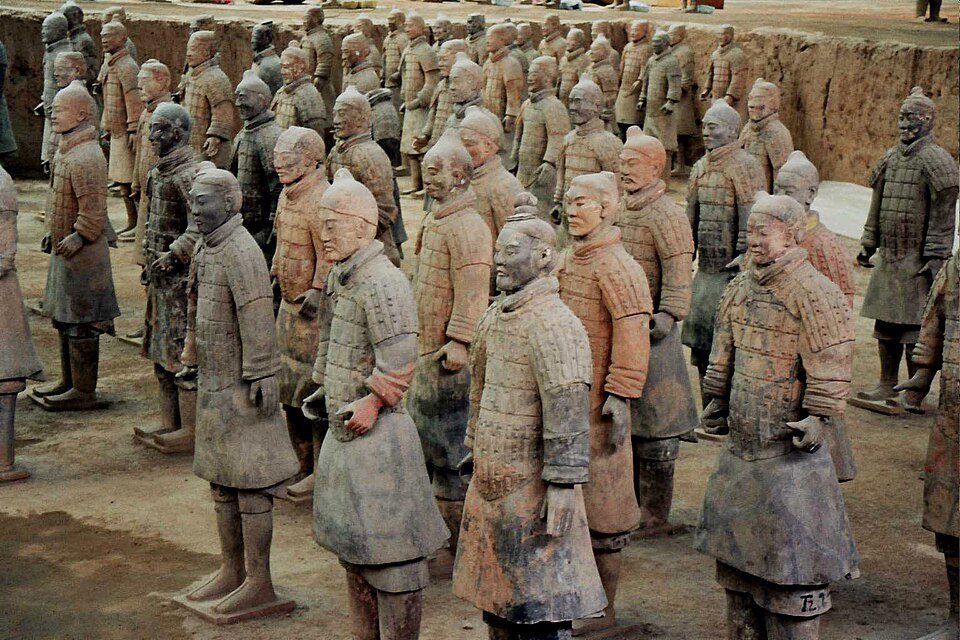
Vanguard infantry ranks of the Terracotta Army standing in battle formation within Pit 1 of the Emperor Qin Shi Huang Mausoleum Site Museum in Lintong, Xi'an, Shaanxi Province. (Mausoleum of Qin Shi Huang Museum)
The Crucible of the Warring States: Shang Yang's Legalist Machine
To comprehend Qin's sudden ascent from an uncouth, semi-barbaric frontier duchy into an unstoppable imperial juggernaut, one must examine the transformative reforms enacted a century earlier. During the Warring States period (475–221 BCE), the ancient Zhou feudal order fractured into seven major kingdoms—Qin, Chu, Qi, Yan, Han, Zhao, and Wei—locked in total, industrial-scale warfare. Armies swelled from small aristocratic chariot retinues to massive conscript infantries numbering upwards of 500,000 men armed with mass-produced cast-iron swords and high-velocity bronze crossbows.
In 356 BCE, Duke Xiao of Qin appointed the visionary statesman Shang Yang, a radical disciple of the philosophical school of Legalism (Fajia). Rejecting Confucian ideals of moral benevolence and filial etiquette, Shang Yang argued that the survival of the state depended solely on two pillars: agriculture (nong) and warfare (zhan). Shang Yang executed a ruthless restructuring of Qin society:
Abolition of Hereditary Aristocracy: Aristocratic titles were stripped of political power; social status and state stipends were allocated strictly according to military merit, measured by the verified number of severed enemy heads brought back from the battlefield.
Universal Mutual Responsibility (Baojia): The entire population was organized into units of five and ten households. If one person committed a crime, the remaining members were legally bound to denounce them; failure to do so resulted in the entire group being cut in two at the waist.
Agrarian Totalitarianism: Commerce and intellectual debate were suppressed as parasitic; farmers who produced surplus grain were rewarded with tax exemptions, while those who fell into debt through laziness were enslaved by the state.
When the thirteen-year-old King Zheng ascended the throne of Qin in 246 BCE, he inherited the most efficient military-agrarian machine in the ancient world. Guided by his brilliant Legalist Chancellor Li Si, King Zheng systematically deployed vast armies, bribery, and targeted assassinations to dismantle the rival states one by one: Han fell in 230 BCE, Zhao in 228, Wei in 225, the colossal southern kingdom of Chu in 223, Yan in 222, and finally Qi in 221 BCE. For the first time in history, "All Under Heaven" (Tianxia) was unified under a single emperor.
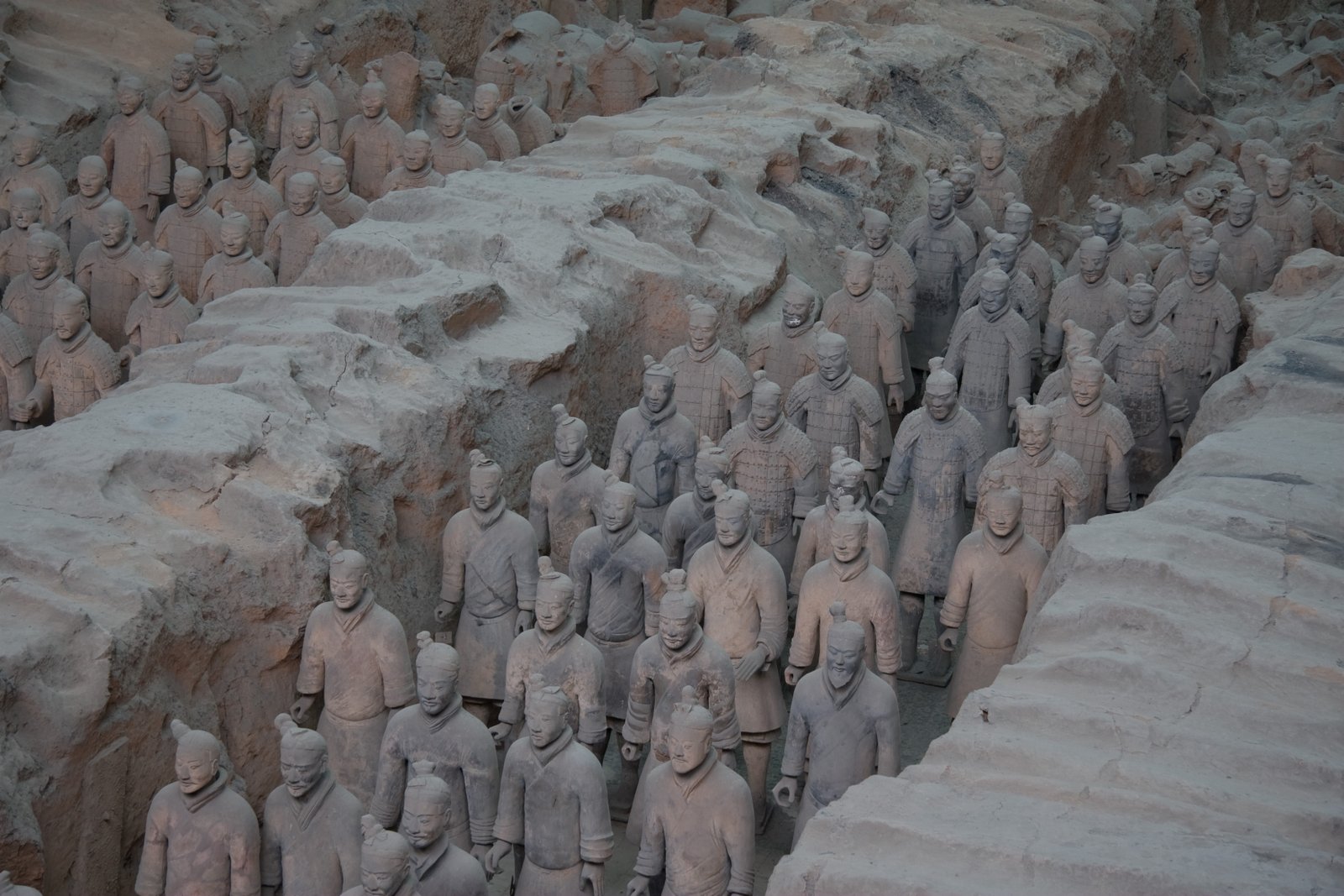
Archaeological excavation trenches inside Pit 1 at Lintong, revealing hundreds of life-sized terracotta infantrymen and officers in restorative conservation. (Mausoleum of Qin Shi Huang Museum, Xi'an)
The Imperial Blueprint: Universal Standardization and the Great Wall
Refusing to divide the conquered territories among royal princes—a practice that had caused the bloody disintegration of the Zhou dynasty—Qin Shi Huang and Li Si abolished feudal fiefdoms entirely. They divided the empire into thirty-six centralized administrative commanderies (jun), each governed by a civil governor (shou), a military commander (wei), and an imperial inspector (jian) reporting directly to the throne.
To permanently bind these diverse regional cultures into a unified civilization, the First Emperor enacted four sweeping standardized systems that defined Chinese statecraft for the next two millennia:
1. Standardization of the Written Script (Xiaozhuan)
Prior to 221 BCE, each Warring State had developed its own regional variant of Chinese characters, creating severe administrative and legal confusion. Li Si promulgated the Small Seal Script (Xiaozhuan), an elegant, standardized logographic script enforced across all government offices, legal decrees, and literary records. This linguistic reform ensured that while spoken dialects varied widely across northern plains and southern river valleys, educated elites across thousands of miles could read the exact same administrative texts—creating an enduring cultural glue that preserved Chinese unity across dynasties.
2. Economic Standardization: Weights, Measures, and Ban Liang Coins
Qin abolished the chaotic assortment of regional currencies—knife-shaped bronze coins of Qi, spade money of Zhao, and gold blocks of Chu—replacing them with a single national currency: the circular bronze Ban Liang coin, featuring a square hole in the center symbolizing the earth enclosed by the circular dome of heaven. Standardized bronze measuring cups, balances, and iron weights bearing official imperial seals were distributed to every market official across the empire.
3. Infrastructure: The Imperial Highway and Cart Axles
Qin engineers constructed over 4,200 miles of paved imperial highways (Chidao), including the famous 500-mile "Straight Road" connecting the capital Xianyang to the northern frontier. Crucially, the emperor mandated the standardization of cart wheel axle widths (six Chinese feet). Because heavy carts gouged deep parallel ruts into the soft loess soil of northern China, carts with non-standard axle widths could not travel on Qin roads; standardizing axle widths allowed wagons, troop convoys, and grain carts to travel without delay from the capital to the border outposts.
4. The Early Great Wall and the Lingqu Canal
To protect the agrarian heartland from the fast-moving nomadic horse archers of the Xiongnu confederation, Qin Shi Huang dispatched General Meng Tian with 300,000 troops to the northern steppe. Meng Tian connected and expanded earlier defensive earth walls into the first continuous Great Wall of China, stretching over 3,000 miles from Lintao in modern Gansu to the Liaodong peninsula. In the south, Qin engineers dug the breathtaking 22-mile Lingqu Canal in Guangxi, linking the Xiang River (Yangtze basin) with the Li River (Pearl River basin), allowing military barges to float provisions directly into southern China.
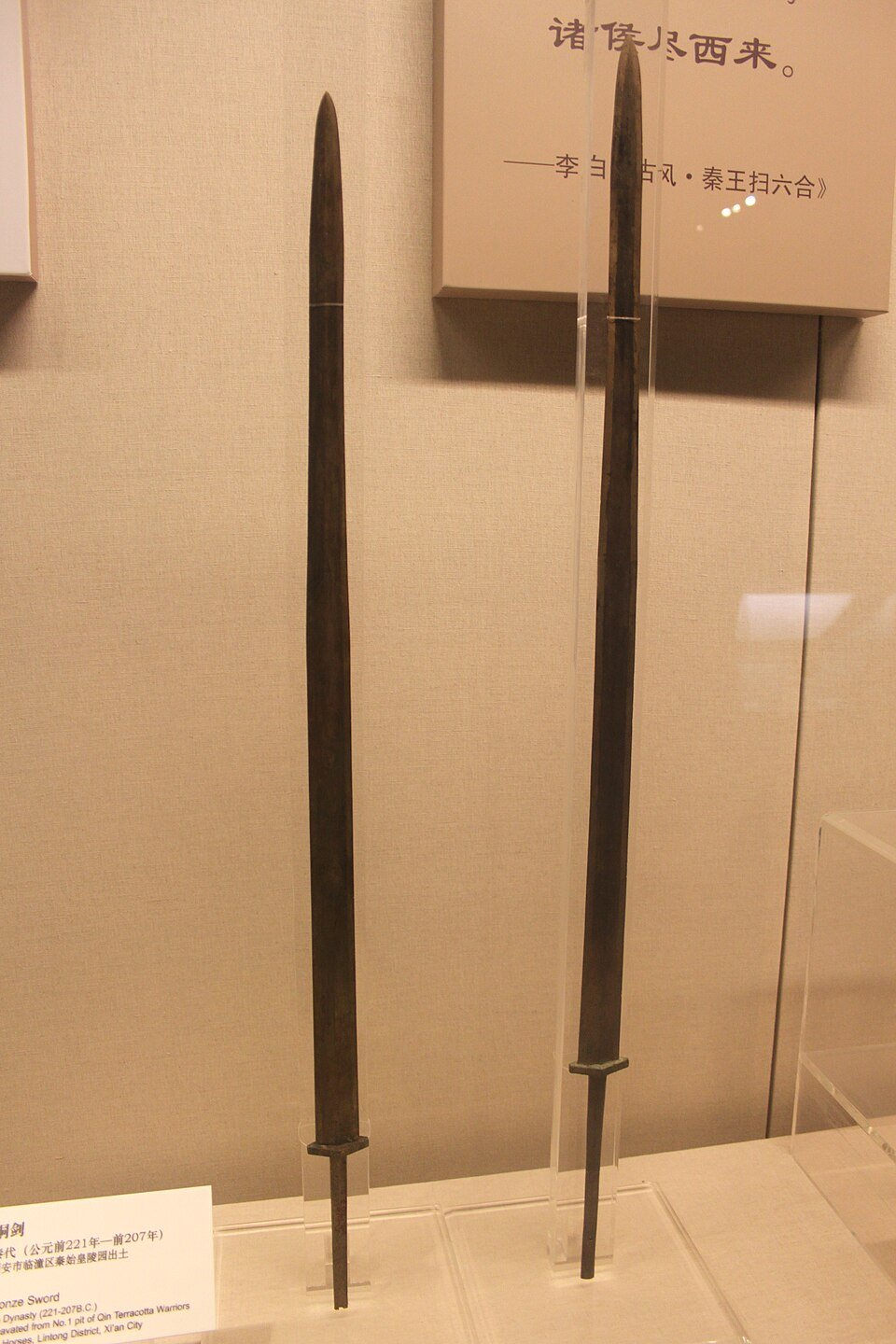
Two-and-a-half-foot bronze swords with chromium-plated anti-corrosion surfaces, excavated from Pit 1 of the Qin Terracotta Army, demonstrating advanced metallurgy (c. 221–207 BCE). (Mausoleum of Qin Shi Huang Museum, Xi'an)
The Mount Li Necropolis: The 8,000-Man Subterranean Army
Despite his absolute power, Qin Shi Huang was haunted by the prospect of death. In his later years, he dispatched expedition fleets under alchemist Xu Fu across the Eastern Sea in search of the mythical elixir of immortality, while consuming lethal doses of mercury concoctions prepared by court Daoist sorcerers who promised eternal life. Ironically, the toxic heavy metals accelerated his physical degeneration and mental paranoia.
Convinced that he would continue to rule his empire in the spirit world, the emperor began building his colossal mausoleum at the base of Mount Li immediately upon ascending the throne in 246 BCE. According to the Han dynasty historian Sima Qian in his Records of the Grand Historian (Shiji), the subterranean tomb was an astonishing microcosm of the universe:
"The laborers dug through three subterranean watercourses and poured molten copper to secure the outer coffin. Palaces and scenic towers for a hundred officials were constructed, and the tomb was filled with rare artifacts and wonderful treasures. Artisans were ordered to construct mechanical crossbows triggered to shoot anyone who entered. The hundred rivers, the Yangtze, the Yellow River, and the great sea were simulated using mechanically pumped flowing mercury, with the heavenly constellations depicted above on the copper ceiling and the geography of the earth below."
— Sima Qian, Records of the Grand Historian (Shiji), Chapter 6: The Basic Annals of Qin Shi Huang (National Palace Museum, Taipei)
On March 29, 1974, during a severe drought in Lintong County near Xi'an, six local farmers digging a water well struck hard terracotta fragments and bronze arrowheads. Archaeological excavations by the Chinese Academy of Social Sciences revealed three massive subterranean pits containing more than 8,000 life-sized terracotta soldiers, 130 war chariots with 520 horses, and 150 cavalry steeds—stationed in battle-ready array approximately one mile east of the emperor's unexcavated burial mound to guard against the vengeful spirits of the conquered Warring States.
The terracotta figures were crafted through sophisticated modular assembly: artisans molded legs from solid clay for weight and stability, attached hollow torso cylinders, and hand-sculpted ears, noses, and hairstyles onto standardized head molds. Remarkably, no two faces among the 8,000 warriors are identical, reflecting the multi-ethnic diversity of Qin's conscripted armies—from fierce bearded northern cavalrymen to youthful southern infantry. Originally, each warrior was painted in vibrant purple, green, red, and blue mineral lacquers and equipped with actual, fully functional bronze weapons: three-bladed arrowheads, long lances (pi), and three-foot bronze swords treated with a protective chromium oxide layer that kept their edges razor-sharp after 2,200 years underground.
Hereditary aristocratic fiefdoms; centrifugal local loyalties; weak royal oversight
36 centralized commanderies (jun) governed by rotating bureaucrats appointed by the throne
Writing & Legal Code
Dozens of regional scripts and dialectical variants; unwritten customary laws
Unified Small Seal Script (Xiaozhuan); rigidly codified statutory laws applied equally to all
Commercial Economy
Diverse regional currencies (knife, spade, block money); conflicting weights/measures
Standardized circular bronze Ban Liang coin with square hole; universal volume and weight units
Military Structure
Aristocratic chariot duels; seasonal tribal levies; promotion by hereditary lineage
Mass conscript infantry; standardized bronze crossbows; 20 ranks of merit based on enemy heads
Intellectual Freedom
The "Hundred Schools of Thought" (Confucianism, Daoism, Mohism, Legalism)
State Legalism; burning of non-technical books and execution of dissenting scholars (213–212 BCE)
Archival Fact: The Burning of the Books and Burying of Scholars
In 213 BCE, Chancellor Li Si argued that Confucian scholars reciting ancient Zhou poems were undermining imperial authority. Qin Shi Huang ordered the burning of all historical annals except those of Qin, along with all copies of the Classic of Poetry and Classic of History. Only practical manuals on agriculture, medicine, and divination were spared. The following year, after discovering that court scholars were ridiculing his search for immortality, the emperor reportedly ordered 460 scholars buried alive in the capital as a warning against sedition.
⚖️
Historian Debate: Tyrant of Antiquity vs. Architect of Chinese Civilization
The Confucian Condemnation
For two millennia, traditional Chinese historiography (from Jia Yi's famous essay The Faults of Qin to Ming scholars) condemned Qin Shi Huang as a paranoid despot whose Legalist cruelty, exorbitant taxation, and forced corvée labor exhausted the empire's mandate of heaven, causing Qin to collapse within three years of his death.
The Structuralist Nation-Builder
Modern historians like Mark Edward Lewis and Yuri Pines argue that without Qin Shi Huang's radical standardization of writing, law, and administrative geography, China would have fractured permanently into competing linguistic nation-states like Western Europe. The subsequent Han dynasty retained Qin's entire bureaucratic framework, merely softening its Legalist edges with Confucian rhetoric.
Scientific tests on soil samples above the Mount Li tumulus have confirmed mercury concentrations 100 times higher than natural background levels, validating Sima Qian's ancient accounts.
Long-Term Legacy & Modern Relevance
Qin Shi Huang died unexpectedly in July 210 BCE while traveling through eastern China. Terrified that news of his death would trigger immediate rebellions, Chancellor Li Si and eunuch Zhao Gao concealed the emperor's corpse inside his covered carriage, loading carts of rotting fish around it to disguise the stench until they reached the capital. Their puppet successor, the weak Second Emperor Qin Er Shi, was overthrown within four years by widespread peasant uprisings led by Chen Sheng and the veteran general Xiang Yu.
Yet though the Qin dynasty lasted a mere fifteen years, its structural achievement was permanent. Out of its ashes rose the glorious Han Dynasty, which governed using Qin's commanderies, Qin's roads, Qin's coins, and Qin's unified script. Even the Western name for the civilization itself—China—is derived through Sanskrit from the ancient name of the state of Qin. Standing silently in their earthen pits for twenty-two centuries, the Terracotta Warriors remain a testament to the iron will of an emperor who forged a civilization that has endured for thousands of years.
📖 SCHOLARLY INQUIRIES
Frequently Asked Questions
Essential historical questions and evidence-based answers concerning this chronicle.
Q.Why is Qin Shi Huang significant in world history?
Qin Shi Huang played a pivotal role by transforming technology, social structure, and regional connection, serving as a vital link in human civilization.
Q.Why did Qin Shi Huang build the Terracotta Army?
Qin Shi Huang believed the 8,000 life-sized clay soldiers, horses, and chariots would protect his soul and military empire in the afterlife.
Q.Are any two terracotta warriors identical?
No. Craftsmen used modular molds for body parts but hand-carved unique facial features, hairstyles, armor plates, and weapons for every soldier.
Q.How did Qin Shi Huang unify China?
Through ruthless Legalist military strategy, the state of Qin systematically conquered the six rival Warring States (Han, Zhao, Yan, Wei, Chu, Qi) between 230 and 221 BCE.
📚 Academic Sources & Scholarly Bibliography
Sima Qian (1993).
Records of the Grand Historian (Qin Dynasty).
Columbia University Press.
Portal, J. (2007).
The First Emperor: China's Terracotta Army.
British Museum Press.
Barbieri-Low, A. J. (2007).
Artisans in Early Imperial China.
University of Washington Press.
📖 Scholar Mode Active — Click to exit focused reading
History Lab 🧪
Interactive historical deduction games, tactical matchup simulators, and currency calculators.
🕵️ Who Am I? (The Historical Guess Game)
A secret historical figure has been selected. Ask yes/no questions to narrow down the pool of candidates. Click any active card to make your accusation!
Secret Identity
❓ Who Am I?
Ask questions using the board below to narrow down my identity.
Ask a Question:
Question LogQuestions: 0 / 7
No questions asked yet.
Candidate Board:
🗺️ Timeline Scramble
Five historical events appear out of order. Click them in the correct chronological sequence — from oldest to most recent. How well do you know your history?
🏺 Relic or Fake?
Is this a real historical artifact or a convincing fabrication? Judge each one based on its description and era — then see the truth revealed!
Artifact 1 / 10Score: 0
Empire Matchup Simulator
Empire ATerritory Size (Peak, M km²)Empire B
00
Empire APopulation (Peak, Millions)Empire B
00
Empire AMilitary Power (Army Size)Empire B
00
Tactical Battle Analysis
Select empires and click simulate to run evaluations.
Historical Purchasing Power Converter
See what ancient coins are worth in modern terms and check their historical purchasing power.
Modern Value Equivalent
$0.00 USD
Historical Purchasing Power:
Select currency to view purchasing capability.
Historical Identity Generator
Forge an authentic historical identity from ancient civilisations, complete with linguistic meaning and biography.
Neutral
Gaius Julius
Meaning:Descendant of Jupiter
Historical Background:
A Roman citizen and clerk who worked in the forum under Roman republic rule.
Chrono-Cultural Fusion Simulator
Fuse the culture, technology, and governance of two legendary civilizations to synthesize a unique hybrid society.
Cohesion & Coexistence Rate
85%
🏛️ Hybrid Architecture
⚙️ Synthesized Asset
📜 Synthetic Governance
Historical Tactics & Trivia Quiz
Test your historical knowledge and battle tactics to claim your administrative rank.
8 Questions • Multi-Era
You will be presented with random scenarios and trivia spanning ancient Egypt, classical Rome, Islamic Golden Age, and the modern industrial era. Complete the evaluation to see your historical title!
Question 1 of 8Score: 0
What was the Code of Hammurabi written on?
Correct!
Evaluation Complete!
6 / 8
Correct
Rank Attained
Imperial Legionary
Your knowledge of classical strategy and administrative structures is respectable.
🎲 Counterfactual "What If?" Scenario Simulator
Explore alternative historical trajectories by tweaking key civilizational pivot points.
Simulated Shift
Selected Era
Prehistoric Era
Millions of years ago to ~3000 BCE
The dawn of humanity. From the evolutionary split of early hominids to the mastery of stone tools, fire, and the birth of language.
Landmark Milestones
Welcome to Historia
Enter your Scholar Name to synchronize your chronicles and save your journey.
 ⭐ Featured Chronicle

 ANCIENT AGES
 ANCIENT AGES
 ANCIENT AGES
 MEDIEVAL PERIOD
 MEDIEVAL PERIOD
 PREHISTORIC ERA