From prehistoric origins to the modern era—discover the turning points, lost empires, and breakthroughs of world history through interactive timelines and visual guides.
Examine the tangible relics, physical tokens, and revolutionary machines that shaped civilizational growth.
🎥 VIDEO HUB & SHORTS
Watch visual summaries, site intros, and mini-documentaries chronicling 300,000 years of world history.
📊 HISTORICAL INFOGRAPHICS ARCHIVE
Museum-grade visual graphics, civilizational timelines, and architectural breakdowns curated for educators and history lovers.
THE HISTORIA CIRCLE
Join the collective discussion, study logs, and contributions of fellow historians mapping humanity's path.
Historia Forum Discussions
Start a Discussion Thread
THEMATIC PATHWAYS
Trace a single thread — disease, trade, energy, migration — across all eras and civilizations.
History is not just a sequence of events — it is a network of patterns. These thematic pathways allow you to follow a single concept across thousands of years: how agriculture spread, how warfare evolved, how trade routes shaped civilizations. Each pathway collects the most relevant chronicles across all eras.
🧩
How is this different from the sidebar Topics?
While the sidebar Topics (like Science & Tech or Empires) filter articles within your selected historical Era, Thematic Pathways cut horizontally across all eras (from Prehistoric to the Future). Use Themes to trace a single concept's evolutionary line across 300,000 years.
CIVILIZATION HUBS
Comprehensive profiles of the world's greatest civilizations and empires — from ancient cradles to global super-states.
Human Historia provides an academically rich exploration of the world's most influential civilizations. From the monumental achievements of ancient Egypt, Han China, and the Roman Empire, to the sophisticated societies of the Maya, the Islamic Caliphates, and West African empires, these hubs offer deep insights into the cultural, political, and technological legacies that continue to shape our global story.
EVOLUTION OF HUMAN SKILLS
Trace the compounding technologies, practical capabilities, and cognitive milestones of the human species.
Human progress is a story of compounding skills. Every breakthrough, from the spark of prehistoric fire to modern silicon transistors, builds directly on previous generations of ingenuity. Hover over a skill node to trace its historical prerequisites, and click it to explore its development timeline, species-wide impact, and related chronicles.
Prehistoric Ancient Medieval Modern Future
🧠
Select any skill node in the tree to explore its evolutionary path, development timeline, and historical impact.
ACADEMIC PASSPORT
Track your intellectual journey, quiz outcomes, and historical badges of honor.
HISTORIA PASSPORT⏳
👤Scribe Novice
Scholar NameHistoria Explorer
Rank RatingSumerian Record Scribe
Chronicles Read0 / 48
Study Guide Pins0 Guides
Security AccessLevel 1 (Novice)
Earned Badges of Honor
🔥
Fire Keeper
Unlock 3 prehistoric chronicles.
🏛️
Codex Keeper
Unlock 3 ancient chronicles.
🏰
Guild Master
Unlock 3 medieval chronicles.
⚙️
Steam Engineer
Unlock 3 modern chronicles.
🚀
Singularity Sage
Unlock 3 future chronicles.
👑
Grand Scholar
Score 5/5 on the Lab Quiz.
Recent Lab Activities
No recent activities recorded. Take a quiz or bookmark articles!
🏛️ MISSION & ARCHIVAL STANDARDS
About Human Historia
A visual encyclopedia and timeline of human history, dedicated to documenting 300,000 years of civilizational evolution through rigorous research, authentic artifacts, and visual clarity.
🌍
The 300,000-Year Story
Human Historia traces our collective journey across five historical epochs: Prehistory, Ancient Worlds, Middle Ages, Modern Age, and Future Horizons. From the first control of fire to quantum computation, we organize turning points into interconnected timelines.
📜
Historiographical Rigor
Every chronicle is built upon primary historical manifests, contemporary excavation reports, and peer-reviewed historical consensus. We prioritize authentic public domain artifacts and clearly identify scholarly debates surrounding major civilizational transitions.
🎨
Museum-Grade Visuals
Complex historical transitions demand visual understanding. We develop high-resolution infographics, architectural cutaways, and comparative territorial maps to transform abstract timelines into vivid, unforgettable learning experiences.
📖
Educational Access
Knowledge belongs to humanity. Human Historia is free, ad-light, and engineered as an educational resource for students, classroom educators, academic researchers, and curious minds across all continents.
Editorial Governance & Inquiries
We welcome peer reviews, academic corrections, museum archival collaborations, and educational partnerships. To submit historical inquiries or provide archival feedback, reach our editorial desk directly.
An immersive graphical anthology tracing the paths of civilizations, breakthroughs, and conflicts that forged the modern consciousness.
25Chronicles
Showing all articles
The Epic of Gilgamesh: Humanity's Oldest Heroic Literary Myth
Written by Humanhistoria LinguisticsHistorical Era: ANCIENT
Long before Homer composed the hexameter verses of the Iliad or the scribes of Judea set pen to the Hebrew scriptures, the temple poets of southern Mesopotamia inscribed humanity's oldest surviving literary masterpiece onto soft river clay. The Epic of Gilgamesh is not merely an adventure tale of monster-slaying monarchs; it is a timeless meditation on friendship, the agony of human mortality, and the existential reconciliation between wild nature and urban civilization. Centered on the semi-legendary fifth king of Uruk, this twelve-tablet cuneiform cycle captured the collective anxieties of an emerging urban world, wrestling with the terrifying realization that while mighty stone walls endure, the human heart that built them must inevitably turn to dust.
🎯 Quick Historical Summary
What Is the Epic of Gilgamesh and Why Is It Significant?
The Epic of Gilgamesh is the world's oldest surviving epic poem, composed in ancient Mesopotamia between 2100 and 1200 BCE. Inscribed in cuneiform on twelve clay tablets, it recounts King Gilgamesh's quest for immortality, his brotherhood with the wild man Enkidu, and an ancient flood narrative that predates the biblical account.
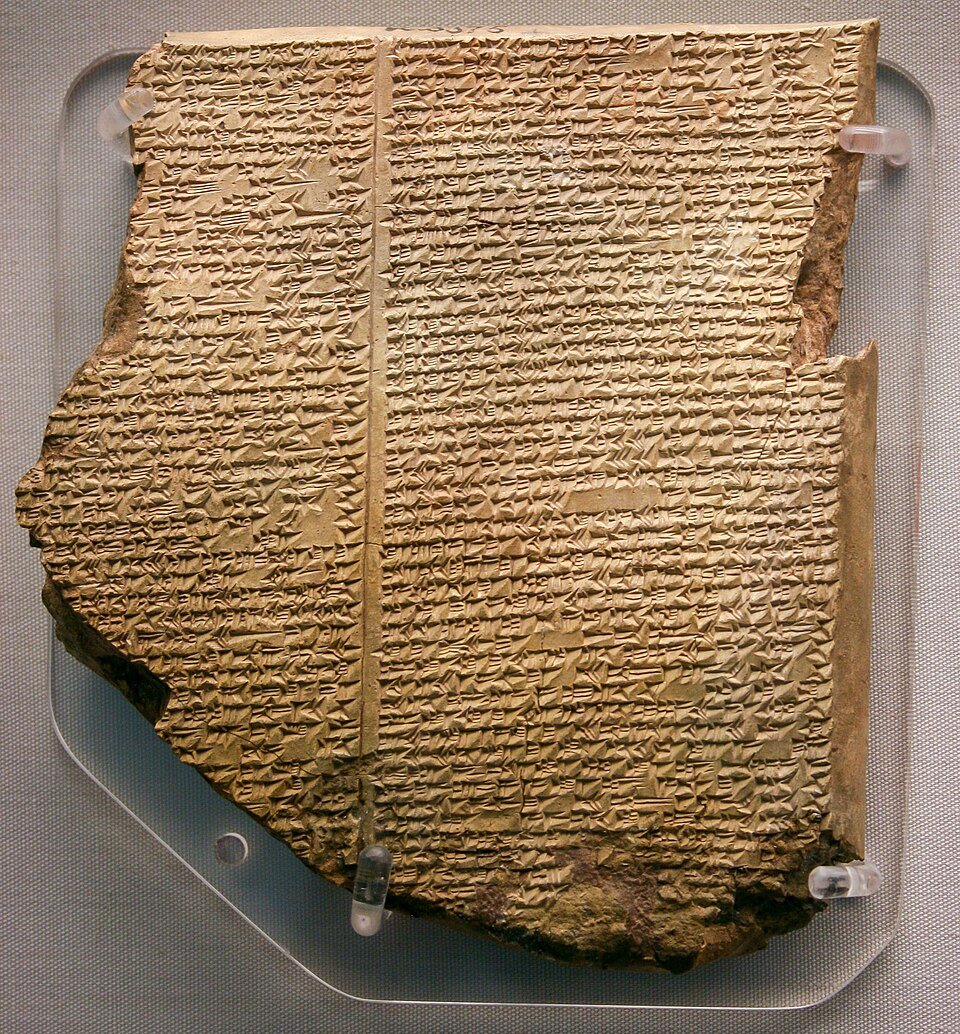
Tablet XI of the Standard Babylonian Epic of Gilgamesh (the "Flood Tablet"), inscribed in Akkadian cuneiform on clay, excavated from the Royal Library of Ashurbanipal at Nineveh. (British Museum, London, K.3375)
The Historical Setting: Uruk and the Third Millennium BCE
To understand the roots of the epic, one must look south toward the marshes and alluvial plains between the Tigris and Euphrates rivers around 2700 BCE. Here flourished Uruk (modern Warka in southern Iraq), widely considered by archaeologists to be the world's first true metropolis. At its peak during the Early Dynastic II period, Uruk encompassed over 250 hectares protected by six miles of kiln-baked mudbrick ramparts, housing an estimated population of 50,000 farmers, artisans, and temple bureaucrats.
According to the historic Sumerian King List, Gilgamesh (originally rendered in Sumerian as Bilgames, meaning "the ancestor was a young man") ruled as the fifth king of Uruk's first post-deluvian dynasty. Historical and epigraphic evidence—including the Tummal Inscription discovered at Nippur—confirms that Gilgamesh was an actual historical ruler who rebuilt the sacred precinct of Enlil and reinforced Uruk's monumental brick fortifications. In an era when tribal kinship was giving way to bureaucratic kingship, a king's legacy was measured by his civic engineering and his defense of his people against hostile city-states like Kish.
Over the following five centuries, the historical warlord was elevated into myth. Sumerian court bards composed discrete oral poems detailing Bilgames' heroic deeds—including his expedition to the Cedar Forest and his duel with the giant Huwawa. When the Semitic-speaking Akkadians and Amorites absorbed Sumerian culture during the early second millennium BCE, these fragmentary Sumerian songs were synthesized into a unified Akkadian narrative, culminating in the Old Babylonian version titled Surpassing All Other Kings (Shūtur eli sharrī).
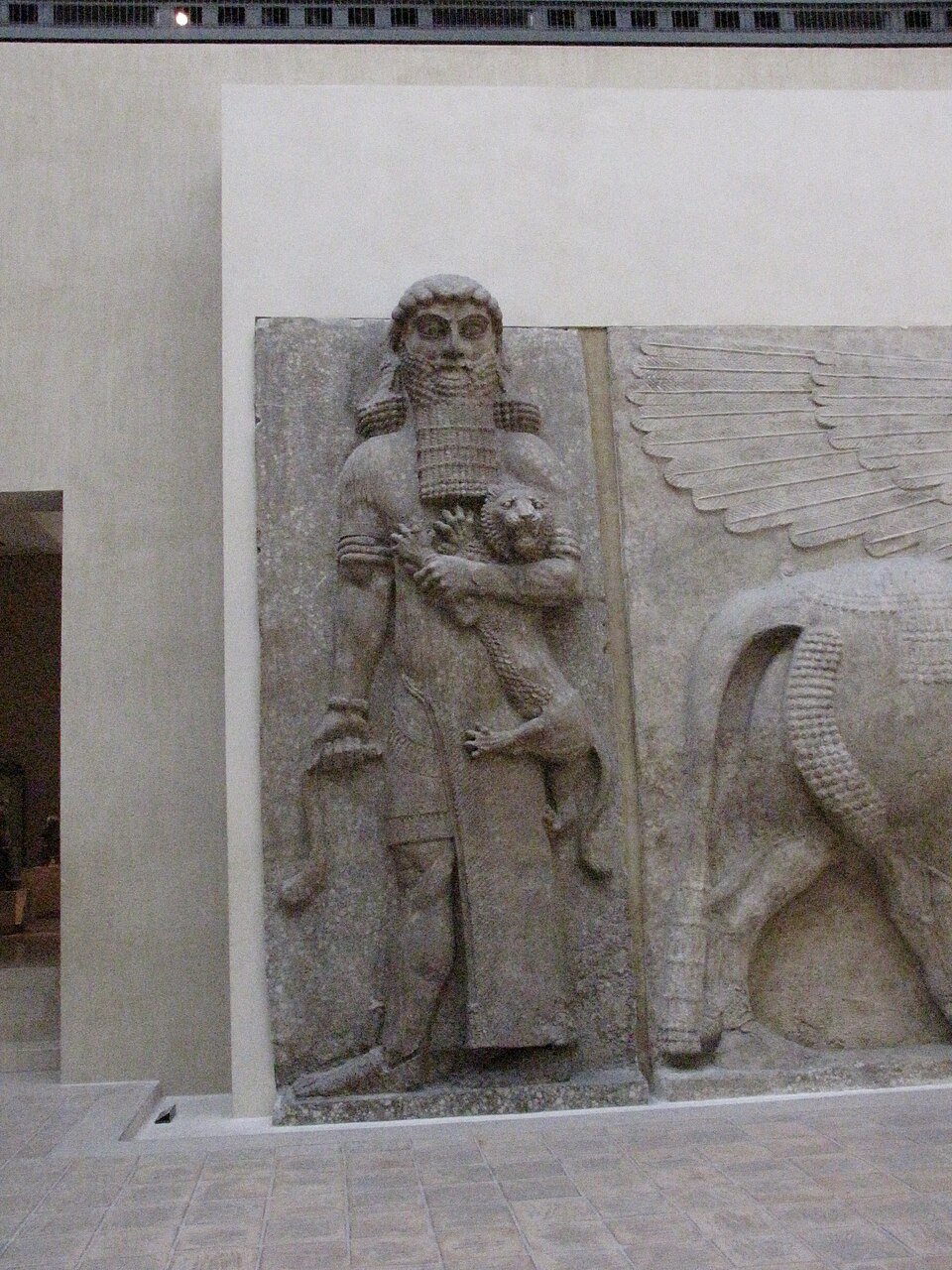
Colossal stone relief of a royal hero mastering a lion, widely identified with the mythic depiction of Gilgamesh, from the Palace of Sargon II at Khorsabad (Dur-Sharrukin), 8th century BCE. (Louvre Museum, Paris, AO 19862)
The Master Narrative: From Tyranny to Existential Quest
Around 1200 BCE, an elite Babylonian priest-exorcist (mashmashshu) named Sin-leqi-unninni compiled, edited, and expanded earlier versions into the definitive twelve-tablet masterwork known in antiquity by its opening line: Sha naqba īmuru ("He Who Saw the Deep"). Sin-leqi-unninni shifted the focus of the epic from military conquest to philosophical self-discovery.
The Creation of Enkidu and the Clashing of Two Worlds
The epic opens with Gilgamesh ruling Uruk as an oppressive despot. Endowed by the gods with two-thirds divine blood and one-third human ancestry, his superhuman vitality drives him to exhaust the youth of Uruk in relentless construction labor and sexual exploitation. Hearing the cries of the oppressed citizens, the sky-god Anu commands the mother goddess Aruru to create an equal counterweight to the king:
Aruru pinches off a lump of clay and flings it into the wilderness, fashioning Enkidu—a wild, hairy man who grazes alongside gazelles and destroys the traps of human hunters. Enkidu represents raw, uncorrupted nature. To civilize him, the temple priestess Shamhat is dispatched to the wild steppe. Through seven days of intimate congress, Shamhat introduces Enkidu to human eroticism, clothing, cooked bread, and fermented beer. When Enkidu attempts to return to the herds, the wild beasts flee from his changed scent; his wilderness innocence is gone, but he gains human wisdom and speech.
Arriving in Uruk to confront the tyrant, Enkidu bars Gilgamesh's path at a wedding threshold. The two titans clash in a violent wrestling match that shatters doorposts and shakes city walls. When Gilgamesh finally throws Enkidu to the earth, the rivalry transforms instantly into profound mutual devotion. The feral wanderer and the civilized monarch discover in each other the mirror of their own souls.
The Cedar Forest and the Hubris of Immortality
Seeking to carve their names into history before death claims them, the brothers embark on an expedition into the mythical Cedar Forest of Lebanon. Armed with massive bronze axes and supervised by the sun god Shamash, they confront the forest's divine guardian, the monstrous giant Humbaba, whose breath is roaring flame. Despite Humbaba's desperate pleas for mercy, the companions slay the beast and fell the ancient sacred cedars to craft a colossal monumental gate for the temple of Enlil at Nippur.
Flushed with triumph, Gilgamesh washes his hair and dons his royal purple robe, catching the eye of Ishtar, the goddess of love and warfare. When Ishtar proposes marriage, Gilgamesh scathingly rejects her advances, reciting the grim fates of her previous lovers—from Tammuz to the shepherd who was transformed into a wolf. Enraged by this public humiliation, Ishtar ascends to heaven and forces her father Anu to release the terrifying Bull of Heaven (Gugalanna) upon Uruk. As the celestial beast's snorts tear open chasms in the earth swallowing hundreds of warriors, Gilgamesh and Enkidu flank the monster, with Enkidu holding it by the horns while Gilgamesh drives his bronze blade into the back of its neck.
The Death of Enkidu and the Descent into Terror
Hubris brings swift divine retribution. Meeting in nighttime council, the great gods decree that one of the heroes must die for slaying Humbaba and the Bull of Heaven. Enkidu falls stricken with a painful, wasting sickness. In his delirium, he curses the hunter and the temple priestess who brought him into civilization, before blessing Shamhat on his deathbed for introducing him to love and companionship.
When Enkidu draws his last breath, Gilgamesh tears his garments, covers his friend's face like a bride, and refuses to allow burial for seven days and nights—weeping over the body until a worm drops from Enkidu's nose. Shattered by grief, the illusion of royal invulnerability collapses completely. For the first time, Gilgamesh confronts his own inevitable death: "Shall I not die like Enkidu? Dread has entered my marrow; I am afraid of death, and so I roam the wilderness."
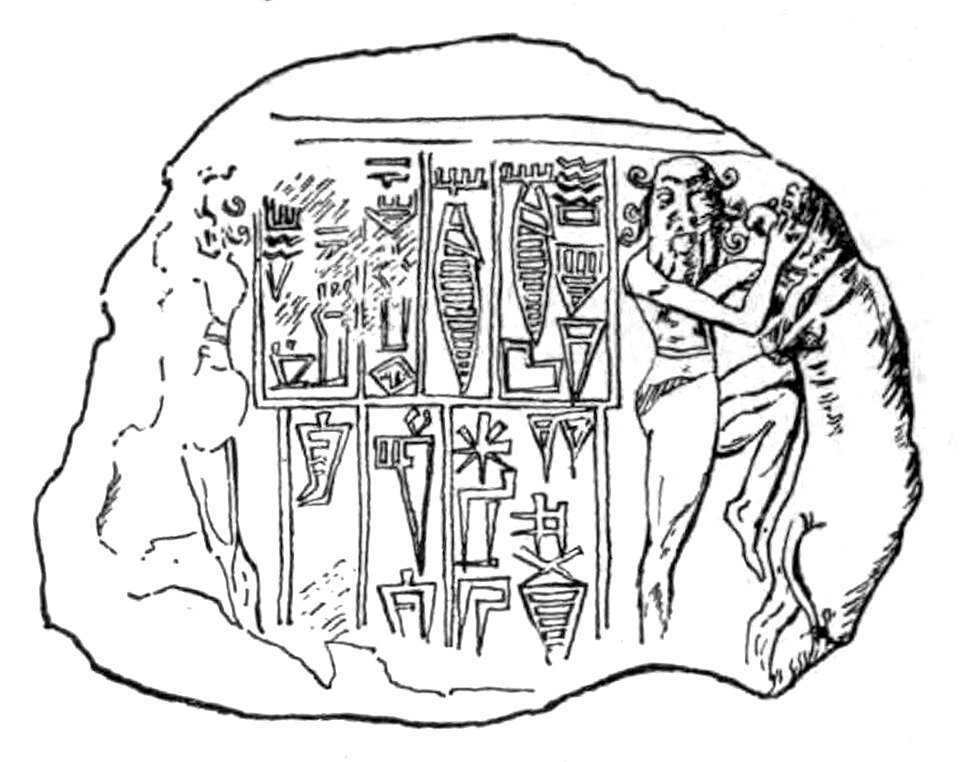
Impression drawing of a Mesopotamian carved hematite cylinder seal depicting the heroic master of animals wrestling a rampant lion and celestial bull, c. 2200 BCE. (British Museum, London)
The Quest for Utnapishtim and the Wisdom of Siduri
Doffing his royal raiment and dressing in wild lion skins, Gilgamesh embarks on an impossible pilgrimage to the ends of the cosmos to find Utnapishtim (the "Distant One"), the only mortal who was granted eternal life by the assembly of the gods after surviving the great primeval deluge.
Gilgamesh passes through the twin peaks of Mount Mashu, guarded by terrifying Scorpion-men whose gaze is death. He traverses twelve leagues of absolute darkness along the Sun's subterranean pathway until he emerges into a glittering garden of jewel-bearing trees on the shore of the vast Cosmic Sea. There he meets Siduri, the wise divine alewife who operates a celestial tavern at the edge of the world. Observing his hollow cheeks, haggard expression, and ragged animal pelts, Siduri delivers the most famous philosophical counsel in ancient literature:
"Gilgamesh, where are you hurrying to? You will never find that life for which you are looking. When the gods created mankind, they allotted death to mankind, but life they retained in their own keeping. As for you, Gilgamesh, fill your belly with good things; day and night, night and day, dance and be merry! Feast and rejoice! Let your clothes be fresh and clean; bathe your body in water. Cherish the little child that holds your hand, and make your wife happy in your embrace; for this is the true lot of mortal man."
— Old Babylonian Tablet of the Epic of Gilgamesh, Meissner Fragment (Vorderasiatisches Museum, Berlin, VAT 4105)
Deaf to Siduri's pragmatic existential wisdom, Gilgamesh insists on crossing the impassable Waters of Death. With the help of the divine boatman Urshanabi, for whom he cuts one hundred and twenty cedar poles to avoid touching the lethal water with his bare hands, Gilgamesh finally reaches the distant shore where Utnapishtim dwells.
Utnapishtim dispels the king's fantasies of physical immortality. In Tablet XI, he recounts the harrowing history of the Great Deluge: how the gods, weary of human noise, conspired to flood the earth; how the compassionate god Ea whispered the secret through the reed wall of Utnapishtim's hut; and how Utnapishtim built a giant cube-shaped ark coated in bitumen, loading it with his family, craftsmen, and pairs of every living creature. After the storm subsided, Utnapishtim sent forth a dove, a swallow, and finally a raven that did not return. For preserving life, the god Enlil touched Utnapishtim's forehead and granted him and his wife eternal life—a unique divine gift that could never be repeated.
To prove to Gilgamesh that he is unfit for divine immortality, Utnapishtim challenges him to conquer sleep, the younger sibling of death: "Remain awake for six days and seven nights." But exhausted from his travels, Gilgamesh collapses immediately. Each day he sleeps, Utnapishtim's wife bakes a loaf of bread and places it beside his head. When Gilgamesh awakes seven days later, protesting that he only shut his eyes for an instant, Utnapishtim points to the seven loaves—the first hard and dried, the second moldy, the third rotten, and the latest still warm from the oven. Gilgamesh is forced to acknowledge that he cannot conquer even seven days of slumber, let alone eternity.
Taking pity on the broken king, Utnapishtim reveals a parting secret: a spiny water plant growing at the bottom of the abyssal sweetwaters (the Apsu) that possesses the power to restore youth to the aged. Tying heavy stones to his feet, Gilgamesh dives into the deep, plucks the prickly plant, and vows to bring it back to Uruk to share with his elders before consuming it himself. Yet on the return journey, while Gilgamesh bathes in a refreshing spring, a water serpent smells the fragrant herb, slithers from the pool, and carries it away—instantly sloughing its old skin to emerge rejuvenated. Gilgamesh sits beside the water and weeps bitter tears: all his labor has produced fruit only for a snake.
Textual Version / Tradition
Historical Date
Language & Script
Key Thematic Distinction
Surviving Tablet Archives
Sumerian Bilgames Poems
c. 2100–1900 BCE (Third Dynasty of Ur)
Sumerian (Cuneiform)
Independent courtly heroic songs; no unified flood quest or single epic arc
Nippur, Ur, Isin scribal schools
Old Babylonian Epic
c. 1800–1600 BCE (First Dynasty of Babylon)
Old Babylonian Akkadian
Integrates Enkidu's brotherhood and mortality crisis; contains Siduri's carpe diem advice
Sippar, Ishchali, Tell Harmal
Standard Babylonian Version
c. 1200 BCE (Compiled by Sin-leqi-unninni)
Standard Babylonian Akkadian
Authoritative 12-tablet synthesis; introduces the "He Who Saw the Deep" prologue & Tablet XI Flood narrative
Royal Library of Ashurbanipal, Nineveh; Sultantepe; Babylon
Hittite & Hurrian Adaptations
c. 1400–1200 BCE (Late Bronze Age)
Hittite & Hurrian (Cuneiform)
International transmission across Anatolia and Syria, demonstrating trans-cultural appeal
The Rediscovery: George Smith and the Victorian Sensation
For more than two thousand years, following the fall of Babylon and the destruction of Nineveh in 612 BCE, the Epic of Gilgamesh was buried beneath mounds of Mesopotamian rubble. Classical Greek and Roman historians knew virtually nothing of its existence.
The modern resurrection of the epic began in the 1850s, when British archaeologist Austen Henry Layard and his Christian Chaldean collaborator Hormuzd Rassam uncovered the subterranean ruins of King Ashurbanipal's royal palace and temple libraries at Kouyunjik (ancient Nineveh). More than 25,000 fragmentary cuneiform tablets were packed into wooden crates and shipped to the British Museum in London.
In the autumn of 1872, a self-taught assistant in the museum's Department of Oriental Antiquities named George Smith was sorting through the uncataloged fragments of cuneiform. Cleaning off a dark tablet numbered K.3375, Smith began deciphering the lines of Tablet XI. As he read the description of the catastrophic deluge, the stranding of the vessel on Mount Nimush, and the release of the dove and the raven, Smith realized he was reading an ancient Mesopotamian account of the Flood that predated the Book of Genesis by more than a millennium. Legend records that Smith became so overcome with intellectual excitement that he leapt from his desk, began tearing off his clothes, and danced through the museum galleries.
On December 3, 1872, Smith presented his translation before the Society of Biblical Archaeology in London, attended by Prime Minister William Gladstone and covered on the front pages of international newspapers. The revelation revolutionized the emerging fields of Assyriology, comparative mythology, and biblical criticism, definitively demonstrating that the sacred stories of the ancient Mediterranean and Near East were part of a vast, interconnected literary ecosystem.
Archival Facts: The Cuneiform Scribes of Mesopotamia
The Epic of Gilgamesh was recorded by temple scribes (tupsharru) using triangular-cut reed styluses pressed into moist river silt. Scribes memorized the work in royal academies (edubba or "tablet houses"), which served as the educational foundation of Mesopotamian administrative elites. Cuneiform tablets were intentionally baked in kiln fires during warfare or unintentionally baked when conquerors burned palaces—preserving clay records that have outlasted papyrus, parchment, and digital magnetic media.
⚖️
Historian Debate: Nature vs. Civilization and Mythic Archetypes
Structuralist & Environmental Reading
Anthropologists like Claude Lévi-Strauss and assyriologist Thorkild Jacobsen argue that the epic documents the traumatic psychological transition from hunter-gatherer existence (represented by Enkidu) to urban agrarian society (represented by Gilgamesh). The felling of the Cedar Forest symbolizes human deforestation and the subjugation of ecology for state building.
Existential & Psychological Reading
Literary scholars like David Damrosch and Andrew George interpret Gilgamesh as humanity's foundational existential journey. The narrative moves beyond heroic triumphalism to embrace human vulnerability, grief, and the acceptance of limits. Gilgamesh fails in his supernatural quest for immortality, but succeeds as an architect and narrator.
Contemporary scholarship emphasizes that Tablet XII was appended later as a direct translation of the Sumerian poem "Bilgames and the Netherworld," exploring the shadowy afterlife of the Kur.
Long-Term Legacy & Modern Relevance
The ultimate triumph of the Epic of Gilgamesh is that it ends where it began: upon the monumental baked-brick walls of Uruk. In the closing lines of Tablet XI, Gilgamesh returns to his city accompanied by the ferryman Urshanabi. Stripped of his delusions of immortality, he does not lament his doomed physical body. Instead, he invites the boatman to climb the walls of Uruk, survey its foundation terraces, inspect its kiln-fired brickwork, and admire its palm groves and temple precincts.
Gilgamesh discovers that true human immortality does not consist of escaping death through divine favor or magic herbs. It is achieved through the cultural monuments, ethical institutions, and artistic stories that we leave behind for future generations. Four thousand years after its verses were first pressed into wet Euphrates clay, the epic continues to speak directly to the modern condition—reminding us that love, companionship, and shared human creativity are the only lasting answers to the terrifying brevity of life.
📊 Museum-Grade Infographic Poster
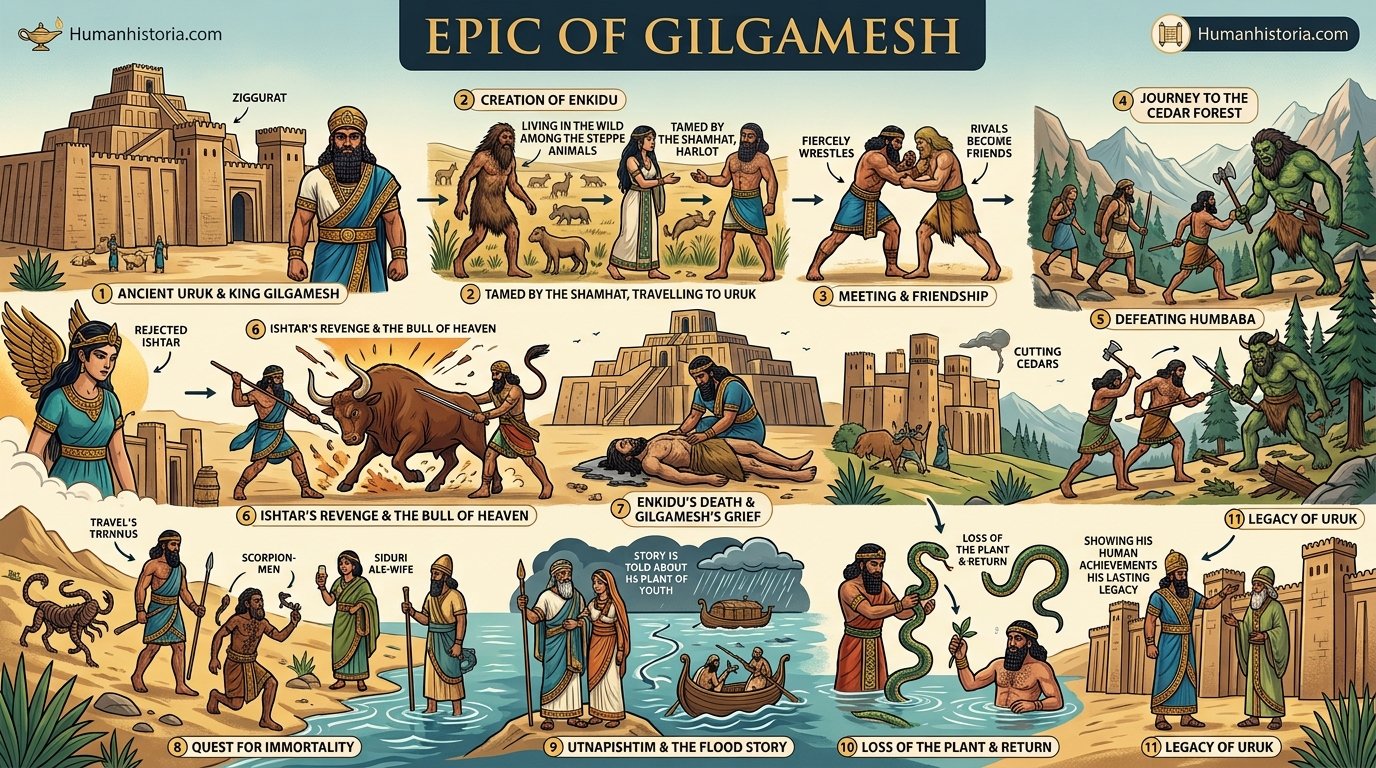
The Epic of Gilgamesh & Clay Tablets Infographic
💡 Click anywhere on poster to expand in high resolution🔎 Expand Lightbox
Visual mapping outlining the twelve clay tablets of Ashurbanipal's library, chronicling Gilgamesh's journeys with Enkidu.
📖 SCHOLARLY INQUIRIES
Frequently Asked Questions
Essential historical questions and evidence-based answers concerning this chronicle.
Q.What is the plot of the Epic of Gilgamesh?
Gilgamesh, tyrant king of Uruk, bonds with wild man Enkidu. After Enkidu's death, grief-stricken Gilgamesh journeys to the edge of the world seeking immortality from flood survivor Utnapishtim.
Q.How was the Epic of Gilgamesh rediscovered?
In 1853, Assyriologist Hormuzd Rassam excavated thousands of broken clay tablets from King Ashurbanipal's library in Nineveh, translated by George Smith at the British Museum in 1872.
Q.How does Gilgamesh relate to the Biblical Flood story?
Tablet XI contains Utnapishtim's narrative of a global flood, building a massive reed ship, releasing birds (dove, swallow, raven), and sacrificing on a mountain top, pre-dating Genesis by centuries.
📚 Academic Sources & Scholarly Bibliography
George, A. R. (2003).
The Babylonian Gilgamesh Epic: Introduction, Critical Edition and Cuneiform Texts.
Oxford University Press.
Damrosch, D. (2007).
The Buried Book: The Loss and Rediscovery of the Great Epic of Gilgamesh.
Henry Holt.
Foster, B. R. (2001).
The Epic of Gilgamesh: A New Translation.
W. W. Norton.
📖 Scholar Mode Active — Click to exit focused reading
History Lab 🧪
Interactive historical deduction games, tactical matchup simulators, and currency calculators.
🕵️ Who Am I? (The Historical Guess Game)
A secret historical figure has been selected. Ask yes/no questions to narrow down the pool of candidates. Click any active card to make your accusation!
Secret Identity
❓ Who Am I?
Ask questions using the board below to narrow down my identity.
Ask a Question:
Question LogQuestions: 0 / 7
No questions asked yet.
Candidate Board:
🗺️ Timeline Scramble
Five historical events appear out of order. Click them in the correct chronological sequence — from oldest to most recent. How well do you know your history?
🏺 Relic or Fake?
Is this a real historical artifact or a convincing fabrication? Judge each one based on its description and era — then see the truth revealed!
Artifact 1 / 10Score: 0
Empire Matchup Simulator
Empire ATerritory Size (Peak, M km²)Empire B
00
Empire APopulation (Peak, Millions)Empire B
00
Empire AMilitary Power (Army Size)Empire B
00
Tactical Battle Analysis
Select empires and click simulate to run evaluations.
Historical Purchasing Power Converter
See what ancient coins are worth in modern terms and check their historical purchasing power.
Modern Value Equivalent
$0.00 USD
Historical Purchasing Power:
Select currency to view purchasing capability.
Historical Identity Generator
Forge an authentic historical identity from ancient civilisations, complete with linguistic meaning and biography.
Neutral
Gaius Julius
Meaning:Descendant of Jupiter
Historical Background:
A Roman citizen and clerk who worked in the forum under Roman republic rule.
Chrono-Cultural Fusion Simulator
Fuse the culture, technology, and governance of two legendary civilizations to synthesize a unique hybrid society.
Cohesion & Coexistence Rate
85%
🏛️ Hybrid Architecture
⚙️ Synthesized Asset
📜 Synthetic Governance
Historical Tactics & Trivia Quiz
Test your historical knowledge and battle tactics to claim your administrative rank.
8 Questions • Multi-Era
You will be presented with random scenarios and trivia spanning ancient Egypt, classical Rome, Islamic Golden Age, and the modern industrial era. Complete the evaluation to see your historical title!
Question 1 of 8Score: 0
What was the Code of Hammurabi written on?
Correct!
Evaluation Complete!
6 / 8
Correct
Rank Attained
Imperial Legionary
Your knowledge of classical strategy and administrative structures is respectable.
🎲 Counterfactual "What If?" Scenario Simulator
Explore alternative historical trajectories by tweaking key civilizational pivot points.
Simulated Shift
Selected Era
Prehistoric Era
Millions of years ago to ~3000 BCE
The dawn of humanity. From the evolutionary split of early hominids to the mastery of stone tools, fire, and the birth of language.
Landmark Milestones
Welcome to Historia
Enter your Scholar Name to synchronize your chronicles and save your journey.
 ⭐ Featured Chronicle

 ANCIENT AGES
 ANCIENT AGES
 ANCIENT AGES
 MEDIEVAL PERIOD
 MEDIEVAL PERIOD
 PREHISTORIC ERA