From prehistoric origins to the modern era—discover the turning points, lost empires, and breakthroughs of world history through interactive timelines and visual guides.
Examine the tangible relics, physical tokens, and revolutionary machines that shaped civilizational growth.
🎥 VIDEO HUB & SHORTS
Watch visual summaries, site intros, and mini-documentaries chronicling 300,000 years of world history.
📊 HISTORICAL INFOGRAPHICS ARCHIVE
Museum-grade visual graphics, civilizational timelines, and architectural breakdowns curated for educators and history lovers.
THE HISTORIA CIRCLE
Join the collective discussion, study logs, and contributions of fellow historians mapping humanity's path.
Historia Forum Discussions
Start a Discussion Thread
THEMATIC PATHWAYS
Trace a single thread — disease, trade, energy, migration — across all eras and civilizations.
History is not just a sequence of events — it is a network of patterns. These thematic pathways allow you to follow a single concept across thousands of years: how agriculture spread, how warfare evolved, how trade routes shaped civilizations. Each pathway collects the most relevant chronicles across all eras.
🧩
How is this different from the sidebar Topics?
While the sidebar Topics (like Science & Tech or Empires) filter articles within your selected historical Era, Thematic Pathways cut horizontally across all eras (from Prehistoric to the Future). Use Themes to trace a single concept's evolutionary line across 300,000 years.
CIVILIZATION HUBS
Comprehensive profiles of the world's greatest civilizations and empires — from ancient cradles to global super-states.
Human Historia provides an academically rich exploration of the world's most influential civilizations. From the monumental achievements of ancient Egypt, Han China, and the Roman Empire, to the sophisticated societies of the Maya, the Islamic Caliphates, and West African empires, these hubs offer deep insights into the cultural, political, and technological legacies that continue to shape our global story.
EVOLUTION OF HUMAN SKILLS
Trace the compounding technologies, practical capabilities, and cognitive milestones of the human species.
Human progress is a story of compounding skills. Every breakthrough, from the spark of prehistoric fire to modern silicon transistors, builds directly on previous generations of ingenuity. Hover over a skill node to trace its historical prerequisites, and click it to explore its development timeline, species-wide impact, and related chronicles.
Prehistoric Ancient Medieval Modern Future
🧠
Select any skill node in the tree to explore its evolutionary path, development timeline, and historical impact.
ACADEMIC PASSPORT
Track your intellectual journey, quiz outcomes, and historical badges of honor.
HISTORIA PASSPORT⏳
👤Scribe Novice
Scholar NameHistoria Explorer
Rank RatingSumerian Record Scribe
Chronicles Read0 / 48
Study Guide Pins0 Guides
Security AccessLevel 1 (Novice)
Earned Badges of Honor
🔥
Fire Keeper
Unlock 3 prehistoric chronicles.
🏛️
Codex Keeper
Unlock 3 ancient chronicles.
🏰
Guild Master
Unlock 3 medieval chronicles.
⚙️
Steam Engineer
Unlock 3 modern chronicles.
🚀
Singularity Sage
Unlock 3 future chronicles.
👑
Grand Scholar
Score 5/5 on the Lab Quiz.
Recent Lab Activities
No recent activities recorded. Take a quiz or bookmark articles!
🏛️ MISSION & ARCHIVAL STANDARDS
About Human Historia
A visual encyclopedia and timeline of human history, dedicated to documenting 300,000 years of civilizational evolution through rigorous research, authentic artifacts, and visual clarity.
🌍
The 300,000-Year Story
Human Historia traces our collective journey across five historical epochs: Prehistory, Ancient Worlds, Middle Ages, Modern Age, and Future Horizons. From the first control of fire to quantum computation, we organize turning points into interconnected timelines.
📜
Historiographical Rigor
Every chronicle is built upon primary historical manifests, contemporary excavation reports, and peer-reviewed historical consensus. We prioritize authentic public domain artifacts and clearly identify scholarly debates surrounding major civilizational transitions.
🎨
Museum-Grade Visuals
Complex historical transitions demand visual understanding. We develop high-resolution infographics, architectural cutaways, and comparative territorial maps to transform abstract timelines into vivid, unforgettable learning experiences.
📖
Educational Access
Knowledge belongs to humanity. Human Historia is free, ad-light, and engineered as an educational resource for students, classroom educators, academic researchers, and curious minds across all continents.
Editorial Governance & Inquiries
We welcome peer reviews, academic corrections, museum archival collaborations, and educational partnerships. To submit historical inquiries or provide archival feedback, reach our editorial desk directly.
An immersive graphical anthology tracing the paths of civilizations, breakthroughs, and conflicts that forged the modern consciousness.
25Chronicles
Showing all articles
Emperor Justinian I: History, Origins & Impact
Written by Humanhistoria EditorialHistorical Era: ANCIENT
In the freezing January of 532 CE, the imperial capital of Constantinople was consumed by fire and rebellion. Chanting the insurrectionist slogan "Nika!" ("Victory!"), violent rioters torched the imperial palace, burned the ancient cathedral of Holy Wisdom, and crowned a rival senator upon the blood-stained sands of the Hippodrome. Poised to abandon his crown and flee into exile aboard waiting imperial galleys, Emperor Justinian I was halted by the steel resolve of his wife, Empress Theodora, whose declaration that "the imperial purple makes a fine burial shroud" altered the course of Roman civilization. Crushing the insurrection, Justinian transformed the smoldering ash into the golden age of the Byzantine Empire. Over a monumental thirty-eight-year reign, Justinian codified a thousand years of Roman jurisprudence into the monumental Corpus Juris Civilis—the bedrock of modern civil law across Europe—and crowned his resurrected empire with Hagia Sophia, antiquity's supreme architectural wonder.
🎯 Quick Historical Summary
What Was Emperor Justinian's Legal and Architectural Legacy?
Reigning from 527 to 565 CE, Byzantine Emperor Justinian I ordered the codification of classical Roman law into the Corpus Juris Civilis, which forms the foundational bedrock for modern civil legal systems worldwide. In Constantinople, he reconstructed Hagia Sophia, crowning it with the world's largest unsupported pendentive dome.
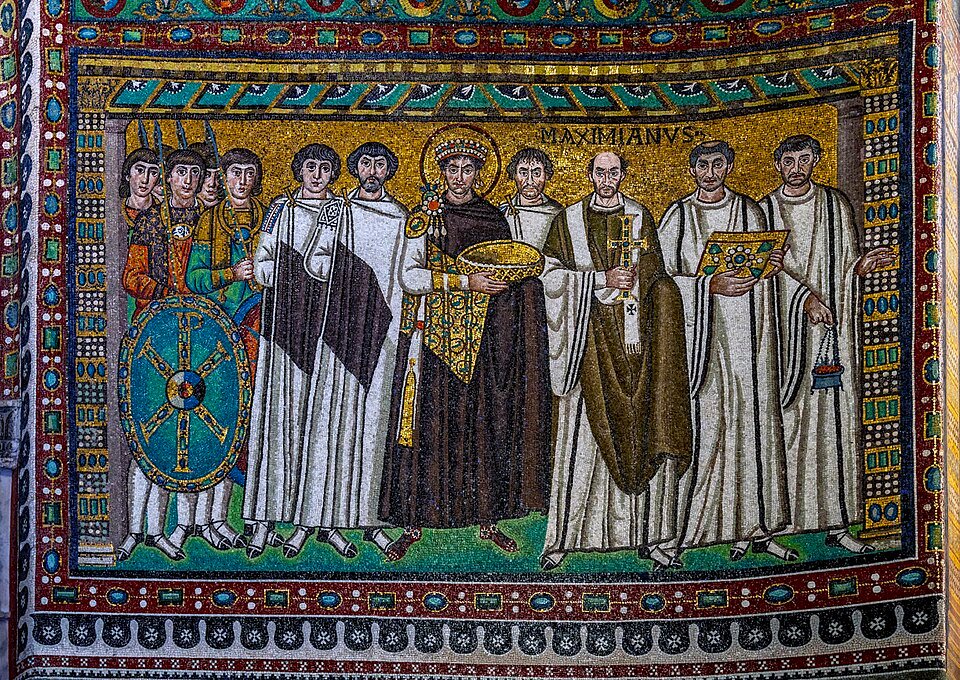
Contemporary Byzantine mosaic panel inside the north wall of the apse at the Basilica of San Vitale in Ravenna, Italy (consecrated 547 CE), depicting Emperor Justinian I bearing a gold paten, flanked by General Belisarius, Bishop Maximian, and imperial bodyguards. (Basilica of San Vitale, Ravenna)
From Illyrian Peasant to Byzantine Autocrat
The sovereign who would transform the Eastern Roman world was not born into purple silk or patrician luxury. Born around 482 CE in the impoverished Balkan hamlet of Tauresium (modern North Macedonia), Flavius Petrus Sabbatius was an ethnic Illyrian peasant. His fortune shifted when his maternal uncle, Justin I—an illiterate peasant soldier who had walked barefoot to Constantinople—rose through the ranks of the imperial palace guards (the Excubitors) through raw combat courage, eventually seizing the imperial throne upon the death of Emperor Anastasius in 518 CE.
Recognizing the boy's extraordinary intellect, Justin adopted his nephew, gave him a classical education in Latin literature, theology, and Roman jurisprudence, and groomed him as his administrative right hand. Upon Justin's death in 527 CE, thirty-five-year-old Justinian ascended the throne of the Eastern Roman (Byzantine) Empire. Possessing an obsessive work ethic that led courtiers to dub him "the emperor who never sleeps", Justinian pursued a singular, grand imperial ambition: Restitutio Orbis—the total political, military, legal, and spiritual reconquest of the fallen Western Roman Empire from Germanic barbarian kingdoms.
The Nika Riots & The Iron Will of Empress Theodora
Before Justinian could reconquer Rome, he had to survive his own citizens. In 6th-century Constantinople, public life revolved around chariot racing in the colossal Hippodrome, which seated one hundred thousand spectators. The racing clubs—principally the Blues and the Greens—were not merely sports teams; they were heavily armed political factions, civic militias, and religious lobbies with immense street influence.
In January 532 CE, outrage over exorbitant imperial taxation and the botched hanging of two faction brawlers ignited the Nika Riots. Uniting under the battle cry "Nika!", the Blues and Greens stormed the city, setting fire to the Praetorium, the Senate house, and the magnificent 4th-century wooden basilica of Hagia Sophia. For five days, fires raged through the imperial center while mobs besieged Justinian and his senior ministers inside the Great Palace.
Terrified of capture, Justinian and his council prepared to board imperial war galleys loaded with the palace treasury and flee across the Sea of Marmara. At that fateful moment, thirty-two-year-old Empress Theodora rose to speak. A former comedic actress, dancer, and courtesan whose marriage to Justinian had required changing ancient Roman laws barring patricians from marrying women of the stage, Theodora possessed an unyielding imperial spine. As recorded by court historian Procopius, she addressed the trembling imperial council:
"Whether or not a woman should give an example of courage to men is neither here nor there... If you wish to save your skin, sire, it is easily done. We have plenty of money, the sea is out there, and our ships are ready. But watch out that once you have saved yourself, you do not find yourself preferring death to safety. For my part, I hold to the old saying: The imperial purple makes a fine burial shroud."
— Empress Theodora addressing the Imperial Council, recorded in Procopius, History of the Wars (Book I.24)
Shamed by her courage, Justinian resolved to fight. Vizier Narses slipped out of the palace carrying sacks of imperial gold, meeting secretly with the leaders of the Blue faction in the Hippodrome, reminding them that Justinian was a lifelong Blue and bribing them to abandon their alliance with the Greens. As confusion broke out in the stands, Justinian's peerless military commanders, Generals Belisarius and Mundus, stormed the Hippodrome with veteran Illyrian and Herulian mercenary shock troops. Sealing the gates, the imperial troops trapped the insurrectionists, slaughtering over thirty thousand rioters in an afternoon of horrific butchery. The rebellion was extinguished, leaving Justinian with absolute, unchallenged autocratic authority.
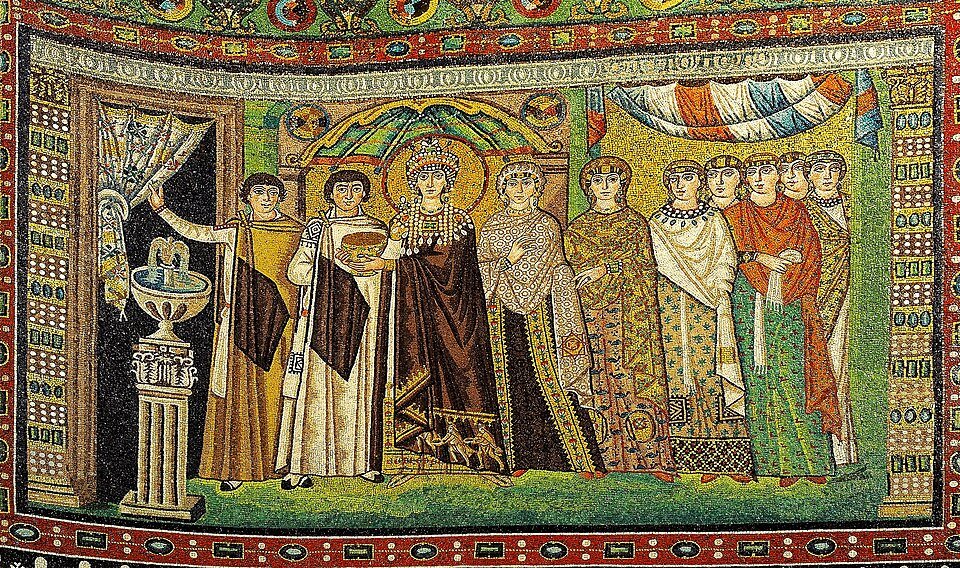
Mosaic panel of Empress Theodora (c. 547 CE) inside the Basilica of San Vitale, Ravenna, depicting the empress crowned with pearls and imperial emeralds, bearing a jeweled chalice alongside court ladies. (Basilica of San Vitale, Ravenna)
The Great Legal Synthesis: Tribonian & The Justinian Code
With domestic opposition silenced, Justinian turned immediately to his greatest intellectual monument: the total reorganization of Roman law. Over more than a thousand years—from the ancient Twelve Tables (c. 450 BCE) through centuries of praetorian edicts, imperial rescripts, and scholarly commentaries—Roman law had accumulated into a chaotic, contradictory mountain of hundreds of thousands of scrolls. Conflicting statutes allowed wealthy litigants to exploit legal ambiguities, while judges in regional provinces could rarely determine which laws were active.
Justinian appointed his brilliant, pagan legal scholar and quaestor, Tribonian, to lead an elite commission of jurists and law professors from the legal academies of Constantinople and Berytus (Beirut). Working with superhuman speed between 528 and 534 CE, Tribonian's team sifted through millions of words of jurisprudence, ruthlessly eliminating obsolete statutes, harmonizing contradictions, and editing the texts into a systematic, unified Latin legal code: the Corpus Juris Civilis ("Body of Civil Law").
The Four Pillars of the Justinian Code
The Codex Justinianus: A comprehensive compilation of imperial constitutions and edicts issued from Emperor Hadrian through Justinian, systematically organized into twelve thematic books covering ecclesiastical law, criminal procedure, administrative duties, and private rights.
The Digest (Pandectae): The most ambitious intellectual feat in legal history. In just three years, Tribonian's commission condensed three million lines of writing from classical Roman jurists (such as Ulpian, Papinian, Gaius, and Paulus) into fifty structured books, preserving the finest legal reasoning of antiquity.
The Institutes: An authoritative introductory textbook designed for first-year law students, standardizing legal education across the empire around core concepts: persons, property, obligations, and legal actions.
The Novels (Novellae Constitutiones): New statutes enacted by Justinian after 534 CE. Uniquely, while the first three works were composed in traditional Latin, the Novels were issued in Greek, reflecting the linguistic reality of the Eastern Roman Mediterranean.
Theodora's Legal Revolution: Women's Civil Rights
Through the direct influence of Empress Theodora, the Justinian Code enacted unprecedented legal protections for women. Roman law had historically subjected women to lifelong patriarchal guardianship (patria potestas), leaving daughters and wives without property ownership. Theodora's legislation fundamentally reformed imperial family law:
Wives gained the legal right to own, manage, and inherit private property independently of their husbands.
Forced prostitution and human trafficking of young girls was outlawed under penalty of capital execution and property confiscation.
Husbands were legally barred from taking financial loans against their wives' marriage dowries without explicit written consent.
Widows were granted primary legal custody over their minor children, preventing paternal relatives from seizing orphans' estates.
Divorce laws were reformed, granting mistreated wives the legal right to dissolve marriages and retain their complete dowries.
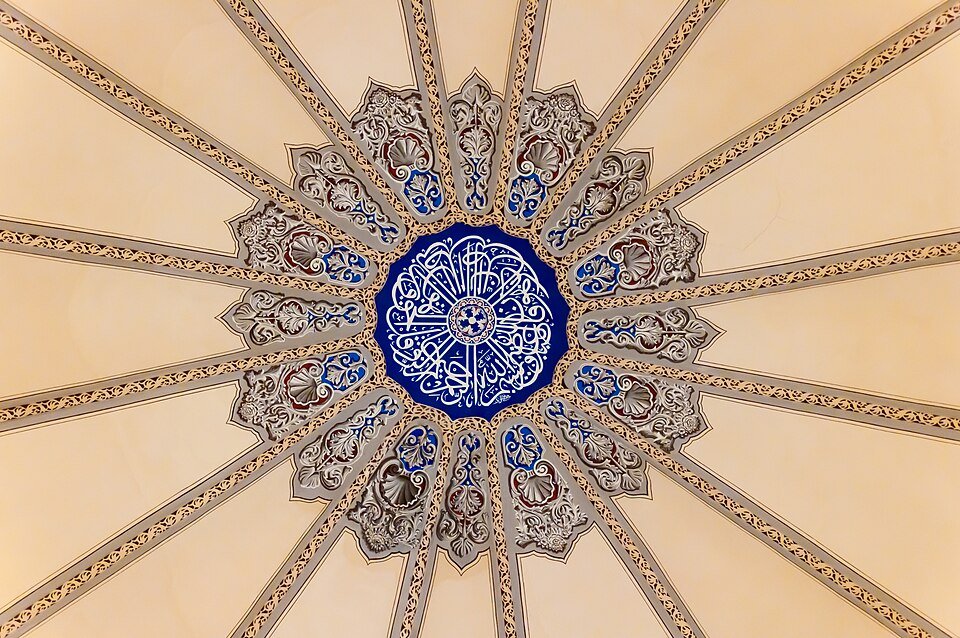
The breathtaking interior of Hagia Sophia in Constantinople, showcasing the 102-foot central dome suspended over four colossal stone pendentives, framed by forty arched windows that flood the golden mosaic nave with celestial light. (Hagia Sophia Historical Complex, Istanbul)
Architectural Wonder: The Construction of Hagia Sophia (532–537 CE)
Thirty-nine days after the Nika Riots burned the old cathedral, Justinian ordered the construction of a monument that would reflect the divine glory of his imperial state: the church of Hagia Sophia ("Holy Wisdom"). Rejecting conventional architects, Justinian commissioned two theoretical scientists: Isidore of Miletus, a brilliant physicist, and Anthemius of Tralles, a professor of geometry and author of treatises on conics.
Over an astonishingly brief construction period of just five years, ten months, and four days—utilizing ten thousand stonemasons and artisans organized into competing construction brigades—the builders erected the largest enclosed interior space in the ancient world. To achieve this, the architects revolutionized structural engineering through the mastery of the pendentive: four colossal triangular curved masonry vaults that transition the square ground footprint into a circular rim, supporting a massive 102-foot-wide hemispherical dome that rises 180 feet above the pavement.
Lined with forty arched windows around the dome's base, sunlight poured through the limestone openings, illuminating millions of gold-leaf glass mosaic tiles (tesserae). As contemporary historian Procopius described in awe: "The dome seems not to rest upon solid masonry, but to be suspended by a golden chain from heaven itself." When Justinian formally dedicated the cathedral on December 27, 537 CE, he walked to the central porphyry altar, looked up into the floating dome, and famously exclaimed: "Solomon, I have surpassed thee!"
Code Component
Original Volume / Format
Primary Purpose & Scope
Modern Civil Law Legacy
Codex Justinianus
12 Books (over 4,600 imperial edicts).
Systematized statutory imperial legislation from Hadrian to 534 CE.
Codified statutory authority and constitutional supremacy of written law.
Digest (Pandectae)
50 Books (3 million words reduced to 150,000 lines).
Collected jurisprudence and legal philosophy of classical jurists (Ulpian, Papinian).
Foundation of modern tort law, contract theory, property rights, and judicial precedent.
Institutes
4 Books (Standard student textbook).
Foundational law textbook for university legal curricula.
Standardized Western legal education; defined 'justice', 'rights', and 'contracts'.
Novels (Novellae)
168 New imperial laws (issued in Greek).
Reformed family law, women's property rights, administrative anti-corruption.
Pioneered modern inheritance law, marital equality, and public administrative law.
"Justice is the constant and perpetual desire to render to each man his due. The precepts of the law are these: to live honestly, to injure no one, and to give to every man that which belongs to him."
— Emperor Justinian I, The Institutes (Book I, Title I, 533 CE)
Historiographical Debate: Imperial Restoration vs. The Ruin of the Mediterranean
The reign of Emperor Justinian I represents one of the most fiercely contested legacies in classical and medieval history. Traditional historiography, echoing Justinian's court chronicler Procopius in The Buildings, celebrated the emperor as the glorious restorer of the Roman Empire, a pious lawgiver who codified Western civil law and raised the architectural marvel of Hagia Sophia. However, contemporary Byzantine historians like Anthony Kaldellis and Peter Brown emphasize the devastating cost of his reconquests. Justinian's relentless taxation, combined with the catastrophic demographic shock of the 541 CE bubonic plague, bled Italy, North Africa, and the Balkans dry. Within decades of his death, an exhausted, depopulated empire was left powerless to prevent the Lombard invasion of Italy, the Slavic migration into Greece, and the subsequent early Islamic expansion.
Reconquest, the Justinianic Plague & Historical Legacy
While Justinian's legal and architectural triumphs endured, his military reconquests carried a tragic, exhausting human price. Under General Belisarius, Byzantine expeditionary forces smashed the Vandal Kingdom of North Africa in 533 CE in a brilliant six-month campaign, restoring Carthage to Roman control. Belisarius subsequently invaded Italy, recapturing Sicily, Rome, and the Ostrogothic capital of Ravenna by 540 CE.
Yet in 541 CE, total disaster struck: the Plague of Justinian—the first documented global pandemic of bubonic plague (Yersinia pestis)—swept through the Mediterranean. At its peak in Constantinople, five to ten thousand corpses were carted out of the city daily. Over two years, the epidemic wiped out nearly forty percent of the imperial capital's population and up to a quarter of the Mediterranean basin. Justinian himself contracted the bubonic swellings, surviving only after falling into a deep coma during which Theodora managed state affairs.
The demographic collapse crippled the empire's agricultural tax base and annihilated recruitment for the imperial legions. In Italy, the Gothic Wars dragged into a twenty-year war of attrition that devastated Italian agriculture, destroyed aqueducts, and depopulated Rome. When Justinian died in 565 CE at the age of eighty-three, the reconquered empire was financially hollowed out, leaving the frontiers vulnerable to the incoming Lombard invasion of Italy and the rise of Islam in the 7th century.
Yet Justinian's ultimate victory was intellectual rather than military. Rediscovered in 11th-century Italy at the University of Bologna, the Corpus Juris Civilis sparked the medieval legal renaissance across Europe. It formed the direct foundation for the French Napoleonic Code of 1804, the German Bürgerliches Gesetzbuch, and the civil law systems of modern Europe, Latin America, Japan, and international maritime law. Long after the swords of Belisarius turned to dust, Justinian's laws still govern the modern world.
💡 Click anywhere on poster to expand in high resolution🔎 Expand Lightbox
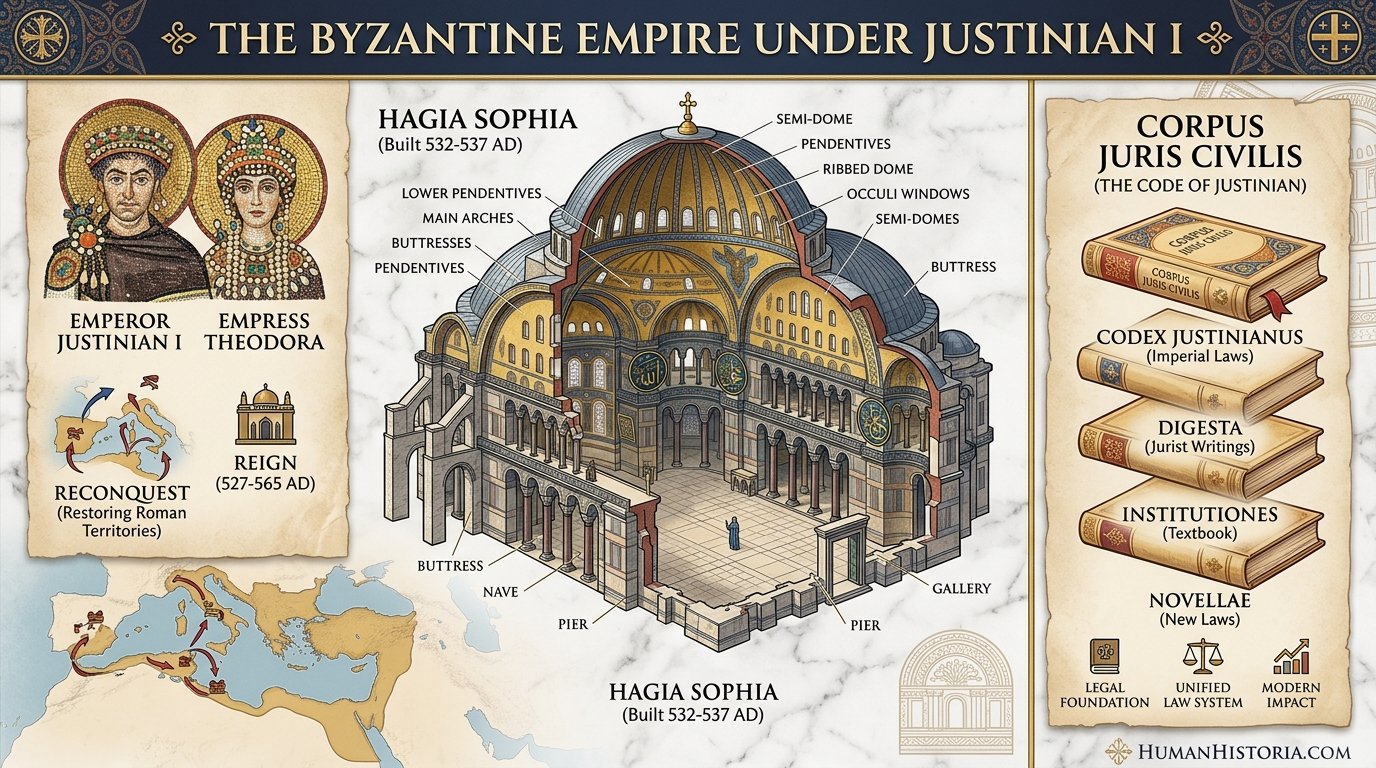
Architectural rendering of the Hagia Sophia's pendentive dome system, Justinian's legal code divisions, and Belisarius's reconquests.
📖 SCHOLARLY INQUIRIES
Frequently Asked Questions
Essential historical questions and evidence-based answers concerning this chronicle.
Q.Why is Emperor Justinian I significant in world history?
Emperor Justinian I played a pivotal role by transforming technology, social structure, and regional connection, serving as a vital link in human civilization.
Q.What is the Corpus Juris Civilis?
The Corpus Juris Civilis (Body of Civil Law) was Justinian's 6th-century consolidation of centuries of Roman statutes, legal opinions, and judicial precedents into a systematic legal code.
Q.Why was the dome of Hagia Sophia an engineering marvel?
Completed in 537 CE, Hagia Sophia used innovative spherical triangular masonry (pendentives) to suspend a massive 105-foot dome over a square nave, creating an illusion of floating in mid-air.
Q.Who was Empress Theodora?
Empress Theodora was Justinian's influential wife and co-ruler who championed women's legal rights and prevented Justinian from fleeing during the bloody Nika Riots of 532 CE.
📚 Academic Sources & Scholarly Bibliography
Procopius (1914).
History of the Wars & Buildings of Justinian.
Loeb Classical Library.
Moorhead, J. (1994).
Justinian.
Longman.
Evans, J. A. S. (1996).
The Age of Justinian: The Circumstances of Imperial Power.
Routledge.
📖 Scholar Mode Active — Click to exit focused reading
History Lab 🧪
Interactive historical deduction games, tactical matchup simulators, and currency calculators.
🕵️ Who Am I? (The Historical Guess Game)
A secret historical figure has been selected. Ask yes/no questions to narrow down the pool of candidates. Click any active card to make your accusation!
Secret Identity
❓ Who Am I?
Ask questions using the board below to narrow down my identity.
Ask a Question:
Question LogQuestions: 0 / 7
No questions asked yet.
Candidate Board:
🗺️ Timeline Scramble
Five historical events appear out of order. Click them in the correct chronological sequence — from oldest to most recent. How well do you know your history?
🏺 Relic or Fake?
Is this a real historical artifact or a convincing fabrication? Judge each one based on its description and era — then see the truth revealed!
Artifact 1 / 10Score: 0
Empire Matchup Simulator
Empire ATerritory Size (Peak, M km²)Empire B
00
Empire APopulation (Peak, Millions)Empire B
00
Empire AMilitary Power (Army Size)Empire B
00
Tactical Battle Analysis
Select empires and click simulate to run evaluations.
Historical Purchasing Power Converter
See what ancient coins are worth in modern terms and check their historical purchasing power.
Modern Value Equivalent
$0.00 USD
Historical Purchasing Power:
Select currency to view purchasing capability.
Historical Identity Generator
Forge an authentic historical identity from ancient civilisations, complete with linguistic meaning and biography.
Neutral
Gaius Julius
Meaning:Descendant of Jupiter
Historical Background:
A Roman citizen and clerk who worked in the forum under Roman republic rule.
Chrono-Cultural Fusion Simulator
Fuse the culture, technology, and governance of two legendary civilizations to synthesize a unique hybrid society.
Cohesion & Coexistence Rate
85%
🏛️ Hybrid Architecture
⚙️ Synthesized Asset
📜 Synthetic Governance
Historical Tactics & Trivia Quiz
Test your historical knowledge and battle tactics to claim your administrative rank.
8 Questions • Multi-Era
You will be presented with random scenarios and trivia spanning ancient Egypt, classical Rome, Islamic Golden Age, and the modern industrial era. Complete the evaluation to see your historical title!
Question 1 of 8Score: 0
What was the Code of Hammurabi written on?
Correct!
Evaluation Complete!
6 / 8
Correct
Rank Attained
Imperial Legionary
Your knowledge of classical strategy and administrative structures is respectable.
🎲 Counterfactual "What If?" Scenario Simulator
Explore alternative historical trajectories by tweaking key civilizational pivot points.
Simulated Shift
Selected Era
Prehistoric Era
Millions of years ago to ~3000 BCE
The dawn of humanity. From the evolutionary split of early hominids to the mastery of stone tools, fire, and the birth of language.
Landmark Milestones
Welcome to Historia
Enter your Scholar Name to synchronize your chronicles and save your journey.

 ⭐ Featured Chronicle

 ANCIENT AGES
 ANCIENT AGES
 ANCIENT AGES
 MEDIEVAL PERIOD
 MEDIEVAL PERIOD
 PREHISTORIC ERA