~7,000 Years from farming to writing
๐Ÿ›๏ธ

Ancient Ages

c. 3,200 BCE โ€” 500 CE ยท Empires, Laws & Philosophy
~400 Years from Roman fall to medieval rebirth
๐Ÿฐ

Medieval Period

c. 500 CE โ€” 1500 CE ยท Empires of Faith, Trade & Castles
~50 Years from printing press to Scientific Revolution
โš™๏ธ

Modern Age

c. 1450 CE โ€” 2000 CE ยท Revolutions, Industry & Discovery
~50 Years from computers to quantum age

THE ARTIFACT GALLERY

Examine the tangible relics, physical tokens, and revolutionary machines that shaped civilizational growth.

๐ŸŽฅ VIDEO HUB & SHORTS

Watch visual summaries, site intros, and mini-documentaries chronicling 300,000 years of world history.

๐Ÿ“Š HISTORICAL INFOGRAPHICS ARCHIVE

Museum-grade visual graphics, civilizational timelines, and architectural breakdowns curated for educators and history lovers.

THE HISTORIA CIRCLE

Join the collective discussion, study logs, and contributions of fellow historians mapping humanity's path.

Historia Forum Discussions

Start a Discussion Thread

THEMATIC PATHWAYS

Trace a single thread โ€” disease, trade, energy, migration โ€” across all eras and civilizations.

History is not just a sequence of events โ€” it is a network of patterns. These thematic pathways allow you to follow a single concept across thousands of years: how agriculture spread, how warfare evolved, how trade routes shaped civilizations. Each pathway collects the most relevant chronicles across all eras.

๐Ÿงฉ
How is this different from the sidebar Topics?
While the sidebar Topics (like Science & Tech or Empires) filter articles within your selected historical Era, Thematic Pathways cut horizontally across all eras (from Prehistoric to the Future). Use Themes to trace a single concept's evolutionary line across 300,000 years.

CIVILIZATION HUBS

Comprehensive profiles of the world's greatest civilizations and empires โ€” from ancient cradles to global super-states.

Human Historia provides an academically rich exploration of the world's most influential civilizations. From the monumental achievements of ancient Egypt, Han China, and the Roman Empire, to the sophisticated societies of the Maya, the Islamic Caliphates, and West African empires, these hubs offer deep insights into the cultural, political, and technological legacies that continue to shape our global story.

EVOLUTION OF HUMAN SKILLS

Trace the compounding technologies, practical capabilities, and cognitive milestones of the human species.

Human progress is a story of compounding skills. Every breakthrough, from the spark of prehistoric fire to modern silicon transistors, builds directly on previous generations of ingenuity. Hover over a skill node to trace its historical prerequisites, and click it to explore its development timeline, species-wide impact, and related chronicles.

Prehistoric Ancient Medieval Modern Future
๐Ÿง 

Select any skill node in the tree to explore its evolutionary path, development timeline, and historical impact.

ACADEMIC PASSPORT

Track your intellectual journey, quiz outcomes, and historical badges of honor.
HISTORIA PASSPORT โณ
๐Ÿ‘ค Scribe Novice
Scholar Name Historia Explorer
Rank Rating Sumerian Record Scribe
Chronicles Read 0 / 48
Study Guide Pins 0 Guides
Security Access Level 1 (Novice)

Earned Badges of Honor

๐Ÿ”ฅ
Fire Keeper
Unlock 3 prehistoric chronicles.
๐Ÿ›๏ธ
Codex Keeper
Unlock 3 ancient chronicles.
๐Ÿฐ
Guild Master
Unlock 3 medieval chronicles.
โš™๏ธ
Steam Engineer
Unlock 3 modern chronicles.
๐Ÿš€
Singularity Sage
Unlock 3 future chronicles.
๐Ÿ‘‘
Grand Scholar
Score 5/5 on the Lab Quiz.

Recent Lab Activities

No recent activities recorded. Take a quiz or bookmark articles!
Curated Exhibition

Human Historia

An immersive graphical anthology tracing the paths of civilizations, breakthroughs, and conflicts that forged the modern consciousness.

25Chronicles
Showing all articles

The Astrolabe: How Medieval Astronomers Calculated Time, Stars, and Coordinates

Written by Historia Science Historical Era: MEDIEVAL
* Note: Cover image is an AI-generated historical illustration.

๐Ÿง Key Chronicle Takeaway (Atomic Summary)

The spherical geometry and fine metallurgy that turned the astrolabe into a portable analog computer for time and navigation.

During the medieval era, while Western Europe was experiencing a fragmentation of scientific learning, the Islamic world was driving a golden age of mathematics, medicine, and astronomy. Under the patronage of the Abbasid Caliphate in Baghdad and the Fatimids in Cairo, scholars preserved classical Greek texts and expanded them through systematic observation and calculation. Scribes and engineers developed the Astrolabe into the most sophisticated scientific instrument of the pre-modern world. By combining advanced spherical geometry, metallurgy, and astronomical observation, the astrolabe functioned as a medieval analog computer, allowing navigators, astronomers, and religious scholars to calculate time, map star paths, and determine geographic coordinates, shaping global navigation and scientific methodology for centuries.

The Origin and Islamic Adaptation of the Instrument

The mathematical principles of the astrolabe were discovered by ancient Greek scholars like Hipparchus and Ptolemy, who described the stereographic projectionโ€”the process of representing a three-dimensional sphere (the night sky) on a two-dimensional plane. However, the Greeks built only primitive, heavy instruments. The true development of the astrolabe occurred in the Islamic Golden Age (starting in the 8th century CE), when scholars translated Greek astronomical works into Arabic and set out to solve practical and religious challenges using mathematics.

For Muslims, the astrolabe was a vital religious and administrative tool. Islamic religious practice required tracking specific times of day for the five daily prayers, based on the sun's position, and determining the precise direction of Mecca (Qibla) from any geographic location in the world. Scribes and astronomers realized that the astrolabe could solve these spherical trigonometry calculations instantly, bypassing hours of manual calculation, making it an essential instrument for mosques, courts, and travelers.

The Anatomy of a Brass Computer

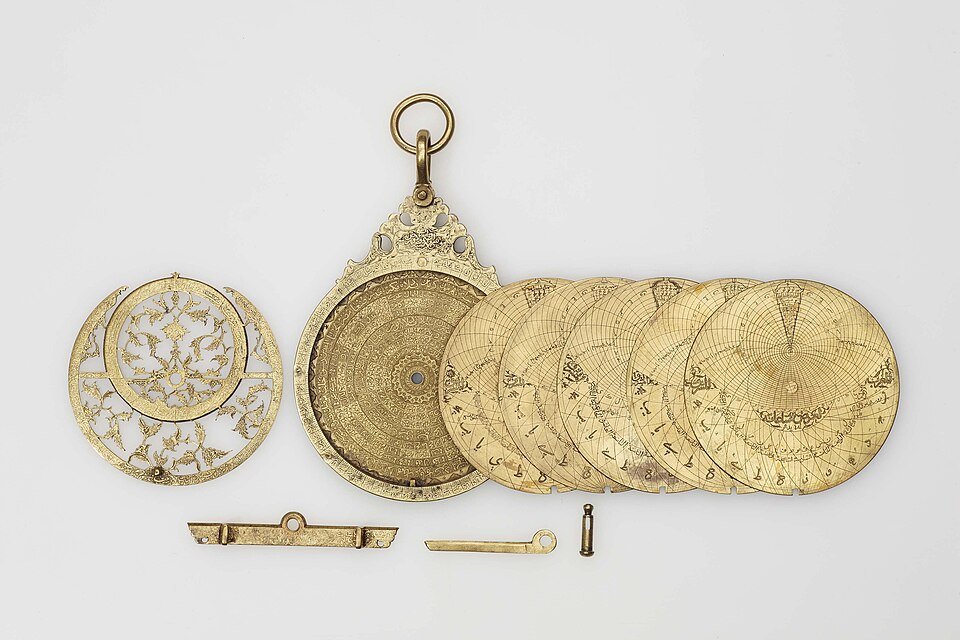
A classic Islamic astrolabe was a masterpiece of metalwork, typically cast from brass and engraved with microscopic accuracy. It consisted of several interlocking components:

  • The Mater (Mother): A heavy brass outer frame with a deep recess designed to hold several interchangeable plates, its outer rim marked with degrees or hours of the day.
  • The Tympans (Plates): Interchangeable brass discs engraved with coordinate grids showing altitude and azimuth lines for specific geographic latitudes. An astrolabe would include plates for cities like Baghdad, Cairo, Mecca, and Cordoba.
  • The Rete (Net): A skeletal brass plate that sat over the tympan, featuring pointers that marked the positions of the brightest stars and a circular path showing the sun's yearly movement through the zodiac. Scribes carved the rete with artistic calligraphy, turning astronomical utility into visual art.
  • The Alidade: A sighting arm on the back of the mater, with small pinholes used to measure the angle of the sun or stars above the horizon.

Mariam al-Astrolabiya: The Master Maker

The manufacture of astrolabes required high skill in both mathematics and brass casting. In 10th-century Aleppo (modern Syria), a woman named Mariam al-Ijliya (known to history as Mariam al-Astrolabiya) became famous for her skill in designing and engineering astrolabes. She was employed by the ruler of Aleppo, Sayf al-Dawla, to manufacture astronomical instruments for the court, showcasing that women participated in the intellectual and mechanical engineering of the Islamic Golden Age.

Calculations in the Palm of the Hand

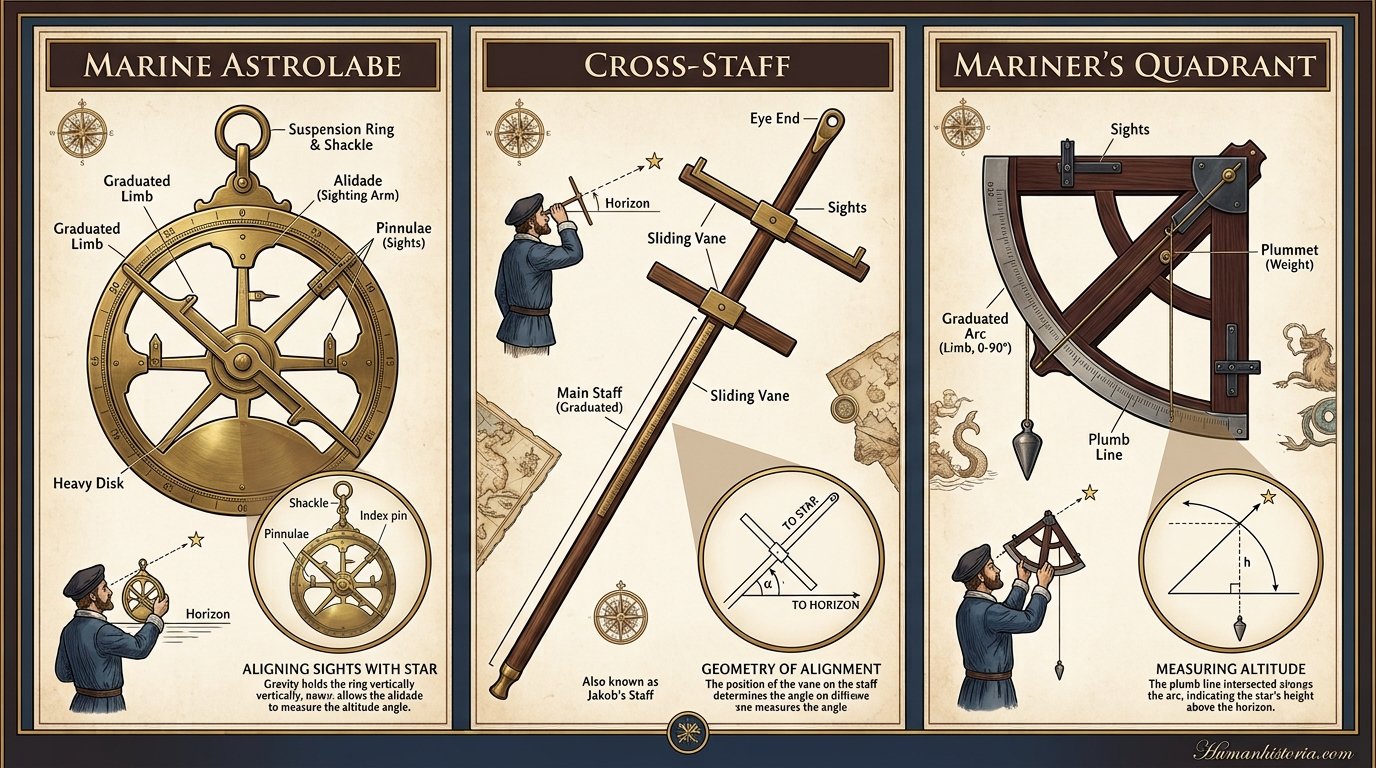
To use an astrolabe, the astronomer held the instrument by a cord at the top, allowing gravity to align it vertically. Looking through the sights of the alidade, they aligned the sighting arm with a star or the sun, reading its altitude off the outer rim degree scale. Scribes and users could then rotate the rete until the star's pointer aligned with the corresponding altitude line on the underlying plate.

Once aligned, the face of the astrolabe showed a direct model of the night sky at that exact moment. From this alignment, the user could instantly read:

  • The local time of day or night.
  • The rising and setting times of the sun and major stars, facilitating nighttime navigation.
  • The sun's position within the zodiac, essential for astrology and agricultural calendars.
  • The direction of Mecca, calculated using the geographic coordinates marked on the plates.

By acting as a mechanical slide rule, the astrolabe allowed merchants, navigators, and scholars to calculate time and position in the palm of their hand, driving trade efficiency and maritime safety across the Indian Ocean and Mediterranean networks.

The Astrolabe Travels to Europe

In the 10th and 11th centuries, Islamic astrolabes entered Western Europe through the shared cultural borders of Islamic Spain (Al-Andalus) and Sicily. Scholars like Gerbert of Aurillac (later Pope Sylvester II) studied Arabic astronomical treatises in Catalonia, translating them into Latin. Scribes copied these manuals, introducing European scholars to spherical geometry. The astrolabe became the primary scientific instrument of medieval European universities, driving the revival of astronomy and navigation that prepared the Age of Discovery.

The Evolution of Navigation and Legacy

The astrolabe remained the standard scientific instrument of the globe for a millennium. Scribes and makers continuously refined its design, developing the Universal Astrolabe (which could be used at any latitude without changing plates) and the Mariner's Astrolabe (a simplified, heavy ring design with cutouts to let the wind pass through, used by explorers like Vasco da Gama and Christopher Columbus to navigate open oceans). The mariner's astrolabe allowed captains to calculate their latitude at sea, unlocking the oceanic trade routes of the 15th and 16th centuries.

By the 17th century, the astrolabe was replaced by the pendulum clock (which measured time more accurately) and the sextant (which offered more precise sighting measurements). However, its legacy survives. The astrolabe established the principles of mechanical computation, proving that complex mathematical calculations can be automated through physical geometry, laying the intellectual foundations for modern computer processors.

The Mathematical Foundations of Stereographic Projection

The scientific brilliance of the astrolabe is based on the mathematical principle of Stereographic Projection, which maps a three-dimensional sphere onto a two-dimensional flat plate without distorting angles. Developed by Greek mathematicians and perfected by Islamic scholars, this geometry allowed astronomers to project the curved paths of the stars and the sun onto the flat surface of the astrolabe's brass plate, turning a complex sphere into an easy-to-read analog computer.

This projection was engraved on a series of interchangeable plates, called tympan, each designed for a specific latitude. Above the plate sat the reteโ€”a skeletal brass wheel carved with pointers representing the brightest stars and a ring representing the sun's path. By rotating the rete, the user could match the positions of the stars to the local time, allowing them to solve astronomical equations without calculations, proving that the astrolabe was a masterpiece of geometry and metallurgy that integrated science, navigation, and faith.

The Astrolabe in Islamic Faith and Practice

In the Islamic Golden Age, the astrolabe was not just an academic instrument; it was a vital tool for daily religious practice. Islamic astronomers and clockmakers perfected the design of the astrolabe to solve three key religious requirements: calculating the Qibla (the direction toward Mecca), determining the five daily prayer times, and predicting the sighting of the crescent moon to mark the start of Islamic months (such as Ramadan).

To calculate these astronomical alignments, makers engraved specialized coordinates on the astrolabe's tympan plates, known as the "plates of the horizons." By matching the altitude of the sun or stars to the coordinates, users could instantly find the direction of Mecca from any city in the Islamic world. Scribes and makers, such as the famous 10th-century Syrian astrolabe maker Mariam al-Astrolabiya, were highly respected for their mathematical and metallic skills, showing how the astrolabe integrated scientific research with religious devotion, driving the development of mathematics and astronomy across the Caliphate.

The Astrolabe as a Prestige Object

Beyond its scientific and religious utility, the astrolabe served as a prestige object that symbolized wealth, education, and political power. Emperors, caliphs, and wealthy merchants commissioned astrolabes made of gilded brass and engraved with intricate floral motifs and astronomical inscriptions. Scribes and metalworkers signed their names on the instruments as a mark of craftsmanship. Having an astrolabe in one's study or library was a sign of intellectual sophistication, indicating that the owner was connected to the latest developments in mathematics and astronomy, proving that scientific instruments carried social and cultural value in both the Islamic and Western worlds.

Antique brass Islamic astrolabe
An authentic antique brass astrolabe, showcasing the intricate scientific coordinate engravings used by Islamic astronomers.

Conclusion: The Mechanical Cosmos

The Islamic golden age astrolabe was a physical model of the universe. By turning the movements of the stars into a set of brass gears and plates, medieval engineers demonstrated that the cosmos was a rational, mathematical system that could be modeled and understood by human reason. The astrolabe standing in museums today is a testament to an era when art, faith, and science were unified, proving that the tools of exploration are the ultimate engines of human progress.

โš–๏ธ

Historian Debate: The Astrolabe as a Cultural Bridge

Islamic Mathematical Innovation

Proponents argue that Islamic astronomers transformed the astrolabe from a simple Greek sky-map into a sophisticated computer capable of calculating coordinates and prayer times.

Hellenistic Legacy

Alternative views emphasize that the mathematical principles of stereographic projection were fully developed by Ptolemy and Hipparchus in Alexandria.

The astrolabe was the most advanced navigational computer before the sextant.

"The astrolabe is the mirror of the universe โ€” it brings the movements of the stars down to the palm of the hand."

โ€” Al-Sufi, Treatise on the Astrolabe (c. 964 CE).

Further Reading

  • The Astrolabe โ€” by James E. Morrison. The definitive guide to the mathematics, design, and history of the instrument.
  • Science and Technology in Islam โ€” by Fuad Sezgin. A monumental catalog of Islamic contributions to navigation and astronomy.
๐Ÿ“– Scholar Mode Active โ€” Click to exit focused reading
Selected Era

Prehistoric Era

Millions of years ago to ~3000 BCE

The dawn of humanity. From the evolutionary split of early hominids to the mastery of stone tools, fire, and the birth of language.

Landmark Milestones

Welcome to Historia

Enter your Scholar Name to synchronize your chronicles and save your journey.