From prehistoric origins to the modern era—discover the turning points, lost empires, and breakthroughs of world history through interactive timelines and visual guides.
Examine the tangible relics, physical tokens, and revolutionary machines that shaped civilizational growth.
🎥 VIDEO HUB & SHORTS
Watch visual summaries, site intros, and mini-documentaries chronicling 300,000 years of world history.
📊 HISTORICAL INFOGRAPHICS ARCHIVE
Museum-grade visual graphics, civilizational timelines, and architectural breakdowns curated for educators and history lovers.
THE HISTORIA CIRCLE
Join the collective discussion, study logs, and contributions of fellow historians mapping humanity's path.
Historia Forum Discussions
Start a Discussion Thread
THEMATIC PATHWAYS
Trace a single thread — disease, trade, energy, migration — across all eras and civilizations.
History is not just a sequence of events — it is a network of patterns. These thematic pathways allow you to follow a single concept across thousands of years: how agriculture spread, how warfare evolved, how trade routes shaped civilizations. Each pathway collects the most relevant chronicles across all eras.
🧩
How is this different from the sidebar Topics?
While the sidebar Topics (like Science & Tech or Empires) filter articles within your selected historical Era, Thematic Pathways cut horizontally across all eras (from Prehistoric to the Future). Use Themes to trace a single concept's evolutionary line across 300,000 years.
CIVILIZATION HUBS
Comprehensive profiles of the world's greatest civilizations and empires — from ancient cradles to global super-states.
Human Historia provides an academically rich exploration of the world's most influential civilizations. From the monumental achievements of ancient Egypt, Han China, and the Roman Empire, to the sophisticated societies of the Maya, the Islamic Caliphates, and West African empires, these hubs offer deep insights into the cultural, political, and technological legacies that continue to shape our global story.
EVOLUTION OF HUMAN SKILLS
Trace the compounding technologies, practical capabilities, and cognitive milestones of the human species.
Human progress is a story of compounding skills. Every breakthrough, from the spark of prehistoric fire to modern silicon transistors, builds directly on previous generations of ingenuity. Hover over a skill node to trace its historical prerequisites, and click it to explore its development timeline, species-wide impact, and related chronicles.
Prehistoric Ancient Medieval Modern Future
🧠
Select any skill node in the tree to explore its evolutionary path, development timeline, and historical impact.
ACADEMIC PASSPORT
Track your intellectual journey, quiz outcomes, and historical badges of honor.
HISTORIA PASSPORT⏳
👤Scribe Novice
Scholar NameHistoria Explorer
Rank RatingSumerian Record Scribe
Chronicles Read0 / 48
Study Guide Pins0 Guides
Security AccessLevel 1 (Novice)
Earned Badges of Honor
🔥
Fire Keeper
Unlock 3 prehistoric chronicles.
🏛️
Codex Keeper
Unlock 3 ancient chronicles.
🏰
Guild Master
Unlock 3 medieval chronicles.
⚙️
Steam Engineer
Unlock 3 modern chronicles.
🚀
Singularity Sage
Unlock 3 future chronicles.
👑
Grand Scholar
Score 5/5 on the Lab Quiz.
Recent Lab Activities
No recent activities recorded. Take a quiz or bookmark articles!
🏛️ MISSION & ARCHIVAL STANDARDS
About Human Historia
A visual encyclopedia and timeline of human history, dedicated to documenting 300,000 years of civilizational evolution through rigorous research, authentic artifacts, and visual clarity.
🌍
The 300,000-Year Story
Human Historia traces our collective journey across five historical epochs: Prehistory, Ancient Worlds, Middle Ages, Modern Age, and Future Horizons. From the first control of fire to quantum computation, we organize turning points into interconnected timelines.
📜
Historiographical Rigor
Every chronicle is built upon primary historical manifests, contemporary excavation reports, and peer-reviewed historical consensus. We prioritize authentic public domain artifacts and clearly identify scholarly debates surrounding major civilizational transitions.
🎨
Museum-Grade Visuals
Complex historical transitions demand visual understanding. We develop high-resolution infographics, architectural cutaways, and comparative territorial maps to transform abstract timelines into vivid, unforgettable learning experiences.
📖
Educational Access
Knowledge belongs to humanity. Human Historia is free, ad-light, and engineered as an educational resource for students, classroom educators, academic researchers, and curious minds across all continents.
Editorial Governance & Inquiries
We welcome peer reviews, academic corrections, museum archival collaborations, and educational partnerships. To submit historical inquiries or provide archival feedback, reach our editorial desk directly.
An immersive graphical anthology tracing the paths of civilizations, breakthroughs, and conflicts that forged the modern consciousness.
25Chronicles
Showing all articles
Copernicus & Galileo: The Astronomical Shift That Removed Earth from the Center
Written by Humanhistoria EditorialHistorical Era: MEDIEVAL
Nicolaus Copernicus, Galileo Galilei & The Heliocentric Revolution | HumanHistoria
Nicolaus Copernicus, Galileo Galilei & The Heliocentric Revolution
By HumanHistoria Editorial Board •
Published: Early Modern Chronicles •
Reading Time: ~11 min (1,850 words)
On a frigid January evening in 1610, in the university city of Padua, a forty-five-year-old Tuscan mathematics professor named Galileo Galilei adjusted a handheld tube of lead and ground optical glass, aiming its fragile twenty-power lens toward Jupiter. What swam into focus shattered two thousand years of consecrated celestial cosmology. Hovering beside the radiant gas giant were three pinpricks of light—soon recognized as orbiting moons—that moved with clockwork precision through the velvety blackness. Until that hour, Western theology and Natural Philosophy had rested upon an immovable foundation: the Earth sat motionless at the geometric and spiritual center of creation, orbited by crystalline spheres bearing the Moon, planets, Sun, and immutable stars. By documenting celestial bodies that orbited another world entirely, Galileo dealt a mortal physical blow to the geocentric universe, transforming Nicolaus Copernicus’s theoretical mathematical hypothesis into an observable empirical truth that permanently dislodged humanity from the throne of cosmic architecture.
🎯 Quick Historical Summary
What Was the Significance of the Heliocentric Revolution?
The Heliocentric Revolution (1543–1687) was the fundamental scientific transformation initiated by Nicolaus Copernicus, mathematically codified by Johannes Kepler, and empirically verified by Galileo Galilei, which demonstrated that Earth and planets revolve around the Sun. It replaced Aristotelian scholasticism with empirical observation and mathematical physics, laying the cornerstone of modern science.
Galileo Galilei presenting his astronomical telescope to the Venetian Signoria at the Campanile of St. Mark’s in August 1609. (Venice State Archives)
The Geocentric Prison: Aristotle, Ptolemy & The Scholastic Universe
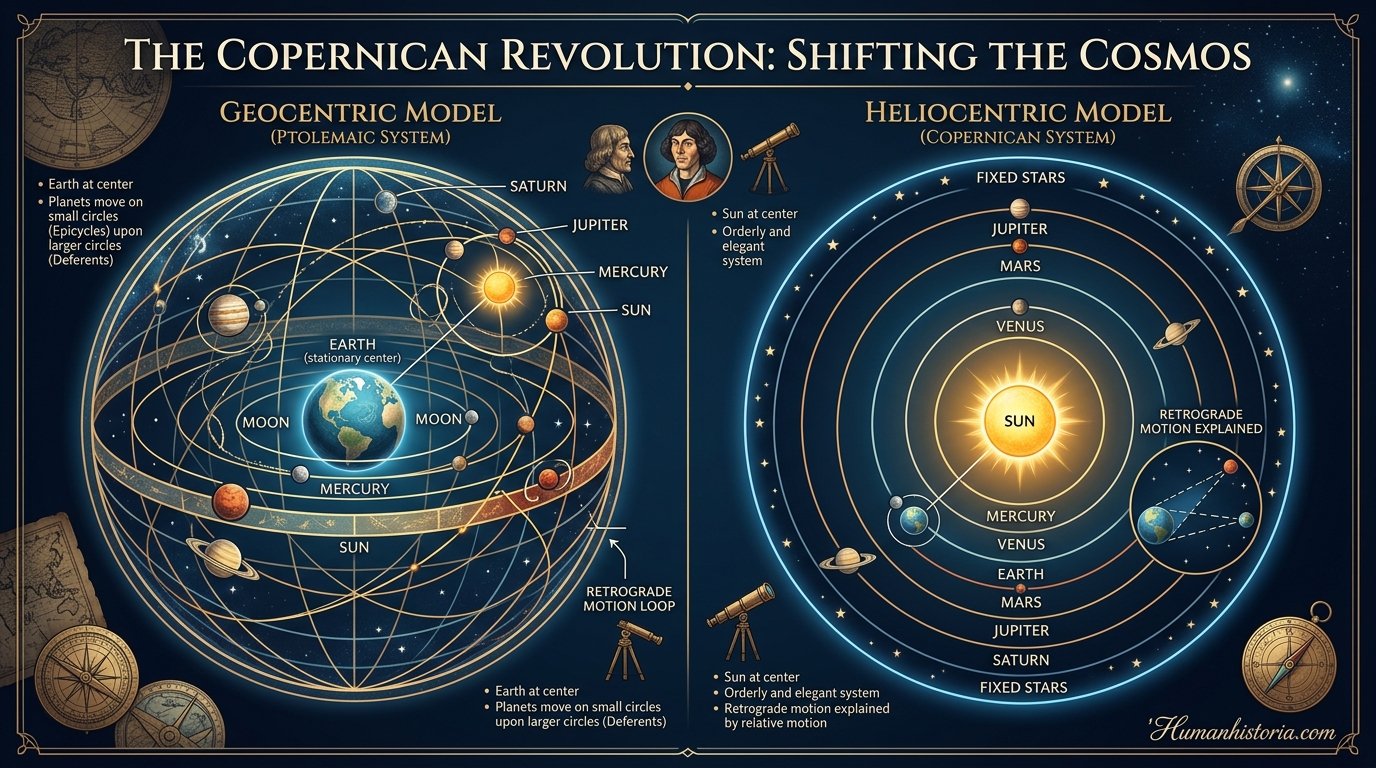
To understand the existential shock of heliocentrism, one must appreciate the intellectual fortress it assaulted. For fourteen centuries, European civilization understood the cosmos through Claudius Ptolemy’s second-century CE Almagest, fused seamlessly with the fourth-century BCE physics of Aristotle. In this geocentric model, the cosmos was divided into two radically distinct physical realms: the sublunary sphere (beneath the Moon), consisting of four corruptible, mutable elements (earth, water, air, and fire) governed by linear motion; and the celestial sphere, composed of incorruptible, crystalline fifth essence (“aether” or quintessence), where heavenly bodies moved in eternal, uniform circular paths.
Yet celestial geometry refused to conform neatly to pristine circles. Viewed from Earth, planets such as Mars, Jupiter, and Saturn occasionally slowed, halted, and traveled backward across the constellations before resuming forward motion—a visual phenomenon known as retrograde motion. To preserve geocentrism while accounting for retrograde loops and variable brightness, Ptolemy constructed a dizzying contraption of secondary geometric devices: epicycles (smaller circles whose centers moved along larger deferent circles), eccentrics (centers offset from Earth), and the equant (a theoretical point from which planetary speed appeared uniform). While mathematically versatile enough to predict eclipses and compile liturgical calendars, the Ptolemaic machinery was an ad-hoc geometric labyrinth that offended purists who sought harmonious physical truth.
Engraving comparing Ptolemy’s Earth-centered universe and Copernicus’s Sun-centered cosmology from the Harmonia Macrocosmica by Andreas Cellarius (1660). (British Library)
Nicolaus Copernicus & The Frombork Awakening
The first seismic crack in this edifice was chiseled by a reclusive Polish canon named Nicolaus Copernicus (1473–1543). Serving as church administrator in the windswept Baltic cathedral town of Frombork (Frauenburg), Copernicus was neither a laboratory experimentalist nor an optical observer; telescopes would not be invented for another six decades. Instead, he was a humanist mathematician trained in canon law and medicine in Kraków, Bologna, and Padua. Plagued by the arbitrary clumsiness of Ptolemy’s equant, Copernicus asked a revolutionary question: what if planetary calculations were reckoned not from the terrestrial observer, but from the Sun?
Between 1510 and 1514, Copernicus circulated an anonymous handwritten manuscript titled the Commentariolus (“Little Commentary”) among trusted scholars, proposing seven foundational axioms: the Earth is not the center of all celestial motions; the center of the universe lies near the Sun; the apparent daily rotation of the heavens is caused by Earth turning on its axis; and the annual progression of the Sun through the zodiac is caused by Earth orbiting the Sun like any other planet. Retrograde motion was revealed as a magnificent optical illusion: when the faster-moving Earth catches and overtakes an outer planet like Mars in its orbit, Mars appears to reverse direction against the distant stars, exactly like a slower train appears to slip backward when viewed from a faster express train overtaking it.
Fearing ridicule and church condemnation, Copernicus withheld his comprehensive mathematical treatise for three decades until urged by a young Austrian disciple, Georg Joachim Rheticus. In the spring of 1543, as Copernicus lay dying of a stroke in Frombork, the first printed copies of De revolutionibus orbium coelestium (“On the Revolutions of the Heavenly Spheres”) rolled off Johannes Petreius’s presses in Nuremberg. Tragically, the Lutheran theologian Andreas Osiander had inserted an unauthorized, anonymous preface assuring readers that the book presented merely mathematical computing fictions to simplify astrological tables rather than physical reality. Yet the fuse of revolution had been lit.
“In the center of all rests the Sun. For who would place this lamp of a very beautiful temple in another or better place than this wherefrom it can illuminate everything at the same time? As it is, seated upon a royal throne, the Sun guides his family of planets that circle round him.”
— Nicolaus Copernicus, De revolutionibus orbium coelestium, Book I, Chapter 10 (1543)
Kepler’s Laws: Breaking the Circle of Perfection
Copernicus’s system was mathematically radical in principle, yet physically conservative in detail: because he clung dogmatically to the ancient Aristotelian axiom that celestial motion must consist of uniform circular paths, he was forced to retain dozens of mini-epicycles to reconcile his calculations with reality. The man who demolished the circular myth was the German mathematician and imperial astronomer Johannes Kepler (1571–1630).
Inheriting the peerless, naked-eye observational records compiled over decades by Danish nobleman Tycho Brahe at the island observatory of Uraniborg, Kepler spent eight grueling years attempting to map the orbit of Mars. After finding an eight-arcminute discrepancy between circular orbits and Brahe’s raw data—an error too small to ignore—Kepler made the conceptual leap that saved heliocentrism. Nature did not move in sacred circles; it moved in ellipses.
In his 1609 masterpiece Astronomia Nova (“New Astronomy”) and 1619 Harmonices Mundi (“The Harmony of the World”), Kepler formulated the Three Laws of Planetary Motion:
First Law (Elliptical Orbits): The orbit of each planet is an ellipse with the Sun situated at one of the two foci.
Second Law (Equal Areas): A line joining a planet and the Sun sweeps out equal areas during equal intervals of time, meaning planets accelerate as they approach the Sun (perihelion) and decelerate at their farthest distance (aphelion).
Third Law (Harmonic Ratio): The square of the orbital period of a planet is directly proportional to the cube of the semi-major axis of its orbit (P² = a³), establishing a precise, universal mathematical relationship governing all planetary distances.
Galileo Galilei: The Telescope & Empirical Reality
While Kepler provided the theoretical mathematics, Galileo Galilei supplied the empirical proof that made the old cosmos indefensible. Hearing reports of a Dutch optical spyglass invented by Hans Lippershey in 1608, Galileo ground his own biconvex and planoconcave lenses, improving magnification from 3x to 20x. When he pointed this instrument skyward in 1609–1610, he dismantled Aristotelian dogma night after night.
In March 1610, Galileo published his findings in a sensational 24-page pamphlet titled Sidereus Nuncius (“The Starry Messenger”). Its revelations swept across Europe:
The Imperfect Moon: Rather than a pristine, smooth crystalline sphere of celestial quintessence, the Moon possessed rugged mountain ranges, deep valleys, and craggy impact craters, proving that celestial bodies were made of rough, earthly matter.
The Moons of Jupiter: Galileo tracked four tiny satellites (which he named the “Medicean Stars” to honor Grand Duke Cosimo II de’ Medici) orbiting Jupiter, proving beyond dispute that celestial bodies could orbit centers other than Earth.
The Phases of Venus: Observing Venus over several months in late 1610, Galileo documented a complete cycle of crescent, gibbous, and full phases matching changes in apparent size—a geometric impossibility in the Ptolemaic model, which dictated that Venus could never pass behind the Sun from Earth’s perspective.
Sunspots: Projecting images of the Sun onto paper, Galileo tracked dark blemishes traversing the solar disc, proving that the Sun rotated on its axis and was itself subject to change and imperfection.
Cosmological Model
Primary Proponent
Center of Motion
Orbital Geometry
Empirical Vulnerability
Ptolemaic Geocentrism
Claudius Ptolemy (c. 150 CE)
Earth (Stationary)
Complex circles with epicycles, deferents, and equants
Cannot explain phases of Venus, moons of Jupiter, or stellar aberration
Tychonic Hybrid
Tycho Brahe (1588)
Earth (Center of Moon/Sun); Sun (Center of Planets)
Circles centered on moving Sun while Sun orbits stationary Earth
Arbitrary geometric compromise designed to save biblical geocentric literalism
Copernican Heliocentrism
Nicolaus Copernicus (1543)
Sun (Stationary)
Circular orbits retaining secondary minor epicycles
Failed to predict precise planetary positions due to refusal to abandon circular motion
Keplerian-Galilean Physics
Kepler (1609) & Galileo (1610)
Sun (Heliocentric Focus)
Ellipses with variable orbital velocities governed by mathematical laws
Vindicated by telescopic observation; completed by Newton’s universal gravitation
The Inquisition, Pope Urban VIII & The Trial of 1633
The confrontation between heliocentrism and the Catholic Counter-Reformation was not merely a clash between science and faith; it was an acute battle over institutional authority, biblical hermeneutics, and Reformation-era censorship. In 1615, Galileo traveled to Rome to defend Copernicanism, arguing in his famous Letter to the Grand Duchess Christina that the Bible was written to teach “how to go to heaven, not how heaven goes,” and that scriptures employed allegorical language tailored to the understanding of ancient readers.
However, in the wake of the Council of Trent, Catholic orthodoxy strictly forbade interpreting scripture contrary to the literal consensus of the Church Fathers. In March 1616, the Congregation of the Index placed De revolutionibus on the Index of Prohibited Books “until corrected,” and Cardinal Robert Bellarmine formally admonished Galileo to abandon Copernican views and cease holding, teaching, or defending them in any way.
The crisis reignited in 1623 with the election of Cardinal Maffeo Barberini as Pope Urban VIII—a sophisticated patron of the arts and personal admirer of Galileo. Barberini granted Galileo permission to write an objective comparison of the Copernican and Ptolemaic systems, provided he treated both as hypothetical models and included the Pope’s theological view that an omnipotent God could arrange the heavens in ways beyond human comprehension.
Published in Florence in 1632, Galileo’s Dialogue Concerning the Two Chief World Systems betrayed the Pope’s conditions. Written in vibrant vernacular Italian rather than academic Latin, the book took the form of a four-day debate between Salviati (a brilliant Copernican proxy for Galileo), Sagredo (an intelligent layman), and Simplicio (a dogmatic Aristotelian scholastic whose name carried the double meaning of “simpleton”). Decisively demolishing geocentric arguments, Galileo placed the Pope’s exact theological caveat into the mouth of the bumbling Simplicio on the book’s final page.
Enraged and embroiled in the geopolitical nightmare of the Thirty Years’ War, Urban VIII summoned the ailing sixty-nine-year-old scientist to Rome. Interrogated under threat of torture by the Roman Inquisition in the spring of 1633, Galileo was convicted of “vehement suspicion of heresy.” On June 22, 1633, kneeling on the marble floor of the convent of Santa Maria sopra Minerva, dressed in the white penitential sackcloth, Galileo read a formal abjuration, swearing that he cursed and detested his past heliocentric errors. Legend maintains that upon rising from his knees, he muttered under his breath: “Eppur si muove” (“And yet it moves”). His Dialogue was banned, and he spent the remaining nine years of his life under permanent house arrest at his villa Il Gioiello in Arcetri near Florence, slowly going blind while composing his greatest physical masterpiece: Discourses and Mathematical Demonstrations Relating to Two New Sciences (1638), laying the mathematical foundations of kinematics and classical mechanics.
Historiographical Debate: Paradigm Shift vs. Continuity
Historians of science continue to debate the exact nature of the Copernican Revolution. In The Structure of Scientific Revolutions (1962), Thomas Kuhn characterized Copernicus’s work as the archetype of a radical paradigm shift that obliterated traditional scholastic frameworks. In contrast, revisionist scholars like Edward Grant and David Lindberg emphasize institutional and theoretical continuity: fourteenth-century Paris scholastics like Jean Buridan and Nicole Oresme had already theorized the diurnal rotation of Earth, while medieval Islamic astronomers of the Maragha Observatory (notably Nasir al-Din al-Tusi and Ibn al-Shatir) developed the mathematical theorems (“Tusi couple”) that Copernicus incorporated directly into his diagrams. Rather than an isolated epiphany, the revolution represented the convergence of global mathematical legacies ignited by Renaissance humanist philology and optical technology.
Long-Term Institutional Legacy: The Birth of Modern Science
The Heliocentric Revolution altered human consciousness more profoundly than any political upheaval. By dethroning the Earth, Copernicus, Kepler, and Galileo broke the ancient cosmic hierarchy that linked moral theology to spatial topography. The universe was no longer a cozy, finite medieval theatre bounded by heaven above and hell below, but an infinite, isotropic void governed everywhere by the same physical laws.
Half a century after Galileo’s trial, Isaac Newton unified Kepler’s celestial kinematics with Galileo’s terrestrial mechanics in his 1687 Philosophiae Naturalis Principia Mathematica. Newton’s universal law of gravitation demonstrated that the exact same mathematical force pulling an apple from an orchard tree holds the Moon in its orbit and guides the planets around the Sun. In dismantling geocentrism, the pioneers of the Scientific Revolution did something vastly greater than repositioning planets: they forged the empirical scientific method—combining precision instrumental observation, experimental reproducibility, and universal mathematical law—which remains humanity’s supreme tool for deciphering reality.
📊 Museum-Grade Infographic Poster
The Heliocentric Revolution & Telescope Studies Infographic
💡 Click anywhere on poster to expand in high resolution🔎 Expand Lightbox
Scientific diagram contrasting the geocentric Ptolemaic universe with the Copernican sun-centered planetary model, illustrating early telescopic optics.
📖 SCHOLARLY INQUIRIES
Frequently Asked Questions
Essential historical questions and evidence-based answers concerning this chronicle.
Q.What was the Heliocentric Model proposed by Copernicus?
The heliocentric model, published by Nicolaus Copernicus in 1543 in De revolutionibus orbium coelestium, proposed that the Sun rests motionless near the center of the universe, and that Earth and other planets revolve around it in circular orbits while Earth rotates daily on its axis.
Q.What did Galileo discover with his telescope in 1609–1610?
Using an improved 20x magnification telescope, Galileo discovered that the Moon possessed rugged mountains and craters, tracked four moons orbiting Jupiter (proving not all celestial bodies circle Earth), documented the full cycle of phases of Venus (disproving Ptolemaic cosmology), and observed sunspots.
Q.Why did the Roman Catholic Church condemn Galileo in 1633?
Following the publication of his 1632 Dialogue Concerning the Two Chief World Systems, which ridiculed geocentrism and appeared to mock Pope Urban VIII, the Roman Inquisition tried Galileo for violating a 1616 injunction against teaching or defending Copernicanism. He was convicted of vehement suspicion of heresy and sentenced to lifelong house arrest.
Q.Did Galileo really say 'Eppur si muove' ('And yet it moves')?
While the dramatic legend that Galileo muttered 'Eppur si muove' immediately after abjuring on his knees before the Inquisition is celebrated in scientific folklore, contemporary 1633 court trial records do not mention it. The phrase first appeared in print in 1757, though a 1640s painting attributed to Bartolomé Esteban Murillo depicts Galileo in prison with the words scratched on the wall.
📚 Academic Sources & Scholarly Bibliography
Kuhn, Thomas S. (1957).
The Copernican Revolution: Planetary Astronomy in the Development of Western Thought.
Harvard University Press.
Drake, Stillman (1978).
Galileo at Work: His Scientific Biography.
University of Chicago Press.
Westfall, Richard S. (1989).
Essays on the Trial of Galileo.
Vatican Observatory Publications.
Sobel, Dava (1999).
Galileo's Daughter: A Historical Memoir of Science, Faith, and Love.
Walker & Company.
📖 Scholar Mode Active — Click to exit focused reading
History Lab 🧪
Interactive historical deduction games, tactical matchup simulators, and currency calculators.
🕵️ Who Am I? (The Historical Guess Game)
A secret historical figure has been selected. Ask yes/no questions to narrow down the pool of candidates. Click any active card to make your accusation!
Secret Identity
❓ Who Am I?
Ask questions using the board below to narrow down my identity.
Ask a Question:
Question LogQuestions: 0 / 7
No questions asked yet.
Candidate Board:
🗺️ Timeline Scramble
Five historical events appear out of order. Click them in the correct chronological sequence — from oldest to most recent. How well do you know your history?
🏺 Relic or Fake?
Is this a real historical artifact or a convincing fabrication? Judge each one based on its description and era — then see the truth revealed!
Artifact 1 / 10Score: 0
Empire Matchup Simulator
Empire ATerritory Size (Peak, M km²)Empire B
00
Empire APopulation (Peak, Millions)Empire B
00
Empire AMilitary Power (Army Size)Empire B
00
Tactical Battle Analysis
Select empires and click simulate to run evaluations.
Historical Purchasing Power Converter
See what ancient coins are worth in modern terms and check their historical purchasing power.
Modern Value Equivalent
$0.00 USD
Historical Purchasing Power:
Select currency to view purchasing capability.
Historical Identity Generator
Forge an authentic historical identity from ancient civilisations, complete with linguistic meaning and biography.
Neutral
Gaius Julius
Meaning:Descendant of Jupiter
Historical Background:
A Roman citizen and clerk who worked in the forum under Roman republic rule.
Chrono-Cultural Fusion Simulator
Fuse the culture, technology, and governance of two legendary civilizations to synthesize a unique hybrid society.
Cohesion & Coexistence Rate
85%
🏛️ Hybrid Architecture
⚙️ Synthesized Asset
📜 Synthetic Governance
Historical Tactics & Trivia Quiz
Test your historical knowledge and battle tactics to claim your administrative rank.
8 Questions • Multi-Era
You will be presented with random scenarios and trivia spanning ancient Egypt, classical Rome, Islamic Golden Age, and the modern industrial era. Complete the evaluation to see your historical title!
Question 1 of 8Score: 0
What was the Code of Hammurabi written on?
Correct!
Evaluation Complete!
6 / 8
Correct
Rank Attained
Imperial Legionary
Your knowledge of classical strategy and administrative structures is respectable.
🎲 Counterfactual "What If?" Scenario Simulator
Explore alternative historical trajectories by tweaking key civilizational pivot points.
Simulated Shift
Selected Era
Prehistoric Era
Millions of years ago to ~3000 BCE
The dawn of humanity. From the evolutionary split of early hominids to the mastery of stone tools, fire, and the birth of language.
Landmark Milestones
Welcome to Historia
Enter your Scholar Name to synchronize your chronicles and save your journey.

 ⭐ Featured Chronicle
 ANCIENT AGES
 ANCIENT AGES
 ANCIENT AGES
 MEDIEVAL PERIOD
 MEDIEVAL PERIOD
 PREHISTORIC ERA