>
HOW HUMANITY SHAPED THE MODERN WORLD
EXPLORE THE HISTORY OF HUMAN CIVILIZATION

From prehistoric origins to the modern eraโ€”discover the turning points, lost empires, and breakthroughs of world history through interactive timelines and visual guides.
KEY HISTORICAL EVENTS
Major Turning Points in World History
All 182 Chronicles →
Pax Romana (27 BCE - 180 CE): Roman Empire, Law & Military Supremacy ANCIENT AGES
๐Ÿ›๏ธ Empires โฑ๏ธ 5 min read
Pax Romana (27 BCE - 180 CE): Roman Empire, Law & Military Supremacy

Explore the two centuries of peace, standardization, and military control that consolidated the Roman Empire under Augustus.

Read Chronicle →
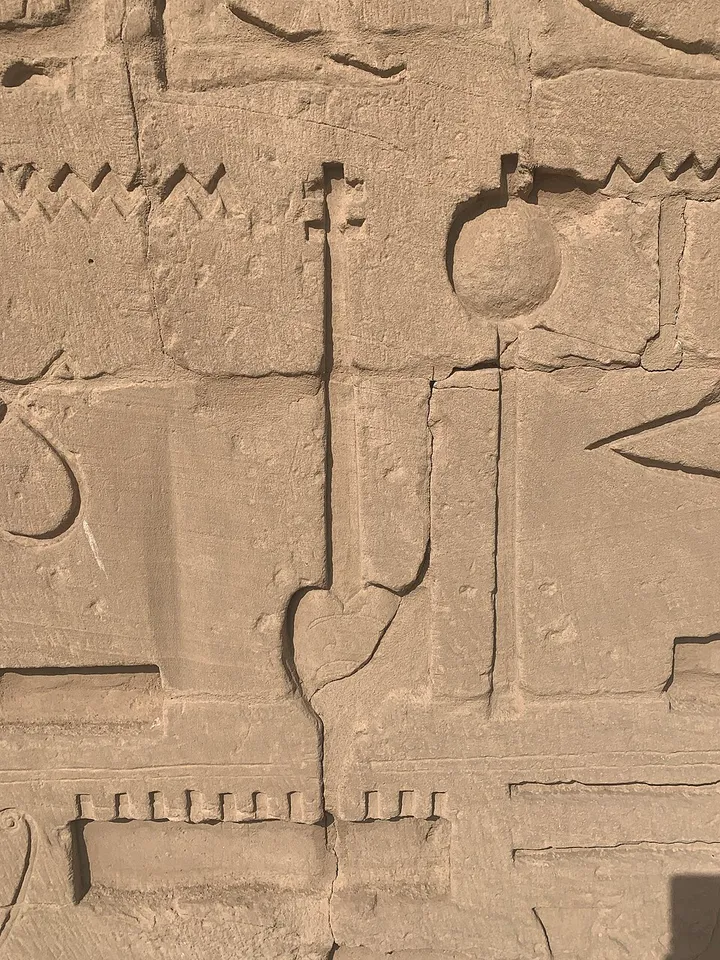
Egyptian Hieroglyphs: Decipherment, Scribes & Sacred Carvings ANCIENT AGES
๐Ÿ›๏ธ Languages โฑ๏ธ 9 min read
Egyptian Hieroglyphs: Decipherment, Scribes & Sacred Carvings

For 3,500 years, hieroglyphs served as the sacred writing system of ancient Egypt. Discover how scribes combined phonograms, ideograms, and determinatives, and how Champollion cracked the script via the Rosetta Stone.

Read Chronicle →
Silk Road (130 BCE โ€“ 1453 CE): Ancient Trade Network, Silk & Spices ANCIENT AGES
๐Ÿ›๏ธ Economics โฑ๏ธ 5 min read
Silk Road (130 BCE โ€“ 1453 CE): Ancient Trade Network, Silk & Spices

Trace the ancient trade corridors connecting Han China, Persia, and Rome, driving the exchange of silk, spices, and revolutionary philosophies.

Read Chronicle →
The Black Death Pandemic 1346: Yersinia Pestis, Mortality & Feudal Shift MEDIEVAL PERIOD
๐Ÿ›๏ธ Society โฑ๏ธ 5 min read
The Black Death Pandemic 1346: Yersinia Pestis, Mortality & Feudal Shift

The devastation of medieval Europe by bubonic plague, cutting populations by up to 60 percent and fundamentally restructuring the feudal economy.

Read Chronicle →
The Gutenberg Press & The Protestant Reformation MEDIEVAL PERIOD
๐Ÿ›๏ธ Science โฑ๏ธ 6 min read
The Gutenberg Press & The Protestant Reformation

Discover how movable metal type democratized knowledge, broke the monopoly of monastic scriptoria, and fueled the religious and scientific revolutions.

Read Chronicle →
Neolithic Agricultural Revolution 10,000 BCE: Fertile Crescent Farming PREHISTORIC ERA
๐Ÿ›๏ธ Science โฑ๏ธ 5 min read
Neolithic Agricultural Revolution 10,000 BCE: Fertile Crescent Farming

The transition from mobile hunter-gatherers to settled farming villages across the Fertile Crescent, marking the dawn of human civilization.

Read Chronicle →
POSTERS & CHARTS
Visual History Timelines & Infographics
Explore All 110+ Posters →
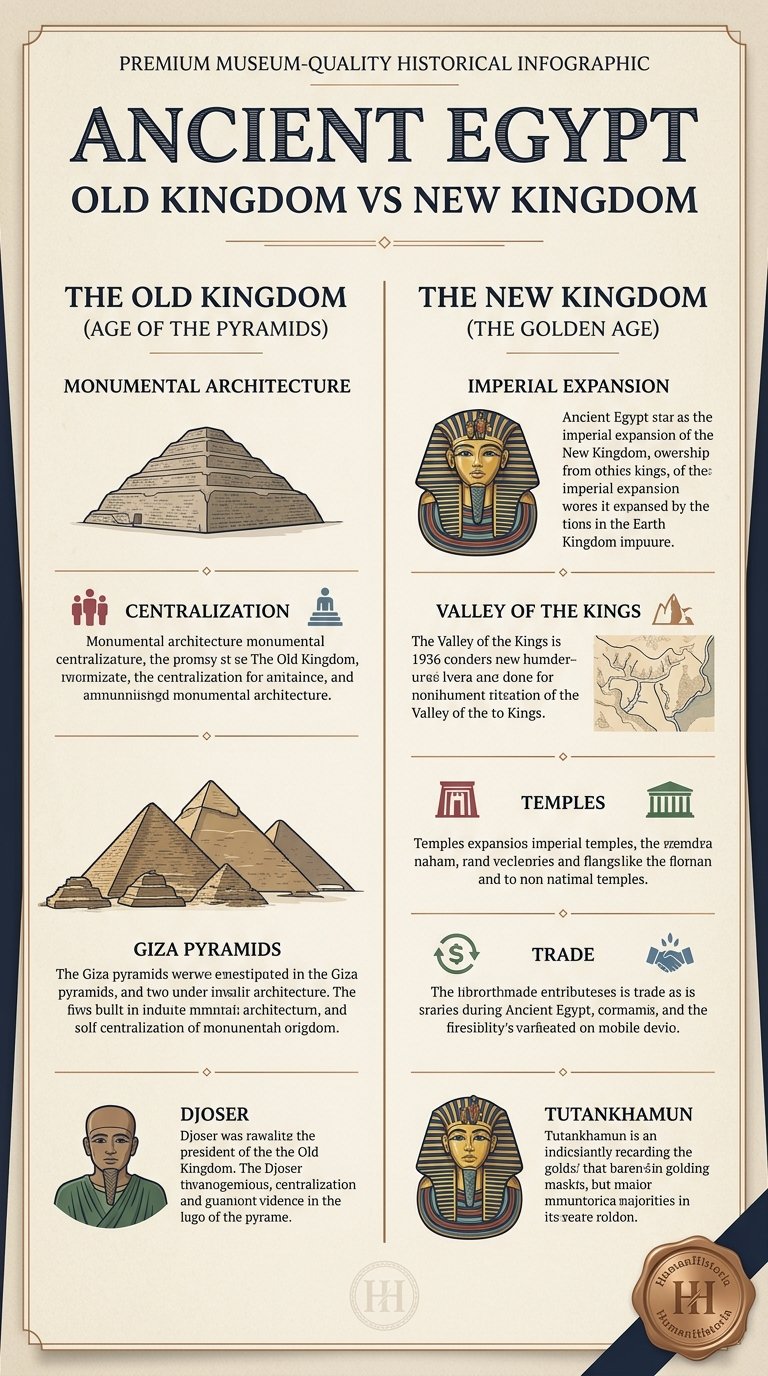
Ancient Egypt: Old Kingdom vs. New Kingdom
๐Ÿ” Tap to Zoom
Ancient Egypt: Old Kingdom vs. New Kingdom
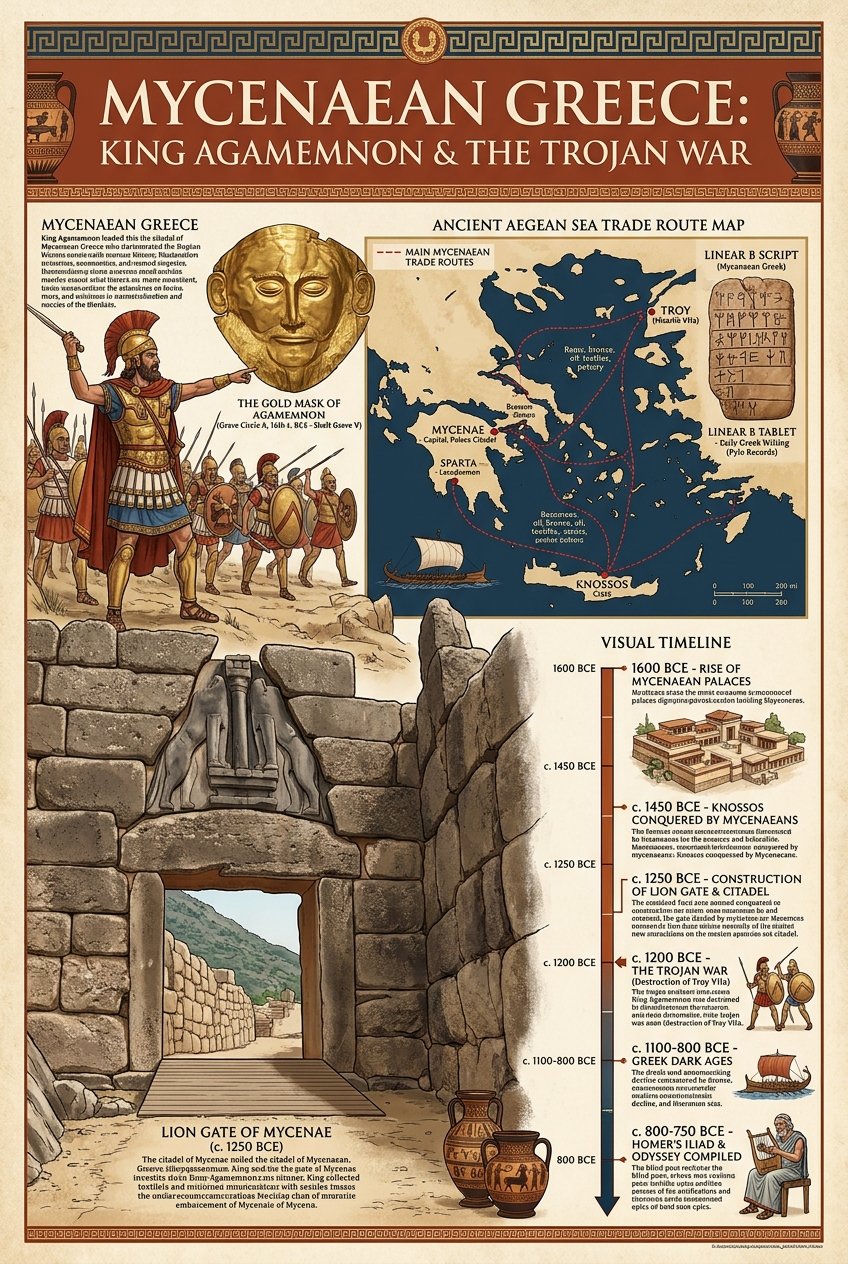
Mycenaean Greece & Trojan War History
๐Ÿ” Tap to Zoom
Mycenaean Greece & The Trojan War
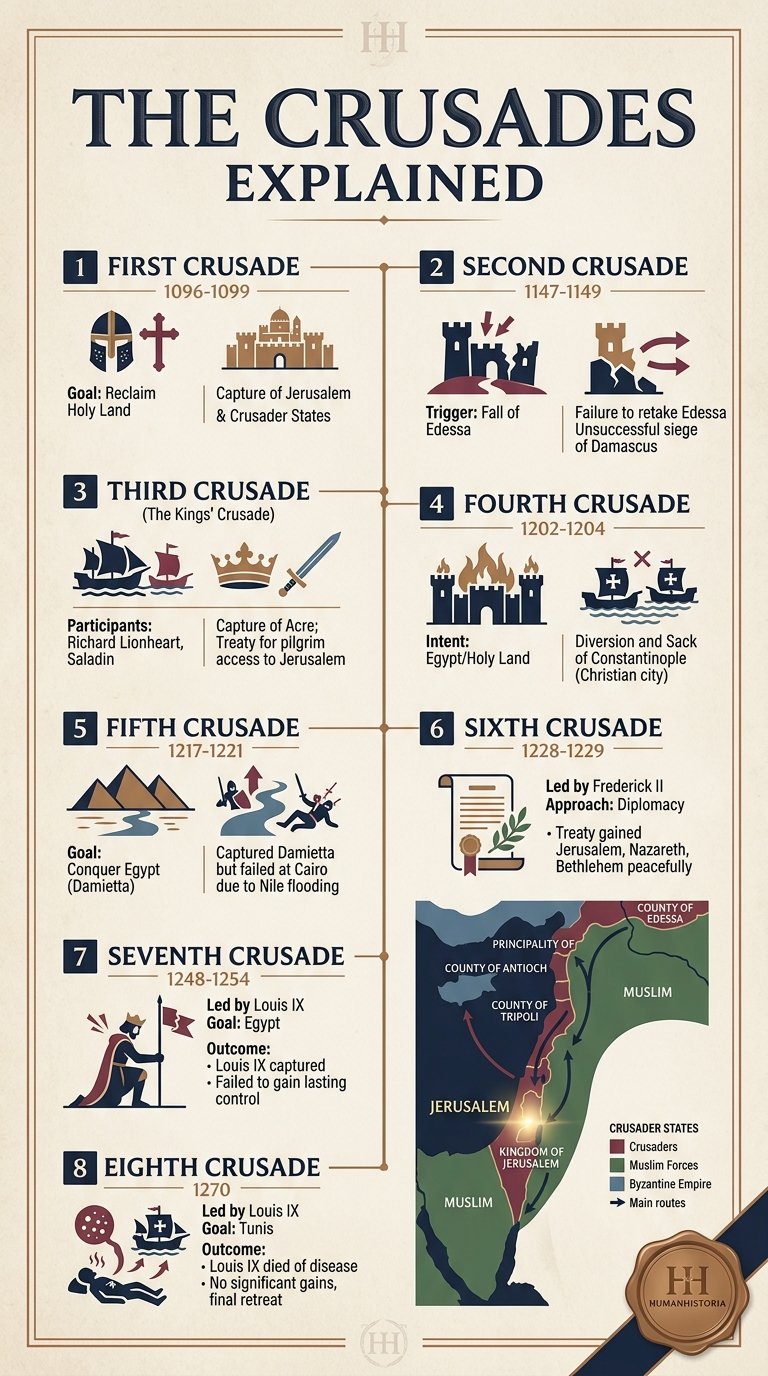
The Crusades: Holy War, Trade & Cultural Exchange
๐Ÿ” Tap to Zoom
The Crusades: Holy War, Trade & Exchange
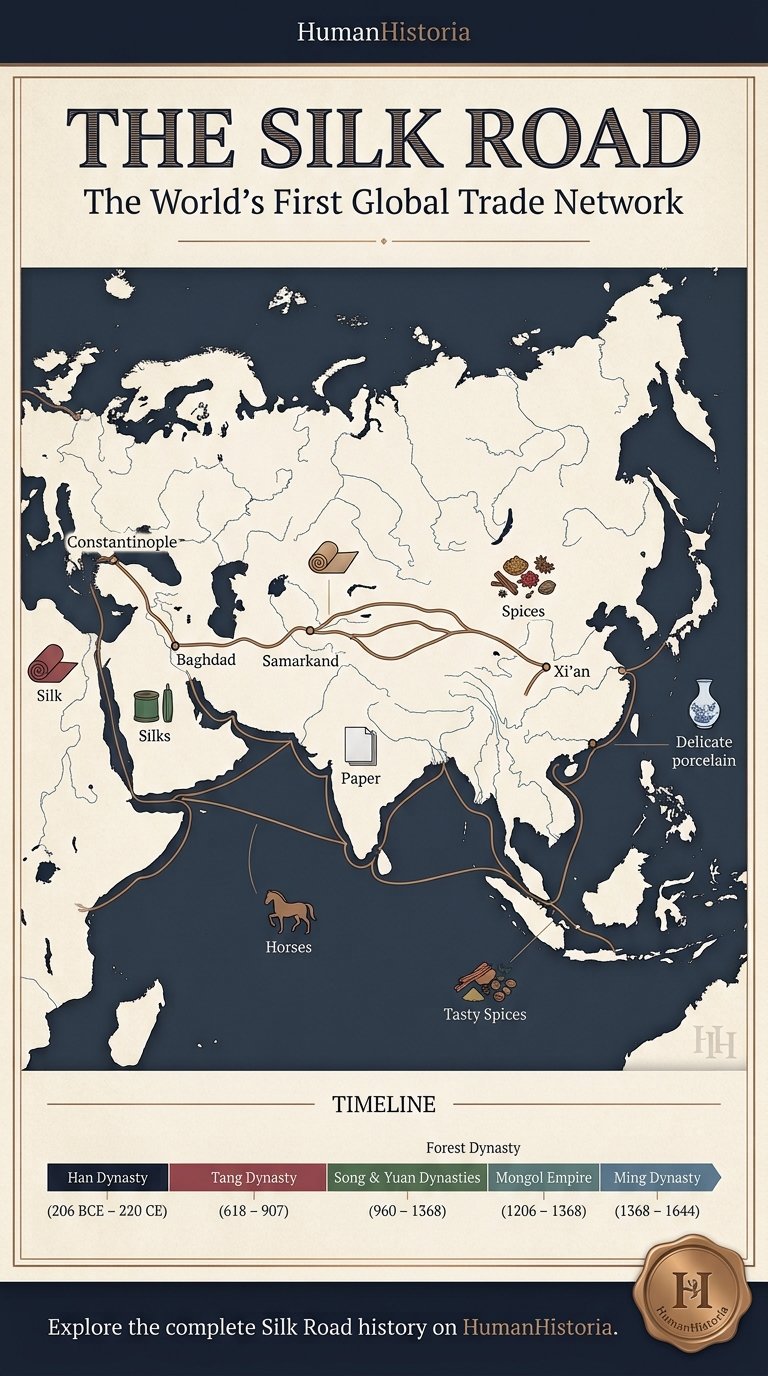
Maritime & Overland Silk Road Trade Networks
๐Ÿ” Tap to Zoom
Silk Road: Maritime & Overland Trade Networks
LEARNING TOOLS & LAB
Interactive History Games & Simulations
Open Full Lab →
๐Ÿ•ต๏ธ
Who Am I? (Historical Guessing Game)

A secret historical figure has been chosen. Ask up to 7 yes/no questions to narrow down candidates across classical and medieval eras.

Play Game →
๐Ÿ—บ๏ธ
Timeline Scramble

Five historical events appear out of order. Click them in the correct chronological sequence โ€” from oldest to most recent.

Test Chronology →
โš–๏ธ
Empire Matchup Simulator

Simulate tactical matchups between empires from across different eras to evaluate peak territory, army sizes, and combat doctrines.

Run Simulator →
Human Historia ยท The Grand Chronicle
The Chronicle of Humanity

300,000 years. 5 eras. Countless turning points that shaped every moment of your world.

๐Ÿฆด
Prehistoric Era
c. 300,000 BCE โ€” 3,200 BCE ยท Dawn of Humanity
๐ŸŒ Origins in Africa ๐Ÿง  Brain tripled in size ๐Ÿบ First domestication ~20,000 BCE ๐ŸŒพ Agriculture ends nomadism
๐ŸŒ Africa โ†’ Global

Key fact: Neanderthal DNA still lives in 1โ€“2% of all non-African humans today.

Related: Animal Domestication, Cave Art

๐Ÿ”ฅ Africa

Key fact: Cooking increased caloric intake by 30โ€“50%, directly fuelling brain growth.

Related: Stone Tools, Migration

๐ŸŒพ Fertile Crescent

Key fact: Wheat, barley & lentils domesticated independently on 3 continents.

Related: Gรถbekli Tepe, Cuneiform

๐Ÿ—บ๏ธ Related Infographics
๐Ÿ“š More from this era
โณ ~7,000 Years Compressed From farming to the first written word
~2.3% of recorded human history
๐Ÿ›๏ธ
Ancient Ages
c. 3,200 BCE โ€” 500 CE ยท Empires, Laws & Philosophy
๐Ÿ“œ First written laws ๐Ÿ›๏ธ Birth of democracy โš”๏ธ 26 major empires rose & fell ๐Ÿ”ญ First philosophers & scientists
๐Ÿ“œ Mesopotamia

Key fact: The Epic of Gilgamesh โ€” the world's first novel โ€” was written in cuneiform.

Related: Epic of Gilgamesh, Hammurabi

๐Ÿ“š Alexandria, Egypt

Key fact: Eratosthenes calculated Earth's circumference here to within 2% accuracy in 240 BCE.

Related: Greek Philosophy, Roman Empire

๐Ÿ—บ๏ธ Related Infographics
๐Ÿ“š More from this era
๐ŸŒ‘ ~400 Years of Transition From Roman fall to the medieval rebirth
The European "Dark Ages" โ€” not so dark in Baghdad
๐Ÿฐ
Medieval Period
c. 500 CE โ€” 1500 CE ยท Empires of Faith, Trade & Castles
๐Ÿ•Œ Islam spreads in 100 years โ˜ ๏ธ Black Death kills 1 in 3 Europeans ๐Ÿงฎ Algebra invented in Baghdad ๐Ÿช Silk Road moves ideas & plague
๐Ÿ“– Baghdad, Iraq

Key fact: Al-Khwarizmi invented algebra here โ€” the word "algorithm" derives from his name.

Related: Silk Road, Mansa Musa

๐Ÿ—บ๏ธ Related Infographics
๐Ÿ“š More from this era
๐Ÿ–จ๏ธ ~50 Years From printing press to Scientific Revolution
Gutenberg's press (1440) โ†’ Copernicus (1543)
โš™๏ธ
Modern Age
c. 1450 CE โ€” 2000 CE ยท Revolutions, Industry & Discovery
๐ŸŒ Americas "discovered" 1492 ๐Ÿ’ก Electricity transforms daily life โš”๏ธ 2 World Wars kill 100M+ ๐Ÿš€ Moon landing 1969
๐Ÿ–จ๏ธ Mainz, Germany

Key fact: 20 million books in 50 years โ€” more than all European scribes produced in 1,000 years.

Related: Scientific Revolution, Reformation

๐Ÿš‚ Britain

Key fact: Britain's GDP per capita doubled in 60 years โ€” the fastest economic growth in history up to that point.

Related: Electricity, Wright Brothers

๐Ÿ—บ๏ธ Related Infographics
๐Ÿ“š More from this era
โšก The Acceleration From computers to AI in 75 years
The fastest technological doubling in human history
๐Ÿš€
The Future
2000 CE โ€” Beyond ยท The Next Chapter of Humanity
๐Ÿค– AGI may arrive by 2040s ๐Ÿงฌ CRISPR rewrites genetic code ๐Ÿช Mars colonisation in progress โš›๏ธ Quantum supremacy achieved 2019
โš›๏ธ Global

Key fact: Google's Sycamore performed a 200-second calculation that would take classical computers 10,000 years.

Related: AI Singularity, CRISPR, Space

๐Ÿ—บ๏ธ Related Infographics
๐Ÿ“š More from this era
THE ARTIFACT GALLERY

Examine the tangible relics, physical tokens, and revolutionary machines that shaped civilizational growth.

๐ŸŽฅ VIDEO HUB & SHORTS

Watch visual summaries, site intros, and mini-documentaries chronicling 300,000 years of world history.

๐Ÿ“Š HISTORICAL INFOGRAPHICS ARCHIVE

Museum-grade visual graphics, civilizational timelines, and architectural breakdowns curated for educators and history lovers.

THE HISTORIA CIRCLE

Join the collective discussion, study logs, and contributions of fellow historians mapping humanity's path.

Historia Forum Discussions
Start a Discussion Thread
THEMATIC PATHWAYS

Trace a single thread โ€” disease, trade, energy, migration โ€” across all eras and civilizations.

History is not just a sequence of events โ€” it is a network of patterns. These thematic pathways allow you to follow a single concept across thousands of years: how agriculture spread, how warfare evolved, how trade routes shaped civilizations. Each pathway collects the most relevant chronicles across all eras.

๐Ÿงฉ
How is this different from the sidebar Topics?
While the sidebar Topics (like Science & Tech or Empires) filter articles within your selected historical Era, Thematic Pathways cut horizontally across all eras (from Prehistoric to the Future). Use Themes to trace a single concept's evolutionary line across 300,000 years.
CIVILIZATION HUBS

Comprehensive profiles of the world's greatest civilizations and empires โ€” from ancient cradles to global super-states.

Human Historia provides an academically rich exploration of the world's most influential civilizations. From the monumental achievements of ancient Egypt, Han China, and the Roman Empire, to the sophisticated societies of the Maya, the Islamic Caliphates, and West African empires, these hubs offer deep insights into the cultural, political, and technological legacies that continue to shape our global story.

EVOLUTION OF HUMAN SKILLS

Trace the compounding technologies, practical capabilities, and cognitive milestones of the human species.

Human progress is a story of compounding skills. Every breakthrough, from the spark of prehistoric fire to modern silicon transistors, builds directly on previous generations of ingenuity. Hover over a skill node to trace its historical prerequisites, and click it to explore its development timeline, species-wide impact, and related chronicles.

Prehistoric Ancient Medieval Modern Future
๐Ÿง 

Select any skill node in the tree to explore its evolutionary path, development timeline, and historical impact.

ACADEMIC PASSPORT

Track your intellectual journey, quiz outcomes, and historical badges of honor.
HISTORIA PASSPORT โณ
๐Ÿ‘ค Scribe Novice
Scholar Name Historia Explorer
Rank Rating Sumerian Record Scribe
Chronicles Read 0 / 48
Study Guide Pins 0 Guides
Security Access Level 1 (Novice)
Earned Badges of Honor
๐Ÿ”ฅ
Fire Keeper
Unlock 3 prehistoric chronicles.
๐Ÿ›๏ธ
Codex Keeper
Unlock 3 ancient chronicles.
๐Ÿฐ
Guild Master
Unlock 3 medieval chronicles.
โš™๏ธ
Steam Engineer
Unlock 3 modern chronicles.
๐Ÿš€
Singularity Sage
Unlock 3 future chronicles.
๐Ÿ‘‘
Grand Scholar
Score 5/5 on the Lab Quiz.
Recent Lab Activities
No recent activities recorded. Take a quiz or bookmark articles!
๐Ÿ›๏ธ MISSION & ARCHIVAL STANDARDS
About Human Historia

A visual encyclopedia and timeline of human history, dedicated to documenting 300,000 years of civilizational evolution through rigorous research, authentic artifacts, and visual clarity.

๐ŸŒ
The 300,000-Year Story

Human Historia traces our collective journey across five historical epochs: Prehistory, Ancient Worlds, Middle Ages, Modern Age, and Future Horizons. From the first control of fire to quantum computation, we organize turning points into interconnected timelines.

๐Ÿ“œ
Historiographical Rigor

Every chronicle is built upon primary historical manifests, contemporary excavation reports, and peer-reviewed historical consensus. We prioritize authentic public domain artifacts and clearly identify scholarly debates surrounding major civilizational transitions.

๐ŸŽจ
Museum-Grade Visuals

Complex historical transitions demand visual understanding. We develop high-resolution infographics, architectural cutaways, and comparative territorial maps to transform abstract timelines into vivid, unforgettable learning experiences.

๐Ÿ“–
Educational Access

Knowledge belongs to humanity. Human Historia is free, ad-light, and engineered as an educational resource for students, classroom educators, academic researchers, and curious minds across all continents.

Editorial Governance & Inquiries

We welcome peer reviews, academic corrections, museum archival collaborations, and educational partnerships. To submit historical inquiries or provide archival feedback, reach our editorial desk directly.

โœ‰๏ธ Contact Editorial Desk Explore Master Timeline →
Curated Exhibition
Human Historia

An immersive graphical anthology tracing the paths of civilizations, breakthroughs, and conflicts that forged the modern consciousness.

25Chronicles
Showing all articles

Declaration of the Rights of Man 1789's Human Rights Charter

Written by Humanhistoria Editorial Historical Era: MODERN
The Declaration of the Rights of Man (1789): The Birth of Universal Human Rights | HumanHistoria

The Declaration of the Rights of Man (1789): The Birth of Universal Human Rights

In the sweltering late August of 1789, within the gilded confines of the royal tennis court and meeting halls at Versailles, the newly formed French National Constituent Assembly carried out a legal and moral revolution that detonated the ancient architecture of European feudalism. Six weeks after the Parisian populace stormed the Bastille fortress, and three weeks after the nobility surrendered their ancient feudal tax exemptions in the ecstatic midnight session of August 4, the delegates promulgated a concise, seventeen-article charter: the Déclaration des droits de l’homme et du citoyen (Declaration of the Rights of Man and of the Citizen). Drafted by the hero of two worlds, the Marquis de Lafayette, in close consultation with American minister Thomas Jefferson, the document accomplished something unprecedented: it proclaimed that sovereignty resided neither in the anointed body of a Bourbon monarch nor in the apostolic authority of the Roman Catholic Church, but solely in the collective body of the nation, and that all human beings possessed natural, imprescriptible rights to liberty, property, security, and resistance to oppression.

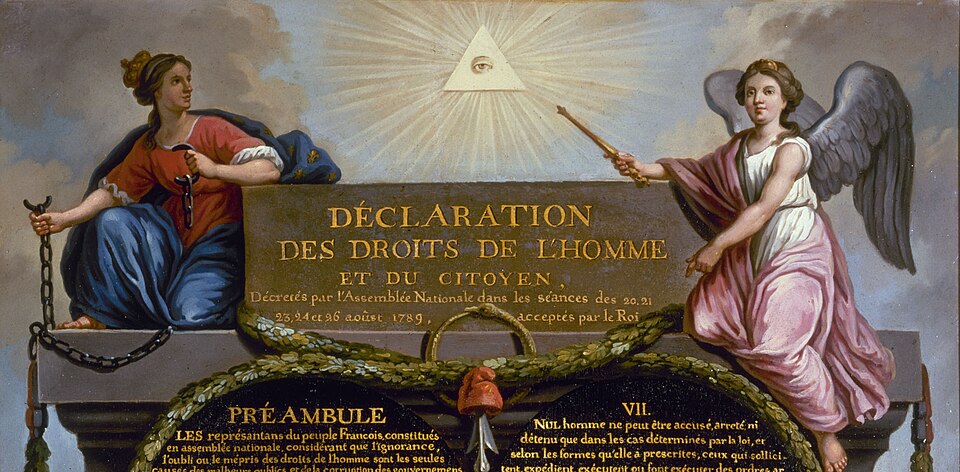
Jean-Jacques-Franรงois Le Barbier painting of the Declaration of the Rights of Man and of the Citizen (c. 1789)
Jean-Jacques-François Le Barbier’s celebrated 1789 allegorical painting depicting the Declaration framed as stone law tablets beneath the eye of Reason. (Musée Carnavalet, Paris)

The Crucible of 1789: Bankruptcy, Bread Riots & The Estates-General

The Declaration was forged in the furnace of acute systemic collapse. Under the Ancien Régime, French society had been frozen into a rigid medieval hierarchy known as the Three Estates. The First Estate (the Catholic clergy) and the Second Estate (the hereditary nobility) constituted less than two percent of the kingdom’s twenty-six million inhabitants, yet held forty percent of the land, monopolized all senior military, judicial, and state offices, and enjoyed near-total exemption from taxation.

The crushing burden of royal taxation fell squarely on the Third Estateโ€”a vast, volatile agglomeration comprising wealthy bourgeois merchants, lawyers, rural peasants, and urban artisans. By 1788, the French crown was functionally bankrupt, its treasury drained by decades of global warfare, including heavy naval and financial underwriting of the American Revolutionary War. When catastrophic hailstorms and droughts destroyed the 1788 wheat harvest, the price of a four-pound loaf of bread spiked to eighty percent of an artisan’s daily wage, provoking bread riots across the kingdom.

Desperate for tax revenue, King Louis XVI convened the Estates-General in May 1789 for the first time since 1614. When the crown insisted that each Estate vote by order rather than by headโ€”guaranteeing that the two privileged orders could perpetually outvote the ninety-eight percent majorityโ€”the Third Estate delegates rebelled. On June 17, led by the reformist Abbé Emmanuel-Joseph Sieyès, they declared themselves the National Assembly. Locked out of their official chamber, they reconvened on a nearby indoor tennis court, swearing the solemn Tennis Court Oath never to disband until they had drafted a written constitution for France.

Contemporary broadsheet engraving of the Storming of the Bastille on July 14, 1789
Contemporary hand-colored print of the storming of the Bastille on July 14, 1789, the catalytic event that forced Louis XVI to recognize the National Assembly. (Bibliothèque nationale de France)

Philosophical Architecture: Locke, Rousseau & The General Will

The seventeen articles of the Declaration represented a brilliant philosophical synthesis of Enlightenment political thought, blending the Anglo-American natural rights tradition with radical French political theory:

  • Lockean Natural Rights (Articles 1 & 2): Channeling John Locke’s Second Treatise of Government, the preamble affirmed that governments exist solely to protect pre-existing, natural human rights. Article 1 delivered the immortal opening stroke: “Men are born and remain free and equal in rights. Social distinctions may be based only upon common utility.” Article 2 defined these natural rights as “liberty, property, security, and resistance to oppression.”
  • Rousseau & The General Will (Article 6): Drawing directly from Jean-Jacques Rousseau’s The Social Contract, Article 6 established that “Law is the expression of the general will. Every citizen has a right to participate personally, or through his representative, in its foundation.” Furthermore, it abolished aristocratic nepotism: all citizens, being equal in the eyes of the law, were equally eligible to all public dignities, positions, and employments according to their capacity, without any distinction other than that of their virtues and talents.
  • Popular Sovereignty (Article 3): In a single sentence, the delegates dismantled divine-right absolutism: “The principle of all sovereignty resides essentially in the nation. No body nor individual may exercise any authority which does not proceed directly from the nation.” The monarch was transformed from God’s earthly deputy into a salaried civil servant of the sovereign people.
  • Procedural Justice & Due Process (Articles 7, 8 & 9): Decrying the notorious lettres de cachetโ€”secret royal warrants that permitted the indefinite imprisonment of citizens without trialโ€”the Declaration codified the presumption of innocence, outlawed retroactive penalties, and mandated that no man could be accused, arrested, or detained except in cases determined by the law.
  • Freedom of Thought & Expression (Articles 10 & 11): The charter guaranteed that no one should be disquieted on account of his opinions, including religious views, provided their manifestation did not disturb public order. Article 11 declared the free communication of ideas and opinions to be “one of the most precious of the rights of man.”

“The representatives of the French people, organized as a National Assembly, believing that the ignorance, neglect, or contempt of the rights of man are the sole causes of public calamities and of the corruption of governments, have determined to set forth in a solemn declaration the natural, unalienable, and sacred rights of man...”

— Preamble, Declaration of the Rights of Man and of the Citizen, National Constituent Assembly of France (August 26, 1789)
Constitutional Charter Year Promulgated Primary Author / Influence Source of Sovereignty Universal vs. Particularist Scope
Magna Carta 1215 CE Rebel Barons & Archbishop Langton Feudal pact between King and Barons Strictly particularist; protected aristocratic feudal privileges against the Crown
English Bill of Rights 1689 CE Parliament (Glorious Revolution) King-in-Parliament Particularist; codified historic “ancient rights and liberties” of Protestant Englishmen
US Declaration & Bill of Rights 1776 / 1791 CE Thomas Jefferson & James Madison Consent of the Governed (“We the People”) Universalist philosophical preamble, but legally compromised by sanctioning race slavery
French Declaration of Rights of Man 1789 CE Lafayette, Mirabeau & Sieyès The Sovereign Nation (General Will) Radically universalist; framed as natural human entitlements applicable to all mankind

Paradoxes & Exclusions: Women, Slaves & Active Citizens

While the Declaration spoke in soaring, universalist rhetoric, its immediate legal implementation exposed profound, hypocritical contradictions. The Assembly’s bourgeois leadership immediately drew a distinction between “active citizens” (men aged twenty-five and older who paid direct taxes equal to three days of manual labor, granting them voting rights) and “passive citizens” (three million poor men and all women), who enjoyed legal protection but no political voice.

This exclusion prompted immediate feminist counter-mobilization. In September 1791, playwright and activist Olympe de Gouges published her blistering Déclaration des droits de la femme et de la citoyenne (Declaration of the Rights of Woman and of the Female Citizen). Gouges mimicked the 1789 text line by line, boldly opening Article 1: “Woman is born free and remains equal to man in rights.” She demanded female suffrage, equal access to public office, and maternal rights, warning that “woman has the right to mount the scaffold; she must equally have the right to mount the speaker’s rostrum.” For her radical defiance of Jacobin orthodoxy, Gouges was arrested during the Reign of Terror and guillotined in November 1793.

An even more explosive contradiction lay in France’s overseas colonies. In Saint-Domingue (modern Haiti), the wealthiest sugar colony on Earth, half a million enslaved Africans produced two-fifths of the world’s sugar and half its coffee under brutal torture. When white plantation owners embraced the Declaration to demand commercial freedom from Paris while refusing to emancipate their slaves, the enslaved population took the universal words literally.

In August 1791, led by the voodoo priest Boukman and subsequently commanded by the brilliant military strategist Toussaint Louverture, the enslaved workers launched the Haitian Revolution. Defeating British, Spanish, and Napoleonic armies across twelve years of brutal warfare, they established the Republic of Haiti in 1804โ€”creating history’s first independent republic ruled by formerly enslaved people and the first nation to abolish slavery universally and unconditionally.

Historiographical Debate: Universal Blueprint vs. Bourgeois Class Weapon

The historiography of the 1789 Declaration is deeply polarized. Marxist historians like Albert Soboul and Georges Lefebvre argued that the Declaration was fundamentally a class weapon engineered by the French bourgeoisie. By enshrining private property as an “inviolable and sacred right” (Article 17) while restricting voting rights to tax-paying property owners, the assembly dismantled aristocratic feudalism only to entrench capitalist hegemony. In contrast, revisionist historians like François Furet and Lynn Hunt (Inventing Human Rights) contend that the Declaration possessed a transcendent, self-fulfilling ideological force. Regardless of the conservative intentions of its authors, the document’s radical universalist vocabulary created an inescapable moral standard that disenfranchised groupsโ€”women, religious minorities, enslaved people, and the working poorโ€”weaponized over subsequent centuries to dismantle their own oppression.

Long-Term Institutional Legacy: The Universal Charter

Despite being eclipsed during the Jacobin Reign of Terror (1793โ€“1794) and subsequent Napoleonic authoritarianism, the Declaration of the Rights of Man established the moral vocabulary of modern political civilization. It dismantled the divine right of kings, shattered the corporate privileges of the feudal order, emancipated French Protestants and Jews, and established the secular legal framework that culminated in the 1804 Napoleonic Code.

In the twentieth century, in the smoking aftermath of the Second World War and the Holocaust, the United Nations Commission on Human Rights, chaired by Eleanor Roosevelt and drafted by French jurist René Cassin, looked back to 1789 as their prime intellectual blueprint. Adopted by the UN General Assembly in Paris in December 1948, the Universal Declaration of Human Rights lifted the core tenets of the 1789 charterโ€”universal equality, freedom of conscience, procedural due process, and the rejection of tyrannyโ€”and projected them onto a global scale, ensuring that the ideals born in the crucible of revolutionary Versailles remain humanity’s supreme universal moral standard.

๐Ÿ“– SCHOLARLY INQUIRIES

Frequently Asked Questions

Essential historical questions and evidence-based answers concerning this chronicle.

Why is Declaration of the Rights of Man 1789 significant in world history?

Declaration of the Rights of Man 1789 played a pivotal role by transforming technology, social structure, and regional connection, serving as a vital link in human civilization.

What is the Declaration of the Rights of Man and of the Citizen?

Adopted on August 26, 1789, by France's National Constituent Assembly, it is a 17-article charter defining the individual and collective rights of all citizens, establishing the principles of popular sovereignty, legal equality, freedom of speech and religion, and the presumption of innocence.

Who wrote the Declaration of the Rights of Man?

The initial draft was authored by Gilbert du Motier, the Marquis de Lafayette, working in close consultation with his close friend Thomas Jefferson (then the American minister to France). It was subsequently revised and expanded by French revolutionary leaders, including Abbรฉ Sieyรจs, Jean-Joseph Mounier, and Honorรฉ de Mirabeau.

How did Olympe de Gouges challenge the Declaration?

Recognizing that the 1789 charter excluded women from political rights, French playwright Olympe de Gouges published the Declaration of the Rights of Woman and of the Female Citizen in 1791, opening with 'Woman is born free and remains equal to man in rights' and demanding female voting and property equality. She was guillotined in 1793.

How did the Declaration impact the Haitian Revolution?

When the French assembly proclaimed that 'Men are born and remain free and equal in rights,' half a million enslaved Africans in Saint-Domingue (Haiti) applied the universal principle to themselves. Under Toussaint Louverture, they launched the 1791 Haitian Revolution, creating the first independent black republic in 1804.

๐Ÿ“š Academic Sources & Scholarly Bibliography
  • Hunt, Lynn (2007). Inventing Human Rights: A History. W.W. Norton & Company.
  • Furet, Franรงois (1988). Interpreting the French Revolution. Cambridge University Press.
  • Schama, Simon (1989). Citizens: A Chronicle of the French Revolution. Alfred A. Knopf.
  • Dubois, Laurent (2004). Avengers of the New World: The Story of the Haitian Revolution. Belknap Press.
โšก Fast Facts
  • Historical EraMODERN
  • Region๐ŸŒ EUROPE
  • CategoryEmpires
  • Reading Timeโฑ 12 min read
๐Ÿ“– Scholar Mode Active โ€” Click to exit focused reading
Selected Era

Prehistoric Era

Millions of years ago to ~3000 BCE

The dawn of humanity. From the evolutionary split of early hominids to the mastery of stone tools, fire, and the birth of language.

Landmark Milestones

Welcome to Historia

Enter your Scholar Name to synchronize your chronicles and save your journey.