From prehistoric origins to the modern era—discover the turning points, lost empires, and breakthroughs of world history through interactive timelines and visual guides.
Examine the tangible relics, physical tokens, and revolutionary machines that shaped civilizational growth.
🎥 VIDEO HUB & SHORTS
Watch visual summaries, site intros, and mini-documentaries chronicling 300,000 years of world history.
📊 HISTORICAL INFOGRAPHICS ARCHIVE
Museum-grade visual graphics, civilizational timelines, and architectural breakdowns curated for educators and history lovers.
THE HISTORIA CIRCLE
Join the collective discussion, study logs, and contributions of fellow historians mapping humanity's path.
Historia Forum Discussions
Start a Discussion Thread
THEMATIC PATHWAYS
Trace a single thread — disease, trade, energy, migration — across all eras and civilizations.
History is not just a sequence of events — it is a network of patterns. These thematic pathways allow you to follow a single concept across thousands of years: how agriculture spread, how warfare evolved, how trade routes shaped civilizations. Each pathway collects the most relevant chronicles across all eras.
🧩
How is this different from the sidebar Topics?
While the sidebar Topics (like Science & Tech or Empires) filter articles within your selected historical Era, Thematic Pathways cut horizontally across all eras (from Prehistoric to the Future). Use Themes to trace a single concept's evolutionary line across 300,000 years.
CIVILIZATION HUBS
Comprehensive profiles of the world's greatest civilizations and empires — from ancient cradles to global super-states.
Human Historia provides an academically rich exploration of the world's most influential civilizations. From the monumental achievements of ancient Egypt, Han China, and the Roman Empire, to the sophisticated societies of the Maya, the Islamic Caliphates, and West African empires, these hubs offer deep insights into the cultural, political, and technological legacies that continue to shape our global story.
EVOLUTION OF HUMAN SKILLS
Trace the compounding technologies, practical capabilities, and cognitive milestones of the human species.
Human progress is a story of compounding skills. Every breakthrough, from the spark of prehistoric fire to modern silicon transistors, builds directly on previous generations of ingenuity. Hover over a skill node to trace its historical prerequisites, and click it to explore its development timeline, species-wide impact, and related chronicles.
Prehistoric Ancient Medieval Modern Future
🧠
Select any skill node in the tree to explore its evolutionary path, development timeline, and historical impact.
ACADEMIC PASSPORT
Track your intellectual journey, quiz outcomes, and historical badges of honor.
HISTORIA PASSPORT⏳
👤Scribe Novice
Scholar NameHistoria Explorer
Rank RatingSumerian Record Scribe
Chronicles Read0 / 48
Study Guide Pins0 Guides
Security AccessLevel 1 (Novice)
Earned Badges of Honor
🔥
Fire Keeper
Unlock 3 prehistoric chronicles.
🏛️
Codex Keeper
Unlock 3 ancient chronicles.
🏰
Guild Master
Unlock 3 medieval chronicles.
⚙️
Steam Engineer
Unlock 3 modern chronicles.
🚀
Singularity Sage
Unlock 3 future chronicles.
👑
Grand Scholar
Score 5/5 on the Lab Quiz.
Recent Lab Activities
No recent activities recorded. Take a quiz or bookmark articles!
🏛️ MISSION & ARCHIVAL STANDARDS
About Human Historia
A visual encyclopedia and timeline of human history, dedicated to documenting 300,000 years of civilizational evolution through rigorous research, authentic artifacts, and visual clarity.
🌍
The 300,000-Year Story
Human Historia traces our collective journey across five historical epochs: Prehistory, Ancient Worlds, Middle Ages, Modern Age, and Future Horizons. From the first control of fire to quantum computation, we organize turning points into interconnected timelines.
📜
Historiographical Rigor
Every chronicle is built upon primary historical manifests, contemporary excavation reports, and peer-reviewed historical consensus. We prioritize authentic public domain artifacts and clearly identify scholarly debates surrounding major civilizational transitions.
🎨
Museum-Grade Visuals
Complex historical transitions demand visual understanding. We develop high-resolution infographics, architectural cutaways, and comparative territorial maps to transform abstract timelines into vivid, unforgettable learning experiences.
📖
Educational Access
Knowledge belongs to humanity. Human Historia is free, ad-light, and engineered as an educational resource for students, classroom educators, academic researchers, and curious minds across all continents.
Editorial Governance & Inquiries
We welcome peer reviews, academic corrections, museum archival collaborations, and educational partnerships. To submit historical inquiries or provide archival feedback, reach our editorial desk directly.
An immersive graphical anthology tracing the paths of civilizations, breakthroughs, and conflicts that forged the modern consciousness.
25Chronicles
Showing all articles
Battle of Thermopylae: History, Origins & Impact
Written by Humanhistoria MilitaryHistorical Era: ANCIENT
In the sweltering late summer of 480 BCE, three hundred royal Spartan hoplites and several thousand Greek allies marched north into a narrow coastal defile known as the Hot Gates. Facing them across the Malian plain was the colossal imperial host of King Xerxes I—an overwhelming military armada drawn from forty-six subject nations, numbering well over one hundred thousand soldiers and accompanied by an imperial fleet of twelve hundred galleys. For three legendary days, Spartan King Leonidas I turned the extreme topography of Thermopylae into an impenetrable bronze fortress, neutralizing Persian numerical superiority and slaughtering thousands of elite imperial shock troops. When a mountain betrayal rendered encirclement unavoidable, Leonidas and his final guard chose an intentional rear-guard sacrifice, purchasing with their lives the vital weeks necessary for the Greek fleet to regroup, shatter Xerxes at Salamis, and safeguard the fledgling institutions of Western civilization.
🎯 Quick Historical Summary
What Happened at the Battle of Thermopylae in 480 BCE?
In late summer 480 BCE, Spartan King Leonidas led 300 elite royal guards and roughly 6,000 Greek allies to hold the narrow pass of Thermopylae against King Xerxes' massive Persian invasion. Betrayed by a local guide via a mountain path, Leonidas and his men fought to the death, rallying Greece to ultimate victory.
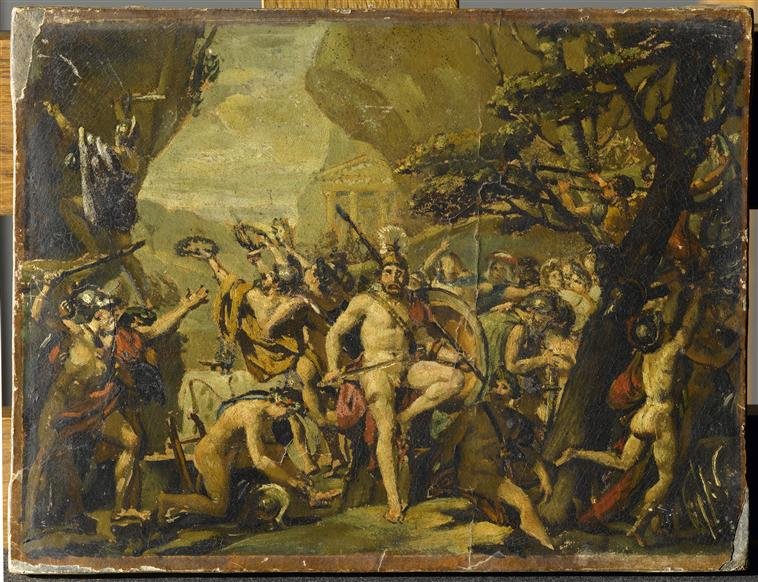
Jacques-Louis David's monumental 1814 neoclassical painting 'Leonidas at Thermopylae', depicting the Spartan king meditating calmly before the final assault as his warriors prepare their armor. (Louvre Museum, Paris, Inv. 3690)
The Imperial Mandate: Xerxes' Grand Invading Host
The clash at Thermopylae represented the climax of the Second Persian Invasion of Greece, an imperial reckoning a decade in the making. In 490 BCE, Xerxes' father, Darius I the Great, had launched an expeditionary punitive fleet to punish Athens for its support of the Ionian Revolt, only to suffer a humiliating tactical rout at the Battle of Marathon. Vowing to avenge his father and incorporate mainland Greece into the Achaemenid imperial fold as a European satrapy, Xerxes I spent five years preparing the largest joint military campaign antiquity had ever witnessed.
Ancient historian Herodotus recorded the Persian host at an astonishing 2.6 million men; modern military logistics historians place combatant numbers at roughly 120,000 to 180,000 infantry and cavalry, supported by an armada of 1,207 Phoenician, Egyptian, and Ionian triremes. To facilitate this unprecedented mobilization, Persian imperial engineers executed staggering feats of engineering: cutting a two-kilometer canal through the Mount Athos peninsula to protect the fleet from Aegean gales, and lashing together 674 galleys with cables of flax and papyrus to construct two floating pontoon bridges across the Hellespont (Dardanelles), over which the imperial armies marched into Europe for seven continuous days and nights.
In response to this existential threat, thirty-one fractious Greek city-states convened at the Isthmus of Corinth in 481 BCE to form the Hellenic League. Acknowledging Sparta's undisputed supremacy in terrestrial heavy warfare, the league appointed King Leonidas I as supreme land commander, while Athenian statesman Themistocles directed the naval defense. However, when the Persian armada crossed the borders of Thessaly in mid-480 BCE, the Spartan state faced a profound religious dilemma: the sacred peace of the Olympic Games and the sacred festival of the Carneia prohibited military mobilization until the full moon. Recognizing that failure to hold the northern choke points would force Central Greece to medize (surrender to Persia), Leonidas took the radical step of marching north with an advance guard of only 300 royal bodyguards (the Hippeis)—deliberately selecting only veteran warriors who had living sons to perpetuate their family lineages.
The Hot Gates: Topography, Armor & Tactical Asymmetry
The strategic brilliance of the Greek defensive posture lay in its geographical synergy: holding the land pass of Thermopylae while the allied fleet held the narrow maritime straits of Artemisium just forty miles away, preventing the Persian navy from outflanking the land army via coastal amphibious landings.
Thermopylae—meaning literally the "Hot Gates", named for the sulfurous mineral springs bubbling at the foot of Mount Kallidromo—was not a single valley, but a series of three narrow constrictions. At the Middle Gate, where an ancient ruined stone breastwork built by the Phocians guarded the road, the navigable passage between vertical limestone cliffs and the marshy shore of the Malian Gulf shrank to barely fifteen meters wide. In this confined funnel, Xerxes' cavalry was useless, archery was neutralized by heavy bronze armor, and the Great King could deploy no more than a few hundred warriors at a time against the defensive line.
Hoplite Bronze vs. Imperial Levies
The clash at Thermopylae was an extreme demonstration of asymmetrical military equipment. The Spartan hoplite was the heaviest shock infantryman of the ancient world. Encased in a bronze Corinthian helmet that protected the skull and cheeks, a bronze bell-shaped cuirass (or layered linen linothorax), and bronze shin greaves, each warrior carried the revolutionary aspis—a three-foot-wide, bowl-shaped wooden shield faced with sheet bronze, held across the chest with a central forearm strap (porpax) and handgrip (antilabe). Arrayed in the dense, overlapping phalanx, this wall of bronze bristled with eight-foot cornel-wood thrusting spears (dory) tipped with leaf-shaped iron heads and bronze butt-spikes (sauroter).
Opposing them were the diverse levies of the Persian Empire: Medes, Cissians, and Hyrcanians clad in embroidered tunics, loose trousers, and soft felt caps. Their principal defenses were lightweight wicker shields (gerrha) and short four-foot javelins designed for mobile, open-field warfare on the Iranian plateau. When forced into a brutal face-to-face collision against the locked Greek phalanx, their weapons shattered against bronze while the longer Greek spears skewered their unarmored torsos with mechanical precision.
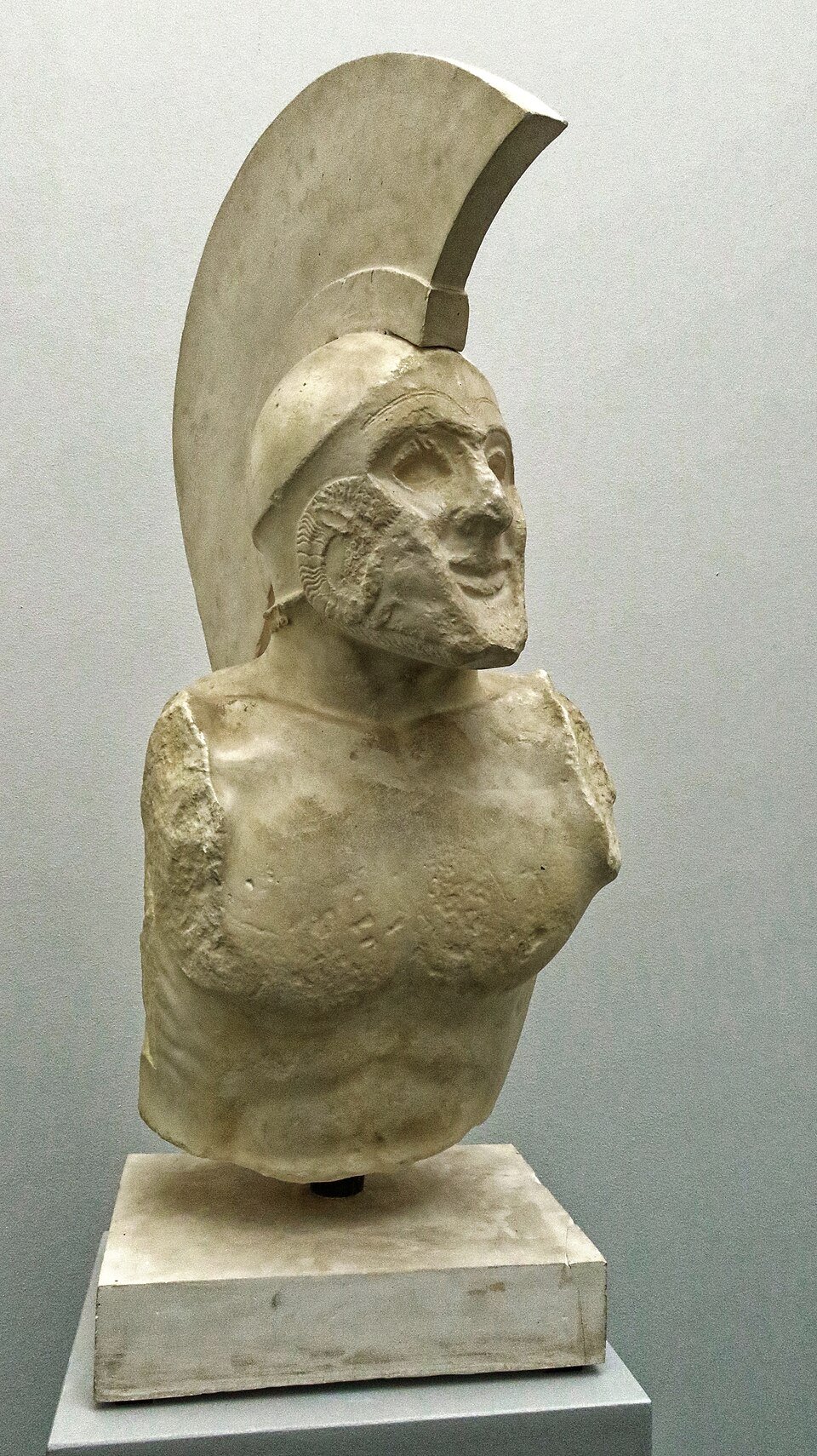
The modern bronze memorial statue of King Leonidas I erected at Thermopylae, depicting the Spartan king wielding a spear and aspis shield above the immortal challenge 'Molon Labe'. (Thermopylae Battlefield Historical Site, Greece)
The Three Days: From Frontal Slaughter to Mountain Betrayal
Arriving at the pass, Xerxes pitched his royal pavilion and waited four days in incredulous silence, assuming that the minuscule Greek force would scatter in terror once they saw the magnitude of his host. When his mounted scout reported back that the Spartans were casually stripping down for gymnastic exercises and combing their long braided hair—a sacred Spartan ritual performed exclusively before fighting to the death—Xerxes sent a herald demanding that they surrender their arms. Leonidas delivered his laconic, three-word reply: "Molon labe" ("Come and take them").
Day One: The Wave Assaults Shatter
On the morning of the fifth day, Xerxes unleashed the battle. He ordered his Mede and Cissian contingents forward with orders to take the insolent Greeks alive and drag them in chains before his throne. For hours, wave after wave charged into the bottleneck, only to be slaughtered in heaps before the Phocian wall. Enraged by the slaughter, Xerxes ordered forward his personal royal guard: the 10,000 Immortals (Athanatoi), commanded by General Hydarnes, so named because their numbers were never allowed to drop below ten thousand. Yet even the Immortals could make no headway. The Spartans executed disciplined feigned retreats—turning their backs and fleeing in apparent panic, baiting the Persians into breaking formation in pursuit, only to wheel around with terrifying cohesion and skewer the disorganized attackers.
Day Two: Deadlock & Treachery
On the second day, Xerxes attacked with fresh infantry, assuming the defenders must be exhausted and wounded. The result was identical; Leonidas rotated his allied contingents (Thespians, Phocians, Arcadians, and Corinthians) through the front line to rest his men, maintaining an impenetrable wall of corpses. Xerxes reportedly leaped three times from his imperial throne in terror for his army.
The stalemate was broken that evening not by martial prowess, but by civilian greed. A local Malian Greek named Ephialtes of Trachis gained an audience with the Great King, offering for a rich gold bounty to reveal a hidden goat track over Mount Kallidromo: the Anopaea Path. Under cover of night, Hydarnes led the surviving Immortals up the steep mountain track through dense oak forests, surprising and brushing aside the 1,000 Phocian hoplites whom Leonidas had stationed on the crest to guard the trail.
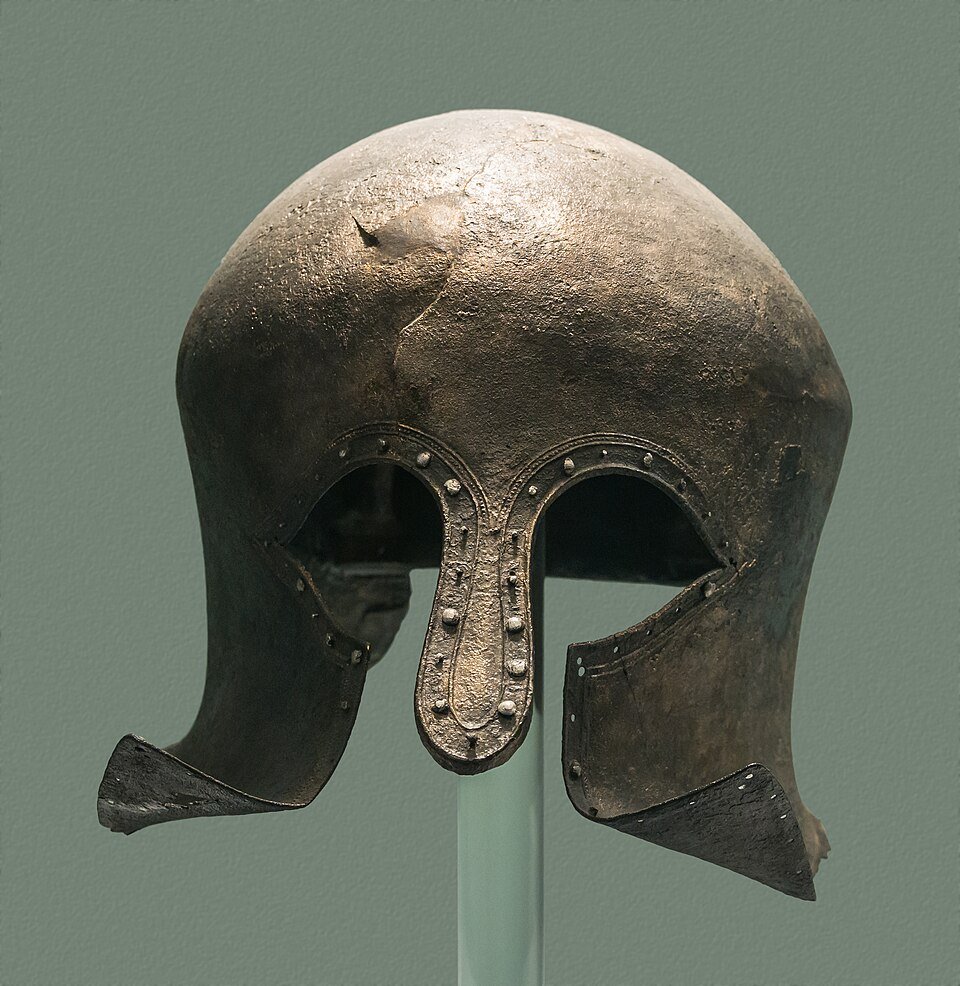
Archaeological Corinthian-type bronze helmet from the 5th century BCE displaying battle-dents and reinforced brow ridges, excavated near ancient Greek defensive fortifications. (Altes Museum, Berlin)
The Final Stand: The Sacrifice of the 300 & The 700 Thespians
At dawn on the third day, lookouts rushed down the mountain slopes to alert Leonidas that Hydarnes' Immortals were descending behind the pass. Greek encirclement was complete. Calling an emergency council of war, Leonidas recognized that the pass was lost. To preserve the core of the allied army for future campaigns, he dismissed the majority of the Greek forces, ordering them to retreat south immediately.
Yet Leonidas himself refused to flee. Spartan military law (instituted by the legendary lawgiver Lycurgus) forbade retreat under any circumstance, while the Delphic Oracle had foretold that either Sparta would be laid waste by barbarians or a Spartan king must perish. Standing steadfastly beside the 300 Spartans were 700 Thespians led by their heroic general Demophilus, who proudly refused to abandon their Spartan comrades, and 400 Theban hostages kept under guard.
Knowing they were marching to their graves, Leonidas led his warriors out of the narrow bottleneck into the wider section of the pass to maximize the slaughter. They fought with savage fury: when their heavy spears shattered, they drew their curved short swords (kopis); when their swords broke, they fought with bare hands, teeth, and stones. King Leonidas fell early in the melee. A desperate, savage struggle erupted over his corpse, with the Spartans repelling four Persian charges and slaying two of Xerxes' royal brothers before dragging the king's body back into their line.
Withdrawing to a small knoll behind the Phocian wall (the Kolonos Hill), the surviving defenders formed a desperate circle. Xerxes, refusing to sacrifice any more infantry in hand-to-hand combat, ordered his archers to surround the mound. A dense curtain of tens of thousands of arrows rained down until the last defender was buried under iron and bronze. In an extraordinary act of vengeance that violated traditional Persian burial customs, Xerxes ordered Leonidas' corpse decapitated and his head impaled upon a wooden cross.
Mass missile barrage softening; cavalry flanking maneuvers; wave attrition.
Casualties Sustained
~2,000–4,000 killed (including all 300 Spartans & 700 Thespians).
~20,000 killed (including two royal princes and thousands of Immortals).
"Go tell the Spartans, stranger passing by, that here, obedient to their laws, we lie."
— Simonides of Ceos, contemporary epitaph carved on the memorial stone at Kolonos Hill, Thermopylae (480 BCE)
Historiographical Debate: Heroic Self-Sacrifice vs. Operational Strategic Failure
While western cultural memory, from Simonides' ancient epitaph to modern cinema, celebrates the Battle of Thermopylae as the ultimate paradigm of selfless heroic sacrifice for Greek liberty, military historians debate its operational value. Scholars like Paul Cartledge emphasize the immense psychological and moral impact of the Spartan stand: by demonstrating that the Persian host was neither invulnerable nor invincible, Leonidas galvanized allied Greek unity, buying vital time for the Athenian naval victory at Salamis. Conversely, revisionist historians like Michael A. Flower suggest that the defense of the pass was a strategic blunder. The failure to adequately guard the mountain Anopaea path and the subsequent annihilation of the allied rear-guard left Central Greece and Athens completely undefended, forcing the total evacuation and burning of the Athenian Acropolis.
Strategic Legacy: The Crucible of Western Independence
While Thermopylae was tactically a catastrophic defeat—resulting in the loss of the pass, the devastation of Boeotia, and the burning of the Athenian Acropolis—it was a strategic and moral triumph of the highest magnitude. Leonidas' three-day stand bought invaluable time: it allowed Athenian general Themistocles to complete the naval evacuation of Athens and draw the Persian armada into the narrow confines of the Straits of Salamis.
At the Battle of Salamis in September 480 BCE, the Greek triremes executed precisely the same tactical doctrine that Leonidas had deployed on land: using narrow waters to nullify Persian numbers, destroying over two hundred Persian ships and forcing Xerxes to flee back to Asia with the majority of his army. The following spring, at the Battle of Plataea (479 BCE), a unified Greek host led by Spartan regent Pausanias smashed the remaining Persian field army, terminating the Persian threat forever. Thermopylae became the foundational archetype of martial devotion in human memory: the supreme demonstration that when free men fight in defense of their laws and liberty, disciplined sacrifice can alter the trajectory of human civilization.
📊 Museum-Grade Infographic Poster
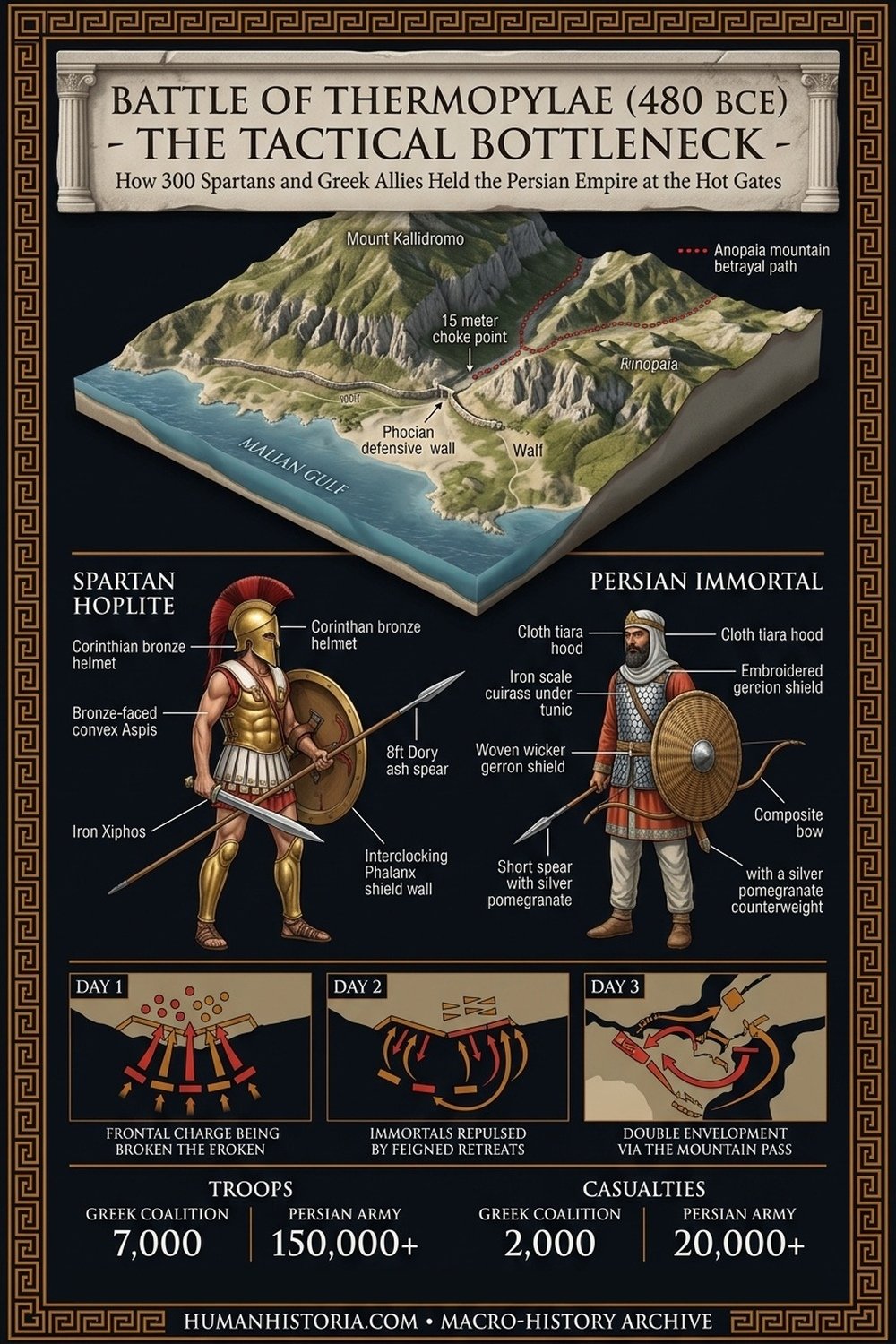
The Battle of Thermopylae (480 BCE): The Tactical Bottleneck
💡 Click anywhere on poster to expand in high resolution🔎 Expand Lightbox
Museum-grade tactical blueprint illustrating the Phocian wall bottleneck, 3D topographical pass relief, Spartan vs Persian warrior equipment comparison, and 3-day battle progression.
📖 SCHOLARLY INQUIRIES
Frequently Asked Questions
Essential historical questions and evidence-based answers concerning this chronicle.
Q.Why is Battle of Thermopylae significant in world history?
Battle of Thermopylae played a pivotal role by transforming technology, social structure, and regional connection, serving as a vital link in human civilization.
Q.Why was Thermopylae called the Hot Gates, and who were the 300?
Thermopylae literally translates from Greek as 'Hot Gates' (thermos = hot, pylai = gates), named for the bubbling geothermal sulfur springs at Mount Kallidromo. The '300' were King Leonidas's hand-picked royal Spartan bodyguards with living sons, who held the narrow 15-meter pass alongside 700 devoted Thespians and 400 Thebans.
Q.Were there really only 300 Spartans at Thermopylae?
While 300 elite Spartan royal guards led the defense under King Leonidas, they were supported by approximately 6,000 allied Greek hoplites from Thespiae, Thebes, and Arcadia.
Q.How did the Persians finally bypass the pass at Thermopylae?
A local Greek named Ephialtes betrayed the defenders by revealing a mountain goat path (the Anopaea path) that allowed Persian Immortals to encircle the Greek army.
Q.What was the strategic impact of the Battle of Thermopylae?
The battle delayed Xerxes' invasion force long enough for the Athenian navy under Themistocles to prepare the fleet, leading to the decisive Greek victory at the Battle of Salamis.
📚 Academic Sources & Scholarly Bibliography
Herodotus (1998).
The Histories (Book VII: Polymnia).
Oxford World's Classics.
Cartledge, P. (2006).
Thermopylae: The Battle That Changed the World.
Vintage Books.
Lazenby, J. F. (1993).
The Defence of Greece 490-479 B.C..
Aris & Phillips.
📖 Scholar Mode Active — Click to exit focused reading
History Lab 🧪
Interactive historical deduction games, tactical matchup simulators, and currency calculators.
🕵️ Who Am I? (The Historical Guess Game)
A secret historical figure has been selected. Ask yes/no questions to narrow down the pool of candidates. Click any active card to make your accusation!
Secret Identity
❓ Who Am I?
Ask questions using the board below to narrow down my identity.
Ask a Question:
Question LogQuestions: 0 / 7
No questions asked yet.
Candidate Board:
🗺️ Timeline Scramble
Five historical events appear out of order. Click them in the correct chronological sequence — from oldest to most recent. How well do you know your history?
🏺 Relic or Fake?
Is this a real historical artifact or a convincing fabrication? Judge each one based on its description and era — then see the truth revealed!
Artifact 1 / 10Score: 0
Empire Matchup Simulator
Empire ATerritory Size (Peak, M km²)Empire B
00
Empire APopulation (Peak, Millions)Empire B
00
Empire AMilitary Power (Army Size)Empire B
00
Tactical Battle Analysis
Select empires and click simulate to run evaluations.
Historical Purchasing Power Converter
See what ancient coins are worth in modern terms and check their historical purchasing power.
Modern Value Equivalent
$0.00 USD
Historical Purchasing Power:
Select currency to view purchasing capability.
Historical Identity Generator
Forge an authentic historical identity from ancient civilisations, complete with linguistic meaning and biography.
Neutral
Gaius Julius
Meaning:Descendant of Jupiter
Historical Background:
A Roman citizen and clerk who worked in the forum under Roman republic rule.
Chrono-Cultural Fusion Simulator
Fuse the culture, technology, and governance of two legendary civilizations to synthesize a unique hybrid society.
Cohesion & Coexistence Rate
85%
🏛️ Hybrid Architecture
⚙️ Synthesized Asset
📜 Synthetic Governance
Historical Tactics & Trivia Quiz
Test your historical knowledge and battle tactics to claim your administrative rank.
8 Questions • Multi-Era
You will be presented with random scenarios and trivia spanning ancient Egypt, classical Rome, Islamic Golden Age, and the modern industrial era. Complete the evaluation to see your historical title!
Question 1 of 8Score: 0
What was the Code of Hammurabi written on?
Correct!
Evaluation Complete!
6 / 8
Correct
Rank Attained
Imperial Legionary
Your knowledge of classical strategy and administrative structures is respectable.
🎲 Counterfactual "What If?" Scenario Simulator
Explore alternative historical trajectories by tweaking key civilizational pivot points.
Simulated Shift
Selected Era
Prehistoric Era
Millions of years ago to ~3000 BCE
The dawn of humanity. From the evolutionary split of early hominids to the mastery of stone tools, fire, and the birth of language.
Landmark Milestones
Welcome to Historia
Enter your Scholar Name to synchronize your chronicles and save your journey.

 ⭐ Featured Chronicle

 ANCIENT AGES
 ANCIENT AGES
 ANCIENT AGES
 MEDIEVAL PERIOD
 MEDIEVAL PERIOD
 PREHISTORIC ERA