From prehistoric origins to the modern era—discover the turning points, lost empires, and breakthroughs of world history through interactive timelines and visual guides.
Examine the tangible relics, physical tokens, and revolutionary machines that shaped civilizational growth.
🎥 VIDEO HUB & SHORTS
Watch visual summaries, site intros, and mini-documentaries chronicling 300,000 years of world history.
📊 HISTORICAL INFOGRAPHICS ARCHIVE
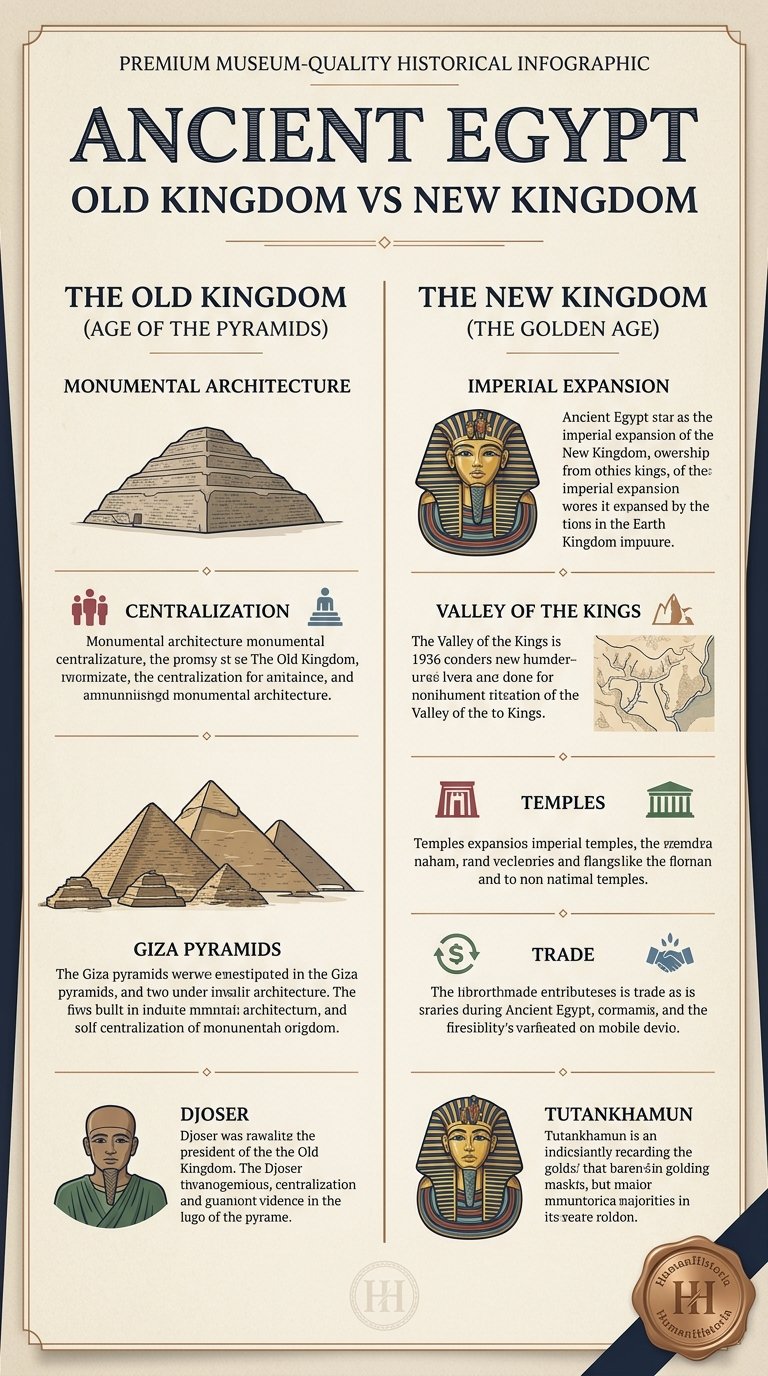
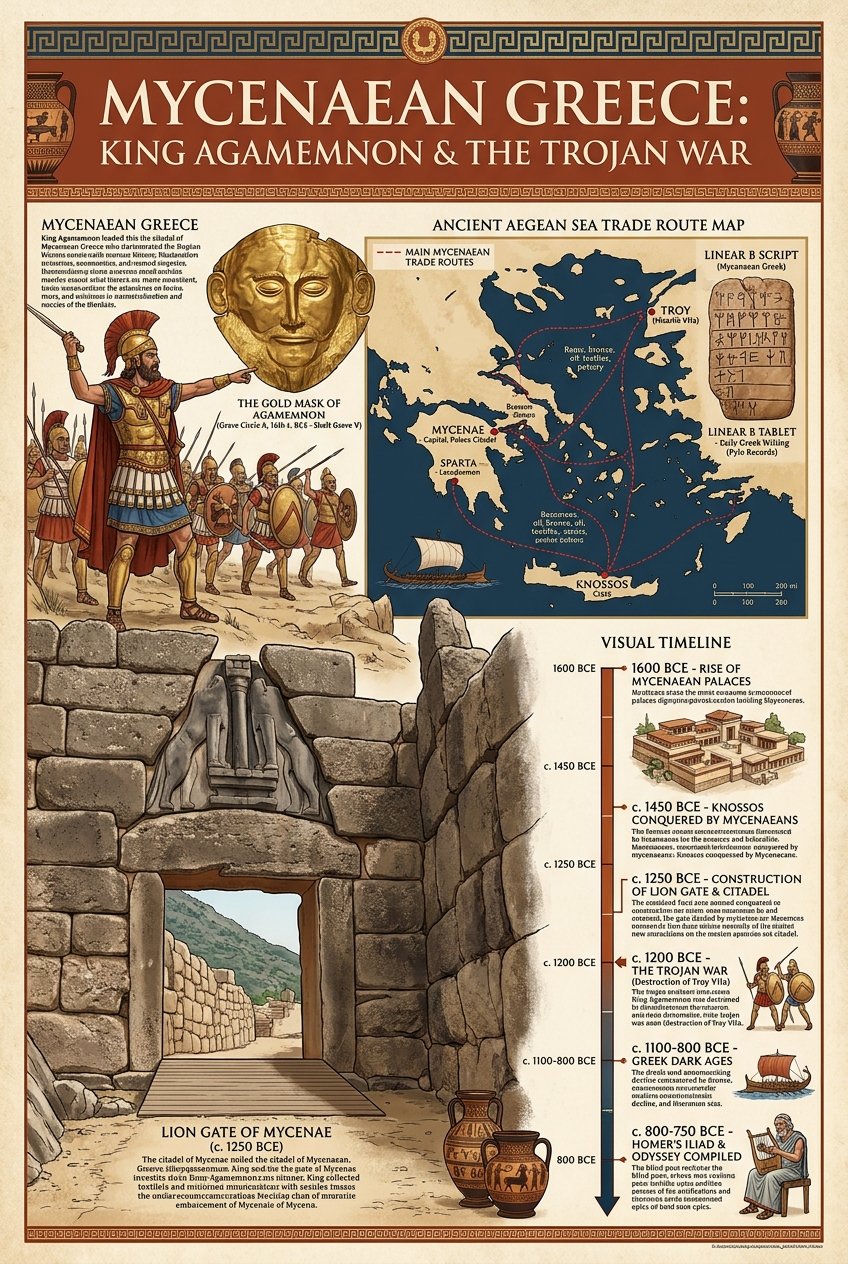
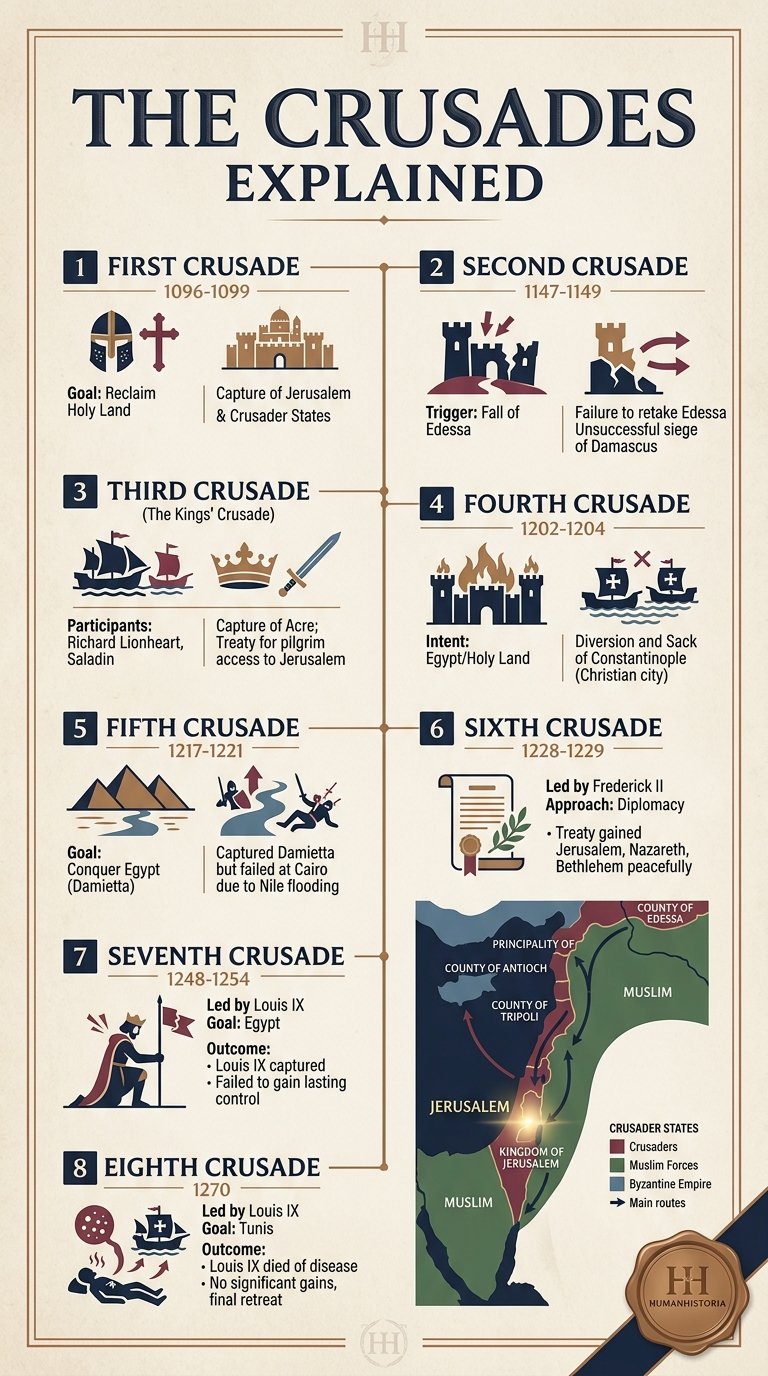
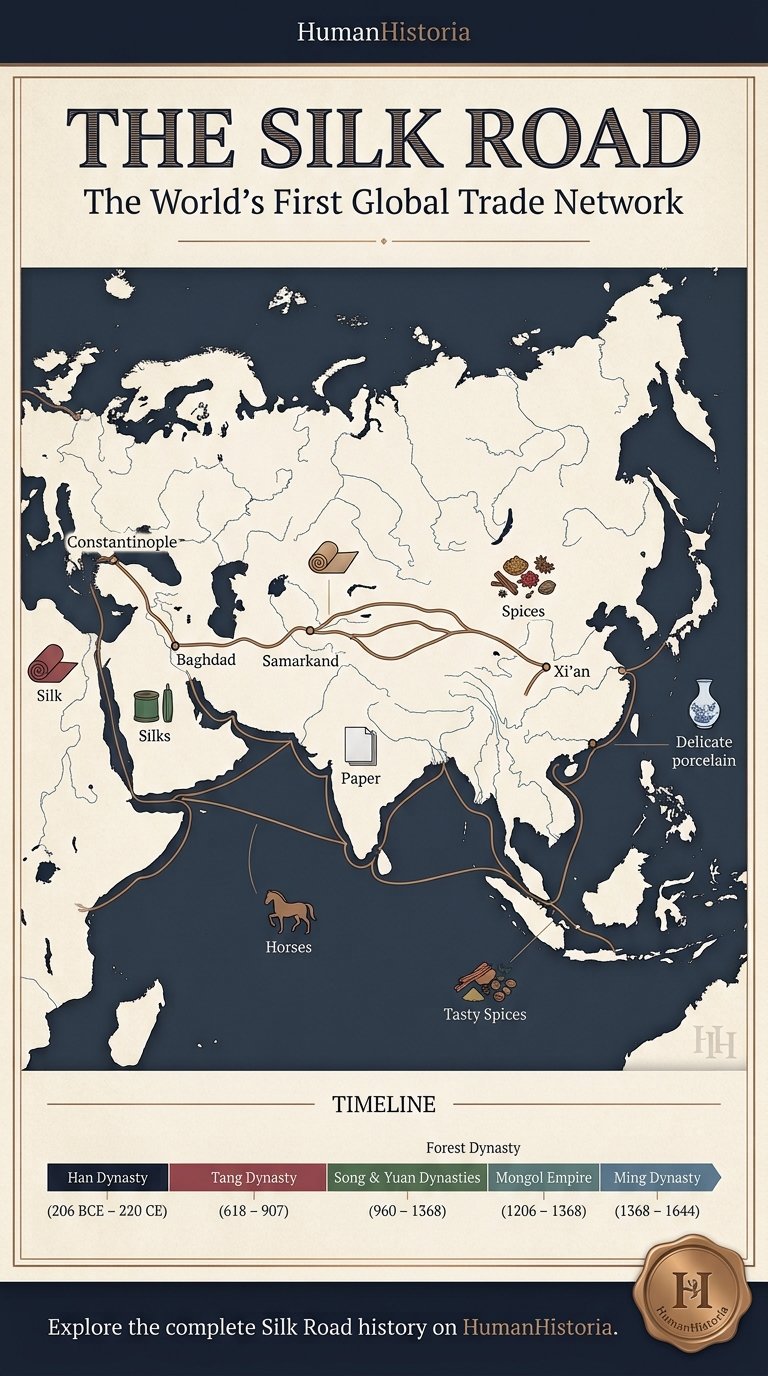
Museum-grade visual graphics, civilizational timelines, and architectural breakdowns curated for educators and history lovers.
THE HISTORIA CIRCLE
Join the collective discussion, study logs, and contributions of fellow historians mapping humanity's path.
Historia Forum Discussions
Start a Discussion Thread
THEMATIC PATHWAYS
Trace a single thread — disease, trade, energy, migration — across all eras and civilizations.
History is not just a sequence of events — it is a network of patterns. These thematic pathways allow you to follow a single concept across thousands of years: how agriculture spread, how warfare evolved, how trade routes shaped civilizations. Each pathway collects the most relevant chronicles across all eras.
🧩
How is this different from the sidebar Topics?
While the sidebar Topics (like Science & Tech or Empires) filter articles within your selected historical Era, Thematic Pathways cut horizontally across all eras (from Prehistoric to the Future). Use Themes to trace a single concept's evolutionary line across 300,000 years.
CIVILIZATION HUBS
Comprehensive profiles of the world's greatest civilizations and empires — from ancient cradles to global super-states.
Human Historia provides an academically rich exploration of the world's most influential civilizations. From the monumental achievements of ancient Egypt, Han China, and the Roman Empire, to the sophisticated societies of the Maya, the Islamic Caliphates, and West African empires, these hubs offer deep insights into the cultural, political, and technological legacies that continue to shape our global story.
EVOLUTION OF HUMAN SKILLS
Trace the compounding technologies, practical capabilities, and cognitive milestones of the human species.
Human progress is a story of compounding skills. Every breakthrough, from the spark of prehistoric fire to modern silicon transistors, builds directly on previous generations of ingenuity. Hover over a skill node to trace its historical prerequisites, and click it to explore its development timeline, species-wide impact, and related chronicles.
Prehistoric Ancient Medieval Modern Future
🧠
Select any skill node in the tree to explore its evolutionary path, development timeline, and historical impact.
ACADEMIC PASSPORT
Track your intellectual journey, quiz outcomes, and historical badges of honor.
HISTORIA PASSPORT⏳
👤Scribe Novice
Scholar NameHistoria Explorer
Rank RatingSumerian Record Scribe
Chronicles Read0 / 48
Study Guide Pins0 Guides
Security AccessLevel 1 (Novice)
Earned Badges of Honor
🔥
Fire Keeper
Unlock 3 prehistoric chronicles.
🏛️
Codex Keeper
Unlock 3 ancient chronicles.
🏰
Guild Master
Unlock 3 medieval chronicles.
⚙️
Steam Engineer
Unlock 3 modern chronicles.
🚀
Singularity Sage
Unlock 3 future chronicles.
👑
Grand Scholar
Score 5/5 on the Lab Quiz.
Recent Lab Activities
No recent activities recorded. Take a quiz or bookmark articles!
🏛️ MISSION & ARCHIVAL STANDARDS
About Human Historia
A visual encyclopedia and timeline of human history, dedicated to documenting 300,000 years of civilizational evolution through rigorous research, authentic artifacts, and visual clarity.
🌍
The 300,000-Year Story
Human Historia traces our collective journey across five historical epochs: Prehistory, Ancient Worlds, Middle Ages, Modern Age, and Future Horizons. From the first control of fire to quantum computation, we organize turning points into interconnected timelines.
📜
Historiographical Rigor
Every chronicle is built upon primary historical manifests, contemporary excavation reports, and peer-reviewed historical consensus. We prioritize authentic public domain artifacts and clearly identify scholarly debates surrounding major civilizational transitions.
🎨
Museum-Grade Visuals
Complex historical transitions demand visual understanding. We develop high-resolution infographics, architectural cutaways, and comparative territorial maps to transform abstract timelines into vivid, unforgettable learning experiences.
📖
Educational Access
Knowledge belongs to humanity. Human Historia is free, ad-light, and engineered as an educational resource for students, classroom educators, academic researchers, and curious minds across all continents.
Editorial Governance & Inquiries
We welcome peer reviews, academic corrections, museum archival collaborations, and educational partnerships. To submit historical inquiries or provide archival feedback, reach our editorial desk directly.
An immersive graphical anthology tracing the paths of civilizations, breakthroughs, and conflicts that forged the modern consciousness.
25Chronicles
Showing all articles
The Peloponnesian War: History, Origins & Impact
Written by Humanhistoria EditorialHistorical Era: ANCIENT
In the spring of 431 BCE, the fragile peace that had held the Greek world together for a generation fractured beyond repair. For twenty-seven catastrophic years, the Peloponnesian War pitted the naval empire and radical democracy of Athens against the militarized terrestrial hegemony of Sparta and its Peloponnesian allies. What began as a dispute over regional colonies escalated into a total civilizational conflict that engulfed the Aegean, decimated populations through siege, plague, and massacre, and ultimately toppled the Golden Age of Pericles. Documented with clinical detachment by the exiled general Thucydides, the war exposed the profound fragility of democratic institutions under existential stress and bequeathed to political theory the enduring concept of structural conflict between an established hegemon and a rising challenger.
🎯 Quick Historical Summary
Why Did the Peloponnesian War Tear Classical Greece Apart?
Fought from 431 to 404 BCE, the Peloponnesian War pitted the maritime empire of democratic Athens against the terrestrial army of oligarchic Sparta. Spurred by Athenian imperial expansion and Spartan fear, the 27-year conflict devastated the Greek economy, brought plague and tyranny to Athens, and left the Greek city-states vulnerable to Macedonian conquest.
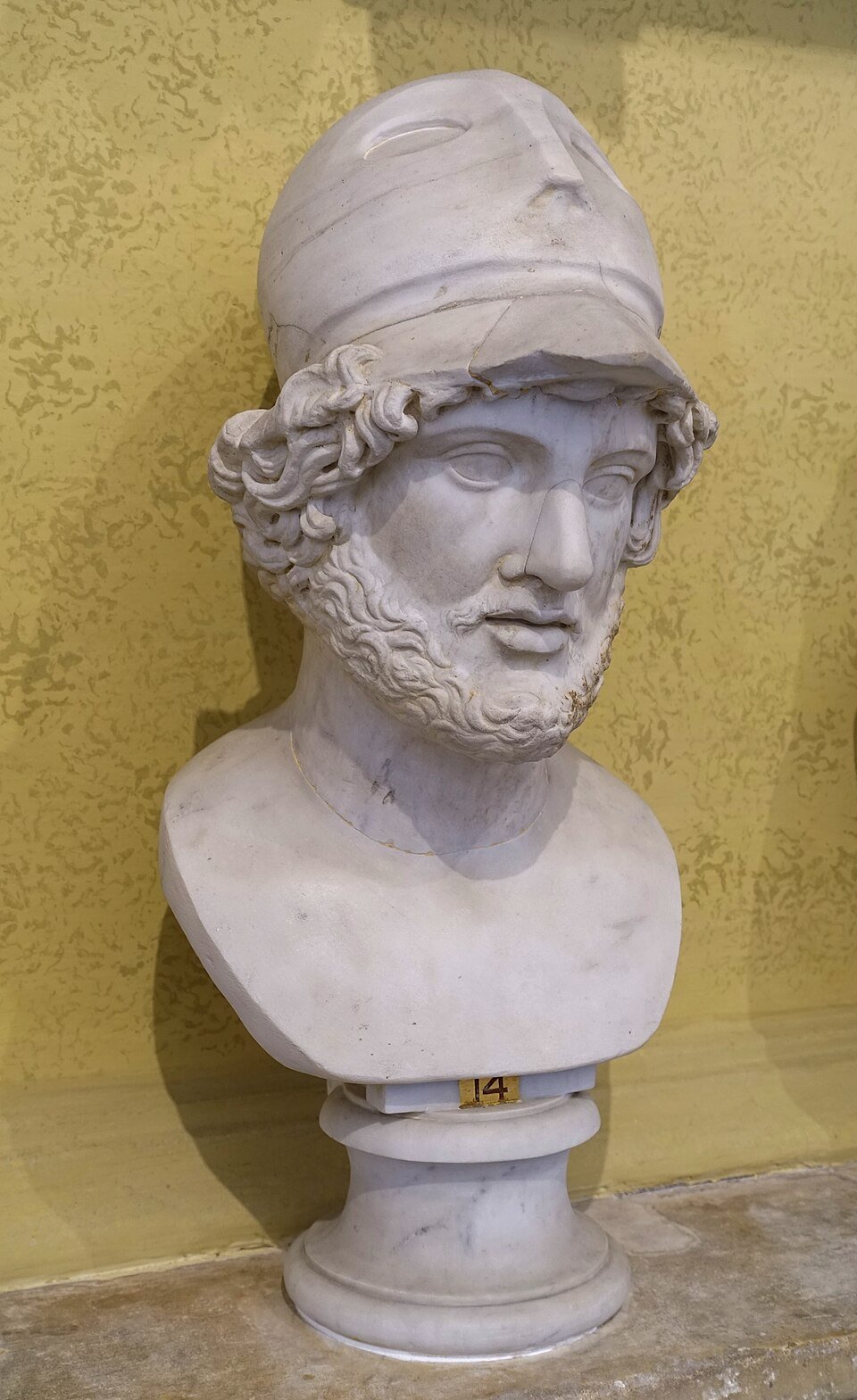
Roman marble copy of a 5th-century BCE Greek bronze bust of Pericles, the Athenian statesman and general whose grand strategic vision defined the opening years of the war. (Vatican Museums, Museo Pio-Clementino, Rome, Inv. 269)
The Structural Crucible: Delian Imperialism & The Thucydides Trap
To understand why the Greek world devoured itself between 431 and 404 BCE, one must trace the aftermath of the Greco-Persian Wars fifty years prior. Following the decisive naval triumph at Salamis in 480 BCE and the land victory at Plataea in 479 BCE, the Greek poleis faced the ongoing threat of Persian retaliation. While Sparta retreated into its traditional Peloponnesian isolationism—preoccupied with subjugating its restive serf population, the helots—Athens seized the diplomatic initiative.
In 478 BCE, on the sacred island of Delos, Athenian diplomats formed the Delian League. Initially a voluntary maritime alliance where member states contributed either warships or cash tributes (phoros) to maintain a standing defense fleet, the league rapidly mutated into a tributary empire under Athenian hegemony. Member states that attempted to secede—such as Naxos and Thasos—were ruthlessly besieged, their city walls demolished, their navies confiscated, and their autonomy extinguished. In 454 BCE, the league's vast treasury was brazenly transferred from Delos directly to the Athenian Acropolis, where Athenian leader Pericles diverted alliance funds to finance the monumental construction of the Parthenon, the Propylaea, and the monumental chryselephantine statue of Athena.
By mid-century, Athens commanded an armada of three hundred state-of-the-art triremes, enforced commercial monopolies across the Aegean, and forced allied citizens to try major legal disputes before Athenian jury courts. Across the Peloponnese, Sparta and its major commercial ally, Corinth, watched this exponential growth of Athenian naval dominance with mounting dread. As the contemporary historian Thucydides famously diagnosed in his opening analysis:
"The real cause of the war was one which was formally kept out of sight. The growth of the power of Athens, and the fear which this inspired in Sparta, made war inevitable."
— Thucydides, History of the Peloponnesian War (Book I.23)
The Archidamian War: Plague, Walls & Attrition (431–421 BCE)
The conflict formally ignited following three diplomatic crises in the late 430s BCE: Athenian naval intervention in the civil war of Epidamnus against Corinthian ships, Athens' punitive siege of the Corinthian colony of Potidaea, and the Megarian Decree, an economic embargo whereby Athens banned the merchants of Megara from all ports within the Athenian Empire. Corinth and Megara successfully lobbied the Spartan assembly, arguing that if Sparta failed to strike immediately, Athenian naval power would render resistance futile.
When Spartan King Archidamus II invaded Attica in 431 BCE, Pericles enacted an audacious grand strategy: refuse pitched land battles against the invincible Spartan hoplites. Instead, Pericles ordered the entire rural population of Attica to abandon their olive groves and farmsteads, evacuating behind the monumental Long Walls—a fortified four-mile stone corridor connecting the city of Athens directly to its fortified deep-water harbor at Piraeus. While Spartan armies burned Attica's crops outside the walls, Athenian triremes sailed unopposed across the Aegean, raiding Peloponnesian coastlines and guaranteeing food supplies via grain shipments from the Black Sea and Egypt.
The Great Plague of Athens (430–426 BCE)
Pericles' fortress strategy relied on an unyielding logistical assumption: that the city inside the walls could remain sanitary and supplied indefinitely. In the scorching summer of 430 BCE, that assumption collapsed into catastrophe. An acute viral hemorrhagic illness or virulent typhus—arriving via merchant ships docking at Piraeus—exploded through the overcrowded, refugee-packed city streets.
Over four horrifying years, the epidemic claimed an estimated 75,000 to 100,000 lives—roughly one-third of Athens' entire citizen body and military personnel. The physical symptoms, recorded with terrifying medical precision by Thucydides (who contracted and survived the illness), included burning fever, throat ulcerations, uncontrollable vomiting, gangrenous extremities, and delirium. The social breakdown was even more devastating: civil laws collapsed, religious rites were abandoned, corpses were heaped around sacred temple fountains, and citizens indulged in reckless hedonism, anticipating sudden death. In 429 BCE, the plague claimed Pericles himself, robbing Athens of its most temperate and far-sighted statesman.
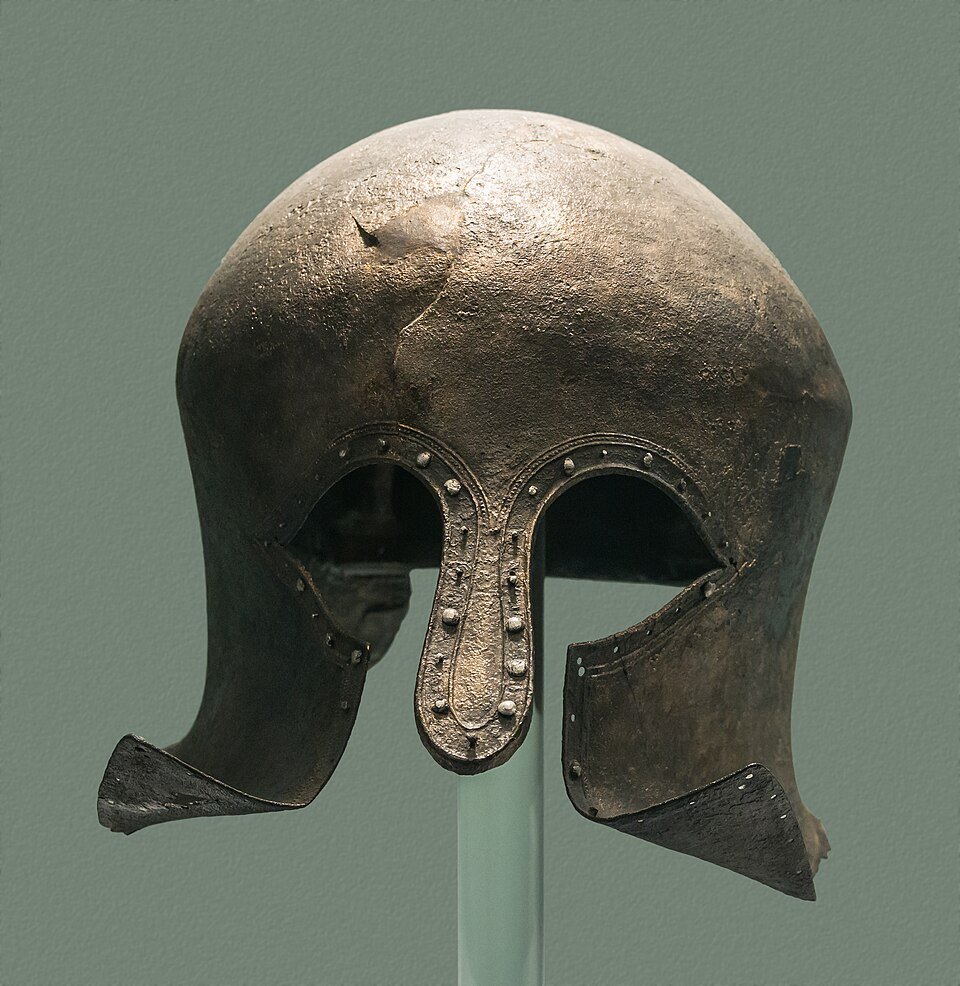
An ancient Greek Corinthian bronze hoplite helmet (c. 5th century BCE) of the type worn by heavy infantry at the battles of Delium, Amphipolis, and Mantinea. (Altes Museum, Antikensammlung Berlin)
Brasidas, Demagogues & The Fragile Peace of Nicias
Pericles' demise unleashed radical demagogues in the Athenian popular assembly (ecclesia), led by the wealthy leather merchant Cleon, who advocated unrestrained ruthlessness. When the island of Mytilene on Lesbos rebelled in 427 BCE, Cleon persuaded the assembly to pass an execution decree condemning every adult male in Mytilene to death and all women and children to enslavement—a genocidal order revoked at the eleventh hour by a second dispatch galley rowing frantically day and night across the Aegean.
In 425 BCE, Athenian fortune spiked when the unorthodox general Demosthenes and Cleon trapped a garrison of 420 Spartan hoplites—including 120 elite Spartiates—on the tiny island of Sphacteria off Pylos. After a forest fire stripped away the defenders' cover, the Spartans laid down their arms and surrendered—an unprecedented event that shattered the myth that Spartans would always die rather than yield. Desperate to ransom their aristocratic hostages, Sparta sued for peace, but an overconfident Athenian assembly rejected the terms.
Sparta found salvation in the audacious general Brasidas. Recognizing that Athens' Achilles' heel lay in its northern silver mines and timber reserves in Thrace, Brasidas marched an expeditionary force of freed helots and Peloponnesian mercenaries through Thessaly, capturing the strategic Athenian colony of Amphipolis in 424 BCE. When Cleon sailed north to recapture the city in 422 BCE, Brasidas launched a lightning counter-attack: the Athenians were routed, and both Brasidas and Cleon were slain in the melee. With the chief warmongers dead on both sides, the conservative Athenian aristocrat Nicias negotiated a treaty in 421 BCE—the Peace of Nicias—intended to establish a fifty-year cessation of hostilities based on the status quo ante.
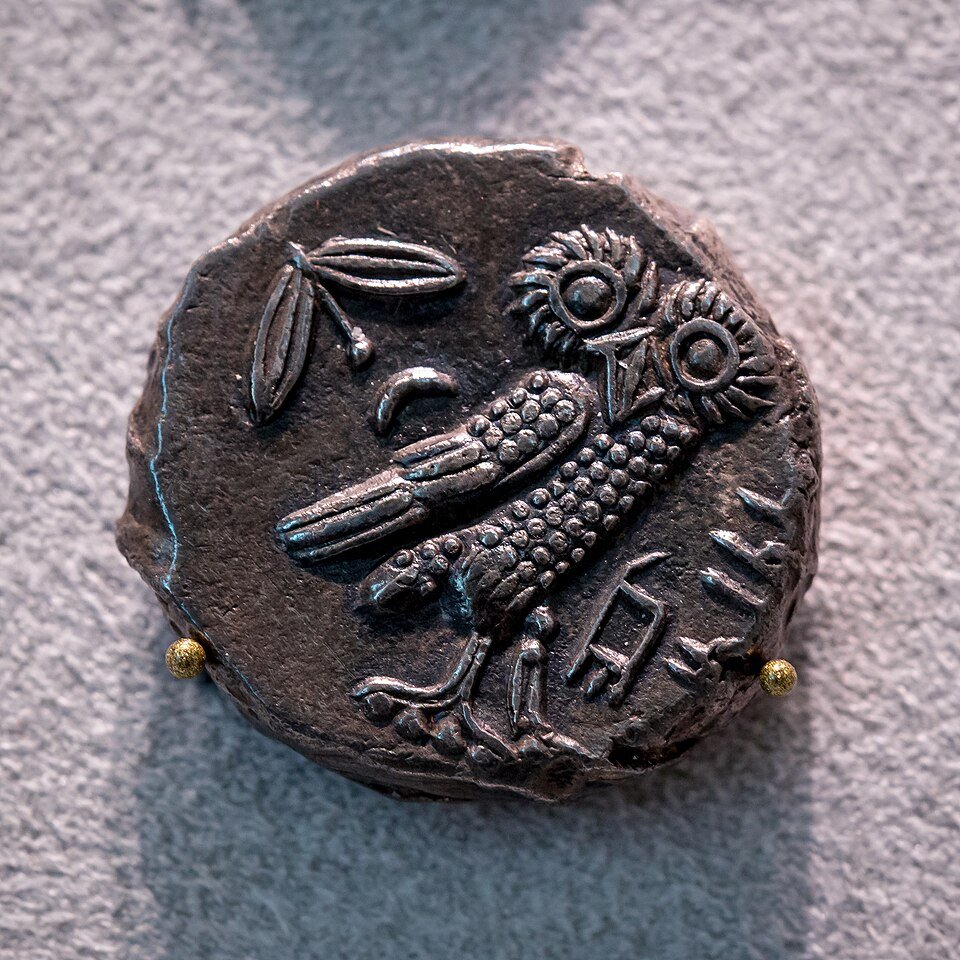
Athenian silver tetradrachm (c. 450 BCE) bearing the helmeted head of Athena on the obverse and the owl of wisdom, olive branch, and letters 'ΑΘΕ' on the reverse—the imperial reserve currency that financed the Delian fleet. (British Museum, London, RPK,p120C.1.Ath)
The Sicilian Expedition: Hubris and Annihilation (415–413 BCE)
The Peace of Nicias proved to be an illusion. The peace was openly contested by Sparta's key allies (Corinth, Thebes, and Megara), while in Athens, charismatic aristocrat Alcibiades—a handsome, flamboyant protégé of Socrates—campaigned for imperial expansion. In 415 BCE, under the pretext of aiding the minor Sicilian city of Segesta against Syracuse, Alcibiades convinced the assembly to launch the colossal Sicilian Expedition.
On the eve of the fleet's departure, a scandalous act of religious sacrilege stunned Athens: statues of Hermes (herms) standing outside private homes throughout the city were systematically mutilated overnight. Accused of blasphemy and parodying the sacred Eleusinian Mysteries, Alcibiades was allowed to depart with the fleet under a cloud of suspicion. Arriving in Sicily with 134 triremes and over 5,000 elite hoplites, an official state trireme, the Salaminia, arrived to arrest Alcibiades for capital treason. Feigning compliance, Alcibiades escaped during the return voyage to southern Italy and defected directly to Sparta.
In Sparta, Alcibiades provided devastating military counsel: he urged the Spartans to dispatch a veteran commander, Gylippus, to organize the defense of Syracuse, and advised King Agis II to establish a permanent fortified garrison at Decelea in northern Attica, permanently cutting Athens off from its silver mines at Laurium and blocking agricultural transit.
In Sicily, the Athenian siege of Syracuse degraded into an unmitigated nightmare. General Nicias, suffering from chronic kidney disease, conducted the siege with crippling timidity, allowing Gylippus to construct a counter-wall that permanently blocked the Athenian encirclement. When reinforcements under Demosthenes failed to turn the tide, an eclipse of the moon on August 27, 413 BCE prompted the superstitious Nicias to delay the fleet's evacuation for twenty-seven days. The Syracusans blocked the harbor mouth with chains of merchant ships, trapping the Athenian armada. In the ensuing naval bloodbath inside the Great Harbor, the Athenian fleet was smashed against the shore.
Attempting a desperate overland retreat through arid Sicilian valleys, forty thousand Athenian soldiers were hunted down by Syracusan cavalry. Seven thousand survivors, including Nicias and Demosthenes, were forced to surrender. Both generals were executed, while the surviving legion of hoplites was cast into the suffocating, unshaded limestone quarries of Epipolae, where thousands perished of thirst, exposure, and untreated wounds before the remnants were branded with the mark of a horse and auctioned into slavery.
Archidamus II, Brasidas, Gylippus, Agis II, Lysander.
The Decelean War, Persian Gold & The Fall of Athens (413–404 BCE)
The annihilation of the Sicilian Expedition stripped Athens of two-thirds of its navy and thousands of experienced oarsmen, prompting revolts across Ionia and the Aegean. Yet, demonstrating astonishing civic resilience, the Athenian citizens broke open their reserve treasury of 1,000 talents on the Acropolis, fell timber from Macedonia, and laid down new hulls.
The final decade of the war—the Decelean or Ionian War—centered on control of the maritime grain route through the Hellespont (Dardanelles). Here, the geopolitical balance tipped permanently when Spartan diplomacy secured an alliance with the Achaemenid Empire of Persia. Satraps Tissaphernes and Pharnabazus, coordinated by Persian prince Cyrus the Younger, poured Persian imperial gold directly into Spartan coffers, allowing Sparta to build warships and pay hireling rowers higher daily wages than Athens could afford.
In Spartan commander Lysander, Sparta found an admiral with the political cunning and operational ruthlessness to close the war. In 405 BCE, Lysander caught the Athenian fleet anchored at Aegospotami on the European side of the Hellespont while the crews were ashore foraging for rations. Without losing a single ship, Lysander captured 170 of the 180 Athenian triremes, executing three thousand captured Athenian citizens on the beach.
With its grain route permanently severed and grain ships blockaded from entering Piraeus, Athens was starved into capitulation over the winter of 404 BCE. While Corinth and Thebes demanded that Athens be razed to the ground and its population enslaved, Sparta intervened, refusing to destroy a city that had rendered heroic service during the Persian Wars. Instead, Lysander imposed unconditional terms: Athens surrendered all but twelve warships, demolished the sacred Long Walls to the celebratory music of Spartan flute-girls, dissolved the Delian League, and accepted an oligarchic junta of thirty pro-Spartan aristocrats—the infamous Thirty Tyrants led by Critias—who unleashed a reign of terror and execution against democratic partisans.
"The strong do what they can and the weak suffer what they must."
— The Melian Dialogue, Thucydides, History of the Peloponnesian War (Book V.89)
Historiographical Debate: "Thucydides' Trap" vs. Domestic Contingency
Few historical texts have shaped modern geopolitical theory as profoundly as Thucydides' claim that "what made war inevitable was the growth of Athenian power and the fear which this caused in Sparta." Political scientists like Graham Allison popularized this concept as "Thucydides' Trap"—arguing that structural friction between an established hegemon and a rising challenger makes systemic conflict nearly inescapable. However, classical military historians like Donald Kagan and G.E.M. de Ste. Croix strongly contest this fatalistic determinism. They argue that the war was not inevitable, but precipitated by specific, avoidable diplomatic blunders—such as Athens' aggressive Megarian Decree and intervention in the Corcyra dispute—alongside domestic political factionalism within both city-states. Far from an impersonal structural collision, the catastrophe was driven by human miscalculation, hubris, and volatile democratic demagogues like Cleon and Alcibiades.
Long-Term Legacy: The Exhaustion of the Classical Polis
The Peloponnesian War was the funeral pyre of the classical Greek golden age. Although Athenian democrats under Thrasybulus overthrew the Thirty Tyrants in 403 BCE and restored democratic institutions, the intellectual self-confidence of the fifth century had perished. The bitter trial and execution of Socrates in 399 BCE—condemned on trumped-up charges of corrupting the youth, but in reality stained by his association with his former students Alcibiades and Critias—symbolized a traumatized society clinging defensively to orthodoxy.
Sparta's victory proved hollow and ephemeral. Incapable of governing an empire without relying on mercenary garrisons and oppressive harmosts, Sparta alienated its former allies. Within three decades, Thebes shattered the myth of Spartan military invincibility at the Battle of Leuctra (371 BCE), liberating Messenia's helots and reducing Sparta to a second-rate regional power. By exhausting their finances, slaughtering their citizen bodies, and poisoning inter-city diplomacy, the Greek city-states left the Aegean world an open geopolitical vacuum—clearing the path for King Philip II of Macedon and his son Alexander the Great to subjugate all of Greece by 338 BCE.
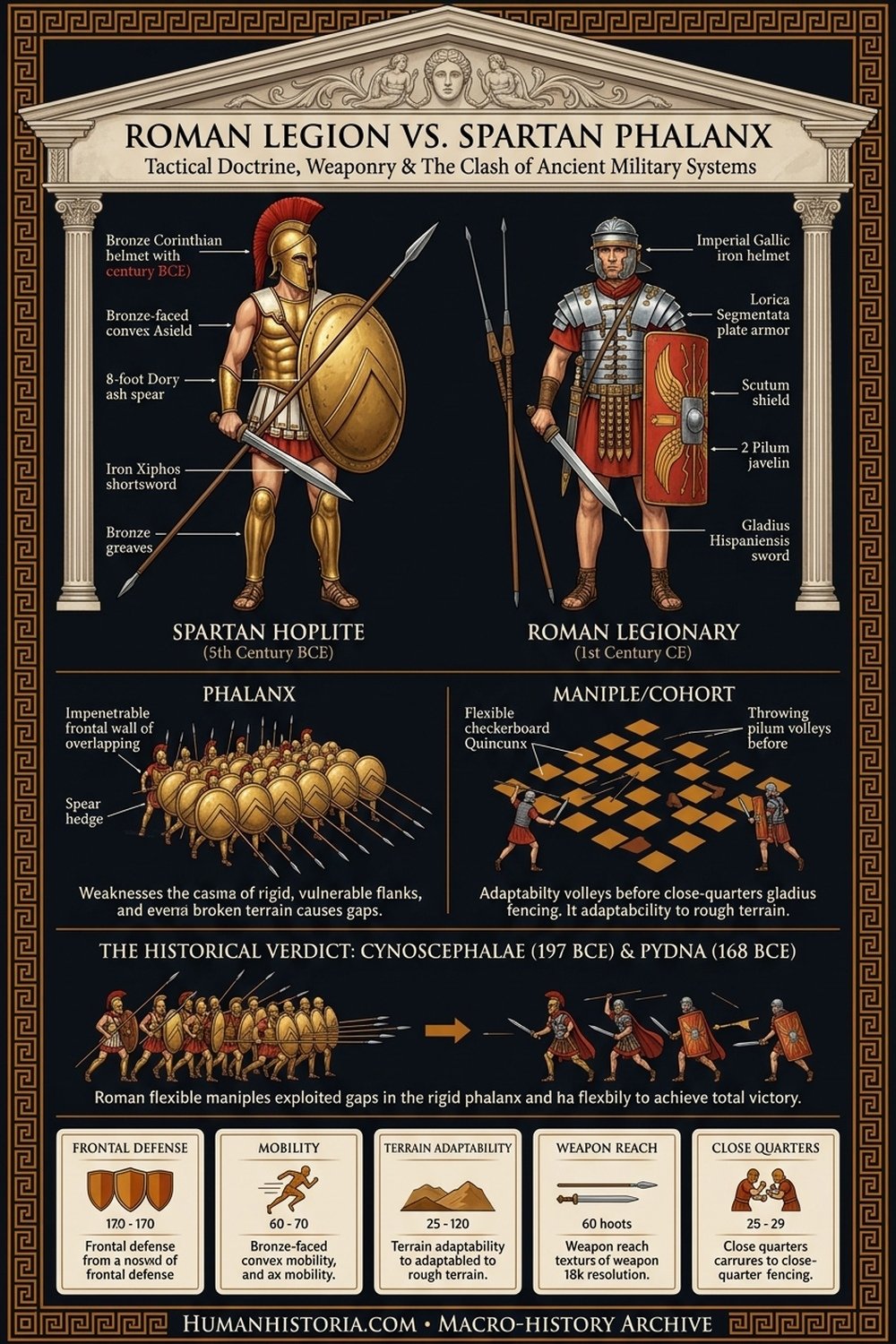
📊 Museum-Grade Infographic Poster
Roman Legion vs. Spartan Phalanx: Tactical Doctrine & Combat Comparison
💡 Click anywhere on poster to expand in high resolution🔎 Expand Lightbox
Thriving along the desert coast of Peru around 3000 BCE, Caral-Supe is the oldest known civilization in the Americas, flourishing at the same time as Egypt's pyramids. Its stone platform mounds, sunken circular plazas, and quipu knotted-string recordkeeping emerged without ceramics, grain agriculture, or evidence of warfare.
📖 SCHOLARLY INQUIRIES
Frequently Asked Questions
Essential historical questions and evidence-based answers concerning this chronicle.
Q.Why is The Peloponnesian War significant in world history?
The Peloponnesian War played a pivotal role by transforming technology, social structure, and regional connection, serving as a vital link in human civilization.
Q.What caused the Peloponnesian War?
Historian Thucydides identified the fundamental cause as the rapid growth of Athenian imperial power (Delian League) and the fear this growth inspired in Sparta.
Q.What was the Plague of Athens?
In 430 BCE, a catastrophic epidemic struck crowded Athens during the Spartan siege, killing one-third of the population including Athenian leader Pericles.
Q.What was the Sicilian Expedition?
In 415 BCE, Athens dispatched a massive naval armada to invade Syracuse in Sicily. The campaign ended in total annihilation, losing 200 ships and 30,000 soldiers.
📚 Academic Sources & Scholarly Bibliography
Thucydides (1972).
History of the Peloponnesian War.
Penguin Classics.
Kagan, D. (2003).
The Peloponnesian War.
Viking Press.
Hornblower, S. (2011).
The Greek World 479-323 BC.
Routledge.
📖 Scholar Mode Active — Click to exit focused reading
History Lab 🧪
Interactive historical deduction games, tactical matchup simulators, and currency calculators.
🕵️ Who Am I? (The Historical Guess Game)
A secret historical figure has been selected. Ask yes/no questions to narrow down the pool of candidates. Click any active card to make your accusation!
Secret Identity
❓ Who Am I?
Ask questions using the board below to narrow down my identity.
Ask a Question:
Question LogQuestions: 0 / 7
No questions asked yet.
Candidate Board:
🗺️ Timeline Scramble
Five historical events appear out of order. Click them in the correct chronological sequence — from oldest to most recent. How well do you know your history?
🏺 Relic or Fake?
Is this a real historical artifact or a convincing fabrication? Judge each one based on its description and era — then see the truth revealed!
Artifact 1 / 10Score: 0
Empire Matchup Simulator
Empire ATerritory Size (Peak, M km²)Empire B
00
Empire APopulation (Peak, Millions)Empire B
00
Empire AMilitary Power (Army Size)Empire B
00
Tactical Battle Analysis
Select empires and click simulate to run evaluations.
Historical Purchasing Power Converter
See what ancient coins are worth in modern terms and check their historical purchasing power.
Modern Value Equivalent
$0.00 USD
Historical Purchasing Power:
Select currency to view purchasing capability.
Historical Identity Generator
Forge an authentic historical identity from ancient civilisations, complete with linguistic meaning and biography.
Neutral
Gaius Julius
Meaning:Descendant of Jupiter
Historical Background:
A Roman citizen and clerk who worked in the forum under Roman republic rule.
Chrono-Cultural Fusion Simulator
Fuse the culture, technology, and governance of two legendary civilizations to synthesize a unique hybrid society.
Cohesion & Coexistence Rate
85%
🏛️ Hybrid Architecture
⚙️ Synthesized Asset
📜 Synthetic Governance
Historical Tactics & Trivia Quiz
Test your historical knowledge and battle tactics to claim your administrative rank.
8 Questions • Multi-Era
You will be presented with random scenarios and trivia spanning ancient Egypt, classical Rome, Islamic Golden Age, and the modern industrial era. Complete the evaluation to see your historical title!
Question 1 of 8Score: 0
What was the Code of Hammurabi written on?
Correct!
Evaluation Complete!
6 / 8
Correct
Rank Attained
Imperial Legionary
Your knowledge of classical strategy and administrative structures is respectable.
🎲 Counterfactual "What If?" Scenario Simulator
Explore alternative historical trajectories by tweaking key civilizational pivot points.
Simulated Shift
Selected Era
Prehistoric Era
Millions of years ago to ~3000 BCE
The dawn of humanity. From the evolutionary split of early hominids to the mastery of stone tools, fire, and the birth of language.
Landmark Milestones
Welcome to Historia
Enter your Scholar Name to synchronize your chronicles and save your journey.

 ⭐ Featured Chronicle

 ANCIENT AGES
 ANCIENT AGES
 ANCIENT AGES
 MEDIEVAL PERIOD
 MEDIEVAL PERIOD
 PREHISTORIC ERA