From prehistoric origins to the modern era—discover the turning points, lost empires, and breakthroughs of world history through interactive timelines and visual guides.
Examine the tangible relics, physical tokens, and revolutionary machines that shaped civilizational growth.
🎥 VIDEO HUB & SHORTS
Watch visual summaries, site intros, and mini-documentaries chronicling 300,000 years of world history.
📊 HISTORICAL INFOGRAPHICS ARCHIVE
Museum-grade visual graphics, civilizational timelines, and architectural breakdowns curated for educators and history lovers.
THE HISTORIA CIRCLE
Join the collective discussion, study logs, and contributions of fellow historians mapping humanity's path.
Historia Forum Discussions
Start a Discussion Thread
THEMATIC PATHWAYS
Trace a single thread — disease, trade, energy, migration — across all eras and civilizations.
History is not just a sequence of events — it is a network of patterns. These thematic pathways allow you to follow a single concept across thousands of years: how agriculture spread, how warfare evolved, how trade routes shaped civilizations. Each pathway collects the most relevant chronicles across all eras.
🧩
How is this different from the sidebar Topics?
While the sidebar Topics (like Science & Tech or Empires) filter articles within your selected historical Era, Thematic Pathways cut horizontally across all eras (from Prehistoric to the Future). Use Themes to trace a single concept's evolutionary line across 300,000 years.
CIVILIZATION HUBS
Comprehensive profiles of the world's greatest civilizations and empires — from ancient cradles to global super-states.
Human Historia provides an academically rich exploration of the world's most influential civilizations. From the monumental achievements of ancient Egypt, Han China, and the Roman Empire, to the sophisticated societies of the Maya, the Islamic Caliphates, and West African empires, these hubs offer deep insights into the cultural, political, and technological legacies that continue to shape our global story.
EVOLUTION OF HUMAN SKILLS
Trace the compounding technologies, practical capabilities, and cognitive milestones of the human species.
Human progress is a story of compounding skills. Every breakthrough, from the spark of prehistoric fire to modern silicon transistors, builds directly on previous generations of ingenuity. Hover over a skill node to trace its historical prerequisites, and click it to explore its development timeline, species-wide impact, and related chronicles.
Prehistoric Ancient Medieval Modern Future
🧠
Select any skill node in the tree to explore its evolutionary path, development timeline, and historical impact.
ACADEMIC PASSPORT
Track your intellectual journey, quiz outcomes, and historical badges of honor.
HISTORIA PASSPORT⏳
👤Scribe Novice
Scholar NameHistoria Explorer
Rank RatingSumerian Record Scribe
Chronicles Read0 / 48
Study Guide Pins0 Guides
Security AccessLevel 1 (Novice)
Earned Badges of Honor
🔥
Fire Keeper
Unlock 3 prehistoric chronicles.
🏛️
Codex Keeper
Unlock 3 ancient chronicles.
🏰
Guild Master
Unlock 3 medieval chronicles.
⚙️
Steam Engineer
Unlock 3 modern chronicles.
🚀
Singularity Sage
Unlock 3 future chronicles.
👑
Grand Scholar
Score 5/5 on the Lab Quiz.
Recent Lab Activities
No recent activities recorded. Take a quiz or bookmark articles!
🏛️ MISSION & ARCHIVAL STANDARDS
About Human Historia
A visual encyclopedia and timeline of human history, dedicated to documenting 300,000 years of civilizational evolution through rigorous research, authentic artifacts, and visual clarity.
🌍
The 300,000-Year Story
Human Historia traces our collective journey across five historical epochs: Prehistory, Ancient Worlds, Middle Ages, Modern Age, and Future Horizons. From the first control of fire to quantum computation, we organize turning points into interconnected timelines.
📜
Historiographical Rigor
Every chronicle is built upon primary historical manifests, contemporary excavation reports, and peer-reviewed historical consensus. We prioritize authentic public domain artifacts and clearly identify scholarly debates surrounding major civilizational transitions.
🎨
Museum-Grade Visuals
Complex historical transitions demand visual understanding. We develop high-resolution infographics, architectural cutaways, and comparative territorial maps to transform abstract timelines into vivid, unforgettable learning experiences.
📖
Educational Access
Knowledge belongs to humanity. Human Historia is free, ad-light, and engineered as an educational resource for students, classroom educators, academic researchers, and curious minds across all continents.
Editorial Governance & Inquiries
We welcome peer reviews, academic corrections, museum archival collaborations, and educational partnerships. To submit historical inquiries or provide archival feedback, reach our editorial desk directly.
An immersive graphical anthology tracing the paths of civilizations, breakthroughs, and conflicts that forged the modern consciousness.
25Chronicles
Showing all articles
The Mysterious Sea Peoples: Maritime Warfare at the Iron Age Dawn
Written by Humanhistoria MilitaryHistorical Era: ANCIENT
Around the year 1177 BCE, a mysterious maritime confederation descended upon the ancient Mediterranean like a tidal wave of fire and iron. Originating from uncharted islands and shattered archipelagos to the north and west, the seafaring marauders whom Egyptian hieroglyphs called the Sea Peoples shattered the great geopolitical order of the Late Bronze Age. Within a single generation, the cyclopean fortress-palaces of Mycenaean Greece, the imperial kingdom of the Hittites in Anatolia, and cosmopolitan trading emporiums like Ugarit were sacked and burned to ash. Only New Kingdom Egypt under Pharaoh Ramesses III survived to record their names in stone, trapping their armada in a desperate aquatic trap at the Battle of the Delta. This epochal catastrophe terminated an interconnected, globalized palace economy that had endured for five centuries, extinguishing writing systems and plunging the Mediterranean into centuries of silence before birthing the Iron Age.
🎯 Quick Historical Summary
Who Were the Mysterious Sea Peoples and What Did They Destroy?
Around 1200–1175 BCE, maritime warrior confederations known collectively as the Sea Peoples ravaged the Eastern Mediterranean. Their migratory invasions toppled the Hittite Empire, destroyed Mycenaean palace states, and sacked Syrian trade hubs like Ugarit, triggering the catastrophic Late Bronze Age Collapse.
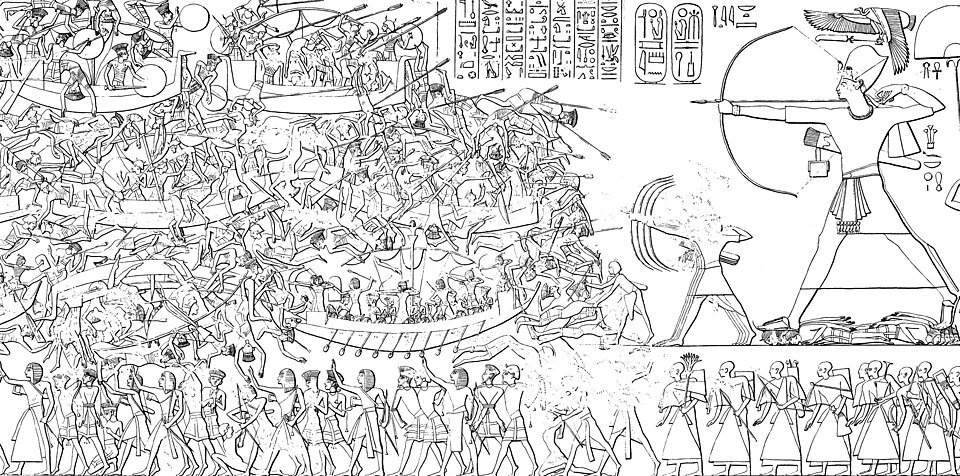
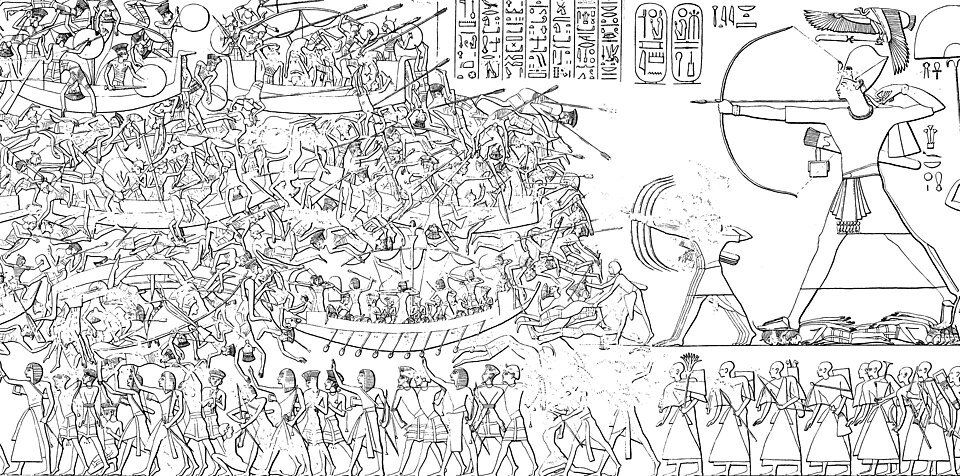
The monumental relief drawing of the naval Battle of the Delta from the north wall of Pharaoh Ramesses III's mortuary temple at Medinet Habu (c. 1175 BCE), showing Egyptian war galleys trapping the horned and feathered warships of the Sea Peoples. (Epigraphic Survey, Oriental Institute of the University of Chicago / Medinet Habu Complex, Luxor)
The Interconnected World of 1250 BCE: A Fragile Global Order
To grasp the magnitude of the Sea Peoples' destructive impact, one must understand that the Eastern Mediterranean of 1250 BCE was not an isolated, primitive landscape. It was arguably the most complex, interconnected, and globalized economic network humanity had yet produced. Known to modern historians as the "Age of Internationalism," this high Bronze Age world functioned through elaborate royal diplomacy, reciprocal gift exchange, and vital long-distance supply chains connecting five major superpowers: the New Kingdom of Egypt, the Hittite Empire of Anatolia, the Kassite Dynasty of Babylon, the Middle Assyrian Empire, and the Mycenaean Greek Kingdoms.
The entire material infrastructure of this world depended on bronze—an alloy requiring nine parts copper to one part tin. While copper was abundantly mined on the island of Cyprus (ancient Alashiya), tin had to be imported across staggering overland distances from Afghanistan's Badakhshan mountains or maritime routes reaching the tin mines of Cornwall. Wealthy royal scribes corresponded across thousands of miles using Akkadian cuneiform clay tablets, negotiating dynastic marriages and trading gold, lapis lazuli, cedar wood, olive oil, and Baltic amber. Cosmopolitan coastal ports like Ugarit in northern Syria flourished as international clearinghouses where Syrian, Canaanite, Cypriot, Egyptian, and Aegean merchants bartered alongside one another.
Yet this hyper-specialized palatial system possessed a fatal structural vulnerability: systemic fragility. The palace centers were hyper-centralized command economies that collected, stored, and redistributed every bushel of grain, bronze sickle, and wool garment. If international trade arteries snapped or agricultural yields failed for multiple consecutive seasons, the palaces possessed zero resilience. Between 1200 and 1150 BCE, the system ruptured completely.
The Medinet Habu Inscriptions: The Nine Tribes of the Sea
Our primary historical testimony concerning the Sea Peoples comes from the monumental mortuary temple of Pharaoh Ramesses III at Medinet Habu in Luxor, Egypt. Commissioned during his eighth regnal year (c. 1175 BCE), the stone relief carvings and accompanying hieroglyphic annals provide a chilling panoramic chronicle of a world in collapse.
The Egyptian inscriptions record that a massive migratory confederation had swept down through Anatolia, Cyprus, and the Levant, crushing every kingdom in its path before descending upon the Nile Delta by both land and sea. The land contingent advanced in ponderous ox-drawn wagons laden with women, children, and household furniture, guarded by bronze-armed infantry, while a vast armada of single-masted, clinker-built war galleys with high duck-head prows shadowed them along the coast.
Who Were the Invaders?
The hieroglyphic inscriptions explicitly identify at least nine discrete tribal confederacies, whose historical identities scholars have debated for over two centuries:
The Peleset: Widely recognized by biblical scholars and archaeologists as the direct ancestors of the biblical Philistines. Depicted at Medinet Habu wearing distinctive fluted or feathered headdresses, their Aegean-style pottery and pork-consuming dietary habits confirm their maritime origins in Crete and the Aegean.
The Sherden: Elite maritime warriors distinguished by crested helmets topped with curved bull horns and a central bronze ball. Many Sherden served as mercenary royal bodyguards for Egyptian Pharaoh Ramesses II at the Battle of Kadesh before turning against Egypt; scholars link them to the island of Sardinia.
The Shekelesh: Associated by philologists and historians with the Sicels, an ancient maritime population that subsequently colonized and gave its name to Sicily.
The Denyen: Identified by classical scholars with the Danaoi (Danaans)—one of the primary terms used by Homer in the Iliad to describe the Mycenaean Greeks.
The Tjeker & Weshesh: Likely originating from northwestern Anatolia (the region of the Troad/Troy) and Caria.
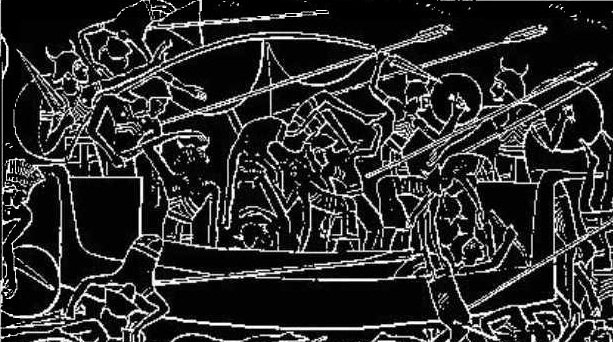
Carved stone relief from the exterior wall of the mortuary temple of Ramesses III at Medinet Habu, depicting elite Sherden warriors bearing their iconic horned bronze helmets, round bucklers, and straight broadswords. (Medinet Habu Complex, Luxor)
The Fall of Great Kingdoms: Ugarit, Hattusa & Mycenae
The physical devastation wrought during this crisis is corroborated by deep destruction layers across every excavated Bronze Age citadel from Greece to the Levant. At Ugarit, French archaeologists unearthed one of the most poignant archives in antiquity: baked clay tablets discovered frozen in the palace kilns where they were fired just hours before the city was razed.
In a desperate diplomatic dispatch (RS 20.238), King Ammurapi of Ugarit wrote to the King of Alashiya (Cyprus), pleading for military aid:
"My father, behold, the enemy's ships came here; my cities were burned, and they did evil things in our country. Does not my father know that all my troops and chariots are in the Land of Hatti, and all my ships are in the Land of Lukka? Thus, the country is abandoned to itself. May my father know it: the seven ships of the enemy that came here inflicted much damage upon us."
— Cuneiform Letter from King Ammurapi of Ugarit to the King of Alashiya (Ras Shamra Tablet RS 20.238, National Museum of Damascus)
Before that message could be dispatched, Ugarit was overwhelmed. Excavations reveal collapsed palace walls, soot-blackened stones, smashed luxury pottery, and bronze arrowheads embedded deep in courtyard ramparts; the great commercial metropolis was never rebuilt. Further north, the imperial Hittite capital of Hattusa was sacked and burned so violently that the mudbrick and limestone walls vitrified under the intense furnace heat. In mainland Greece, the cyclopean citadels of Mycenae, Tiryns, and Pylos were torched, their Linear B scribal traditions permanently erased, and their populations dispersed into remote mountain refuges.
Tactical Masterclass: The Battle of the Delta (c. 1175 BCE)
By 1175 BCE, Egypt stood as the final bastion of civilization. Recognizing that his heavy infantry and two-wheeled war chariots could not defeat the Sea Peoples in open naval warfare, Pharaoh Ramesses III devised a brilliant combined-arms ambush at the mouth of the Nile Delta.
Ramesses lured the Sea Peoples' sailing vessels into the narrow, winding distributary branches of the Nile. As the invaders navigated the shallow waters, Egyptian war galleys—propelled by both oars and sails—rammed the enemy ships from flank positions, snapping their oars. Hidden along the reed banks, Egyptian archers armed with composite bows poured a relentless rain of bronze-tipped arrows onto the crowded open decks. Egyptian sailors hurled heavy iron grapples attached to ropes, hooking the rigging of the Sea Peoples' ships and capsizing them into the mud. Weighted down by their heavy bronze cuirasses and swords, thousands of invaders drowned, while survivors dragging themselves ashore were massacred or branded as state captives.
Carved granite relief from the interior pylon at Medinet Habu showing captured Sea Peoples prisoners—identifiable by their characteristic feathered headdresses and fringed kilts—bound with ropes following the naval Battle of the Delta. (Medinet Habu Complex, Luxor)
The Modern Consensus: Systems Collapse & The Perfect Storm
For over a century, traditional 19th-century historians viewed the Sea Peoples as the sole, demonic instigators of the Bronze Age Collapse—a unified barbarian wave that swept down from northern Europe to dismantle civilization. Modern archaeology, paleoclimatology, and archaeoseismology have completely overturned this simplistic narrative.
As synthesizing historian Eric Cline argues in his seminal work 1177 B.C.: The Year Civilization Collapsed, the Sea Peoples were more likely a symptom rather than the ultimate cause of the collapse. Paleoclimatic pollen data extracted from lake sediment cores across Greece, Syria, and Israel confirm that the Mediterranean suffered a severe, multi-century mega-drought beginning around 1250 BCE, causing catastrophic crop failures and famine. Simultaneously, geologists have identified a cluster of devastating earthquake storms along the North Anatolian and Dead Sea fault lines between 1225 and 1175 BCE, leveling palace walls at Mycenae, Tiryns, Knossos, and Megiddo.
In this modern systems-collapse framework, the Sea Peoples were not an organized conqueror army, but desperate climate refugees driven from their drought-ravaged Aegean and Mediterranean homelands. When these migrating displaced populations converged upon already fraying palatial kingdoms, the entire hyper-specialized Mediterranean trade matrix collapsed in a cascading domino effect.
Kingdom / Region
Status in 1250 BCE
Fate During the Collapse (1200–1150 BCE)
Long-Term Historical Outcome
Mycenaean Greece
Palatial military kingdoms (Mycenae, Pylos, Tiryns); Linear B literacy.
Total destruction and abandonment; palaces burned; writing system vanished.
400-year Greek Dark Age; gave birth to the classical Greek Iron Age polis.
Hittite Empire
Anatolian imperial superpower; rivals of Egypt; treaty of Kadesh.
Imperial capital Hattusa destroyed and burned; empire collapsed entirely.
Fragmented into decentralized Neo-Hittite and Luwian city-states in Syria.
Totally leveled by Sea Peoples naval raiding; never rebuilt.
Paved the way for the rise of independent Phoenician trading city-states (Tyre, Byblos).
New Kingdom Egypt
Imperial zenith under Ramesses II; controlled Levantine provinces.
Successfully repelled invaders at the Delta (1175 BCE) but exhausted treasury.
Lost all Levantine territories; entered Third Intermediate Period; permanent economic decline.
Southern Levant Coast
Canaanite tributary city-states subordinate to Egyptian garrisons.
Occupied by Sea Peoples migrants (Peleset) settling five cities.
Formed the Philistine Pentapolis (Gaza, Ashkelon, Ashdod, Gath, Ekron).
"The foreign countries made a conspiracy in their islands. All at once the lands were removed and scattered in the fray. No land could stand before their arms: from Hatti, Kode, Carchemish, Arzawa, and Alashiya on, being cut off at one time. A camp was set up in Amurru. They desolated its people, and its land was like that which has never come into being."
— Year 8 Inscription of Pharaoh Ramesses III, Mortuary Temple at Medinet Habu (c. 1175 BCE)
Historiographical Debate: Exogenous Barbarian Invasion vs. Endogenous Systems Collapse
The Late Bronze Age Collapse has witnessed a profound historiographical shift over the past century. Early 19th-century Egyptologists like Gaston Maspero attributed the catastrophic destruction of Mycenaean, Hittite, and Levantine cities solely to the external ravages of the "Sea Peoples"—depicting them as a coordinated barbarian tidal wave sweeping across the Mediterranean. Contemporary archaeological science, spearheaded by scholars like Eric Cline (1177 B.C.: The Year Civilization Collapsed) and Robert Drews, challenges this mono-causal invasion narrative. Modern consensus views the Sea Peoples not as the prime cause of the collapse, but as a symptom of a broader "perfect storm": prolonged megadroughts identified in fossil pollen records, seismic earthquake storms, severe famine, and fragile, over-centralized palatial economies whose trade networks fractured under systemic environmental stress.
Long-Term Legacy: The Birth of the Iron Age
The Late Bronze Age Collapse was an apocalypse, but it was also a profound civilizational reboot. By shattering the fossilized, despotic monopolies of Bronze Age palaces, the Sea Peoples inadvertently created the geopolitical vacuum necessary for a more decentralized, democratic world to emerge.
Deprived of imported bronze, Mediterranean blacksmiths turned out of necessity to the difficult, widespread metal they had previously ignored: iron. Unlike rare copper and tin, iron ore was found in nearly every hillside, democratizing military technology and agricultural tools. Liberated from imperial Egyptian and Hittite tribute, the Canaanite seafarers of the Levantine coast transformed into the Phoenicians, pioneering maritime trade routes across the Atlantic and inventing the phonetic alphabet. In the Judean highlands, the decentralized tribal confederation of Israel emerged into statehood, while in the Aegean, the ruins of Mycenaean autocracy gave birth to the civic experiments of the classical Greek city-state. Out of the ashes of the Bronze Age, the modern world was forged.
📊 Museum-Grade Infographic Poster
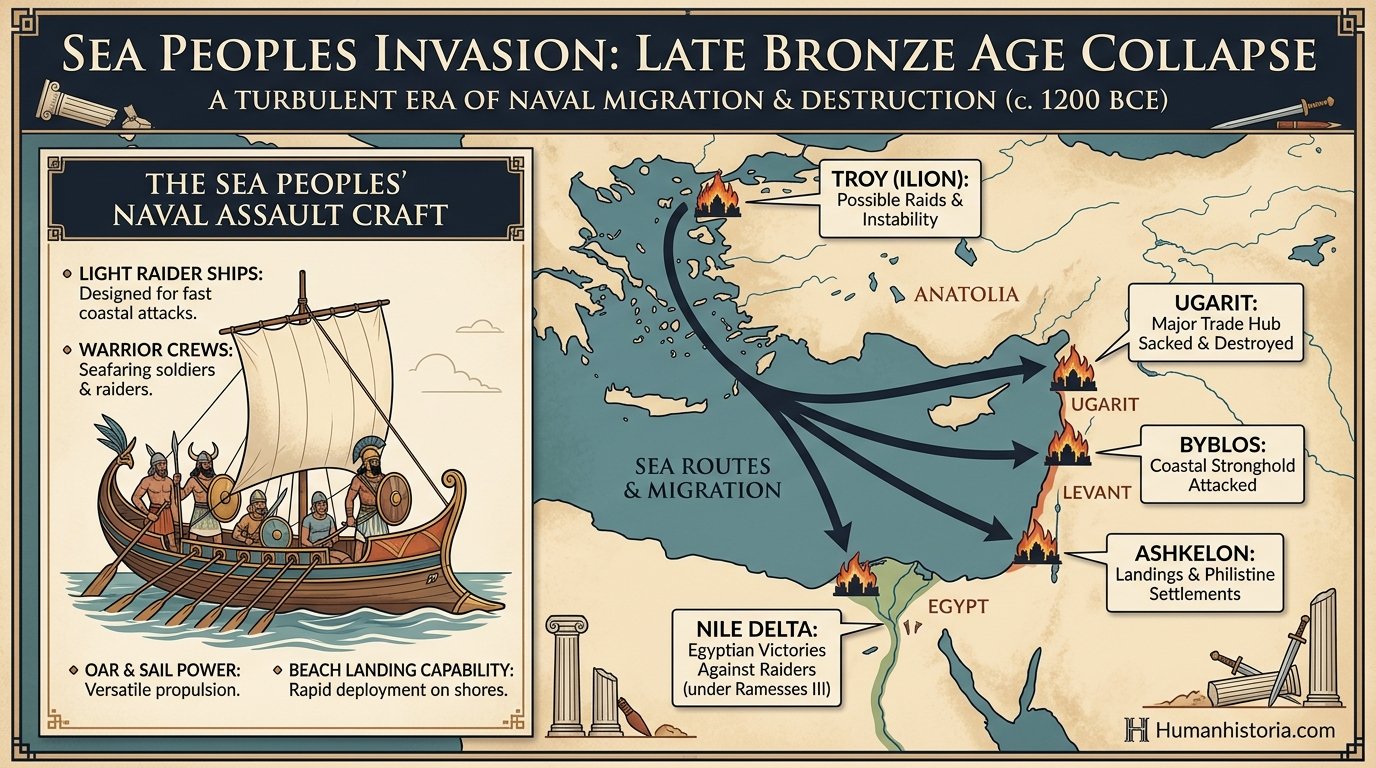
The Sea Peoples Naval Invasions (c. 1177 BCE) Infographic
💡 Click anywhere on poster to expand in high resolution🔎 Expand Lightbox
Strategic battle map showing Ramesses III's archers lining the Nile delta shore, capturing Sea Peoples' warships in ambushes.
📖 SCHOLARLY INQUIRIES
Frequently Asked Questions
Essential historical questions and evidence-based answers concerning this chronicle.
Q.Who were the Sea Peoples?
The Sea Peoples were a mysterious confederation of displaced maritime raiding tribes (including the Peleset, Sherden, Shekelesh, and Denyen) originating from the Aegean, Western Anatolia, and Mediterranean islands.
Q.What happened at the Battle of the Delta (c. 1175 BCE)?
Pharaoh Ramesses III lured the Sea Peoples' fleet into the Nile Delta channels, where Egyptian archers on shore and warships ambushed and destroyed the invading fleet.
Q.How did the Sea Peoples relate to the Philistines?
After their defeat in Egypt, the Peleset tribe settled along the southern Levant coast, becoming the biblical Philistines (giving their name to Palestine).
📚 Academic Sources & Scholarly Bibliography
Cline, E. H. (2014).
1177 B.C.: The Year Civilization Collapsed.
Princeton University Press.
Sandars, N. K. (1985).
The Sea Peoples: Warriors of the Ancient Mediterranean 1250-1150 B.C..
Thames & Hudson.
Drews, R. (1993).
The End of the Bronze Age.
Princeton University Press.
📖 Scholar Mode Active — Click to exit focused reading
History Lab 🧪
Interactive historical deduction games, tactical matchup simulators, and currency calculators.
🕵️ Who Am I? (The Historical Guess Game)
A secret historical figure has been selected. Ask yes/no questions to narrow down the pool of candidates. Click any active card to make your accusation!
Secret Identity
❓ Who Am I?
Ask questions using the board below to narrow down my identity.
Ask a Question:
Question LogQuestions: 0 / 7
No questions asked yet.
Candidate Board:
🗺️ Timeline Scramble
Five historical events appear out of order. Click them in the correct chronological sequence — from oldest to most recent. How well do you know your history?
🏺 Relic or Fake?
Is this a real historical artifact or a convincing fabrication? Judge each one based on its description and era — then see the truth revealed!
Artifact 1 / 10Score: 0
Empire Matchup Simulator
Empire ATerritory Size (Peak, M km²)Empire B
00
Empire APopulation (Peak, Millions)Empire B
00
Empire AMilitary Power (Army Size)Empire B
00
Tactical Battle Analysis
Select empires and click simulate to run evaluations.
Historical Purchasing Power Converter
See what ancient coins are worth in modern terms and check their historical purchasing power.
Modern Value Equivalent
$0.00 USD
Historical Purchasing Power:
Select currency to view purchasing capability.
Historical Identity Generator
Forge an authentic historical identity from ancient civilisations, complete with linguistic meaning and biography.
Neutral
Gaius Julius
Meaning:Descendant of Jupiter
Historical Background:
A Roman citizen and clerk who worked in the forum under Roman republic rule.
Chrono-Cultural Fusion Simulator
Fuse the culture, technology, and governance of two legendary civilizations to synthesize a unique hybrid society.
Cohesion & Coexistence Rate
85%
🏛️ Hybrid Architecture
⚙️ Synthesized Asset
📜 Synthetic Governance
Historical Tactics & Trivia Quiz
Test your historical knowledge and battle tactics to claim your administrative rank.
8 Questions • Multi-Era
You will be presented with random scenarios and trivia spanning ancient Egypt, classical Rome, Islamic Golden Age, and the modern industrial era. Complete the evaluation to see your historical title!
Question 1 of 8Score: 0
What was the Code of Hammurabi written on?
Correct!
Evaluation Complete!
6 / 8
Correct
Rank Attained
Imperial Legionary
Your knowledge of classical strategy and administrative structures is respectable.
🎲 Counterfactual "What If?" Scenario Simulator
Explore alternative historical trajectories by tweaking key civilizational pivot points.
Simulated Shift
Selected Era
Prehistoric Era
Millions of years ago to ~3000 BCE
The dawn of humanity. From the evolutionary split of early hominids to the mastery of stone tools, fire, and the birth of language.
Landmark Milestones
Welcome to Historia
Enter your Scholar Name to synchronize your chronicles and save your journey.

 ⭐ Featured Chronicle

 ANCIENT AGES
 ANCIENT AGES
 ANCIENT AGES
 MEDIEVAL PERIOD
 MEDIEVAL PERIOD
 PREHISTORIC ERA