From prehistoric origins to the modern era—discover the turning points, lost empires, and breakthroughs of world history through interactive timelines and visual guides.
Examine the tangible relics, physical tokens, and revolutionary machines that shaped civilizational growth.
🎥 VIDEO HUB & SHORTS
Watch visual summaries, site intros, and mini-documentaries chronicling 300,000 years of world history.
📊 HISTORICAL INFOGRAPHICS ARCHIVE
Museum-grade visual graphics, civilizational timelines, and architectural breakdowns curated for educators and history lovers.
THE HISTORIA CIRCLE
Join the collective discussion, study logs, and contributions of fellow historians mapping humanity's path.
Historia Forum Discussions
Start a Discussion Thread
THEMATIC PATHWAYS
Trace a single thread — disease, trade, energy, migration — across all eras and civilizations.
History is not just a sequence of events — it is a network of patterns. These thematic pathways allow you to follow a single concept across thousands of years: how agriculture spread, how warfare evolved, how trade routes shaped civilizations. Each pathway collects the most relevant chronicles across all eras.
🧩
How is this different from the sidebar Topics?
While the sidebar Topics (like Science & Tech or Empires) filter articles within your selected historical Era, Thematic Pathways cut horizontally across all eras (from Prehistoric to the Future). Use Themes to trace a single concept's evolutionary line across 300,000 years.
CIVILIZATION HUBS
Comprehensive profiles of the world's greatest civilizations and empires — from ancient cradles to global super-states.
Human Historia provides an academically rich exploration of the world's most influential civilizations. From the monumental achievements of ancient Egypt, Han China, and the Roman Empire, to the sophisticated societies of the Maya, the Islamic Caliphates, and West African empires, these hubs offer deep insights into the cultural, political, and technological legacies that continue to shape our global story.
EVOLUTION OF HUMAN SKILLS
Trace the compounding technologies, practical capabilities, and cognitive milestones of the human species.
Human progress is a story of compounding skills. Every breakthrough, from the spark of prehistoric fire to modern silicon transistors, builds directly on previous generations of ingenuity. Hover over a skill node to trace its historical prerequisites, and click it to explore its development timeline, species-wide impact, and related chronicles.
Prehistoric Ancient Medieval Modern Future
🧠
Select any skill node in the tree to explore its evolutionary path, development timeline, and historical impact.
ACADEMIC PASSPORT
Track your intellectual journey, quiz outcomes, and historical badges of honor.
HISTORIA PASSPORT⏳
👤Scribe Novice
Scholar NameHistoria Explorer
Rank RatingSumerian Record Scribe
Chronicles Read0 / 48
Study Guide Pins0 Guides
Security AccessLevel 1 (Novice)
Earned Badges of Honor
🔥
Fire Keeper
Unlock 3 prehistoric chronicles.
🏛️
Codex Keeper
Unlock 3 ancient chronicles.
🏰
Guild Master
Unlock 3 medieval chronicles.
⚙️
Steam Engineer
Unlock 3 modern chronicles.
🚀
Singularity Sage
Unlock 3 future chronicles.
👑
Grand Scholar
Score 5/5 on the Lab Quiz.
Recent Lab Activities
No recent activities recorded. Take a quiz or bookmark articles!
🏛️ MISSION & ARCHIVAL STANDARDS
About Human Historia
A visual encyclopedia and timeline of human history, dedicated to documenting 300,000 years of civilizational evolution through rigorous research, authentic artifacts, and visual clarity.
🌍
The 300,000-Year Story
Human Historia traces our collective journey across five historical epochs: Prehistory, Ancient Worlds, Middle Ages, Modern Age, and Future Horizons. From the first control of fire to quantum computation, we organize turning points into interconnected timelines.
📜
Historiographical Rigor
Every chronicle is built upon primary historical manifests, contemporary excavation reports, and peer-reviewed historical consensus. We prioritize authentic public domain artifacts and clearly identify scholarly debates surrounding major civilizational transitions.
🎨
Museum-Grade Visuals
Complex historical transitions demand visual understanding. We develop high-resolution infographics, architectural cutaways, and comparative territorial maps to transform abstract timelines into vivid, unforgettable learning experiences.
📖
Educational Access
Knowledge belongs to humanity. Human Historia is free, ad-light, and engineered as an educational resource for students, classroom educators, academic researchers, and curious minds across all continents.
Editorial Governance & Inquiries
We welcome peer reviews, academic corrections, museum archival collaborations, and educational partnerships. To submit historical inquiries or provide archival feedback, reach our editorial desk directly.
An immersive graphical anthology tracing the paths of civilizations, breakthroughs, and conflicts that forged the modern consciousness.
25Chronicles
Showing all articles
Ramesses the Great & Battle of Kadesh 1274 BCE: Egyptian Empire
Written by Humanhistoria EditorialHistorical Era: ANCIENT
Ramesses II (reigned 1279–1213 BCE), also known to history as Ramesses the Great, was the third pharaoh of the Nineteenth Dynasty of Egypt. He is widely recognized as the most powerful, celebrated, and influential pharaoh of the New Kingdom—an era representing the absolute peak of ancient Egyptian imperial power, military dominion, and cultural achievement. His reign of sixty-six years became a golden benchmark of stability, security, and administrative efficiency against which all subsequent rulers of Egypt were measured. Over more than six decades, Ramesses II consolidated Egypt's borders, engaged in legendary diplomatic negotiations, initiated an unprecedented monument-building campaign, and left behind a legacy that shaped the historical consciousness of the ancient Mediterranean and Near East for centuries.
🎯 Quick Historical Summary
Why Was Ramesses II Called 'The Great'?
Ruling Egypt for 66 years during the 13th century BCE, Ramesses II campaigned across Syria, fought the Hittites to a standstill at the Battle of Kadesh, and signed the world's first recorded peace treaty. His colossal temples at Abu Simbel and Thebes cemented his legendary status across three millennia.
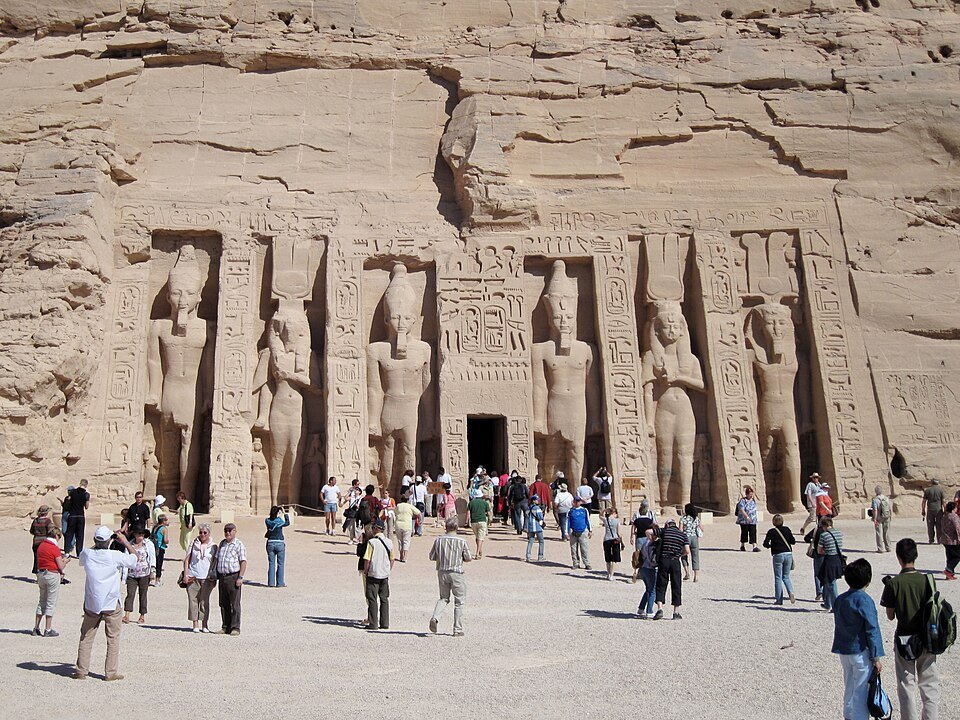
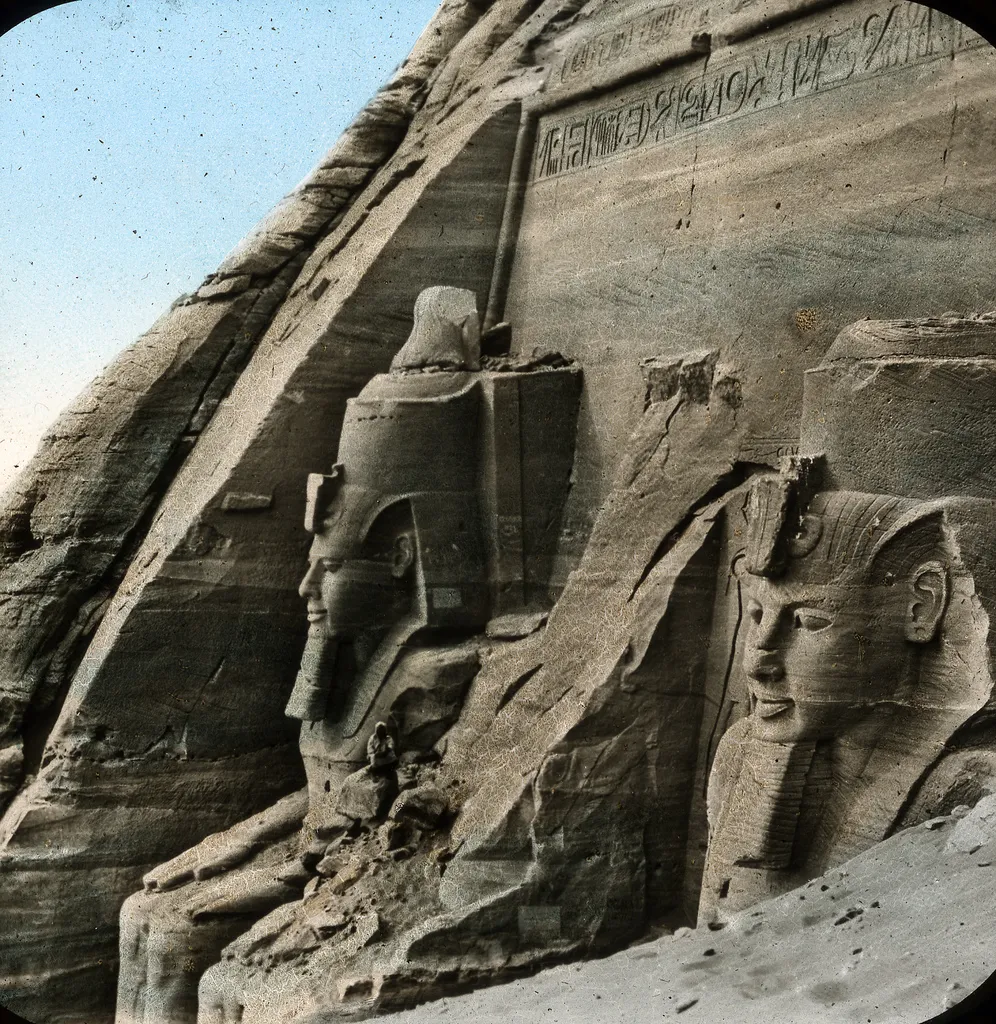
Colossal statues of Ramesses II flanking the entrance of the Great Temple at Abu Simbel, Egypt (c. 1264 BCE). .
The New Kingdom Geopolitical Landscape
To understand the rise and impact of Ramesses II, one must examine the complex, interconnected geopolitical environment of the Late Bronze Age Near East. The New Kingdom (c. 1550–1069 BCE) emerged after the traumatic second intermediate period, which had seen northern Egypt ruled by the Hyksos, a dynasty of Levantine origin. The expulsion of these foreign rulers by Ahmose I sparked a structural and psychological shift in Egyptian foreign policy. No longer content to rely on the natural isolation provided by the Eastern and Western Deserts, Egypt adopted an aggressive, expansionist, imperialist stance. The goal was to establish deep buffer zones and tributary relationships in Canaan, Syria, and Nubia, ensuring that no foreign power could ever threaten the Nile Valley again.
By the time of Ramesses' grandfather, Ramesses I (the founder of the Nineteenth Dynasty), and his father, Seti I, Egypt was locked in a fierce, multi-generational battle for hegemony over the vital trade corridors of the Levant. The chief competitor in this arena was the Hittite Empire, centered in Hattusa on the Anatolian plateau. Both empires sought control over critical trade ports along the Mediterranean coast, such as Byblos, Tyre, and Ugarit, as well as the inland routes—most notably the Via Maris (Way of the Sea) and the King's Highway—which moved copper from Cyprus, tin from the east, cedar wood from Lebanon, and exotic goods from Africa and Mesopotamia. Seti I had campaigned extensively in the Levant, even capturing the key city of Kadesh, but Egypt could not maintain a permanent garrison, and the region quickly slipped back into the Hittite sphere of influence. Ramesses II was groomed from early childhood to lead this imperial struggle. Appointed co-regent by his father at the age of fourteen, he was exposed to statecraft, administrative duties, and extensive tactical military training, accompanying his father on campaigns in Libya and Western Asia.
The Levantine Campaigns and the Battle of Kadesh
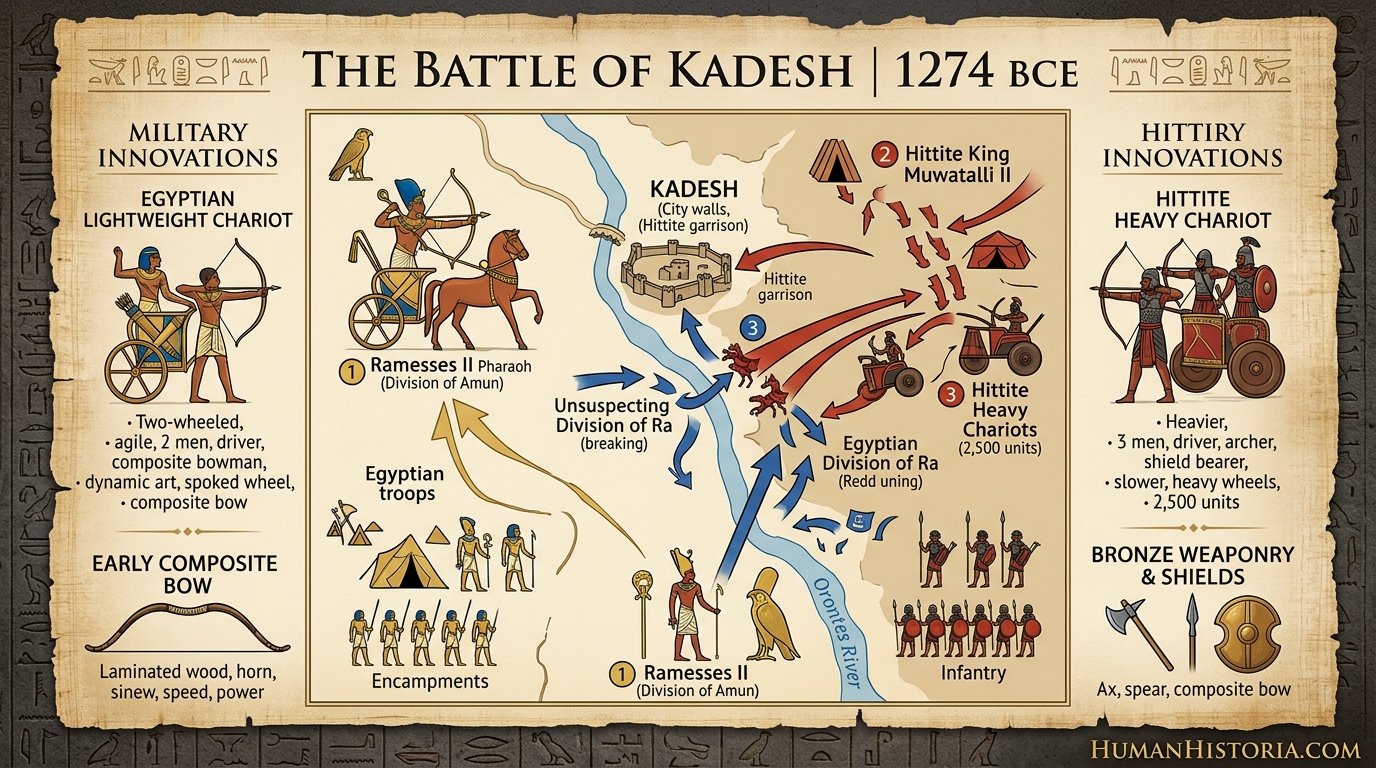
In the fifth year of his sole reign (c. 1274 BCE), Ramesses II launched his most ambitious military campaign to reclaim the strategic Syrian city of Kadesh. Situated on the Orontes River, Kadesh was a fortified key node that controlled trade routes entering the Syrian interior. Its defection back to the Hittite sphere under King Muwatalli II was a direct challenge to Egyptian authority. Ramesses assembled a massive force of approximately 20,000 men, a remarkably large army for the Late Bronze Age. This force was organized into four distinct divisions, each numbering about 5,000 men and named after the major gods of the Egyptian pantheon: the Division of Amun (led by the pharaoh himself), the Division of Ra, the Division of Ptah, and the Division of Seth. Also marching with the army was an elite unit of Sherden mercenaries—pirates from the Mediterranean whom Ramesses had defeated early in his reign and integrated into his personal royal guard.
The campaign, however, was compromised from the outset by a severe failure of intelligence. As the Egyptian army neared Kadesh, scouts captured two Shasu nomads who claimed to be deserters from the Hittite army. They informed Ramesses that King Muwatalli II, fearing the pharaoh's advance, had retreated far to the north near Aleppo. Eager to seize the city and claim a quick victory, Ramesses raced ahead with his personal guard and the Division of Amun, leaving the remaining three divisions strung out in a long march miles behind. He established his camp on the ridge overlooking Kadesh, completely unaware that the nomadic spies were double agents sent to lure him into a trap. In reality, Muwatalli II had amassed a massive coalition army of 40,000 infantry and 3,000 heavy chariots, concealed behind the tell (mound) of Kadesh.
Tactical Crisis at the Orontes
While the Division of Amun was pitching camp, the Hittite heavy three-man chariots launched a devastating surprise flank attack. They crossed the Orontes River, bypassed the city, and crashed into the Division of Ra as it marched north in column formation, splitting it in two and scattering the panicked soldiers. The survivors fled toward the vanguard camp, bringing the chaos with them. With the Hittite chariot corps surging into his camp, Ramesses found himself surrounded and facing total annihilation. Displaying immense personal bravery and tactical composure, the pharaoh donned his armor, mounted his light war chariot, and charged the Hittite forces on the eastern flank, pushing them back toward the river. By repeatedly driving his chariot into the enemy lines, Ramesses held the Hittite forces at bay until the Ne'arin—an elite reserve unit of Canaanite allies loyal to Egypt—arrived from the coast. Their timely arrival caught the looting Hittites by surprise, turning the tide of the battle and forcing the survivors to retreat across the Orontes.
The Battle of Kadesh ended in a bloody tactical stalemate. Although Muwatalli's chariot force had suffered severe casualties, his massive infantry reserves remained uncommitted inside the city walls. Ramesses, low on supplies and with a battered army, was unable to capture Kadesh and was forced to withdraw back to Egypt. Upon his return, the pharaoh launched a massive propaganda campaign, commissioning the Poem of Pentaur and the Bulletin to be inscribed on the walls of major temples, including Karnak, Luxor, and Abu Simbel. These texts depicted the battle as a glorious personal victory, highlighting Ramesses' solo stand against thousands of enemies. However, the strategic reality was clear: neither empire could decisively defeat the other or maintain permanent control over northern Syria without ruinous expense.
A relief carving from the Great Temple of Abu Simbel depicting Pharaoh Ramesses II in his war chariot charging the Hittite forces at the Battle of Kadesh (c. 1274 BCE). .
The Egyptian-Hittite Peace Treaty
Recognizing the strategic deadlock and facing new geopolitical threats—most notably the rise of the Middle Assyrian Empire in the east and the migration of proto-Sea Peoples along the coasts—Ramesses II and the new Hittite King, Hattusili III, decided to formalize their relations. In 1259 BCE, the two rulers negotiated the Egyptian-Hittite Peace Treaty (often referred to as the Treaty of Kadesh). Inscribed on silver tablets in Akkadian cuneiform (the international diplomatic language of the era) and translated into Egyptian hieroglyphs, this document represents the oldest surviving written international peace treaty in history. A clay copy of this historic accord, discovered at the Hittite capital of Hattusa, is today prominently displayed at the United Nations Headquarters in New York as a testament to early diplomacy. The treaty established several pioneering international agreements:
Eternal Peace and Alliance: An absolute cessation of hostilities and a perpetual alliance between the two royal houses, extending to the children and descendants of both monarchs.
Mutual Defense Pact: A commitment that if either Egypt or Hatti were attacked by an external enemy (such as Assyria) or faced internal rebellion, the other would dispatch military forces to assist.
Extradition and Amnesty: A clause guaranteeing that political refugees, defectors, or runaway laborers who fled from one empire to the other would be returned to their homeland, but with the strict condition that they would not be punished, mutilated, or executed, and their families would not suffer reprisal.
Diplomatic Marriage: To cement the alliance, Ramesses II subsequently married the eldest daughter of Hattusili III, who was given the Egyptian name Maathorneferure and welcomed to the royal palace at Pi-Ramesses.
The Master Builder of Monuments
While his military campaigns established a stable frontier, Ramesses II secured his enduring legacy through an unprecedented building program that transformed the physical and cultural landscape of Egypt. Operating on a scale that surpassed any dynasty before or after, his architects and stonemasons constructed massive new temples, expanded ancient shrines, and carved monumental structures directly into the landscape. His key building achievements include:
1. The Twin Temples of Abu Simbel
Located in Nubia, near Egypt's southern border, the temples of Abu Simbel were carved directly into solid sandstone cliffs to assert Egyptian authority over the subject Nubians and warn foreign travelers arriving from the south. The facade of the Great Temple features four colossal, 20-meter-high seated statues of Ramesses II wearing the double crown of Upper and Lower Egypt. The temple's interior hall is an engineering masterpiece, aligned so that twice a year—on February 22 (the pharaoh's birthday) and October 22 (his coronation anniversary)—the sun's rays penetrate 60 meters into the mountain sanctuary, illuminating the statues of Amun-Ra, Ra-Horakhty, and the deified Ramesses, while leaving the statue of Ptah (the god of the underworld) in shadow. In the 1960s, this temple was dismantled and relocated to higher ground in a historic UNESCO project to save it from the rising waters of Lake Nasser.
Authentic view of the facade of the Great Temple of Abu Simbel, featuring four colossal 20-meter seated statues of Ramesses the Great carved directly into the sandstone cliffs of Nubia.
2. The Ramesseum
Built on the west bank of the Nile at Thebes, the Ramesseum was the pharaoh's mortuary temple, designed to serve as the cultic center for his worship after death. It was a massive complex that included the temple itself, royal residences, treasury offices, and extensive vaulted mudbrick granaries capable of storing grain for thousands of people. The complex also contained a house of life, a scriptorium and library housing thousands of papyrus scrolls in medicine, astronomy, law, and literature. The courtyard of the temple featured a colossal seated granite statue of the pharaoh, weighing over 1,000 tons. The fallen fragments of this monumental statue inspired Percy Bysshe Shelley's famous Romantic poem Ozymandias, reflecting on the impermanence of political power.
3. The Great Hypostyle Hall at Karnak
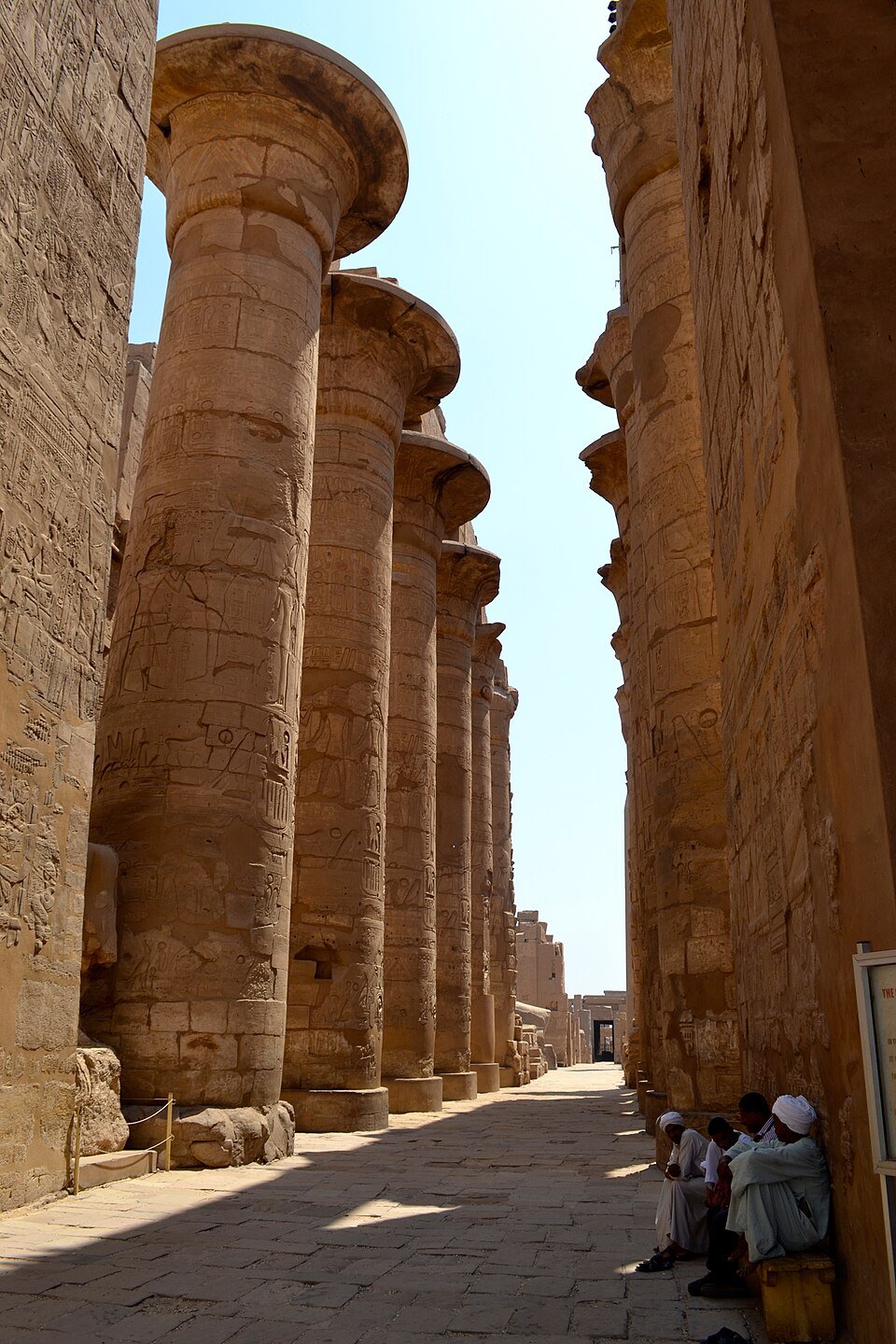
At the temple complex of Karnak in Thebes, Ramesses completed the construction of the Great Hypostyle Hall, which had been begun by his father, Seti I. This architectural wonder contains 134 colossal columns arranged in sixteen rows. The central columns stand 21 meters tall, with capitals carved in the shape of open papyrus blossoms, representing the primeval marsh of creation from which the sun god arose. The walls of the hall are covered in deeply carved reliefs detailing the pharaoh's military victories and religious rituals, showing his devotion to the state god Amun-Ra.
The colossal columns of the Great Hypostyle Hall at Karnak Temple complex in Luxor, covered with deeply incised hieroglyphic reliefs of Ramesses II. .
Domestic Policy, Lineage, and Administration
Managing an empire that stretched from modern Syria to the fourth cataract of the Nile in Sudan required a highly sophisticated and centralized administrative apparatus. Early in his reign, Ramesses made the bold decision to relocate the imperial capital from Thebes in the south to a brand-new city built in the eastern Nile Delta, named Pi-Ramesses ("House of Ramesses"). This move was strategically motivated: it positioned the royal court and the army close to the Levantine border, allowing the administration to respond rapidly to military developments, manage diplomatic relations with the Near Eastern empires, and direct trade with Mediterranean maritime networks.
The administration of Egypt was split between two grand viziers: one for Upper Egypt based in Thebes, who managed the southern provinces and Nubian gold extraction, and one for Lower Egypt based in Memphis, who managed the delta agricultural lands and northern trade. Mining operations in the Sinai Peninsula were expanded to supply copper, malachite, and turquoise, while the gold mines of Nubia were worked intensively, providing the precious metal that Egypt used as its primary diplomatic currency to buy the loyalty of neighboring states. Ramesses also reorganized the priesthood, placing loyal associates and family members in high positions within the wealthy temples of Amun, Ra, and Ptah, thereby balancing the power of the priesthood against the royal court.
To ensure dynastic stability and prevent the succession crises that had plagued previous dynasties, Ramesses fathered a vast family, consisting of over 100 children with his multiple wives and concubines. His chief consort and the love of his life was Queen Nefertari, for whom he built a smaller temple at Abu Simbel and commissioned a spectacular tomb in the Valley of the Queens, renowned for its exquisite wall paintings. His eldest sons were appointed to high military commands and administrative offices, while his daughters were married to foreign rulers or integrated into the religious administration. While this vast lineage successfully filled administrative positions with loyal royal sons, it created succession challenges after his death. Many of his older sons died before him, and he was eventually succeeded by his thirteenth son, Merneptah, who inherited a state facing the first waves of the Bronze Age Collapse.
Historical Memory: Cartouche Hacking
Ramesses II was a master of political branding and historical memory. In addition to building his own massive monuments, he routinely ordered his stonemasons to "hack" the monuments of his predecessors, such as Hatshepsut, Akhenaten, and Tutankhamun. By chiseling out their names (cartouches) and replacing them with his own, Ramesses claimed their achievements as his own, effectively erasing his predecessors from the public record and projecting an image of absolute, eternal authority that dominated Egyptian history for generations.
Conclusion and Legacy
Ramesses II lived to the exceptional age of ninety and ruled for sixty-six years, a length of reign that meant most of his subjects had known no other pharaoh. After his death, his successors referred to him as the "Great Ancestor," and nine subsequent pharaohs adopted his name to associate themselves with his prestige. By securing borders, codifying the world's first peace treaty, and erecting monuments that survived for millennia, Ramesses II defined the archetypal ruler of ancient Egypt, leaving a legacy of imperial administration that continues to fascinate the modern world. His mummified remains, discovered in the royal cache at Deir el-Bahari in 1881 and currently housed in the National Museum of Egyptian Civilization in Cairo, serve as a physical connection to the golden age of Egypt's imperial story.
⚖️
Historian Debate: Did Ramesses II Win the Battle of Kadesh?
The Egyptian Propaganda View
Official monuments like the Temple of Abu Simbel and the 'Poem of Pentaur' depict the battle as a miraculous solo victory by Ramesses II, who routed the Hittite chariotry after his troops fled.
The Hittite Strategic Victory View
Clay tablets found at Hattusa show the battle was a Hittite ambush that halted Egyptian expansion. Ramesses failed to capture the city of Kadesh, leading to a stalemate and the world's first peace treaty.
Egyptian and Hittite archives reveal the first documented case of military propaganda and peace negotiations in 1258 BCE.
"I found the Hittite king had prepared an ambush, with his chariots and soldiers... My army abandoned me, but I charged them, and defeated them while I was alone..."
— Inscription of Ramesses II, The Poem of Pentaur, Luxor Temple (c. 1274 BCE).
Pharaoh Triumphant: The Life and Times of Ramesses II — by K.A. Kitchen. The definitive academic biography of Egypt's most famous builder and commander.
The Battle of Kadesh — by Alan R. Schulman. A detailed tactical analysis of the largest chariot battle in ancient history.
📊 Museum-Grade Infographic Poster
The Battle of Kadesh (1274 BCE) Infographic
💡 Click anywhere on poster to expand in high resolution🔎 Expand Lightbox
Detailed strategic battle map chronicling the clash between Egyptian and Hittite composite chariot divisions on the Orontes River.
📖 SCHOLARLY INQUIRIES
Frequently Asked Questions
Essential historical questions and evidence-based answers concerning this chronicle.
Q.Why is Ramesses II called 'Ramesses the Great'?
Ramesses II reigned for 66 years, lived into his 90s, fathered over 100 children, and built more colossal temples, statues, and monuments than any other pharaoh in Egyptian history.
Q.Who won the Battle of Kadesh?
Both sides claimed victory. Ramesses II depicted a heroic triumph on temple walls, but historically the battle ended in a tactical draw, leading to a non-aggression peace treaty.
Q.How were the Abu Simbel temples saved in modern times?
In the 1960s, UNESCO dismantled and relocated the entire mountain-cut temple complex 65 meters higher to save it from rising waters caused by the Aswan High Dam.
📚 Academic Sources & Scholarly Bibliography
Kitchen, K.A. (1982).
Pharaoh Triumphant: The Life and Times of Ramesses II.
Aris & Phillips.
Tyldesley, J. (2000).
Ramesses: Egypt's Ultimate Pharaoh.
Penguin Books.
Freed, R.E. (1987).
Ramesses the Great.
Memphis State University.
📖 Scholar Mode Active — Click to exit focused reading
History Lab 🧪
Interactive historical deduction games, tactical matchup simulators, and currency calculators.
🕵️ Who Am I? (The Historical Guess Game)
A secret historical figure has been selected. Ask yes/no questions to narrow down the pool of candidates. Click any active card to make your accusation!
Secret Identity
❓ Who Am I?
Ask questions using the board below to narrow down my identity.
Ask a Question:
Question LogQuestions: 0 / 7
No questions asked yet.
Candidate Board:
🗺️ Timeline Scramble
Five historical events appear out of order. Click them in the correct chronological sequence — from oldest to most recent. How well do you know your history?
🏺 Relic or Fake?
Is this a real historical artifact or a convincing fabrication? Judge each one based on its description and era — then see the truth revealed!
Artifact 1 / 10Score: 0
Empire Matchup Simulator
Empire ATerritory Size (Peak, M km²)Empire B
00
Empire APopulation (Peak, Millions)Empire B
00
Empire AMilitary Power (Army Size)Empire B
00
Tactical Battle Analysis
Select empires and click simulate to run evaluations.
Historical Purchasing Power Converter
See what ancient coins are worth in modern terms and check their historical purchasing power.
Modern Value Equivalent
$0.00 USD
Historical Purchasing Power:
Select currency to view purchasing capability.
Historical Identity Generator
Forge an authentic historical identity from ancient civilisations, complete with linguistic meaning and biography.
Neutral
Gaius Julius
Meaning:Descendant of Jupiter
Historical Background:
A Roman citizen and clerk who worked in the forum under Roman republic rule.
Chrono-Cultural Fusion Simulator
Fuse the culture, technology, and governance of two legendary civilizations to synthesize a unique hybrid society.
Cohesion & Coexistence Rate
85%
🏛️ Hybrid Architecture
⚙️ Synthesized Asset
📜 Synthetic Governance
Historical Tactics & Trivia Quiz
Test your historical knowledge and battle tactics to claim your administrative rank.
8 Questions • Multi-Era
You will be presented with random scenarios and trivia spanning ancient Egypt, classical Rome, Islamic Golden Age, and the modern industrial era. Complete the evaluation to see your historical title!
Question 1 of 8Score: 0
What was the Code of Hammurabi written on?
Correct!
Evaluation Complete!
6 / 8
Correct
Rank Attained
Imperial Legionary
Your knowledge of classical strategy and administrative structures is respectable.
🎲 Counterfactual "What If?" Scenario Simulator
Explore alternative historical trajectories by tweaking key civilizational pivot points.
Simulated Shift
Selected Era
Prehistoric Era
Millions of years ago to ~3000 BCE
The dawn of humanity. From the evolutionary split of early hominids to the mastery of stone tools, fire, and the birth of language.
Landmark Milestones
Welcome to Historia
Enter your Scholar Name to synchronize your chronicles and save your journey.
 ⭐ Featured Chronicle

 ANCIENT AGES
 ANCIENT AGES
 ANCIENT AGES
 MEDIEVAL PERIOD
 MEDIEVAL PERIOD
 PREHISTORIC ERA