~7,000 Years from farming to writing
๐Ÿ›๏ธ

Ancient Ages

c. 3,200 BCE โ€” 500 CE ยท Empires, Laws & Philosophy
~400 Years from Roman fall to medieval rebirth
๐Ÿฐ

Medieval Period

c. 500 CE โ€” 1500 CE ยท Empires of Faith, Trade & Castles
~50 Years from printing press to Scientific Revolution
โš™๏ธ

Modern Age

c. 1450 CE โ€” 2000 CE ยท Revolutions, Industry & Discovery
~50 Years from computers to quantum age

THE ARTIFACT GALLERY

Examine the tangible relics, physical tokens, and revolutionary machines that shaped civilizational growth.

๐ŸŽฅ VIDEO HUB & SHORTS

Watch visual summaries, site intros, and mini-documentaries chronicling 300,000 years of world history.

๐Ÿ“Š HISTORICAL INFOGRAPHICS ARCHIVE

Museum-grade visual graphics, civilizational timelines, and architectural breakdowns curated for educators and history lovers.

THE HISTORIA CIRCLE

Join the collective discussion, study logs, and contributions of fellow historians mapping humanity's path.

Historia Forum Discussions

Start a Discussion Thread

THEMATIC PATHWAYS

Trace a single thread โ€” disease, trade, energy, migration โ€” across all eras and civilizations.

History is not just a sequence of events โ€” it is a network of patterns. These thematic pathways allow you to follow a single concept across thousands of years: how agriculture spread, how warfare evolved, how trade routes shaped civilizations. Each pathway collects the most relevant chronicles across all eras.

๐Ÿงฉ
How is this different from the sidebar Topics?
While the sidebar Topics (like Science & Tech or Empires) filter articles within your selected historical Era, Thematic Pathways cut horizontally across all eras (from Prehistoric to the Future). Use Themes to trace a single concept's evolutionary line across 300,000 years.

CIVILIZATION HUBS

Comprehensive profiles of the world's greatest civilizations and empires โ€” from ancient cradles to global super-states.

Human Historia provides an academically rich exploration of the world's most influential civilizations. From the monumental achievements of ancient Egypt, Han China, and the Roman Empire, to the sophisticated societies of the Maya, the Islamic Caliphates, and West African empires, these hubs offer deep insights into the cultural, political, and technological legacies that continue to shape our global story.

EVOLUTION OF HUMAN SKILLS

Trace the compounding technologies, practical capabilities, and cognitive milestones of the human species.

Human progress is a story of compounding skills. Every breakthrough, from the spark of prehistoric fire to modern silicon transistors, builds directly on previous generations of ingenuity. Hover over a skill node to trace its historical prerequisites, and click it to explore its development timeline, species-wide impact, and related chronicles.

Prehistoric Ancient Medieval Modern Future
๐Ÿง 

Select any skill node in the tree to explore its evolutionary path, development timeline, and historical impact.

ACADEMIC PASSPORT

Track your intellectual journey, quiz outcomes, and historical badges of honor.
HISTORIA PASSPORT โณ
๐Ÿ‘ค Scribe Novice
Scholar Name Historia Explorer
Rank Rating Sumerian Record Scribe
Chronicles Read 0 / 48
Study Guide Pins 0 Guides
Security Access Level 1 (Novice)

Earned Badges of Honor

๐Ÿ”ฅ
Fire Keeper
Unlock 3 prehistoric chronicles.
๐Ÿ›๏ธ
Codex Keeper
Unlock 3 ancient chronicles.
๐Ÿฐ
Guild Master
Unlock 3 medieval chronicles.
โš™๏ธ
Steam Engineer
Unlock 3 modern chronicles.
๐Ÿš€
Singularity Sage
Unlock 3 future chronicles.
๐Ÿ‘‘
Grand Scholar
Score 5/5 on the Lab Quiz.

Recent Lab Activities

No recent activities recorded. Take a quiz or bookmark articles!
Curated Exhibition

Human Historia

An immersive graphical anthology tracing the paths of civilizations, breakthroughs, and conflicts that forged the modern consciousness.

25Chronicles
Showing all articles

The Invention of Dictionaries: How Lexicographers Standardized Languages

Written by Historia Linguistics Historical Era: MODERN
* Note: Cover image is an AI-generated historical illustration.

๐Ÿง Key Chronicle Takeaway (Atomic Summary)

How Enlightenment scholars compiled Samuel Johnson's dictionary to standardize spelling and grammar rules across printing networks.

The invention of movable type printing in the 15th century democratize knowledge, accelerated literacy, and fueled the Renaissance. However, it also created a major administrative and cultural challenge: the fragmentation of language. In the early modern era, there were no standardized rules for spelling, grammar, or word definitions. Scribes in different towns spelled identical words differently, while vernacular dialects varied so much that travelers from the north of England could not understand the speech of the south. Scribes realized that to build effective nation-states, international trade networks, and stable scientific communities, they had to standardize language. This challenge led to the birth of the Modern Dictionary. By systematically cataloging words, standardizing spellings, and defining meanings, lexicographers constructed the linguistic infrastructure that unified modern nations.

The Linguistic Chaos of the Early Modern Era

Before the 18th century, English and other European languages were highly fluid. Scribes wrote based on phonetics, leading to massive variations in spelling. William Shakespeare, for example, spelled his own name in at least six different ways. Furthermore, the influx of foreign words from the Age of Exploration and the Scientific Revolution created a chaotic vocabulary: writers adopted Latin, French, and Italian terms, known as "inkhorn terms," which were often misunderstood by the public. Scribes and book printers faced high costs due to these spelling variations, while lawyers struggled to interpret legal contracts containing ambiguous regional terms.

This linguistic chaos was not just an inconvenience; it was a barrier to administrative integration. A centralized state requires clear, unambiguous communication between the capital and the provinces. To solve this, intellectual academies across Europeโ€”such as the Accademia della Crusca in Italy (founded 1583) and the Acadรฉmie Franรงaise in France (1635)โ€”set out to publish official dictionaries designed to purify and freeze their national languages, establishing strict rules for correct speech and writing.

Samuel Johnson and the Heroic Lexicography

In England, the government did not fund a language academy. Instead, the task of standardizing English was undertaken by a private coalition of London booksellers who hired the writer and scholar Samuel Johnson in 1746. Scribes expected the project to take three years, but it required nine years of grueling labor. Working in a dusty garret on Gough Square, Johnson compiled 42,773 words, illustrating each definition with over 114,000 literary quotations from writers like Shakespeare, Milton, and Bacon.

Published in 1755, A Dictionary of the English Language was a masterpiece of scholarship. Johnson's innovations standardized modern lexicography:

  • Descriptive Definitions: Johnson did not just list synonyms; he wrote precise definitions that captured the subtle nuances of words, occasionally adding humor (such as defining lexicographer as "a writer of dictionaries; a harmless drudge").
  • Usage Citations: By illustrating definitions with quotations from classic literature, Johnson showed how words functioned in context, establishing a literary canon for correct usage.
  • Standardized Spelling: The dictionary fixed spelling patterns (such as choosing music over musick), resolving centuries of phonetic variations across printing shops.

Noah Webster and the American Accent

In the United States, lexicographer Noah Webster viewed language reform as an act of patriotic independence. In 1828, he published An American Dictionary of the English Language, which introduced simplified, phonetic spellings designed to distinguish American English from British English (such as changing colour to color, theatre to theater, and musick to music). Webster's spelling reforms were adopted by American schools, creating a distinct national spelling standard that helped integrate the diverse immigrant population of the young republic.

Language as an Engine of State Integration

The publication of standardized dictionaries allowed for the rapid expansion of national educational systems. Governments could now print textbooks, train teachers, and establish universal literacy standards using a single, official grammar and spelling guide. Scribes and administrators in the civil service utilized this standard language to draft clear regulations, write contracts, and publish newspapers, creating what sociologist Benedict Anderson calls "print capitalism"โ€”the shared reading culture that allowed citizens of different regions to view themselves as members of a single nation.

Standardization also drove scientific progress. By establishing precise definitions for technical terms, dictionaries allowed scientists across the world to communicate observations without ambiguity. Lexicographers added lists of chemical elements, biological taxonomies, and mechanical terms to their books, turning the dictionary from a literary list into a comprehensive catalog of human knowledge, a vital reference tool for the industrial age.

The Scale of the Oxford English Dictionary

In the late 19th century, the Philological Society of London realized that English was expanding too fast for a single writer to catalog. They initiated the Oxford English Dictionary (OED) project, which used a crowdsourced model, asking thousands of volunteers across the globe to send in citation slips showing word usages. The first edition, completed in 1928 after 70 years of work, filled 10 massive volumes and cataloged over 400,000 words, standing as the most comprehensive linguistic map ever constructed.

Lexicography as a Tool of Social Control

While the standardization of language drove literacy and administrative efficiency, it also served as a tool of social control and class division. Prior to the publication of dictionaries, regional dialects were the standard form of speech. However, by defining one specific dialect (usually the speech of the wealthy elite in the capital) as "correct" English or French, dictionaries created a hierarchy of language. Scribes and educators used these books to label regional spellings and pronunciations as "vulgar" or "ignorant," dividing society based on accent and grammar.

This linguistic division restricted access to higher education, legal systems, and government jobs, which required mastery of the official standard. Scribes and lexicographers became the gatekeepers of culture, using the dictionary to select which words were allowed into polite literature and which were excluded as slang. Standard language became a mark of status and power, showing how standardizing communication can also reinforce class inequalities by suppressing the linguistic heritage of regional communities.

The Linguistic Standardization of Modern French

The role of lexicography in state integration is clearly demonstrated by the history of the Acadรฉmie Franรงaise in France. Founded by Cardinal Richelieu in 1635, the Acadรฉmie was chartered with the explicit mission to give French rules, to render it pure, eloquent, and capable of treating the arts and sciences. The Acadรฉmie's primary project was the publication of the *Dictionnaire de l'Acadรฉmie franรงaise* (first published in 1694). Scribes and scholars spent decades debating word definitions, spelling rules, and correct grammar, aiming to purge the language of regional accents, slang, and archaic terms.

This linguistic standardization was a key tool in the centralization of the French state. In the 17th century, only a minority of French citizens spoke standard Parisian French, with the majority speaking regional dialects such as Occitan, Breton, and Gascon. By establishing the Parisian dialect as the official standard for literature, administration, and law, the French crown asserted its cultural authority over the provinces. Local dialects were labeled as "patois" and suppressed in schools, showing how standardizing language was used by the state to assimilate regional populations and build a unified national identity.

Modern Digital Lexicography and Global English

In the 21st century, lexicography has transitioned from printed volumes to dynamic digital databases, reflecting the rise of Global English. Online databases like Oxford Languages and Dictionary.com update their entries in real-time, tracking how English is used across diverse international communities. Lexicographers no longer act as prescriptivist guardians who freeze language; they serve as descriptivist observers who document how language adapts to new technologies, cultural shifts, and global varieties (such as Singlish or Indian English). This digital evolution proves that standardizing language is a continuous, living process that reflects the global integration of the modern world.

Dictionaries in the Digital Age

In the modern era, lexicography has transitioned from printed volumes to dynamic digital databases, reflecting the rise of global communication and the internet. Online dictionaries like the Oxford English Dictionary Online and Merriam-Webster update their databases in real-time, tracking how language evolves across diverse digital spaces and international communities. Lexicographers no longer act as prescriptivist gatekeepers who freeze spelling and meaning; they serve as descriptivist observers who document how language adapts to new technologies, cultural shifts, and regional variations, proving that standardizing language is an ongoing, living process that mirrors the integration of global society.

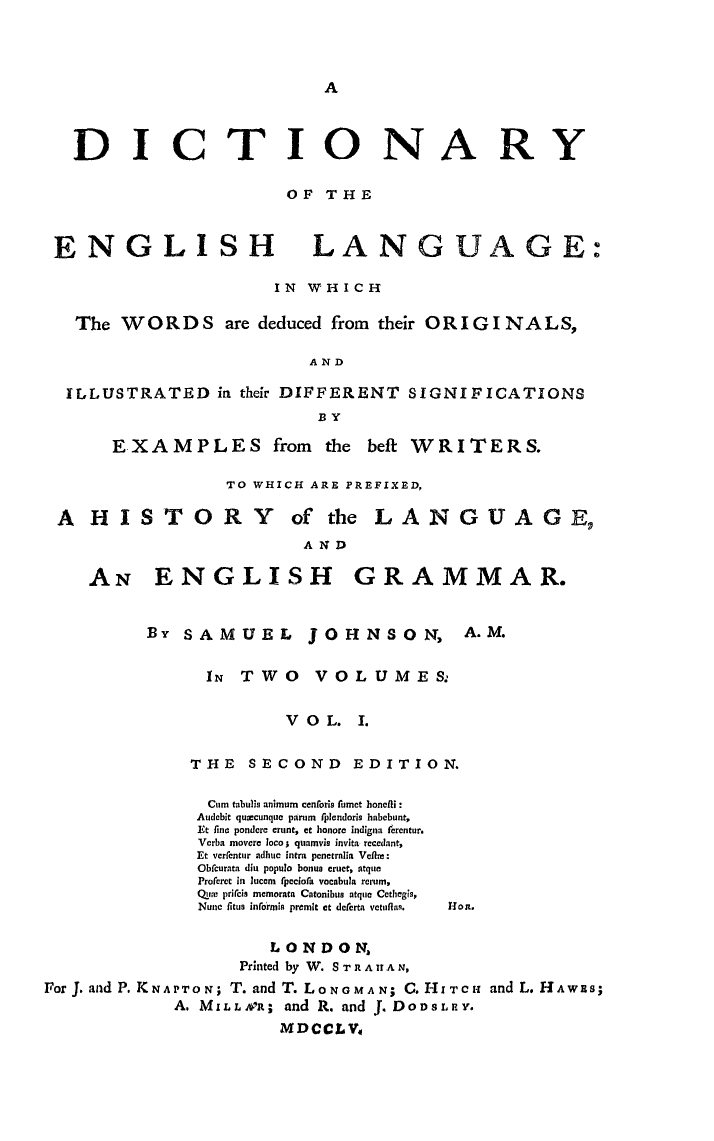
Title page of Samuel Johnson Dictionary of the English Language
The authentic title page of the first edition of Samuel Johnson's Dictionary of the English Language published in London in 1755.

Conclusion: The Code of Human Thought

The modern dictionary was the software update that standardized human communication. By replacing regional dialects and phonetic spelling variations with a single, clear code of writing and definitions, lexicographers constructed the shared infrastructure that made modern nations, industrial markets, and global science possible. The dictionary open on our desks or integrated into our computer systems today is a direct legacy of those harmless drudges who sorted through the chaos of human speech to give us a shared voice, proving that words are the ultimate tools of the human odyssey.

โš–๏ธ

Historian Debate: Descriptive vs. Prescriptive Dictionaries

Prescriptive Language Control

Early lexicographers like Samuel Johnson and the Acadรฉmie Franรงaise sought to establish a 'pure' standard language, purging slang and foreign words to preserve cultural stability.

Descriptive Documentation

Modern linguists argue that dictionaries should act as mirrors of living language, documenting how people actually speak rather than enforcing artificial grammatical rules.

The standardization of dictionaries supported the rise of the modern nation-state.

"I am not so lost in lexicography as to forget that words are the daughters of earth, and that things are the sons of heaven."

โ€” Samuel Johnson, Preface to the Dictionary of the English Language (1755).

Further Reading

  • The Professor and the Madman โ€” by Simon Winchester. The extraordinary story of the creation of the Oxford English Dictionary.
  • Defining the World โ€” by Henry Hitchings. A detailed history of Samuel Johnson's monumental dictionary.
๐Ÿ“– Scholar Mode Active โ€” Click to exit focused reading
Selected Era

Prehistoric Era

Millions of years ago to ~3000 BCE

The dawn of humanity. From the evolutionary split of early hominids to the mastery of stone tools, fire, and the birth of language.

Landmark Milestones

Welcome to Historia

Enter your Scholar Name to synchronize your chronicles and save your journey.