From prehistoric origins to the modern era—discover the turning points, lost empires, and breakthroughs of world history through interactive timelines and visual guides.
Examine the tangible relics, physical tokens, and revolutionary machines that shaped civilizational growth.
🎥 VIDEO HUB & SHORTS
Watch visual summaries, site intros, and mini-documentaries chronicling 300,000 years of world history.
📊 HISTORICAL INFOGRAPHICS ARCHIVE
Museum-grade visual graphics, civilizational timelines, and architectural breakdowns curated for educators and history lovers.
THE HISTORIA CIRCLE
Join the collective discussion, study logs, and contributions of fellow historians mapping humanity's path.
Historia Forum Discussions
Start a Discussion Thread
THEMATIC PATHWAYS
Trace a single thread — disease, trade, energy, migration — across all eras and civilizations.
History is not just a sequence of events — it is a network of patterns. These thematic pathways allow you to follow a single concept across thousands of years: how agriculture spread, how warfare evolved, how trade routes shaped civilizations. Each pathway collects the most relevant chronicles across all eras.
🧩
How is this different from the sidebar Topics?
While the sidebar Topics (like Science & Tech or Empires) filter articles within your selected historical Era, Thematic Pathways cut horizontally across all eras (from Prehistoric to the Future). Use Themes to trace a single concept's evolutionary line across 300,000 years.
CIVILIZATION HUBS
Comprehensive profiles of the world's greatest civilizations and empires — from ancient cradles to global super-states.
Human Historia provides an academically rich exploration of the world's most influential civilizations. From the monumental achievements of ancient Egypt, Han China, and the Roman Empire, to the sophisticated societies of the Maya, the Islamic Caliphates, and West African empires, these hubs offer deep insights into the cultural, political, and technological legacies that continue to shape our global story.
EVOLUTION OF HUMAN SKILLS
Trace the compounding technologies, practical capabilities, and cognitive milestones of the human species.
Human progress is a story of compounding skills. Every breakthrough, from the spark of prehistoric fire to modern silicon transistors, builds directly on previous generations of ingenuity. Hover over a skill node to trace its historical prerequisites, and click it to explore its development timeline, species-wide impact, and related chronicles.
Prehistoric Ancient Medieval Modern Future
🧠
Select any skill node in the tree to explore its evolutionary path, development timeline, and historical impact.
ACADEMIC PASSPORT
Track your intellectual journey, quiz outcomes, and historical badges of honor.
HISTORIA PASSPORT⏳
👤Scribe Novice
Scholar NameHistoria Explorer
Rank RatingSumerian Record Scribe
Chronicles Read0 / 48
Study Guide Pins0 Guides
Security AccessLevel 1 (Novice)
Earned Badges of Honor
🔥
Fire Keeper
Unlock 3 prehistoric chronicles.
🏛️
Codex Keeper
Unlock 3 ancient chronicles.
🏰
Guild Master
Unlock 3 medieval chronicles.
⚙️
Steam Engineer
Unlock 3 modern chronicles.
🚀
Singularity Sage
Unlock 3 future chronicles.
👑
Grand Scholar
Score 5/5 on the Lab Quiz.
Recent Lab Activities
No recent activities recorded. Take a quiz or bookmark articles!
🏛️ MISSION & ARCHIVAL STANDARDS
About Human Historia
A visual encyclopedia and timeline of human history, dedicated to documenting 300,000 years of civilizational evolution through rigorous research, authentic artifacts, and visual clarity.
🌍
The 300,000-Year Story
Human Historia traces our collective journey across five historical epochs: Prehistory, Ancient Worlds, Middle Ages, Modern Age, and Future Horizons. From the first control of fire to quantum computation, we organize turning points into interconnected timelines.
📜
Historiographical Rigor
Every chronicle is built upon primary historical manifests, contemporary excavation reports, and peer-reviewed historical consensus. We prioritize authentic public domain artifacts and clearly identify scholarly debates surrounding major civilizational transitions.
🎨
Museum-Grade Visuals
Complex historical transitions demand visual understanding. We develop high-resolution infographics, architectural cutaways, and comparative territorial maps to transform abstract timelines into vivid, unforgettable learning experiences.
📖
Educational Access
Knowledge belongs to humanity. Human Historia is free, ad-light, and engineered as an educational resource for students, classroom educators, academic researchers, and curious minds across all continents.
Editorial Governance & Inquiries
We welcome peer reviews, academic corrections, museum archival collaborations, and educational partnerships. To submit historical inquiries or provide archival feedback, reach our editorial desk directly.
Written by Humanhistoria LinguisticsHistorical Era: MEDIEVAL
Following the collapse of the Western Roman Empire, the physical and intellectual infrastructure of Western Europe experienced a profound fragmentation. Cities shrank, public libraries were burned, and the capacity for literacy dropped to its lowest point in centuries. During this era, the survival of written history, classical literature, and religious texts depended on a network of isolated Monasteries. Within these stone sanctuaries, generations of dedicated monks operated the Scriptorium (writing room), copying, translating, and preserving parchment codices by hand. By developing new scripts, illuminating pages with pigments and gold leaf, and cataloging libraries, these medieval scribes saved the written heritage of Greece and Rome from extinction, building the intellectual bridge that made the Renaissance possible.
🎯 Quick Historical Summary
What Was the Significance of Illuminated Manuscripts?
Illuminated manuscripts were hand-written books produced in medieval Europe between 400 and 1500 CE, adorned with gold leaf, silver, and brilliant mineral pigments. Crafted on animal parchment (vellum), they preserved biblical texts, classical philosophy, and herbal medicine before the printing press.
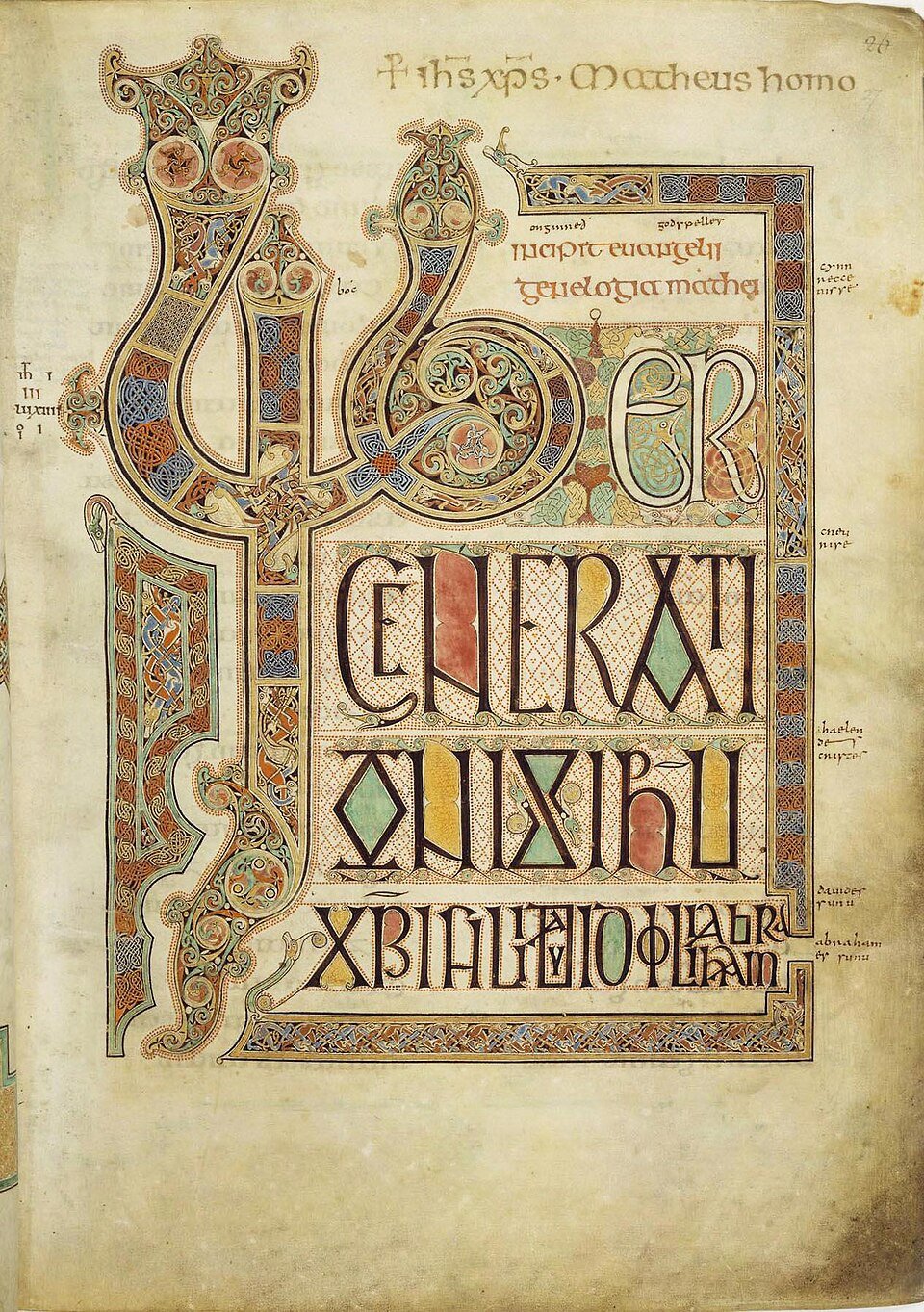
Folio 27r from the Lindisfarne Gospels (c. 700 CE), displaying the illuminated Celtic-Saxon incipit page. Source: British Library, London (Public Domain).
The Scriptorium: The Writing Factory
A scriptorium was a dedicated room in a monastery, typically located near the library or calefactory (warming room), designed to maximize sunlight and provide a quiet environment for writing. Scribes worked in silence for up to twelve hours a day, copying texts from master manuscripts. The work was physically taxing: monks wrote in cold rooms, using goose quills and iron-gall ink on thick parchment, bending over wooden desks. Scribes often left personal notes in the margins, writing: "Three fingers write, but the whole body suffers," or "As the sailor longs for the port, so the scribe longs for the final line."
The production of a single book was a long-term project:
Parchment Preparation: Monks used animal skins (sheep, goat, or calf) that were soaked in lime, scraped to remove hair, stretched on wooden frames, and rubbed smooth with pumice stone to create vellum. A single large bible required the hides of over 200 animals.
Ink Manufacture: Black ink was made by mixing crushed oak galls (parasitic growths on oak trees) with copper sulfate and gum arabic, creating a rich, dark fluid that bonded chemically with the parchment fibers.
Illumination: Master artists decorated pages with gold leaf and vibrant pigments derived from crushed minerals, such as lapis lazuli for blue or malachite for green, turning books into holy visual treasures.
The cross carpet page introducing the Gospel of Matthew from the Lindisfarne Gospels (c. 715 CE). (British Library)
Carolingian Minuscule: A Writing Revolution
Before the 9th century, Latin script was highly localized, written in messy, disjointed hands like Merovingian or Visigothic, which were filled with irregular abbreviations and lacked spaces between words. This made books difficult to read and copy, leading to errors in transmission and administrative confusion across kingdoms. Scribes in different regions could not read each other's work, creating an intellectual barrier to communication.
To resolve this fragmentation, Emperor Charlemagne (reigned 768–814 CE) initiated a cultural revival known as the Carolingian Renaissance. Under the guidance of the English scholar Alcuin of York, scribes at the monastery of St. Martin in Tours developed a standardized script known as Carolingian Minuscule:
Clarity and Space: The script introduced lowercase letters, clear spacing between words, and standardized punctuation (including the question mark), making reading rapid and intuitive.
Uniformity: The script was adopted across Charlemagne's vast empire, allowing an administrator in Paris to easily read a document written in Munich, unifying the imperial administration.
Error Reduction: By standardizing spelling and grammar, Carolingian Minuscule reduced errors in scriptorium copies, preserving the integrity of texts.
The Preservation of Classical Pagan Literature
While monasteries were Christian institutions, their scribes did not copy only religious texts. They realized that classical Latin grammar, rhetoric, and science were essential for education. As a result, monks copied the works of pagan Roman writers like Cicero, Virgil, Seneca, Horace, and Ovid. In fact, almost everything we know about classical Latin literature survives today because of the copies made by Carolingian and Ottonian monks in the 9th and 10th centuries, proving that these medieval sanctuaries saved the pagan heritage of Rome.
From Scriptura Continua to Word Spacing: The Evolution of the Written Word
To understand the revolutionary typography of medieval scriptoria, one must examine how the ancient world recorded language. In classical Greece and the Roman Empire, texts were written in scriptura continua (continuous script)—an unbroken stream of capital letters with zero spaces between words, no punctuation marks, and no distinction between uppercase and lowercase.
In ancient Rome, reading was almost exclusively an oral performance (lectio). Because texts lacked word dividers, an educated reader had to read aloud, sounding out the phonetic rhythm and cadence of the syllables to decipher where one word ended and the next began. While native Latin speakers could parse continuous text through auditory cues, this system created a major barrier when the Roman Empire fragmented and Latin became a foreign theological language across Ireland, Britain, and Germany.
Beginning in the 7th century, Irish and Anglo-Saxon monastic scribes pioneered an intellectual revolution: they inserted distinct spaces between words to facilitate comprehension for non-native readers. Under Charlemagne, Alcuin of York formalized word division into Carolingian Minuscule, adding standardized punctuation, paragraph breaks, and hierarchical capitalization. For the first time in Western history, readers could read rapidly and silently—a cognitive shift that transformed solitary scholarship and contemplation.
Concurrently, the format of the written medium underwent a profound transition from the ancient illuminated scroll (volumen) to the bound codex. While ancient scrolls constructed of fragile Egyptian papyrus were clumsy to manipulate and prone to tearing in moist European climes, the parchment codex allowed scribes to bind hundreds of calfskin leaves between protective wooden boards. Scribes could illustrate both sides of a page (recto and verso), insert illuminated chapter headings, and cross-reference multiple texts simultaneously—creating the structural prototype of the modern book.
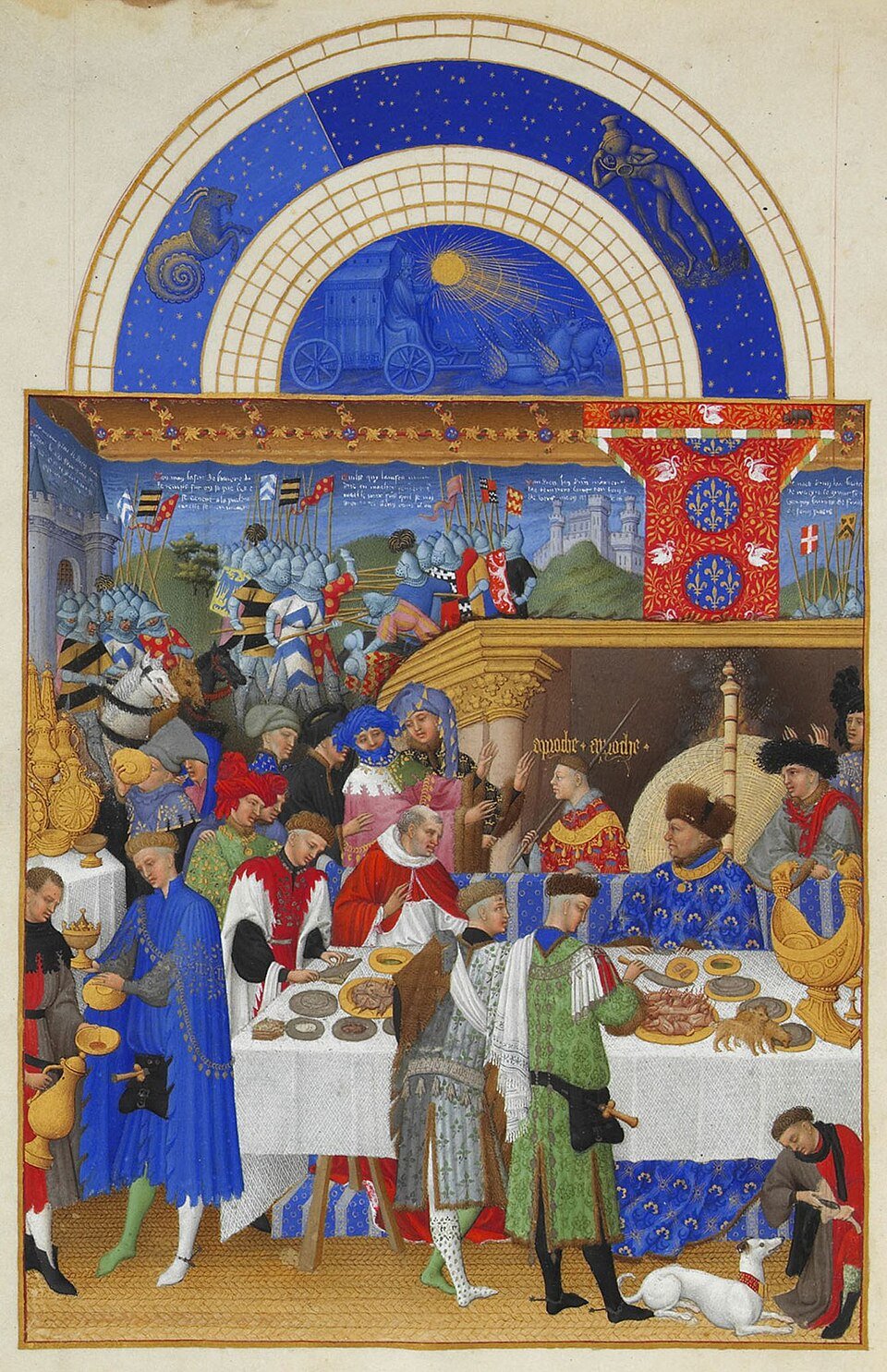
The January page from the Très Riches Heures du Duc de Berry (c. 1416), showing a courtly feast. (Musée Condé)
The Monastic Library and the Chained Book
Because hand-copied manuscripts were incredibly valuable—a single bible could take a team of scribes a year to write and cost the equivalent of a country estate—monasteries took extreme measures to secure their collections. Scribes developed the Chained Library, where books were attached to wooden reading desks by heavy iron chains. The chain was long enough to allow the book to be read on the desk but prevented it from being removed from the library room.
Libraries were cataloged using structured systems. Monks wrote Book Curses on the first pages of manuscripts, warning that anyone who stole or damaged the book would be excommunicated and face eternal damnation. These curses highlight the immense value placed on written knowledge in a world where books were rare treasures. Scribes acted as guardians of human thought, defending the records of history against the chaos of the outside world, preserving the seeds of learning until Europe was ready to build universities.
The Irish Monks who Saved Civilization
In his popular book How the Irish Saved Civilization, historian Thomas Cahill argues that during the height of the barbarian invasions of Europe, Irish monks on the edge of the known world preserved the literary heritage of both Latin and Greek. Isolated from the mainland conflicts, monasteries like Clonmacnoise and Skellig Michael copied not only Christian scriptures but also classical Greek philosophy and grammar texts, later reintroducing these works to continental Europe as missionaries in the 8th century.
The Scriptorium Workflow and the Invention of Minuscule
The production of manuscripts in a medieval scriptorium was a highly structured, collaborative workflow managed by the monastery's Armarius (librarian and director). The process began with the preparation of the writing material: sheep or calf skins were soaked in lime, scraped with a crescent-shaped knife to remove hair, stretched on wooden frames, and dried to create smooth, durable vellum. Scribes then used lead rulers to draw horizontal guidelines across the pages, ensuring the text lines were straight and aligned.
To speed up the copying process and save valuable vellum, scribes during the reign of Charlemagne developed a new script called Carolingian Minuscule. Before this reform, scribes wrote in capital letters or messy regional scripts that were difficult to read and took up too much space. Carolingian Minuscule introduced lowercase letters, spaces between words, and standard punctuation marks (like the question mark). This clear, standardized script was adopted across European scriptoriums, allowing scribes to copy books faster and reducing reading errors, creating the typographical foundation for the modern printed books we read today.
The Scriptores, Illuminators, and Binders
The production of a medieval manuscript was a highly specialized division of labor that involved several skilled craftsmen working in sequence. The first stage was completed by the Scriptores (scribes), who copied the text from a model book using quill pens cut from goose feathers and iron-gall ink. Scribes had to maintain a consistent hand size and script style across hundreds of pages, a task that required years of training. Scribes often worked in silence for hours, copying up to four pages a day, and occasionally added humorous comments in the page margins (such as "The ink is thin" or "Now I've written the whole book, give me a drink").
Once the text was complete, the manuscript was passed to the Illuminators (artists), who painted the large decorative letters at the start of chapters and added colorful illustrations in the margins. Illuminators used expensive pigments made from ground minerals—such as lapis lazuli for blue and malachite for green—and applied thin sheets of gold leaf to the page, which caught the light and made the manuscript "illuminate." Finally, the completed vellum sheets were sent to the Binders, who sewed the pages together, attached them to heavy wooden boards, and covered the boards with leather, creating a durable book that could survive for centuries in a monastery library.
The Secularization of Book Production
By the late Middle Ages, the monopoly of the monastery scriptorium on book production began to decline, giving rise to secular writing workshops in growing university cities like Paris, Bologna, and Oxford. Scribes in these urban workshops were professionals who belonged to guilds, copying legal texts, medical treatises, and vernacular literature for students and wealthy nobles. Scribes and stationers introduced the pecia system, where a book was split into separate sections (pecias) that could be rented out to multiple students to copy at the same time, which drastically increased the speed of book production and lowered costs, initializing the commercial book trade that preceded the Gutenberg press.
Conclusion: The Silent Guardians
The medieval scriptorium was the bridge that linked the classical world to the modern world. Scribes who spent their lives in cold stone cells, copying texts they would never see published, kept the intellectual spark of humanity alive during centuries of isolation. When the printing press was invented in 1440, it was these monastic manuscript libraries that provided the texts to be printed, ending the monopoly on knowledge and launching the Renaissance. The letters we write today, from lowercase characters to standard punctuation, are the direct heritage of those silent guardians who saved written history, one page at a time.
⚖️
Historian Debate: Did Monasteries Save Classical Literature?
Monastic Preservation
Traditional narratives credit Christian monks, particularly during the Carolingian Renaissance, with copying and saving the Latin classics (Cicero, Virgil) from destruction.
Selective Erasure and Palimpsests
Critics argue that monks frequently erased classical pagan texts to write scriptures over them (palimpsests) and allowed secular library collections to rot.
The Carolingian minuscule script standardized medieval writing, enhancing literacy.
"Every word written by the scribe is a wound inflicted upon the devil. The scriptorium is our battlefield."
— Monastic Rule of St. Benedict, Scriptorium Inscription, France (c. 800 CE).
Related Civilizations & Contexts
Carolingian EmpireHoly Roman EmpireByzantine EmpireAbbasid Caliphate
Further Reading
Scribes and Scholars — by L.D. Reynolds & N.G. Wilson. A guide to the transmission of Greek and Latin literature from antiquity to the Renaissance.
The Swerve: How the World Became Modern — by Stephen Greenblatt. The story of the rediscovery of Lucretius' lost classical manuscript in a Renaissance monastery.
📖 SCHOLARLY INQUIRIES
Frequently Asked Questions
Essential historical questions and evidence-based answers concerning this chronicle.
Q.What materials were used to create medieval manuscript inks?
Monks used crushed lapis lazuli for deep blue, malachite for green, vermilion for red, and ground oak galls mixed with iron sulfate for black writing ink.
Q.What is scriptura continua, and why did scribes abandon it?
Scriptura continua ('continuous script') was the ancient Greek and Roman practice of writing without word spaces, punctuation, or lowercase letters. Because classical reading was an oral performance, readers sounded out syllables aloud. Between the 7th and 9th centuries, Irish and Carolingian monks abandoned scriptura continua by inventing word spacing and standardized punctuation to make silent reading and comprehension easier for non-native Latin speakers.
Q.What is the difference between an illuminated scroll and an illuminated codex?
An illuminated scroll (volumen) was made of rolled papyrus sheets joined horizontally, requiring two hands to roll and unroll, making random access and cross-referencing difficult. The illuminated codex (bound book of parchment or vellum) replaced the scroll between the 2nd and 4th centuries CE, enabling rapid page-turning, dual-sided writing (recto and verso), indexing, and durable preservation of gilded illuminations.
Q.How long did it take to copy a single manuscript?
A medium-length text like the Psalms (about 150 chapters) took a skilled scribe working 6 hours a day approximately 2–3 months to copy. A large Bible (over 1,000 pages of parchment) required years of work by multiple scribes. The materials alone—parchment from 250+ sheep skins, oak-gall ink, gold leaf for illumination—made each manuscript enormously expensive.
Q.What classical texts were nearly lost?
Many classical texts survived in single manuscript copies: Lucretius's De Rerum Natura was preserved in one manuscript, rediscovered by Poggio Bracciolini in 1417. Tacitus's Annals survived in two manuscripts. Had those been lost in fires or floods, those authors would be unknown today. Estimate: roughly 90% of classical Latin literature has been permanently lost.
Q.What is an illuminated manuscript?
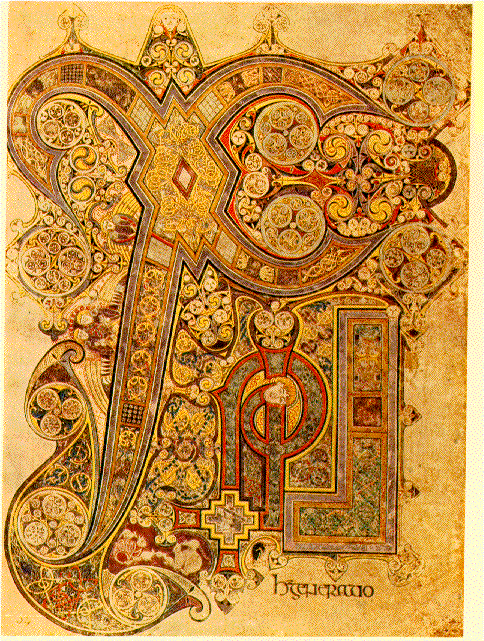
Illuminated manuscripts feature decorative embellishments painted in gold, silver, and vivid mineral pigments (lapis lazuli for blue, vermillion for red). The gold and silver leaf literally 'illuminated' the page when candlelight reflected off it. Major examples include the Book of Kells (c. 800 CE), the Lindisfarne Gospels (715 CE), and the Book of Hours of the Duc de Berry (c. 1410 CE).
📚 Academic Sources & Scholarly Bibliography
De Hamel, C. (2016).
Meetings with Remarkable Manuscripts.
Allen Lane.
Reynolds, L.D. & Wilson, N.G. (1991).
Scribes and Scholars: A Guide to the Transmission of Greek and Latin Literature.
Oxford University Press.
Meehan, B. (1994).
The Book of Kells.
Thames & Hudson.
📖 Scholar Mode Active — Click to exit focused reading
History Lab 🧪
Interactive historical deduction games, tactical matchup simulators, and currency calculators.
🕵️ Who Am I? (The Historical Guess Game)
A secret historical figure has been selected. Ask yes/no questions to narrow down the pool of candidates. Click any active card to make your accusation!
Secret Identity
❓ Who Am I?
Ask questions using the board below to narrow down my identity.
Ask a Question:
Question LogQuestions: 0 / 7
No questions asked yet.
Candidate Board:
🗺️ Timeline Scramble
Five historical events appear out of order. Click them in the correct chronological sequence — from oldest to most recent. How well do you know your history?
🏺 Relic or Fake?
Is this a real historical artifact or a convincing fabrication? Judge each one based on its description and era — then see the truth revealed!
Artifact 1 / 10Score: 0
Empire Matchup Simulator
Empire ATerritory Size (Peak, M km²)Empire B
00
Empire APopulation (Peak, Millions)Empire B
00
Empire AMilitary Power (Army Size)Empire B
00
Tactical Battle Analysis
Select empires and click simulate to run evaluations.
Historical Purchasing Power Converter
See what ancient coins are worth in modern terms and check their historical purchasing power.
Modern Value Equivalent
$0.00 USD
Historical Purchasing Power:
Select currency to view purchasing capability.
Historical Identity Generator
Forge an authentic historical identity from ancient civilisations, complete with linguistic meaning and biography.
Neutral
Gaius Julius
Meaning:Descendant of Jupiter
Historical Background:
A Roman citizen and clerk who worked in the forum under Roman republic rule.
Chrono-Cultural Fusion Simulator
Fuse the culture, technology, and governance of two legendary civilizations to synthesize a unique hybrid society.
Cohesion & Coexistence Rate
85%
🏛️ Hybrid Architecture
⚙️ Synthesized Asset
📜 Synthetic Governance
Historical Tactics & Trivia Quiz
Test your historical knowledge and battle tactics to claim your administrative rank.
8 Questions • Multi-Era
You will be presented with random scenarios and trivia spanning ancient Egypt, classical Rome, Islamic Golden Age, and the modern industrial era. Complete the evaluation to see your historical title!
Question 1 of 8Score: 0
What was the Code of Hammurabi written on?
Correct!
Evaluation Complete!
6 / 8
Correct
Rank Attained
Imperial Legionary
Your knowledge of classical strategy and administrative structures is respectable.
🎲 Counterfactual "What If?" Scenario Simulator
Explore alternative historical trajectories by tweaking key civilizational pivot points.
Simulated Shift
Selected Era
Prehistoric Era
Millions of years ago to ~3000 BCE
The dawn of humanity. From the evolutionary split of early hominids to the mastery of stone tools, fire, and the birth of language.
Landmark Milestones
Welcome to Historia
Enter your Scholar Name to synchronize your chronicles and save your journey.
 ⭐ Featured Chronicle

 ANCIENT AGES
 ANCIENT AGES
 ANCIENT AGES
 MEDIEVAL PERIOD
 MEDIEVAL PERIOD
 PREHISTORIC ERA