From prehistoric origins to the modern era—discover the turning points, lost empires, and breakthroughs of world history through interactive timelines and visual guides.
Examine the tangible relics, physical tokens, and revolutionary machines that shaped civilizational growth.
🎥 VIDEO HUB & SHORTS
Watch visual summaries, site intros, and mini-documentaries chronicling 300,000 years of world history.
📊 HISTORICAL INFOGRAPHICS ARCHIVE
Museum-grade visual graphics, civilizational timelines, and architectural breakdowns curated for educators and history lovers.
THE HISTORIA CIRCLE
Join the collective discussion, study logs, and contributions of fellow historians mapping humanity's path.
Historia Forum Discussions
Start a Discussion Thread
THEMATIC PATHWAYS
Trace a single thread — disease, trade, energy, migration — across all eras and civilizations.
History is not just a sequence of events — it is a network of patterns. These thematic pathways allow you to follow a single concept across thousands of years: how agriculture spread, how warfare evolved, how trade routes shaped civilizations. Each pathway collects the most relevant chronicles across all eras.
🧩
How is this different from the sidebar Topics?
While the sidebar Topics (like Science & Tech or Empires) filter articles within your selected historical Era, Thematic Pathways cut horizontally across all eras (from Prehistoric to the Future). Use Themes to trace a single concept's evolutionary line across 300,000 years.
CIVILIZATION HUBS
Comprehensive profiles of the world's greatest civilizations and empires — from ancient cradles to global super-states.
Human Historia provides an academically rich exploration of the world's most influential civilizations. From the monumental achievements of ancient Egypt, Han China, and the Roman Empire, to the sophisticated societies of the Maya, the Islamic Caliphates, and West African empires, these hubs offer deep insights into the cultural, political, and technological legacies that continue to shape our global story.
EVOLUTION OF HUMAN SKILLS
Trace the compounding technologies, practical capabilities, and cognitive milestones of the human species.
Human progress is a story of compounding skills. Every breakthrough, from the spark of prehistoric fire to modern silicon transistors, builds directly on previous generations of ingenuity. Hover over a skill node to trace its historical prerequisites, and click it to explore its development timeline, species-wide impact, and related chronicles.
Prehistoric Ancient Medieval Modern Future
🧠
Select any skill node in the tree to explore its evolutionary path, development timeline, and historical impact.
ACADEMIC PASSPORT
Track your intellectual journey, quiz outcomes, and historical badges of honor.
HISTORIA PASSPORT⏳
👤Scribe Novice
Scholar NameHistoria Explorer
Rank RatingSumerian Record Scribe
Chronicles Read0 / 48
Study Guide Pins0 Guides
Security AccessLevel 1 (Novice)
Earned Badges of Honor
🔥
Fire Keeper
Unlock 3 prehistoric chronicles.
🏛️
Codex Keeper
Unlock 3 ancient chronicles.
🏰
Guild Master
Unlock 3 medieval chronicles.
⚙️
Steam Engineer
Unlock 3 modern chronicles.
🚀
Singularity Sage
Unlock 3 future chronicles.
👑
Grand Scholar
Score 5/5 on the Lab Quiz.
Recent Lab Activities
No recent activities recorded. Take a quiz or bookmark articles!
🏛️ MISSION & ARCHIVAL STANDARDS
About Human Historia
A visual encyclopedia and timeline of human history, dedicated to documenting 300,000 years of civilizational evolution through rigorous research, authentic artifacts, and visual clarity.
🌍
The 300,000-Year Story
Human Historia traces our collective journey across five historical epochs: Prehistory, Ancient Worlds, Middle Ages, Modern Age, and Future Horizons. From the first control of fire to quantum computation, we organize turning points into interconnected timelines.
📜
Historiographical Rigor
Every chronicle is built upon primary historical manifests, contemporary excavation reports, and peer-reviewed historical consensus. We prioritize authentic public domain artifacts and clearly identify scholarly debates surrounding major civilizational transitions.
🎨
Museum-Grade Visuals
Complex historical transitions demand visual understanding. We develop high-resolution infographics, architectural cutaways, and comparative territorial maps to transform abstract timelines into vivid, unforgettable learning experiences.
📖
Educational Access
Knowledge belongs to humanity. Human Historia is free, ad-light, and engineered as an educational resource for students, classroom educators, academic researchers, and curious minds across all continents.
Editorial Governance & Inquiries
We welcome peer reviews, academic corrections, museum archival collaborations, and educational partnerships. To submit historical inquiries or provide archival feedback, reach our editorial desk directly.
An immersive graphical anthology tracing the paths of civilizations, breakthroughs, and conflicts that forged the modern consciousness.
25Chronicles
Showing all articles
The Trojan War: Real History, Greek Heroes & Homer
Written by Humanhistoria EditorialHistorical Era: ANCIENT
For three millennia, the Trojan War has stood as humanity's definitive epic: a ten-year siege fought across the wine-dark waters of the Aegean Sea, driven by sacred oaths, bronze blades, hubris, and profound tragedy. Immortalized in Homer’s Iliad and Odyssey, the conflict pitted a unified armada of Mycenaean Greek warlords against the formidable fortified citadel of Troy. But behind the mythological tapestry of quarreling Olympian gods, golden apples, and wooden horses lies a startling historical reality. Late Bronze Age archaeology, deciphered Linear B clay tablets, and royal Hittite diplomatic cuneiform archives now confirm that Homer’s epic clash preserved the authentic memory of geopolitical rivalry, maritime trade warfare, and violent destruction during the catastrophic Late Bronze Age Collapse around 1180 BCE.
🎯 Quick Historical Summary
Was the Trojan War Real and Who Fought in It?
The Trojan War was an authentic Late Bronze Age conflict fought around 1180 BCE between a coalition of Mycenaean Greek kingdoms (termed Achaeans by Homer and recorded as Ahhiyawa in Hittite imperial tablets) led by King Agamemnon of Mycenae, and the wealthy Anatolian citadel of Troy (historically known as Wilusa or Ilion) commanded by King Priam and Crown Prince Hector. Modern excavations at Hisarlik in northwestern Turkey prove that Troy VIIa suffered violent siege warfare, scorched masonry, and weapon trauma exactly matching the chronological horizon of Homeric oral tradition.
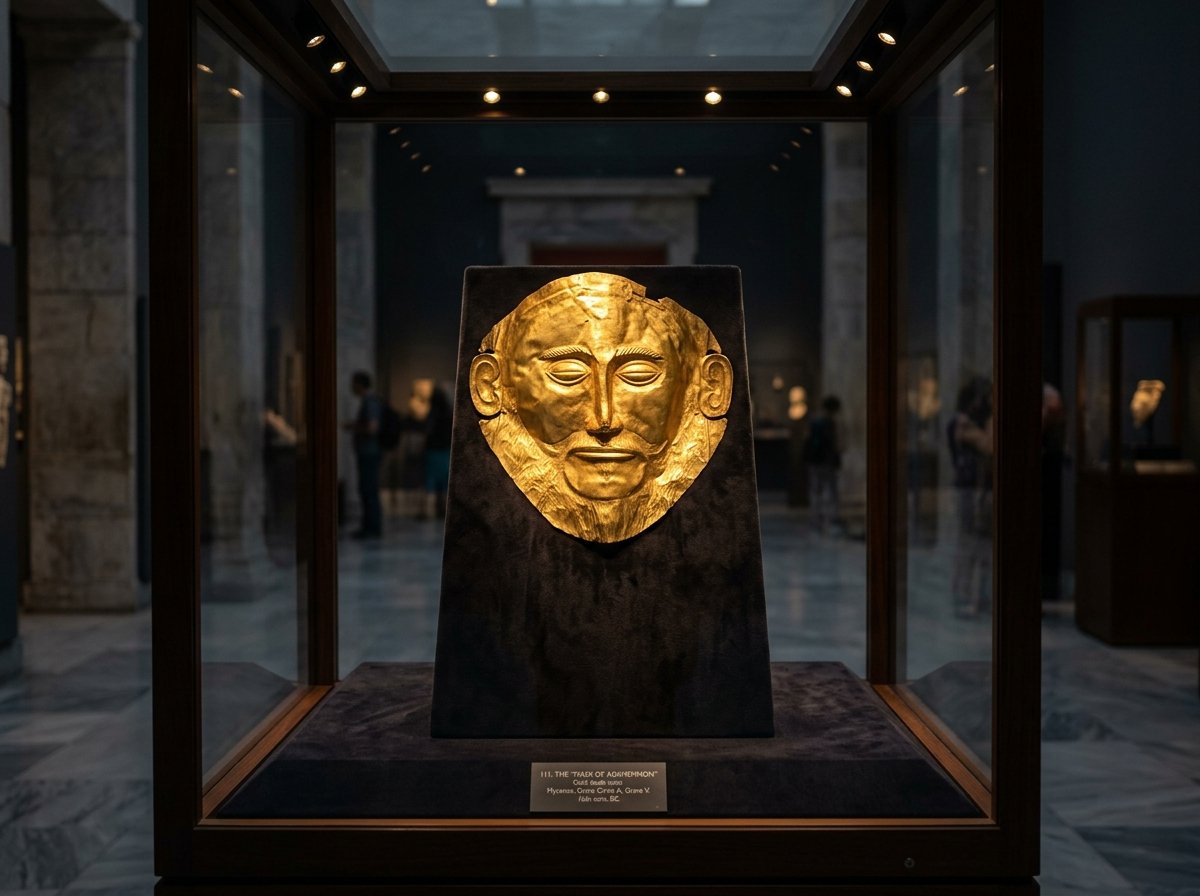
The Gold "Mask of Agamemnon", discovered by Heinrich Schliemann in Grave Circle A at Mycenae (c. 1550 BCE). Hammered from a single sheet of pure gold, this funeral mask exemplifies the lavish wealth of the Bronze Age warrior kings who inspired the Homeric epics. National Archaeological Museum, Athens.
1. The Trojan War Between Who? Bronze Age Geopolitics & Trade
To understand why the Trojan War was fought, one must look past the romantic myth of Helen's abduction and examine the economic choke points of the ancient Mediterranean. Troy was not merely an isolated fortress; it occupied the single most strategic maritime gateway in the Bronze Age world: the entrance to the Hellespont (modern Dardanelles). Every merchant vessel sailing between the mineral-rich Aegean and the grain, gold, and timber ports of the Black Sea was forced to pass directly beneath Troy's fortified battlements.
Prevailing northeasterly headwinds and treacherous currents frequently trapped ancient sailing ships at the mouth of the straits for weeks at a time. The rulers of Troy leveraged this natural funnel into immense wealth, levying heavy harbor taxes, provisioning trapped merchant fleets, and controlling the lucrative trade in horses, purple dye, and Baltic amber. For the militarized Mycenaean Greek kings (Wanakes) of the Peloponnese, whose palatial economies depended desperately on importing tin and copper to forge bronze weapons, Troy represented both an intolerable economic barrier and an irresistibly wealthy target for coordinated maritime plunder.
2. Trojan War Heroes: Greeks vs. Trojans Compared
The Iliad endures because it is fundamentally a human tragedy—an exploration of warrior honor (time), everlasting glory (kleos), and the devastating grief wrought by unchecked pride. The battlefield before the Scaean Gates assembled the greatest military champions of the Aegean and Anatolian spheres:
On the Achaean (Greek) side stood heroes defined by their extreme prowess and flawed temperaments. Achilles, prince of the Myrmidons, was the supreme warrior of antiquity: invincible in single combat, swift of foot, yet consumed by existential rage after Agamemnon dishonored him. Agamemnon, the High King (Wanax) of Mycenae, possessed unmatched resources and commanded over a thousand warships, yet suffered from authoritarian insecurity. Alongside them fought Odysseus, king of rocky Ithaca, renowned not for brute strength but for cunning intellect (metis); Ajax the Great, a towering colossus who wielded an eight-layered bronze shield like an impenetrable mobile fortress; and Diomedes, the fearless king of Argos who spearheaded Greek counter-charges with savage efficiency.
Defending Troy was an equally illustrious pantheon of eastern heroes. Chief among them was Crown Prince Hector, the noble bulwark of Troy. Unlike Achilles, who fought for personal immortality, Hector fought out of filial devotion, love for his wife Andromache, and civic duty to protect his infant son and elderly father, King Priam. At Hector's flank were Paris (Alexandros), whose passion sparked the cataclysm and whose archery ultimately proved lethal; Aeneas, commander of the allied Dardanians, whose valor preserved the royal bloodline to found the legendary ancestors of Rome; and Sarpedon, heroic king of Lycia and son of Zeus, leading Anatolian allies to defend the imperial city.
Key Dimension
Achaean Greek Coalition
Trojan Kingdom & Anatolian Allies
Primary Heroes
Achilles, Agamemnon, Odysseus, Ajax the Great, Menelaus, Diomedes, Patroclus
Hector, King Priam, Paris (Alexandros), Aeneas, Sarpedon, Glaucus
Geographic Origin
Peloponnese, Central Greece, Crete, Ionian Islands (Hittite: Ahhiyawa)
The Troad (Northwest Anatolia), Lycia, Phrygia, Thrace, Maeonia (Hittite: Wilusa)
Apollo (archery & pestilence), Aphrodite (passion), Ares (frenzy of slaughter), Artemis
Archaeological Legacy
Palaces of Mycenae, Tiryns, and Pylos; Linear B scribal tax inventories
Troy VIIa fortress at Hisarlik, burnt ash destruction strata, embedded sling stones
3. Trojan War Armor, Helmets & Bronze Age Warfare
Popular depictions of the Trojan War frequently outfit warriors in Classical Greek hoplite gear—crested Corinthian helmets, sculpted muscled cuirasses, and round bronze aspides. However, Late Bronze Age military equipment was radically different, far heavier, and remarkably sophisticated:
The most iconic piece of headgear was the legendary Trojan War helmet fashioned from wild boar tusks. In Book 10 of the Iliad, Homer describes the helmet worn by Odysseus: a cap of stout leather lined with thick wool felt, its exterior covered in dense, interlocking rows of curved white boar tusks pointing in alternating directions. For decades, 19th-century philologists dismissed this description as poetic fantasy. That skepticism evaporated when archaeologists excavated chamber tombs across mainland Greece, unearthing dozens of authentic boar tusk helmets. Because each wild boar yields only four suitable canines, crafting a single helmet required hunting 30 to 40 mature wild boars—making it an extraordinary status symbol of lethal aristocratic privilege.
Body protection was equally formidable. In 1960, archaeologists unearthing a Mycenaean warrior grave at Dendra near Argos discovered the complete Dendra Panoply (dated c. 1400 BCE). Consisting of fifteen hammered bronze plates that encased the torso, shoulders, neck, and upper thighs like an armored tank, the suit proved that elite Bronze Age champions rode into the fray aboard two-horse light chariots, acting as shock troops armed with massive three-meter thrusting lances. Ground infantry carried gigantic "figure-eight" or "tower" shields made of multiple layers of bull's hide stitched over wicker armatures, capable of stopping bronze-tipped arrows and javelins across the entire length of the warrior's body.
4. Was the Trojan War Real? Archaeological Evidence & Troy VIIa
For centuries following the fall of Rome, Western scholars regarded the Trojan War as pure myth, akin to the labors of Hercules or the voyage of the Argonauts. That illusion was shattered in the 1870s when the eccentric German pioneer Heinrich Schliemann, guided by Homeric topographic descriptions, began excavating the artificial tell mound of Hisarlik in northwestern Turkey.
Schliemann proved that Troy was a living, breathing reality. However, in his reckless haste, Schliemann blasted through upper strata with dynamite to reach "Troy II", mistakenly believing its charred ruins and gold treasure belonged to King Priam—when in fact Troy II had burned a thousand years too early (c. 2400 BCE). Subsequent scientific excavations led by Wilhelm Dörpfeld, Carl Blegen, and later Manfred Korfmann unlocked nine distinct chronological levels of the city, spanning over 3,000 years of continuous habitation:
Troy VI (c. 1750–1300 BCE): A magnificent, wealthy fortress with towering sloping limestone walls, monumental bastions, and expansive royal palaces, matching Homer's "steep and windy Ilion". However, Blegen confirmed this stratum was brought down by a violent earthquake around 1300 BCE.
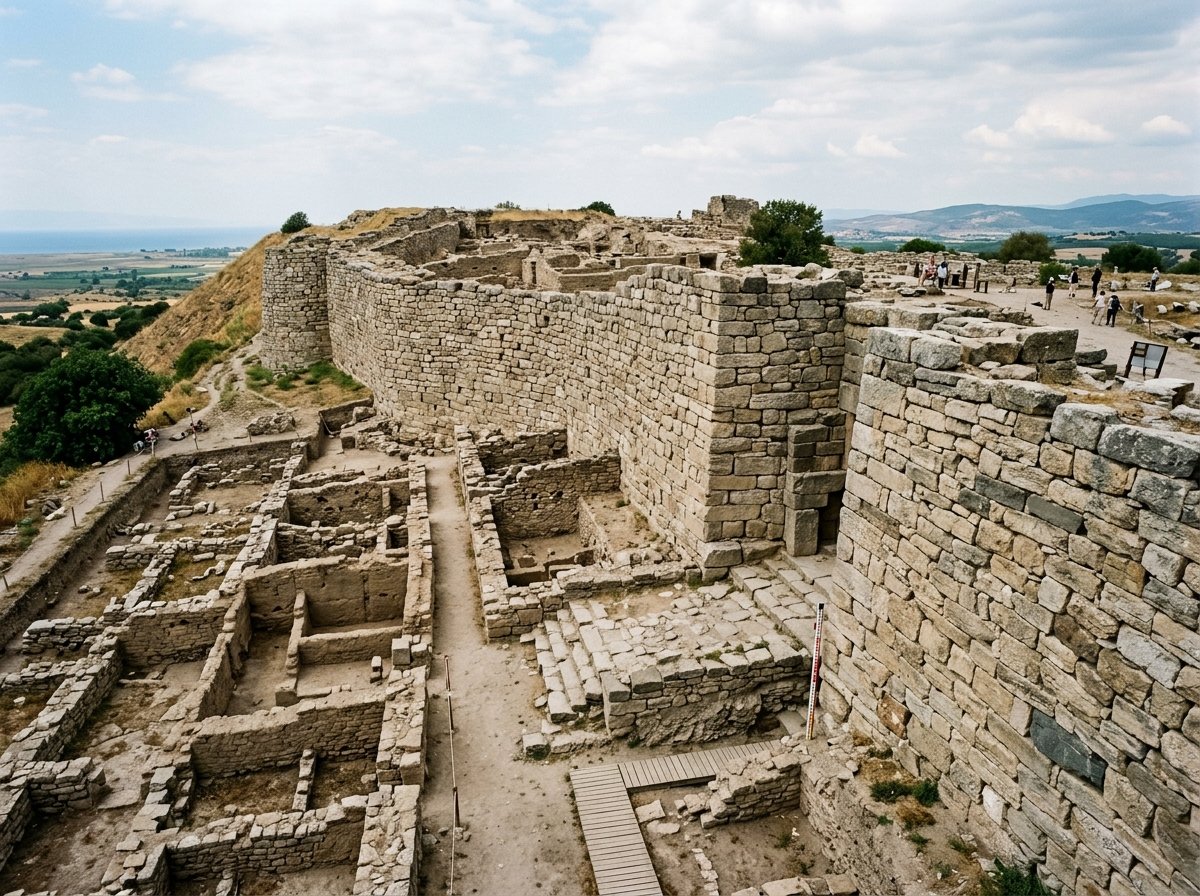
Troy VIIa (c. 1300–1180 BCE): Rebuilt immediately by survivors using the ruins of Troy VI, this city tells a grim tale of siege and desperation. Houses were subdivided into cramped, crowded quarters packed inside the citadel walls. Large clay storage jars (pithoi) were buried flush with house floors to stockpile grain, oil, and water against prolonged blockade. Around 1180 BCE, Troy VIIa met an apocalyptic end: excavators found thick layers of ash, burnt timbers, piles of sling stones stockpiled along defensive parapets, bronze arrowheads embedded in masonry, and unburied human skeletons exhibiting lethal trauma.
The Imperial Hittite Archives: The final confirmation came not from Greece, but from the royal archives of the Hittite Empire at Hattusa. Clay cuneiform tablets from the 13th century BCE explicitly record ongoing diplomatic crises in western Anatolia involving a kingdom called Wilusa (the Hittite phonetic rendering of Ilion / Troy) and an aggressive naval power termed Ahhiyawa (the Mycenaean Achaeans). The famous Manapa-Tarhunta Letter and Tawagalawa Letter document Achaean warlords raiding the Anatolian coast and supporting anti-Hittite insurrections, providing irrefutable contemporary historical proof of Greek military aggression around the Troad.
Excavated Late Bronze Age stone fortification walls of Troy VIIa at Hisarlik, Turkey. The sloping cyclopean stone foundations and burned destruction layers date precisely to the 12th century BCE horizon of the Trojan conflict.
5. Trojan War Gods Sides: Which Olympians Backed Greeks vs. Trojans?
To the ancient mind, human warfare was the earthly reflection of divine discord. When examining the Trojan War gods' sides, Mount Olympus was sharply polarized, with immortal deities actively descending into the smoke and dust of the Scamander plain to deflect spears, cast mists of invisibility, and duel one another:
The Greek Coalition enjoyed the relentless backing of Hera and Athena, both burning with fury after the Trojan prince Paris awarded the golden Apple of Discord to Aphrodite in the infamous "Judgment of Paris". Athena acted as the personal divine guardian of Achilles, Diomedes, and Odysseus, granting them superhuman vision to see disguised gods upon the battlefield. Poseidon, master of the seas and earthquakes, staunchly aided the Achaeans due to an ancient grudge against Troy: generations earlier, King Laomedon had refused to pay Poseidon for building the city's divine walls.
Conversely, Troy was championed by Apollo, the archer god whose golden arrows unleashed a devastating plague upon the Greek encampment in the opening lines of the Iliad. Apollo repeatedly shielded Hector from mortal blows and guided the fatal arrow shot by Paris that pierced Achilles' heel. Aphrodite protected her Trojan lover Paris and rescued her demigod son Aeneas from slaughter, while Ares, the ferocious god of bloody warfare, revelled in the slaughter alongside Trojan lines until wounded by Diomedes' bronze spear. Above them all sat Zeus, who remained ostensibly neutral, weighing the twin golden scales of death (keres) to decree which side fate had marked for destruction.
6. The Trojan Horse: Myth vs. Military Reality
No symbol from the war has captivated Western imagination more than the Trojan Horse: the gigantic hollow wooden steed built by the Greeks, left upon the deserted beach as a faux peace offering to Athena, concealing an elite commando unit of Greek warriors within its belly. But did a wooden horse ever actually breach the Scaean Gate?
Scholars and military historians offer three compelling historical interpretations for what the "Horse" genuinely represented:
The Ancient Battering Ram: In Near Eastern and Assyrian warfare, siege engines consisted of massive wheeled timber towers equipped with iron-tipped battering rams, frequently draped in wet horsehides to protect the operators from flaming arrows. In archaic oral verse, such a devastating siege engine was colloquially termed a "horse". Over four centuries of dark-age retelling, literal-minded bards may have transformed a horse-hide-covered siege ram into a literal wooden animal.
The Wrath of Poseidon (Earthquake Theory): Poseidon held two primary titles in Bronze Age religion: Poseidon Hippios ("Poseidon of Horses") and Enosichthon ("The Earth-Shaker"). Western Anatolia sits along volatile tectonic faults; excavations at Troy VI confirmed that catastrophic earthquakes shattered the citadel walls around 1300 BCE. If an earthquake cracked Troy's defenses during a siege, Greek oral memory may have thanked Poseidon the Horse-God, which poets later re-imagined as a tangible wooden horse.
Covert Commando Deception: Disguising a small naval raiding team aboard an offering vessel or using a sacrificial tribute to infiltrate an otherwise impregnable gate was a well-documented tactic in the ancient Mediterranean. Odysseus's stratagem represents the triumph of intellect (metis) over unyielding stone.
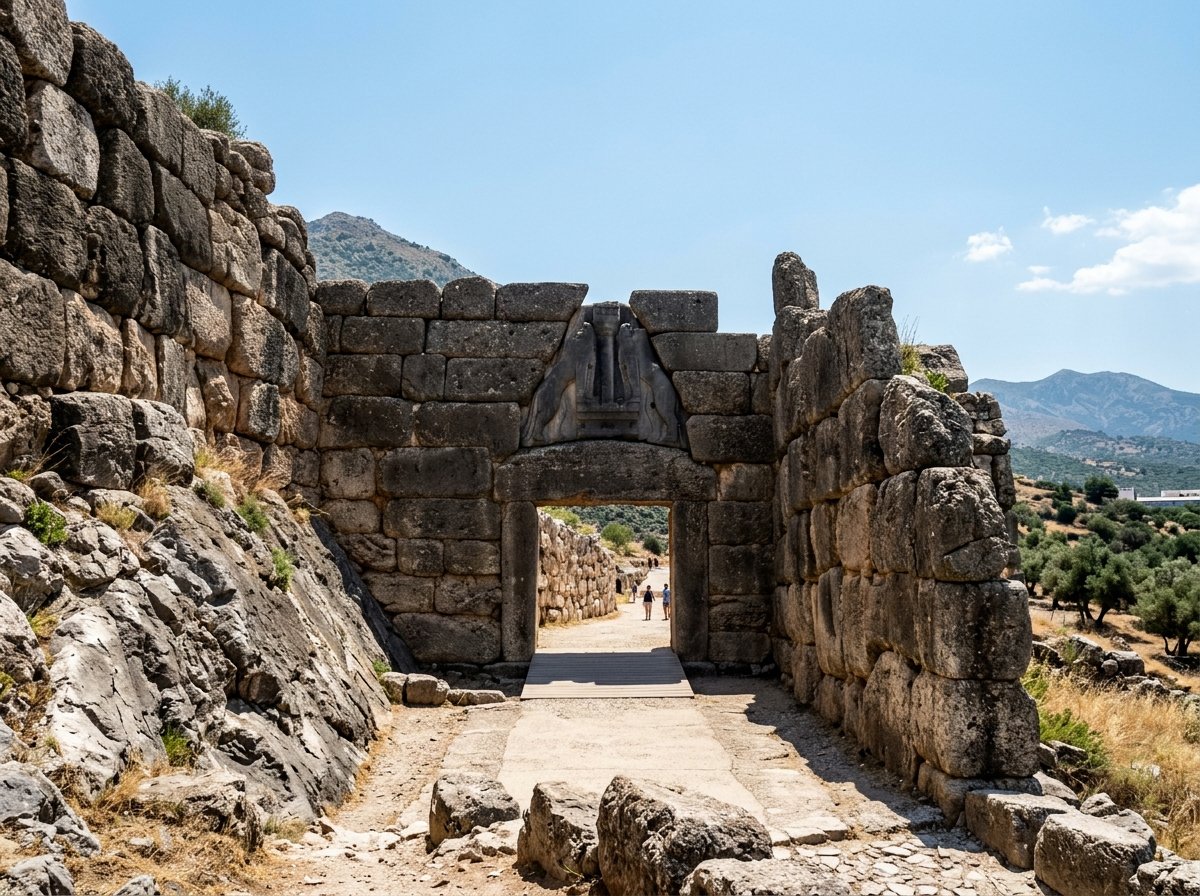
The monumental Lion Gate, principal entrance to the citadel of Mycenae (c. 1250 BCE). Europe's oldest surviving monumental stone sculpture, this relief symbolized the imperial authority of the High King (Wanax) over the Aegean world.
7. Agamemnon’s Citadel: Mycenae, the Lion Gate & Linear B
Perched high upon a rocky crest commanding the fertile Argive plain, the citadel of Mycenae was the geopolitical epicenter of mainland Greece. Its imposing perimeter walls were constructed of raw limestone boulders so colossal—weighing up to 20 tons each—that classical Greeks believed only supernatural one-eyed giants (Cyclopes) could have moved them, giving rise to the term Cyclopean masonry.
At the citadel's entrance stands the monumental Lion Gate, erected around 1250 BCE. Depicting two rearing lionesses flanking an Aegean Minoan-style pillar atop a massive lintel stone, it represents Europe's oldest surviving monumental relief sculpture, projecting ferocious imperial dominance to any approaching diplomat or invader.
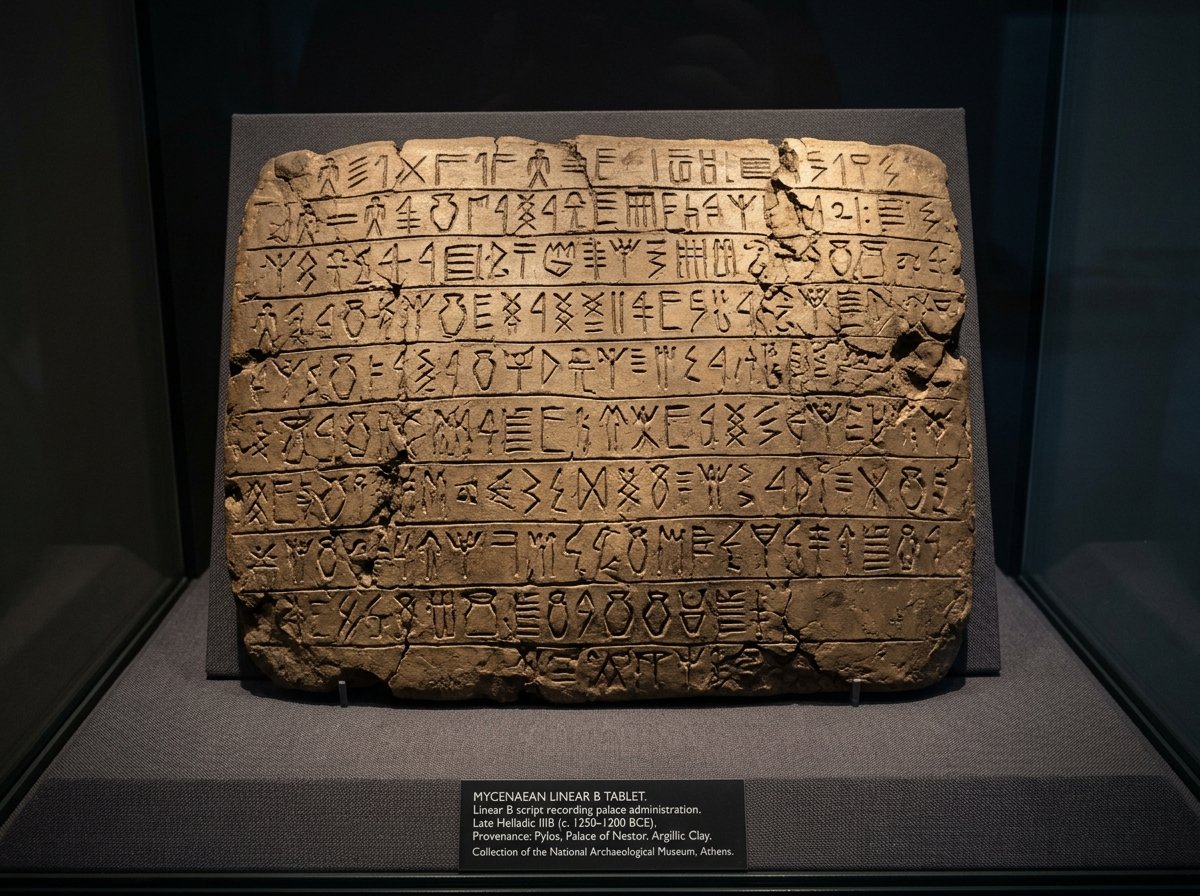
Deep within the ruins of Mycenae, Tiryns, and the palace of Nestor at Pylos, archaeologists unearthed hundreds of unbaked clay tablets covered in Linear B script. In 1952, British architect and cryptographer Michael Ventris cracked the code, proving that Linear B was not an unknown Minoan tongue, but the earliest written form of the Greek language. Rather than recording poetry or heroic deeds, these tablets preserve the meticulous everyday bookkeeping of the royal palace: inventories of bronze spears, chariot wheels, perfumed coriander oils, wool rations, and records of palace slaves under the absolute command of the Wanax.
Linear B clay tablet from the Palace of Nestor at Pylos, recording Mycenaean palatial inventories in an archaic dialect of ancient Greek. Baked accidentally during the palace's fiery destruction in 1180 BCE, these tablets proved the historical Greek identity of Homer's heroes.
8. The Late Bronze Age Collapse & Homer's Eternal Legacy
The fall of Troy was not an isolated triumph; it was the prologue to civilizational catastrophe. Within decades of Troy VIIa’s destruction, the entire interconnected network of the Eastern Mediterranean collapsed in fire and chaos. The palaces of Mycenae, Tiryns, and Pylos were burned to the ground. The Hittite Empire disintegrated. Ugarit was erased from the map, and Egypt was pushed to the brink of extinction by waves of mysterious sea raiders known as the Sea Peoples.
With the burning of the Mycenaean palaces, the art of writing Linear B vanished completely. Mainland Greece plunged into a four-century Greek Dark Age (c. 1100–750 BCE). Cities shrank into impoverished hamlets, trade networks evaporated, and bronze gave way to crude early iron. Yet in the flickering shadows of village hearths, the memory of the heroic age refused to die.
Generations of blind traveling bards (aoidoi) preserved the tales of Achilles, Hector, Agamemnon, and Odysseus through oral song, utilizing rhythmic dactylic hexameter and formulaic memory devices ("wine-dark sea", "swift-footed Achilles"). When Greeks re-adopted literacy from the Phoenician alphabet around 750 BCE, a poet known to posterity as Homer codified these oral memories into the twin founding masterworks of Western literature: the Iliad and the Odyssey. The Trojan War ceased to be merely a forgotten Bronze Age skirmish over Anatolian harbor tolls; it became the eternal mirror through which humanity contemplates the price of war, the fragile beauty of life, and the immortal pursuit of truth.
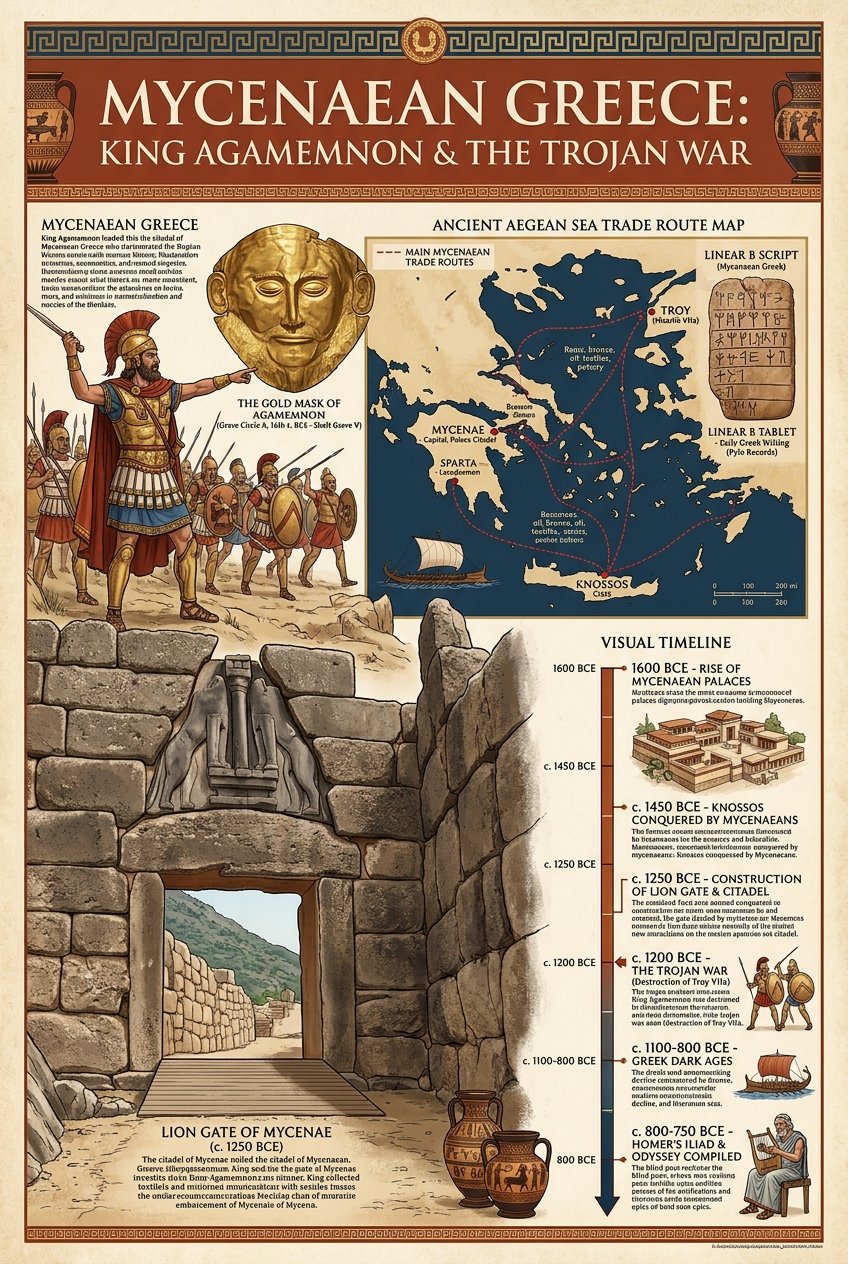
📊 Museum-Grade Infographic Poster
Mycenaean Greece & Trojan War History Infographic
💡 Click anywhere on poster to expand in high resolution🔎 Expand Lightbox
Comprehensive historical infographic mapping Agamemnon's Mycenae, the archaeological strata of Hisarlik (Troy VIIa), Linear B palatial tablets, Hittite Ahhiyawa diplomatic letters, and the maritime voyage routes of Homer's Odyssey.
📖 SCHOLARLY INQUIRIES
Frequently Asked Questions
Essential historical questions and evidence-based answers concerning this chronicle.
Q.Why is Mycenaean Greece & The Trojan War significant in world history?
Mycenaean Greece & The Trojan War played a pivotal role by transforming technology, social structure, and regional connection, serving as a vital link in human civilization.
Q.Was King Agamemnon a real historical figure?
While Agamemnon as depicted by Homer is likely a composite or legendary figure, he represents real Mycenaean high kings (Wanax) who held hegemony over smaller Greek warlords in the 13th century BCE.
Q.Did the Trojan War actually happen?
Archaeological evidence at Hisarlik (Troy VIIa) shows a major siege and fire around 1200 BCE. Combined with Hittite tablets mentioning Achaeans (Ahhiyawa) fighting over Wilusa (Troy), most historians agree a major war took place.
Q.Is the Gold Mask of Agamemnon really his?
Heinrich Schliemann named it the 'Mask of Agamemnon' when he found it in 1876, but modern radiocarbon and stylistic dating place the mask around 1550 BCE—about 300 years before the Trojan War.
📖 Scholar Mode Active — Click to exit focused reading
History Lab 🧪
Interactive historical deduction games, tactical matchup simulators, and currency calculators.
🕵️ Who Am I? (The Historical Guess Game)
A secret historical figure has been selected. Ask yes/no questions to narrow down the pool of candidates. Click any active card to make your accusation!
Secret Identity
❓ Who Am I?
Ask questions using the board below to narrow down my identity.
Ask a Question:
Question LogQuestions: 0 / 7
No questions asked yet.
Candidate Board:
🗺️ Timeline Scramble
Five historical events appear out of order. Click them in the correct chronological sequence — from oldest to most recent. How well do you know your history?
🏺 Relic or Fake?
Is this a real historical artifact or a convincing fabrication? Judge each one based on its description and era — then see the truth revealed!
Artifact 1 / 10Score: 0
Empire Matchup Simulator
Empire ATerritory Size (Peak, M km²)Empire B
00
Empire APopulation (Peak, Millions)Empire B
00
Empire AMilitary Power (Army Size)Empire B
00
Tactical Battle Analysis
Select empires and click simulate to run evaluations.
Historical Purchasing Power Converter
See what ancient coins are worth in modern terms and check their historical purchasing power.
Modern Value Equivalent
$0.00 USD
Historical Purchasing Power:
Select currency to view purchasing capability.
Historical Identity Generator
Forge an authentic historical identity from ancient civilisations, complete with linguistic meaning and biography.
Neutral
Gaius Julius
Meaning:Descendant of Jupiter
Historical Background:
A Roman citizen and clerk who worked in the forum under Roman republic rule.
Chrono-Cultural Fusion Simulator
Fuse the culture, technology, and governance of two legendary civilizations to synthesize a unique hybrid society.
Cohesion & Coexistence Rate
85%
🏛️ Hybrid Architecture
⚙️ Synthesized Asset
📜 Synthetic Governance
Historical Tactics & Trivia Quiz
Test your historical knowledge and battle tactics to claim your administrative rank.
8 Questions • Multi-Era
You will be presented with random scenarios and trivia spanning ancient Egypt, classical Rome, Islamic Golden Age, and the modern industrial era. Complete the evaluation to see your historical title!
Question 1 of 8Score: 0
What was the Code of Hammurabi written on?
Correct!
Evaluation Complete!
6 / 8
Correct
Rank Attained
Imperial Legionary
Your knowledge of classical strategy and administrative structures is respectable.
🎲 Counterfactual "What If?" Scenario Simulator
Explore alternative historical trajectories by tweaking key civilizational pivot points.
Simulated Shift
Selected Era
Prehistoric Era
Millions of years ago to ~3000 BCE
The dawn of humanity. From the evolutionary split of early hominids to the mastery of stone tools, fire, and the birth of language.
Landmark Milestones
Welcome to Historia
Enter your Scholar Name to synchronize your chronicles and save your journey.
 ⭐ Featured Chronicle

 ANCIENT AGES
 ANCIENT AGES
 ANCIENT AGES
 MEDIEVAL PERIOD
 MEDIEVAL PERIOD
 PREHISTORIC ERA